1. Introduction
India differs little from much of the rest of the world in its fascination with alternative dispute resolution (ADR). The list includes the seemingly ever-changing world of lok adalats,Footnote 1 the new gram nyayalayas,Footnote 2 the all but defunct nyaya panchayats,Footnote 3 court-annexed alternatives such as family courts,Footnote 4 and fast-track courts on the criminal side, as well as a wide variety of specialized tribunals. Under the Consumer Protection Act of 1986 (CPA), new additions to the list, consumer fora at the district level and consumer Commissions at the state and national levels, were added. The particulars differ from other forms of ADR in terms of jurisdiction and structure, but the immediate goal for all of them is relatively simple and straightforward—to facilitate access to justice by shortcutting the often dysfunctional formal court system and processes and its concomitant delays and expenses.
This essay pieces together an empirical record for 14 district-level consumer fora from seven states in an attempt to provide a portrait of the inputs and outputs of these institutions. Data on Indian courts, and dispute resolution in India more generally, have been sparse and, when available, often haphazard and scattered. Marc Galanter and Jay Krishnan described a situation in which “(r)eliable data are scarce, and the state of recordkeeping makes collecting them a daunting task.”Footnote 5 Pratap Bhanu Mehta, in a plea for more research, referred to the universe of work on the Indian courts as “something of an empirical vacuum.”Footnote 6 Others have expressed similar frustrations when attempting empirical work on the Indian justice system. Even at the Supreme Court level, where one might expect to find much more thorough and clear reporting, barriers exist to data collection and analysis that are far from inconsequential. In a recent attempt to gain a firmer handle on understanding the Supreme Court’s workload, Nick Robinson broke down the challenges confronted with the data as those of availability, accuracy, and understanding, while at one point characterizing what is accessible as a “hodgepodge of data.”Footnote 7 As one moves down the hierarchy of courts to the district level and then into the realm of alternatives to the courts, the paucity and reliability of data become increasingly problematic. Indicative of this is Marc Galanter’s review of the literature available on filing rates. Exploring what he refers to as the “myth of litigious India,” Galanter ends up relying on a grab bag of data from different courts at different pre-independence and post-independence periods (2009). The good news is that, with the recent expansion of data made available from the Indian Supreme Court, Eisenberg, Kalantry, and Robinson have managed to calculate filing rates for the Indian states in their analysis of the links between filing rates and increased prosperity (2013). However, serious limitations remain with what has been made available.Footnote 8 With reference to their study in particular, they note that the state-wide numbers provided cannot account for significant variations among districts within states that almost certainly exist, for variations among different categories of civil actions, nor for variations among different income and social groupings.Footnote 9
What this study attempts to do is to continue the recent works piercing Mehta’s empirical vacuum, and at the same time overcome some of the limitations on data collection and analysis experienced by others, at least with regard to a select group of consumer fora. This differs from the previously cited studies in that, for the most part, it avoids gross data generated and tabulated by government agencies or the courts themselves in favour of accessing original source material (i.e. case decisions) and extracting data points from it to piece together a database that brings into focus what these fora actually do and whom they serve. The availability of the actual district forum decisions online provides the raw material to create a far more accurate picture of what these fora actually do than we currently have for India’s formal district-level courts. Drilling down to the district level enables one to focus attention on any distinctions between districts, in addition to any patterns that may emerge across districts and states. The variations among districts highlight the necessity of viewing these fora from the bottom up. Gross data accumulated at the centre simply cannot begin to capture precisely what these institutions do, how they do it, and what their effect on access to justice may be. The data collected, on the length of cases, winners and losers, presence of attorneys, and for whom, the amount of damages and costs awarded, and the types of cases filed can then be analyzed as one piece of the much larger access to justice dilemma that plagues India.
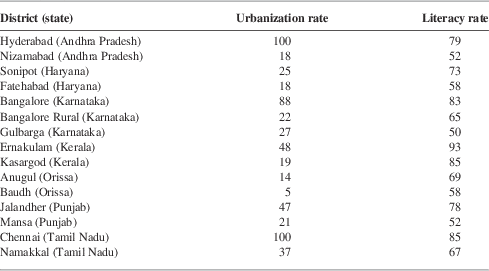
For purposes of the study, two district-level consumer fora in each of seven states have been selected (Table 1). Starting from April 30, 2012, the most recent 100 cases preceding that date were included for each of the 14 districts. Although every district in the country is supposed to have a functioning consumer forum, they are not required to upload all of their decisions on to the National Consumer Dispute Redressal Commission (NCDRC) website. (The most recent set of regulations issued by the NCDRC in 2005 simply calls for every district forum to “take steps for its computerization and networking” (§26(2)).) This reduced the universe of possible districts for this study significantly. For example, as recently as June 17, 2014, Bihar had only two districts out of 37 which had reported cases: Madhya Pradesh 30 of 45 and Uttar Pradesh 58 of 75 (NCDRC 2014b). Whether any particular non-reporting district was not functioning because of unfilled vacancies or simply not uploading their decisions is unclear. There were other factors limiting the potential districts for this study as well. Some that did report showed very few cases. For example, the two Bihar districts, Pashchim Champaran and Patna, listed only three and 72 cases since their establishment, respectively. Others reported wholly or partially in the vernacular and, lastly, many did not provide all of the information in their decisions needed for the development of the database. Most commonly, the missing information was the filing date of the complaint and/or the presence or absence of attorneys. Even within states, there were often variations in the information provided in the decisions. Seven of the eight states for which could be found at least two districts with sufficient numbers of cases reported that also had the necessary information were selected for the study. The seven together with the two districts from each are: Andhra Pradesh (Nizamabad/Hyderabad II); Haryana (Sonipot/Fatehabad); Karnataka (Gulbarga/Bangalore Rural and Urban I Additional); Kerala (Kasaragod/Ernakulam); Orissa (Anugul/Baudh); Punjab (Jalandher/Mansa); and Tamil Nadu (Namakkal/Chennai (South)). Among the districts that could be used in any given state, the selection, to the extent possible, was based on urban-rural division and variation in level of education, the belief being that these are two variables that could have a significant effect on the types of disputes coming before these fora. The eighth state for which there were at least two districts reporting with adequate data was Himachal Pradesh. However, it was not included in the study because there was relatively little distinction between the two variables among the three districts reporting. The data collected are supplemented by interviews with participants in the process and observations of consumer fora conducted over three visits to India in 2011, 2012, and 2013.
Urbanization and literacy rates (percentages) for 15 districts
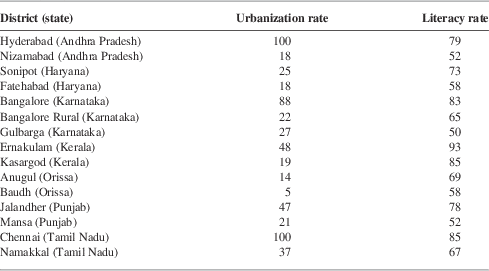
Although the 2011 Census was accessed, the data given in that report are from the 2001 Census. Rates for Bangalore and Bangalore Rural are included because the Bangalore Rural and Urban I Additional forum draws cases from both districts. Source: Census of India 2011, District Profile.
2. Structure of District Consumer Fora
As noted above, the CPA calls for a consumer forum in every district in the country, and it also provides for a state-level Commission in each state as well as a national Commission in New Delhi.Footnote 10 At the district level, they consist of three members—the President who either is or has been or is qualified to be a district court judge, and two other members, one of whom must be a woman (Ch. III, 10(1)(a) and (b)). Section (b) goes on to prescribe the specific qualifications for the two non-judge members requiring they be at least 35 years old, have a bachelor’s degree, and ten years’ experience in one of a number of enumerated fields, including the practice of law. Both Presidents and members are appointed by the state government on the recommendation of a selection committee, consisting of the President of the state Commission, the secretary of the law department in the state, and the secretary in charge of the department in the state which handles consumer affairs (Ch. III, 10(1A)). Presidents and members serve five-year terms or until age 65, whichever comes first. If young enough, they can be reappointed for one additional five-year term (Ch. III, 10(2)). For a case to be heard, the President and at least one of the members must be present (Ch. III, 14(2)). The district fora have jurisdiction over cases valued up to Rs 20 lakhs. From Rs 20 lakhs to Rs 1 crore, cases are initiated in the state Commissions, and those valued at over 1 crore start in the national Commission.Footnote 11 Setting the jurisdictional maximum at such a high level for the district fora makes it clear that the two upper levels are to be primarily appellate bodies. The limit was originally set at Rs 1 lakh raised to Rs 5 lakhs in 1993, and finally to its current level in 2002. In order to facilitate access, the Consumer Protection Rules, 1987 (9A), create a sliding scale of filing fees for the district-level fora that is quite low, and based upon the value of the compensation claimed:
∙ Up to 1 lakh: Rs 100 (no fee for those below the poverty line)
∙ 1–5 lakhs: Rs 200
∙ 5–10 lakhs: Rs 400
∙ 10–20 lakhs: Rs 500.
The CPA did not originally establish any time limits by which decisions must be reached, but the 2002 amendments provided that “endeavor shall be made to decide the complaint” within three months of notice being given to the opposite party (OP) unless testing or analysis is required, in which case a decision should be handed down within five months (Ch. III 13(3A)). In addition to the recommended timeframe, the 2005 NCDRC Regulations (§19) state that fora are expected to dispose of 75–100 matters per month, although it is unlikely that many districts, particularly rural ones, get close to that many filings in a month.Footnote 12 Among the 14 districts covered in this study, Ernakulam took the least amount of time (four months) to issue 100 decisions.
3. Process in the District Fora
As the Supreme Court has noted, the object of the consumer fora is to provide “simple, inexpensive and speedy” resolution of disputes.Footnote 13 In practice, they function in an informal, inquisitorial manner. The President and members control the questioning and there are very few witnesses (other than the occasional experts, particularly in cases alleging medical malpractice).Footnote 14 The CPA itself says relatively little about the specific procedures to be followed in these proceedings. Complaints relating to the provision of goods or services can be filed with a district forum which should provide the complainant with the opportunity to be heard, and decide on its admissibility within 21 days (Ch. III 12(3)). If admitted, the OP should be served with a copy of the complaint within 21 days of its admission, and should file a response within 30 days (Ch. III 13(1&2)). Beyond these requirements, the Act says little other than the district forum should proceed to settle the dispute. Any other procedural requirements are left to the individual states to determine if they so desire (Ch. III 14(3)). Therefore, how the process actually works may vary widely from state to state or, if a particular state opts to default on providing detailed procedural guidelines, significant variations may be found from district to district within a state. (For example, the state rules for Karnataka and Andhra Pradesh add little in the way of additional guidance on how cases should proceed through the fora.Footnote 15) Potentially adding to the variability of procedures found in different fora, section 26 of the Regulations laid out by the NCDRC encourages parties and their counsel to avoid resorting to the Code of Civil Procedure (CCP) in the hope of reducing the availability of procedural ploys to delay proceedings.
Following is a step-by-step description of the process followed in the two fora in Chennai. The numbers in parentheses indicate the estimated time involved for each stage, but do not include possible delays due to adjournments which the interviewee suggested are routine at stages 3–7 and 10Footnote 16:
1. Filing and Numbering (Admission) Stage (two to three weeks)—if there are doubts, a hearing may be scheduled regarding the jurisdiction of the forum to hear the matter
2. Service of OP (three to four weeks)—service and date set for OP appearance
3. OP Appearance and Response (30 days)—provided any necessary documents and time to respond
4. Affidavits filed (no specific time set, estimate 90 days)
5. Written Arguments filed (no specific time set, estimate 90 days)
6. Oral Arguments (no estimated time)—can be dispensed with if neither party wants to appear and President permits it
7. Orders (time varies greatly depending on President, estimates ranged from two weeks to six months)
8. Execution Petition Filed and Numbered (if necessary, normally wait six weeks to file; two to three weeks to number)
9. Service of Execution Petition (four weeks)
10. Appearance of OP and File Response (two weeks)
11. Enquiry (two to three appearances)
12. Issue Arrest Warrant—if the OP refuses to comply with the order, CPA Ch. III 27 gives the President the powers of a Judicial Magistrate first class to impose the specified punishments and try the case summarily.
Presidents of fora seem to exercise a significant amount of discretion over many of the stages in the process, potentially resulting in significant variations in time to disposal. This was found even between the two Chennai fora. In Chennai (North), the President would limit adjournments to three and try to reschedule matters fairly quickly (10–14 days) while the Chennai (South) President was apparently far more liberal in granting adjournments. Their policies regarding oral arguments also differed in that they were ordinarily required in Chennai (South) but in the North forum cases were more likely to be decided on the basis of written arguments alone. Lastly, with regard to the issuing of orders, it normally took about two weeks in Chennai (North), but could take up to six months in the South forum. While some of these disparities may be partially due to backlog built up over a number of years and prior to the terms of the current Presidents, it is clear that the preferences of particular Presidents can have a major effect on the functioning of a forum.Footnote 17
4. Empirical Findings
The NCDRC website provides a broad and highly simplified overview of the work of all three levels of consumer fora and Commissions. By providing data on filings, disposals, and pending cases at national and state levels since the inception of these institutions, the fora and Commissions are presented in a quite positive light at first glance.Footnote 18 As of March 24, 2014, the total filings at all three levels is given as 4,105,364 with 3,739,447 disposals, leaving approximately 366,000 pending cases for a 91% disposal rate. The district fora have actually performed slightly better than the two higher levels with a 92% disposal rate compared with 85% for the state Commissions and 87% for the national Commission. When broken out by state, all seven states in this study have over 90% disposal rates in the district fora since their inception. Orissa has the lowest at 92%, while Andhra Pradesh and Punjab the highest at 97%. Of course, these types of gross data tell very little about the functioning of the district fora, or for that matter the state and national Commissions. Besides providing no qualitative data about the cases themselves, there are no annual data to provide information on increases or decreases over time in filings and disposals and, more importantly, there is no indication of length of time to decision. A state can have a 95% disposal rate since its inception but, if the median time to disposal is two years, that state’s fora would be failing miserably in terms of the three- and five-month goals set by the CPA. The accessibility of complete decisions online for many of the districts, even with all of the limitations earlier referenced, does provide the opportunity to crack open these institutions for a far more detailed exploration of what the raw material is that flows in and how it is processed.
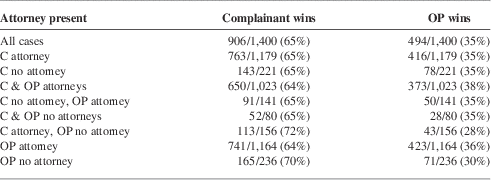
Table 2 provides the gross winning percentages for complainants and OPs, and then breaks that down into various combinations of when attorneys are present and when they are not. The first thing one notices when looking at the data from these fora is that consumers win almost two out of every three cases. Out of a total of 1,400 cases, complainants won 65% of the time. This is slightly lower than the 68% figure for complainant wins that was found in a 2009 tabulation of numbers the author completed, but nonetheless confirms over a span of between five and six years and a broad range of districts that these fora have generally proven to be quite consumer-friendly.Footnote 19 Among the individual districts, there are clear outliers. The two Kerala districts were the most pro-consumer in terms of wins and losses, with consumers winning 84% of the time in Ernakulam and 77% in Kasaragod. The least consumer-friendly districts were Chennai (South) in Tamil Nadu, where consumers won only 46% of the time, and Jalandher in Punjab, where they won only 48% of the cases. Why the results for these districts are so far from the norm is unclear from the case-law. Whether it has to do with who the Presidents are, the encouragement or discouragement of bringing certain cases by the local bar, the filtering of cases or the lack thereof by local consumer non-governmental organizations (NGOs), or a combination of these and perhaps other variables is left unanswered absent much closer scrutiny at the district level.
Winning and losing parties and whether attorney(s) present
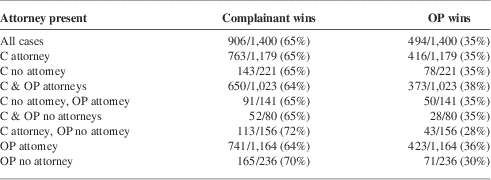
“C” refers to complainant and “OP” to opposite party. Source: Case decisions from NCDRC and author’s calculations of data points extracted.
Initially, it was hoped that attorneys would not come to dominate the proceedings and, prior to the passage of the 2002 amendments to the CPA, there was an effort to limit their presence in the fora.Footnote 20 As the numbers in Table 2 indicate, that has not been the case, with complainants retaining one in 1,179 cases or 84% of the time and OPs in 1,164 cases or 83%. In only 80 cases (6%) did neither side have an attorney. They have become so common in these fora that the NCDRC in its Consumer Protection Regulations, 2005, felt it necessary to include a warning that the “consumer forum shall not insist upon the parties” engaging counsel (§26(4)). At the individual district level, three of the districts, from three different states, were responsible for 62 of the 80 cases in which no attorney appeared—Baudh (26), Bangalore Rural and Urban I Additional (22), and Kasaragod (14). Four districts had at least one attorney present in every case, and five more had one there in all but one or two cases.Footnote 21 The general pattern among districts was for attorneys to appear more frequently for complainants, which is somewhat of a surprise. Normally, OPs will be the wealthier party and in many cases a large corporation (e.g. financial institutions or insurance companies).Footnote 22 This was the case in nine of the districts, with the Bangalore district having the largest percentage differential, at 68–57%. The five districts which had attorneys appearing more frequently for the OP were Kasaragod (68–72%), Ernakulam (74–76%), Baudh (48–69%), Namakkal (81–84%), and Chennai (South) (85–92%).
While there is no shortage of attorneys in these fora, the question remains of what effects their presence has on the cases with which they are involved. In particular, does an attorney make winning more likely, and how does their presence affect the length of cases? In the literature on the formal courts, attorneys and their billing methods, use of continuances, and other practices have commonly been pointed to as a major cause of delays.Footnote 23 However, there is no study of the district courts quantifying the presence or absence of attorneys and their effects on outcomes and delays.Footnote 24Table 2 provides a look at the effectiveness of attorneys in winning cases by breaking out the cases in which two, one, or no attorneys were present, and also looking at the possible combinations. Based on the national numbers, there does not appear to be any great advantage to hiring an attorney, particularly in the case of complainants. Complainants with attorneys won 65% of the time (763 of 1,179), and the same percentage when they were not represented by counsel (143 of 221). For OPs, it is slightly different. They won 36% of cases in which they had professional representation (423–1,164) but only 30% (71–236) when appearing without such assistance. When considering the presence of attorneys, the combination that produced the highest rate of success was when the complainant had an attorney and the OP did not. In such cases, the complainant won 72% of the time (113–156). However, when the situation is reversed and the OP had the attorney and the complainant did not, the latter still won 65% of the cases (91–141). At the individual district level, the numbers for some combinations become so small that they have little significance. However, there are some peculiarities worth mentioning. Bangalore Rural and Urban I Additional, where overall the complainants won 64% of the cases, presents a situation in which it appears there was a distinct disadvantage to retaining counsel. Although consisting of only ten cases, when the complainant had no attorney but the OP did, the complainant won eight of those. Winning rates for the complainant drop to 55% when neither party had counsel (12–22) and 50% when the complainant had counsel but the OP did not (10–20). When looking at how the OPs fared with and without counsel, again attorneys seem to be an impediment. OPs with attorneys won only 28% of the cases (16–58) while they won 49% (20–42) without counsel. Baudh presents a similar situation. There OPs with counsel won only 24% of the time (16–66) while those who opted not to retain attorneys won 44% (15–34). Mirroring the outcomes in Bangalore, only with more cases, when the combination of no attorney for the complainant but an attorney for the OP occurred in Baudh, the complainant won a very high percentage of the time, at 80% (20–25). In contrast with the situation in Bangalore and Baudh, there are districts in which there was a large disparity with and without an attorney in which the percentage favoured those with the attorney, but the numbers are quite small. The most glaring example is in Mansa, where, out of 13 cases without an attorney, OPs won none while winning 37% (31–87) in which they retained counsel.
There are at least two possible explanations for why in general the presence of counsel does not seem to be particularly advantageous, even when the other side is not represented. The first is that consumer NGOs are common throughout much of India, particularly in urban areas. Many of them may provide advice prior to and after filing which helps not only to weed out weaker cases, but will also better prepare the complainant for appearance at the forum.Footnote 25 The second possible explanation is that some judges may attempt to “level the playing field” when one side is represented by counsel and the other is self-represented. While the tone of the proceedings may be adversarial in nature, the procedures do allow for a good deal of informality.
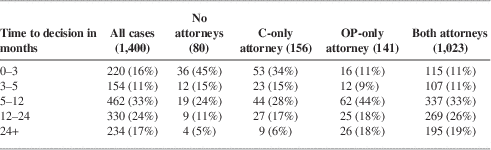
Table 3 provides data on the length of cases from filing to decision. (This does not include any appeals that may have been taken.) Here, the standards are the three- and five-month goals established by the CPA, the latter for cases requiring testing or analysis. (Due to difficulties in determining which standard applied in individual cases, this study does not distinguish between cases for the purpose of meeting these three- and five-month goals, but rather treats them all uniformly.) While we know that 73% of the cases certainly did not meet either the three- or five-month goals, still these fora completed their work in a year or less in 60% of the cases, and with only 17% of the cases falling into the bottom category of two years or more. This does compare quite favourably to numbers available on the formal courts where Hazra and Micevska give a figure of 63% of civil cases in the lower courts lasting more than one year and 31% of them lasting more than three years.Footnote 26 When broken down by district, again it is clear that individual districts can differ dramatically from one another. At one extreme are Bangalore Rural and Urban I Additional and Mansa. In the former, 88% of cases were completed within three months and another 9% within five. In the latter, the respective percentages were 81 and 17. No other districts were close to accomplishing what was done in Bangalore and Mansa.Footnote 27 At the other extreme was Chennai (South), where none was decided within five months and 87% took over two years to complete. Indicating what might be a state-wide problem (perhaps a failure to rapidly fill vacancies), Namakkal, the other district in Tamil Nadu, had 43% of its cases taking longer than two years and an additional 27% lasting between one and two years.
Time to decision: all cases, without attorneys, complainant-only attorney, opposite party-only attorney, and both attorneys
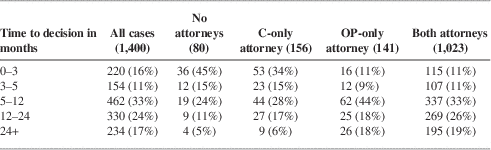
“C” refers to complainant and “OP” to opposite party. Source: Case decisions from NCDRC and author’s calculations of data points extracted.
As Table 3 indicates, when length of case is combined with the presence of attorneys, the length of cases increases sharply, although an interesting distinction emerges when there is only one attorney present. There were only 80 cases in the study in which no attorneys participated. In 36 of those (45%), the case was completed within three months. An additional 12 were completed between three and five months, for an additional 15%. Only four cases with no attorneys lasted more than two years. When there is one attorney present, whose attorney it is appears to make a significant difference in the length of the case. Cases tend to move quite a bit faster when the one present represents the complainant, although not nearly as fast as when no attorneys appear. Thirty-four percent of the cases finish within three months when only the complainant has an attorney, with an additional 15% completed in the three-to-five-month range. Only 6% lasted more than two years. When only the OP has an attorney, 11% finished within three months and an additional 9% during the next two months; 18% took over two years. Cases where both sides were represented by counsel constituted the vast majority (1,023) and, as Table 3 demonstrates, the results were quite similar to cases in which only the OP was represented. The largest differences occur in the 5–12-month and one-to-two-year categories where a reversal takes place. With two attorneys present, a lower percentage of cases was decided in the former category (33–44%) and a higher percentage (26–18%) in the latter. These numbers may reflect a reality in which OPs have a greater interest in delaying matters, perhaps to “exhaust” a complainant with far fewer resources with the goal of having him/her accept a less favourable settlement or drop the matter entirely. The data indicate that the longer a case continues, the better OPs tend to perform. Their highest winning percentages occur in the one-to-two-year category (39%) and the two years and above category (43%). On the other hand, complainants in these cases would seem to have little incentive to delay. As the party seeking relief, ordinarily in the form of money or replacement goods, there is little or no benefit to be gained from delay. In addition, with the OP often being a large company, the complainant will normally control far fewer resources.
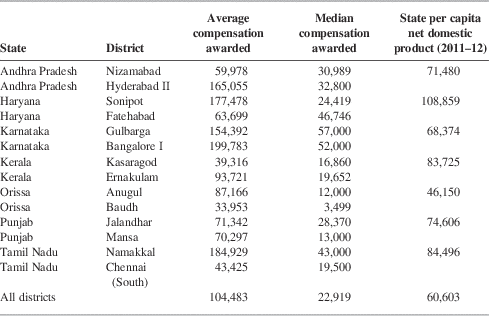
Table 4 provides data on the average and median compensation awarded, and also includes the per capita net state domestic product for reference purposes.Footnote 28 Compensation here includes any court costs awarded, as well as any additional money awarded for what the CPA refers to as “punitive damages” but which is referred to in many of the written decisions as “mental anguish” (Ch. III, 14(1)(d)). Those cases were excluded in which no monetary award resulted from the case (either in the form of compensation or to cover costs of litigation). Some of those cases were won by the complainant, but the order may have required the OP to take or refrain from some action without any monetary award or costs involved. Also, it is common for an order to include interest to any cash award (usually 9%) until it is paid. That is not factored into the average and median figures provided in the table. The range of average compensation runs from Rs 33,953 in Baudh to Rs 199,783 for Bangalore Rural and Urban I Additional. For median awards, the span is from Rs 3,499 in Baudh to Rs 57,000 in Gulbarga. Baudh’s position at the bottom of both measures is not surprising—not only is it from the poorest state in the study, but it is the smallest of the 14 districts in terms of population (373,372) and has the smallest urban population in both raw numbers (18,025) and percentage (5%). Its literacy rate is low (57%), but there are three districts reporting lower rates—Nizamabad (52%), Mansa (52%), and Gulbarga (50%). The one pattern that holds within all of the states except Tamil Nadu is that the more urbanized and educated district has the higher average compensation. However, in the case of median awards, that holds true only for Andhra Pradesh, Kerala, Orissa, and Punjab. If there is a surprise in this category, other than Chennai (South) with its relatively low average and median awards compared to Bangalore and Hyderabad, the other two large cities in the study, it is Gulbarga with the fifth highest average and highest median awards. The district is “only” 27% urban and has the lowest literacy rate in the study. What partially explains these numbers in Gulbarga, and at the same time highlights the localized nature of these fora, is the comparatively high number and types of tort cases filed and won there, and the large amount of damages awarded in many of them. Out of the sampling of 100 cases from that forum, 17 were torts, 14 of which involved actions against the electricity supplier seeking damages from fallen power lines or short circuits that resulted in crop losses, animal deaths, or injuries or death to humans. Two of the remaining three involved damages from exploding gas cylinders and the last case alleged legal malpractice. Complainants prevailed in 13 of these, the only losses coming in two of the electricity disputes: one of the gas cylinder cases and the legal malpractice case. In the 13 wins, the median and average damages awarded were Rs 134,000 and Rs 422,885. When these cases are removed from Gulbarga’s totals, the remaining median and average awards for the district fall to Rs 43,500 and Rs 136,333, which would still leave it with relatively high rankings: third and fifth among the districts in the study, but with substantially lower totals. Among the other districts, tort cases were rare. There were 24 in total, with 16 involving allegations of medical malpractice. Out of those 24 cases, complainants won in only six. This makes Gulbarga unusual not only in the number and types of tort cases filed, but in the high success rate of complainants in these cases.
District average and median compensation awarded, and state per capita net domestic product

Sources: Case decisions from NCDRC and author’s calculations of rupee amounts awarded. State Per Capita Net Domestic Product: Economic Survey 2012–2013: Statistical Appendix, Table 1.8.
5. Discussion
The data presented above provide insights into the inputs and outputs of the consumer fora including time to decision, who wins/loses, the presence of attorneys, their effects on the process, and the amounts of money involved. However, when one steps back from the numbers, there are larger issues upon which the data and supporting information shed light. Two in particular—the potential for the broad exercise of discretion by the Presidents and the effects on access to justice—warrant further discussion.
5.1 How the Presidents Can Take Control
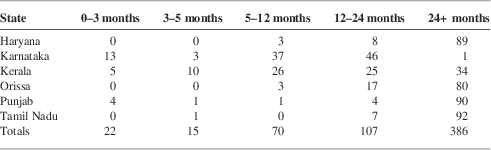
Based on the preceding data in conjunction with supporting information from published sources as well as interviews and observations, the consumer fora prove to be an interesting mix of players and practices borrowed from the formal courts, but with sufficient differences in design to allow for a far more rapid and informal, and some might argue successful, dispute resolution process. There are certainly similarities to the formal courts which can lead to longer times to disposition and increased costs. Perhaps most importantly, the appearance of attorneys in these proceedings has become ubiquitous. As the data above demonstrate, in only 80 cases out of 1,400 were no attorneys present. Four of the districts studied had no cases without at least one attorney present, and in 1,023 there were attorneys for both sides. While many of the concerns expressed about delays in these fora centre on the number of vacancies around the country,Footnote 29 the need for more benches, and poor infrastructure,Footnote 30 as the numbers here make it clear that, when attorneys are involved, cases do take longer, particularly when the OP is represented by counsel. This may result from the stalling tactics of counsel on behalf of OPs who feel it benefits their clients to take such actions and, as noted earlier, they do tend to win more frequently the longer a case remains undecided. Second, the use of adjournments to extend cases, which is a carryover from the formal courts where their use is commonly abused, is a problem that does plague some consumer fora. This is so despite the CPA Regulations’ calling for costs to be imposed when adjournments are grantedFootnote 31 and the Supreme Court’s urging the levying of “heavy cost(s)” in such situations to avoid unnecessary delays and to adhere strictly to the time limits laid out in the CPA.Footnote 32 The third factor that is common in the formal courts which can also carry over to these fora and add significantly to delays and costs are appeals. Among the state Commissions for the seven states in this study, data on time to decision from the date of filing could be tabulated for all but Andhra Pradesh, which did not have filing dates included in its decisions.Footnote 33 The results show a disturbing pattern. As Table 5 indicates, out of the 600 cases, 386 (64%) took two years or more. Should a second appeal be filed to the NCDRC, that could add significantly to an already lengthy appellate process.Footnote 34 Absent reliable data on the rates of first and second appeals, it is unclear how much of a threat this presents to a would-be complainant computing the possible costs of pursuing a case.
Time in months from filing to decision in state consumer dispute redressal Commissions
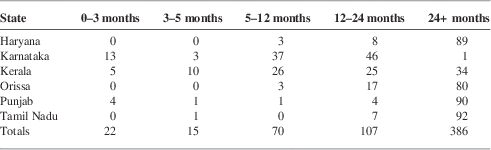
Andhra Pradesh did not provide filing dates in its decisions and therefore is absent from the table. Source: Case decisions from NCDRC and author’s calculations.
However, in a number of important ways, these fora do differ from the formal courts, which allows for a far more efficient process and improved product over that produced in the courts. Three related attributes of these fora appear to be largely responsible for the potential improvements over the formal courts—a more powerful President’s position vis-à-vis attorneys; a more inquisitorial style of proceeding; and a greater encouragement of and willingness to settle disputes short of a full hearing. It should be emphasized that the extent to which any of these are taken advantage of is up to the President of a given forum, turning these into highly localized institutions which can account for differing processes and outcomes in individual fora, even between those in the same district.Footnote 35
Due to both structural factors and informal power relations with the Bar in India’s district-level courts, judges are often left weakened, and unwilling or unable to take greater control over the judicial process. This goes a long way towards explaining problems with both delays and costs in those courts.Footnote 36 However, for a number of reasons, both structural and informal, the Presidents in these fora find themselves in a far more powerful position with greater freedom to exercise discretion over the flow of cases coming before them if they so desire. There are a number of reasons for the enhanced position of the Presidents:
∙ Many are retired district court judges
∙ Many will only serve one term before reaching the mandatory retirement age of 65
∙ They are encouraged to avoid the CCP and the CPA provides little guidance on the process to be followed
∙ The Supreme Court has encouraged speed and informality in the proceedings
∙ Many of the attorneys appearing are younger and less experienced.
The fact that many of these Presidents are retired district court judges and that there is a mandatory retirement age of 65 places them in a far more secure employment position and one in which possible threats to any future promotions or transfers, as sometimes occur in the district courts, likely are insignificant or nonexistent in most cases. Promotions as such do not exist. When reaching 65, some might be interested in moving to the state Commission as a member, but that would only last for two years, as 67 is the retirement age at that level.Footnote 37 Regarding transfers, in the lower courts, they are a required part of a judge’s career, but the possibility of a premature transfer due to complaints from attorneys can result in major disruptions to both the judge’s career and personal life.Footnote 38 In the consumer fora, transfers, while permitted if approved by the state selection committee which originally appointed the President, are not a routinized element of the job and, if used, should be done “sparingly and in (the) public interest.”Footnote 39 With the likelihood that the vast majority of Presidents are retired district court judges and will likely serve only one term in the position, it is unlikely that the possibility of transfer is something most Presidents would have cause to fear. Perhaps typical of this, in Solanki, the respondent retired before the case challenging his transfer was decided. The effective elimination of these two leverage points in most cases, when combined with the scarcity of procedural rules required to be followed and the Supreme Court’s encouragement of a process emphasizing speed and informality, results in a situation in which Presidents are left with significant discretion in how to process cases. One other ingredient in the mix, although largely impressionistic, may turn out to be quite important as well. This is the comparative youth of many of the attorneys appearing in these fora which provide the more experienced Presidents additional influence. Supporting this impression, Krishnan et al., in their study of district courts in Gujarat, Himachal Pradesh, and Maharashtra, found judges in those states to be much less insecure and more assertive when dealing with younger attorneys.Footnote 40 There were few older or senior attorneys observed in the fora who might be more willing to “push back” on some of the procedural shortcuts adopted by a forum.Footnote 41 According to people familiar with the situation, the impressive record of completing 97 out of the 100 cases in this study within five months from Bangalore Rural and Urban I Additional was the result of the then President’s exercise of his discretion to combine appearances, condense calendaring, and hold to a tight schedule on issuing opinions.
The discretion of the President is enhanced further by a forum process that is best described as inquisitorial. That is one in which the President and members conduct the questioning, and few witnesses appear (except in medical malpractice cases). Highlighting the informality of the process, in the fora observed, the parties and attorneys were called to the front of the room where they stood directly in front of the President and members. The case documents were given to the members by a clerk and questioning by the panel proceeded, which, at least in the fora observed, was dominated by the President. It is a process that ordinarily does not allow for direct questioning of one party by another, and over which the panel members exercise complete control.
These factors leading to enhanced power of the President and the members can also lead to a situation in which the President exercises his/her influence to encourage the parties to settle the case. One President in Bangalore noted that 50 of the 185 disposals in his forum in the previous four months were the result of settlements, many of which were encouraged by him. (Conversely, a second President from Chennai said he did not use his authority to encourage settlements in his forum.Footnote 42) Such assertiveness in shortcutting the process and encouraging settlements is unlikely to be a practice found in India’s formal courts and results largely from a shift in power towards the decision-maker in these fora, although it would be expected that this is far more prevalent when attorneys are not present. Of course, shortening the process in such a manner does not invariably produce a better brand of justice. Some would certainly argue that the potential for coercion would make such a process, particularly if unmonitored, deeply problematic.Footnote 43
5.2 Access to Justice
Related to the enhanced discretion of the Presidents is the effect(s) of these fora on access to justice and the quality of justice dispensed. It seems clear that these are not institutions designed primarily to increase access to justice for and to legally empower the “dispossessed”Footnote 44 or the “disadvantaged.”Footnote 45 While virtually all Indians are consumers in one sense or another, these fora may provide little better opportunity for the poor to access justice than do the formal courts. Even assuming knowledge of these institutions and an awareness of some legal cause of action,Footnote 46 formal complaints would need to be completed and court appearances made. For many of the poor, absent assistance from a consumer organization and it seems in most cases an attorney, the hurdles to access would be very nearly insurmountable. In addition, since these fora are restricted to consumer disputes, there will also be a cost-benefit analysis invariably applied. Since the poor are unlikely to be consumers of comparatively expensive services or goods, any possible benefits of approaching these fora are likely to be small compared to the money and time expended, as well as any emotional costs involved. Therefore, for the poor, these may provide no viable solution at all. The one set of cases found in this study which directly impacted the poor were a small number involving government-sponsored BPL (Below Poverty Line) schemes, in particular rice distribution programmes. Baudh and Mansa were the only two districts where these types of cases arose. Baudh had 18 of these cases, but the final ten were all dismissed after the state Commission in Orissa decided that those receiving the subsidized rice under the plan are not consumers under the CPA. Mansa had only two of these cases and both were dismissed for lack of jurisdiction.
Although many discussions of access to justice focus on the marginalized and the poor, this by no means implies these fora should be dismissed as largely superfluous institutions with regard to the issue. Whether intentionally or otherwise, these appear to be designed primarily for India’s growing middle class and some are taking advantage of them. The vast majority of cases brought involve issues one would expect to find common among the middle class. For the purposes of this study, the following four categorizations were used and are followed by the percentage of cases in each:
∙ Other services/goods (e.g. utility bills/connections; automobiles; electronics; school fees; couriers; medical; travel agents)—50%
∙ Insurance (e.g. life; automobile)—24%
∙ Finance (e.g. bank loans, chit funds, pension funds)—20%
∙ Housing/land purchases—6%.
Most likely, many of these claims (with a median award of Rs 22,919 for all of the districts) would not make it to the district courts. However, with minimal court fees mandated nationwide (ranging from Rs 100 to Rs 500),Footnote 47 in many districts, a shorter time to decision and therefore lower legal fees than in the courts (assuming an attorney is retained), a strong pro-consumer trend in judgments with almost a two out of three chance of winning (varying based on the district), and a simplified process, these disputes are more likely to find their way into the consumer fora. Still, despite such favourable conditions combined with India’s growing middle class, the available numbers suggest a surprisingly limited use of these fora. Only two states in the study (Karnataka and Andhra Pradesh) provide annualized numbers of filings in the district fora on their respective state consumer dispute redressal Commission websites. (The NCDRC provides only the total number of filings since inception for each state. This is of little use, since no dates are given for when fora were established and operational, nor any sense of whether filings have increased over the years since inception.) Karnataka, with a population of approximately 61,000,000, showed 7,703 filings in 2013 for a filing rate of 13 per 100,000. Andhra Pradesh, with a much larger population of close to 85,000,000, had only 4,308 filings in 2012 for a rate of 5 per 100,000.Footnote 48 Averaging the filings for the most recent five years for which data were available, the rates remained very low. Karnataka had a filing rate of 15 per 100,000 and Andhra Pradesh 6 per 100,000. What data on filings are available for the formal courts indicate that Indians are not particularly highly litigious. However, even allowing for that, these numbers seem shockingly low.Footnote 49
6. Conclusion
While much work is left to be done on India’s consumer fora, this project concludes with a conflicted picture of these district-level institutions and their effects on access to justice. Despite some glaring variations among districts, on the whole, they are certainly cheaper and faster than the formal courts, at least based upon the minimal data available on those courts. They have also proven to be strongly pro-consumer in their decision-making. The Supreme Court in a 1994 decision described the position of consumers against more powerful businesses as one of “helplessness” and noted that the CPA was designed to remedy that situation.Footnote 50 The reality of consumers’ winning two out of every three cases suggests that those who do access these fora are no longer helpless in their disputes with providers of services or goods. Nor, it should be emphasized, do these fora fit into Marc Galanter and Jay Krishnan’s concept of “debased informalism” (2003). While some are certainly choosing these fora as a way to escape the formal courts, and avoid what Pratiksha Baxi referred to as “the pathologies of the Indian legal system,”Footnote 51 they are not dealing in discounted justice. As opposed to Galanter and Krishnan’s lok adalats, these fora are handing down decisions with compensation, costs, interest, and punitive damages, when warranted, based upon the claims made and evidence presented in the case, and not discounted in exchange for escape from any torments and tribulations that otherwise might be suffered at the hands of the formal courts.Footnote 52 Nor do the consumer fora appear to suffer from the related “power imbalances” Krishnan et al. found to be problematic in some specialized fora where the absence of due process safeguards can give the more powerful disputant a distinct advantage.Footnote 53 The frequency with which complainants win in these fora certainly weaken arguments of possible power imbalances.
Despite such evidence of success in these fora, they remain flawed institutions. While they do increase access to justice for the middle class, they remain out of reach for the poor. Additionally, they appear to be seriously underused. Why this is so is unclear, but almost certainly a combination of factors play a role including lack of awareness of their existence, inconvenient locations, and a general aversion of many to approaching anything that looks or acts like a court. Still, with the relative speed, low cost, and high probability of the consumer’s winning, one might expect with more widespread knowledge of their comparative success there would be far more business generated for these fora. Of course, should that come to pass, additional resources would have to be provided to avoid overwhelming the fora and resulting in a decrease in efficiency and a corresponding rise in costs. Additionally, delays are a problem now in some districts and, when appeals are factored in, this may be one of the flaws in the system keeping prospective complainants away. Finally, there is a topic not broached in this paper, but hanging over the effectiveness of these fora and the quality of justice dispensed. This is the issue of collection on judgments. With reference to India’s lower courts, the few data available (albeit quite old and confined to Uttar Pradesh) have shown it to be a serious problem there.Footnote 54 Whether or not it proves to be as serious a concern in consumer fora remains to be seen.Footnote 55
Unquestionably, there is substantial room for improvement in the consumer fora, more so in some districts than others but, based on this limited sampling, they do represent progress over what the formal courts have to offer. Access is increased, costs and time lessened, judgments justified, and as a result consumers are empowered.