Introduction
A deep neck space abscess is a collection of pus in one of the potential spaces of the neck, such as the parapharyngeal or retropharyngeal space. It can result in significant morbidity and may be fatal as a result of sepsis or loss of the airway.Reference Vieira, Allen, Stocks and Thompson1
The incidence of deep neck space abscess cases has decreased since the advent of antibiotics. However, in the past 10 years, this trend has reversed, and numbers are once again rising. Lau et al., in a study of hospital admissions across England, showed that admissions for parapharyngeal abscesses rose by 39 per cent between 1991 and 2011 (r = –0.55; p = 0.026).Reference Lau, Upile, Wilkie, Leong and Swift2 This was accompanied by, and appears to correlate with, a large increase in tonsillitis and a decrease in tonsillectomies. A similar picture was seen in Wales, between 1999 and 2014, with a positive correlation between a rise in admissions for tonsillitis and retropharyngeal abscesses (adjusted r 2 = 0.442; p = 0.00254).Reference Lau, Upile, Wilkie, Leong and Swift2 However, despite the large numbers detailed in the literature, derived from national hospital admissions data, the strength of the conclusions we can draw is limited because the data are reliant on clinical coding, and direct causation cannot be proven.
Studies that look in detail at the causation of deep neck space abscesses are scarce, particularly in recent years. Parhiscar and Har-El analysed deep neck space abscess cases between 1981 and 1998 in New York and concluded that non-dental infections were no longer a significant aetiological factor.Reference Parhiscar and Har-El3 However, floor-of-mouth abscesses were included, and this data is now twenty years old.
Proving or disproving a link between deep neck space abscesses and tonsillitis would be useful. Lau et al. showed a 310 per cent rise in admissions for tonsillitis in England over a 20-year period.Reference Lau, Upile, Wilkie, Leong and Swift2 Tonsillitis can cause huge morbidity to patients and results in a significant economic cost to the country and to the National Health Service (NHS).
In the UK, tonsillectomy is one of the procedures that has undergone a large reduction in case volume as part of the Procedures of Low Clinical Effectiveness reforms.4 The number of tonsillectomies performed has fallen, and this correlates with a significant rise in emergency admissions, with no savings benefit from the reduction in procedures despite the new measures.Reference Lau, Upile, Wilkie, Leong and Swift2, Reference Yap, Harris and Clarke5 The number of patients suffering with deep neck space abscesses is small compared with admissions for tonsillitis. However, the length of hospital stay, associated morbidity and significant mortality rate highlights the clinical importance of this subject. Through identifying the cause of the increase in deep neck space abscesses, it may be possible to prevent these serious infections.
This study aimed to identify and review consecutive cases of deep neck space abscesses at a single centre and analyse them in detail to identify causation and any associated factors. The alternative hypothesis was that tonsillitis was the commonest cause of deep neck space abscesses.
Materials and methods
This was a retrospective cohort study of all patients presenting to the Royal Gwent Hospital (Newport, South Wales) diagnosed with a deep neck space abscess from April 2006 to March 2016.
The patients were identified through the clinical coding department and the radiology reporting system by searches for ‘parapharyngeal’, ‘retropharyngeal’ or ‘prevertebral’ and ‘abscess’. These two lists of patients were reviewed and any patients with submandibular, floor-of-mouth or peritonsillar abscesses were excluded.
Searching for patients by both clinical codes and radiology reports provided a safeguard to ensure all patients were included. Electronic and paper records of the identified patients were then reviewed and assessed for evidence of preceding infection source, management, lifestyle risks, comorbidities and patient demographics.
The location of the abscess was determined by computed tomography (CT). If two or more spaces were involved, the abscess was termed multi-space. Tonsillitis was diagnosed clinically; this is standard practice as further investigations such as throat cultures have not been shown to be useful or reliable in making the diagnosis.Reference Bird, Biggs and King6 A patient was considered to have tonsillitis if a record of the diagnosis was documented in the notes by the ENT team. In order to reduce false positives, a diagnosis made by the emergency department was not counted unless confirmed by the ENT team. Microsoft Excel® spread sheet software was used to anonymously record and analyse the data.
Ethical approval was not required for this study because it was retrospective; all data were obtained as part of the patients’ standard care, and all authors were part of the team caring for these patients. This is in line with NHS Health Research Authority guidelines.7
Results
Patient demographics
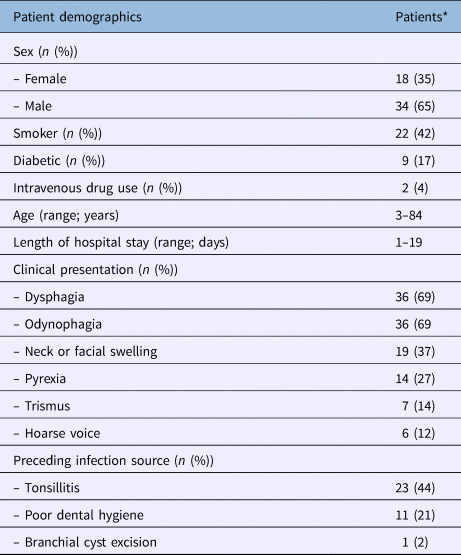
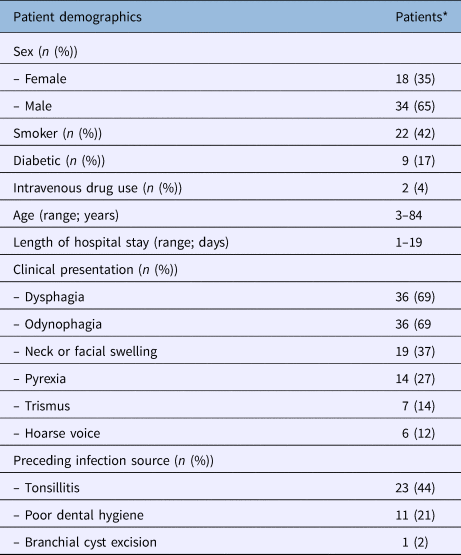
Fifty-two patients were admitted with a deep neck space abscess within the study period. The majority were male, and there was an age range of 3–84 years, with an average age of 40.8 years. The average length of stay was 5.6 days, with a range of 1–19 days. Of the 52 patients, 22 (42 per cent) were current smokers, 2 (4 per cent) were intravenous drug users and 9 (17 per cent) were diabetic (Table 1). Figure 1 shows the potential risk factors for a deep neck space infection.
Potential risk factors for a deep neck space infection. IVDU = intravenous drug use

Demographics of patients presenting with a deep neck space infection
* Total n = 52
Primary outcomes
Over the 10-year study period, the number of deep neck space abscesses increased from 1 in 2006 to 15 in 2015 (correlation value of 0.9; p = 0.00019). The most common site of infection was the parapharyngeal space in 31 patients (60 per cent), followed by the retropharyngeal space in 10 patients (19 per cent) and multi-space involvement in 8 patients (15 per cent).
A diagnosis of a deep neck space abscess was confirmed in 49 patients (94 per cent) by CT scan, and the remaining 3 patients (6 per cent) were diagnosed intra-operatively.
Twenty-three patients (44 per cent) were documented as having concurrent or recent (during the previous 4 weeks) evidence of tonsillitis, and 11 patients (21 per cent) had poor dental hygiene. One patient (2 per cent) developed a deep neck space abscess as a complication of a branchial cyst excision, 1 patient (2 per cent) was diagnosed with bilateral pneumonia (although this was not thought to be the source of the deep neck space infection) and 18 patients (35 per cent) had no cause documented in their notes (Table 1).
Secondary outcomes
The most common presenting symptoms were sore throat and dysphagia, both of which were observed in 36 patients (69 per cent), followed by neck swelling and pyrexia each in 14 patients (27 per cent). Two patients reported chest pain, both of whom had mediastinal extension (Figure 2).
Symptoms on presentation with a deep neck space abscess.

The average white cell count was 18.2 (range 11–34.8), the average neutrophil count was 15.4 (range 8.4–33.4) and the average c-reactive protein level was 209.9 (range 5–401).
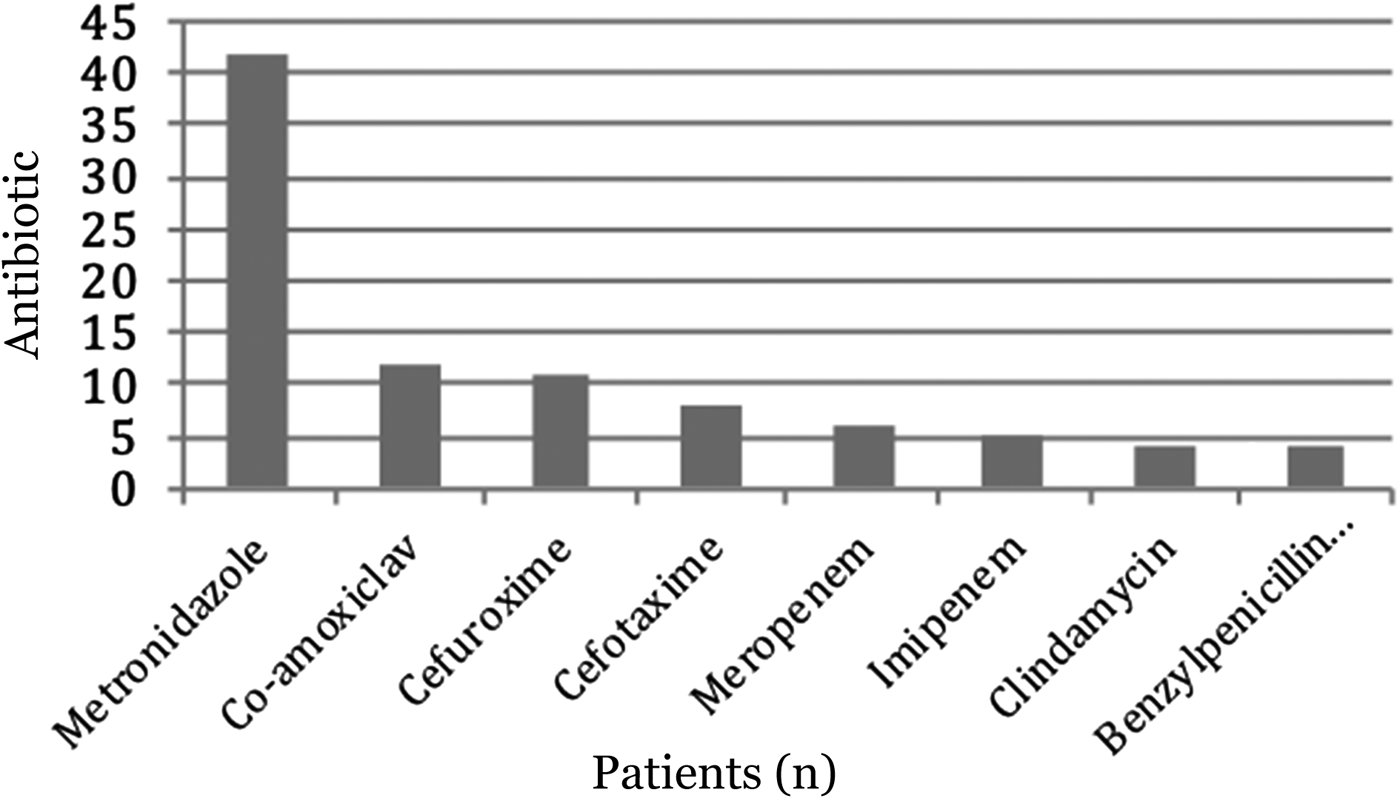
Metronidazole was the most common antibiotic used, in 42 patients (81 per cent), in conjunction with another antibiotic. Co-amoxiclav was the next most common, used for 12 patients (23 per cent), followed by cephalosporins such as cefuroxime used for 11 patients (21 per cent) and cefotaxime used for 8 patients (15 per cent). The antibiotic was not recorded for 5 patients (10 per cent) (Figure 3).
Antibiotics used to treat deep neck space abscesses.

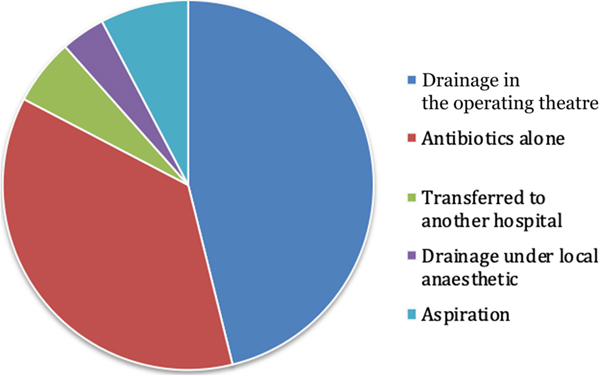
Twenty-four patients (46 per cent) underwent formal incision and drainage in the operating theatre, 6 patients (12 per cent) had local anaesthetic drainage and 3 patients (6 per cent) were transferred to a tertiary care centre for management. Five patients (10 per cent) underwent a dental extraction during their admission, 2 patients (4 per cent) had a ‘hot tonsillectomy’ (performed during the acute infection) and 3 more patients (6 per cent) have since had a tonsillectomy.
Two patients (4 per cent) had a mediastinal extension of their abscess and required transfer to a tertiary care centre with a cardiothoracic department. One patient had a major haemorrhage as a result of shearing of the external jugular vein by a drain, and one patient had right internal jugular thrombosis. One patient died as a result of sepsis. Eleven patients (21 per cent) required admission to the intensive care unit (Figure 4).
Management of patients with a deep neck space abscess.

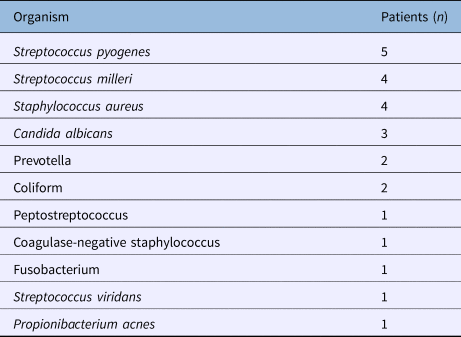
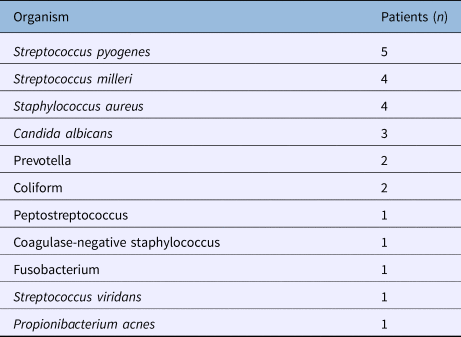
Positive culture results were obtained in 23 patients (44 per cent). The majority of these were grown from pus samples sent intra-operatively (n = 18; 35 per cent), and the remainder were from blood cultures and one throat swab. Twenty-six patients had an incision and drainage either in the operating theatre or under local anaesthetic, resulting in pus samples being sent for analysis; of these, 18 (69 per cent) had positive growth identified. From the pus samples, Streptococcus pyogenes was the most common bacteria found, followed by Staphylococcus aureus and Streptococcus milleri (Table 2).
Microbiology results of patients with a deep neck space infection
Discussion
Incidence and aetiology
This 10-year retrospective study of consecutive patients treated for deep neck space abscesses at one centre has shown that the incidence of deep neck space abscess cases is increasing and is most commonly a sequela of tonsillitis in this cohort.
These results compare well with studies in England and Wales looking at national hospital admissions data, which also describe an increase in deep neck space abscess cases over this period and shows a correlation with the increase in tonsillitis and the fall in tonsillectomy.Reference Lau, Upile, Wilkie, Leong and Swift2, 4 However, these larger studies were unable to analyse individual patients and were reliant on national coding data. The present study therefore complements these other studies by providing more detailed information on the cause of deep neck space abscesses.
In this cohort, the majority of deep neck space abscesses were caused by tonsillitis rather than by dental infection. For a diagnosis of dental infection to be made, the patient either had to undergo a dental extraction during or immediately prior to their admission or have documented evidence of caries or a dental abscess in their notes. The studies that included infections of deep neck spaces that are most associated with dental infection, such as Ludwig's angina and submandibular abscess, found dental infection to be the most common source for infection.Reference Lee and Kanagalingam8–Reference Srivanitchapoom, Sittitrai, Pattarasakulchai and Tananuvat12 The studies that showed lower rates of abscess in these compartments were more likely to find a higher rate of tonsillitis as the site of primary infection.Reference Brito, Hazboun, Fernandes, Bento, Zappelini and Chone13, Reference Huang, Huang, Chien and Chen14
A possible confounding factor was the contract change in 2006, which led to the privatisation of many dental practitioners. This could be related to the rising rate of deep neck space abscess cases during the study period, as poor dental hygiene was identified as a preceding infection in 21 per cent of patients.
The source of infection was unable to be determined in 35 per cent of cases, which represents a major limitation of this study. However, other authors have also reported a high rate of infection of unknown primary origin, in up to 50 per cent of patients.Reference Lee and Kanagalingam8, Reference Brito, Hazboun, Fernandes, Bento, Zappelini and Chone13 This is possibly because the initial infection had resolved by the time of presentation; however, documentation was not always clear. A diagnosis of tonsillitis as the preceding source has only been accepted in this paper if recorded by a member of the otolaryngology team. Therefore, it is possible that the rate of tonsillitis in this patient group has been underestimated. At present there is no reliable test to confirm a diagnosis of tonsillitis, and this data is therefore reliant on the documentation of a clinical diagnosis. There is no current role for throat cultures in diagnosing tonsillitis; this is mainly because of the very high rate of positive cultures in asymptomatic carriers.Reference Bird, Biggs and King6
A prospectively designed study could have strengthened the conclusions of this study, because it would likely result in a lower level of unknown primary infections. The conclusions of the present study are heavily reliant on the quality of the records documented at the time of admission. However, the large proportion of confirmed tonsillitis is felt to be reliable, although possibly under-recorded, and therefore useful conclusions can still be drawn.
Management
Surgical intervention remains the mainstay of treatment for deep neck space abscesses, although in this study 19 patients (37 per cent) were managed conservatively with antibiotic treatment alone. This is in keeping with recent evidence showing that in some cases, where the response to antibiotics is favourable, conservative management is appropriate.Reference Wong, Brown, Mills, Spielmann and Neeff15, Reference Carbone, Capra and Brigger16 Six cases were managed by aspiration under local anaesthetic. Further studies have been carried out investigating ultrasound-guided aspiration as an alternative to surgical drainage, finding a reduction in hospital stay and no increase in complications or recurrence.Reference Biron, Kurien, Dziegielewski, Barber and Seikaly10
In this study, a low rate of positive culture results was obtained. All abscesses undergoing drainage had samples sent for microbiology; of these, 69 per cent gave positive cultures. Where there was no growth it may be because of prior antibiotic therapy. Those that were managed conservatively did not have a pus sample sent for analysis, and no microbiology results were therefore available, unless positive blood cultures were obtained. The most common bacteria grown were similar to those found in other studies, as seen in Table 2. There was also a similarly high rate of unknown bacteria.Reference Vieira, Allen, Stocks and Thompson1, Reference Lee and Kanagalingam8, Reference Wong, Brown, Mills, Spielmann and Neeff15
There was a major complication rate of 12 per cent, with the most common of these being mediastinitis and airway obstruction requiring endotracheal intubation in 2 patients (3.8 per cent); this is similar to other studies.Reference Huang, Huang, Chien and Chen14, Reference Baldassari, Howell, Amorn, Budacki, Choi and Pena17 Two of the patients who suffered from complications had significant comorbidities that have the potential to affect immune function. The patient who suffered from internal jugular thrombosis was an intravenous drug user. Another patient who suffered a respiratory arrest requiring intubation, and later passed away from sepsis, suffered from decompensated alcoholic liver disease and diabetes. This incidence of adverse events that are secondary to a deep neck space abscess further highlights the importance of prevention.
Risk factors for deep neck space abscesses
The percentage of patients admitted with a deep neck space abscess who were smokers during the study period was 42 per cent, and the percentage of smokers in the population in the Newport area from 2013 to 2014 was approximately 24 per cent.18 Smoking could therefore be a contributing factor in the development of a deep neck space abscess as smoking prevalence was high in the study population; however, confounding factors, such as socioeconomic status have not been adjusted for.
In this patient group, the prevalence of diabetes was 17 per cent, compared to the local population (covered by the Aneurin Bevan Health Board) with a diabetes prevalence of 5.7 per cent in 2010.19 This suggests diabetes may also play a role in the development of deep neck space abscesses. Other research has also found diabetes to be the most prevalent systemic disease in patients with deep neck space abscesses,Reference Lee and Kanagalingam8, Reference Brito, Hazboun, Fernandes, Bento, Zappelini and Chone13 this is thought to be because of impaired neutrophil function.Reference Delamaire, Maugendre, Moreno, Le Goff, Allannic and Genetet20, Reference Hostetter21
• Deep neck space abscesses are a serious complication of many head and neck infections, including dental and tonsil infections
• The incidence of deep neck space abscesses had been falling but recent studies have shown an increase in admission numbers
• Recent evidence has pointed towards dental infections being the most common primary source
• The rise in deep neck space abscesses has been shown to correlate with a fall in tonsillectomies
• This paper found tonsillitis was the most commonly associated site of infection in the study population
• Smoking and type 2 diabetes were more prevalent in patients with a deep neck space abscess than the local population, suggesting these are risk factors
Conclusion
The incidence of deep neck space abscess cases is increasing and should therefore be a focus for research in order to determine effective prevention and treatment. Tonsillitis was the most common initial infection in this cohort, confirming our alternative hypothesis. This challenges previous research that proposed dental infection as the main causative factor for deep neck space abscesses. Smoking was identified as a possible associated risk factor, which, although unsurprising, is a novel finding.
This focused study complements the national cohort studies described above, which relate an increased incidence of deep neck space abscess cases with increased admissions for tonsillitis. This new evidence further adds to the argument that the threshold for tonsillectomy has been raised too high. It is important that the ENT community continues to explore this area, in order to provide policy makers with the best evidence to judge the cost-effectiveness and importance of tonsillectomy.
Competing interests
None declared