




No CrossRef data available.
Understanding Democratic Survival and Democratic Failure in Africa: Insights from Divergent Democratic Experiments in Benin and Congo (Brazzaville)
Published online by Cambridge University Press: 18 August 2005
Extract
How do we explain adequately the relative success or failure of complex political phenomena such as democratization? In the battle between conceptual and explanatory parsimony, on the one hand, and rich, thick description on the other, social scientists often fall into traps that obscure more complete explanations for our cases from the portfolio of the possible. For example, we often unconsciously generalize from the cases we know best. In single case studies, we can fail to recognize the explanations that don't shine brightly or bark loudly. More generally, we acquire a habit of thinking that orders causality in particular ways for each of us, a result both of an empirical reliance on our own familiar cases, and the conceptual and theoretical conclusions we have generalized consciously or unconsciously from those cases. In this article, we are self-consciously engaged in two tasks: (1) comparing divergent outcomes of democratization in otherwise fairly similar cases—Benin and the Republic of Congo (Brazzaville); and (2) proposing three possible primary causal hypotheses for the successful (Benin) and failed (Congo) outcomes.
Information
- Type
- Research Article
- Information
- Copyright
- © 2005 Society for Comparative Study of Society and History
Acknowledgments
We wish to acknowledge the many helpful comments we received on early versions of this article presented at the American Political Science Association and the African Studies Association meetings, as well as by the anonymous CSSH reviewers. In addition, we are grateful to Leonardo Villalón and Peter VonDoepp for stimulating our reflections on the Benin-Congo comparison during a conference at the University of Kansas convened to begin work on their edited volume The Fate of Africa's Democratic Experiments: Elites and Institutions (Indiana University Press, 2005).
How do we explain adequately the relative success or failure of complex political phenomena such as democratization? In the battle between conceptual and explanatory parsimony, on the one hand, and rich, thick description on the other, social scientists often fall into traps that obscure more complete explanations for our cases from the portfolio of the possible. For example, we often unconsciously generalize from the cases we know best. In single case studies, we can fail to recognize the explanations that don't shine brightly or bark loudly. More generally, we acquire a habit of thinking that orders causality in particular ways for each of us, a result both of an empirical reliance on our own familiar cases, and the conceptual and theoretical conclusions we have generalized consciously or unconsciously from those cases. In this article, we are self-consciously engaged in two tasks: (1) comparing divergent outcomes of democratization in otherwise fairly similar cases—Benin and the Republic of Congo (Brazzaville); and (2) proposing three possible primary causal hypotheses for the successful (Benin) and failed (Congo) outcomes.
The hypotheses we examine here are precisely the ones suggested by good social science, ranging as they do along the agency-structure continuum. They are logical and interesting points of departure for our analysis. In addition, we have chosen this method because of the additional purchase we get on each of our cases by focusing on hypotheses that can explain both success and failure. In other words, our explanation is better served by a narrative that considers explanatory hypotheses for both outcomes. We suggest—in contrast, for example, to the more formal method suggested by Robert Bates et al. (1998) regarding the extraction of broadly applicable hypotheses from single historical cases—that a closely structured direct comparison will generate a more complex, if less certain, explanation of differing outcomes than the single cases alone would have allowed. In doing so, we highlight the limits to what we can honestly generalize.
Democratization in Africa and the Benin-Congo (Brazzaville) Comparison
Prior to the end of the Cold War and the wave of political reform movements that swept over the African continent, only a handful of African states could claim governments chosen in free, multiparty elections (Diamond et al. 1988). While the authoritarian governments in power managed to contain many of the newly animated democratic movements, in a number of other cases these reform movements did succeed in bringing about democratic transitions to new, de jure multiparty regimes. According to one carefully considered operational definition, sixteen different African states experienced a democratic transition between 1991 and 1994 (Bratton and van de Walle 1997:116–22). In the former French colonies, the mode of transition was frequently a “sovereign national conference” (Clark 1994; Robinson 1994). In other cases such as Zambia and Malawi, existing authoritarian governments were simply forced to allow free elections in which the ruling presidents and their parties lost power (Joseph 1992; Villalón and VonDoepp 2005).
Dramatic though these transitions to multiparty democracy were, they represented only a first step toward the establishment of stable, consolidated democratic governments. For the sixteen African states identified by Bratton and van de Walle, the post-transition record of democratic consolidation has been mixed, but their experiences generally confirm the well-observed proposition that impoverished states do not consolidate democratic regimes easily. Of the sixteen, only three (Benin, Cape Verde, and Madagascar) underwent consolidation as defined by the minimal condition of the peaceful replacement of a post-transition party or president in power through electoral means. In light of the post-election spectacle of dueling presidents in Madagascar during 2002, even that number is questionable. In nine cases (Central African Republic, Malawi, Mali, Mozambique, Namibia, São Tomé and Principe, Seychelles, South Africa, and Zambia) democratic experiments are ongoing and have not been disturbed by unconstitutional changes of power, but they have not yet been consolidated in the formal sense of having experienced regime alternation. Three other states (Guinea-Bissau, Lesotho, and Niger) experienced military coups or civil war after their transitions, but subsequently continued to experiment with democracy after peace was restored. In all three, elections of reasonable fairness have followed the breakdown of democratic rule. One of the most spectacular failures has been Congo Republic.1
In this paper, the Republic of Congo, or Congo-Brazzaville, will be identified by the common shorthand label, “Congo Republic.” Congo Republic is to be distinguished from its much larger neighbor to the east, the Democratic Republic of Congo, or Congo-Kinshasa.
These variable outcomes suggest that in African states the consolidation of democratic rule following transitions from authoritarianism may be possible, but they raise the question of why some of these democratic experiments have survived over the medium-term while others have failed. In all of these states structural economic conditions militate heavily against democratic consolidation. Yet the results with regard to democratic survival, if not unambiguous consolidation, have been good enough to beg explanations for success and failure. One obvious approach would be to compare systematically these sixteen cases across a number of criteria. Theories of democratic consolidation suggest that this entire group of countries might be compared in the areas of economic status at the moment of transition and economic performance since the transition (Przeworski et al. 2000), the nature of the ethnic or ethno-regional configuration of society before the transition (Smith 2000), and/or the type of institutions put in place immediately following the moment of transition (Mozaffar 1995). Such an approach has the appeal of apparent methodological rigor and careful analysis of possible causes of variable outcomes. A more inductive approach might ask country specialists to examine several, or all, of the sixteen cases individually, in light of their particular histories and circumstances.2
Villalón and vonDoepp (2005) are currently engaged in such an effort.
One manner of enriching such comprehensive approaches as these, in turn, would be to begin by comparing in more detail particularly interesting dyads from among the collective set of cases. Careful comparison of well-chosen pairs of states would also serve to generate hypotheses for more comprehensive studies, pointing to possible areas to explain the variation in post-transition outcomes. The method of examining two cases closely has frequently yielded interesting results for scholars when the dyads are well chosen. For instance, Grindle (1997) studied how states respond to external shocks by comparing the cases of Mexico and Kenya, and Heilbrunn (1993) and Houngnikpo (2001) both compared Benin and Togo to try to understand the variable outcomes of their national conferences and democratization movements.
In order for two-case comparisons to be useful, however, the dyads must be carefully chosen. Comparisons of pairs of states are typically most revealing about social processes in one of two circumstances, both of which present the observer with puzzling outcomes. One is the puzzle presented when obviously differing cases experience a similar outcome, and where the areas of difference are thought to account for the outcome. This was the case for Grindle, who found that both the Mexican and Kenyan states underwent broadly similar changes in response to external economic shocks, despite variation in their capacities and functioning.
The other puzzle is when two states seem to have many things in common, yet follow different socio-political trajectories following similar crises or other stimuli. In such a circumstance, one can narrow down the list of possible differences in structural conditions or variation across the independent variables that may account for differing outcomes. The Benin-Congo dyad we examine here presents us with just such a puzzle, and an opportunity for understanding of this kind. Despite their geographical separation on the African continent, the two cases share an impressive number of social, political, historical, and even demographic features. Moreover, in the early 1990s, both states experienced broadly similar transitions to multiparty rule under nearly identical circumstances. Yet the two states have followed dramatically different post-transition political trajectories. This leads us to the main question that we address in this paper: Why have Benin and Congo had such different outcomes in their democratic experiments given that the two countries appear to have so many structural and historical similarities? Following a discussion of what makes these two countries analytically similar, we proceed to analyze the divergent paths they have taken following democratic reforms. We then generate and discuss three possible hypotheses to answer our question based on three particularly promising areas of difference.
The pairing of Benin and Congo as two similar cases, or as cases grouped among a larger set of cases, has been fairly common in major scholarly work, primarily with respect to regime type and ideology. These began with Samuel Decalo's 1976 book, Coups and Army Rule in Africa, in which Congo and Benin represented two different paths to military rule. The second edition of this work (1990) pairs them as representing two forms of “radical military rule.” Elsewhere, Decalo (1979) compares the two countries on the basis of their shared “Marxist-Leninist” ideologies, as did Crawford Young (1982) and later Chris Allen et al. (1989).
Let us begin by enumerating some of the similarities shared by Congo and Benin. First, both are former French colonies, and as such, experienced a relatively similar type of colonial rule, although Congo suffered a harsher form than did Benin.3
Between 1898 and 1930, the French virtual ceded the administration of Congo to some thirteen different “concessionary companies” (Coquery-Vidrovitch 1972) whose activities were only lightly supervised by colonial political authorities. Benin did not suffer an equally ruthless form of economic exploitation.
Benin and Congo also share important geographic and demographic features. Both are medium-sized Africa states with small populations. While such features as population size, territory size, and population distribution might seem pedestrian considerations, a major new book has recently argued that demographics is a key to understanding how African states consolidate control over national spaces and populations (Herbst 2000). In turn, such considerations are likely to be central to other political issues, including the possibility of democratic consolidation. Although Congo is approximately three times larger than Benin in geographical expanse, neither is in the smallest or largest category of African states, according to Herbst's taxonomy (2000:146). Although Benin's population density is an even larger multiple of that in Congo, Herbst, incorporating a number of other variables in his calculus of what makes for favorable political geographies, ends by including both states in his category of “countries with favorable political geographies” (for political consolidation) (2000:161).
Benin and Congo also share strikingly similar ethno-regional structures, a variable that can be seen as another dimension of political demographics. In each case, there is one predominant ethnic cluster and several smaller ethnic clusters that represent substantial fractions of the population. For Benin the major ethnic clusters include the Fon (39 percent), Yoruba (12 percent), Adja (11 percent), Aizo/Houéda (10 percent), and Bariba (9 percent) (Decalo 1995:xvii). For Congo, the major groups are the Kongo (53 percent), the Téké (13 percent), Mbochi (12 percent), and the Kota (10 percent) (Decalo, Thompson, and Adloff 1996:260). In each country a lack of firm political cohesion within the predominant ethnic clusters located in the south (the Fon in Benin and Kongo in Congo), has prevented them from exercising the political influence that their demographic weight would suggest. The conquests of the major northern groups in each country were undertaken as separate actions of French colonial authorities. In each country colonial authorities bestowed social advantages on southern groups, who had experienced a much longer period of contact with European traders and missionaries than had northerners. Yet colonial authorities also drew disproportionately on northerners from each country for military service. Accordingly, there is a fundamental regional split (north-south, in both cases) in the ethno-regional politics of each country, in addition to more localized ethnic and regional rivalries.
The class strata of the two countries are also somewhat parallel. Specifically, both states have a proportionately larger-than-average middle class compared to their poorer neighbors. As we shall see, the sources of these middle classes are rather different, but one common source has been the higher incomes that have accrued to the unusually large intelligentsia of each country. As Ronen notes of Benin, “. . . Dahomey was called the ‘Latin Quarter of West Africa,’ because as an intellectual center it supplied a large number of administrators, professionals, and teachers to other parts of France's African colonial empire” (1975:2). In Congo, Brazzaville also became an early “intellectual quarter” thanks to its selection as the regional headquarters of Afrique Equatoriale Française (AEF) in 1910. The revolutionary post-colonial regimes continued a high level of commitment to education, allowing Congo to attain the astoundingly high literacy rate of 75 percent. The country is also known internationally for its prominent literary figures (Tchicaya U'Tamsi, Sony Labou-Tansi, and Jean-Baptitse Tati-Loutard) and social scientists (Théophile Obenga). Meanwhile, Benin has produced an unusual share of high-ranking international civil servants, including executive directors of the World Bank, high-level functionaries in the ILO and FAO, and clergy high in the Vatican hierarchy.
In the political realm, the two countries followed parallel post-colonial trajectories. Benin has a legacy of political instability illustrated by the six successful coups d'état the country witnessed during the 1960s and 1970s, until the rise to power of Mathieu Kérékou in 1972. Similarly, Congo had nearly constant political turmoil in the 1960s involving two different changes of regimes through unconstitutional means. Even more intriguingly, both countries were finally stabilized through “revolutions” that established de jure one-party states of a nominally Marxist character. Congo's revolutionary leaders actually established a single party, the Mouvement National de la Révolution (MNR), as the sole legal party in 1964. Following the rise to power of Marien Ngouabi in 1968, the new regime replaced the MNR with the Parti Congolais du Travail (PCT), a party putatively run according to rigorous Marxist-Leninist principles, in 1970. In Benin, Kérékou founded the Parti de la Révolution Populaire du Bénin (PRPB) as that country's sole legal party, announcing that the country would follow a Marxist-Leninist path to development in 1974. Besides their nominal commitment to Marxist ideology, the Kérékou and Ngouabi regimes shared other features in common: the leaders of both regimes were northern military officers, and both relied quietly on northern cadres for the core of their support, although the main intellectual forces behind each came from the south. After Ngouabi's assassination in 1977, he was succeeded by another northern army officer, Denis Sassou-Nguesso. Kérékou, on the other hand, was able to withstand and defeat a mercenary invasion in 1977 purportedly backed by Gabon and France.
Both regimes enjoyed a peak of popularity in the mid-1970s, and a decline in popularity thereafter as the economies of both countries began to experience crisis by the late 1980s. Moreover, both regimes suffered an ideological shock when European communism collapsed in 1989. Political reform movements in both countries correspondingly gained momentum. The reform movement in Benin was organized rapidly, and Kérékou saw the handwriting on the wall more quickly as support from France and the East bloc suddenly evaporated. In February 1990, only weeks after the fall of the Berlin Wall, Kérékou was pressured by internal reformers and external donors to convene a “sovereign national conference” to reconsider the country's political future. This conference became the instrument of a thorough political transformation to a new, multiparty regime, and the model for all of francophone Africa (Heilbrunn 1993; Clark 1994; Decalo 1997). Sassou behaved more grudgingly, holding out against a conference until February 1991. When he did allow one to convene, he still hoped to keep it under his control, but opposition participants were able to wrest control away from Sassou's supporters and break the dictator's grip on power. They proceeded to establish an interim government, erect the framework for a new, pluralist constitution, and propose a timetable for elections under the new regime. Thus, even the instruments of the transition in the two countries were similar.
Despite these impressive similarities in their histories and constraints, Benin and Congo experienced strikingly divergent outcomes of their transitional democratic experiences. The next section briefly describes, separately, the divergent paths that the two countries followed. It ends by returning to a direct comparison of the two states, and identifying three areas of difference that promise to explain the divergent trajectories followed since 1990. These differences, in turn, generate three different hypotheses about divergence that are explored in subsequent sections.
Divergent Trajectories
Both Benin and Congo experienced major challenges to the stability of their new and fragile democratic systems after they were launched at the beginning of the 1990s. Congo's democratic experiment survived several major crises before definitively collapsing in a major civil war in 1997.4
Elections organized in Congo during early 2002 did not meet the standard of “free and fair,” and thus the country has become what Diamond, Linz, and Lipset call a “pseudodemocracy” (1995:8).
Despite having met this operational definition, it is less clear that Benin has consolidated its democratic system in a more qualitative sense. For instance, Diamond describes consolidation conceptually as the “deep, unquestioned, routinized commitment to democracy and its procedures at the elite and mass levels . . . ” (1999:65). It is certainly open to question how much Beninois elites or citizens have internalized democratic values to this degree, even if democratic survival in the country has been impressive, and political conflict there is mostly resolved along constitutional lines.
Democratic Survival in Benin
The story of Benin's National Conference has been told many times (e.g., Decalo 1997; Boulaga 1993; Dossou 1993). Like Congo, Benin was suffering from the consequences of the latest oil-price-decline shock in the late 1980s. Less a problem of direct government revenue than in Congo, a decline in oil prices resulted in Benin in declining demand for consumer goods in neighboring Nigeria and a substantial contraction of the informal trade revenues on which much of Benin's population depended for sustenance in an otherwise bankrupt formal economy.6
For a detailed discussion of Benin's informal economy, see Igue and Soule (1992).
Unlike Congo, Benin possesses only a small offshore oilfield. In fact, it was Politburo meddling in this oilfield in the mid-1980s that was perhaps the first real indication (in hindsight) of the collapse to follow.
With the demise of Kérékou during the National Conference, and given the historical division of ethno-regional politics, the outcome of new elections of whatever form were going to be uncertain at best. The National Conference established a Constitutional Commission to draw up a new multiparty, democratic constitution, a Council (Haut Conseil de la Republique—HCR) that was given sovereign national legislative powers until a new constitution was established, and appointed Nicephore Soglo, a former executive director of the World Bank, to act as Prime Minister during the interim. Kérékou was permitted to retain the Presidency as a figurehead, but was stripped of effective power. Neither Soglo nor Kérékou controlled the constitutional commission that would draw up new regime rules, nor did they control the HCR that would develop new electoral law. In fact, Soglo claimed early on that he would not be a candidate for President in the 1991 elections, a promise he later broke. With the outcome of any election uncertain at best, those who were likely to compete for power found incentives to create a system that would not guarantee absolute power to the elected but rather limit their rivals' ability to monopolize the regime—a presidency and a proportional system of representation that makes it extremely difficult for a president to assert ethno-regional political dominance. In addition, Benin had ample experience of the weaknesses of multiple constitutional arrangements up until 1972 from which to draw lessons. The choice of institutional arrangements reflected both of these considerations, and is discussed below in more detail.
The new constitution was approved overwhelmingly by referendum in 1990, and elections for the Presidency and National Assembly were held in 1991 with only minimal violence in two northern districts. Soglo, now a candidate for President, won the runoff with Kérékou by a two-to-one margin. Kérékou retired quietly to his compound in Cotonou and stayed out of public life until the 1996 elections. Unlike that of Congo, the Beninois constitution rejected the French Fifth Republic-style dual executive (semi-presidential) model, opting instead for a strong executive, and a separate legislature with some important powers. It is noteworthy that Benin resisted pressure by the French to establish a semi-presidential system, and by the United States to establish single-member legislative districts.
As in Congo, the first years of multiparty politics were plagued by a series of crises, some of constitutional magnitude, but all of which tested the limits of leadership and institutions. During the Soglo presidency an environment of uncertainty was created by rumors of coup plots, the reality of arms thefts, and the exploits of a few renegade but low-level military discontents, but it was the political confrontations between President and National Assembly, and the assertiveness of the new Constitutional Court vis-à-vis both other branches of government, that provided most of the constitutional drama. These confrontations resulted in the finest hours of the new democratic regime, a period remarkable for every quiet and unknown decision by the military not to intervene in these personal and institutional squabbles. Soglo's more authoritarian reflexes were thwarted, the National Assembly's overreaching was quelled, and the Constitutional Court established a level of deep public legitimacy and respect for the process.8
Established finally in 1993, Benin's 1st Constitutional Court consisted of seven high-profile and highly respected members, including Dahomey's first president, Hubert Maga, and constitutional scholar Maurice Ahahanzo Glele. For more on how the Court obtained such high legitimacy, see Magnusson (2001).
Despite these initial successes, a reformed and now democratic Kérékou was able to create a political coalition that defeated Soglo in the 1996 presidential elections. The elections were problematic, especially in the first round, and the Constitutional Court nullified nearly 25 percent of the vote. Soglo left office reluctantly, claiming voting irregularities and accusing the Court of complicity with Kérékou (Adjovi 1998). He left nonetheless, and in the 2001 elections was clearly on his way to losing the second round when he pulled out from the race, leaving Kérékou to win handily over the remaining participant.
On the parliamentary side, National Assembly elections continue to attract a huge number of candidates and nearly fifty political parties. Incumbents are not safe—the turnover in 1995, for example, was nearly 75 percent. With multiple party alliances and organized parliamentary groups of parties, coalitions are often haphazard and fleeting. Just as important, the President is continually forced to retool a workable coalition within the Assembly by allocating ministerial posts to temporary coalition partners. While exceedingly inefficient for governing purposes, it is a powerful check on presidential power.
On a more somber note, the 2001 presidential elections left a nastier than usual aftermath, especially among Soglo supporters, who have claimed, against most evidence, that the election was stolen. Because it was ultimately the Constitutional Court that determined the vote count in the election's first round, it too was tarnished in the process. Both Soglo and Kérékou will be constitutionally ineligible to run for the Presidency in 2006 because of a provision prohibiting candidates age seventy or older. The constitutional question to watch will be whether their supporters will attempt to amend the constitution to allow either to return to the presidency.
Democratic Collapse in Congo
Like that in Benin, the democratic transition in Congo issued from a political reform movement that gathered steam at the end of the Cold War, and culminated in a National Conference, in this case from February to June 1991 (Quantin 1997). Following the Beninois example, the Congolese National Conference temporarily reduced the President's powers, leaving Sassou in office, but only as a figurehead. Meanwhile, it set up an interim government under the authority of André Milongo, a former high-level World Bank official. The Conference also put in place the mechanisms to draw up a new constitution, duly approved in a referendum in March 1992. Under the new constitution, Pascal Lissouba was elected to the presidency in second-round elections held in August 1992.
Over the course of its short life, the Congolese democratic experiment underwent a series of severe challenges. The first crises began in the transitional period. One involved efforts by the transitional government to rein in the army, accompanied by alleged coup plots; a second concerned alleged cheating by the transitional government in the local and municipal elections of May 1992 (Clark 1997:69–70). Soon after the election of Lissouba, a far more serious crisis erupted, occasioned by the collapse of the President's coalition in Parliament. Lissouba had won the second round of the 1992 elections by forging a partnership with former President Sassou. Through this alliance, Lissouba won not only the presidency but also a controlling majority in the Assembly. His own UPADS party held thirty-nine seats and Sassou's PCT held eighteen after the legislative elections. With the cooperation of some smaller parties, Lissouba's coalition achieved a majority in the 125-seat body. When Lissouba announced the formation of his first government in September, however, Sassou's PCT only received three minor cabinet posts. Insulted, Sassou bolted the coalition, and made an alliance with Lissouba's strongest competitor, Bernard Kolélas. Kolélas had finished second in the presidential balloting, and his MCDDI party had won twenty-nine seats in the Assembly, the second highest total. Rather than naming a prime minister from this opposition coalition, Lissouba dissolved the Assembly and ordered new elections for the following year.
The opposition did not concede to this “solution,” however, and a major confrontation ensued. According to any honest reading of the constitution, Lissouba should have named a prime minister from the majority (opposition) coalition in the Assembly. When the opposition demonstrated outside the Presidency in December, the first blood of the conflict was spilled: Lissouba's presidential guard fired on the protesters, killing three. Toward the end of the year, the crisis was temporarily resolved when Lissouba was persuaded to appoint a “national unity” government, headed by a neutral prime minister. Congo's new multiparty system thus survived its first test, though not very gracefully, and in a way that undermined the authority of the constitution.
The re-run of the legislative elections in May 1993 marked the beginning of a far more serious crisis, Congo's first “civil war.” In the presence of numerous international observers, Lissouba's new coalition of his UPADS and several smaller parties won a total of sixty-two seats in the Assembly. With eleven seats still undecided because of a lack of majority in the first round, it was clear that Lissouba had won a majority. Citing “monstrous frauds and irregularities,” however, the opposition rejected the election results.9
Opposition spokesperson cited in Marchés Tropicaux et Méditerranéens (MTM), 21 May 1993:1321.
Although the militia groups in Congo played an important instrumental role in the collapse of the democratic experiment, their genesis was the product of the choices of Congo's post-transition rulers; they were not the inevitable by-product of class or other structural forces in society. On the subsequent role of the militia groups, see Bazenguissa-Ganga (1999).
In October, the elections for the eleven seats in which no majority was gained in the first round of elections were re-run. The results yielded three more seats for the presidential coalition and eight more for the opposition coalition. The three additional seats gave Lissouba an undisputed majority in the Assembly. This development caused the opposition groups to boycott the opening of the new Assembly session, and led to a renewal of violence in the streets. The violence was even worse this time, with further rounds of ethnic cleansing, and incredible violence aimed at the representatives of rival ethno-regional constituencies. The worst of the killing took place between November 1993 and January 1994, when Lissouba finally ordered the shelling of the Bacongo and Makélékélé neighborhoods. During this round of fighting, like that between May and July, Sassou and his “Cobra” militia mostly stood on the sidelines.
In the case of this conflict, it was the Congolese themselves who restored peace, chiefly through an interregional committee in the Assembly, composed of deputies from the two warring sides (Zartman and Vogeli 2000:278). By 31 January, the basic accord was in place, and peace returned gradually to the country, though it was marked with localized outbreaks of violence. In January 1995, a new agreement was reached between Lissouba and Kolélas in which the latter's party, the MCDDI, gained cabinet posts, including the Interior Ministry, in a new government named by Lissouba. Relative peace prevailed in Congo from the middle of 1994 through the first months of 1997, when the next presidential election campaign got underway.
Sadly for Congo, the 1997 re-election campaign proved to be the context in which the country's fragile civil peace—and democratic experiment—was destroyed. The delicate peace was first broken in the northern region of Cuvette, whence hailed two former Congolese presidents: Sassou and Joachim Yhombi-Opango, the latter of whom had joined the Lissouba government in 1993 at the height of the first electoral standoff. In early May, when Sassou sought to be carried into Yhombi's hometown of Owando on a ceremonial chair reserved for chiefs, violence broke out between Yhombi's (mostly Kouyou) supporters and Sassou's (mostly Mbochi) bodyguards (Pourtier 1998:18). A bout of fighting between the supporters of Yhombi and Sassou in the towns of Oyo and Owando ensued, leaving several persons dead. Before the fighting got out of hand, however, outside mediators again intervened. In this instance, UNESCO Director-General Federico Mayor persuaded the feuding politicians to sign a pledge on 31 May to refrain from any further violence during the campaign.
Although the Congolese surely breathed a sigh of relief when this accord was signed, their hopes were soon dashed. On 5 June government forces surrounded Sassou's residence in Mplia with the mission of arresting two of his associates implicated in the Owando violence, and of seizing the arms of the Cobras. Since Sassou's Cobras had already organized the residence as a virtual armed camp, however, the arrests could not be effected, and fighting soon broke out and spread to the surrounding neighborhoods, and then to all of Brazzaville. The result was a four-month-long civil war, with Sassou's well-armed militia fighting the government forces that remained loyal to Lissouba, as well as his own militia (Clark 1998). Kolélas initially remained neutral and even tried to mediate the dispute before Lissouba finally persuaded him to join his government in September. Before his forces could have any impact on the stalemated war, however, a more important intervener, Angola, joined the fray. In apparent revenge for Lissouba's embrace of UNITA, Angola sent thousands of its troops into Congo on behalf of Sassou, allowing him to seize the country's key installations in October.
Hypotheses about the Divergent Trajectories
The divergent trajectories of the post-transitional histories of these two strikingly similar states bring our thesis question into sharper focus: How could two such similar countries have suffered such different fates with regard to their democratic experiments? Three major hypotheses suggest themselves, and each falls at a different point along the agent-structure continuum. One is that democracy has survived in Benin because that country was more fortunate to have leaders who put the rule of law according to democratic principles above their personal political fortunes. This hypothesis suggests that the exigencies of the personalities and choices of the most important agents determine the possibilities for the short-term survival of new democracies. A second hypothesis is that democracy has survived in Benin until the present because of the difference in the institutions its leaders chose at the moment of transition. These new institutions reflected equally the choices of the agents of the transition and the structural weight of history and culture. A third hypothesis is that democracy failed in Congo because of the structure of the country's economy, namely that petroleum rents serve as the chief source of government revenues and income. This economic structure has produced class arrangements and social expectations that made the consolidation of democracy in Congo impossible. If this third hypothesis is correct, no different institutional arrangement or set of political figures could have brought about a different result for Congo. Each of the following three sections explores one of these hypotheses.
Leadership, Personality, and Democratic Outcomes
Our first hypothesis claims that divergent post-transition political trajectories in Benin and Congo are due to differences in the quality of leadership. Why would one think that the quality of leadership might make a difference in the outcomes of democratic experiments? One might begin with the general observation that kind or quality of leadership always matters in political affairs, but that it is generally slighted by social theorists. This tendency is understandable since social theorists examine the human domain by looking for macro-level forces and trends that affect clusters of societies and cause them to follow common trajectories. While historians are more likely to take account of individual agency in their quest to discern the source of social outcomes, they, too, sometimes become the prisoners of the macro-level theoretical expectations. Thus, individual agency may be playing a much larger role than social observers realize when variable outcomes are observed across apparently similar cases.
More specifically, individual agency clearly plays a greater role than institutional or structural forces at certain points in the political history of societies. For instance, in societies where institutions are weak and/or where the relevant political norms have not been fully absorbed into consciousness of the political class or population at large, individual agency certainly matters more. Thus, the quality of leadership mattered much more for the first American president than for the fortieth. By the time the latter was elected, the procedural norms of the republic were well enough internalized that even devastatingly poor leadership would not necessarily destroy the democratic experiment. Had the first president been exceptionally venal or self-regarding, however, the chances of democratic survival would have been low.
This realization provided the impetus for one of the most important studies of African leadership to date, that of Jackson and Rosberg (1982). These scholars recognized clearly that the personality type of African leaders heavily conditioned the type of polity that arose in African states following their independence. Accordingly, they created inductively a typology of four different leadership styles (autocrat, prince, prophet, or tyrant), and described the emergence of different polities according to the typology. As African states got further and further from their point of independence, leadership generally seemed to matter somewhat less . . . that is, until the onset of Africa's “second independence” in the early 1990s. At this “critical juncture” in the political history of African societies, the influence of leadership again became fundamental. In addition to other variables, the differing outcomes of the national conferences in Benin and Togo, for instance, were due in part to the different leadership styles and preferences of Kérékou and Gnassingbé Eyadema, respectively (Houngnikpo 2001:171–76). Likewise, as a number of scholars have recognized (e.g., Widner 1994), the quality of leadership also has a huge impact on the prospects for democratic consolidation, especially during crises that threaten the rule of law.
A related observation is that personality type and agency exerted an unusually large influence in certain socio-political domains. For new democracies, leadership is crucial in the area of elections organization. When new leaders respect the rule of law, and make serious efforts to organize free and transparent elections, new democracies are much more likely to be consolidated. This obvious point helps explain the scholarly focus on elections as a key indicator of the survival prospects for new democracies.
Leadership, therefore, could be an important variable for explaining outcome divergence in Benin and Congo. Both countries had reached critical junctures at the moment of their respective democratic transitions in the early 1990s. Whether or not the new norms enunciated at the national conferences and enshrined in the new constitutions took root vitally depended on the actions and rhetoric of individual agents in the two countries' respective political classes. Once these norms could be thoroughly inculcated into the consciousnesses of these classes, the importance of leadership would wane. The tests of leadership would arise particularly at moments of national crisis, especially if those crises involved elections.
A second major question about leadership is which leaders or individual agents matter most. Here, a return to our cases provides clear direction. Clearly, in each case it was the newly elected presidents of each country that mattered most. Each of them held in his hands a tremendous power to undermine or strengthen national support for their countries' new, multiparty institutions. Beyond the new presidents, how the outgoing former dictator of each country behaved is also clearly important, particularly with respect to how each played a major role in the subsequent political life of his country, each returning to power by very different means. Finally, a small subset of other actors has occasionally been critical in the democratization processes. The chiefs of staff of the armed forces for each country have possessed considerable influence regarding the level of military forbearance that has, in turn, been a condition of democratic consolidation. In the Congo case, for instance, the role of former Chief of Staff Jean-Michel Marie Mokoko was crucial both to Congo's successful transition and to the survival of the democracy in the country in the early period (Clark 1997:71). Religious leaders have also proved to be extremely important in both cases. The helpful roles of Monsignor Ernest Kombo, as the Chairman of Congo's National Conference, and of Benin's Monsignor de Souza, who played a critical part in reaching a resolution over the role of Kérékou during the transition, are obvious. The level of consent to the new regimes by ethno-regional political leaders is certainly crucial. The members of the Constitutional Court in Benin also played an extremely courageous, if not heroic, role in insisting on the constitutional letter of the law in early key tests of their power and influence.
A third major consideration is the quality of leadership that can make the difference when democratic survival is at stake, and how such qualities can be detected. The basic qualities of leadership important for democratic consolidation are not difficult to identify: tolerance for differing views of others, basic integrity, and, above all, respect for the rule of law. How to determine whether such qualities are present is more difficult, but observation of behavior in political crises is one obvious, if anecdotal, solution.
With these considerations in mind, let us compare the behavior of Soglo and Lissouba at critical moments in their respective presidencies. In general, the behavior of Lissouba compares most unfavorably with that of Soglo. When Soglo became embroiled in disputes with the Beninois National Assembly, he was willing, first, to promptly submit the questions to the Constitutional Court, and, second, to respect the decisions of the Court. Lissouba, on the other hand, demonstrated his utter disregard for the rule of law from his first months in office. When he lost his majority in the Assembly through the defection of the PCT in late September 1992, he illegally dissolved the body. According to Article 75 of the Constitution, he should have named a prime minister “coming from the parliamentary majority in the National Assembly.” Several months later, in April 1993, the Congolese Supreme Court found that Lissouba had acted improperly (Baniafouna 1995:192–95), but he insisted that the legislative elections would go forward. Lissouba again violated an agreement between his political forces and the opposition coalition in May and June 1993, following the first round of the re-run legislative elections. During this time, Lissouba ignored the official results of the first round as tabulated by a neutral electoral commission,11
The official name was the Commission Nationale d'Organization et de Supervision des Elections Legislatives Anticipées.
It might be claimed that Soglo's behavior was only marginally better than that of Lissouba, but such a position does not stand up to close scrutiny. It is true that Soglo was not a particularly gracious loser in the 1996 presidential race, accusing the Constitutional Court of unfairness and favoritism toward Kérékou. Yet Soglo did not use the power of his office to organize elections that were so blatantly fraudulent as to return him to office against the popular will. It is also the case that Soglo withdrew from the second round of the 2001 presidential race claiming irregularities, even though in fact he was clearly poised to lose even an entirely fair election. Nevertheless, the key fact in both cases was that Soglo was willing to step aside once it was clear that he had lost. By clear contrast, rather than accept electoral defeat in 1997, Lissouba provoked a military confrontation that destroyed Brazzaville and led to several more years of fighting.
Likewise, with regard to the out-going presidents, the behavior of Sassou compared most unfavorably with that of Kérékou. When Sassou left power, he kept his presidential guard intact, and later made them the core of his own, private militia group. When Kérékou left power, he never again tried to use military force as a lever to return to power, while Sassou, during the crisis of the 1993 elections in Congo, reportedly transferred arms to the Kolélas militia group, which was then engaging in violent confrontations with the militia groups of Lissouba.12
This was reported to one of the authors in a number of confidential interviews in Brazzaville in May and June of 2002.
These observations suggest that Congo's democracy was doomed by the poor quality of leaders that it found itself with after its 1991 transition. While the behavior of Benin's leaders was not necessarily exemplary, by contrast with those in the Congo they appear selfless and heroic. Moreover, nothing in the economic or institutional structure of Congo seems to have produced the new leaders that it got or coerced those leaders to act as they did. Lissouba and Soglo share a similar profile as exiled international bureaucrats who returned to their respective countries to take power. Few could have predicted in early 1992 that Lissouba's behavior would prove to be so much more venal and grasping than that of Soglo. Finally, we could also observe that nothing (structural) forced either Lissouba or Sassou to act in destructive ways. As initially observed, Congo's institutions seem to have failed not because they were poorly designed, but because human actors decided to ignore them in their quest for power. Likewise, the bad behaviors that ultimately destroyed Congolese democracy do not seem to have been forced by painful economic dilemmas created by unfavorable international markets or ruthless policies of the IMF. Rather, leadership appears to have been a genuinely independent variable with considerable explanatory power.
Institutional Design and Democratic Outcomes
From another perspective, though, it might be claimed that if Congo had had better institutional mechanisms with which to constrain the actions of its leaders, democracy might have survived. A pure institutional explanation for the differing democratic outcomes in Congo and Benin, like our other hypotheses, could be built on the similar political-historical contexts of the two states. Such an explanation would claim that Benin's democracy survived and Congo's did not because the democratic institutions that Benin developed enabled the regime and its leaders to weather the immediate crises it faced, while those in the Congo did not. If Congo had chosen a different institutional form of democracy (i.e., parliamentary or presidential, rather than the French mixed form) it would have avoided an initial cause of democratic breakdown—the dissolving of the National Assembly in order to avoid appointing an opposition prime minister.
In its pure form, such a hypothesis would assume that a given set of democratic institutions could survive bad leaders. This would be difficult to defend and simplistic at best. Any institution, after all, requires a certain level of participation and agency, even if guided through particular channels of norms and rules. To take an extreme case, it is unlikely that any configuration of democratic institutions could have or would have constrained the behavior of an Idi Amin or a Mobutu. But for Lissouba and Sassou, is the answer so clear?
A more nuanced institutional hypothesis would claim that the institutional configuration of democracy does matter, that it shapes leadership (and popular) choices, and that the survival of democracy is more likely if the institutions are crafted in such a way as to avoid the obvious pitfalls of competitive, electoral politics in Africa. DiPalma (1990) clearly recognizes the important interplay of institutions and agency in his work on democratic transitions. Others, such as Arend Lijphart, have examined the political management of cultural cleavages through institutional engineering (1977) and the effect of institutional design on the quality and success of policy outcomes (1999). Still others have engaged in more narrow debates about the relative effectiveness and survival capacity of parliamentary versus presidential democracies (e.g., Valenzuela 1992), or proportional versus majoritarian versus all manner of mixed electoral systems (e.g., Barkan 1995; Reynolds 1995). These research programs and others all assume that institutions shape political behavior and leadership choices, but stop short of the claim that institutions determine political behavior and choices.
A convincing institutional explanation would require demonstrating that institutions actually constrain, permit, or provoke particular outcomes; or, that given similar problems under different institutional frameworks, the same leaders would make different choices; or, that leaders actually pay attention to institutional constraints; or that institutions exert “power” over leaders through their popular legitimacy. Moreover, one is left with the multiple problems of case-study comparison, including the credibility of counterfactual analysis, and explaining why institutions appear to be strong in one case but weak in another. Compliance with institutional rules makes institutions appear strong, but as soon as the rules are successfully broken, strength becomes weakness. General compliance does not guarantee that leaders or others will always comply, nor even make it more likely that they will comply. In fact, a case could be made that institutional compliance is simply another form of agency argument. That acknowledged, a cohesive institutional explanation for the divergent outcomes in Benin and Congo can be made.
In brief, that explanation is as follows. Several key institutional differences can explain the divergent outcomes in our two cases. In Benin, the strength of the Constitutional Court and the overall configuration of regime institutions were able to prevent the kind of political deadlock so common in the 1960s, whose only egress was through military intervention. In Congo, the choice of a French style semi-presidential system and the lack of a strong Constitutional Court (Supreme Court) to hold leaders accountable permitted the gradual weakening of the rule of law, enabling the series of leadership choices that eventually resulted in civil war and the end of democracy.
Let us return to the example discussed earlier under the leadership/personality hypothesis. Both Soglo and Lissouba faced enormous and early challenges to their presidential power. In Benin, Soglo was frustrated by a National Assembly that refused to comply with his (and the World Bank's) budget guidelines, forcing a constitutional crisis that left him without a majority in the Assembly. In Congo, Lissouba failed to reward Sassou adequately with cabinet appointments for his electoral support in the 1992 elections, resulting in Sassou's withdrawal from the governing coalition, Lissouba's loss of a parliamentary majority, and his constitutionally dubious decision to dissolve parliament and call new elections.
The 1994 budget crisis in Benin was Soglo's third and most serious constitutional confrontation of that year. Having finally been appointed only the year before, the Constitutional Court had wasted no time asserting its preeminent Constitutional authority.13
The seven-member Constitutional Court in Benin has a five-year term. Three members are appointed by the President and four by the National Assembly. Organizing the Court had taken nearly two years following the elections. By contrast, the entire Supreme Court in Congo was appointed by a joint session of the bicameral Congolese National Assembly.
The series of four Constitutional Court decisions that ensued from cases brought by the National Assembly and the counter-cases brought by the President are extremely detailed analyses not only of the substantive constitutional issues at stake, but of the procedural letter of the law and of the Constitution (Benin, DCC 27-94, 29-94, 30-94, 31-94; Avis CC-001/94). The Court was able to slap the wrists of both the President and the Assembly for procedural failings, while on the major substantive issue of whether or not the Assembly could set salary and scholarship levels it ruled against the National Assembly. Rulings on the constitutionality of Soglo's declaration of emergency power were similarly nuanced, declaring him out of order on procedural grounds. The crisis abated, but Soglo's majority coalition in the National Assembly was shattered, and he was forced to engage in issue-by-issue negotiations with a fluid set of temporary coalition partners for the remainder of his term. Soglo's decision-making in this case also reinforced public perceptions that he was arrogant, a major problem for him in the 1996 elections that he lost to Mathieu Kérékou, who was no longer an ideological Marxist, but a humble, born-again Christian espousing the virtues of democracy.14
More comprehensive treatment of the Constitutional Court crises can be found in Magnusson (1999; 2001).
Given Benin's history of political paralysis and military coups, it is no exaggeration to claim that the Constitutional Court was able to thwart a repetition of such outcomes, partially because it had already achieved a level of credibility and independence prior to this major crisis.15
See the more detailed discussion of the Constitutional Court's independent decisions in Magnusson (1999).
In Congo, following Sassou's defection from the ruling coalition, Lissouba unconstitutionally dissolved the National Assembly and called new elections rather than appoint an opposition prime minister. It could be argued that this decision undermined the legitimacy of the rule of law so fundamentally that subsequent political decisions were framed, not in terms of what was constitutional, but rather how political outcomes could best be manipulated. This decision and the contested outcome of the new elections resulted in the mobilization of and war between ethno-regional militias loyal to their particular leaders. It is possible to argue that had Congo been living under the kind of democratic institutions that Benin was, this chain of events would have been averted. First of all, the loss of a majority in the National Assembly would have required Lissouba only to fire the three Ministers from Sassou's party and try to organize temporary coalitions with other groups—appointing a governing prime minister from among his political rivals would not have been his only alternative. It would have been impossible for him to call for new elections—in Benin, National Assembly elections are for a four-year term, and the president has no power to dissolve the Assembly. Under the Congolese Constitution, Lissouba had such a power, although not under the circumstances in which he exercised it. Because he would have retained the power to appoint the cabinet (i.e., the government) of his choice, he would have had clear incentives for making a different set of choices than he did, and the democratic regime could have stumbled along. Thus, in Benin's case, the crisis reinforced the authority of the Constitution and the rule of law—in Congo, it shattered them.
While there are limits to the usefulness of such conjecture, it does illustrate that while institutions may not force particular actions by leaders, they do provide a different menu of political choices. In Benin, the Constitutional Commission paid considerable attention to the failures of its multiple efforts in the past to organize a democracy. Benin (then Dahomey) had tried, among many other institutional configurations, the French style semi-presidential system in the 1960s. That approach quickly resulted in a political impasse that the army, as usual, attempted to resolve. It is interesting, too, that Niger's democratic transition stumbled into a similar political impasse between president and prime minister.
The Curse of Resources for Congo
A third major hypothesis about the divergence between the trajectories of the democratic experiments in Congo and Benin focuses on structural differences between the two economies, primarily generated by the fact that Congo is a modest oil producer. Although the amount of petroleum Congo produces is not huge compared to the production of states like Nigeria or Angola, the level of petroleum revenues per capita is the second highest in sub-Saharan Africa, following Gabon. Meanwhile, Benin not only does not produce significant amounts of petroleum, it possesses no other large mineral resource that might produce large “rents” for the state.
That the Congolese economy generates significant petroleum income does not by itself suggest that the country would necessarily have a more difficult task in consolidating democracy. There is a large theoretical literature that demonstrates that oil producing states, and states generating large rents from other natural resources that do not require the employment of large numbers of workers, are much less likely to experience democratic transitions (e.g., Ross 2001). But because there have been so few democratic transitions in large oil producing states, there is no parallel literature on the prospects for democratic consolidation for such states. Indeed, from one perspective, Congo's high per capita petroleum income could be seen as a boon to the prospects of democratic consolidation. After all, systematic observers of democratic consolidation have been able to demonstrate that states with higher per capita incomes are more likely to consolidate new democratic systems than poorer states. Przeworski et al. (2000:98–99) show that the probability of democratic survival rises with each increment of increasing income. In Congo's case, the country had steady increases in petroleum production through the 1970s and 1980s that produced rising, if uneven, levels of per capita income. Moreover, some of this flow redounded to the benefit of the country's socio-economic status. In fact, by 1995 Congo had among the highest levels of literacy (75 percent) and urbanization (58 percent) in Africa. Benin's literacy rate had only reached 37 percent, while its level of urbanization had increased more slowly to 38 percent (United Nations Development Program [UNDP] 1998:129–30, 175). According to the UNDP index, largely due to its oil income, Congo had reached the level of “medium human development,” one of the few sub-Saharan African states to do so.
From another perspective, though, one can also identify effects from the oil revenues that do appear to have eroded Congo's prospects for democratic consolidation. Analytically, these are intervening variables between the basic economic structures of the two countries and the observed consolidation outcomes. Four such variables are relevant to our comparison: the development of differing socio-economic class structures, the economic stakes of political outcomes, foreign political involvement, and economic performance capacity.
A large and vibrant middle class has been thought to be one of the main prerequisites for democratic success in Africa and elsewhere (Bates 1999). As a result of the differing economic structures of the two states, the class structures in Benin and Congo have become strikingly different since independence, particularly regarding the makeup of the middle classes. Congo's oil wealth helped produce a large middle class, mainly through the expansion of government employment during the 1970s and 1980s (Clark 2002b:32–33). Virtually all of the new middle class worked directly or indirectly for the state. The country accrued nearly 100 parastatals and state-owned enterprises during the 1970s and 1980s, while the size of the civil service ballooned to some 80,000 by 1990. Hence, Congo's middle class was not well positioned to play the role that has been classically assigned to a bourgeoisie following a transition to democracy. Whereas a true bourgeoisie chiefly gains its wealth from the accumulation of capital in the private domain, Congo's middle class was, conversely, totally dependent on the state. As a result, members of this class put strong pressure on the state to continue to distribute economic rents via salaries without serving as an independent bulwark of democracy.
Under its own Marxist regime, Benin also experienced an impressive expansion of the “bureaucratic bourgeoisie” during the 1970s and 1980s, though it was much smaller than in Congo, owing to fewer public resources. But, given its long-time status as a trading entrepôt, Benin had developed a small but thriving class of commercial traders during the colonial period. Thanks to the oil boom in Nigeria in the 1970s, this small class grew during the 1970s and 1980s, thriving off both licit and illicit trade between external suppliers and Nigerian consumers (Igue 1992). Necessarily linked to state elites and benefiting from patronage relationships between state and trade, this class did play a very important role in bringing down the Kérékou dictatorship when it became clear that the regime was destroying the financial infrastructure that sustained this relationship (Heilbrunn 1993; Westebbe 1994).
Natural resource wealth, whether oil, diamonds, or timber, raises the economic stakes of political outcomes, while providing both the powerful and their rivals the resources and the incentives to seek or maintain political power by any means necessary. Gaining power in Congo means acquiring control over the revenues that flow into the state coffers from oil, and out again into the accounts of foreign donors, investors, and state functionaries. Most Congolese assume that during the years of the oil boom in Congo, Sassou must certainly have put away many millions into his foreign bank accounts. The prima facie evidence for large-scale theft of state resources is Sassou's extravagant standard of living while in exile in Paris during the early 1990s. Kérékou, by contrast, lived a rather humbler existence in downtown Cotonou. While Kérékou's cronies also diverted relatively large amounts of state revenue during his term in office, these paled in comparison with what Sassou redirected into his personal accounts (Adjaho 1992; Chabi 1993). Even Benin's relatively tiny oil production, though, managed to produce an international scandal in 1985 in which members of Kérékou's politburo were implicated.
Sassou's greater access to easily divertable wealth during his first stint in power (1979–1991), and his potential to regain access to it, had important consequences. First, he was able to maintain his militia intact throughout his years out of power. Lissouba's Cobras were relatively well armed and well fed during his entire tenure in office owing, in part, to the resources he could take from his private bank account. Second, once he became involved in a military contest to retake power in 1997–a contest for which he was well prepared, even if he did not launch it—he could count on external backers who would take a risk on his returning to power. As for Kérékou, his decision to stay out of politics during Soglo's term in office may have been motivated primarily by basic elements of his personality, as suggested above, or by the lack of a “well-oiled” support system through which he could finance a political opposition. In any case, he did not face the same temptations, nor did he have the same possibilities of support that the oil economy of Congo provided Sassou.
Natural resource wealth also attracts foreign interests and foreign intervention. France has a cultural and emotional stake in both countries as former components of its African empire. As demonstrated by its support for the regime of Juvénal Habyarimana in Rwanda until its demise in 1994, France has shown great support for its clients in Africa even when they do not possess significant mineral wealth (Schraeder 2000). Both Kérékou and Sassou were French clients during the 1980s, and France took a variety of steps to protect its economic and cultural interests by helping them retain power. Although it sought Eastern Bloc partners for many other purposes, the Sassou regime and its successors in Congo relied heavily on the France-based multinational oil firm Elf-Aquitaine to develop its petroleum endowment. When the wave of political reform reached francophone Africa in the early 1990s, however, France was more willing to leave its Marxist clients to their fates, while maintaining support for the more market-oriented regimes in Gabon and Côte d'Ivoire. This withdrawal of French support—or, more accurately, public and behind the scenes support for reform—was among the reasons why Benin and Congo both experienced the kind of transitions they did in the early 1990s.
Subsequently, France's efforts to establish new patron-client relationships along pre-reform lines with the two countries' new rulers met with mixed success. French officials had misgivings about Soglo, especially due to his close World Bank (and U.S.) connections, but they established a working relationship with him. French relations with the Lissouba regime were initially correct and supportive, if not warm, but the relationship was totally soured by the so-called “Oxy affair” in August 1993 (Clark 2002a). Desperate for cash to put into his electoral campaign for the 1993 legislative elections, Lissouba negotiated a secret deal to sell to the American firm Occidental Petroleum fifty million barrels of oil at the rock-bottom price of U.S.$2 per barrel. French officials immediately assumed that their “private hunting reserve” had been permanently opened to “Anglo-Saxon” competition. The wound that was opened by the Oxy affair was slow to heal, though there were outward signs that it did (Clark 2002a). As a result, the exact role played by various French networks in the war that ended Congolese democracy remains contested. While some analysts have blamed France directly for the war and the collapse of democracy (Verschave 1998), others have been more cautious (Clark 2002a). In either case, it is beyond doubt that French foreign policy, in Congo at least, created a troubled environment for the consolidation of democracy, even if it did not directly destroy it. Benin has faced no similar challenge from foreign sources to democratic consolidation, though the French government was never warm toward the Soglo regime and actively supported his rivals.
A fourth area in which petroleum revenues affected the variable outcomes for Benin and Congo was that of economic performance. Logically, one would expect economic performance after a democratic transition to affect the level of pressure put on the new, transitional institutions and the personnel who made them function. One would anticipate that those new democracies that performed poorly would face public demand for the redistribution of scarce resources, inevitably frightening the wealthy and the rentier classes. More important for the African context, many agents with unconstitutional agendas would have a pretext to seize power in a context of public disillusionment with the new regimes. Przeworski et al. (1997) tested this empirically, and did find an explicit linkage between economic performance and the probability of democratic consolidation, especially for poorer countries. Their study found that new democracies with per capita incomes below U.S.$1,000 have a much greater chance of survival over time if they experienced economic growth and moderate (but not low) levels of inflation (1997:298).
A comparison of the economic performance of Benin and Congo after the transition supports this hypothesis. Benin experienced relatively strong economic growth during the years following the democratic transition. Congo, on the other hand, experienced average annual contractions of its economy. During the years 1993–1997, inflation was about one-quarter lower in the case of Benin, falling squarely in the range Przeworski et al. seemed to have in mind (see Table 1). In both cases, inflation was high only in 1994, the year of the devaluation of the CFA franc. The more variable performance in economic growth is somewhat harder to account for, but Congo's awful record is apparently attributable to declining world oil prices and stagnant production during the years in question, as well as the economic dislocation caused by the 1993–1994 civil war. The two years of the first Congolese civil war were by far its worst two for GDP growth performance. Yet another factor in Congo's poor performance was the extreme corruption and incompetence of the Lissouba administration.

Nonetheless, the annual declines in world oil prices after the end of the 1991 Persian Gulf War contributed more to the poor performance of the Congolese economy. As noted above, state revenues in Congo are heavily dependent on petroleum rents. In turn, the regular payment of public salaries depends directly on the ability of the Congolese state to collect these rents. During the periods in question, however, government salaries were paid only infrequently, with salary arrears often accumulating for periods of more than a year. As a result, strikes by public workers and protests over salary non-payment were common during the period of democratic experimentation. Indeed, it was Lissouba's desperation for money to pay public salaries that led him to cut the infamous deal with Occidental Petroleum in 1993. The loan he received from Occidental in the middle of that year allowed him to pay several months' back wages to workers on the eve of the re-run of the 1993 legislative elections. These payments, in turn, helped his coalition win an immediate electoral victory. Had government revenues been more reliable during this period, the Lissouba regime might have had more breathing space, and thus might have acted in less obviously discreditable ways.
On the other hand, one might note that the relatively strong economic performance of Benin between 1993 and 1996 may have been critical to the survival of Beninois democracy, but this is not obviously so. A large number of Beninois were apparently quite dissatisfied with the results of the democratic transition (Houngnikpo 2001:70–71; Decalo 1997). Structural adjustment loans financed the decline in public employment by providing some short-term financial relief to those who lost their jobs. Those remaining in the public sector found relief from the chronic arrears in salary payments they had experienced during the 1980s, and enjoyed the return to a healthier public finance situation. Nevertheless, these economic reforms in the public sector, especially the effort to privatize the petrol distribution company, were probably one major reason why Soglo failed to be re-elected in 1996. At the same time, the structure of Benin's economy, so dependent on transit trade, requires a higher degree of regulatory and political openness than does an oil economy. Likewise, the final demise of Congolese democracy in 1997 does not appear to have been directly linked to economic performance.
Conclusion
Explanations for democratic success and failure range widely along the agency-structure continuum. We have chosen three hypotheses within this range to explain divergent results in two relatively similar cases. We have found this to be a rather different task than explaining democratic success or failure in a single case. In fact, it is possible, although not completely convincing, to construct a serious argument for each hypothesis alone that could answer our research question. In any case, the grounds for making such arguments are good enough that it becomes difficult to dismiss them out of hand. These possibilities raise a number of interesting epistemological questions about the kinds of answers that we might provide for our master question. Is it even theoretically possible to know, in the end, why democracy has survived in Benin and failed in Congo? If so, it is clearly no surprise that the causal weight is unlikely to fall squarely on one of the possible sources identified in the three hypotheses. Put differently, can one be relatively (or probabilistically) sure that Congo's democracy would have survived if its first president had been a different sort of leader, or that with other leaders Benin's would have failed? Would Congo's democracy have survived if it had adopted a different set of constitutional institutions in 1991? And would Benin's democracy have failed if it had suddenly discovered a major petroleum reserve in 1992?
These counterfactual questions all highlight the problem of identifying a single variable explanation for the outcomes observed in Benin and Congo, and the dangers of relying on any one of them for explanation. Yet, as analysts, we often weight the possible explanations for our single case studies by our focus, for example, on leaders and their choices, or on the constraints imposed by or the choices informing institutional design, or the clear effects that structural position or resource endowments might have had on political outcomes. We are swayed by our own explanatory predilections. The question that remains, then, is whether we can combine the insights achieved through exploring these multiple hypotheses, and thereby generate more comprehensive explanations for the differing outcomes in these two cases? To merely state that the proper explanation will appropriate a bit of from each hypothesis is, ultimately, unsatisfying.
One task of structured comparisons such as this is to develop conceptual tools by which to understand not the relative independence of these variable categories of analysis, but rather how it is that they are differentially interdependent in each case. Is it, after all, surprising that one can easily make an institutional argument for the success of institutions, but likewise make a leadership/agency argument for their failure. In other words, we could simply change the hypothesis to: Democracy survived in Benin because the institutions succeeded in constraining leaders from destroying it, but failed in Congo because leaders succeeded in destroying the institutions. Another possible, and parallel, hypothesis could hold that: Democracy survived in Benin because leaders were invested in making the institutions work, but failed in Congo because the institutions were unable to survive a leadership assault. Introducing structural economic conditions to the possible hypotheses further complicates these problems.
Ultimately, though, how interesting is it that democratic survival or failure were caused by agency, institutions, or economic structure? For our two cases, the more compelling story is of how leadership, institutions, and economic structure interacted to produce the outcomes—in other words, the explanations are found in the interdependence of these single variables in each case. A specific choice of one of the three (or more) hypotheses we have posited is interesting only with respect to a “large n” study. But, if even in a close reading of single cases it is difficult to isolate a single key variable at work, are such “large n” studies possible, feasible, or even desirable? For what purposes would conclusions drawn from them be used? If it were determined that democracies failed across Africa and elsewhere because of poor leadership, what are the available policy options? What does poor leadership mean? What are poorly designed institutions? Can such contextually contingent concepts be usefully decontextualized? From a purely policy perspective, then, it would seem that only by paying attention to the interdependence of these variables along the agency-structure continuum can we begin to gain some leverage on why democracy survives or fails. One cannot understand leadership and elite choices without considering institutional and structural constraints and opportunities, and one cannot understand the emergence of particular institutions and of structural change in the absence of agency, or human choice.
Finally, then, this analysis reminds us that case comparisons have multiple purposes. They can generate new hypotheses that can be applied to more cases in the effort to explain a wider set of outcomes across cases. This use of the comparative method has become more and more common. But, case comparisons can also deepen our understanding of individual cases by illuminating possible explanatory narratives, more visible in one case than in the other, that enrich and broaden the contextual basis for understanding both. It becomes increasingly clear that the implicit social science (or political science) goals of finding clear and parsimonious explanations for the successes and failures of democracy are probably unrealistic. To complicate the analysis and develop narratives that explain the relationships among these key variables requires sensitivity to historical and social contingency that is more often available to us from anthropologists and historians than political scientists. But our reward will be stories that provide a better understanding of the relative successes and failures of democracy. These stories will be all the more compelling because they will be deeply informed by the agency-structure dialectic.
References
Adjaho Richard
1992
La Faillite du contrôle des Finances publiques au Bénin (1960–1990)
Cotonou
Editions du Flamboyant
Adjovi Emmanuel V.
1998
Une élection libre en Afrique: La présidentielle du Bénin (1996)
Paris
Karthala
Allen Chris
Joan Baxter
Michael C. Radu
Keith Somerville
1989
Benin, The Congo, Burkina Faso
Marxist Regimes Series
New York
Pinter
Baniafouna Calixte
1995
Congo Démocratie: Les Références
Vol. 2
Paris
Harmattan
Bates Robert H.
1999
The Economic Bases of Democratization
State, Conflict, and Democracy in Africa
Richard Joseph
Boulder
83–94
Lynne Rienner
Bates Robert H.
Avner Grief
Margaret Levi
Jean-Laurent Rosenthal
Barry Weingast
1998
Analytic Narratives
Princeton
Princeton University Press
Bazenguissa-Ganga Remy
1994
Ninja, Cobra et la malice d'Aubeville: Sociologies des pratiques de la violence urbaine a Brazzaville
Isaac O. Albert et al.
Urban Management and Urban Violence in Africa
Ibadan
IFRA, n.p
Bazenguissa-Ganga Remy
1999
The Spread of Political Violence in Congo-Brazzaville
African Affairs
98
37
54Google Scholar
Bénin
0000
Cour Constitutionnelle. Décisions, nos. 16-94; 27-94; 29-94; 30-94; 31-94; Avis 001/94
Boulaga F. Eboussi
1993
Les Conférences Nationales en Afrique Noire
Paris
Karthala
Bratton Michael
Nicolas Van de Walle
1997
Democratic Experiments in Africa: Regime Transitions in Comparative Perspective
Cambridge
Cambridge University Press
Chabi Maurice
1993
Banqueroute: Mode d'emploi (Un marabout dans les griffes de la mafia béninoise)
Cotonou
Editions Gazette Livres
Clark John F.
1994
The National Conference as an Instrument of Democratization in Francophone Africa
Journal of Third World Studies
11
1 (Spring)
304–35Google Scholar
Clark John F.
1997
Congo: Transition and the Struggle to Consolidate
John F. Clark and David E. Gardinier
Political Reform in Francophone Africa
Boulder
Westview Press
62–85
Clark John F.
1998
Democracy Dismantled in the Congo Republic
Current History
97
619
(May)
234–37Google Scholar
Clark John F.
2002a
The Neo-Colonial Context of the Democratic Experiment of Congo-Brazzaville
African Affairs
101
403
(Apr.)
171–92Google Scholar
Clark John F.
2002b
Resource Revenues and Political Development in Sub-Saharan Africa: Congo Republic in Comparative Perspective
Afrika Spectrum
37
1
25
41Google Scholar
Coquery-Vidrovitch Catherine
1972
Le Congo au temps des grandes compagnies concessionnaires, 1898–1930
Paris
Mouton
Decalo Samuel
1990 [1976]
Coups and Army Rule in Africa: Studies in Military Style
New Haven
2d ed.
Yale University Press
Decalo Samuel
1979
Ideological Rhetoric and Scientific Socialism in Benin and Congo/Brazzaville
Carl G. Rosberg and Thomas M. Callaghy
Socialism in Sub-Saharan Africa: A New Assessment
Berkeley
University of California Institute of International Studies
231–64
Decalo Samuel
1995
Historical Dictionary of Benin
3d ed.
Lanham, Md
Scarecrow Press
Decalo Samuel
1997
Benin: The First of the New Democracies
John F. Clark and David Gardinier
Political Reform in Francophone Africa
Boulder
Westview Press
43–61
Decalo Samuel
Virginia Thompson
Richard Adloff
1996
Historical Dictionary of Congo
3d ed.
Lanham, Md.
Scarecrow Press
Diamond, Larry, Juan J. Linz and Seymour Martin Lipset
1988
Democracy in Developing Countries
Volume Two, Africa
Boulder
Lynne Rienner
Diamond, Larry, Juan J. Linz and Seymour Martin Lipset
1995
What Makes for Democracy?
Politics in Developing Countries: Comparing Experiences with Democracy
Boulder
Lynne Rienner, n.p
Diamond Larry
1999
Developing Democracy: Towards Consolidation
Baltimore
Johns Hopkins University Press
DiPalma Giuseppe
1990
To Craft Democracies: An Essay on Democratic Transitions
Berkeley
University of California Press
Dossou Robert
1993
Le Bénin: Du Monolithisme à la démocratie pluraliste, un temoignage
Gerard Conac
L'Afrique en Transition vers le pluralisme politique
Paris
Editions Economica
Grindle Merilee
1997
Challenging the State
Cambridge
Cambridge University Press
Heilbrunn John
1993
Social Origins of National Conferences in Benin and Togo
The Journal of Modern African Studies
31
2
277–99Google Scholar
Herbst Jeffrey
2000
States and Power in Africa: Comparative Lesson in Authority and Control
Princeton
Princeton University Press
Houngnikpo Mathurin C.
2001
Determinants of Democratization in Africa: A Comparative Study of Benin and Togo
Lanham, Md.
University Press of America
Igue John O.
Bio G. Soule
1992
L'État entrepôt au Bénin: Commerce informel où solution à la crise?
Paris
Karthala
Jackson Robert
Carl Rosberg
1982
Personal Rule in Black Africa: Autocrat, Prophet, Prince, and Tyrant
Berkeley
University of California Press
Joseph Richard
1992
Zambia: A Model for Democratic Change
Current History
91
565
199–201Google Scholar
Le Pape, Marc, and Pierre Salignon
2001
Une Guerre Contre les Civils: Réflexions sur les pratiques humanitaires au Congo Brazzaville (1998–2000)
Paris
Karthala and Médecins Sans Frontières
Lijphart Arend
1977
Democracy in Plural Societies: A Comparative Exploration
New Haven
Yale University Press
Lijphart Arend
1999
Patterns of Democracy: Government Forms and Performance in Thirty-Six Countries
New Haven
Yale University Press
Magnusson Bruce
1999
Testing Democracy in Benin: Experiments in Institutional Reform
Richard Joseph
State, Conflict, and Democracy in Africa
Boulder
Lynne Rienner
217–38
Magnusson Bruce
2001
Democratization and Domestic Insecurity: Navigating the Transition in Benin
Comparative Politics
33
2 (Jan.)
211–30Google Scholar
Magnusson Bruce
2005
Democratic Legitimacy in Benin: Institutions and Identity in a Regional Context”
Leo Villalón and Peter VonDoepp
The Fate of Africa's Democratic Experiments: Elites and Institutions
Bloomington
Indiana University Press
1993
Marchés Tropicaux et Méditerranéens
Paris
Mozaffar Shaheen
1995
The Institutional Logic of Ethnic Politics: A Prolegomenon
Harvey Glickman
Ethnic Conflict and Democratization in Africa
Atlanta
African Studies Association, n.p
Pourtier Roland
1998
1997: Les raisons d'une guerre ‘incivile’
Afrique Contemporaine
186 (2d Trimester)
7
32Google Scholar
Przeworski Adam
et al
1997
What Makes Democracies Endure?
Larry Diamond, et al.
Consolidating the Third Wave Democracies
Baltimore
Johns Hopkins University Press
295–311
Przeworski Adam
et al
2000
Democracy and Development: Political Institutions and Well-Being in the World, 1950–1990
Cambridge
Cambridge University Press
Quantin Patrick
1997
Congo: Transition démocratiques et conjoncture critique
Jean-Pascal Daloz and Patrick Quantin
Transitions démocratiques africaines: Dynamiques et contraintes (1990–1994)
Paris
Karthala
139–91
Robinson Pearl
1994
The National Conference Phenomenon in Francophone Africa
Comparative Studies in Society and History
36
3
575
610Google Scholar
Ronen Dov
1975
Dahomey: Between Tradition and Modernity
Ithaca
Cornell University Press
Schraeder Peter J.
2000
Cold War to Cold Peace: Explaining U.S.-French Competition in Francophone Africa
Political Science Quarterly
115
3
395
419Google Scholar
Smith Zeric Kay
2000
Democratisation and Ethnic Conflict in Africa.
Journal of Modern African Studies
38
1
21
39Google Scholar
United Nations Development Program
1998
Human Development Report
New York
Oxford
Valenzuela J. Samuel
1992
Democratic Consolidation in Post-Transitional Settings: Notion, Process, and Facilitating Conditions
Scott Mainwaring et al.
Issues in Democratic Consolidation
Notre Dame
University of Notre Dame Press
57–104
Verschave François-Xavier
1998
La Françafrique: Le plus long scandale de la République
Paris
Stock
Villalón, Leonardo and Peter VonDoepp
2005
The Fate of Africa's Democratic Experiments: Elites and Institutions
Bloomington
Indiana University Press
Westebbe Richard
1994
Structural Adjustment, Rent Seeking, and Liberalization in Benin
Jennifer Widner
Economic Change and Political Liberalization in Sub-Saharan Africa
Baltimore
Johns Hopkins University Press
80–100
Widner Jennifer
1994
Two Leadership Styles and Patterns of Political Liberalization
African Studies Review
37
1
151–74Google Scholar
Young Crawford
1982
Ideology and Development in Africa
New Haven
Yale University Press
Zartman I. William and Katharina R. Vogeli
2000
“Prevention Gained and Prevention Lost: Collapse, Competition, and Coup in Congo”
Bruce W. Jentleson
Opportunities Missed, Opportunities Seized: Preventive Diplomacy in the Post-Cold War World
Lanham, Md.
Rowman and Littlefield, n.p
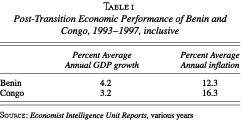
 You have
Access
- 6
- Cited by