Introduction
Given the increasing number of older adults and prolonged life expectancy, how to live longer and healthier is becoming a significant public issue among older adults. Rowe and Kahn (Reference Rowe and Kahn1997) posited that one of the crucial aspects of successful ageing is active engagement in life, such as having interpersonal relationships and participating in productive activities. Indeed, a recent literature review on social and leisure activities among older adults (Adams, Leibbrandt and Moon Reference Adams, Leibbrandt and Moon2011) showed a positive relationship between leisure activity engagement and physical and psycho-social wellbeing. Although types of activities differ across studies, findings have shown that engaging in leisure activities is associated with lower levels of depression (Glass et al. Reference Glass, De Leon, Bassuk and Berkman2006; Hong, Hasche and Bowland Reference Hong, Hasche and Bowland2009), fewer functional limitations (Janke, Payne and Van Puymbroeck Reference Janke, Payne and Van Puymbroeck2008), higher levels of life satisfaction (Fernández-Ballesteros, Zamarrón and Ruíz Reference Fernández-Ballesteros, Zamarrón and Ruíz2001) and better quality of life (Silverstein and Parker Reference Silverstein and Parker2002).
Nonetheless, leisure activity engagement in later life often becomes more complicated when older adults experience significant life transitions such as retirement and loss of a spouse (e.g. widowhood, divorce or separation). Two competing theories, activity and disengagement, have often been used in previous studies to explain the relationships between leisure activity engagement and life transitions in later life among older adults (Adams, Leibbrandt and Moon Reference Adams, Leibbrandt and Moon2011; Janke, Davey and Kleiber Reference Janke, Davey and Kleiber2006; Johnson and Mutchler Reference Johnson and Mutchler2014; Nimrod Reference Nimrod2007; Nimrod and Kleiber Reference Nimrod and Kleiber2007; Scherger, Nazroo and Higgs Reference Scherger, Nazroo and Higgs2011; Utz et al. Reference Utz, Carr, Nesse and Wortman2002). Activity theory posits that older individuals replace their lost roles by engaging in new compensatory activities (Havighurst Reference Havighurst1961), whereas disengagement theory posits that they withdraw from society or the environment in which they are involved (Cumming and Henry Reference Cumming and Henry1961), thus engaging less in leisure activities. Based on activity theory, retirement or loss of a spouse can offer an opportunity to replace a lost role with an increased level of leisure activity engagement. According to disengagement theory, on the other hand, retirement or loss of a spouse can represent a reduced opportunity to engage in leisure activities coupled with withdrawal from society and previous roles (as an employee or a spouse). However, none of these theoretical approaches is sufficient when it comes to exploring specific categories of retirement and marital status (e.g. working, completely or partly retired; married, divorced or separated, widowed, or never married).
In offering an explanation for leisure engagement in relation to marital and employment status, researchers have also considered the time availability perspective (Esteve, Martin and Lopez Reference Esteve, Martin and Lopez1999; Nomaguchi and Bianchi Reference Nomaguchi and Bianchi2004), which posits that time constraints related to holding many work and family responsibilities can be a barrier to engagement in leisure activities. Indeed, lack of time has often been considered one of the major challenges to leisure engagement (Crawford and Godbey Reference Crawford and Godbey1987; Hawkins et al. Reference Hawkins, Peng, Hsieh and Eklund1999). Employing the time availability perspective, Nomaguchi and Bianchi (Reference Nomaguchi and Bianchi2004) found that work and family roles were negatively related to physical activities. Specifically, longer working hours and being married (versus non-married) were related to less engagement in physical exercise.
Until now, no studies have focused explicitly both on various types of retirement and marital status as major study variables with one sample to examine leisure activity engagement among older adults. Previous studies have simply considered one category such as widowhood (Fitzpatrick et al. Reference Fitzpatrick, Spiro, Kressin, Greene and Bossé2001; Michael et al. Reference Michael, Crowther, Schmid and Allen2003; Okun et al. Reference Okun, Reynolds, Buysse, Monk, Mazumdar, Begley and Hall2011; Utz et al. Reference Utz, Carr, Nesse and Wortman2002) or compared retired versus non-retired or married versus unmarried individuals (Berger et al. Reference Berger, Der, Mutrie and Hannah2005; Janke, Davey and Kleiber Reference Janke, Davey and Kleiber2006; Nomaguchi and Bianchi Reference Nomaguchi and Bianchi2004). This may have overlooked significant variation among retired and unmarried individuals, considering the fact that heterogeneity exists in this group (Pinquart Reference Pinquart2003).
Moreover, findings have been equivocal in previous relevant studies. Some studies found that compared to working individuals, retirees participate more in physical (Evenson et al. Reference Evenson, Rosamond, Cai, Diez-Roux and Brancati2002; Godfrey et al. Reference Godfrey, Lord, Galna, Mathers, Burn and Rochester2014; Lahti et al. Reference Lahti, Laaksonen, Lahelma and Rahkonen2011) and informal social activities (Janke, Davey and Kleiber Reference Janke, Davey and Kleiber2006), whereas others found no change in physical or social activities after retirement (Rosenkoetter, Gams and Engdahl Reference Rosenkoetter, Gams and Engdahl2001). Similarly for marital status, some studies found that married individuals had higher levels of physical activity participation than their non-married counterparts (Pettee et al. Reference Pettee, Brach, Kriska, Boudreau, Richardson, Colbert, Satterfield, Visser, Harris, Ayonayon and Newman2006), whereas others found the opposite (Nomaguchi and Bianchi Reference Nomaguchi and Bianchi2004).
Likewise in some widowhood studies, widowed individuals were found to engage more in religious (Michael et al. Reference Michael, Crowther, Schmid and Allen2003) or informal social activities (e.g. visiting friends, neighbours or relatives; Utz et al. Reference Utz, Carr, Nesse and Wortman2002) than their married counterparts, whereas engagement in formal social activities (e.g. attending meetings of groups, clubs or organisations) was comparable between the two groups (Utz et al. Reference Utz, Carr, Nesse and Wortman2002). Other studies found that bereaved older individuals exercised less compared to their non-bereaved counterparts (Okun et al. Reference Okun, Reynolds, Buysse, Monk, Mazumdar, Begley and Hall2011), whereas Fitzpatrick et al. (Reference Fitzpatrick, Spiro, Kressin, Greene and Bossé2001) found no significant difference in leisure activity engagement between bereaved and married men (e.g. social, solitary, sports or exercise activities).
Several factors may explain these mixed findings, including having a limited or confined category of retirement or marital status and only considering certain types of leisure activities (Evenson et al. Reference Evenson, Rosamond, Cai, Diez-Roux and Brancati2002; Nomaguchi and Bianchi Reference Nomaguchi and Bianchi2004). Thus, it is unclear whether findings will be similar for a wide array of leisure activities in the same sample. Hence, it is necessary to explore more specific classifications of life transition and leisure activity type.
Moreover, gender cannot be overlooked when examining leisure activity engagement among older adults. Many relevant studies have conducted separate analyses for older men and women to assess the role of gender (Agahi and Parker Reference Agahi and Parker2005; Azevedo et al. Reference Azevedo, Araújo, Reichert, Siqueira, da Silva and Hallal2007; Mein et al. Reference Mein, Shipley, Hillsdon, Ellison and Marmot2005; Sayer Reference Sayer2005). Preferences for and motivation to engage in various types of leisure activities are not often comparable for men and women, due to not only the inherent nature of each gender but also expected gender roles based on societal norms. For example, research has shown that men are more physically active than women (Agahi and Parker Reference Agahi and Parker2005; Azevedo et al. Reference Azevedo, Araújo, Reichert, Siqueira, da Silva and Hallal2007; Mein et al. Reference Mein, Shipley, Hillsdon, Ellison and Marmot2005), whereas women engage more in religious activities (e.g. attending religious services, affiliating with a religion).
In sum, the present study investigated engagement in four types of leisure activity (mental, physical, social and religious activities) among older men and women in association with retirement and marital status in the United States of America (USA). We classified retirement status into three groups (working, completely retired and partly retired) and marital status into four groups (married, divorced or separated, widowed and never married). We used one wave (2011) from the Consumption and Activities Mail Survey (CAMS; 2011), a supplementary survey of the Health and Retirement Study (HRS; 2010), which provided a recent profile of older American men and women in relation to retirement and marital status. In comparison, previous relevant studies used non-US national data such as the English Longitudinal Study of Ageing (Scherger, Nazroo and Higgs Reference Scherger, Nazroo and Higgs2011) or Longitudinal Aging Study Amsterdam (Koeneman et al. Reference Koeneman, Chinapaw, Verheijden, van Tilburg, Visser, Deeg and Hopman-Rock2012), or earlier US data such as Survey of Midlife Development in the United States (Choi and Chou Reference Choi and Chou2010).
Two research questions are addressed for this study:
1. Does engagement in four types of leisure activity vary by retirement status among older American men and women?
2. Does engagement in four types of leisure activity vary by marital status among older American men and women?
Method
Data and sampling
This study used one wave from the CAMS 2011, which is a supplementary component of the HRS 2010. The HRS is an ongoing nationally representative longitudinal study of older adults aged 50 or older in the USA that uses a stratified, multi-stage area probability sample design with over-sampling for African Americans, Hispanics and Floridians. The data include a wide array of information on demographics, income, housing, family structure, employment, and mental and physical health of respondents. The original HRS data collection began in 1992 with follow-up interviews every two years (Juster and Suzman Reference Juster and Suzman1995). This study used RAND HRS data file version N, which is a cleaned version of HRS data with a key variable across waves, including imputations for income, assets and medical expenditures.
The CAMS is a random sub-sample of the HRS collected biennially in the years between core HRS interviews starting in 2001. It includes information about time spent on various activities, household patterns of consumption and prescription drug use (Hurd and Rohwedder Reference Hurd and Rohwedder2005). In 2001, a random sub-sample of 5,000 respondents (38.2% of all households interviewed in 2000) received the supplemental questionnaire. Data are now available through 2013 (Hurd and Rohwedder Reference Hurd and Rohwedder2007, Reference Hurd and Rohwedder2009).
For the current study, we used one wave from HRS 2010 matched with CAMS 2011. This is because CAMS 2011 has the largest sample size of all CAMS waves and features a new sub-sample of the middle baby-boomer cohort from HRS 2010. In 2011, 9,078 participants were randomly selected from the HRS 2010 core survey to receive the CAMS, and 6,531 questionnaires (simple response rate of 71.9%) were returned. Of these 6,531 individuals, 1,031 were excluded from the present study because the respondent (a) had not responded to both the RAND HRS and CAMS 2011 (N = 106); (b) was younger than 50 years old (N = 262); (c) had a proxy complete the interview (N = 179); (d) did not report retirement status (N = 66); (e) responded ‘irrelevant’ for retirement statistics items (N = 257); or (f) had a cognitive function score of less than 7 out of 27 (N = 161). The cut-off score of 7 is based on the previous literature, wherein individuals who scored below 7 on the same cognition measure were considered to have a severe cognitive impairment (e.g. dementia; Crimmins et al. Reference Crimmins, Kim, Langa and Weir2011). After taking into account the aforementioned exclusion criteria and cases with missing key variables (N = 95), the total sample for the current study was 5,405.
Dependent variables
The CAMS includes a broad array of social, productive, cognitive and physical activities, and the questionnaire was developed based on literature reviews, focus groups, cognitive interviews, expert panel consultation and a formal pretest (Hurd and Rohwedder Reference Hurd and Rohwedder2007). Respondents were asked to recall how much time they spent on each of these activities using a paper-and-pencil questionnaire (Hurd and Rohwedder Reference Hurd and Rohwedder2007). This kind of mode allows flexible time for respondents to recall information, whereas face-to-face or telephone interviews can limit the amount of time respondents have to retrieve answers (Hurd and Rohwedder Reference Hurd and Rohwedder2009).
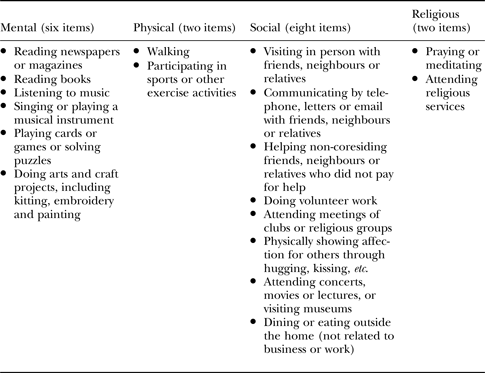
Eighteen items were used from CAMS data and were categorised into four domains: (a) mental (six items), (b) physical (two items), (c) social (eight items) and (d) religious (two items). This classification was based on the face validity and classification of previous relevant studies (Adams, Leibbrandt and Moon Reference Adams, Leibbrandt and Moon2011; Chang, Wray and Lin Reference Chang, Wray and Lin2014; Lachman et al. Reference Lachman, Agrigoroaei, Murphy and Tun2010; Paillard-Borg et al. Reference Paillard-Borg, Wang, Winblad and Fratiglioni2009; Parker Reference Parker1996). For example, the ‘attending concerts, movies, or lectures or visiting museums’ item was considered to refer to cultural activities (Paillard-Borg et al. Reference Paillard-Borg, Wang, Winblad and Fratiglioni2009) and therefore was included in the social domain in our study. In addition, the ‘physically showing affection for others through hugging, kissing’ item was considered to refer to social leisure activities because it involves pleasurable activities such as staying intimate with loved ones (Berdychevsky et al. Reference Berdychevsky, Nimrod, Kleiber and Gibson2013). The remaining items (e.g. sleeping or napping, personal grooming) were excluded from the present study because they did not fit into any of the four domains nor were considered leisure activities. Detailed items for each domain are presented in Table 1.
Sub-domains of leisure activities in the 2011 Consumption and Activities Mail Survey (18 items)

Original CAMS questions asked participants how many hours were spent on these activities during the previous week or month; activities considered to be less frequent among older adults were asked in reference to the previous month, such as ‘attending religious services’. For the present study (due to the highly skewed nature of these items), we dichotomised each item coded as 0 = no time spent on the specific activity and 1 = any time spent on the activity, regardless of whether the question referred to the previous month or week. Scores for these items were summed for each domain of leisure activities (mental: 0–6; physical: 0–2; social: 0–8; religious: 0–2). Higher scores indicated more engagement in each leisure activity domain.
Independent variables
To assess self-reported retirement status, respondents were asked, ‘At this time do you consider yourself to be completely retired, partly retired or not retired at all?’ Three groups were identified in this study, coded categorically as non-retired (reference group), completely retired and partly retired. Marital status was assessed through self-report by asking, ‘Are you currently married, living with a partner, separated, divorced, widowed or never been married?’ Four groups were identified in this study, coded categorically as married (reference group), divorced or separated, widowed and never married.
Control variables
Three health-related factors – self-rated health, cognitive function and depressive symptoms – were included in this study as control variables because previous studies have shown that activity involvement is significantly associated with health among older adults (Freysinger and Stanley Reference Freysinger and Stanley1995).
Respondents’ self-reported perceived health status was measured by one item with a five-point scale: ‘Would you say your health is excellent, very good, good, fair or poor?’ Higher scores indicated worse self-rated health.
Three domains of cognitive function were included in the present study: (a) memory, (b) working memory and (c) processing speed. For memory, both immediate and delayed word recall were measured. Working memory was measured by a serial sevens test, whereas processing speed was assessed via a backwards counting test (Fisher et al. Reference Fisher, Hassan, Rodgers and Weir2013). The combined score of the three domains was calculated, with a theoretical range of 7 to 27. Higher scores indicated better cognitive function. As previously mentioned, individuals who had a cognitive score less than 7 were considered cognitively impaired and thus excluded from the present study.
Depressive symptoms were measured with a modified eight-item scale based on the Center for Epidemiologic Studies Depression Scale. The measure asked whether respondents felt (a) depressed, (b) that everything was an effort, (c) their sleep was restless, (d) they could not get things going, (e) lonely, (f) they enjoyed life (reverse coded), (g) sad and (h) happy (reverse coded) much of the time during the previous week. Higher scores indicated more depressive symptoms (theoretical range = 0–8). Several demographic factors were also included in the analysis: age (years); gender (0 = male, 1 = female); race and ethnicity (coded categorically as non-Hispanic White (referent), non-Hispanic Black, Hispanic and other); education (years of formal education); and household income (first (referent) second, third and fourth quartiles).
Data analysis
First, bivariate analyses were conducted to explore characteristics for the total sample. To investigate any significant gender differences regarding these characteristics, t-tests for continuous variables and chi-square tests for categorical variables were conducted. Second, we conducted multiple regression analyses for each dependent variable (mental, physical, social and religious activities) to investigate the relationships among retirement status, marital status and leisure activity engagement among older men and women. Each dependent variable was analysed separately for older men and women, controlling for the aforementioned covariates. All analyses were conducted using Stata software (version 13.0). During our main analyses, we found no multicollinearity issues; each analysis had a variance inflation factor less than 3.
Results
Descriptive statistics
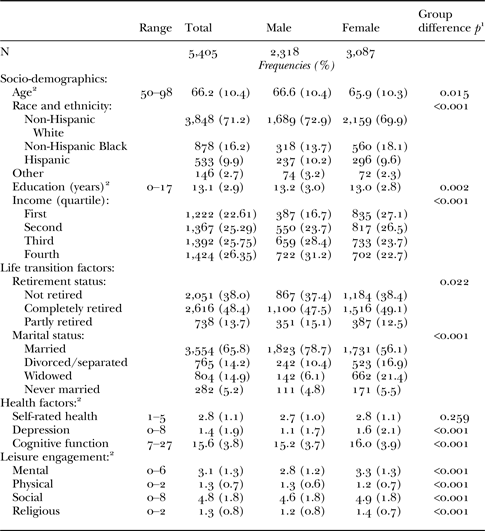
Descriptive statistics for the study sample are presented in Table 2. The majority of our sample (N = 5,405) was non-Hispanic White (71.2%), retired (62.1%; completely retired: 48.4%, partly retired: 13.7%) and married (65.8%). The mean age (range = 50–98) of the participants was 66.2 (standard deviation (SD) = 10.4) and respondents had an average of 13.1 (SD = 2.9) years of education. In terms of health-related factors, the mean score was 2.8 (SD = 1.1) for self-rated health, 1.4 (SD = 1.9) for depressive symptoms and 15.6 (SD = 3.8) for cognitive function. Regarding leisure activity engagement, the average score was 3.1 (SD = 1.3) for mental activities, 1.3 (SD = 0.7) for physical activities, 4.8 (SD = 1.8) for social activities and 1.3 (SD = 0.8) for religious activities.
Description of sample characteristics

Notes: 1. t-Test for age, education, self-rated health, depressive symptoms, cognitive function, mental, physical, social, religious leisure activities, and χ2 test for race and ethnicity, household income (quartile), retirement status and marital status. 2. Values represent mean (standard deviation).
Significant gender differences were found among all study variables except self-rated health. Specifically, male participants were significantly older and more likely to be non-Hispanic White, have more years of education and to be in a higher household income quartile. Moreover, older men were more likely to be married and less likely to be retired than their female counterparts. Regarding health-related factors, older women had higher depressive symptoms, but better cognitive function compared to older men. In terms of leisure activity engagement, older women were more likely to engage in mental, social and religious activities, but less likely to engage in physical activities compared to older men.
Regression results
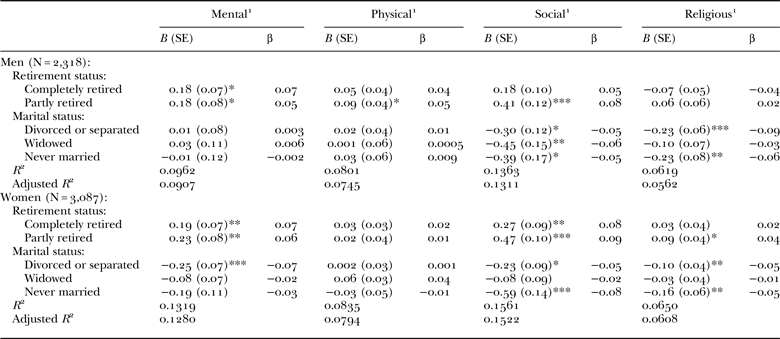
Table 3 shows the results of multiple regression analyses of four domains (mental, physical, social and religious) of leisure activity engagement in relation to retirement and marital statuses. Each domain of leisure activities was regressed, controlling for age, race and ethnicity, education, household income (quartile), self-rated health, depressive symptoms and cognitive function. The reference category for retirement status was working individuals, who were compared with (a) completely retired and (b) partly retired groups. The reference category of marital status was married individuals, who were compared with (a) divorced or separated, (b) widowed and (c) never married groups. Separate analyses were conducted by gender. Adjusted R 2 values for each domain of activities were as follows for men and women, respectively: mental (0.0907 and 0.1280), physical (0.0745 and 0.0794), social (0.1311 and 0.1522) and religious (0.0562 and 0.0608).
Multiple regression analyses of retirement, marital status and leisure activity engagement

Notes: N = 5,405. 1. Dependent variables (number of activities engaged in in each domain of leisure). Due to the small number of items (two items) for physical and religious activities, ordered logistic regression analyses were also conducted and the results were comparable to multiple regression analyses in terms of direction and significance (results available upon request). All analyses controlled for age, race and ethnicity, education, household income (quartile), self-rated health, depressive symptoms and cognitive function. Reference categories were working for retirement status and married for marital status. SE: standard error.
Significance levels: * p < 0.05, ** p < 0.01, *** p < 0.001.
In terms of retirement status, older men who were completely retired engaged more in mental (β = 0.07, p < 0.05) activities than their working counterparts. Older men who were partly retired engaged more in mental (β = 0.05, p < 0.05), physical (β = 0.05, p < 0.05) and social activities (β = 0.08, p < 0.001) compared to their working counterparts. Among older women, those who were completely retired engaged more in mental (β = 0.07, p < 0.01) and social (β = 0.08, p < 0.01) activities compared to working individuals. Older women who were partly retired engaged more than their employed counterparts in mental (β = 0.06, p < 0.01), social (β = 0.09, p < 0.001) and religious (β = 0.04, p < 0.05) activities.
Regarding marital status, older men who were divorced or separated engaged less in social (β = −0.05, p < 0.05) and religious (β = −0.09, p < 0.001) activities compared to their married counterparts. Second, older men who were widowed engaged less in social activities (β = −0.06, p < 0.01). Lastly, older men who were never married engaged less in social (β = −0.05, p < 0.05) and religious (β = −0.06, p < 0.01) activities compared to their married counterparts.
Among older women, those who were divorced or separated engaged less in mental (β = −0.07, p < 0.001), social (β = −0.05, p < 0.05) and religious (β = −0.05, p < 0.01) activities than married individuals. Second, older women who were widowed showed no significant difference across any domains of leisure activities. Lastly, older women who were never married engaged less in social (β = −0.08, p < 0.001) and religious (β = −0.05, p < 0.01) activities than their married counterparts.
Discussion
This study investigated the relationship between leisure activity engagement and different retirement and marital statuses among older American men and women using national US data from the CAMS, a supplementary sample of the HRS. This study contributed to expanding the understanding of leisure activity engagement by specifically considering various groups for both retirement (working, completely retired or partly retired) and marital (married, divorced or separated, widowed or never married) statuses, which can be considered crucial life transitions among older adults in later life.
Retirement status
Our first research question involved how leisure activity engagement varies across different retirement statuses. The overall relationship showed that being retired was positively related to leisure activity engagement. Specifically, participants who were completely or partly retired engaged more in leisure activities compared to working individuals. This finding can be linked to the time availability perspective (Crawford and Godbey Reference Crawford and Godbey1987; Esteve, Martin and Lopez Reference Esteve, Martin and Lopez1999; Hawkins et al. Reference Hawkins, Peng, Hsieh and Eklund1999), which posits that retirees have more disposable time than working individuals and thus engage more in leisure activities. Activity theory (Havighurst Reference Havighurst1961) can also be supported in the sense that the loss of a work role might prompt retirees to compensate by engaging in more leisure activities.
However, when compared to the working group, partly retired individuals engaged in more domains of leisure activities relative to completely retired persons. Older men who had completely retired engaged more in one domain (mental) of leisure activities than working individuals. On the other hand, older men who had partly retired engaged more in three domains (mental, physical and social) of leisure activities than working individuals. We found a similar trend among older women. Participants who had completely retired engaged more in mental and social activities, whereas those who were partly retired engaged more in mental, social and religious activities compared to working individuals.
Such results can be less explained by the time availability perspective if we assume completely retired individuals to have more disposable time than partially retired individuals. Partly retired individuals in this study can be considered to be transitioning from employment to complete retirement in the form of a part-time job, self-employment or temporary employment (Doeringer Reference Doeringer and Doeringer1990). This is often referred to as a bridge job, which is defined as ‘transitional jobs that bridge the period between the end of career employment and ultimate withdrawal from the labor force’ (Ruhm Reference Ruhm1990: 483). More recent attention has been drawn to this population because an increasing number of older adults are choosing to stay in bridge jobs instead of full retirement (Shultz Reference Shultz, Adams and Beehr2003). Thus, partly retired individuals might have greater resources and networks as members of the bridged labour force (e.g. social activities with co-workers) than completely retired individuals, and therefore engage in more leisure activities. In addition, better health may have enabled them, both physically and mentally, to participate in more domains of leisure activities. Indeed, self-rated health status was significantly better among partly retired individuals when compared to completely retired individuals (p < 0.001, results not shown) in our sample. Zhan et al. (Reference Zhan, Wang, Liu and Shultz2009) also found that compared to full retirees, individuals in bridge employment have fewer major diseases and functional limitations.
Moreover, considering the fact that our study examined the number of activities involved instead of time spent engaged in each domain of activities, how individuals increase or decrease their range of activities following life transitions can be another explanation for such results. Indeed, selective optimisation with compensation theory (Baltes and Baltes Reference Baltes, Baltes, Baltes and Baltes1990) posits that as individuals get older, they tend to focus more on certain activities while ceasing or reducing other activities in which they can no longer engage due to limitations in health (Nimrod and Adoni Reference Nimrod and Adoni2006).
In this respect, our finding that partly retired individuals engaged in more leisure domains (versus the working group) when compared to completely retired individuals (versus the working group) might be explained by the argument that the completely retired group focused on a decreased range of leisure activities, whereas partly retired individuals still remained engaged in a broader number of leisure domains. This speculation will be supported by examining time spent in each domain of activities to capture the overall picture of leisure activity patterns.
Marital status
Our second research question focused on how leisure activity engagement varies across different marital statuses. The overall relationship showed that relative to married status, being divorced or separated, widowed, or never married was negatively related to leisure activity engagement.
First, divorced or separated older men engage less in social and religious activities compared to their married counterparts. Similarly, divorced or separated older women engaged less in mental, social and religious activities than married individuals. Such findings suggest that separation or divorce status may constrain engagement in social or religious activities for both older men and women. For a majority of older adults, social networks are mainly composed of close ties with family members and friends (Fiori, Smith and Antonucci Reference Fiori, Smith and Antonucci2007). But absence of a spouse after divorce or separation may provide a smaller social network for this population when compared to married counterparts, who can still share their spouse's social circle. Reduced social network after divorce or separation may entail decreased engagement in both social and religious activities. Moreover, Exline, Yali and Sanderson (Reference Exline, Yali and Sanderson2000) posited that individuals may experience feelings of guilt after divorce that might result in religious strain (e.g. difficulty trusting God, feeling abandoned by God). This may in turn, at least for a certain period, discourage engagement in religious activities in this population.
Similar results for both religious and social activities in this study may be due to the close relationship between the two activities (Taylor and Chatters Reference Taylor and Chatters1988). For example, individuals may form a social relationship with members from their religious organisations (e.g. social gathering with church members). Previous studies have shown the positive role of social support on leisure activities (Orsega-Smith et al. Reference Orsega-Smith, Payne, Mowen, Ho and Godbey2007), and future studies that include social support or social network variables will enable a better understanding of how enriched social networks play a role in leisure activity engagement among older adults.
With regard to gender differences, divorced or separated women engaged less in mental, social and religious domains than their married counterparts, whereas divorced or separated men engaged less only in the social domain. This difference might be explained by the supposition that women are more emotionally disrupted by divorce or separation than their male counterparts. Indeed, Iwasaki and Smale (Reference Iwasaki and Smale1998: 47) argued that ‘the lack of a partner as a result of divorce or separation makes women feel the loss of a former shared leisure style’. This suggests that women may be more influenced by the absence of a previous leisure partner, which may significantly reduce their engagement in leisure activities. There may be financial reasons as well. Older women may experience more financial strain than older men after divorce or separation (Day and Bahr Reference Day and Bahr1986), considering the fact that men were often the breadwinner in this cohort. Thus, older women may struggle more financially than older men after divorce or separation when it comes to affording multiple leisure activities.
Such gender differences were most noteworthy when comparing widowed individuals with married counterparts in our study. Widowers engaged less in social activities compared to their married counterparts, but not widows. In the previous studies, widowers have been found to receive less emotional support from their adult children after widowhood compared to widows (Kaufman and Uhlenberg Reference Kaufman and Uhlenberg1998). This may indicate insufficient social support from close ties among widowers, thus reduced engagement in social activities. On the other hand, widows were more likely to engage in physical activities than married individuals. This is similar to a recent systematic review (Engberg et al. Reference Engberg, Alen, Kukkonen-Harjula, Peltonen, Tikkanen and Pekkarinen2012), which found that as the duration of their widowhood increased, older women increased their engagement in physical activities.
Nonetheless, our study did not account for the duration of widowhood, so how this result may change after controlling for widowhood duration remains to be answered in future studies. In a similar respect, the lack of a significant relationship between widowhood status and religious activity engagement in our study may also be related to not including duration as a covariate. Brown et al. (Reference Brown, Nesse, House and Utz2004) found that increased engagement in religious activities (e.g. religious beliefs and behaviours) among widowed individuals only lasted for a short term, which suggests that longer-term widowhood effects should also be explored.
Lastly, older men and women who never married engaged less in social and religious activities. This is very similar to the aforementioned findings related to divorced or separated and widowed individuals when compared to their married counterparts. Often, individuals who never married do not seem to face as much stress and change (Goldman, Korenman and Weinstein Reference Goldman, Korenman and Weinstein1995) as those who experienced divorce, separation or widowhood, which are obvious transitions from the presence to absence of a spouse (either by choice or not). However, our study suggests that not having a spouse can also generate a cumulative disadvantage among single older adults, which may eventually result in a less active lifestyle than married groups. To our knowledge, no study has specifically focused on leisure activity engagement among individuals who never married, making it difficult to interpret our results. Considering the increasing number of single older adults, studies focused on never-married individuals are needed.
In terms of control variables, individuals with higher education, in higher household income quartiles, with better self-rated health, with higher cognitive function and with lower levels of depressive symptoms showed more engagement in each domain of leisure activities overall (results not shown but available upon request).
Limitations
There are several limitations of this study. First, due to the nature of cross-sectional analysis, causality cannot be established between retirement or marital status and leisure activity engagement among older American men and women. The purpose of the current study was to first explore leisure activity profiles among older Americans with the largest sample available, so we limited our sample to one wave from the available data. However, to determine whether retirement or marital status increased or decreased the level of engagement in leisure activities over time, future studies using several waves of both HRS and CAMS data will be necessary to address this limitation. Second, other covariates such as occupation type or duration of retirement or widowhood may provide more insight into study results. Types of occupation in earlier life might be related to more engagement in certain domains of leisure activities in later life. In addition, assessing the duration of retirement or widowhood might elucidate how these life transitions affect leisure activity engagement in the long term. Also, retirement status was a self-reported measure in the present study, which may be a weakness as stated by Gustman and Steinmeier (Reference Gustman and Steinmeier2000: 59) regarding the definition of retirement: ‘People have different internal standards for what divides nonretirement from partial retirement, so that two people may report different retirement states when filing the same job’. Moreover, a valid scale for categorisation of leisure activities is needed to compare results across relevant studies in this field. The current classification was based on the previous literature, but an improved measure with greater consensus will be requisite in future studies to replicate results (e.g. distinguishing between leisure-time and free-time activities). Finally, the present study only focused on the number of leisure activities in which older adults engaged during the prior month or week in each domain, but not the actual time spent on these activities. Thus, it was not possible to interpret the results in terms of frequency or duration of activity engagement. Future studies examining both number and time spent on these leisure domains (e.g. comparing individuals who engage in fewer leisure activities but for more time versus those who engage in more leisure activities for less time) might better explain leisure patterns in this population that experienced significant life transitions in later life.
Implications and conclusion
This study contributed to a better understanding of leisure activity engagement related to retirement and marital status among older American men and women. Our results validate that wide variation exists among retirees and non-married individuals compared to their employed and married counterparts. Nonetheless, the overall trend of a positive relationship between retirement and leisure activity engagement shows that retirement provides a chance for older adults to participate in different types of activities after withdrawal from the labour force. This study supported both activity theory and the time availability perspective. Although these theories focus on the wellbeing of older adults rather than engagement in leisure activities per se, we consider leisure activity engagement to be a bridge to healthy and successful ageing. However, more types of leisure activity engagement among partly retired individuals than completely retired individuals (relative to working participants) suggest that there is a further explanation beyond these two theoretical frameworks. Maintaining a social network via a bridge job may provide a greater opportunity for social activity engagement. Moreover, partial retirement can also provide greater financial resources, with some amount of income still available, that enable engagement in some leisure activities compared to complete retirement. In this respect, how social ties and economic resources affect leisure activity engagement should be explored in future studies to advance these theories.
On the other hand, the overall trend of a negative relationship between non-married status (e.g. divorced or separated, widowed, never married) and leisure activity engagement suggests that the loss or absence of a spouse may become a barrier to an active lifestyle, which partially supports disengagement theory. Nonetheless, significant variation existed in the non-married group beyond this general trend. This implies that challenges and barriers to leisure activity engagement may vary in this group, indicating the need for more comparative studies with this population. Instead of simply comparing this group with married individuals, further comparisons between divorced or separated and widowed individuals or between widowed and never-married individuals will lead to better understanding of leisure activity profiles among non-married older adults. Taking into account that adult children, friends and relatives can become significant sources of social support for non-married individuals in later life, how to combine close social networks and coping strategies after significant life transitions (e.g. divorce, widowhood) with existing activity-related theories should be contemplated. Future studies are needed to explore the mechanism between these life transitions and leisure activity engagement to identify protective or risk factors for an active lifestyle in later life. Such study findings will inform strategies to encourage more leisure activity engagement, which will ultimately yield better health outcomes and improved wellbeing in this population.