





Introduction
Work-related stress among nurses has been widely studied; however, death – one of its most significant sources – has received comparatively limited attention (Yilmaz and Vermisli Reference Yilmaz and Vermisli2015; Rana et al. Reference Rana, Tambag and Ozturk2020). Nurses’ relationships with patients are inherently shaped by life and death experiences (Alıcılar et al. Reference Alicilar, Aylaz and Gunes2021), and repeated exposure to patient loss may involve disrupted relationships, identification with patients, reactivation of personal grief, and loss of professional expectations (Wisekal Reference Wisekal2015; Chen and Chow Reference Chen and Chow2021). These experiences may also evoke deep emotional responses, including identification with bereaved families (Chen et al. Reference Chen, Chow and Tang2019). These reactions are conceptualized as professional bereavement, referring to the grief experienced by healthcare professionals following patient death (Broden and Uveges Reference Broden and Uveges2018; Du et al. Reference Du, Chen and Yang2020). Although introduced in 1994 (Saunders and Valente Reference Saunders and Valente1994), the concept remains insufficiently recognized (Shanfield Reference Shanfield1981). Nurses often struggle to identify and express these emotions (Brosche Reference Brosche2007; Aqtam and Shouli Reference Aqtam and Shouli2026), and professional bereavement is frequently considered disenfranchised grief (Doka Reference Doka2009). In settings where nurses simultaneously face patient death, systemic violence, and institutional neglect, the emotional burden of professional bereavement is compounded by moral distress, a pattern that may generalize to other high-mortality contexts (Aqtam and Shouli Reference Aqtam and Shouli2026). This lack of recognition may hinder help-seeking, impair coping, and obstruct meaning-making (Andersson et al. Reference Andersson, Salickiene and Rosengren2016; Zheng et al. Reference Zheng, Lee and Bloomer2016; Chen et al. Reference Chen, Chow and Tang2019). Although professional bereavement has been conceptualized as an individual psychological response, recent evidence from high-mortality settings suggests that cumulative patient loss – when unsupported by institutional policies – functions as a chronic occupational stressor rather than an acute event (Batran et al. Reference Batran, Aqtam and Ayed2025; Aqtam and Shouli Reference Aqtam and Shouli2026). This distinction between short-term reactions and long-term cumulative changes has critical implications for how healthcare organizations design bereavement support. This study therefore examines both dimensions of professional bereavement and their differential effects on compassion satisfaction, burnout, and compassion fatigue.
Professional bereavement manifests through physical, psychological, and social symptoms, including crying, denial, preoccupation with death, fatigue, and sleep disturbances (Barnes et al. Reference Barnes, Jordan and Broom2020), as well as anxiety, sadness, anger, guilt, and emotional numbing (Betriana and Kongsuwan Reference Betriana and Kongsuwan2020). It may also lead to social withdrawal and isolation (Chen et al. Reference Chen, Chow and Xu2021). Given the nature of nursing, where close patient relationships and repeated exposure to death are common, these experiences may be intense and recurrent, potentially resulting in unresolved grief (Adwan Reference Adwan2014).
Although prior research has addressed death exposure, end-of-life care, and death anxiety (Anderson et al. Reference Anderson, Kent and Owens2015; Chen et al. Reference Chen, Chow and Tang2019), studies focusing specifically on healthcare professionals’ bereavement remain limited. For many years, nurses’ grief was considered comparable to familial grief (Faschingbauer et al. Reference Faschingbauer, Zisook, DeVaul, Stroebe, Stroebe and Hansson1987; Hogan et al. Reference Hogan, Greenfield and Schmidt2001; Anderson et al. Reference Anderson, Ewen and Miles2010; Pereira et al. Reference Pereira, Ferreira and Abrantes2020; Chen and Chow Reference Chen and Chow2021; Evren et al. Reference Evren, Evren and Dalbudak2021; Eryuksel and Atli Ozbas Reference Eryuksel and Atli Ozbas2023), yet recent evidence suggests that professional bereavement may differ significantly (Wisekal Reference Wisekal2015; Chen et al. Reference Chen, Chow and Tang2019).
This difference is partly due to nurses’ conflicting roles, as they are expected to provide support while managing their own emotional responses to patient loss (Du et al. Reference Du, Chen and Yang2020). As a result, many adopt avoidance or suppression strategies, which may contribute to burnout and adverse physical and emotional outcomes (Gerow et al. Reference Gerow, Conejo and Alonzo2010).
Cross-cultural studies indicate that professional bereavement is more openly expressed and supported institutionally in Western societies, whereas in Eastern cultures it is more often suppressed and normalized within professional roles (Betriana and Kongsuwan Reference Betriana and Kongsuwan2019; Agyei et al. Reference Agyei, Nti and Anago2022; Esplen et al. Reference Esplen, Wong and Vachon2022; Eryuksel and Atli Ozbas Reference Eryuksel and Atli Ozbas2023). Across cultures, difficulties in coping with professional bereavement have been associated with burnout, compassion fatigue, and reduced job satisfaction (Phillips et al. Reference Phillips, Trainum and Thomas Hebdon2025). As a culturally shaped phenomenon, grief may influence both healthcare delivery and professional quality of life, underscoring the need to examine professional bereavement within different cultural and healthcare contexts.
Evidence further suggests that repeated exposure to death may adversely affect nurses’ professional quality of life (Samson and Shvartzman Reference Samson and Shvartzman2018; Harding et al. Reference Harding, Ishibashi and Mori2020; Dwyer et al. Reference Dwyer, Alt and Brooks2021). Accordingly, examining the relationship between professional bereavement, professional quality of life, and sociodemographic factors is essential to identify at-risk groups and inform interventions aimed at supporting nurses’ well-being (Hegney et al. Reference Hegney, Rees and Eley2015; Yilmaz et al. Reference Yilmaz, Ustun and Gunusen2018). This study aimed to examine the relationship between professional bereavement, professional quality of life, and sociodemographic factors among nurses.
This study aims to answer the following research questions:
1. What is the level of professional bereavement experienced by the participants?
2. Do participants’ professional bereavement experiences differ significantly according to their sociodemographic characteristics?
3. What is the relationship between participants’ experiences of professional bereavement and their professional quality of life?
Methods
The study was designed as descriptive research employing a correlational model. A convenience sampling method was used, whereby all nurses meeting inclusion criteria in the 3 participating hospitals were invited to participate via an online survey link distributed through institutional email and WhatsApp groups. The study sample consisted of nurses who voluntarily agreed to participate and were actively involved in direct one-to-one patient care in inpatient clinical settings. Establishing a one-to-one professional relationship with the patient was determined as a prerequisite inclusion criterion; therefore, nurse managers, nurses working in outpatient diagnosis and treatment units, and those with less than 6 months of professional experience were excluded from the study. Nurse managers and outpatient nurses were excluded because the Professional Bereavement Scale (PBS) assumes a direct, sustained therapeutic relationship with patients who may die – a condition less frequently met in managerial or ambulatory roles.
The research was conducted in 3 major hospitals located in Ankara, the capital of Türkiye, where institutional approval was granted. The researcher visited the respective institutions and provided detailed information to potential participants regarding the study. To ensure confidentiality and enhance participant comfort during the response process, the online survey link was shared individually with eligible nurses. Data collection in the research was completed between January 16 and June 16, 2022.
Sample size
The sample size was determined using the PASS 11 (Power Analysis and Sample Size) software. Since the aim of the study was to examine the relationship between variables, the “One Correlation Power Analysis” option was employed. In the calculation, the significance level (α) was set at 0.05, statistical power (1 − β) at 0.80, the correlation coefficient under the null hypothesis (R₀) at 0.30, and the correlation coefficient under the alternative hypothesis (R₁) at 0.50. Based on these parameters, the expected effect size was 0.20 (Baltosser Reference Baltosser1996). According to the PASS 11 output, the minimum sample size required to achieve 80% power with these parameters was calculated as 139 participants. However, considering the possibility of missing data and participant exclusions, a larger sample was targeted. Consequently, a total of 176 nurses were included in the study.
Datas
The study employed several data collection instruments, including the Socio-Demographic Data Form, the PBS and the Professional Quality of Life Scale (ProQOL). The Socio-Demographic Data Form, as informed by previous literature (MacDermott and Keenan Reference MacDermott and Keenan2014; Chen and Chow Reference Chen and Chow2021; Chen et al. Reference Chen, Chow and Xu2021), was designed to capture essential socio-demographic characteristics of the participants. These characteristics encompassed age, gender, marital status, educational attainment, and professional attributes like the specific patient group under care, clinic department, and years of experience in the nursing profession.
Professional Bereavement Scale
PBS was utilized to evaluate the grief experiences of healthcare professionals. This scale, developed by Chen and Chow (Reference Chen and Chow2021), comprises 2 dimensions: the “Short-term Bereavement Reactions Sub-Scale (PBS-SBR)” and the “Accumulated Global Changes Sub-Scale (PBS-AGC)”. While PBS-SBR measures the health worker’s acute reactions to patient loss, PBS-AGC measures the long-term effects of patient loss on the health worker. Both subscales employ a 5-point Likert-type scoring system, with the PBS-SBR consisting of 17 items and the PBS-AGC consisting of 15 items. Each item in the PBS-SBR subscale is scored from 0 to 4, with “0” indicating that the behavior described is experienced as insignificant and “4” indicating that it is experienced as extremely severe. Four factors, namely, frustration and trauma, guilt, grief, and being moved, are involved in PBS-SBR. Each item in the PBS-AGC subscale is scored from 0 to 4, with “0” indicating that the described behavior is not experienced and “4” indicating that it is experienced very much. Five factors are involved in PBS-AGC, which are new insights, more acceptance of limitations, more death-related anxiety, less influenced by patient deaths, and better coping with patient deaths. There are no predefined cutoff points for either subscale. Higher scores on the scale indicate a higher intensity of experiences as described by the participant. The adaptation of the scale to the Turkish language and culture was carried out by Eryuksel and Atli Ozbas (Reference Eryuksel and Atli Ozbas2023), who reported a Cronbach’s alpha value of 0.86 for the PBS-SBR and 0.89 for the PBS-AGC subscale. In the present study, the Cronbach’s alpha coefficient was 0.90 for the PBS-SBR and 0.92 for the PBS-AGC. For the subdimensions of the PBS-SBR, Cronbach’s alpha coefficients for Guilt, Grief, and Trauma were 0.91, 0.84, and 0.80, respectively. For the PBS-AGC, Cronbach’s alpha values for New Insights, Greater Acceptance of Limitations, Increased Death-related Anxiety, Reduced Emotional Impact of Patient Deaths, and Improved Coping with Patient Deaths were 0.81, 0.90, 0.73, 0.94, and 0.89, respectively. The Turkish language adaptation of the PBS (PBS-TR), validated by Eryuksel and Atli Ozbas (Reference Eryuksel and Atli Ozbas2023), was used in this study. The PBS-TR maintains the original 2-factor structure: Short-term Bereavement Reactions and Accumulated Global Changes.
Professional Quality of Life Scale (ProQOL-R-IV)
The ProQOL, Revision IV (ProQOL-R-IV), developed by Stamm (Reference Stamm2010), was designed to assess symptoms related to compassion satisfaction, compassion fatigue, and burnout. The ProQOL-R-IV comprises 3 subdimensions: “compassion satisfaction,” “burnout,” and “compassion fatigue.” In scoring the scale, it is noteworthy that items 1, 4, 15, 17, and 29 are reverse-scored. ProQOL subscale scores were calculated as raw sums per the developer’s manual (Stamm Reference Stamm2010), with higher scores indicating greater compassion satisfaction, burnout, or compassion fatigue, respectively. No cutoff scores were applied, consistent with the scale’s descriptive use. Yesil et al. (Reference Yesil, Ergun and Amasyali2010) adapted this scale to the Turkish language and culture, and it does not feature a predefined cutoff point. In a previous study by Yesil et al., the Cronbach’s alpha value for the scale was reported as 0.83, and in the present study, it was also found to be 0.83. The Cronbach’s alpha coefficients for the subscales of Compassion Satisfaction, Burnout, and Compassion Fatigue were 0.92, 0.73, and 0.88, respectively.
Implementation of the research
The nursing services directorates and clinical nurses of the hospitals that permitted the study were contacted, and they were asked to share the study link only with the e-mail addresses of the nurses working in the clinic or with the clinic WhatsApp groups. Data were collected on the online platform in both stages of the study. Data collection tools were transferred to Google Forms. Nurses who volunteered to participate in the study reached the survey by clicking on the link via their smartphones or computers. The informed consent form for the study was included on the first page, and nurses who clicked on the “I agree to participate in the study” button at the bottom of the form accessed the survey questions.
Analysis
The data analysis for this study utilized IBM SPSS (Statistical Package for Social Sciences) Version 23.0. To assess the normal distribution of the data, Kolmogorov–Smirnov and Skewness–Kurtosis tests were employed, confirming that the sample followed a normal distribution pattern. In terms of statistical significance, a threshold of p < 0.05 was adopted. The Levene test was applied to assess the homogeneity of variances, aiding in selecting the appropriate t/F values for comparisons. Pearson Correlation analysis was utilized to explore relationships between continuous variables, while multiple linear regression analysis was employed to assess the predictive role of occupational grief in relation to quality of life. Prior to regression analysis, assumptions of normality (Kolmogorov–Smirnov, skewness–kurtosis < |2|), linearity (scatterplots), homoscedasticity (standardized residual plots), and independence of errors (Durbin–Watson statistic = 1.89–2.11) were tested and met.
Findings
The findings of the study, which was conducted to determine the status of nurses experiencing professional bereavement, the relationship between professional bereavement and professional quality of life, and sociodemographic factors, are presented in a way and order to answer the research questions. Demographics and professional profiles are shown in Table 1.
Overview of participant demographics and professional profiles

Table 1 Long description
Participant demographics and professional characteristics are summarized for 176 respondents, reporting counts and percentages for each category. Most participants were aged 19 to 35 (120, 68.1%), and the average age was about 30 years with a spread of about 6.6 years. Gender was predominantly female (157, 89.2%) with 18 males (10.2%). Marital status was fairly balanced, with 93 single (52.8%) and 83 married (47.2%). Education was mainly bachelor’s level (157, 89.2%), with 19 holding postgraduate degrees (10.8%). For years in the profession, 0 to 5 years was most common (106, 60.3%); the average time in the profession was about 9.4 years with a wide spread of about 9.2 years. Work settings were led by internal medicine (56, 31.8%) and intensive care (49, 27.9%), followed by surgical (28, 15.9%), pediatrics (18, 10.2%), oncology (16, 9.1%), and emergency (9, 5.1%). Childhood loss was reported by 74 (42.0%) and not reported by 102 (58.0%). Feeling competent in caring for terminally ill patients was reported as yes by 86 (48.9%), partly by 66 (37.5%), and no by 24 (13.6%); percentages may not sum perfectly due to rounding or reporting.
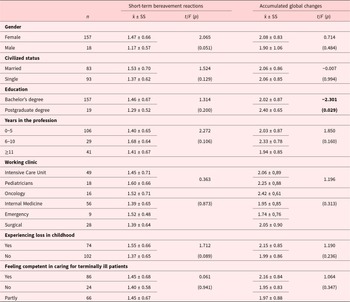
An examination of the participants’ descriptive characteristics revealed that more than half of the nurses (68.1%) were between 19 and 35 years of age, and the majority (89.2%) were female. The duration of employment in their current clinical unit ranged between 0 and 5 years. Additionally, 48.9% of the nurses reported feeling competent in providing care for patients with terminal illnesses. Distribution of the PBS-SBR and PBS-AGC subscale scores according to the descriptive characteristics of the participants is shown in Table 2.
Distribution of the PBS-SBR and PBS-AGC subscale scores according to the descriptive characteristics of the participants

Table 2 Long description
Participant subgroups are compared on two outcomes: short-term bereavement reactions and accumulated global changes, reported as mean with standard deviation alongside group test results and p values. For accumulated global changes, education is the only characteristic with a statistically significant difference: postgraduates average about 2.40 (standard deviation about 0.65) versus about 2.02 (standard deviation about 0.87) for bachelor’s degree holders, with p about 0.029. Gender differences are small and not significant: females average about 1.47 for short-term reactions and 2.08 for accumulated changes, while males average about 1.17 and 1.90, with p values about 0.051 and 0.484. Marital status shows nearly identical accumulated global changes means (both about 2.06) and a modest, non-significant difference in short-term reactions (married about 1.53 versus single about 1.37). Years in the profession vary in short-term reactions (highest in 6 to 10 years at about 1.68) and accumulated changes (highest in 6 to 10 years at about 2.33), but the overall tests are not significant. Working clinic means range roughly from 1.39 to 1.60 for short-term reactions and from about 1.74 to 2.42 for accumulated changes, with no significant overall differences. Childhood loss and feeling competent caring for terminally ill patients show slightly higher means in some groups but no statistically significant differences. Interpretation should be cautious because some subgroups are small, such as males and emergency staff, which can limit power and stability of estimates.
Bold formatting is used to indicate the statistically significant finding for education level (p < 0.05).
When the distribution of PBS scores of the participants according to the sociodemographic and professional variables is examined, it is seen that the short-term bereavement reactions do not make a significant difference according to the participant variables, but the accumulated global changes subscale score differs according to the education variable. Nurses with postgraduate education have a higher PBS-AGC score than nurses with a bachelor’s degree (t = 2.3; p = 0.02). Contrary to the hypothesis that higher education would be protective, nurses with postgraduate degrees reported greater cumulative bereavement (mean = 2.40 vs. 2.02, p = 0.02), suggesting that advanced training may increase emotional sensitivity to patient loss without necessarily providing commensurate coping resources. For the “Feeling competent in caring for terminally ill patients” variable, neither PBS-SBR (F = 0.061, p = 0.941) nor PBS-AGC (F = 1.064, p = 0.347) showed significant differences across groups. Correlation for PBS-SBR, PBS-AGC, and ProQOL-R-IV scores is shown in Table 3.
Correlation for PBS-SBR, PBS-AGC, and ProQOL-R-IV scores

Table 3 Long description
Correlation matrix compares PBS-SBR and PBS-AGC with ProQOL outcomes: compassion satisfaction, burnout, and compassion fatigue. PBS-SBR correlates strongly and positively with compassion fatigue at 0.577, and moderately with PBS-AGC at 0.522. PBS-AGC also correlates positively with compassion fatigue at 0.418 and with compassion satisfaction at 0.327, but has a weak relationship with burnout at 0.096. Compassion satisfaction has a moderate negative correlation with burnout at minus 0.505, indicating higher satisfaction tends to align with lower burnout. Burnout correlates moderately and positively with compassion fatigue at 0.440. Several correlations are marked as statistically significant, while the PBS-AGC to burnout link is not marked significant; correlations do not establish causation.
* p < 0.05; **p < 0.01.
The correlation between PBSs and ProQOL subscales is shown in Table 4. Positive, weak relationship was found between short-term reactions and compassion satisfaction (r = 0.182) and burnout (r = 0.184) dimensions of the ProQOL, and a positive but moderate relationship (r = 0.577) was found between compassion fatigue. There is a moderate, positive relationship between the accumulated global changes experienced and the dimensions of compassion satisfaction (r = 0.327) and compassion fatigue (r = 0.418). Cumulative bereavement (PBS-AGC) was not significantly correlated with burnout (r = 0.096, p > 0.05), suggesting that long-term cumulative grief affects compassion satisfaction and compassion fatigue but not burnout directly. Regression for PBS-SBR, PBS-AGC, and ProQOL-R-IV scores is shown in Table 4.
Regression for PBS-SBR, PBS-AGC, and ProQOL-R-IV scores

Table 4 Long description
Multiple regression results link PBS-SBR and PBS-AGC predictors to three outcomes: compassion satisfaction, burnout, and compassion fatigue, reporting unstandardized coefficients with standard errors plus t values and significance. For PBS-SBR, grief is associated with lower compassion satisfaction and lower burnout, while trauma is associated with higher burnout and much higher compassion fatigue; guilt shows no clear associations. Model fit is modest for compassion satisfaction and burnout under PBS-SBR, but substantially stronger for compassion fatigue. For PBS-AGC, new insight relates to lower compassion satisfaction and higher burnout and compassion fatigue. More acceptance of limitation and being less influenced by patient deaths relate to higher compassion satisfaction and lower burnout, while better coping with patient deaths relates to higher burnout but not compassion fatigue. Across outcomes, PBS-AGC models explain more variance than PBS-SBR for compassion satisfaction and burnout, and both PBS-AGC and PBS-SBR show moderate explanatory power for compassion fatigue. Coefficients reflect associations in these models and should not be interpreted as causal effects.
The PBS-SBR subscale explains 11.6 % of the compassion satisfaction subdimension of ProQOL-R-IV, 15% of the burnout subdimension, and 38% of the compassion fatigue subdimension. On the other hand, the PBS-AGC subscale explains 23% of the compassion satisfaction subdimension of ProQOL-R-IV, 29% of the burnout subdimension, and 30% of the compassion fatigue subdimension.
Discussion
The findings of this study, which examined the relationship between nurses’ experiences of professional bereavement and their professional quality of life, indicate that nurses indeed experience professional bereavement; yet its cumulative effects appear to overshadow its short-term effects. At the outset, several limitations should be acknowledged when interpreting these results within the broader scientific context. The measurement instruments commonly used to assess bereavement among healthcare professionals lack the sensitivity needed to discriminate between short-term effects and long-term cumulative changes, as reflected in the present study (Nunes et al. Reference Nunes, Jose and Capelas2018; Rodriguez et al. Reference Rodriguez, Spilker and Goyal2020). Notably, previous research seldom employed tools specifically designed for healthcare personnel; instead, scales originally developed for bereaved family members were frequently adapted for nurses (Turgut and Yildiz Reference Turgut and Yildiz2023), or studies relied predominantly on qualitative methodologies (Zhang et al. Reference Zhang, Cao and Su2022). Notably, the PBS (Chen and Chow Reference Chen and Chow2021) has now been validated in multiple languages, including Turkish (Eryuksel and Atli Ozbas Reference Eryuksel and Atli Ozbas2023) and Arabic contexts (Aqtam and Shouli Reference Aqtam and Shouli2026), supporting its cross-cultural utility for discriminating short-term from cumulative bereavement. Accordingly, this finding underscores the importance of advancing methodological approaches to more comprehensively elucidate the effects and determinants of professional bereavement among nurses. It further highlights the need for studies that employ measurement instruments specifically designed for healthcare professionals and capable of capturing not only the acute but also the cumulative dimensions of bereavement.
According to the study findings, nurses’ experiences of professional bereavement were not associated with their sociodemographic or occupational characteristics (such as years of experience or clinical unit), yet were found to be related to educational level. This result stands in contrast to the existing literature, as several studies have reported that gender, exposure to death, professional experience, and the clinical setting constitute risk factors for experiencing professional bereavement (Gilart et al. Reference Gilart, Bocchino and Lepiani2025; Phillips et al. Reference Phillips, Trainum and Thomas Hebdon2025).
The finding that nurses with postgraduate education scored higher on the dimension of long-term cumulative changes is particularly striking. Notwithstanding the absence of studies directly examining the influence of educational level on professional bereavement, Rahmani et al. (Reference Rahmani, Hosseinzadeh and Gholizadeh2023) reported that nurses holding a master’s degree experienced lower levels of bereavement than those with a bachelor’s degree. Consistent with our findings, Batran et al. (Reference Batran, Aqtam and Ayed2025) reported that Palestinian nurses with higher emotional intelligence, a trait often cultivated through advanced education and experience, also experienced greater work engagement but simultaneously higher emotional burden when institutional supports were inadequate. Batran et al.’s (Reference Batran, Aqtam and Ayed2025) paradox suggests that empathy and professional commitment, while essential for quality care, may increase vulnerability to cumulative bereavement if not accompanied by organizational protective factors. Educational attainment is generally regarded as a protective factor against professional bereavement (Rahmani et al. Reference Rahmani, Hosseinzadeh and Gholizadeh2023); nevertheless, the pattern observed in our study is distinctly aligned with postgraduate-educated nurses’ heightened awareness of death, amplified emotional sensitivity, strengthened empathy, heightened professional responsibility, and more pronounced care ideals (Fernandez-Martinez et al. Reference Fernandez-Martinez, Martin-perez and Liebana-presa2021; Phillips et al. Reference Phillips, Trainum and Thomas Hebdon2025). In parallel, existing evidence demonstrates that enhanced communication competencies substantially elevate nurses’ sensitivity and empathic responsiveness (Fernandez-Martinez et al. Reference Fernandez-Martinez, Martin-perez and Liebana-presa2021). Moreover, the wider literature indicates that nurses with postgraduate education embrace professional values more strongly (Yalniz et al. Reference Yalniz, Senyuva and Gorugen2024), demonstrate higher care ideals (Hampton et al. Reference Hampton, Heath and Rayens2022), and exhibit greater empathic capacity (Brunero et al. Reference Brunero, Cowan and Chaniang2022). As empathic attunement deepens, nurses are more likely to form profound emotional bonds with their patients, bonds that constitute well-established antecedents of professional bereavement (Shi et al. Reference Shi, Shan and Zheng2022). The loss of such bonds can be experienced as a personal rupture, a disruption of one’s professional trajectory, or even a loss of future aspirations (Chen et al. Reference Chen, Chow and Tang2019). Critically, although empathy enriches therapeutic relationships and enhances care quality, its excessive or insufficiently regulated emotional intensity can become psychologically burdensome, thereby increasing vulnerability to bereavement reactions and compassion fatigue (Shi et al. Reference Shi, Shan and Zheng2022). The present findings cohere closely with this conceptual pathway.
The findings of this study demonstrate that professional bereavement exerts a substantial predictive effect on compassion fatigue. Short-term bereavement reactions accounted for 38% of the variance in compassion fatigue, whereas cumulative changes explained 30%. These effect sizes align closely with findings from Palestinian neonatal and adult Intensive Care Units, where Batran et al. (Reference Batran, Aqtam and Ayed2025) and Ayed et al. (Reference Ayed, Abu Ejheisheh and Aqtam2024) reported that cumulative patient loss accounted for 31–41% of the variance in compassion fatigue among nurses working in high-mortality settings. Taken together, these convergent findings from Türkiye and Palestine suggest that the relationship between professional bereavement and compassion fatigue is robust across different cultural and geopolitical contexts. Hayes et al. (Reference Hayes, Bonner and Douglas2015) similarly reported that the loss of patients to whom nurses had provided prolonged care resulted in bereavement reactions, which in turn contributed to compassion fatigue. Consistent with this evidence, Beaune et al. (Reference Beaune, Muskat and Anthony2018) found that repeated exposure to patient deaths precipitated compassion fatigue among healthcare professionals. Furthermore, Uguz et al. (Reference Uguz, Ozkol and Gungor2025) demonstrated that nurses with higher levels of empathy obtained higher scores on both the short-term and cumulative dimensions of bereavement. Symptoms such as exhaustion, insomnia, physical discomfort (Barnes et al. Reference Barnes, Jordan and Broom2020), anger, diminished motivation to work (Buckley et al. Reference Buckley, Berta and Cleverley2020), withdrawal from social relationships (Chen and Chen Reference Chen and Chen2018), and emotional detachment from individuals under one’s care occur in both bereavement and compassion fatigue, thereby offering compelling evidence of their interconnectedness (Rudman et al. Reference Rudman, Arborelius and Dahlgren2020). Nevertheless, the literature presents differing interpretations regarding the nature of this relationship. In some studies, professional bereavement is conceptualized as a predictor of compassion fatigue (Chen et al. Reference Chen, Chow and Tang2019; Phillips et al. Reference Phillips, Trainum and Thomas Hebdon2025), whereas other research frames compassion fatigue as a consequence of bereavement (Shi et al. Reference Shi, Shan and Zheng2022). The present study offers a significant contribution to this body of work by empirically demonstrating the predictive influence of professional bereavement on compassion fatigue.
In states of compassion fatigue, individuals may exhibit indifference or a lack of emotional responsiveness toward those under their care (Hicdurmaz and Figen Reference Hicdurmaz and Figen2015). This manifestation of emotional withdrawal is identified as a subdimension of burnout (Maslach and Jackson Reference Maslach and Jackson1981) and constitutes one of the most frequently observed indicators of compassion fatigue. Nurses who struggle to manage the psychological impact of professional bereavement are particularly susceptible to developing long-term burnout (Zhang et al. Reference Zhang, Gao and Fang2024). In our study, short-term bereavement reactions accounted for 15% of the variance in burnout, while cumulative changes explained 29%. Existing literature aligns with this observation, as prior research has shown that both short-term and cumulative consequences of patient loss adversely affect nurses’ personal and professional well-being, ultimately contributing to burnout (Anderson et al. Reference Anderson, Kent and Owens2015). Likewise, Chen and Chen (Reference Chen and Chen2024) reported that the meanings nurses attribute to patient loss and their experiences with death are positively associated with burnout. The finding that cumulative bereavement explains nearly twice the variance in burnout as short-term reactions echoes the work of Aqtam and Shouli (Reference Aqtam and Shouli2026), who documented that moral distress from repeated, unsupported patient deaths was the strongest predictor of emotional exhaustion among West Bank nurses. This suggests that organizations should focus not only on acute grief interventions but also on reducing cumulative moral burden through sustained support systems (Aqtam and Shouli Reference Aqtam and Shouli2026).
Acute grief reactions accounted for 11% of compassion satisfaction, whereas cumulative changes explained 23%. Even so, this pattern diverges from earlier studies that generally report an inverse relationship between professional bereavement and compassion satisfaction (Beaune et al. Reference Beaune, Muskat and Anthony2018). That said, numerous studies underscore that nurses profoundly affected by patient deaths experience difficulty maintaining their professional functioning (Conte Reference Conte2014). While therapeutic engagement and empathy are known to enhance compassion satisfaction (Stamm Reference Stamm2010), the short-term and cumulative effects of professional bereavement substantially contribute to both compassion fatigue and burnout (Kapoor et al. Reference Kapoor, Morgan and Siddique2018; Vega et al. Reference Vega, Rodriguez and Galdamez2018; Sullivan et al. Reference Sullivan, King and Holdiness2019). The dual finding that cumulative bereavement predicts both compassion fatigue (negatively valenced) and compassion satisfaction (positively valenced) mirrors the “witness-caregiver” duality described by Aqtam et al. (Reference Aqtam, Shouli and Ayed2026). In their qualitative study of Palestinian nurses, participants described themselves as “more than caregivers; we are witnesses” – a role that simultaneously produces profound grief and a deepened sense of professional meaning. Our quantitative results provide empirical support for this duality, showing that cumulative loss can, paradoxically, co-exist with sustained compassion satisfaction (Aqtam et al. Reference Aqtam, Shouli and Ayed2026). When cumulative changes are considered, the inherently meaningful and rewarding nature of caregiving appears to bolster compassion satisfaction. Nonetheless, this same meaningfulness simultaneously intensifies emotional burden, thereby heightening vulnerability to compassion fatigue over time.
Limitations
This study has several limitations. First, the cross-sectional design precludes causal inference; although regression analysis demonstrated predictive relationships, longitudinal data are needed to establish temporal precedence. Second, the sample was drawn exclusively from 3 hospitals in Ankara, Türkiye, limiting generalizability to other regions, healthcare systems, or cultural contexts where grief expression and professional support differ. Third, data were collected between January and June 2022, a period following the peak of the COVID-19 pandemic but preceding the 2023 Türkiye earthquakes, meaning that subsequent traumatic events may have altered bereavement dynamics in ways not captured here. Fourth, the use of self-report measures introduces the possibility of social desirability bias, particularly regarding sensitive topics such as grief and burnout. Fifth, the study excluded nurse managers and outpatient nurses, so findings apply only to nurses engaged in direct, sustained inpatient care. Sixth, despite the availability of a validated Turkish version of the PBS, the scale remains relatively new, and its test-retest reliability has not yet been established. Finally, the authors’ professional backgrounds in psychiatric nursing may have shaped the interpretation of grief-related findings; this was addressed through regular team discussions and adherence to quantitative analytic protocols.
Implications for nursing practice, education, and policy for clinical practice
Healthcare organizations should implement routine screening for professional bereavement using validated tools such as the PBS, particularly in high-mortality units (Intensive Care, Oncology, Pediatrics, Palliative Care). Institutional policies should include paid bereavement leave following particularly distressing patient deaths, access to grief counseling, and structured peer support debriefing sessions. Nurse managers should receive training to recognize signs of cumulative bereavement (e.g., emotional numbing, withdrawal, reduced care engagement) and refer staff to appropriate resources. Interventions should be implemented to enhance nurses’ self-care by incorporating communication with bereaved families after patient death and strategies to help nurses process their own emotional responses.
For nursing education
Undergraduate and postgraduate nursing curricula should include content on professional bereavement, disenfranchised grief, and coping with cumulative patient loss, topics currently underrepresented in standard nursing education. Simulation-based training on self-care after patient death, including communication with bereaved families and processing one’s own emotional responses, should be integrated into end-of-life care courses.
Given our finding that postgraduate nurses had higher cumulative bereavement scores, advanced practice programs should incorporate resilience training and emotional regulation strategies alongside clinical education.
For health policy and organizational leadership
Accrediting bodies (e.g., Joint Commission, national nursing councils) should consider including professional bereavement support as a standard for workplace certification in high-mortality clinical settings. Health systems should allocate dedicated funding for nurse bereavement support programs, including access to mental health professionals, peer support networks, and flexible scheduling to accommodate grief processing. International nursing organizations (e.g., International Council of Nurses, national nurses associations) should develop position statements recognizing professional bereavement as an occupational health hazard and advocating for protective policies. However, in many high-stress environments, including conflict-affected health systems, such organizational supports are systematically absent. Aqtam et al. (Reference Aqtam, Shouli and Al-qoroum2024) found that Palestinian hospitals lacked formal disaster bereavement protocols, leaving nurses to cope with cumulative patient deaths without institutional acknowledgment or structured debriefing. This gap between recommended practice and on-the-ground reality represents a critical implementation challenge.
Conclusion
Nurses experience professional bereavement as both an acute reaction to individual patient deaths and a cumulative process that fundamentally shapes their professional quality of life. This study demonstrates that short-term bereavement reactions predominantly affect compassion fatigue, whereas cumulative changes influence both compassion fatigue and compassion satisfaction, a duality that reflects the complex emotional landscape of caring for dying patients. Postgraduate-educated nurses, despite their advanced clinical training, are paradoxically more vulnerable to cumulative bereavement, suggesting that empathy and professional commitment, when unsupported by institutional structures, can become risk factors rather than protective factors. These findings carry urgent implications for healthcare organizations, nursing educators, and policymakers. Professional bereavement should no longer be considered a private, individual struggle but rather a documented occupational stressor requiring systemic intervention. The implementation of routine screening, bereavement leave, peer support, and grief counseling is not optional; it is an ethical and professional obligation.
Future research should prioritize longitudinal studies to examine how professional bereavement accumulates over time, intervention studies testing the effectiveness of organizational support programs, and cross-cultural comparative studies to identify contextual moderators (e.g., religious coping, collectivism, institutional resources). Additionally, qualitative research exploring nurses’ lived experiences of cumulative bereavement, particularly in under-resourced and conflict-affected settings, would complement the quantitative findings reported here.
The right to compassionate, sustainable working conditions is not a luxury; it is a prerequisite for safe, humane patient care. Now we must act as if we truly mean it – not through statements alone, but through binding policies, institutional accountability, and a fundamental reorientation of how healthcare organizations value the emotional lives of their nurses.
Acknowledgments
The authors would like to express their sincere appreciation to all nurses who participated in this study and contributed their time and professional experiences. AI tools were used solely for language editing to improve clarity and academic style. No AI was used for generating content, analyzing data, or interpreting results. All scientific work, including study design, data collection, statistical analysis, and conclusions, was performed entirely by the authors.
Author contributions
E.E.: Conceptualization, Data curation, Formal analysis, Funding acquisition, Investigation, Methodology, Software, Validation, Writing – original draft. A.A.O.: Conceptualization, Project administration, Resources, Supervision, Visualization, Writing – review and editing
Competing interests
The authors declare that they have no known competing financial interests or personal relationships that could have appeared to influence the work reported in this paper.
This article is based on a study submitted as a master’s thesis at the Institute of Health Sciences, Hacettepe University.
Ethical approval
E.E. confirms that all data used in the submitted article have been obtained legally in accordance with Ethics committee approval (Project No. GO 21/901) was obtained for the study from the Hacettepe University Non-Interventional Clinical Research Ethics Committee (No. 16969557–1603, Decision No. 2021/14-43). All steps and procedures were performed in accordance with the Declaration of Helsinki. All participants provided electronic informed consent by clicking “I agree to participate in the study” on the first page of the online survey. Participants were informed that they could withdraw at any time without penalty.



 Open access

