I. INTRODUCTION
Along with the development of global economy, the CO2 concentration has been increasing rapidly in the atmosphere. The environmental hazards caused by CO2 have urged people to eliminate carbon footprint in some effective ways.Reference de Tacconi, Chanmanee, Dennis and Rajeshwar1–Reference Ramesha, Brennecke and Kamat4 How to convert CO2 into organic fuel has become the focus of many researchers.Reference Yang, Wood, Bhethanabotla and Joseph5–Reference Li, Luo, Yang, He, Chen, Lin, Zhu and Li8 In 1979, Inoue et al. first used a series of semiconductors as photocatalysts to reduce CO2 to organic compounds such as methanol, methane, formaldehyde, etc.Reference Inoue, Fujishima, Konishi and Honda9 It is significant that solar energy was used as the energy source and semiconductor materials acted as the photocatalysts in the photoreduction process. It is worth noting that solar energy is a renewable and clean energy, which can regulate the global energy structure. TiO2 as an n-type semiconductor has attracted much attention due to its nontoxic nature and cheap prices. The large specific surface area and the superior photocatalytic activity of TiO2 have made it extremely useful and have been used in various fields such as photocatalysis, photovoltaic cells, environmental protection, self-purification building materials, paints, and so forth.Reference Gonell, Puga, Julián-López, García and Corma10,Reference Liu and Zhang11 Therefore, photocatalytic reduction of CO2 by utilizing solar energy and TiO2 is regarded as the most economic and cleanest method because this reaction does not require any additional energy and does not produce secondary pollution to environment.
However, some drawbacks of this reaction system have hindered its application, such as low quantum efficiency and low utilization rate of solar energy. The value of band gap of TiO2 (E g = 3.2 eV for anatase and 3.0 eV for rutile) makes it absorb only the UV light (λ ≤ 387 nm).Reference Pan, Wu, Wang, Liu, Lu and Cheng12 To expand the response range of TiO2 toward visible light, researchers have explored some modification methods, such as ion doping, semiconductor composite, surface reduction, super acidification, precious metal deposition, photosensitization, etc.Reference Low, Cheng and Yu13–Reference Lyu, Liu, Wang and Tian16
Photosensitizers can effectively improve the properties of TiO2 and make it highly responsive to visible light. Composite semiconductor materials modified by sensitizers show better photocatalytic activity compared with those modified by other methods.Reference Song, Brennaman, Concepcion, Jurss, Hoertz and Luo17–Reference Zhang, Lai and Cao19 Porphyrins and polypyridyl metal complexes are considered to be the most promising photosensitizers due to their excellent properties.Reference Yao, Ruther, Zhang, Franking, Hamers and Berry20,Reference Koposova, Liu, Pendin, Thiele, Shumilova, Ermolenko and Mourzina21 Metalloporphyrin complexes have very strong absorption capability in a broad spectral region, and their Soret band is around 420 nm and Q-bands in 500–700 nm. The π-electrons in the porphyrin ring facilitate the transfer of excited electrons during a series of photoreactions. In addition, some molecular O2 can be activated to participate in thermal catalytic oxidation reactions.Reference Wang, Ma and Li22,Reference Wang, Li, Mele, Yang, Zhang, Palmisano and Vasapollo23 Similarly, the polypyridyl complex provides coordination electrons to the transition metal and then forms six coordinated octahedral metal polypyridyl complexes, which show strong stability and high quantum yield in the field of photochemistry.Reference Li, Yao, Wu, Qu, Zhang, Lu, Lin and Wang24–Reference Yan, Li, Calhoun, Cottrell, Lella and Celestian26 In fact, polypyridyl complexes are used as photosensitizers to modify semiconductor electrode materials, such as TiO2, BiVO4, and so forth, to improve their photoelectron chemical performance.Reference Kwak, Kovarik and Szanyi27,Reference Sahara, Kumagai, Maeda, Kaeffer, Artero, Higashi and Ishitani28 Compared with these two kinds of sensitizers, further study is needed to determine whether the combined metalloporphyrin–Ru(II) polypyridyl complexes exhibit better sensitization efficiency.
In general, the molecular structure with large conjugated π-electron system is beneficial for improving the separation of photoelectrons from vacancies, effectively extending the life of excited electrons and thus enhancing the photocatalytic efficiency.Reference Liang, Xie, Chen, Guo, Hou, Wen, Yang, Deng, Wu, Smalyukh and Liu29 Consequently, the metalloporphyrin–Ru(II) polypyridyl complexes should have better performance than porphyrin or polypyridyl complexes which have relatively simpler structures in photocatalytic fields.
The metalloporphyrin–Ru(II) polypyridyl complex molecule consists of one porphyrin molecule in the center, which is surrounded by four peripheral ruthenium polypyridyl molecules, and the similar energy levels of porphyrin and polypyridyl molecules make it possible for the smooth intermolecular transfer of energy and electrons. This special structure can result in high quantum yield and intense absorption of visible light. Besides, the stable structure ensures that it could participate in some reaction under strict conditions.Reference Schneider, Vuong, Calladine, Sun, Whitwood, George and Perutz30 They have attracted some attention from DSSC and photocatalysis in recent years.Reference Zhang, Li, Yan, Wei, Evans and Duan31,Reference Kong, Zhu and Ernst32 However, it has been rarely reported about the photocatalytic reduction of CO2 aqueous solution by these sensitized TiO2 photocatalysts.
On the basis of our previous work,Reference Wang, Ma and Li22 this paper reports the synthesis of three photosensitizers, including μ-meso-[(5,10,15,20-tetra-4-pyridylporphyrinato) zinc(II), cis-dichloro-di-(2,2′-bipyridyl)–ruthenium(II), and μ-meso-[(5,10,15,20-tetra-4-pyridylporphyrinato) zinc(II)] tetrakis [chloro-2,2′-bipyridylruthenium(II)] tetrahexafluorophosphate, which were used to modify the TiO2 nanotube, respectively. CO2 photocatalytic reduction into methanol was used as a probe reaction to evaluate the catalytic properties of different modified catalysts. It is hoped that through all these studies, the synergistic effects between metalloporphyrin and Ru(II) polypyridyl complexes, such as their influence on the electron excitation and transfer, as well as the photocatalytic activity of porphyrin–polypyridyl complex–TiO2 composites.
II. EXPERIMENTAL SECTIONS
A. Materials and measurements
P25 as the precursor of TiO2 nanotubes was purchased from Degussa Corporation of Frankfurt, Germany and the specific surface area was 52 m2/g. Column-layer chromatographic silica gel was obtained from Chemical Engineering Limited Company of Qingdao, China and the particle size range was 200–300 mesh. Pyrrole, trichloromethane, 2,2′-bipyridine, and DMF were obtained from Tianjin Chemical Reagents Company (Tianjin, China). Zinc acetate and anhydrous lithium chloride were purchased from Shanghai Miura Chemical Reagent Company (Shanghai, China). RuCl3·H2O was obtained from Sigma-Aldrich (Shanghai, China). All reagents were AR without further purification except pyrrole, which was distilled before use.
The BET method was used to determine the specific surface area. N2 adsorption–desorption isotherms were measured on a Micromeritics ASAP-2010 (Micromeritics Instrument Corp., Norcross, Georgia). The crystals of precursors and TiO2 nanotubes were analyzed by using a powder X-ray diffractometer (Shimadzu 6000, Shimadzu Corporation, Kyoto, Japan). High-resolution transmission electron microscopy (TEM) was carried out by using a JEOL JEM-3010 instrument (JEOL Ltd., Tokyo, Japan). FT-IR spectra were recorded on a BEQ UZNDX-550 spectrometer on samples embedded in KBr pellets (Bruker Corporation, Karlsruhe, Germany). The gas and liquid phase samples were analyzed by using a gas chromatograph (Agilent Technologies 6890N, Agilent Technologies, Palo Alto, California), and the details of the analytical methods were the same as Ref. Reference Kočí, Obalová, Matějová, Plachá, Lacný, Jirkovský and Šolcová33.
B. Synthesis of the TiO2 nanotube
TiO2 nanotubes were synthesized according to the literature.Reference Das and Bhattacharyya34 1.5 g P25 powder was added into 60 mL of 10 mol/L NaOH aqueous solution. The suspension was stirred for 15 h at room temperature and then transferred into a 100 mL Teflon-lined autoclave at 130 °C for 72 h. After cooling down to room temperature, the reaction solution was diluted with 300 mL deionized water. Some solid products were obtained after washing and filtering, and then kept in rare hydrochloric acid (pH = 3) for 5 h to replace Na+ entirely with H+ in this system. After the mixture was washed, vacuumed, and dried to obtain the amorphous TiO2 nanotubes (named TNT).
C. Synthesis of sensitizers
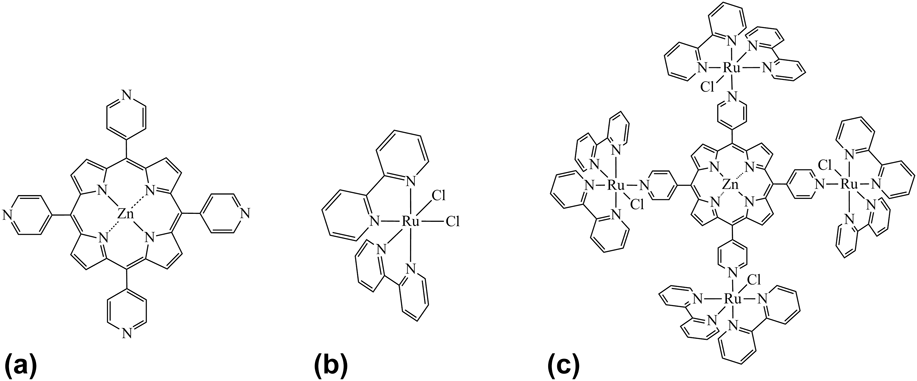
μ-meso-[(5,10,15,20-tetra-4-pyridylporphyrinato) zinc(II) (ZnPyP)Reference Nabid, Zamiraei, Sedghi and Safari35: 101 mg (0.16 mmol) pyridylporphyrin (H2PyP) and 175.6 mg (0.8 mmol) Zn(CH3OO)2·2H2O were dissolved into 20 mL of DMF. The mixture was treated by total reflux operation at 140 °C for 6 h, and TLC was used in the whole process. After the unreacted solid salt was removed, the reaction solution was operated by reduced-pressure distillation. The purification of products was operated by silica gel column chromatography. The developing solvent was CHCl3/CH3OH (20:1 vv), and the second bright purple substance was the product. The structural formula is shown in Scheme 1(a).
Structure of (a) ZnPyP, (b) RuBiPy–Cl, and (c) ZnPyP–RuBiPy.

cis-Dichloro-di-(2,2′-bipyridyl)–ruthenium(II) (RuBiPy–Cl)Reference Liska, Vlachopoulos, Nazeeruddin, Comte and Graetzel36: 30 mL DMF mixture solution, including 119.6 mg (0.46 mmol) RuC13·H2O, 155.5 mg (3.67 mmol) anhydrous lithium chloride (LiCl), and 160.8 mg (1.03 mmol) 2,2′-bipyridine, was reflowed for 6 h at 150 °C under the atmosphere of nitrogen. The filtrate was collected by suction filtration and treated through reduced-pressure distillation to remove the DMF. The solid product was collected by suction filtration and kept in 30 mL of acetone in a refrigerator overnight. Precipitates should be washed with a little acetone and diethyl ether, and then dried under vacuum. The structural formula is shown in Scheme 1(b).
μ-meso-[(5,10,15,20-tetra-4-pyridylporphyrinato) zinc(II)] tetrakis [chloro-2,2′-bipyridylruthenium(II)] tetrahexafluorophosphate (ZnPyP–RuBiPy)Reference Araki, Araujo, Toyama, Franco, Azevedo, Angnes and Toma37: a certain amount of ZnPyP and RuBiPy (M ZnPyP:M RuBiPy = 1:4.1) was added into some glacial acetic acid, and operated by the stirring-reflux method for 45 min. The obtained black solid product was dissolved into methanol solution and refluxed for 45 min after removing the solvent by reduced-pressure distillation. After the reaction solution cooled to room temperature, a LiCl acetone saturated solution was added into the above system to make the product precipitation. The dark brownish-red product was obtained by washing with acetone and drying under vacuum.
Six fluoride phosphate complexes: Dissolved the above chloride into appropriate methanol, and a certain amount of NH4PF6 was added to separate sediment out through replacing Cl− by PF6−. Filter cake was dissolved into the mixture of acetone and methanol (2:1 vv), and then a balanced amount of NH4PF6 was added to make sure that the product translates into six fluoride phosphates totally. The structural formula is shown in Scheme 1(c).
D. Synthesis of the sensitized TiO2 nanotube
Amount of sensitizer was dissolved into 20 mL 1.0 × 10⁻⁴ mmol/L of acetonitrile solution, mixing for 8 h in darkness under the protection of nitrogen after adding 0.5 g TNT. When it was cooled to room temperature, the product was obtained through filtering, washing, and drying.
E. Photocatalytic reduction of CO2
The photoreduction experiments were carried out in the Labsolar-III AG system (Perfectlight, Beijing, China). The setup consisted of a 300 mL beaker irradiated by the UV-vis light provided by a 500 W, 24 V xenon lamp-house system. The reaction solution was about 2 cm away from the lamp in distance, where the light intensity was 0.82 W/cm2 (New Port Dual-Channel Power Meter, model 2832-C, Irvine, CA). A 400 nm cutoff filter was placed between the lamp and the beaker to absorb the UV light. The temperature inside the reactor was maintained at approximately 323 K by means of a continuous circulation of water in a jacket surrounding the reactor. The reacting suspension containing 250 mL 0.05 mol/L NaOH solution, 0.05 mol/L Na2SO3 as the electron donors, and 50.0 mg of catalyst was magnetically stirred and had CO2 bubbled into the suspension for 30 min before switching on the lamp. The photoreduction runs for 4 or 5 h, and the samples were withdrawn from the suspension every 30 min during the irradiation. The photocatalysts were separated from the solution by filtration, and the quantitative determination of liquid and gaseous composition was determined by GC. All the experiments were repeated six times during the test processes and the data were the mean value of six parallel experiments’ result.
III. RESULTS AND DISCUSSION
A. XRD patterns of samples
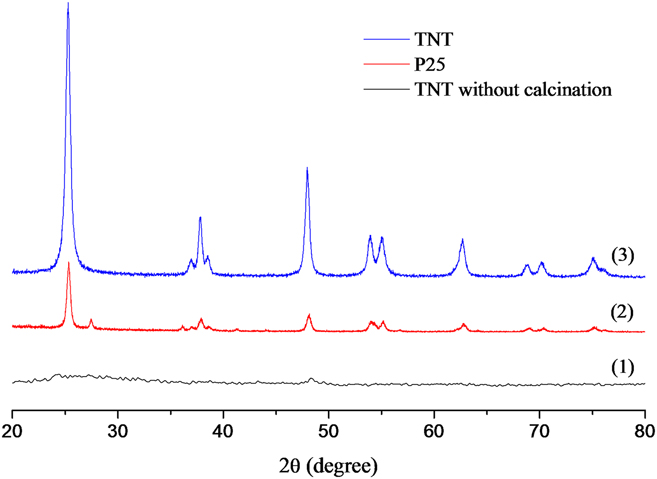
Figure 1 shows the XRD spectra of TNT and P25. The commercial P25 had two crystalline phases (about 70% anatasephase and 30% rutile phase), while the synthetic TNT was amorphous before being calcined and transformed into anatase after the process of calcining at 400 °C. The reason was that the speed of the formation of the 3D lattice structure between two layers was slower than the speed of titanic acid with one layer curling into the tubular structure during the hydrothermal reaction process. The chemical bond between nanotube wall layers would gradually formed in the calcination process, which made the crystal phase of TNT transform from the amorphous to anatase phase.
XRD spectra of (1) titania nanotube (without calcination), (2) P25, (3) titania nanotube (calcined at 400 °C in air for 2 h).

B. N2 adsorption–desorption of samples
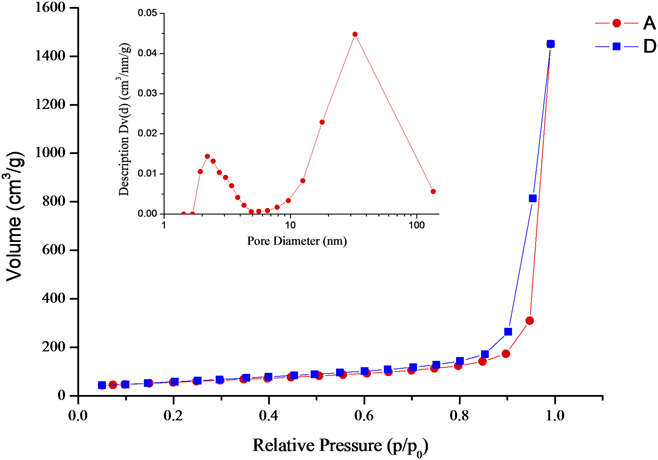
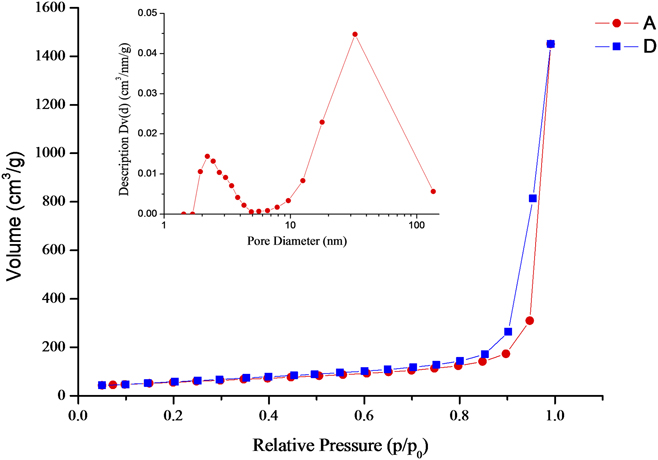
The N2 adsorption–desorption isotherms of TiO2 nanotube samples, presented in Fig. 2, belong to the type IV adsorption–desorption isotherms with distinct hysteresis loops at high relative pressure nearly 0.9 (P/P 0), clarifying the existence of mesopores. The obscure hysteresis loops at the medium relative pressure (P/P 0) can be ascribed to the weak capillary condensation in mesopores. The surface area and total pore volume of the TiO2 nanotube are 152 m2/g and 2.249 cm3/g, respectively. The hierarchical pore distributions can be clearly seen in the pore size distribution curve in the diameter range around 2.3 and 33 nm (the inset in Fig. 2), which may be attributed to the TiO2 nanotubes’ inner diameter and stacking of the nanotubes, respectively.
The N2 adsorption/desorption isotherms and pore size distribution curves of the TiO2 nanotube.
C. TEM of samples
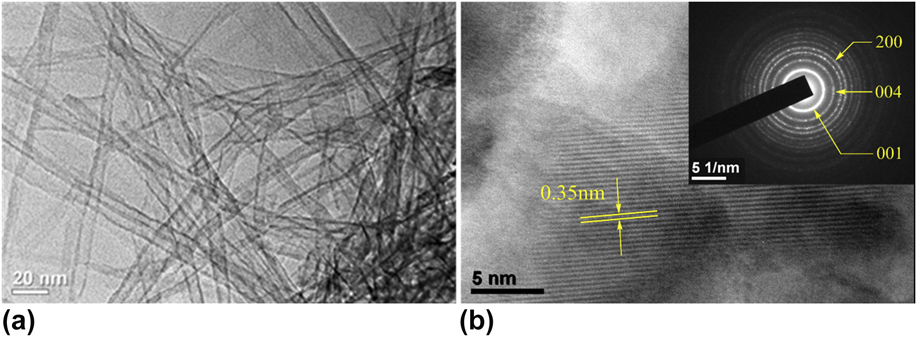
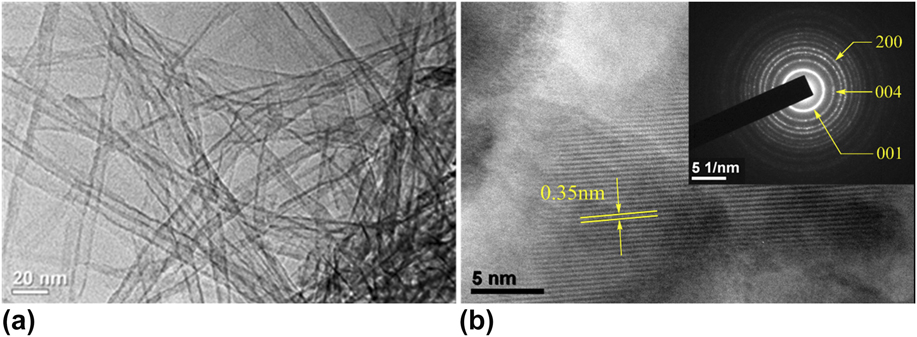
Figure 3 shows the TEM images. It is clear that the synthetic TiO2 was long bar-shaped. The color differences between the middle part and edge section were most likely due to the fact that it had a hollow, tube-like structure and openings at both ends. The tubular was about 500–300 nm long, about 2 nm thick, and had a diameter of 7–10 nm [Fig. 3(a)]. From the HRTEM image [Fig. 3(b)], it can be seen that lattice spacing of TNT was 0.35 nm, which corresponded to the {101} plane of anatase TiO2.Reference Tao, Wu, Xue, Song, Pan, Fang and Dai38 The diffraction ring in the SAED image [the inset in Fig. 3(b)] was the characteristic of anatase TiO2, and corresponded to the {101}, {004}, {200}, {105}, etc.Reference Zhou, Zhou, Liu, Zhang and Liu39,Reference Xiao, Wu, Yue, Xie, Lin and Huang40
(a) TEM images and (b) HRTEM of the TNT (The insert is the electron diffraction pattern).
D. FT-IR spectra of samples
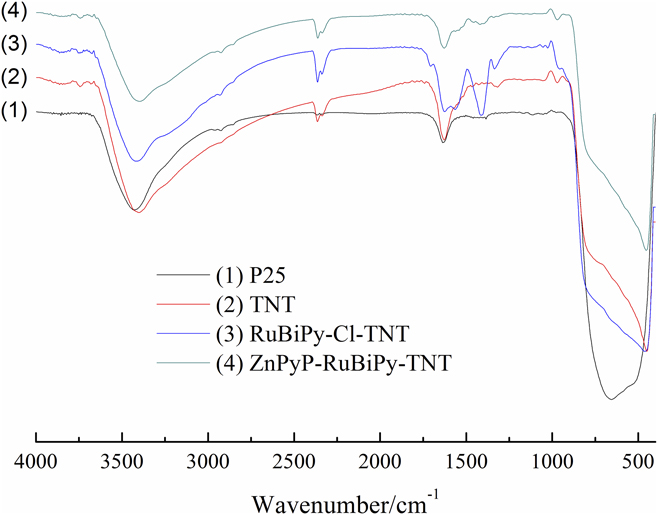
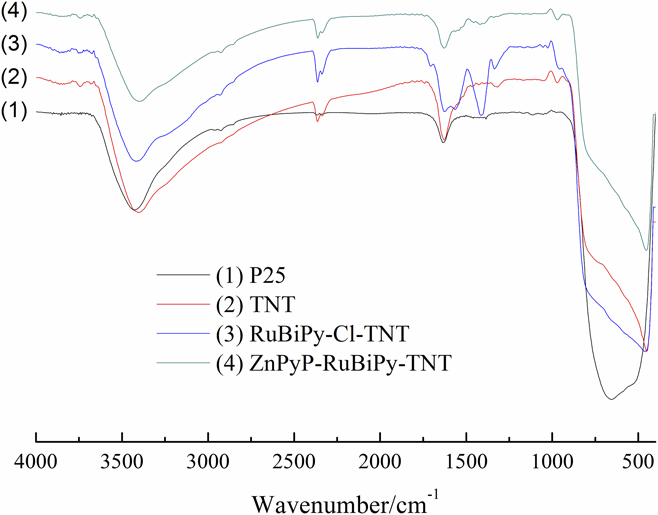
The FT-IR spectra of P25, bare TNT (calcined at 400 °C for 4 h in air), RuBiPy–Cl–TNT, and ZnPy–RuBiPy–TNT are displayed in Fig. 4. Two strong absorption peaks of the hydroxyl group on TNT surfaces are located at 3420 and 1630 cm−1. The bending vibration absorption of hydroxyl groups peaked at 1630 cm−1. The maximum absorption peak at 3420 cm−1 was attributed to the stretch vibration of hydroxyl groups, which indicated that there were more hydroxyl groups adsorbed on TNT surfaces than P25 surfaces according to the width and intensity of the peak.Reference Johnson, Luo, Zhang, Chen, Morton, Echeverría and Zhang41 However, the absorption peaks of RuBiPy–Cl–TNT and ZnPy–RuBiPy–TNT were weaker than that of TNT because the corresponding sensitizers occupied the position of some hydroxyl groups on the surface of TNT. Absorption peaks were observed at 2390–2338 cm−1, which can be attributed to the peaks of CO2 in air. The peak at 2359 cm−1 was derived from the R-branch of CO2 and the peak at 2338 cm−1 was resulted from the P-branch of CO2. The stretching vibrations of C=N and C=C in pyridine were close to 1610–1370 cm−1, while the conjugate effect made it difficult to assign these peaks to a specific group of the corresponding spectrum. From the absorption peaks, it can be judged that some sensitizers have indeed attached to TNT surfaces. The characteristic absorption peak of TiO2 was the stretching vibration of Ti–O near 600 cm−1.
FT-IR spectra of P25, TNT, RuBiPy–Cl–TNT, and ZnPy–RuBiPy–TNT.
E. DRS spectra of samples
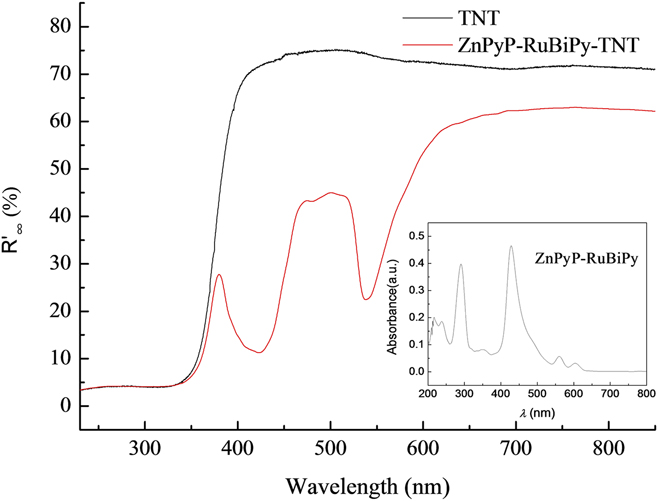
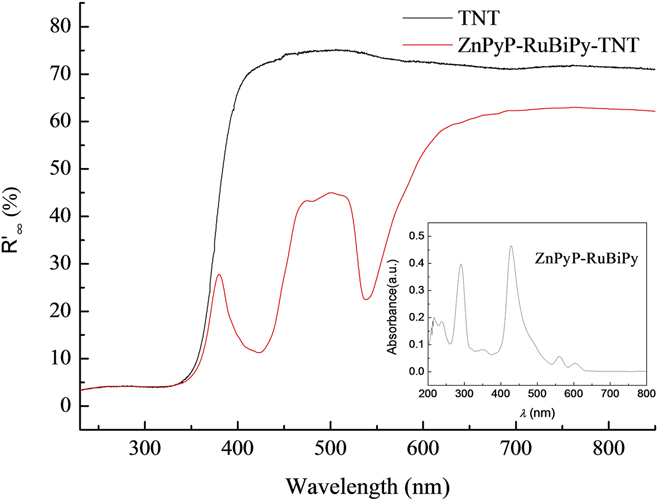
The DRS spectra of ZnPy–RuBiPy–TNT and TiO2 nanotubes are shown in Fig. 5. It was worth noting that the band gap edge of ZnPy–RuBiPy–TNT was identical with the TNT. Two strong characteristic absorption bands peaked at 422 nm (Soret band) and at 538 nm (Q band) came from the sensitizers, which were similar to the peaks of ZnPy–RuBiPy in CHCl3 solution (Fig. 5, inset). However, the peaks of sensitizers before 350 nm were covered up by the characteristic peak of TiO2 nanotubes.
Diffuse reflectance spectra of TiO2 and ZnPy–RuBiPy–TNT. Inset: spectrum of ZnPy–RuBiPy in CHCl3.
F. Photocatalytic activity of samples
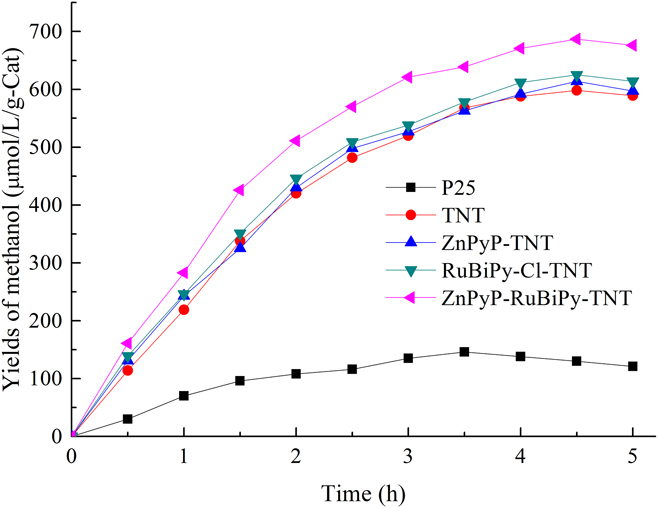
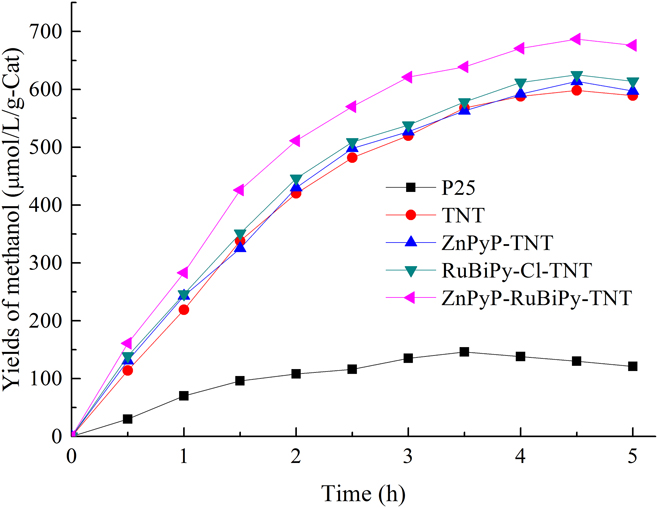
The results of the experiment on the photocatalytic properties are shown in Fig. 6. The five parallel experiments were conducted under UV-vis light. It was obvious that the TNT and sensitized TNTs showed better catalytic performance than P25. The yield of methanol produced by synthesized catalyst was 4.8–5.6 times higher than that of P25 after 4–4.5 h of exposure to the UV-vis light. It can be clearly seen that ZnPyP and RuBiPy–Cl raised the catalytic performance of bare TNT by about 1.4% and 4.3%, respectively. ZnPyP–RuBiPy had the highest sensitization because it improved the performance of TNT to 14.8%. Meanwhile, the same sensitizers modified P25 was 1.2–1.3 times of pure P25. It is worth mentioning that methanol was the only liquid product, and other liquid products such as formaldehyde and formic acid were not found.Reference Rodriguez, Liu, Stacchiola, Senanayake, White and Chen42,Reference Zeng, Qiu, Li, Pavaskar and Cronin43 This result indicated that our synthetic photocatalysts could improve the selectivity of methanol.
Time dependence of methanol yield by using different catalysts.
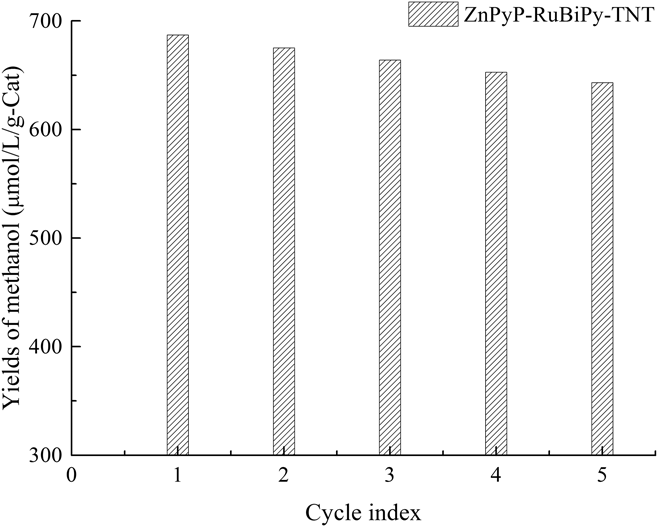
To further explore the stability of sensitized catalysts, ZnPyP–RuBiPy–TNT, we conducted a cycling test (Fig. 7) and found that the catalytic effect decreased by about 6.4% after 5 cycles by ZnPyP–RuBiPy–TNT under UV-vis light. In fact, the decreasing catalytic effect of the sensitized catalyst after each cycle is partly because of a little loss of the powder catalyst during the separation process of the solution. Thus, the sensitizer modified TiO2 are ideal photocatalysts due to their high activity, selectivity, and performance stability.
Yield of methanol in different cycle indices of ZnPyP–RuBiPy–TNT.

The specific surface areas of all the samples are shown in Table I. The BET value of TNT was 2.7 times higher than that of P25, but the methanol yield of TNT was about 4.7 times that of P25. There was a nonidentity in the BET value and the methanol yield, which indicated that the nanotube structure of TiO2 could improve its photocatalytic efficiency. In the process of reducing CO2 aqueous solution, hydrogen and methane were the main gas products and carbon monoxide, ethane, ethylene, and other issuable gas products were not observed. The methanol yield of sensitized TNT was 4.2–4.7 times that of P25 after 4.5 h of UV-visible irradiation, and the hydrogen yield of them was 1.6–2.6 times as much as that of P25 after 5 h. The detailed results could be used to evaluate the photocatalytic performance of different sensitized catalysts. The methanol concentration after 4.5 h of irradiation tended to decrease in the following sequence: ZnPyP–RuBiPy–TNT [687 μmol/(L g)cat] > Ru(BiPy)2Cl2–TNT [625 μmol/(L g)cat] > ZnPyP–TNT [614 μmol/(L g)cat] > TNT [590 μmol/(L g)cat]. While the order about hydrogen concentration and methane concentration after 5 h of irradiation was different. The target product was methanol in this experiment, so ZnPyP–RuBiPy–TNT was considered the very best photocatalyst.
The initial photoreaction rates and the yield of methanol after 4.5 h of irradiation, and the hydrogen and methane yield after 5 h of UV-visible irradiation.

a r 0, The initial photoreaction rates per used mass according to the methanol yield.
To evaluate the ZnPyP–RuBiPy sensitizer, an experiment of the photocatalytic reduction of CO2 aqueous solution was also conducted under visible light (>420 nm). The result showed that methanol yield of ZnPyP–RuBiPy–TNT was 340 μmol/(L g)cat after 5 h. The bare TNT and P25 do not have any catalytic effect under visible light. Obviously, the changes in morphology and structure of TNT do not extend its response light range. That is, the sensitizers indeed widened the TiO2 response range toward the range of visible light, establishing the favorable foundation for the photocatalysis reaction under the visible light.
Different catalytic effects of these samples were caused by different sensitizers, including ZnPyP, Ru(BiPy)2Cl2, and ZnPyP–RuBiPy. The central-metal played an important role in transferring electron and energy in the light-catalyzed reaction.Reference Vesborg and Seger44 Ru(II) polypyridyl complex sensitized TiO2 nanotubes had higher photocatalytic performance than porphyrin-metal complex sensitized TNT. The reason was the efficiency of transfer electrons of Ru(BiPy)2Cl2 was higher than that of ZnPyP, although porphyrin-metal complex had a great light abstraction width. The modified TiO2 nanotubes sensitized by porphyrin/dipyridine metal complexes were inorganic–organic nanocomposites with good photocatalytic performance. It is worth noting that ZnPyP–RuBiPy not only had the merits of Ru(II) polypyridyl complexes but also had the advantage of metalloporphyrin complexes, so ZnPyP–RuBiPy–TiO2 is regarded as the first-rank catalyst.
IV. PROCESS FEATURES AND MECHANISTIC ASPECTS
The photocatalysis mechanisms of sensitized TiO2 nanotubes have been discussed,Reference Mele, Del Sole, Vasapollo, Marcì, Garcìa-Lòpez, Palmisano and Guascito45,Reference Mele, Garcìa-Lòpez, Palmisano, Dyrda and Słota46 although some specific details are not clear. In the process of photocatalytic reduction of CO2 aqueous solution, the oxidant species such as hydroxyl and other radicals could be obtained under UV light, which played an important role in reducing CO2 aqueous solution.Reference Lü, Li, Wang, Duan, Luo, Yao and Wang47
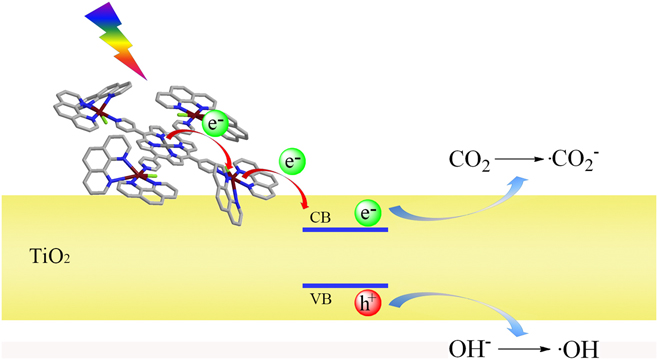
The metalloporphyrins and their analogues have received much attention in recent years, and they are used in biomimetic systems because they play an important role in plant photosynthesis. The biological activity of the porphyrins is closely related to absorption wavelengths when they are used as photosensitizers. Their major bands are in visible area and are also important components of sunlight energy. Compared with polypyridyl complexes, metalloporphyrins are more likely to be excited by lower-frequency light due to their larger conjugated system. That is, the excited electrons are mainly derived from metalloporphyrin when ZnPyP–RuBiPy–TiO2 is used as the catalyst. The metalloporphyrin is the center of the sensitizer molecule, which could transmit excited electrons and energy to peripheral Ru(II) polypyridyl complexes, and then the excited electrons could be transferred into the conduction band of TiO2 nanotubes [Eqs. (1)–(6)]. This process contributes to extending the life of excited electrons and reducing their quenching probability (Fig. 8).
Photocatalytic mechanism of ZnPyP–RuBiPy–TNT under the visible light.
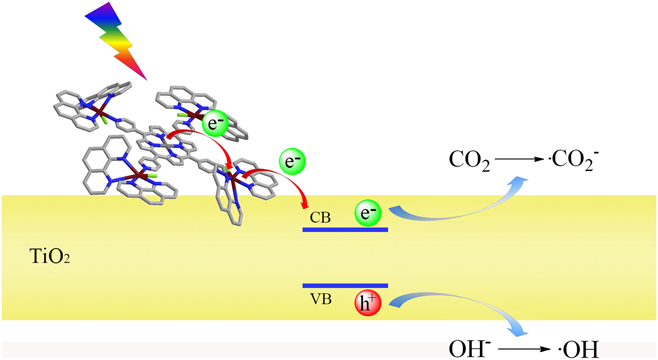
Of course, there is no denying that the metalloporphyrin and Ru(II) polypyridyl complexes are also independent sensitization units, which can produce excited electrons under light, respectively. The excited electrons can be transferred into the CB of the TiO2 and lead to photoreactions, but the effects of this process are weaker than combined metalloporphyrin–Ru(II) polypyridyl sensitizers according to our experimental results.
 $$\left[ {{\rm{ZnPp}} - {\rm{\ RuPy}}} \right] \to \left[ {{\rm{ZnP}}{{\rm{p}}^ * } - {\rm{RuPy}}} \right]\quad ,$$
 $$\left[ {{\rm{ZnP}}{{\rm{p}}^ * } - {\rm{RuPy}}} \right] \to \left[ {{\rm{ZnPp}} - {\rm{RuP}}{{\rm{y}}^ * }} \right]\quad ,$$
 $$\left[ {{\rm{ZnPp}} - {\rm{RuP}}{{\rm{y}}^ * }} \right] \to \left[ {{\rm{ZnPp}} - {\rm{RuP}}{{\rm{y}}^ + }} \right] + {{\rm{e}}^ - }\quad ,$$
 $$\left[ {{\rm{ZnP}}{{\rm{p}}^ * } - {\rm{RuPy}}} \right] \to \left[ {{\rm{ZnP}}{{\rm{p}}^ + }\left( {{{\rm{e}}^ - }} \right) - {\rm{RuPy}}} \right]\quad ,$$
 $$\left[ {{\rm{ZnP}}{{\rm{p}}^ + }\left( {{{\rm{e}}^ - }} \right) - {\rm{RuPy}}} \right] \to \left[ {{\rm{ZnPp}} - {\rm{RuP}}{{\rm{y}}^ + }\left( {{{\rm{e}}^ - }} \right)} \right]\quad ,$$
 $$\left[ {{\rm{ZnPp}} - {\rm{RuPy}} + \left( {{{\rm{e}}^ - }} \right)} \right] \to \left[ {{\rm{ZnPp}} - {\rm{RuP}}{{\rm{y}}^ + }} \right] + {{\rm{e}}^ - }\quad .$$
The reaction of excited electrons with CO2 to form •CO2− radical is an extremely difficult and critical step in the process of photocatalytic reduction of CO2 aqueous solution [Eqs. (7) and (8)Reference Doherty, Grills, Muckerman, Polyansky and Fujita48,Reference Grills and Fujita49 ]. Other reactions will go smoothly after the •CO2− radical appeared, such as the CHx groups will form on the catalyst surface [Eq. (9)]. Then the CH4, CH3OH, and H2 will be produced, respectively [Eqs. (10) and (11)].
 $${\rm{C}}{{\rm{O}}_{\rm{2}}} + {{\rm{e}}^ - } \to {}^{\rm{ \bullet }}{\rm{C}}{{\rm{O}}_2}^ - \quad ,$$
 $${\rm{C}}{{\rm{O}}_2} + 5{}^{\rm{ \bullet }}{\rm{H}} + 2{{\rm{e}}^ - } \to {}^{\rm{ \bullet }}{\rm{C}}{{\rm{H}}_3} + 2{\rm{O}}{{\rm{H}}^ - }\quad ,$$
 $${}^{\rm{ \bullet }}{\rm{C}}{{\rm{H}}_3} + {}^{\rm{ \bullet }}{\rm{H}} \to {\rm{C}}{{\rm{H}}_4}\quad ,$$
 $${}^{\rm{ \bullet }}{\rm{C}}{{\rm{H}}_3} + {}^{\rm{ \bullet }}{\rm{OH}} \to {\rm{C}}{{\rm{H}}_3}{\rm{OH}}\quad {\rm{,}}$$
 $${}^{\rm{ \bullet }}{\rm{H}} + {}^{\rm{ \bullet }}{\rm{H}} \to {{\rm{H}}_2}\quad .$$
Actually, many factors affect the types of products, such as morphology and structure of the catalyst,Reference Dimitrijevic, Vijayan, Poluektov, Rajh, Gray, He and Zapol50 molecular structure of sensitizers, and reaction conditions.Reference Woolerton, Sheard, Reisner, Pierce, Ragsdale and Armstrong51 The structure of TiO2 and sensitizers limited the combination of ·CO2 and H+, so we could not detect the formaldehyde and methanoic acid in the liquid phase.
V. CONCLUSIONS
The porphyrin/dipyridine metal complexes were synthesized as photosensitizers. The photocatalytic activity of TiO2 nanotubes modified with ZnPyP, Ru(BiPy)2Cl2, and ZnPyP–RuBiPy as sensitizers has been investigated by carrying out the photoreduction of CO2 to methanol as a probe reaction in aqueous suspension and under UV-vis or visible light. The sensitizers with different structures have different photosensitized efficiencies when they are impregnated onto the TiO2 surface. All samples showed great selectivity and yields of methanolin following the decreasing order: ZnPyP–RuBiPy–TNT > Ru(BiPy)2Cl2–TNT > ZnPyP–TNT > TiO2 nanotubes (bare). 687 μmol/(L g)cat and 340 μmol/(L g)cat methanol yields were obtained by using ZnPyP–RuBiPy–TNT as the catalyst under the UV-visible light and visible light, respectively.
Although photoreduction of CO2 is a very difficult process and the yield of reduced products is too low to be used in the practical industry at present, the use of sensitized TiO2 as a kind of promising photocatalyst in this reduction process is a significant topic in the theory and practice of the energy and chemical industry.
ACKNOWLEDGMENTS
The authors are very grateful to the National Science Foundation of Shaanxi Province (No. 2014JM2054), the Education Committee Foundation of Shaanxi Province (No. 15JK1736), and the NWU Scientific Research Foundation (No. 12NW24) for the financial support.