INTRODUCTION
The study of tree rings (dendrochronology) is a powerful tool for reconstructing climatic variations throughout the last centuries (Fritts Reference Fritts1976; Schweingruber Reference Schweingruber1988; Cook and Kairiukstis Reference Cook and Kairiukstis1990; Speer Reference Speer2010; Hughes et al. Reference Hughes, Swetnam and Diaz2011). Tree rings allow us to date the occurrence of extreme climatic events such as maximum and minimum river flows, water levels in reservoirs, among others. Another application has been in geomorphological research, in which tree rings are useful to date and to study erosive processes such as landslides, rock, and debris falls, volcanic events, tsunamis, etc., that extend from a few years to centuries ago (Haneca et al. Reference Haneca, Verheyden, Beeckman, Gartne, Helle and Schleser2006; Stoffel and Bollschweiler Reference Stoffel and Bollschweiler2008; Speer Reference Speer2010; Stoffel et al. Reference Stoffel, Bollschweiler, Butler and Luckman2010; Jakob Reference Jakob2019). In archaeology, tree rings have been employed to define the exact year in which the trees were felled, altered or used for the construction of artifacts or buildings (Speer Reference Speer2010; Rubino and Baas Reference Rubino and Baas2019). In addition, dendrochronological methods have been useful to prove the authenticity of some art pieces and musical instruments (Grissino-Mayer et al. Reference Grissino-Mayer, Sheppard and Cleaveland2004; Bernabei et al. Reference Bernabei, Bontadi, Čufar and Baici2017). In summary, dendrochronology is a useful and scientifically accepted method to reconstruct the temporality of particular events.
In another context, the investigation and resolution of legal questions requires the dating of specific events to make decisions based on accepted scientific methods. For example, the application of the dendrochronological methods focused on examining material related to an alleged criminal act or legal dispute rests in forensic sciences. The application of dendrochronology in criminalistics is called forensic dendrochronology (UNODC 2016). Its use ranges from ecological studies up to dating wood pieces from illegal logging, the origin of wood, dating of standing buildings, to dating wooden objects or objects that coincide with crime scenes, through the characterization of wood anatomy or tree rings (Jozsa Reference Jozsa1985; Schweingruber Reference Schweingruber1988; Wolodarsky-Franke and Lara Reference Wolodarsky-Franke and Lara2005; Ng et al. Reference Ng, Lee, Tnah, Ng, Lee and Diway2017; Köse et al. Reference Köse, Okan and Akkemik2018; Pokines Reference Pokines2018; Lehmann and Arruda Reference Lehmann and Arruda2019; Miller Reference Miller2019). This method is broadly accepted in temperate regions in which dendrochronology has been developed and widely used in many applications. In contrast, in the tropics, dendrochronological applications are more recent.
Although there has been dendrochronological research in the tropics for more than a hundred years, the studies have grown exponentially in recent years (Worbes Reference Worbes2002; Brienen et al. Reference Brienen, Schöngart, Zuidema, Goldstein and Santiago2016). These studies have confirmed the presence of annual growth rings in at least 220 tree species in the Neotropics (Brienen et al. Reference Brienen, Schöngart, Zuidema, Goldstein and Santiago2016; Schöngart et al. Reference Schöngart, Bräuning, Barbosa, Lisi, Oliveira, Amoroso, Daniels, Baker and Camarero2017). The integration of dendrochronological methods with radiocarbon (14C) dating has increased the accuracy and certainty in determining the exact year of a growth ring in tropical trees. For this purpose, tropical dendrochronologists frequently use bomb-pulse 14C, a term referring to the sudden increase of 14C in the Earth’s atmosphere due to hundreds of aboveground nuclear bombs tests intensified between 1950 until 1963, when the Limited Test Ban Treaty was signed (Worbes and Junk Reference Worbes and Junk1989). Here, we combine dendrochronology and the bomb-pulse dating method to improve the resolution of temporal events in a legal dispute related to land appropriation. In this case, we reconstruct the date of felling of some trees in a teak (Tectona grandis) plantation. It is worth noting that teak has shown annual growth rings in all places where this species has been studied (Pumijumnong et al. Reference Pumijumnong, Eckstein and Sass1995; Deepak et al. Reference Deepak, Sinha and Rao2010; D’Arrigo et al. Reference D’Arrigo, Palmer, Ummenhofer, Kyaw and Krusic2011; Nocetti et al. Reference Nocetti, Rozenberg, Chaix and MacChioni2011). Our hypothesis is that teak has annual rings in our study area.
Dispute Context
In September 2006, a smallholder planted three hectares of teak (Tectona grandis) in Apartadó (Antioquia, Colombia). Teak is one of the most appreciated and valuable tropical woods in the world’s timber trade (Kollert and Kleine Reference Kollert and Kleine2017). For the plantation with a density of 1233 trees/ha, the property owner (PO) used cuttings of about 50 cm in length and about 1 cm in diameter from new branches of another teak plantation. This method allows an initial fast growth and reduces tree mortality. In August 2015, nine years after the teak was planted, the staff of an electricity company (EC) entered the property to check a power-line-corridor (PLC) established in 2008 that crosses through the teak plantation. Allegedly without the owner’s permission, the EC staff felled 80 trees growing under the PLC, degrading and fragmenting the commercial area of the teak plantation in two stands. After the owner’s complaints, the EC asserted that the area had not been planted at the time of the PLC establishment in 2008. According to the PO, he established the teak plantation in 2006, two years before the PLC was constructed, and claimed that the EC officials must have seen the planted trees in this location. We were asked to establish the age of both the stumps under the PLC and the living trees in the teak plantation surrounding the PLC.
METHODS
Study Area
The teak plantation is located in Antioquia, Colombia (7°53′05″N, 76°38′06″W). The property is hilly, with slopes ranging from slightly up to moderately inclined and an elevation ranging between 80 and 220 m altitudes. We obtained climate data from Tropical Rainfall Measuring Mission (TRMM) (TRMM 2011) from 2000–2015. Mean annual precipitation and mean annual temperature are 2823 mm, and 26.7°C, respectively. February, with about 65 mm, is the month with the lowest rainfall. During the other months, rainfall is over 100 mm. The mean temperature is nearly the same all year round.
Field Sampling
In 2016, we visited the study area to gather evidence that would support the facts. We measured the affected transect and counted the stumps of the felled trees under the PLC. To determine the age of the felled trees, we cut three cross-sections at random from the stumps felled in 2015 by the EC. To date the living trees from the plantation, we felled two trees and obtained a cross-section of each one close to the ground. The use of complete cross-sections is mandatory in this case because it is difficult to handle an increment borer near ground level and reach the pith.
Sample Preparation
The cross-sections were processed in the Tropical Dendroecology Laboratory of the National University of Colombia at Medellin. The cross-sections were oven-dried at 28°C, to reach a constant weight. To highlight the tree rings, we polished the cross-sections with abrasive sandpaper, from 60 to 600 grains inch–2. The cross-sections were scanned at a resolution of 1800 dpi in an Epson Expression 10,000XL Scanner calibrated for dendrochronological studies by Regent Instruments, Canada. The high-resolution images allowed us to characterize the tree-ring widths with a precision of about 10–15 µm. All images were processed with Image J11.52i software (Schindelin et al. Reference Schindelin, Arganda-Carreras, Frise and Cardona2012).
Tree-Ring Analysis
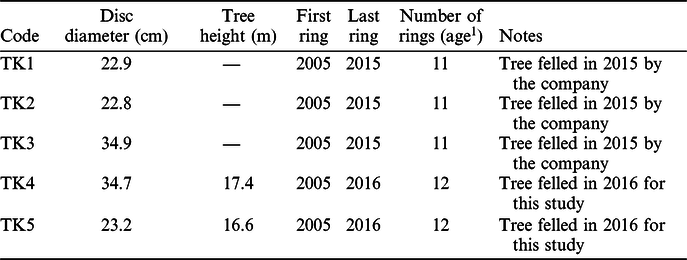
We marked and counted the tree rings from the bark to the pith of each cross-section. We assigned calendar year 2016 to the last and still incomplete rings in the cross-sections of the trees felled by us, because the sampling of the cross-sections was done in mid-July 2016 and growth season of teak in this place occurs from March to December. The same procedure was performed for the cross-sections extracted from the stumps of the trees apparently cut down by the EC (according to PO testimony), but assigning 2015 to the last ring adjacent to the bark. In this way, all samples were dated, assuming an annual formation frequency of the tree rings. By comparing the number of rings in the cross-sections of both the trees felled by the EC in 2015 and by us in 2016, with the planting date provided by the PO, we were able to determine the frequency of ring formation.
Radiocarbon Analysis
To validate the planting date obtained under the hypothesis of annual ring formation, we used the modern 14C fraction (F14C) (Stenström et al. Reference Stenström, Skog, Georgiadou, Genberg and Johansson2011). We extracted about 4–6 g of wood from the oldest part of the trees, closest to the pith of three cross-sections: one sample from a felled tree by the EC in 2015 (labeled TK2 in Table 1) and two pieces from two trees felled by us in 2016 (labeled TK4 and TK5 in Table 1). The 1st ring near the pith was the thinnest and came with the planted cuttings. The 2nd ring was also very thin since teak dedicates most of the photosynthetic products during this first phase of the ontogenetic growth to roots, leaf production, and primary, not secondary growth (Rao and Rajput Reference Rao and Rajput1999; Husen and Pal Reference Husen and Pal2006). Then, most of the wood for 14C analysis by the conventional radiometric method had to be extracted from the 3rd ring in samples TK2 and TK5, to complete the amount of wood needed for the analysis: a mixture of the 1st, 2nd, and 3rd rings. In sample TK4, since all the initial growth rings were very thin, the 4th ring contributed most of the wood mixture sample used for 14C analysis. The wood samples were sent to the Laboratory of Radiocarbon Analysis of the Institute of Health and Medical Ecology, in Ukraine (code IHME), for the determination of F14C by the conventional radiometric method.
Age determined in some trees cut down by the electric company and by us in the teak plantation, by counting the number of growth rings from the bark (felled date) to the pith.

1 Years old.
The wood samples were ground to a fine powder. They were then subjected to solid-liquid extraction in a Soxhlet apparatus (6–7 hr). After extraction, the wood sample was dried at 105°C about 3–5 hr to constant mass. Pretreated wood samples were converted into benzene, using a benzene line (http://benzene-line.com). Benzene samples were counted by liquid scintillation spectrometer (Quantulus 1220™) using of Teflon vials (Skripkin and Kovaliukh Reference Skripkin and Kovaliukh1997; Skripkin and Buzynnyi Reference Skripkin and Buzynnyi2017).
To calibrate the 14C analysis in F14C, we used the bomb-pulse (post-bomb calibration) and the CALIBomb program (Reimer et al. Reference Reimer, Brown and Reimer2004), and the Northern Hemisphere Zone 2 (NHZ2) calibration curve with one-year smoothing. The NHZ2 is the most appropriate calibration curve for the study site. This curve was extended from 1950 to 2010 with data from Hua et al. (Reference Hua, Barbetti and Rakowski2013).
RESULTS
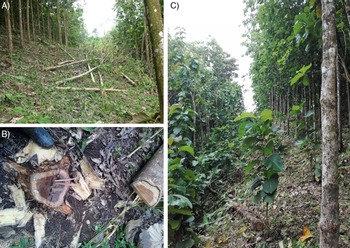
Our measurements made in the field indicated that the felled area was 1166 m2 (11.6 m × 100 m; 3.88% of the planted area). We counted 80 stumps of the original teak plantation as evidence of the felled trees (Figure 1). The results of the growth rings analysis are presented in Table 1.
Photos of the felled area in the teak plantation (1166 m2): A) image of the affected area taken in September 2015 by the property owner; B) the stump of one of the felled trees; C) view of the felled area in July 2016, where some epicormic shoots of the felled trees are visible.

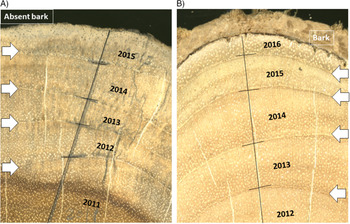
The cross-sections allowed us to characterize the anatomy of the wood in the transverse plane (Figure 2). The teak growth rings can be observed by the naked eye; they are defined by bands of terminal parenchyma (white lines in Figure 2). Vessel distribution is diffuse. The pores or vessels do not follow any clustering pattern. In all samples observed, the heartwood occupies three-quarters of cross-sections, which is notable from an economic point of view.
Photos showing the retrospective dating of the growth rings in teak cross-sections: A) cross-section from a tree felled in 2015 (TK2), absent bark probably due to fungi decay; B) cross-section from a tree felled in 2016 (TK4). White arrows indicate the growth ring boundaries.

Tree rings marked and counted allow us to know the real age of these trees (Table 1). Because the trees whose cross-sections were examined by us from the felled area (TK1, TK2, and TK3 in Table 1) were alive when cut down, we can assume all 80 felled trees were alive when they fell under the PTL. Therefore, the last growth rings formed, or under formation, present in these cross-sections were of the year 2015 (Figure 2A). Based on these last rings formed in 2015, by counting the rings, we established the date of formation of the previous rings up to the pith: The first tree rings correspond to 2005. Likewise, we determined that, in the trees cut down by us in 2016 (TK4, and TK5 in Table 1), the first rings dated from 2005, and by extension, the first rings of all planted trees were 2005.
There are two main findings. The first one is that in all cross-sections sampled, the first growth ring dated from 2005 (TK1 to TK5, in Table 1). This conflicts with the PO, who claims he planted the trees in 2006. However, the PO indicates they did not plant seeds but cuttings, which already had one ring at time of planting. Therefore, the plantation in 2016 was 10 years old and trees were 11 years old. The other find is that the cross-sections of trees felled by us and felled by the EC differ in only one ring (Table 1 and Figure 2). These facts provide strong evidence of the annual nature of the growth rings in the study teak trees, proving the hypothesis.
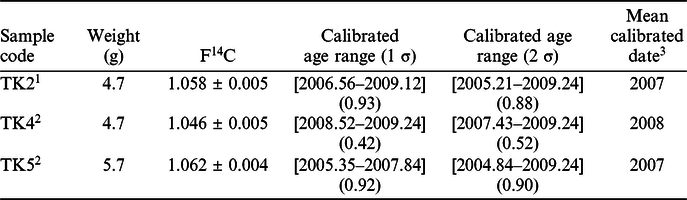
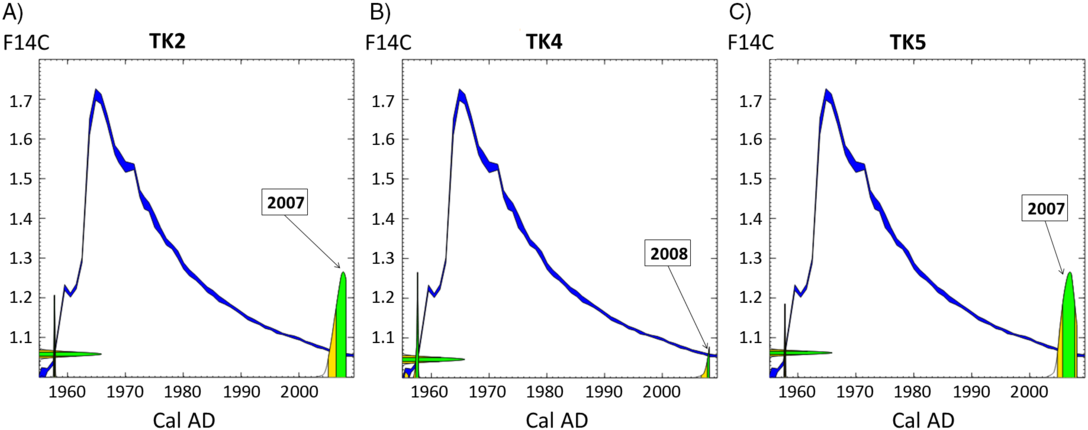
The 14C results in F14C and their calibrations in calendar years are presented in Table 2 and Figure 3. As we explained in the methods, given the small amounts of wood supplied for the 14C analysis by the 1st and 2nd ring, closest to the piths of the cross-sections, the 3rd and 4th growth rings supplied most wood for the three 14C analysis. Then, the 14C isotopic signature of the year 2007 dominates in the TK2 and TK5 samples, and that of 2008 in the sample TK4 in the F14C analysis. Given that, in the cross-sections where the TK2 and TK5 samples were extracted, the 3rd rings from the pith to the bark were dated by counting the rings as belonging to the year 2007, and the 4th ring of the TK4 sample to the year 2008, the 14C dating also confirms the annual nature of the teak growth rings in the study area.
Results of 14C dating and calibration in calendar dates of the samples TK2, TK4, and TK5.

1 This is a dead tree felled in 2015 by the electric company.
2 Trees felled by us in 2016.
3 Date rounded to the first integer calendar year. Values in parentheses indicate of probability percent given by CALIBomb.
Graphs showing the post-bomb 14C calibration dates with 2 σ of the samples TK2, TK4, and TK5 using CALIBomb: A) sample TK2 dated the year 2007 after the bomb-spike with an 88% probability, or the year 1957 with a 12% probability, before the spike; B) sample TK4 dated the year 2008 with a 52% probability, or the year 1957 with a 48% probability; C) sample TK5 dated the year 2007 with a 90% probability, or the year 1957 with 10% probability.

DISCUSSION
Teak have shown annual rings many other places around tropical regions (Pumijumnong et al. Reference Pumijumnong, Eckstein and Sass1995; Deepak et al. Reference Deepak, Sinha and Rao2010; D’Arrigo et al. Reference D’Arrigo, Palmer, Ummenhofer, Kyaw and Krusic2011; Nocetti et al. Reference Nocetti, Rozenberg, Chaix and MacChioni2011; Castaño Reference Castaño2016). Here we also find annual growth rings in teak by counting retrospectively from the last known date ring (Figure 2, and Table 1) to the pith and by bomb-pulse 14C dating (Table 2).
Our results show that when the trees were cut down by the electricity company in 2015, the trees had 11 rings; that is, they were 11 yr old (Table 1). The age of the trees does not coincide with the planting date because the PO used cuttings of almost 1-yr-old trees for planting. Therefore, the plantation was 10 years old in 2015.
It is evident that the cuttings were less than one year old, and that their first rings were barely forming. However, since all the leaves are removed from the cuttings before planting, their growth stops. Only after the roots are formed with the energy supplied by the non-structural carbohydrates stored in the parenchymal tissue of the cuttings wood, appear primary growth’s shoots, and then the leaves, with which the first planting growth rings begin to form. These rings and the subsequent rings tend to be very narrow. It is well known that teak trees grow rapidly in height during their first years, but proportionally not so much in diameter (de Camino and Morales Reference de Camino and Morales2013). Consequently, the isotopic signature of the wood from the years 2007 and 2008 prevailed, given that most samples came from these growth rings. The first two rings, closer to the pith, produced very small amounts of wood useful for 14C dating by the conventional radiometric method, which requires at least 4 g of wood. To date exactly the first ring of the cuttings planted and date 2005 by rings count, we should have used the accelerator mass spectrometer (AMS) 14C dating method, which requires approximately 400 times less mass of wood samples, but this is much more expensive for a smallholder.
The vessel distribution observed was diffuse (Figure 2A and 2B), despite the fact that wood anatomists often describe teak growth rings defined by circular to semicircular porosity (pores grouped at the beginning of the ring), accompanied by a terminal parenchyma band (Vásquez and Ramírez Reference Vásquez and Ramírez2005; Richter and Dallwitz Reference Richter and Dallwitz2009). This suggests a kind of plasticity of the hydraulic traits: under conditions with abundant irrigation or rain, this anatomy may change, as evidenced by recent work (Nocetti et al. Reference Nocetti, Rozenberg, Chaix and MacChioni2011; Cardoso et al. Reference Cardoso, Sousa, Quilhó and Pereira2015; Castaño Reference Castaño2016). It is important to note that this study area receives 2823 mm a year in rainfall.
As shown in Table 2 and Figure 3, the probability of the dating with 2 σ after the spike of the bomb-pulse was 88% (2007), 52% (2008), and 90% (2007) for samples TK2, TK4, and TK5, respectively. The reason why the 14C dates were not 2005, as shown by the dendrochronological analysis, but rather 2007–2008 (Table 2), is because the wood samples used for dating are composed of a mixture of wood coming from 1st, 2nd, and 3rd tree rings in TK2 and TK5, and from 1st to the 4th rings in TK4. However, 14C results and the tree-rings analysis validate the annual frequency of tree rings in the teak from our study area.
CALIBomb, as well as other programs to calibrate 14C dating with the bomb-pulse, systematically assign a higher probability to the dates after the bomb spike (del Valle et al. Reference del Valle, Guarín and Sierra2014). Therefore, more important than these probabilities is the knowledge we have about the most likely dates. That is, are they before or after the bomb spike? In this study, there is no doubt that they are after the bomb spike; all dates obtained in Table 2 are 100% likely.
CONCLUSION
Dendrochronology and 14C dating combined emerge as a tool for effectively resolving some disputes in forensic sciences related to tree cutting dating in tropical tree plantations. During post-bomb years, the precise dating of the first growth ring around the pith of trees using AMS 14C dating would be a great advantage.
ACKNOWLEDGMENTS
We acknowledge to COLCIENCIAS Project 1118-714-51372 and the Tropical Dendroecology Laboratory of the Department of Forest Sciences, National University of Colombia. We thank Ramon Albeiro Morales to help in sampling and Sebastian Gonzalez for comments on the manuscript. The authors wish to express their gratitude to both Radiocarbon Editor A. J. Timothy Jull and to an anonymous reviewer for their help in editing some portions of our manuscript.