Sudden onset disasters (SODs), and especially earthquakes, often damage critical infrastructure, including hospitals and health facilities that are then not able to meet the health-care needs of the community.Reference de Ville de Goyet1,Reference Henderson, Lillibridge and Salinas2 Such events also create a significantly increased need for medical care and health assistance,3 particularly in countries with an already limited health-care capacity. The majority of disasters are managed using local or national resources,4 but, when the needs exceed the capacity of the affected country, the provision of external rescue and health services, such as Emergency Medical Teams (EMTs), may be required and the deployment of relief units requested.5
Such deployment from governmental or nongovernmental sources is in response to a perceived urgent need expressed by the public and mediaReference De Ville De Goyet, Marti and Osorio6 but which sometimes results in an overwhelming influx of humanitarian assistanceReference Cook, Shrestha and Bo Htet7 that does not always meet the needs of the affected population. Many authors describe a wide spectrum of responses and highlight the lack of standardization, coordination, and capacity of the affected government and the health cluster in terms of “tasking” of the teams on arrival and needs assessment.4,Reference Redmond, Mardel and Taithe8–Reference Burnweit and Stylianos11
Despite the deployment of international EMTs is sometimes pivotal to support the affected country, their effectiveness is strongly related to their time of arrival.Reference Bartolucci, Walter and Redmond12,13 Many international teams that travel over long distances may encounter several logistical barriers (eg, transport arrangements, condition of the local infrastructure, support mechanisms, whether airports are open, etc.)Reference Peleg14 and rarely are able to arrive in the immediate aftermath of a disaster,Reference Gerdin, Wladis and Von Schreeb9,Reference Von Schreeb, Riddez and Samnegård10,Reference Brolin, Hawajri and von Schreeb15 especially in the first critical 24-48 h.Reference Bartolucci, Walter and Redmond12 Their late arrival, alongside the lack of information about the needs of the affected population caused by the chaotic situation, may also create further problems for the coordination of relief activitiesReference Okita and Katsube16 with an inundation of assets, donations, and personnel with which the host nation struggles to cope.Reference Cook, Shrestha and Bo Htet7
The decision to deploy and the scale of deployment rely heavily on context and the nature of the event, and consequently, a rapid assessment of needs/gaps, capacities, and vulnerabilities is critical to an appropriate and a customized response, including team profiles and kit.17 World Health Organization (WHO)/Pan American Health Organization (PAHO) have recognized the importance of knowing in advance the time of team arrival18 and underline the importance of anticipating needs of the affected population; the guidelines for the use of Foreign Field Hospitals (FFH) after SODs,18 now followed by the EMT initiative, are the only widely published guidelines that emphasize 2 key considerations before making the decision to deploying a FFH (EMT) in the aftermath of a disaster: (1) “if not within 24 h of the impact, consider accepting this facility using criteria for secondary care and routine emergency” (p. 9). (2) “if not within 5 d of the impact, postpone the decision until you have completed a detailed assessment of the needs and residual health capacity” (p. 13).
Medical needs after an earthquake rapidly change over timeReference Gerdin, Wladis and Von Schreeb9 and, as described by von Schreeb and colleagues,Reference Von Schreeb, Riddez and Samnegård10 are not reflected in the influx of outside resources.
The care provided by medical teams in the aftermath of an event is not limited to the surgical treatment of trauma but, as highlighted by Prado and Reyes,Reference Prado and Reyes19 includes routine emergency care, primary health care, public health and disease control, rehabilitation and physiotherapy services,Reference Nixon, Cleaver and Stevens20 mental health,21 nursing,Reference Kako, Ranse and Yamamoto22 and many other specialized services. EMTs, in fact, provide a wide range of service delivery from emergency care through public health to rehabilitation services. Although initially the EMTs were classified according to type service offered, some EMTs later changed the type of service delivery to meet the health-care needs of the local population (eg, from clinical care to public health, water and sanitation hygiene, rehabilitation services).4
This study describes a desk-based study to develop a decision support framework for deploying emergency medical teams after earthquakes. It provides information, supported by the current literature and the opinion of experts, to better anticipate the configuration of emergency medical teams to meet the needs on the ground by mapping the start time of operations on to the variation in needs/medical resources over time.
The main objective of this study is to enhance disaster managers’ literacyReference Brown, Haun and Peterson23 and to provide a framework that will assist those responsible for deploying and/or accepting EMTs in making informed decision on deployment of emergency medical teams after an earthquake.
METHODS
A literature search was performed to identify the main time phases involved in the deployment of an EMT. This was peer-reviewed online academic journals and books, conference papers, theses and dissertations, and technical reports from national and international organizations.Reference Tober24,Reference Mikki25 The works already described in the introduction section, especially the WHO/PAHO documents and guidelines alongside the graph published by von Schreeb,Reference Von Schreeb, Riddez and Samnegård10 were used to identify the needs/medical resources that an EMT should consider according to the time of the arrival of the unit after an earthquake.
A 3-round modified expert Delphi study was performed. Experts were recruited from 3 stakeholder groups: top ranking academics, staff of the WHO EMT secretariat, and Team Leaders of international EMTs. Expertise was defined as at least 1 of the following criteria satisfied: (1) evidence of research activity on EMT deployment and response after SODs; (2) evidence of involvement in the coordination of the WHO EMT project; and (3) evidence of having held positions of coordination and management of EMT response after earthquakes. Experts were approached by means of email and face-to-face during 2 EMT-related events: the WHO EMT mentor workshop organized by the WHO in Geneva (2018) and the EU Modex in Bucharest, Romania (2018). All expert opinions were equally weighted.
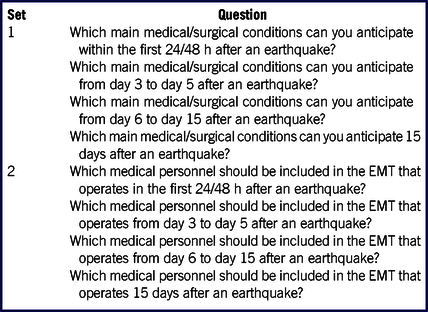
In round 1 of the Delphi, experts were asked to provide their opinion on the needs/medical resources that an EMT should consider according to the time of the arrival of the unit after an earthquake. An open-ended questionnaireReference Custer, Scarcella and Stewart26 made of 2 sets of 4 questions each was administered asking for: (1) the medical conditions they can anticipate according to the time of arrival of the unit; and (2) the staff required according to the time of arrival of the unit (see Table 1).
Questions Used in the First Round of the Delphi Study

The questionnaire was tested internally among academic staff and members of the UKMed with a knowledge in this area of research.
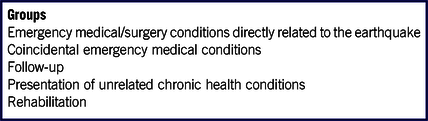
The opinions expressed in round 1, question set 1 were analyzed for uniqueness. The unique conditions mentioned were then thematically collated and fell into the 5 condition-related groups shown in Table 2.
Condition-Related Groups

The opinions expressed in round 2, question set 2 were analyzed for uniqueness. There was little divergence between experts and opinions were in line with the minimum standard provided by the WHO.27 These data were not taken forward to round 2. No additional statements were admitted after round 1.
In round 2, the expert Delphi panel was presented with the condition-related groups derived from thematic analysis of the replies received from round 1, question set 1. In this round, the expert panel was asked to imagine they were operational in the immediate aftermath of an earthquake with the capacity to receive 100 patients per d. They were asked to estimate the percentage of patients presenting in each condition-related group in the first 48 h, between 3 and 5 d, between 6 and 15 d, and over 15 d after the event. The opinions of the experts were collated, and a mean percentage was derived for each condition-related group at each time point.
In round 3, the derived mean percentages for each condition-related group at each time point were fed back to the expert panel together with a reminder of their personal estimate of that percentage in round 2. Members were asked to indicate if they wished to modify their estimate having considered the panel mean. Any changes were used to alter the mean.
Finally, the results of the modified Delphi were combined with the outcomes of the review of the literature search to create a decision support framework.
RESULTS
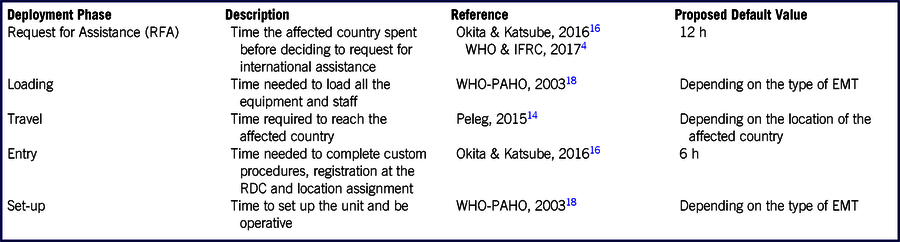
The literature search revealed 5 main time phases in the mobilization of an EMT to becoming operational in the affected area: (1) Request For Assistance (RFA); (2) Loading time; (3) Travel time; (4) Entry time; and (5) Set up/tasking time.
The RFA time considers the time necessary for the affected country to make the assessment of needs, determining whether the international assistance is required, and terminates with the formal request of international assistance.4
The Loading time identifies the time from the RFA to the departure of the team to the affected area. It considers the time the assisting nations need to load all the assets, contact all the staff involved, and the shipping of all the assets from the airport. For International EMTs, WHO and International Federation of Red Cross and Red Crescent Societies (IFRC) reports suggest that the loading time should be within 12 h for all the teams.4
The Travel time considers the time necessary to reach the affected nation. The amount of the hours for the framework strongly depend on the location of the disaster. This time can be affected by unexpected logistical complications, such as the unavailability of the airport like the Nepal earthquake of 2015.
The Entry time considers the time needed to the Reception and Departure Centre (RDC) procedures of registration and location assignment. The RDC requests that necessary conditions are in place to allow the goods and staff into the affected country: some of these conditions are borders control, customs, and contact with local authorities, such as airport and road. This time can be extremely variable and dependent on country and coordination.
The Set-up time is the time from the arrival in the designated area to the complete set up of the team. According to the WHO, EMTs type 1 should be available to arrive in the fastest possible time, ideally within 24-48 h, and be considered light and portable while Type 3 EMTs are unlikely to be operational in the field for at least 5-7 d (WHO, 2013).
The 5 main phases are summarized in Table 3.
Main Time Phases That Define the Time to Be Operational

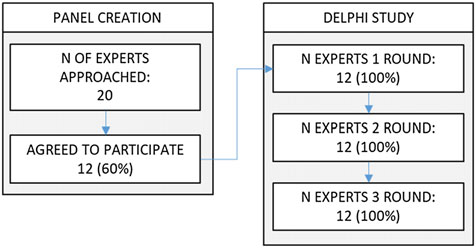
A total of 20 experts were approached, of whom 12 (60%) agreed to participate in the study. In line with the literature,Reference Paliwoda28 the number of the expert in the final panel ranges from 10 to 18 members in size and consists of: 4 academic researchers (3 of them coming from WHO Collaborating Centers), 5 EMT team leaders (Italy, Finland, 2 from China, and United Kingdom), 1 member of the EMT secretariat, 2 WHO EMT mentors.
All of the members participated in all of the rounds and they agreed on all of the data provided (see Figure 1); as underlined by Okoli and Pawlowski,Reference Okoli and Pawlowski29 nonresponse is typically very low in Delphi surveys when researchers have personally obtained assurances of participation.
Overview of the Delphi Flow and the Number of Experts Involved in Each Round

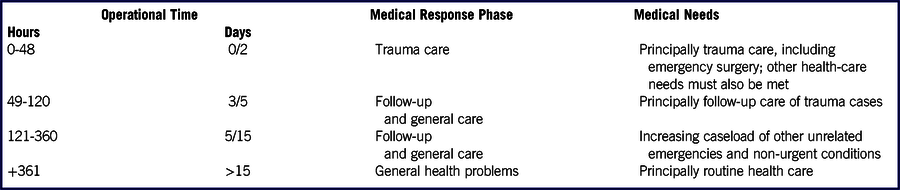
The questionnaire has been used to define the medical needs according to the operational time and the medical response phase (Table 4): in the immediate aftermath of the event (24-48 h), the team can expect to receive 8 of 10 patients with problems directly related to the earthquake, while, after 15 d, the patients will have mostly routine health-care issues. Patients with follow-up needs will start to present from 3 to 15 d.
Medical Needs According to the Operational Time and the Medical Response Phase

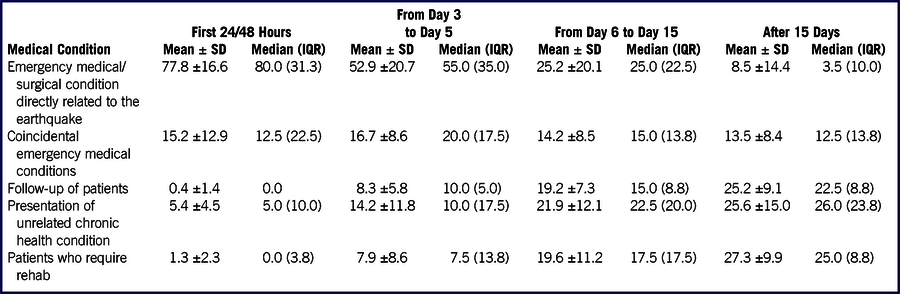
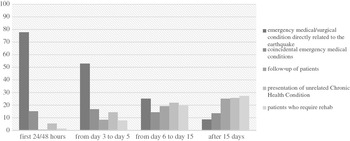
Table 5 and Figure 2 present the results of the round 2, showing the mean percentages of patients presenting in each condition-related group at each time point.
Expected Medical Condition According to the Operational Phases

Expected Medical Condition According to the Operational Phases

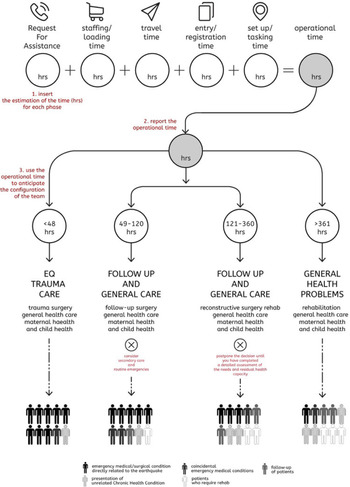
All the information collected has been merged to create the decision support framework shown in Figure 3.
The Decision Support Framework for EMT Deployment (With Instructions)

The framework is divided into 2 parts. The upper part helps to calculate the tentative total time a relief team will need to become operational on the ground; such time is the result of the sum of the estimation of the time required to accept the RFA, prepare the deployment, travel, enter the country, and get ready to be operational. The total time to be operational, resulting from the first part, is used in the second part to allow decision-makers to anticipate the configuration of teams to best meet the needs on the ground at the time of their arrival.
DISCUSSION
The experts confirmed that, after an earthquake, the provision of health care is required throughout all the phases identified in this study and trauma care is needed most in the very early phase after an earthquake; furthermore, they highlighted that after 48 h the number of emergency medical/surgical conditions directly related to the earthquake starts to plunge rapidly. Figures 1 and 2 represent the variation in time of the expected medical conditions result of the opinion of the panel of the experts and reinforce the current published literatureReference Von Schreeb, Riddez and Samnegård10,Reference Fernald and Clawson30 providing further information about the medical needs after a disaster. In the aftermath of an earthquake, in fact, EMTs have focused their training and capacity on providing emergency trauma care for the initial 48 h following the event, while in practice they tend to be operational much later. The deployment of an EMT should also aim at working as surge capacity for pre-existing hospital facilities rather than providing immediate independent trauma care.Reference Von Schreeb, Riddez and Samnegård10
We describe an intuitive, easy-to-use framework (see Figure 3) that helps to calculate the tentative total time required to become operational on the ground and so help decision-makers to: (1) decide whether to deploy the team or not when relief activities are no longer indicated; (2) anticipate which kind of medical/surgical conditions they will meet; and (3) select the most appropriate personnel to deploy according to the anticipated needs. The framework provided in this study needs to be validated in the field during future responses and, because this framework may not be used soon, also through international trainings courses and programs, such as the TEAMS project, the Emergency Medical Team Coordination Cell (EMTCC) Training Course, and United Nations Disaster Assessment and Coordination (UNDAC) Induction Course. This will help to further populate the table and improve the capacity of the framework to support disaster managers. Once the framework is tested and validated, it will serve as a basis for the creation of a Decision Support System (DSS) that can could help the WHO Coordination Centre, host governments, and decision-makers to decide whether to deploy or accept a team.
This study (and the resulting framework) has its limitations. It is the result of a simplification of the deployment process and, of course, the estimated operational time may be different in practice from the real time. The definition of some of the standard time phases for deployment depend on the decision the affected country, unavoidable logistical problems, and the characteristics of team, such as the type of the EMT and the related loading time. It is in the nature of a disaster for there to be unpredictability; nevertheless, the framework we believe is a useful aide memoire to kick-start the deployment process and can be customized by its users.
CONCLUSIONS
The decision to deploy a relief team and the scale of deployment rely heavily on context and the nature of the event; the use of such teams is highly costly and, when a decision is not based on an appropriate assessment of needs/gaps, it can be counter-productive in terms of coordination and outcomes. as shown by the experience of the Nepal earthquake and other past disasters.
This study aims at improving the von Schreeb’s graph with a more detailed description of the expected medical condition for each operational phase of an earthquake and at providing an usable decision support framework that could help better mapping the EMT configuration to the needs on the ground at the time the team becomes operational in the field. Further researches and validations, both in the field and through international trainings courses and programs, are needed to improve the capacity of the framework to support disaster managers; understanding how experts and decision makers benefit from it in making informed decision on deployment of EMTs after an earthquake, in fact, is pivotal to improve its effectiveness and efficacy.
Finally, with additional research, the same approach may also be adapted to support the decision to deploy other types of relief teams such as a SAR team using data from the work by Macintyre and colleaguesReference Macintyre, Barbera and Smith31 that provides an empirical calculation of the maximum survival time in entrapment helps responders.
Funding
This research has been funded by the Hong Kong Jockey Club Charities Trust within the collaborative project “Training and Research Development for Emergency Medical Teams with reference to the WHO Global EMTs initiative, classification and standards” between the Humanitarian and Conflict Response Institute (HCRI) and the Hong Kong Jockey Club Disaster Preparedness and Response Institute (HKJCDPRI)”.
Acknowledgments
The authors thank all the experts who provided their opinion about the topic. Icons used in the framework are made by Freepik from www.flaticon.com.