





An estimated 16.8 million people in the UK (25% of the population) live with a disability, defined as the reduced ability to carry out daily activities for more than 12 months due to poor mental or physical health. Reference Kirk-Wade1 Mental health problems are the most reported cause of functional impairments among working-age adults. Reference Kirk-Wade1 Individuals with disabilities in the UK face significant inequalities, including lower levels of education and employment, higher rates of poverty, loneliness, anxiety and reduced life satisfaction. 2 These disparities highlight the importance of understanding factors that contribute to functional impairments. Cognitive function may be one such determinant of daily functioning. Evidence from older adults shows that reduced cognitive ability is linked to difficulties with everyday activities such as mobility and self-care. Reference Raimo, Maggi, Ilardi, Cavallo, Torchia and Pilgrom3 Although most research has focused on older populations, some studies have shown that cognitive function in young and middle-aged adults also predicts daily functioning, suggesting that the impact of cognition on functioning spans the entire adult lifespan. Reference Elovainio, Kivimäki, Ferrie, Gimeno, De Vogli and Virtanen4–Reference Jacob, Smith, Thoumie, Haro, Stickley and Koyanagi6
Cognitive dysfunction is also a feature of most mental health disorders, Reference Abramovitch, Short and Schweiger7 often affecting individuals’ ability to carry out life activities, maintain self-care and participate in society. Reference Depp, Mausbach, Harmell, Savla, Bowie and Harvey8–Reference Evans, Iverson, Yatham and Lam10 While studies in older adults have found associations between depressive symptoms, cognition and daily functioning, Reference Buss, Aponte Becerra, Trevino, Fortier, Ngo and Novak11–Reference Wu14 less research has explored how mental health may influence the cognition-functioning relationship identified in cohorts including younger populations. Reference Jacob, Smith, Thoumie, Haro, Stickley and Koyanagi6 For example, in a cross-sectional study of adults in England, Jacob et al Reference Jacob, Smith, Thoumie, Haro, Stickley and Koyanagi6 found that lower IQs were associated with greater difficulties with daily living activities. They explored potential confounding factors such as socioeconomic status, obesity and substance use but did not include measures of mental health. Evidence from the Whitehall II and SWAN studies suggests that depressive symptoms have a modest attenuating effect on this relationship in middle-aged adults, but they did not examine anxiety or lifetime psychiatric diagnoses. Reference Elovainio, Kivimäki, Ferrie, Gimeno, De Vogli and Virtanen4,Reference Ford, Sowers, Seeman, Greendale, Sternfeld and Everson-Rose5 Given that mental disorders are a leading cause of disability Reference Kirk-Wade1 and are known to have an impact on cognitive function, Reference Abramovitch, Short and Schweiger7 common mental health symptoms and psychiatric history may confound the association between cognitive function and functional difficulties identified in these studies, but this has not been fully explored.
Current study
The aim of this cross-sectional study was to examine the relationship between cognition, mental health and life functioning in two Welsh cohorts: (a) HealthWise Wales, an online population sample, and (b) the National Centre for Mental Health (NCMH), a clinically ascertained psychiatric sample. To our knowledge, no studies have examined this using population and clinical cohorts with comparable measures, which allowed us to directly compare effect sizes between the two. The inclusion of both samples allowed us to examine whether the association between cognition and functioning is unique to psychiatric populations or is also evident in a population sample. We will use the broad terminology of ‘functioning’ or ‘functional impairment’ in recognition of the fact that not all social, occupational or functional difficulties constitute a disability. We hypothesised that lower cognitive performance would be associated with greater functional difficulties in both cohorts, and current symptoms of depression and anxiety and psychiatric history would partly confound these associations.
Method
Participants
National Centre for Mental Health
The NCMH is a Welsh Government-funded research centre that investigates mental health across the lifespan. Participants were invited to complete the study through letters or emails between October 2016 and July 2018 (N = 6904).
HealthWise Wales
HealthWise Wales is an online national population cohort of adults living in Wales or accessing their healthcare in Wales. The study was added as a module on the HealthWise Wales website in January 2020, and invitation emails were sent to all participants (N = 29 492). Participants completed the study between January and December 2020.
All participants provided informed consent by checking boxes to indicate they agreed to the consent statements online.
Measures
Data sources
In the NCMH, all data were collected at a single time point, supplemented by existing diagnostic data from the wider NCMH project. In HealthWise Wales, data on cognition, self-reported functioning and symptoms of depression and anxiety were collected at a single time point. This was linked to existing HealthWise Wales data and the Secure Anonymised Information Linkage (SAIL) databank via the Secure Access Portal and Protected HWW Information Repository (SAPPHIRe), powered by the UK Secure e-Research Platform. Reference Jones, Ford, Jones, Dsilva, Thompson and Brooks15 SAIL is a national repository of anonymised health and administrative data for over 3 million people in Wales. Reference Tseliou and Ashfield-Watt16,Reference Lyons, Jones, John, Brooks, Verplancke and Ford17 Study data were imported into SAPPHIRe under existing permissions, adhering to research governance and data protection standards. HealthWise Wales data had been previously linked to SAIL, Reference Tseliou and Ashfield-Watt16 allowing us to use existing participant identifiers to match the study data without requiring identifiable information (3151 participants linked). Linked data-sets included the Patient Episode Dataset for Wales, the Welsh Longitudinal GP Dataset, the Outpatient Database for Wales and the Emergency Department Dataset. To mitigate the effects of using data collected at different time points, only HealthWise Wales questionnaires completed within 1 year prior to or following completion of the cognitive and functioning assessments were included.
Cognition
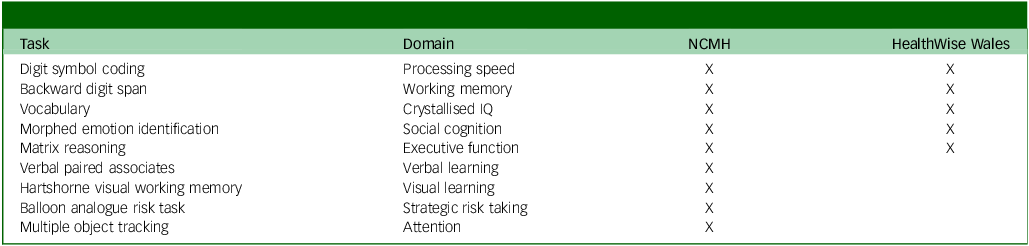
The Cardiff Online Cognitive Assessment (CONCA) was developed for psychiatric research. Reference Lynham, Jones and Walters18 All tasks, including source codes, were developed by The Many Brains Project (https://www.manybrains.net/). NCMH participants completed CONCA between 2016 and 2018, during which time CONCA consisted of nine tasks hosted on The Many Brains Project’s TestMyBrain platform (https://www.testmybrain.org/). Reference Lynham, Jones and Walters18 CONCA was subsequently shortened to five tasks (three core tasks and a further two optional tasks), and hosted on a custom-built website (https://conca.wales/about.html). Reference Lynham, Jones and Walters19 Subsequently, these tasks were completed by HealthWise Wales participants in 2020. The tasks completed by each cohort are shown in Table 1.
Cardiff ONline Cognitive Assessment (CONCA) tasks

Table 1 Long description
A table comparing cognitive assessment tasks across two studies, NCMH and HealthWise Wales. The table has 3 columns and 9 rows. The columns are labeled Task, Domain, NCMH, and HealthWise Wales. The rows list different cognitive tasks, their corresponding domains, and indicate with an X which tasks were completed by each cohort. Row 1: Digit symbol coding, Processing speed, X, X. Row 2: Backward digit span, Working memory, X, X. Row 3: Vocabulary, Crystallised IQ, X, X. Row 4: Morphed emotion identification, Social cognition, X, X. Row 5: Matrix reasoning, Executive function, X, X. Row 6: Verbal paired associates, Verbal learning, X. Row 7: Hartshorne visual working memory, Visual learning, X. Row 8: Balloon analogue risk task, Strategic risk taking, X. Row 9: Multiple object tracking, Attention, X.
National Centre for Mental Health (NCMH) completed nine CONCA tasks (2016–2018). HealthWise Wales completed five CONCA tasks in 2020, two of which were optional (morphed emotion identification and matrix reasoning).
Functioning
Daily functional impairments were assessed using the World Health Organization Disability Assessment Schedule, Version 2 (WHODAS 2.0). Reference Rehm, Üstün, Saxena, Nelson, Chatterji and Ivis20 WHODAS 2.0 measures difficulties over the past 30 days across 6 domains: mobility, self-care, household responsibilities, subjective cognition, social interactions and participation in society, with responses rated from ‘none’ to ‘extreme or cannot do’. It should be noted that the WHODAS 2.0 was an optional questionnaire for HealthWise Wales, which was completed by 1033/3679 participants (28%). A comparison of HealthWise Wales participants who completed the WHODAS and those who did not is provided in Supplementary Table S1. Two additional binary variables were included: (a) living with a partner and (b) employed or in education (for participants under 66 years).
Mental health and lifestyle factors
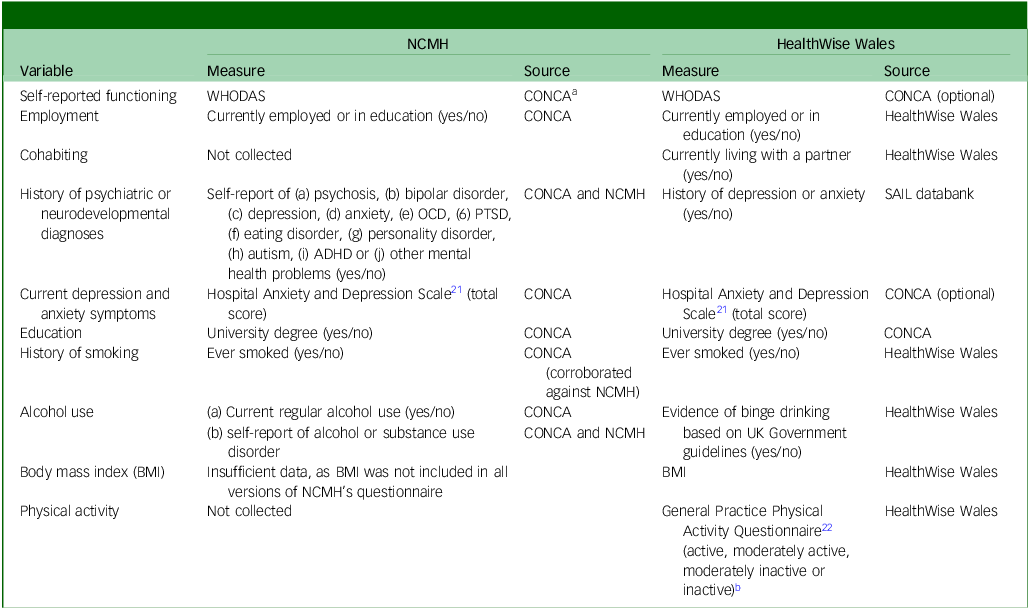
Mental health and lifestyle variables were selected based on existing evidence for their association with cognition and functioning: current depression and anxiety symptoms (Hospital Anxiety and Depression Scale, HADS), Reference Zigmond and Snaith21 history of psychiatric or neurodevelopmental diagnoses, educational attainment, body mass index (BMI), alcohol use, ever smoked and physical activity (General Practice Physical Activity Questionnaire). 22 The depression and anxiety subscales of the HADS were combined into a total score, as the correlations between the subscale scores were too high to allow any meaningful separation (HealthWise Wales: r = 0.76; NCMH: r = 0.70). We attempted to select variables from both samples that were as closely matched as possible. Measures and sources of data for each variable are outlined in Table 2.
Measures across studies

Table 2 Long description
A table comparing measures across two studies, NCMH and HealthWise Wales, with columns for measure, source, and corresponding details for each study. The table has 10 rows and 4 columns. Column headers are Measure, Source for NCMH, Measure for HealthWise Wales, and Source for HealthWise Wales. Row 1: Self-reported functioning (optional), WHODAS, CONCA, WHODAS, CONCA. Row 2: Employment, Currently employed or in education (yes/no), CONCA, Currently employed or in education (yes/no), HealthWise Wales. Row 3: Cohabiting, Not collected,, Currently living with a partner (yes/no), HealthWise Wales. Row 4: History of psychiatric or neurodevelopmental diagnoses databank, Self-report of (a) psychosis, (b) bipolar disorder, (c) depression, (d) anxiety, (e) OCD, (f) PTSD, (g) eating disorder, (h) personality disorder, (i) autism, (j) ADHD or (k) other mental health problems (yes/no), CONCA and NCMH, History of depression or anxiety (yes/no), SAIL. Row 5: Current depression and anxiety symptoms (optional), Hospital Anxiety and Depression Scale (total score), CONCA, Hospital Anxiety and Depression Scale (total score), CONCA. Row 6: Education, University degree (yes/no), CONCA, University degree (yes/no), CONCA. Row 7: History of smoking, Ever smoked (yes/no), CONCA, Ever smoked (yes/no), HealthWise Wales. Row 8: Alcohol use, (a) Current regular alcohol use (yes/no), (b) self-report of alcohol or substance use disorder, CONCA, Evidence of binge drinking based on UK Government guidelines (yes/no), HealthWise Wales. Row 9: Body mass index (BMI), Insufficient data, as BMI was not included in all versions of NCMH’s questionnaire,, BMI, HealthWise Wales. Row 10: Physical activity, Not collected,, General Practice Physical Activity Questionnaire (active, moderately active, moderately inactive or inactive), HealthWise Wales.
NCMH, National Centre for Mental Health; WHODAS, World Health Organization Disability Assessment Schedule; CONCA, Cardiff ONline Cognitive Assessment; SAIL, Secure Anonymised Information Linkage; OCD, obsessive–compulsive disorder; PTSD, post-traumatic stress disorder; ADHD, attention-deficit hyperactivity disorder; BMI, body mass index.
a. CONCA refers to the current study and indicates that the data was collected concurrently with the cognitive assessment.
b. Physical activity includes planned physical exercise (e.g. gym, sports), cycling, walking, housework, gardening and DIY, as well as the type and amount of physical activity involved in their work.
Psychiatric and neurodevelopmental history
In NCMH, psychiatric and neurodevelopmental diagnoses were primarily self-reported in response to the question, ‘Has a doctor or health professional ever told you that you have any of the following diagnoses?’ Participants selected all diagnoses that applied. Additional data were obtained from other NCMH projects, which used self-report and semi-structured interviews (see Supplementary Note 1). The diagnoses included as binary variables were psychosis, bipolar disorder, depression, anxiety, obsessive–compulsive disorder, post-traumatic stress disorder, eating disorder, personality disorder, alcohol or substance use disorder, autism spectrum disorder, attention-deficit hyperactivity disorder and other mental health problems. Diagnoses were not mutually exclusive so participants could be included in multiple groups. This was not the case for individuals with psychosis or bipolar disorder, who were excluded from the depression and anxiety groups.
In HealthWise Wales, we derived data on psychiatric diagnoses from electronic health records held in the SAIL databank. Participants were rated as having a diagnosis of depression or anxiety if they had a historical diagnosis of depression/anxiety and there was a record of treatment and a record of diagnosis or symptoms in their medical records within 12 months of completing CONCA using the algorithm described by John et al Reference John, McGregor, Fone, Dunstan, Cornish and Lyons23 (Algorithm 10).
Analysis
All analyses were conducted using R (Version 3.6.1 for Windows; The R Foundation for Statistical Computing; Vienna, Austria; https://cran.r-project.org/). Z scores were derived for each cognitive task, and general cognitive ability (‘g’) was derived using multidimensional scaling (an analogous approach to principal component analysis that can accommodate missing data), including scores on all the tasks. General cognitive ability (‘g’) was selected as our primary independent variable, as we have previously shown that most of the variance in performance on the tasks can be accounted for by a single factor, Reference Lynham, Jones and Walters19 which is consistent with previous psychiatric research. Reference Harvey, Aslan, Du, Zhao, Siever and Pulver24 Both ‘g’ derived using the five-task and nine-task CONCA have been validated against the MATRICS Consensus Cognitive Battery (both r = 0.78). Reference Lynham, Jones and Walters18,Reference Lynham, Jones and Walters19
We derived WHODAS domains through confirmatory factor analysis using the ‘lavaan’ package, based on theoretical models for the 12-item WHODAS, Reference Andrews, Kemp, Sunderland, Von Korff and Ustun25 as the scoring procedure for the 12-item version produces an overall score only. We used diagonally weighted least squares estimation to estimate the model. We evaluated model fit based on the following criteria: comparative fit index (CFI) > 0.9, Tucker-Lewis index (TLI) > 0.9, root mean square error of approximation (RMSEA) < 0.08 and standardised root mean squared residual (SRMR) < 0.08. Reference Andrews, Kemp, Sunderland, Von Korff and Ustun25,Reference Holmberg, Gremyr, Torgerson and Mehlig26 Model fit was improved by allowing covariance between latent factors based on modification indices. Factor scores were derived from the most appropriate model.
We conducted linear and logistic regressions to assess the associations between cognitive performance and (a) WHODAS factor scores, (b) living with a partner or spouse and (c) employed or in full-time education. Each cognitive task and ‘g’ were analysed separately, with age and gender as covariates; device type was also included for the HealthWise Wales sample (not available for NCMH). P values were corrected using the false discovery rate method.
To assess potential confounding mental health and lifestyle factors, we examined the associations between each variable and (a) cognitive performance and (b) functioning using linear or logistic regression (see Supplementary Table S2). Variables significantly associated with both were added as covariates in follow-up models. Separate models were run for each outcome (WHODAS, employment and cohabiting) in each sample, including all relevant confounding variables.
Results
Sample characteristics
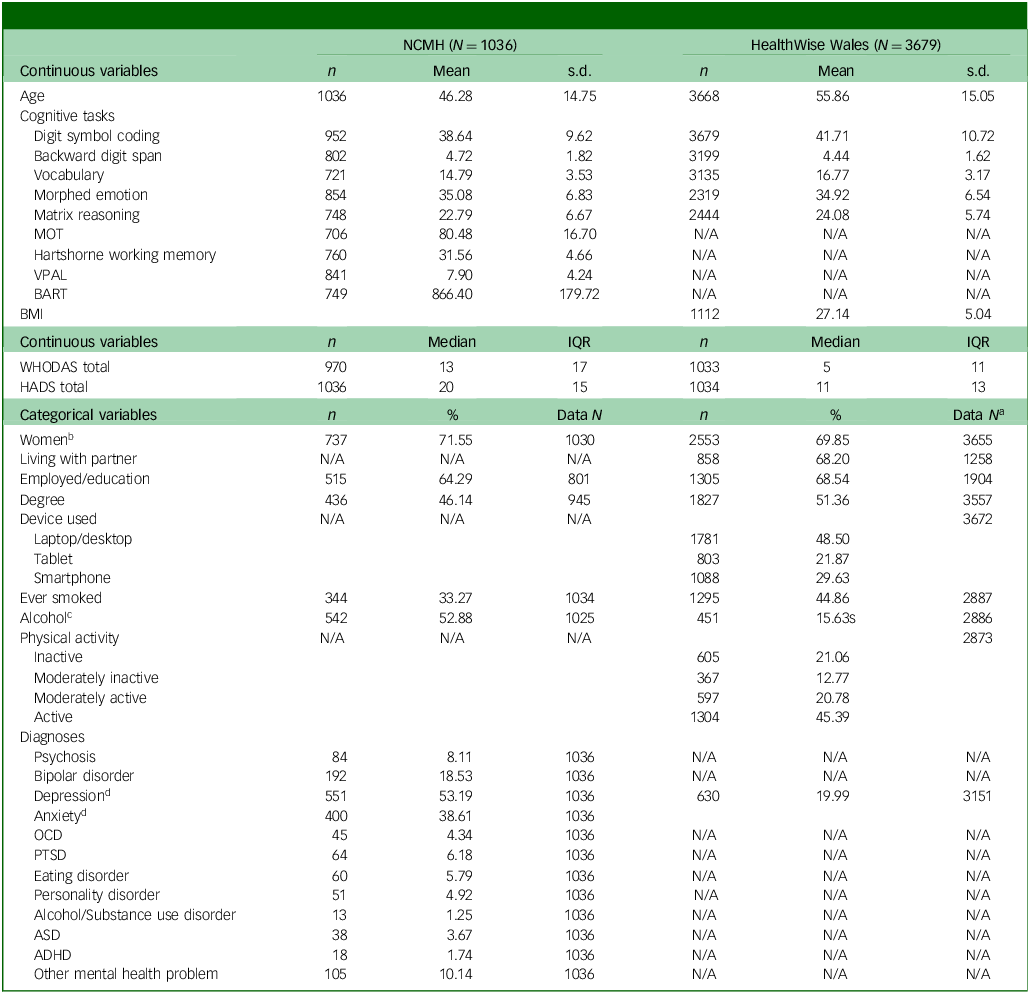
The total number of participants who completed at least 1 cognitive task was 1036 in the NCMH (16–79 years) and 3679 in HealthWise Wales (16–93 years). Completion rates varied across the variables (see Table 3). Compared with the HealthWise Wales sample, the NCMH participants were significantly younger (t(4702) = 18.17, P < 0.001, d = 0.64), had higher WHODAS scores (t(2001) = –15.11, P < 0.001, d = –0.68), higher HADS scores (t(2068) = –15.05, P < 0.001, d = –0.66), lower rates of employment (X 2 = 66.96, P < 0.001), fewer undergraduate degrees (X 2 = 7.95, P = 0.005) and were less likely to report that they had ever smoked (X 2 = 41.77, P < 0.001). The NCMH participants had lower performance than the HealthWise Wales participants on digit symbol coding (t(4629) = 8.04, P < 0.001, d = 0.29), vocabulary (t(3854) = 14.79, P < 0.001, d = 0.61), matrix reasoning (t(3190) = 5.17, P < 0.001, d = 0.22) and higher performance on backward digit span (t(3999) = –4.27, P < 0.001, d = –0.17). The samples did not differ in gender distributions (X 2 = 1.04, P = 0.31) or scores on the morphed emotion identification task (t(3171) = –0.60, P = 0.55, d = –0.02).
Sample characteristics

Table 3 Long description
A table comparing sample characteristics between NCMH (N = 1036) and HealthWise Wales (N = 3679) participants. The table has 30 rows and 12 columns. Column headers include Continuous variables, n, Mean, s.d., n, Mean, and s.d. for both NCMH and HealthWise Wales. Row labels include Age, Cognitive tasks (Digit symbol coding, Backward digit span, Vocabulary, Morphed emotion, Matrix reasoning, MOT, Hartshrone working memory, VPAL, BART), BMI, Continuous variables (WHODAS total, HADS total), Categorical variables (Women, Living with partner, Employed/education, Degree, Device used, Ever smoked, Alcohol, Physical activity, Diagnoses). Row 1: Age, 1036, 46.28, 14.75, 3668, 55.86, 15.05. Row 2: Digit symbol coding, 952, 38.64, 9.62, 3679, 41.71, 10.72. Row 3: Backward digit span, 802, 4.72, 1.82, 3199, 4.44, 1.62. Row 4: Vocabulary, 721, 14.79, 3.53, 3135, 16.77, 3.17. Row 5: Morphed emotion, 854, 35.08, 6.83, 2319, 34.92, 6.54. Row 6: Matrix reasoning, 748, 22.79, 6.67, 2444, 24.08, 5.74. Row 7: MOT, 706, 80.48, 16.70, N/A, N/A, N/A. Row 8: Hartshrone working memory, 760, 31.56, 4.66, N/A, N/A, N/A. Row 9: VPAL, 841, 7.90, 4.24, N/A, N/A, N/A. Row 10: BART, 749, 866.40, 179.72, N/A, N/A, N/A. Row 11: BMI, 1036, N/A, N/A, 1112, 27.14, 5.04. Row 12: WHODAS total, 970, 13, 17, 1033, 5, 11. Row 13: HADS total, 1036, 20, 15, 1034, 11, 13. Row 14: Women, 737, 71.55, 1030, 2553, 69.85, 3655. Row 15: Living with partner, N/A, N/A, N/A, 858, 68.20, 1258. Row 16: Employed/education, 515, 64.29, 801, 1305, 68.54, 1904. Row 17: Degree, 436, 46.14, 945, 1827, 51.36, 3557. Row 18: Device used, N/A, N/A, N/A, Laptop/desktop, 1781, 48.50, 3672. Row 19: Tablet, 803, 21.87. Row 20: Smartphone, 1088, 29.63. Row 21: Ever smoked, 344, 33.27, 1034, 1295, 44.86, 2887. Row 22: Alcohol, 542, 52.88, 1025, 451, 15.63, 2886. Row 23: Physical activity, Inactive, 605, 21.06, 2873. Row 24: Moderately inactive, 367, 12.77. Row 25: Moderately active, 597, 20.78. Row 26: Active, 1304, 45.39. Row 27: Psychosis, 84, 8.11, 1036, N/A, N/A, N/A. Row 28: Bipolar disorder, 192, 18.53, 1036, N/A, N/A, N/A. Row 29: Depression, 551, 53.19, 1036, 630, 19.99, 3151. Row 30: Anxiety, 400, 38.61, 1036, N/A, N/A, N/A.
NCMH, National Centre for Mental Health; IQR, interquartile range, MOT, multiple object tracking, VPAL, Verbal paired associates learning; BART, balloon analogue risk task,; WHODAS, World Health Organization Disability Assessment Schedule; HADS, Hospital Anxiety and Depression Scale; OCD, obsessive–compulsive disorder; PTSD, post-traumatic stress disorder; ASD, autism spectrum disorder; ADHD, attention-deficit hyperactivity disorder.
a. Data were included if it was collected within 1 year of CONCA completion.
b. Included cis women and transwomen.
c. Alcohol use was defined as evidence of binge drinking in HealthWise Wales and current alcohol use in NCMH.
d. In HealthWise Wales, depression and anxiety were a combined variable.
In HealthWise Wales, participants who completed the WHODAS (n = 1033) were younger (t(3666) = 12.60, P < 0.001, d = 0.46), more likely to be women (X 2 = 13.46, P < 0.001), more likely to have a degree (X 2 = 14.1, P < 0.001), less likely to smoke (X 2 = 6.01, P = 0.01), less likely to use a tablet computer (X 2 = 9.37, P = 0.009) and more likely to have a history of depression or anxiety (X 2 = 6.43, P = 0.01) than participants who did not complete the WHODAS (see Supplementary Table S1). After correction for age, gender and device, participants who completed the WHODAS had higher scores on digit symbol coding than participants who did not (B = 0.08, 95% CI (0.03,0.14), P = 0.01), but there were no other significant differences in cognitive scores.
WHODAS
Confirmatory factor analysis
In both samples, the best-fitting WHODAS model included an overall functional impairment factor and six domains: mobility, self-care, household responsibilities, cognition, social and society (see Supplementary Table S3). Model fit was improved by allowing covariation between related latent factors, primarily those linked to physical mobility, which was guided by modification indices and similar models in previous research. Reference Holmberg, Gremyr, Torgerson and Mehlig26 The final model for both samples yielded the following fit indices: CFI = 1, TLI = 1, RMSEA < 0.05, SRMR < 0.05 (see Supplementary Figure 1). Factor scores were derived for overall functioning and each domain.
Associations with cognitive performance
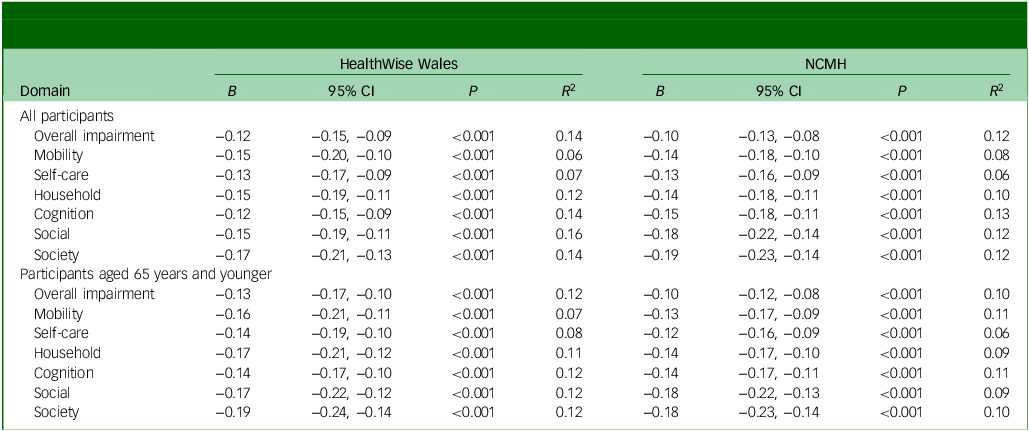
Higher ‘g’ was associated with better overall functioning in the NCMH (B = –0.10, 95% CI (–0.13,–0.08), P < 0.001, adjusted R 2 = 0.12) and HealthWise Wales (B = –0.12, 95% CI (–0.15,–0.09), P < 0.001, adjusted R 2 = 0.14) across all WHODAS domains (see Table 4). The associations between ‘g’ and overall functioning remained significant when the WHODAS cognition domain was removed (NCMH: B = –0.09, 95% CI (–0.11,–0.07), P < 0.001, adjusted R 2 = 0.09; HealthWise Wales: B = –0.12, 95% CI (–0.15,–0.09), P < 0.001, adjusted R 2 = 0.13). Associations between the individual tasks and overall WHODAS scores were all significant and comparable to the associations between ‘g’ and WHODAS (B ranged between –0.18 and –0.06, all P < 0.01; see Supplementary Table S4). Due to WHODAS scores skewed towards 0 in the HealthWise Wales sample, we conducted follow-up analyses using dichotomised domains (any impairment v. none). Higher ‘g’ was associated with lower likelihood of impairment across all domains (odds ratio 0.65–0.83; see Supplementary Table S5). We repeated the analyses restricting the sample to participants of working age (<66 years, NCMH n = 868, HealthWise Wales n = 801). This did not change the results (see Table 4). Finally, due to the different versions of CONCA used in the cohorts, we conducted sensitivity analyses in the NCMH cohort by deriving ‘g’ using the scores from the five tasks of CONCA included in HealthWise Wales and regressing this five-task ‘g’ against our outcome measures. Results were comparable to the main analyses (see Supplementary Table S6).
Associations between functioning domains and general cognitive ability (‘g’) in HealthWise Wales and the National Centre for Mental Health (NCMH)

Table 4 Long description
A table comparing associations between functioning domains and general cognitive ability in HealthWise Wales and the National Centre for Mental Health (NCMH). The table has 14 rows and 10 columns. The columns are labeled as Domain, B, 95% CI, P, R2 for HealthWise Wales, and B, 95% CI, P, R2 for NCMH. The rows are grouped into two sections: All participants and Participants aged 65 years and younger. Each section includes domains such as Overall impairment, Mobility, Self-care, Household, Cognition, Social, and Society. The table presents values for B, 95% CI, P, and R2 for each domain in both studies. Notable trends include significant negative associations between general cognitive ability and various functioning domains in both studies, with P values all less than 0.001.
Results from linear regressions with WHODAS domains and overall functional impairment as outcome measures. P: adjusted p-value; R 2: adjusted R 2.
Role of mental health and other covariates
In the NCMH, the variables associated with both ‘g’ and WHODAS were HADS scores, current alcohol use, ever smoked, education and diagnosis of bipolar disorder (see Supplementary Table S2). After inclusion of these covariates, higher ‘g’ remained significantly associated with higher overall functioning (B = –0.03, 95% CI (–0.05,–0.02), P < 0.001, adjusted R 2 = 0.63). A higher HADS score (B = 0.04, 95% CI (0.04,0.05), P < 0.001) and diagnosis of bipolar disorder (B = 0.13, 95% CI (0.06,0.2), P < 0.001) were associated with lower overall functioning.
In HealthWise Wales, the variables associated with both ‘g’ and WHODAS were HADS scores, BMI, ever smoked, physical activity, education and diagnosis of anxiety/depression (see Supplementary Table S2). After inclusion of these covariates, higher ‘g’ remained significantly associated with higher overall functioning (B = –0.05, 95% CI (–0.08,–0.01), P = 0.02, adjusted R 2 = 0.67). A higher HADS score (B = 0.05, 95% CI (0.04,0.05), P < 0.001) and history of anxiety/depression (B = 0.16, 95% CI (0.04,0.29), P = 0.009) were associated with lower overall functioning, whereas being active (B = –0.14, 95% CI (–0.26,–0.01), P = 0.03) was associated with higher functioning. These results were consistent across the domains of functioning in both samples (see Supplementary Table S7), with the exception that in HealthWise Wales, cognition was no longer associated with the WHODAS social domain after inclusion of covariates.
Real-world indicators of functioning
Higher ‘g’ was associated with being in employment or education in the NCMH (odds ratio 1.31, 95% CI (1.19,1.46), P < 0.001, Nagelkerke’s R 2 = 0.10). The result was similar in a sensitivity analysis using a five-task ‘g’ in the NCMH (see Supplementary Table S6). Data on living with a partner were not available in the NCMH. Higher ‘g’ was associated with a higher likelihood of living with a partner or spouse (odds ratio 1.19, 95% CI (1.06,1.32), P = 0.003, Nagelkerke’s R 2 = 0.03) and being in employment or education (odds ratio 1.22, 95% CI (1.11,1.34), P < 0.001, Nagelkerke’s R 2 = 0.24) in HealthWise Wales. Associations between individual tasks and outcome measures are available in Supplementary Table S4.
Role of mental health and other covariates
In the NCMH, the variables associated with both ‘g’ and current employment were HADS scores, current alcohol use, ever smoked, education and diagnoses of bipolar disorder, psychosis or depression. After inclusion of these covariates, ‘g’ was not associated with employment (odds ratio 1.09, 95% CI (0.97,1.23), P = 0.15, Nagelkerke’s R 2 = 0.29). A higher HADS score (odds ratio 0.93, 95% CI (0.9,0.95), P < 0.001), diagnosis of bipolar disorder (odds ratio 0.52, 95% CI (0.27,0.99), P = 0.047) and diagnosis of psychosis (odds ratio 0.32, 95% CI (0.14,0.73), P = 0.007) were associated with lower likelihood of employment. Current alcohol use (odds ratio 1.50, 95% CI (1,2.24), P = 0.048) and having a degree (odds ratio 2.03, 95% CI (1.34,3.06), P < 0.001) were associated with higher likelihood of employment.
In HealthWise Wales, the variables associated with both ‘g’ and current employment were HADS scores, BMI, ever smoked, physical activity, education and diagnosis of anxiety/depression (see Supplementary Table S2). After inclusion of these covariates, ‘g’ was not significantly associated with employment (odds ratio 1.00, 95% CI (0.73,1.38), P = 1.00, Nagelkerke’s R 2 = 0.37). Higher HADS scores were associated with a reduced likelihood of employment (odds ratio 0.94, 95% CI (0.89,0.98), P = 0.007). Being moderately inactive (odds ratio 5.90, 95% CI (1.64,24.56), P = 0.009) and active (odds ratio 3.70, 95% CI (1.41,10), P = 0.009) were associated with an increased likelihood of employment compared with being inactive. The variables associated with both ‘g’ and cohabiting were HADS scores, ever smoked, physical activity and education. After inclusion of these covariates, ‘g’ was significantly associated with cohabitating (odds ratio 1.15, 95% CI (1.03,1.30), P = 0.02, Nagelkerke’s R 2 = 0.04). A history of smoking was associated with a reduced likelihood of cohabiting (odds ratio 0.73, 95% CI (0.55,0.96), P = 0.02).
Discussion
This cross-sectional study examined the relationships between cognition, mental health and functioning. Lower cognitive scores were associated with more self-reported difficulties and reduced likelihood of cohabitation and employment. Depression and anxiety symptoms were consistently associated with cognition and functioning across clinical and population samples. In both cohorts, the association between cognition and self-reported difficulties remained significant after controlling for depression and anxiety symptoms.
WHODAS
Lower cognitive performance was associated with greater difficulties in participants’ mobility, household management, self-care, self-reported cognitive function, participation in their community and social relationships over the previous 30 days. These findings align with previous research showing that cognition is associated with daily functioning, including personal care, lifting and carrying, walking, managing a household, managing medical care and getting around. Reference Elovainio, Kivimäki, Ferrie, Gimeno, De Vogli and Virtanen4–Reference Jacob, Smith, Thoumie, Haro, Stickley and Koyanagi6 This study extends prior research by including younger adults, as 38% of the NCMH and 31% of HealthWise Wales participants were aged 40 or under. The association between cognition and functioning remained significant after controlling for age and when limited to working-age adults, suggesting the findings are not driven solely by age-related decline. While Jacob et al Reference Jacob, Smith, Thoumie, Haro, Stickley and Koyanagi6 included participants as young as 16 years, they relied on the National Adult Reading Test, a measure of crystallised IQ. Our study employed a broader cognitive battery that incorporated both crystallised and fluid intelligence.
Another strength of this study was the use of the same cognitive and outcome measures in both a clinical sample with diagnosed mental health conditions and a population-based sample. In both data-sets, a one s.d. increase in overall ‘g’ was associated with decreases of 17–35% in the odds of reporting impairment across the six domains. The NCMH is a sample of participants with psychiatric and neurodevelopmental diagnoses, including psychotic, mood and anxiety disorders, so cognitive and functional impairments are more likely and, thus, our results are not unexpected. In contrast, the participants recruited from HealthWise Wales were an online population sample with high levels of education and employment (a full comparison of this sample compared with the Welsh population estimates can be found in Lynham et al). Reference Lynham, Jones and Walters19 Despite this, the strengths of these associations were similar across both the clinical and population-derived data-sets, suggesting that the cognition-functioning relationship is not specific to psychiatric populations or older adults.
As a cross-sectional study, we cannot determine the direction of causality between cognition and functioning (for example, by conducting mediation analysis). Functional impairments such as limited motor function could affect cognitive performance. Cognitive ability also influences how well individuals understand and manage their health conditions, as more complex health information increases cognitive burden, reducing the likelihood it is retained. Reference Wilson and Wolf27,Reference Serper, Patzer, Curtis, Smith, O’Conor and Baker28 In studies of diabetes, asthma and chronic obstructive pulmonary disease, processing speed and working memory have been associated with health literacy and subsequent health management. Reference Levinthal, Morrow, Tu, Wu and Murray29–Reference Nguyen, Kirk, Arcury, Ip, Grzywacz and Saldana32 Thus, poorer cognition may lead to functional impairment due to inadequate health management. Longitudinal research has shown that cognitive function can predict later physical function, but not the reverse. Reference Elovainio, Kivimäki, Ferrie, Gimeno, De Vogli and Virtanen4
In both data-sets, current depression and anxiety symptoms were strongly associated with WHODAS scores. This may partly reflect the commonalities between the HADS and WHODAS, as both assess recent self-reported issues with emotions, self-care and daily activities. Individuals with these symptoms may also be more likely to report difficulties due to negative bias. However, the similar effect of HADS on cognition and employment analysis suggests that the effect extends beyond reporting bias. Cognitive and functional impairments may result from mood and anxiety disorders, Reference Abramovitch, Short and Schweiger7 though it’s also possible that lower cognition increases vulnerability to mood symptoms and functional impairments.
In HealthWise Wales, both history of depression/anxiety and current symptoms were associated with poorer functioning. In the NCMH, history of depression or anxiety was not included in the final model, as neither diagnosis was associated with WHODAS scores. There are three key differences between the NCMH and HealthWise Wales that may explain this finding. First, the NCMH is a clinical sample, so those without depression or anxiety will have other (possibly more severe) mental health conditions. In contrast, HealthWise Wales is a population-based sample, so we were comparing participants with a diagnosis of depression/anxiety against predominantly those without a history of psychiatric disorders. As such, the analyses across the two samples were addressing slightly different questions. Second, diagnoses were derived from different sources in the NCMH (self-report of history of diagnosis by a health professional) and HealthWise Wales (health records). Few studies have compared agreement between self-report and health record diagnoses of depression and anxiety. A UK Biobank study found low agreement between self-report diagnoses of depression and anxiety and those obtained through medical records of hospital admissions, which likely reflects the low rate of hospital admissions among affected individuals. Reference Davis, Cullen, Adams, Brailean, Breen and Coleman33 Nevertheless, self-reported diagnoses are generally considered a valid measure, as studies comparing self-reported clinical diagnoses with validated questionnaires or structured interviews show that most participants who report being diagnosed with depression or anxiety would meet criteria for those disorders. Reference Davis, Cullen, Adams, Brailean, Breen and Coleman33–Reference Davies, Buckman, Adey, Armour, Bradley and Curzons35 Third, definitions of diagnoses differed between cohorts. The NCMH used lifetime history of depression or anxiety diagnosis, while diagnoses in HealthWise Wales were derived using a validated algorithm that combines depression and anxiety and requires both record of diagnosis ever and evidence of treatment and symptoms or diagnosis within 12 months of the CONCA assessment. To improve comparability, we created a combined depression/anxiety variableam restricted to participants reporting current treatment, but this was not associated with cognition so this variable was also not included in the final models for the NCMH. The only diagnosis associated with both cognitive performance and WHODAS scores in the NCMH was bipolar disorder, which is consistent with studies showing poor cognitive and functional outcomes in bipolar disorder. Reference Depp, Mausbach, Harmell, Savla, Bowie and Harvey8
Lifestyle factors that may underlie the association between cognitive function and self-reported functional impairment were also investigated in the current study, including alcohol use, smoking, BMI and physical activity (the latter two in HealthWise Wales only). In HealthWise Wales, physical activity was the only factor associated with better overall functioning. In the NCMH, neither smoking nor alcohol use was significantly associated with functioning in the final model.
Finally, it is worth noting that the association between cognition and WHODAS scores remained significant after controlling for these covariates. This may suggest a direct association between cognition and functioning, or that other explanatory variables were not included in this study. The focus of this study was on the role of mental health, but future studies should evaluate the role of physical health, particularly given evidence that some common physical health problems have an impact on cognition. Reference Xue, Xu, Ou, Cao, Tan and Tan36,Reference Ou, Tan, Shen, Xu, Hou and Dong37
Real-world indicators of functioning
Two real-world functioning indicators were associated with cognition: living with a partner or spouse and being in employment or education. In HealthWise Wales, an increase of 1 s.d. in ‘g’ was associated with a 19% increase in the likelihood of cohabiting. Few studies have examined the relationship between cohabitation/marriage and current cognitive function; however, one study of healthy, middle-aged adults found that married individuals had better episodic memory than single individuals. Reference Mousavi-Nasab, Kormi-Nouri, Sundstrom and Nilsson38 The authors proposed that the social interactions involved in marriage may stimulate cognitive function by facilitating neuronal growth and maintenance, as well as protecting against degeneration. Reference Mousavi-Nasab, Kormi-Nouri, Sundstrom and Nilsson38 An alternative explanation is that cognitive function may play a role in the ability to develop and maintain close interpersonal relationships, as this requires skills such as communication, planning and processing of others’ emotions. It should be noted that cohabitation is an imperfect measure of social functioning. We sought to include a real-world measure to supplement the self-reported WHODAS data. Cohabitation was selected from the existing data as the most appropriate measure of social functioning available in HealthWise Wales, but it does not fully reflect the range of social functioning assessed by the WHODAS, which evaluates community participation, dealing with strangers and maintaining friendships. Nevertheless, we did find an association between cognition and cohabitation, and this remained significant after accounting for current mood symptoms, smoking history, physical activity and education. This suggests that cognition may be a potential determinant of close interpersonal relationships in the general population and warrants further investigation.
Our finding that cognitive function is associated with employment status is consistent with previous research, which demonstrates that employed participants have higher cognitive scores than unemployed participants. Reference Heaton, Akshoomoff, Tulsky, Mungas, Weintraub and Dikmen39 An increase of 1 s.d. in ‘g’ was associated with a 22% increase in the likelihood of employment in HealthWise Wales and a 31% increase in the NCMH. In both data-sets, the association between cognition and employment was not significant after adjusting for covariates. In the NCMH, higher HADS scores and diagnosis of bipolar disorder or psychosis were associated with a reduced likelihood of employment, while current alcohol use and having a degree were associated with a higher likelihood of employment. Thus, the relationship between lower cognition and reduced employment appears to be explained by education and illness-related factors, such as current depressive and anxiety symptoms and diagnosis of severe mental illness. This also seemed to be the case in HealthWise Wales, where the association was not significant after inclusion of current depression/anxiety symptoms and physical activity.
The use of real-world measures was important given evidence from psychiatric studies that self-reported disability may not fully align with objective functional outcomes. Reference Strassnig, Kotov, Fochtmann, Kalin, Bromet and Harvey40 Our findings that cognitive function is associated with WHODAS scores and cohabitation but not employment status (after accounting for covariates) may suggest that cognition is more closely related to perceived disability and social functioning than occupational status. However, a limitation of this study is that we did not have data on other functional measures, such as living independently, other social contact (family, friendships) or performance-based measures to fully explore this.
Limitations
This study has several limitations beyond its cross-sectional design. Online data collection can lead to recruitment bias, as we have previously demonstrated. Reference Lynham, Jones and Walters18,Reference Lynham, Jones and Walters19 In the HealthWise Wales cohort, the WHODAS and HADS were optional, which limited the sample size and generalisability. The subsample who completed the WHODAS was younger, more likely to be women and had a higher degree of education, and was less likely to smoke or use a tablet computer. This may mean they were less likely to report functional impairments than the wider cohort. Nonetheless, we obtained WHODAS data on over 1000 participants, 22–67% of whom reported impairment across domains, and found an association between cognition and WHODAS scores.
Data from CONCA were integrated with existing HealthWise Wales data, resulting in some variables being collected at different times. To address this, we included only data collected within 1 year of CONCA participation. Importantly, variables such as BMI, alcohol use and physical activity are generally stable over time. Reference Mertens, Clarys, Mullie, Lefevre, Charlier and Knaeps41,Reference Burgard, Lin, Segal, Elliott and Seelye42 In addition, there were some differences in the measurement of some variables, such as diagnosis and alcohol use, as the analyses were constrained by the availability of existing data. However, our main variables of interest (cognition, functioning and mood symptoms) were comparable across both cohorts.
While the HADS aims to distinguish between depression and anxiety, the high correlation between subscales and frequent co-occurrence of both disorders meant we could not isolate their effects. However, given the high comorbidity seen in the general population, focusing on these symptoms together may better reflect real-world experiences. Reference Lamers, van Oppen, Comijs, Smit, Spinhoven and van Balkom43
Both HealthWise Wales and the NCMH recruited in the same regions simultaneously, so some sample overlap is possible. We were unable to determine the extent of this due to data-sharing restrictions. Any overlap is likely to be minimal, as this would require participation in four separate studies (HealthWise Wales, the NCMH and two CONCA follow-ups).
Implications and future directions
In summary, we report that cognitive performance was associated with measures of functioning in a population sample and a psychiatric sample and the strength of these associations were similar in both samples. A measure of current depression and anxiety symptoms was identified as a key factor in this relationship, highlighting the important contribution of common mental health symptoms towards functioning. However, cognition remained associated with self-reported functional difficulties after controlling for these symptoms. Taken together, our results suggest that the cognition-functioning relationship is not specific to psychiatric populations and cannot be fully explained by current symptoms or psychiatric history in the general population. This strengthens the existing evidence that cognitive function is an important marker of functional difficulties and suggests both cognitive function and depression/anxiety symptoms may be valuable targets for interventions designed to improve functional outcomes, not just in populations of people with psychiatric disorders but more widely. Longitudinal and mediation approaches are needed to determine the causal direction of the associations between cognition, mental health and functioning.
Supplementary material
The supplementary material for this article is available online at https://doi.org/10.1192/bjo.2026.12109
Data availability
CONCA data on the National Centre for Mental Health (NCMH) participants are available in the MRC Centre for Neuropsychiatric Genetics and Genomics Walters Group Data Repository, https://walters.psycm.cf.ac.uk. Authors are not able to share data from the NCMH or HealthWise Wales cohorts directly due to restrictions. Data on the wider NCMH sample are available through direct application to the NCMH (see https://www.ncmh.info for contact details). The HealthWise Wales data-set is available through HealthWise Wales on reasonable request (https://www.healthwisewales.gov.wales/for-researchers/).
Acknowledgements
This study was facilitated by HealthWise Wales, the Health and Care Research Wales initiative, which is led by Cardiff University in collaboration with SAIL, Swansea University. Responsibility for the interpretation of the information provided in this manuscript is the authors’ alone. The authors thank Dr Pauline Ashfield-Watt for her support with recruitment and linkage for this study. This research was conducted with the support of The Many Brains Project, Inc. (https://www.manybrains.net/) and their web-based testing platform (https://www.testmybrain.org). The web-based tasks remain the intellectual property of The Many Brains Project, which retains the copyright for these tasks and the source code. The authors thank Dr Laura Germine for her support in developing the CONCA battery. This study makes use of anonymised data held in the Secure Anonymised Information Linkage (SAIL) databank. We would like to acknowledge all the data providers who made anonymised data available for research. The responsibility for the interpretation of the information supplied is the authors’ alone. The authors thank our public involvement contributors who co-designed the CONCA battery and supported the study, including our CONCA advisory group, members of the NCMH-PAR and the health professionals of Headroom, Cardiff & Vale University Health Board. The authors also thank the HealthWise Wales and NCMH study participants for their invaluable contribution to this project. The authors made use of Microsoft Copilot to assist with the editing of this article. The tool was accessed via Microsoft 365 and used with modification for language editing in March 2026.
Author contributions
A.J.L. formulated the research question and designed the study with input from all co-authors. A.J.L. selected and created the research assessments and collected the data, with input from I.R.J. and J.T.R.W. A.J.L. and K.M.K. developed the analysis plan. A.J.L. conducted the data analysis. A.J.L. wrote the draft of the manuscript and incorporated revisions by co-authors. All authors reviewed the manuscript for intellectual content, contributed to revisions and approved the final version for publication.
Funding
This work (including A.J.L.’s post) was supported by the NCMH, a collaboration between Cardiff, Swansea and Bangor Universities and is funded by the Welsh Government through Health and Care Research Wales (I.R.J., J.T.R.W.). The development of the CONCA battery was supported by two MRC grants (J.T.R.W., I.R.J., grant: MC_PC_17212; J.T.R.W., A.J.L., I.R.J., grant: MC_PC_17170) and the Wellcome Trust (A.J.L., J.T.R.W., IRJ, grant: 214601/Z/18/Z).
Declaration of interest
J.T.R.W. has received funding from Takeda Pharmaceuticals for research unrelated to this study. J.T.R.W. and I.R.J. have received funding from Akrivia Health for research unrelated to this study. A.J.L., J.T.R.W. and I.R.J. designed and developed the cognitive assessment (CONCA) used in this study. K.M.K. has no declaration of interest.
Ethical standards
The authors assert that all procedures contributing to this work comply with the ethical standards of the relevant national and institutional committees on human experimentation and with the Helsinki Declaration of 1975, as revised in 2013. All procedures involving human participants were approved by: Cardiff University’s School of Medicine Research Ethics Committee (CONCA, reference: 15/64), Wales Research Ethics Committee 3 (HealthWise Wales, reference: 15/WA/0076) and Wales Research Ethics Committee 2 (NCMH, reference: 16/WA/0323).
Transparency declaration
As lead author, I affirm that the manuscript is an honest, accurate and transparent account of the study being reported; that no aspects of the study have been omitted and that any discrepancies from the study as planned have been explained.
Analytic code availability
The analytic code used to generate the findings of this study are available from the corresponding author, A.J.L., upon reasonable request, with the exception of the algorithms used to generate diagnoses from SAIL, which must be requested through SAIL (https://saildatabank.com/).
Preprint
A preprint of this manuscript is available on medRxiv, Reference Lynham, Kendall, Walters and Jones44 first posted on 19 November 2025.


 Open access


eLetters
No eLetters have been published for this article.