Experimental
Cacao (Theobroma cacao L.) is native to the rainforest from the Amazon basin to southern Mexico (Cuatrecasas, Reference Cuatrecasas1964). The traditional classification recognizes three types of grown cacao: Criollo, Forastero and Trinitario. Forastero is the most common, probably from the Amazon basin, while highly valued Criollo presumably originates from Central America. Trinitario found in Trinidad represents hybrids between Forastero and Criollo. However, Motamayor et al. (Reference Motamayor, Lachenaud, da Silva e Mota, Loor, Kuhn, Brown and Schnell2008) proposed a classification including ten groups: Marañon, Curaray, Criollo, Iquitos, Nanay, Contamana, Amelonado, Purús, Nacional and Guiana. This study aims to use microsatellite markers for the characterization of Nicaraguan cacao accessions to reveal genetic diversity and relationships among accessions, discover genotypes putatively resistant to the black pod disease caused by Phytophthora palmivora (Brown et al., Reference Brown, Phillips-Mora, Power, Krol, Cervantes-Martinez, Motamayor and Schnell2007), and identify promising landraces for cacao breeding conducted at the National Institute of Agriculture and Technology (INTA) of Nicaragua.
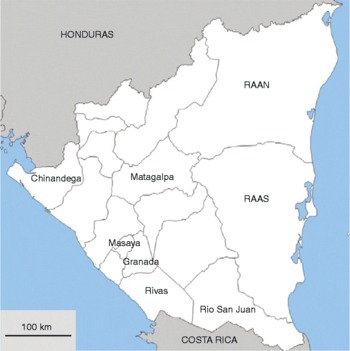
Sixty trees morphologically resembling Criollo were sampled from Nicaraguan farms to create a national Criollo collection (Fig. 1; see Supplementary Table S1, available online only at http://journals.cambridge.org). Additionally, 14 hybrid and seven other clones (breeders' accessions; see Supplementary Table S1, available online only at http://journals.cambridge.org), conserved ex situ at the research station El Recreo, were included in the study. Two samples (Criollo 13 and Yucatan) representing Criollo germplasm obtained from CATIE, Costa Rica, and two samples (ER-011 and ER-012) introduced from Ecuador in 2003 and presumably closely related to Criollo were investigated for comparison (international accessions; see Supplementary Table S1, available online only at http://journals.cambridge.org). Breeders' accession SCA 6 is known to exhibit resistance to black pod (Spence, Reference Spence1961). All samples are maintained at El Recreo.
Sampling regions in Nicaragua. Masaya, Granada and Rivas belong to the region Pacifico Sur. Accession information is given in Supplementary Table S1 (available online only at http://journals.cambridge.org). (A colour version of this figure can be found online at http://www.journals.cambridge.org/pgr)

Air-dried and fresh leaves were used for DNA extraction (Doyle and Doyle, Reference Doyle and Doyle1990). Nine microsatellite loci (mTcCIR1, mTcCIR7, mTcCIR8, mTcCIR10, mTcCIR11, mTcCIR12, mTcCIR15, mTcCIR18 and mTcCIR21; Lanaud et al., Reference Lanaud, Risterucci, Pieretti, Falque, Bouet and Lagoda1999) were used to reveal genetic diversity and relationships among genotypes, and five microsatellites (mTcCIR61, mTcCIR168, mTcCIR200, mTcCIR225 and mTcCIR236; Lanaud et al., Reference Lanaud, Risterucci, Pieretti, N'Goran and Fargeas2004; Pugh et al., Reference Pugh, Fouet, Risterucci, Brottier, Abouladze, Deletrez, Courtois, Clement, Larmande, N'Goran and Lanaud2004) to reveal associations with resistance to black pod. PCR products were analysed using the Applied Biosystems 3730 DNA Analyzer, and fragment sizes were determined using Peak Scanner Software 1.0 (Applied Biosystems).
Following diversity parameters were estimated using POPGENE 3.2. (http://www.ualberta.ca/~fyeh/popgene.html): mean numbers of alleles per locus, and mean observed and expected heterozygosities (H obs and H exp). The calculation of the Shannon index (I), the quantification of genetic differentiation by the analysis of molecular variance (AMOVA), the determination of the F-statistics estimator F ST and the detection of Hardy–Weinberg equilibrium (HWE) for all loci with χ2 tests were conducted using Arlequin 3.11 (http://cmpg.unibe.ch/software/arlequin3/). To reveal relationships between genotypes, the principal coordinate analysis (PCA) was conducted using GENALEX 6.2 (http://www.anu.edu.au/BoZo/GenAlEx).
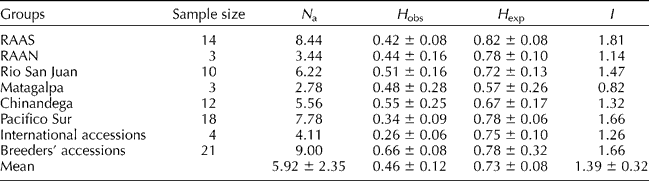
Among the farmers' accessions, mean allele numbers per locus ranged from 2.8 in Matagalpa to 8.4 in RAAS, and I varied from 0.82 in Matagalpa to 1.81 in RAAS (Table 1). Similarly, H exp was lowest in Matagalpa (0.57) and highest in RAAS (0.82). H obs was lowest in Pacifico Sur (0.34) and highest in Chinandega (0.55). All groups showed heterozygote deficiencies. The international and breeders' accessions had the lowest (0.26) and highest (0.66) H obs values, respectively, although their H exp values (0.75 and 0.78) were similar (Table 1). Altogether, 43% of the loci deviated (P < 0.05) from HWE. AMOVA showed that 6.1 and 93.9% of genetic variation were due to variance among and within the groups of the farmers' accessions, respectively. The mean F ST (0.06, P < 0.05) indicated a fairly low level of differentiation.
Mean number of alleles per locus (N a), observed (H obs) and expected (H exp) heterozygosities, and Shannon index (I) in the Nicaraguan farmers' accessions from different regions, and in the international and breeders' accessions of Theobroma cacao based on nine microsatellite locia
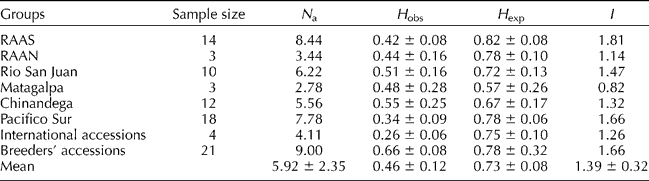
aStandard deviations are shown. Accession information is given in Supplementary Table S1 (available online only at http://journals.cambridge.org).
The PCA results (see Supplementary Fig. S1, available online only at http://journals.cambridge.org) revealed three pairs of the farmers' accessions with similar genotypes (RAAN 0404 and RAAS 0409, MAT 0402 and CHI 0301A, and RSJ 0404 and RSJ 0504). However, based on resistance-associated loci, these genotypes were different. The international Criollo accessions Criollo 13 and Yucatan were very closely related to the farmers' accessions MAS 0402, SJC 0108 and Catarina 0108, and closely related to the farmers' accessions RAAS 0406, RAAS 0410 and RAAS 0414. Furthermore, RAAN 0403 resembled ER-012 from Ecuador. Several breeders' accessions gathered together (SCA 6, SCA 12, EET 62, UF 296, UF 650, IMC 67, UF 654 × Pound 12 and UF 676 × Pound 12), and three farmers' accessions (RSJ 0405, RSJ 0406 and H-3) were closely related to them. Also, accessions RAAS 0403 and UF 296 × Pound 12 were quite similar. The breeders' accession EET 62 was very different when compared with the other accessions.
To identify putative sources of resistance to black pod, genotypes were assessed using five loci linked to resistance and located in three linkage groups (Brown et al., Reference Brown, Phillips-Mora, Power, Krol, Cervantes-Martinez, Motamayor and Schnell2007). Based on the comparison, seven genotypes contained at least 80% identical allelic composition with resistant SCA 6, namely the breeders' accessions EET 95 × SCA 6 and EET 399 × Pound 12, and the farmers' accessions RAAN 0401, Mat 0401, EC 0108, Mombacho 0108 and Mombacho 0308 (see Supplementary Table S2 and Fig. S1, available online only at http://journals.cambridge.org).
Discussion
Heterozygote deficiencies detected in the Nicaraguan farmers' accession groups indicate the presence of inbreeding and/or the Wahlund effect, which coincides with previous results on cacao (e.g. Sereno et al., Reference Sereno, Albuquerque, Vencovsky and Figueira2006; Lachenaud and Zhang, Reference Lachenaud and Zhang2008). Manually pollinated breeders' accessions possess heterozygosities only slightly lower than expected. Furthermore, AMOVA showed little differentiation among the groups of the farmers' accessions. Thus, human influence combined with inbreeding may have mixed the global gene pool of farmers' accessions while causing local homozygosity. However, Trognitz et al. (Reference Trognitz, Scheldeman, Hansel-Hohl, Kuant, Grebe and Hermann2011) discovered considerable differentiation within a young cacao production area in Nicaragua (Waslala), possibly caused by management and selection driven by varying environmental conditions.
The PCA results indicate that samples most closely related to the Criollo accessions Criollo 13 and Yucatan are those from Pacifico Sur. Also, some samples from RAAS showed quite close relationships with Criollo. Otherwise, farmers' accessions were dispersed without appreciable grouping by region and with low Criollo background. Additionally, based on comparison with allele sizes found in resistant SCA 6, seven (9%) of the 82 genotypes tested contain ≥ 80% alleles possibly linked to resistance to black pod that causes great yield losses in cacao production (Brown et al., Reference Brown, Phillips-Mora, Power, Krol, Cervantes-Martinez, Motamayor and Schnell2007).
Breeding for disease resistance should be an important component in breeding programmes to enhance the utilization of valuable Criollo germplasm. Our results contribute to this goal by discovering novel germplasm and characterizing Nicaraguan cacao collections for genetic diversity and relationships among genotypes, and for loci presumably linked to quantitative trait loci providing resistance to black pod.
Acknowledgements
This study was part of the Nicaragua–Finland Agrobiotechnology Program funded by the Finnish Ministry of Foreign Affairs and the INTA. We thank also the Embassy of Finland in Managua, Nicaragua, for valuable assistance, CATIE for providing the Criollo cacao reference samples, and Dr Mark Guiltinan from the Pennsylvania State University for his advice.