Introduction
Falls are the leading cause of hip fractures in older adults (Parkkari et al. Reference Parkkari, Kannus, Palvanen, Natri, Vainio, Aho, Vuori and Järvinen1999). Hip fractures are disabling medical events (Zuckerman, Reference Zuckerman1996; Hannan et al. Reference Hannan, Magaziner, Wang, Eastwood, Silberzweig, Gilbert, Morrison, McLaughlin, Orosz and Siu2001; Magaziner et al. Reference Magaziner, Fredman, Hawkes, Hebel, Zimmerman, Orwig and Wehren2003; Bentler et al. Reference Bentler, Liu, Obrizan, Cook, Wright, Geweke, Chrischilles, Pavlik, Wallace, Ohsfeldt, Jones, Rosenthal and Wolinsky2009) and their recovery is often complicated with depressive symptoms and pain (Holmes & House, Reference Holmes and House2000b ; Williams et al. Reference Williams, Tinetti, Kasl and Peduzzi2006). Depressive symptoms are associated with the risk of falling, functional impairment, and failure to regain walking independence after hip fracture (Mossey et al. Reference Mossey, Knott and Craik1990; Lenze et al. Reference Lenze, Munin, Dew, Rogers, Seligman, Mulsant and Reynolds2004; Givens et al. Reference Givens, Sanft and Marcantonio2008; Morghen et al. Reference Morghen, Bellelli, Manuele, Guerini, Frisoni and Trabucchi2011). Recovery of walking ability is crucial for patients to regain independence, partake in the community, and reintegrate into their environment (Salpakoski et al. Reference Salpakoski, Törmäkangas, Edgren, Sihvonen, Pekkonen, Heinonen, Pesola, Kallinen, Rantanen and Sipilä2014).
Despite these adverse depression-linked outcomes, depression tends to be unrecognized when it emerges after hip fracture (Müller-Thomsen et al. Reference Müller-Thomsen, Mittermeier and Ganzer2002). Most studies after hip fracture have focused on the prevalence of depressive symptoms, thus including a mix of new-onset cases and chronic illness cases (Mossey et al. Reference Mossey, Knott and Craik1990; Holmes & House, Reference Holmes and House2000a , b; Shyu et al. Reference Shyu, Cheng, Teng, Chen, Wu and Tsai2009). To our knowledge, only two studies have reported exclusively on depressive symptoms developing post-fracture (Lenze et al. Reference Lenze, Munin, Skidmore, Amanda Dew, Rogers, Whyte, Quear, Begley and Reynolds2007; Oude Voshaar et al. Reference Oude Voshaar, Banerjee, Horan, Baldwin, Pendleton, Proctor, Tarrier, Woodward and Burns2007). These studies found that apathy, sub-threshold depressive symptoms, anxiety, cognitive impairment, pain, and history of depression were risk factors for incident depression. Questions remain about how depressive symptoms evolve in the longer term after hip fracture and whether additional variables are associated with new-onset depressive symptomology. Proper assessment of new-onset depressive symptoms post-fracture and correlates thereof could help identify patients at risk and subsequently allow interventions to mitigate a decline in functional status (Lenze et al. Reference Lenze, Munin, Dew, Rogers, Seligman, Mulsant and Reynolds2004; Bentler et al. Reference Bentler, Liu, Obrizan, Cook, Wright, Geweke, Chrischilles, Pavlik, Wallace, Ohsfeldt, Jones, Rosenthal and Wolinsky2009), alleviate the burden of disability (Lenze et al. Reference Lenze, Rogers, Martire, Mulsant, Rollman, Dew, Schulz and Reynolds2001), and improve quality of life (Ormel et al. Reference Ormel, Rijsdijk, Sullivan, van Sonderen and Kempen2002).
We recently concluded a longitudinal clinical epidemiologic study to investigate genetic polymorphisms predictive of depressive symptoms arising post-fracture (Rawson et al. Reference Rawson, Dixon, Nowotny, Ricci, Binder, Rodebaugh, Wendleton, Doré and Lenze2015). The study design included in-depth psychosocial and clinical evaluations over 1 year's time post-fracture focusing exclusively on patients not experiencing a depressive episode when the fracture occurred. We therefore constructed a group-based trajectory model to fit depressive symptoms post-fracture and examined how these trajectories correlate with post-operative outcomes in the year following fracture. The group-based trajectory approach creates a practical summary of longitudinal data by recognizing patterns that develop over time. We hypothesized that higher depression scores would correlate with poorer recovery of daily living activities and mobility and worse pain ratings post-fracture. To determine the most relevant correlates of depressive symptomology after hip fracture, we examined covariates that have been shown in previous studies to contribute to depressive symptoms in older adults including lifetime vulnerability health-related factors [medical illness (Lenze et al. Reference Lenze, Munin, Skidmore, Amanda Dew, Rogers, Whyte, Quear, Begley and Reynolds2007; Sutin et al. Reference Sutin, Terracciano, Milaneschi, An, Ferrucci and Zonderman2013), history of depression (Oude Voshaar et al. Reference Oude Voshaar, Banerjee, Horan, Baldwin, Pendleton, Proctor, Tarrier, Woodward and Burns2007), antidepressant use (Lenze et al. Reference Lenze, Munin, Skidmore, Amanda Dew, Rogers, Whyte, Quear, Begley and Reynolds2007; Sutin et al. Reference Sutin, Terracciano, Milaneschi, An, Ferrucci and Zonderman2013), cognition (Oude Voshaar et al. Reference Oude Voshaar, Banerjee, Horan, Baldwin, Pendleton, Proctor, Tarrier, Woodward and Burns2007; Kim et al. Reference Kim, Moon, Lim, Yoon, Min, Lee and Park2012), smoking (Kim et al. Reference Kim, Moon, Lim, Yoon, Min, Lee and Park2012; Heyes et al. Reference Heyes, Tucker, Marley and Foster2015)]; psychosocial factors [exposure to stressful events (Devanand et al. Reference Devanand, Kim, Paykina and Sackeim2002), anxiety symptoms (Oude Voshaar et al. Reference Oude Voshaar, Banerjee, Horan, Baldwin, Pendleton, Proctor, Tarrier, Woodward and Burns2007), social support (George et al. Reference George, Blazer, Hughes and Fowler1989)]; pre-fracture functioning [mobility (Mossey et al. Reference Mossey, Knott and Craik1990; Lenze et al. Reference Lenze, Munin, Dew, Rogers, Seligman, Mulsant and Reynolds2004)]; and characteristics of the fracture [fracture type (Lenze et al. Reference Lenze, Munin, Skidmore, Amanda Dew, Rogers, Whyte, Quear, Begley and Reynolds2007; Kim et al. Reference Kim, Moon, Lim, Yoon, Min, Lee and Park2012), implant type (Bentler et al. Reference Bentler, Liu, Obrizan, Cook, Wright, Geweke, Chrischilles, Pavlik, Wallace, Ohsfeldt, Jones, Rosenthal and Wolinsky2009; Tseng et al. Reference Tseng, Shyu and Liang2012), pain (Oude Voshaar et al. Reference Oude Voshaar, Banerjee, Horan, Baldwin, Pendleton, Proctor, Tarrier, Woodward and Burns2007; Denkinger et al. Reference Denkinger, Lukas, Nikolaus, Peter and Franke2014; Petrovic et al. Reference Petrovic, Milovanovic, Ignjatovic Ristic, Riznic, Ristic and Stepanovic2014)].
Method
Participants
We recruited participants with a primary diagnosis of hip fracture admitted for surgical correction at eight area hospitals in St Louis, MO between 2008 and 2012. Participants aged ⩾60 years were screened for inclusion. Key exclusion criteria were non-ambulatory prior to fracture, current diagnosis of major or minor depressive disorder (i.e. were clinically depressed at time of fracture), and non-transient moderate to severe cognitive impairment (per chart review and brief bedside cognitive testing). Additional exclusions were metastatic cancer, interferon treatment, inoperable fracture, significant language, visual or hearing impairment, lived more than 1 h away, or inability to consent or cooperate with study protocol. All participants signed a written informed consent approved by the Washington University School of Medicine Institutional Review Board and the local hospital's review board.
Participants were followed for 52 weeks with the initial baseline assessment approximately 2 days post-surgery. Assessments were done at scheduled intervals (1, 2, 4, 8, 12, 26, and 52 weeks) after the initial baseline visit. Baseline, week 4, and week 52 assessments were conducted in person while assessments at weeks 1, 2, 8, 12, and 26 were performed over the phone. Trained study personnel performed all assessments.
Measures
Depression
The Montgomery–Asberg Depression Rating Scale (MADRS; Montgomery & Asberg, Reference Montgomery and Asberg1979) was the primary depression measure. Initial MADRS scores assessed depressive symptoms pre-fracture, as hospitalized patients described their mood during the week prior to fracture. The Structured Clinical Interview for DSM-IV disorders (SCID-IV; First et al. Reference First, Spitzer, Gibbon and Williams1996) diagnosed major and minor depressive disorder date of onset. The SCID was administered at the initial visit to assess depressive disorder at time of fracture and lifetime history of depressive disorder. Additionally, if the MADRS score was ⩾10 or if the reported sadness or anhedonia item was ⩾2 at any follow-up visit, participants were assessed with the SCID for new-onset depressive disorder.
Functional recovery
Basic activities of daily living (BADLs), instrumental activities of daily living (IADLs), and mobility were assessed with the Functional Recovery Score (FRS) from the Hospital for Joint Diseases Geriatric Hip Fracture Research Group (Zuckerman et al. Reference Zuckerman, Koval, Aharonoff, Hiebert and Skovron2000). Participants were asked how much help they needed with several activities using a scale of 0 (cannot do activity at all) to 4 (no help needed). Mobility was rated on a scale of 0–4 (0, non-ambulatory or transfers only; 1, cannot walk outdoors, can walk at home with assistive devices; 2, cannot walk outdoors, can walk at home without assistive devices; 3, can walk outdoors with assistive devices; 4, can walk outdoors without assistive devices. These scores were summed and scaled for each section (BADLs, IADLs, mobility) for a total FRS number ranging from 0 to 100. The FRS was obtained at the initial baseline visit to collect pre-fracture functioning, and weeks 4, 12, 26, and 52 to monitor post-fracture functioning. Participants’ use of assistive devices (e.g. cane or walker) and ambulatory status (community ambulator, household ambulator, non-ambulatory) were also documented at each visit. Information about the type of fracture and implant was collected at baseline. Fracture type was classified as (1) femoral neck, (2) intertrochanteric, or (3) subtrochanteric/other. Type of implant consisted of (1) total hip arthroplasty or hemiarthroplasty, (2) internal fixation with screws, or (3) sliding hip screw, intramedullary (IM) nail, or other.
Pain
At all time points, participants used a numerical rating scale with a score of 0 indicating no pain and 10 the worst pain (Jensen & Karoly, Reference Jensen, Karoly, Turk, Melzack, Turk and Melzack1992).
Psychosocial
Stressful life events experienced during the year prior to fracture were assessed with the Geriatric Adverse Life Events Scale (GALES; Devanand et al. Reference Devanand, Kim, Paykina and Sackeim2002). The scale consists of a checklist of 21 adverse life events and the degree of stress of each event was rated on a three-point scale: (1, not at all; 2, somewhat; 3, very stressful). Scores were summed for a total stress score (maximum of 63), with higher scores indicating a higher degree of stress.
The Duke Social Support Index (DSSI; Landerman et al. Reference Landerman, George, Campbell and Blazer1989) was administered at the initial visit to evaluate four different dimensions of social support: (1) size of social network, (2) social interaction, a four-item index measuring the frequency of interaction with members of their network, (3) subjective support, a six-item scale measuring the participant's perception of their inclusion as a valued and useful member of the social network and the participant's perceived satisfaction with social support received, and (4) instrumental support, a 13-item index listing tangible services received from the participant's support network.
Anxiety was measured by summing three items (tense, worried, relaxed) selected from the brief version of the State-Trait Anxiety Inventory – State (STAI-S; Berg et al. Reference Berg, Shapiro, Chambless and Ahrens1998). At the initial visit, participants used a five-point scale to rate the extent they have felt these emotions during the past 24 h (1, not at all; 2, a little; 3, moderately; 4, quite a bit; 5, extremely). The remaining three items of the brief version (steady, strained, comfortable) were not included due to similar wording with other (non-anxiety) symptoms experienced by older adults after fracture.
Cognitive
The Short Blessed Test (SBT) evaluated baseline cognitive status (Katzman et al. Reference Katzman, Brown, Fuld, Peck, Schechter and Schimmel1983). Higher scores indicate more cognitive difficulties. Participants were excluded if they had a previous diagnosis of dementia or showed moderate to severe cognitive impairment on the SBT (score >12), that did not resolve by the end of their surgical repair hospitalization.
During the initial hospitalization, we also ensured absence of delirium symptoms using interviewer's observations, chart records, and the Delirium Rating Scale (DRS; Trzepacz & Dew, Reference Trzepacz and Dew1995).
Health
The Cumulative Illness Rating Scale for Geriatrics (CIRS-G) evaluated medical illness burden (Miller et al. Reference Miller, Paradis, Houck, Mazumdar, Stack, Rifai, Mulsant and Reynolds1992). The scale quantifies medical data from chart reviews and participant interviews. Fourteen bodily systems are rated on a 0–4 scale [0, no problem; 1, mild problem; 2, moderate severity problem; 3, severe disability; 4, extremely severe problem (e.g. acute hip fracture would be rated 4)]. Ratings are then tallied for a total score. Medication usage was also documented at the initial visit. Two dichotomous variables were created to indicate antidepressant and/or psychotropic use. History of smoking was collected at baseline and smoking status was classified as (1) current, (2) past, or (3) never smoked.
Living
At all time points, the participant's place of residence was recorded as living at home or a type of facility (e.g. skilled nursing facility).
Statistical analysis
Trajectory modeling
In this study, we employed group-based trajectory modeling to characterize depressive symptoms after hip fracture. The procedure proc traj, (SAS 9.3, SAS Institute Inc., USA) utilizes semi-parametric maximum likelihood estimation to cluster participants into groups that follow similar progressions of latent trajectories over time without inferring zones of rarity. A series of quadratic models were run that allowed evaluation of an increasing number of trajectories and the removal of higher order non-significant slopes in order to determine the number of trajectories that best characterized our sample over time. Model specification included a zero-inflated Poisson (ZIP) distribution to fit the positively skewed data, review of alphas to determine the inflation function for each trajectory (e.g. intercept, linear, or quadratic zero-inflation probability logit, usual Poisson model), and starting points accounting for the initial, pre-fracture MADRS scores. Careful model selection included clinician interpretation, group sizes >5%, and use of Bayesian Information Criteria (BIC) values to compare competing models with different number of trajectories and polynomial functions. Participants were assigned to a specific trajectory, using the highest probability of membership, once the model was correctly specified. Individuals with probabilities <0.70 were excluded in aid of correct classification (Nagin & Odgers, Reference Nagin and Odgers2010). The resulting group membership was then used in the following analyses including ANOVAs for percent of functioning and mobility recovered and examination of variables obtained at the initial visit (i.e. χ2 for categorical variables, ANOVAs for continuous variables).
Multinomial logistic model (MLN)
Trajectory group membership was the dependent variable. Independent variables included in the final model were age, gender, CIRS-G, antidepressant use, smoking history, pain ratings, SBT cognitive status, FRS mobility scores, GALES stress ratings, DSSI subscales, anxiety symptoms, history of minor/major depression, and implant type. Inclusion of these variables was based on previous research supporting a variable's importance, ensuring variables were not redundant, improvement in model fit, an interpretable MLN coefficient in terms of sign, size, and significance, and/or a significant independent ANOVA or χ2 test. Continuous variables were centered to improve interpretation of log odds.
Generalized estimating equation (GEE)
GEE was used to model the repeated pain assessments. SAS procedure genmod with a normal distribution, log link, and unstructured covariance structure was specified to examine the main effect of time, trajectory group, and the interaction between time and group.
Survival analysis
The log-rank (Mantel–Cox) test compared if the survival curves were identical among the three trajectory groups in regards to likelihood of returning home post-fracture. For the living arrangements analysis, only participants who lived at home at the time of fracture were included. Participants were considered uncensored if they returned home at a particular time point during the study. Participants that did not return home were censored and time to home was recorded as their last available data time point. Survival analysis was calculated using the product limit (Kaplan–Meier) method with GraphPad Prism v. 6.05 for Windows (GraphPad Software, USA).
Results
Identification of trajectories: resilient, distressed, and depressed
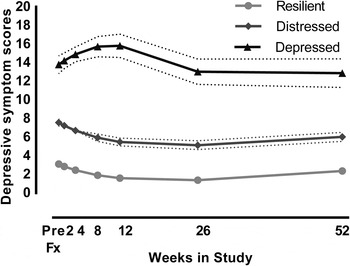
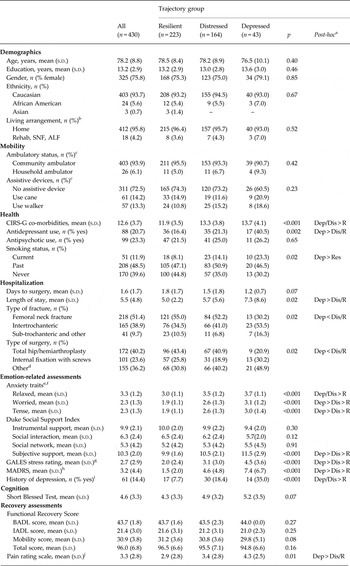
Table 1 presents statistics on demographics, mobility, health, hospitalization, psychosocial, cognition, and recovery for all participants and by the identified trajectory groups. Twenty-three participants were not included in the trajectory model due to missing data on the MADRS at baseline and an additional 29 participants were excluded because their probability of membership to one group was <0.70. The group-based trajectory analysis implied three typical patterns of depressive symptoms emerging during the year post-fracture, which we named ‘resilient’, ‘distressed’, and ‘depressed’ (Fig. 1). The resilient trajectory consisted of 223 (51.8%) participants who exhibited a very low level of depressive symptoms throughout the study period. The distressed trajectory included 164 (38.1%) participants, who had an initial increase in depressive symptoms during the first month post-fracture that gradually subsided to levels similar to pre-fracture scores. The depressed trajectory consisted of 43 (10%) participants who experienced a high level of depressive symptoms throughout the study. Specifically, this group had an elevation of depressive symptoms at week 1 that increased further to a threshold typical of clinical depression in older adults (MADRS ⩾15) between weeks 1 and 8 and remained high for the remainder of the year.
Trajectories of depressive symptoms, measured with Montgomery–Asberg Depression Rating Scale, after hip fracture using group-based trajectory modeling. Three clusters of individuals following similar patterns of depressive symptoms emerging during the year post-fracture were classified in the initial sample of 459 (resilient 50.7%, distressed 39.3%, depressed 10.0%). The depressed group experienced a persistently high number of depressive symptoms throughout the study period. Predicted estimates with 95% confidence intervals are shown. Model specification included a quadratic zero-inflated probability (ZIP) logit for the resilient group, an intercept only ZIP logit for the distressed group, and a typical Poisson function for the depressed group.

Descriptive statistics of study sample and for the different trajectory groups

ALF, Assisted living facility; BADLs, basic activities of daily living; CIRS-G, Cumulative Illness Rating Scale for Geriatrics; Dep, Depressed trajectory group; Dis, Distressed trajectory group; IADLs, instrumental activities of daily living; GALES, Geriatric Adverse Life Events Scale; MADRS, Montgomery–Asberg Depression Rating Scale; R, resilient; Rehab, rehabilitation facility; s.d., standard deviation; SNF, skilled nursing facility.
a Significant χ2 tests were further evaluated to compare cell counts using a z test and Bonferroni correction.
b Place of residence at time of fracture.
c Participants reported on their pre-fracture functional status.
d Other: sliding hip screw, intramedullary nail or specific implant.
e Participants reported on their emotions for the past 24 h.
f For relaxed, high scores reflect less anxiety; for tense and worried, high scores reflect high anxiety.
g Participants reported on adverse life events in the year prior to fracture.
h Participants reported on their mood in the week prior to fracture.
i Clinical interview to determine past major or minor depression disorder.
j Participants reported on their pain levels during the past 24 h.
There were 50 (22.4%) participants clinically diagnosed with new-onset major or minor depression after the initial baseline visit. Of these, participants were more likely to be in the depressed (42.0%) or the distressed (56.0%) trajectory groups than the resilient trajectory group [2.0%, χ2 = 30.18 (2), p ⩽0.001].
Baseline variables associated with trajectory group membership
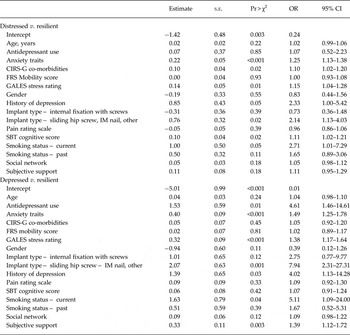
Results from the multinomial logistic model (Table 2) shows that health and emotion-related characteristics obtained at baseline account for part of the differences between trajectory groups (pseudo-R 2 = 0.32, p < 0.001). Compared to the resilient group, on average, the depressed group had 38% higher GALES stressful life-event ratings, 49% higher anxiety, and was 39% less satisfied with subjective support. The depressed group was also 3.6 times more likely to be taking antidepressants, three times more likely to have a history of major or minor depression, 4.1 times more likely to be a current smoker (reference group: never smoked), and 6.9 times more likely to have a sliding hip screw/IM nail/other type of surgical implant (reference group: total hip arthroplasty/hemiarthroplasty) compared to the resilient group. The distressed group, relative to the resilient group, had 10% higher CIRS-G scores, 15% higher GALES ratings, 25% higher anxiety ratings, and 11% poorer SBT cognitive scores. Additionally, the distressed group was 1.3 times more likely to have a history of depression, 1.7 times more likely to be a current smoker, and 1.1 times more likely to have a surgical repair consisting of sliding hip screw/IM nail/other implant in relation to the resilient group.
Estimated odds ratios (OR) and 95% confidence intervals (CI) from multinomial logistic regression of trajectory groups

CIRS-G, Cumulative Illness Rating Scale for Geriatrics; FRS, Functional Recovery Score; GALES, Geriatric Adverse Life Events Scale; IM, intramedullary; SBT, Short Blessed Test.
Reference categories for categorical variables are antidepressant use (none), gender (male), history of depression (no), and smoking status (never smoker), implant type (total hip arthroplasty, hemiarthroplasty).
Likelihood ratio χ2 statistic (d.f.) = 117.23, p < 0.001 (32), AIC = 525.77, R 2 = .32 (Cox & Snell), 0.38 (Nagelkerke adjusted value). Each parameter is independent of the other variables. n = 305.
Post-fracture variables associated with trajectory group membership
Recovery of mobility
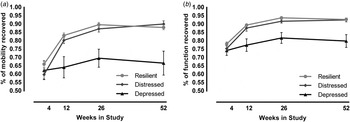
Using the mobility scaled scores from the FRS, we estimated the percent of mobility recovered from their pre-fracture mobility scores [(follow-up week/pre-fracture) × 100] to examine how the groups recovered (Fig. 2a ). At 12 weeks’ post-fracture, the depressed group had recovered to only 64% of their pre-fracture mobility score, whereas the resilient group had recovered to 83% (F 2,360 = 9.1, p < 0.001). Similarly, at 1-year post-fracture, the depressed group recovered to only 67% of their pre-fracture mobility score, whereas the resilient group recovered to 88% (F 2,327 = 13.64, p < 0.001).
Depressed trajectory associated with poorer mobility and functional recovery. Assessment of whether participants returned to pre-fracture functioning was estimated as the percent recovered at each time point relative to pre-fracture scores [(follow-up week/pre-fracture) × 100]. Both percent of (a) mobility recovered and (b) total functional recovery indicated significant differences between the depressed and resilient groups at weeks 12, 26, and 52. Figures display means with standard error bars for each time point.

Overall functional recovery
We found similar results using the percent of total FRS score, which includes not only mobility but also BADLs and IADLs, relative to pre-fracture total FRS (Fig. 2b ). At 12 weeks’ post-fracture, the depressed group had recovered to only 77% of their pre-fracture function, whereas the resilient group had recovered to 89% (F 2,360 = 9.6, p < 0.001). Similarly, at 1-year post-fracture, the depressed group recovered to only 80% of their pre-fracture total FRS, whereas the resilient group recovered to 93% (F 2,327 = 12.0, p < 0.001).
Pain
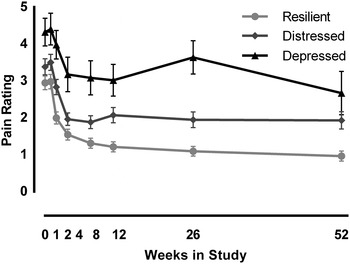
The depressed trajectory group reported more pain than the resilient and distressed groups throughout the study. Results from the GEE model found a significant main effect of time (χ 2 7 = 180.6, p < 0.001), main effect of trajectory group (χ 2 2 = 56.4, p < 0.001), and a time×group interaction (χ 2 14 = 33.8, p = 0.02), indicating participants in the depressed group reported more overall pain and more persistence of pain than the resilient group (Fig. 3).
Depressed trajectory associated with higher pain. Repeated measures of pain ratings, using generalized estimating equations, revealed a significant time, group, and time×group interaction. Estimated means with standard error bars are shown.

Secondary outcomes
Supplementary Table S1 illustrates additional outcomes of mobility, living arrangements, and mortality. At 1-year post-fracture, the depressed trajectory group were less likely to be independent of assistive devices than the resilient group and more likely to use a wheelchair or be non-ambulatory than the distressed and resilient groups (χ2 6 = 27.9, p ⩽ 0.001). Likewise, a lower proportion of participants in the depressed group reported they were able to walk in the community than participants in the resilient and distressed groups (χ2 2 = 18.6, p ⩽ 0.001). In regard to participants who lived at home at the time of fracture and were able to return home during the study period, we found no differences between trajectory groups (χ2 2 = 3.3, p = 0.19), nor between survival curves when examining time to home (log rank = 0.6, p = 0.41). Mortality did not differ between trajectory groups (χ2 2 = 5.8, p = 0.06).
Discussion
In this large sample of patients with hip fracture, we characterized patterns of new-onset depressive symptoms during the year post-fracture. Our data suggested three clusters of participants based on the course of emergent depressive symptoms: the ‘resilient’ group who showed no intense distress, the ‘distressed’ group who exhibited a small but transient rise, and the ‘depressed’ group who experienced high levels of depressive symptoms. Next, we examined which clinical and psychosocial variables were associated with more depressive symptoms and found the depressed trajectory could be distinguished from the resilient group by several health and psychosocial variables collected at the initial visit. Last, we found the depressed trajectory was less likely to recover to their pre-fracture mobility scores and had higher levels of pain throughout the study compared to the distressed and resilient groups.
The study's repeated depressive symptom assessments during the year post-fracture allowed us to observe longitudinal patterns of depressive symptoms that develop after a medical stressor. As depression can go unrecognized post-surgery (Müller-Thomsen et al. Reference Müller-Thomsen, Mittermeier and Ganzer2002), we examined which baseline variables could be characterized as risk factors for developing a depressive trajectory post-fracture. High anxiety, history of stressful life events, less satisfaction with subjective support, antidepressant use, being a current smoker, past clinical diagnosis of major or minor depression, and implant type were found to differentiate the depressed group and resilient group in our study. Among these early indicators of a depressive trajectory, several of them support previous findings. For instance, more anxiety was identified as a risk factor for being in the depressive trajectory, replicating a prior report by Oude Voshaar et al. (Reference Oude Voshaar, Banerjee, Horan, Baldwin, Pendleton, Proctor, Tarrier, Woodward and Burns2007). A history of depressive illness has also been correlated with development of depression post-fracture (Lenze et al. Reference Lenze, Munin, Skidmore, Amanda Dew, Rogers, Whyte, Quear, Begley and Reynolds2007; Oude Voshaar et al. Reference Oude Voshaar, Banerjee, Horan, Baldwin, Pendleton, Proctor, Tarrier, Woodward and Burns2007). Higher stress levels experienced with adverse life events in the year prior to fracture predicted membership in the depression trajectory. To our knowledge, this is the first study to report this association in this setting although it is consistent with research indicating depression often develops in the context of multiple, cumulative stressful life events (Kendler et al. Reference Kendler, Karkowski and Prescott1999; Brown et al. Reference Brown, Craig, Harris, Herbert, Hodgson, Tansey and Uher2014; Swartz et al. Reference Swartz, Williamson and Hariri2014).
Our results also demonstrated that participants who followed the depressive trajectory exhibited worse functional and mobility outcomes in the post-operative repeated measures. The depressed group had the lowest percentage of pre-fracture function recovered, in terms of both mobility and total functional recovery, of the three trajectory groups throughout most of the study period. As can be expected, percent of mobility and total function recovered was low for all three groups 4 weeks after fracture. At 3 months post-fracture, however, the depressed group saw little improvement in mobility, whereas both the distressed and resilient groups had recovered to 80% of their pre-fracture mobility. Additionally, a greater proportion of participants in the depressed group were non-ambulatory or required assistive devices 1-year post-fracture, indicating greater dependence and mobility disability in this group. Our findings agree with previous literature showing depressive symptoms are associated with poor rehabilitation outcomes, loss of independence (Mossey et al. Reference Mossey, Knott and Craik1990; Holmes & House, Reference Holmes and House2000b ; Lenze et al. Reference Lenze, Munin, Dew, Rogers, Seligman, Mulsant and Reynolds2004; Hershkovitz et al. Reference Hershkovitz, Kalandariov, Hermush, Weiss and Brill2007; Tseng et al. Reference Tseng, Shyu and Liang2012), and failure to regain walking ability after hip fracture rehabilitation (Mossey et al. Reference Mossey, Knott and Craik1990; Givens et al. Reference Givens, Sanft and Marcantonio2008; Morghen et al. Reference Morghen, Bellelli, Manuele, Guerini, Frisoni and Trabucchi2011). Likewise, our findings echo prior evidence of poor functional recovery in patients with depressive symptoms in other clinical settings such as stroke and cardiac rehabilitation (Herrmann et al. Reference Herrmann, Black, Lawrence, Szekely and Szalai1998; Swardfager et al. Reference Swardfager, Herrmann, Marzolini, Saleem, Farber, Kiss, Oh and Lanctôt2011).
Another important finding was the progression of pain over time in the depressed trajectory. In contrast to Petrovic et al. (Reference Petrovic, Milovanovic, Ignjatovic Ristic, Riznic, Ristic and Stepanovic2014), who reported higher post-operatory pain after hip arthroplasty in patients with depressive symptoms, we observed that pain ratings were similar among the three trajectories in the immediate post-operatory period. However, differences in pain became evident over time with the depressed group exhibiting higher pain than the distressed and resilient groups the remainder of the year. Overall, this finding adds to existing literature indicating a close association between pain and depression (Williamson & Schulz, Reference Williamson and Schulz1992; Karp et al. Reference Karp, Scott, Houck, Reynolds, Kupfer and Frank2005; Morone et al. Reference Morone, Weiner, Belnap, Hum, Karp, Mazumdar, Houck, He and Rollman2010; Jackson, Reference Jackson2013; Denkinger et al. Reference Denkinger, Lukas, Nikolaus, Peter and Franke2014). It is also possible that pain could have interfered with recovery in the depressive trajectory group, as higher levels of pain have been associated with poorer function after hip fracture (Williams et al. Reference Williams, Tinetti, Kasl and Peduzzi2006; Salpakoski et al. Reference Salpakoski, Törmäkangas, Edgren, Sihvonen, Pekkonen, Heinonen, Pesola, Kallinen, Rantanen and Sipilä2014).
The poorer functional recovery scores and higher pain ratings imply participants in the depressed group experienced a higher burden of disability after hip fracture. In this regard, several studies have shown an association between depression and disability in older adults (Kennedy et al. Reference Kennedy, Kelman and Thomas1990; Zeiss et al. Reference Zeiss, Lewinsohn, Rohde and Seeley1996; Beekman et al. Reference Beekman, Deeg, Braam, Smit and Van Tilburg1997; Prince et al. Reference Prince, Harwood, Blizard, Thomas and Mann1997; Penninx et al. Reference Penninx, Leveille, Ferrucci, van Eijk and Guralnik1999; Lenze et al. Reference Lenze, Rogers, Martire, Mulsant, Rollman, Dew, Schulz and Reynolds2001; Ormel et al. Reference Ormel, Rijsdijk, Sullivan, van Sonderen and Kempen2002). Our research group has previously reported the rapid onset of depressive symptoms is a common event during acute-care hospitalization (Lenze et al. Reference Lenze, Munin, Skidmore, Amanda Dew, Rogers, Whyte, Quear, Begley and Reynolds2007). It has also been postulated that depressed patients are less physically active (Penninx et al. Reference Penninx, Leveille, Ferrucci, van Eijk and Guralnik1999) and participate less in rehabilitation programs, impeding their functional recovery (Feinstein, Reference Feinstein, Stuss, Winocur and Robertson1999; Lenze et al. Reference Lenze, Munin, Dew, Rogers, Seligman, Mulsant and Reynolds2004; Swardfager et al. Reference Swardfager, Herrmann, Marzolini, Saleem, Farber, Kiss, Oh and Lanctôt2011). The findings also call attention to the difficulty in discerning causal inference in an observational study, as it may be that persistent disability and pain led to persistently elevated depressive symptomology.
Unique study strengths include our prospective design, the systematic measurement of depressive symptoms immediately after hip fracture, and the long-term, comprehensive battery of clinical and psychosocial assessments. In addition, study participants were assessed free of depressive illness, delirium, and moderate-severe cognitive impairment at the beginning of the study which allowed us to more accurately examine the trajectory course of emergent depressive symptoms after hip fracture.
Some limitations should be considered when interpreting this study's results. First, information about falls was not included. Given that falls are associated with depression (Kvelde et al. Reference Kvelde, McVeigh, Toson, Greenaway, Lord, Delbaere and Close2013; Stubbs et al. Reference Stubbs, Stubbs, Gnanaraj and Soundy2016) and a history of falls is associated with poor outdoor walking recovery (Salpakoski et al. Reference Salpakoski, Törmäkangas, Edgren, Sihvonen, Pekkonen, Heinonen, Pesola, Kallinen, Rantanen and Sipilä2014) we could not adequately explore confounding effects related to falls in our results. Second, mobility was assessed using the participant's self-report from the FRS at all time points. An objective measure such as the Timed ‘Up & Go’ test (Podsiadlo & Richardson, Reference Podsiadlo and Richardson1991) could have provided a more precise estimation of mobility. Third, the use of the numerical pain rating scale limited our ability to explore different aspects of pain. In future research we would consider using the Brief Pain Inventory (Cleeland & Ryan, Reference Cleeland and Ryan1994), which assesses pain intensity and interference with activities.
In conclusion, three trajectories of depressive symptoms – resilient, distressed, and depressed – were specified using group-based trajectory modeling. Focusing on the depressed trajectory, this group, comprising 10% of participants with hip fracture, had poorer recovery of mobility, poorer functional recovery, and higher ratings of pain in the year following hip fracture. The necessity of walking ability and functional recovery to regaining independence after hip fracture underlines the importance of our findings (Salpakoski et al. Reference Salpakoski, Törmäkangas, Edgren, Sihvonen, Pekkonen, Heinonen, Pesola, Kallinen, Rantanen and Sipilä2014). As well, several clinical and psychosocial variables were identified which could be potentially useful variables in delineating who is at greatest risk for developing a depressive trajectory after hip fracture, although there is considerable additional variance whereby further research could identify other variables (e.g. biological, neurobiological) to create a more robust predictive index of depression.
Last, these findings linking the onset of depressive symptoms and disability suggest that prompt identification and management of depression may prevent continuous and persistent depressive symptoms and thus improve both psychological and functional outcomes after a disabling medical event. Yet, treating depressive symptoms in this context poses a challenge. Antidepressant medications are not indicated in the absence of a major depression diagnosis and they are often poorly tolerated and ineffective in the very old and medically ill (Álamo et al. Reference Álamo, López-Muñoz, García-García and García-Ramos2014; Diniz & Reynolds, Reference Diniz and Reynolds2014; Iaboni et al. Reference Iaboni, Seitz, Fischer, Diong, Rochon and Flint2015). Likewise, psychotherapy would be difficult to carry out with medically ill elders in inpatient and rehabilitation medical settings. We would argue that practical, non-pharmacological interventions are needed that fit the population and setting of medically ill, disabled elderly. Given the strong and likely bidirectional relationship between depression and disability, such strategies might include earlier and more intensive rehabilitation after discharge from the hospital, as well as structured exercise programs to prevent plateauing of function and mobility after formal rehabilitation has ceased. Structured exercise has been shown effective in reducing depression severity in older adults (Bridle et al. Reference Bridle, Spanjers, Patel, Atherton and Lamb2012) and both intensive, supervised exercise programs and progressive resistance training improve functional recovery after hip fracture (Beaupre et al. Reference Beaupre, Binder, Cameron, Jones, Orwig, Sherrington and Magaziner2013). Our group is testing an intervention, ‘Enhanced Medical Rehabilitation’, designed to increase the intensity of post-acute physical and occupational therapy, relying on motivational techniques to overcome patients’ emotional barriers to rehabilitation participation such as depression (Lenze et al. Reference Lenze, Host, Hildebrand, Morrow-Howell, Carpenter, Freedland, Baum and Binder2013). Further testing of this and other practical interventions could help maximize recovery efforts post-fracture when depressive symptoms arise, providing relief from intertwined depression and disability.
Supplementary material
For supplementary material accompanying this paper visit http://dx.doi.org/10.1017/S0033291715002974.
Acknowledgements
We are grateful for the assistance with data management by Peter Dore and data collection by Leah Wendleton. The National Institutes of Mental Health (NIMH; R01 MH074596, R34MH101433, and T32 MH014677-36) and Washington University Institute of Clinical and Translational Sciences grant UL1TR000448 from the National Center for Advancing Translational Sciences (NCATS) of the National Institutes of Health (NIH) and the Taylor Family Institute for Innovative Psychiatric Research supported the conception and design of the study, data collection and management, statistical analysis and interpretation of the data; and preparation, review, and approval of the manuscript.