Introduction
This article belongs to the series of papers devoted to new arsenate minerals from the Arsenatnaya fumarole at the Second scoria cone of the Northern Breakthrough of the Great Tolbachik Fissure Eruption 1975–1976 (NB GTFE), Tolbachik volcano, Kamchatka Peninsula, Far-Eastern Region, Russia. The descriptions of twenty three new mineral species were reported in the previous papers of the series: yurmarinite Na7(Fe3+,Mg,Cu)4(AsO4)6 (Pekov et al., Reference Pekov, Zubkova, Yapaskurt, Belakovskiy, Lykova, Vigasina, Sidorov and Pushcharovsky2014a); two polymorphs of Cu4O(AsO4)2, ericlaxmanite and kozyrevskite (Pekov et al., Reference Pekov, Zubkova, Yapaskurt, Belakovskiy, Vigasina, Sidorov and Pushcharovsky2014b); popovite Cu5O2(AsO4)2 (Pekov et al., Reference Pekov, Zubkova, Yapaskurt, Belakovskiy, Vigasina, Sidorov and Pushcharovsky2015a), structurally related shchurovskyite K2CaCu6O2(AsO4)4 and dmisokolovite K3Cu5AlO2(AsO4)4 (Pekov et al., Reference Pekov, Zubkova, Belakovskiy, Yapaskurt, Vigasina, Sidorov and Pushcharovsky2015b); katiarsite KTiO(AsO4) (Pekov et al., Reference Pekov, Yapaskurt, Britvin, Zubkova, Vigasina and Sidorov2016a); melanarsite K3Cu7Fe3+O4(AsO4)4 (Pekov et al., Reference Pekov, Zubkova, Yapaskurt, Polekhovsky, Vigasina, Belakovskiy, Britvin, Sidorov and Pushcharovsky2016b); pharmazincite KZnAsO4 (Pekov et al., Reference Pekov, Yapaskurt, Belakovskiy, Vigasina, Zubkova and Sidorov2017); arsenowagnerite Mg2(AsO4)F (Pekov et al., Reference Pekov, Zubkova, Agakhanov, Yapaskurt, Chukanov, Belakovskiy, Sidorov and Pushcharovsky2018b); arsenatrotitanite NaTiO(AsO4) (Pekov et al., Reference Pekov, Zubkova, Agakhanov, Belakovskiy, Vigasina, Yapaskurt, Sidorov, Britvin and Pushcharovsky2019a); the two isostructural minerals edtollite K2NaCu5Fe3+O2(AsO4)4 and alumoedtollite K2NaCu5AlO2(AsO4)4 (Pekov et al., Reference Pekov, Zubkova, Agakhanov, Ksenofontov, Pautov, Sidorov, Britvin, Vigasina and Pushcharovsky2019b); anatolyite Na6(Ca,Na)(Mg,Fe3+)3Al(AsO4)6 (Pekov et al., Reference Pekov, Lykova, Yapaskurt, Belakovskiy, Turchkova, Britvin, Sidorov and Scheidl2019c); zubkovaite Ca3Cu3(AsO4)4 (Pekov et al., Reference Pekov, Lykova, Agakhanov, Belakovskiy, Vigasina, Britvin, Turchkova, Sidorov and Scheidl2019d); pansnerite K3Na3Fe3+6(AsO4)8 (Pekov et al., Reference Pekov, Zubkova, Koshlyakova, Agakhanov, Belakovskiy, Vigasina, Yapaskurt, Britvin, Turchkova, Sidorov and Pushcharovsky2020a); badalovite NaNaMg(MgFe3+)(AsO4)3 (Pekov et al., Reference Pekov, Koshlyakova, Agakhanov, Zubkova, Belakovskiy, Vigasina, Turchkova, Sidorov and Pushcharovsky2020b); calciojohillerite NaCaMgMg2(AsO4)3 (Pekov et al., Reference Pekov, Koshlyakova, Agakhanov, Zubkova, Belakovskiy, Vigasina, Turchkova, Sidorov and Pushcharovsky2021a); yurgensonite K2SnTiO2(AsO4)2 (Pekov et al., Reference Pekov, Zubkova, Agakhanov, Yapaskurt, Belakovskiy, Vigasina, Britvin, Turchkova, Sidorov and Pushcharovsky2021b); paraberzeliite NaCaCaMg2(AsO4)3 (Pekov et al., Reference Pekov, Koshlyakova, Belakovskiy, Vigasina, Zubkova, Agakhanov, Britvin, Sidorov and Pushcharovsky2022a); khrenovite Na3Fe3+2(AsO4)3 (Pekov et al., Reference Pekov, Koshlyakova, Belakovskiy, Vigasina, Zubkova, Agakhanov, Britvin, Sidorov and Pushcharovsky2022b); axelite Na14Cu7(AsO4)8F2Cl2 (Pekov et al., Reference Pekov, Zubkova, Agakhanov, Yapaskurt, Belakovskiy, Britvin, Sidorov, Kutyrev and Pushcharovsky2023a); and evseevite Na2Mg(AsO4)F (Pekov et al., Reference Pekov, Zubkova, Agakhanov, Vigasina, Yapaskurt, Britvin, Turchkova, Sidorov, Zhitova and Pushcharovsky2023b). All new Tolbachik minerals discovered prior 2020 are listed in Pekov et al. (Reference Pekov, Agakhanov, Zubkova, Koshlyakova, Shchipalkina, Sandalov, Yapaskurt, Turchkova and Sidorov2020c).
In this paper we describe the new mineral magganasite (Cyrillic: магганасит), ideally CuFe3+3O(AsO4)3. It is named in honour of the Greek mineralogist and petrologist Prof. Dr. Andreas Magganas (born 1954), Professor of Mineralogy, Petrology and Mineral Chemistry at the National and Kapodistrian University of Athens, Greece, a specialist in volcanology and the mineralogy of volcanic fumaroles.
Both the new mineral and its name (symbol Mgg) have been approved by the IMA Commission on New Minerals, Nomenclature and Classification (IMA CNMNC), IMA2021-112. The holotype specimen is deposited in the systematic collection of the Fersman Mineralogical Museum with the catalogue number 97913.
Occurrence and general appearance
The specimens with the new mineral described in this paper were collected by us in July 2021 in the Arsenatnaya fumarole located at the summit of the Second scoria cone of the NB GTFE. This scoria cone is a monogenetic volcano formed in 1975 (Fedotov and Markhinin, Reference Fedotov and Markhinin1983) and Arsenatnaya is one of the largest and hottest Tolbachik fumaroles today, after almost a half of century after this formation. The temperatures in its deep levels measured by us using a chromel–alumel thermocouple in the period 2012–2022, reached 500°C. The mineralogy and zonation of sublimates of the Arsenatnaya fumarole has been reported by Pekov et al. (Reference Pekov, Koshlyakova, Zubkova, Lykova, Britvin, Yapaskurt, Agakhanov, Shchipalkina, Turchkova and Sidorov2018a) and Shchipalkina et al. (Reference Shchipalkina, Pekov, Koshlyakova, Britvin, Zubkova, Varlamov and Sidorov2020); the brief mineralogical characterization of oxidizing-type fumaroles of Tolbachik has been given by Vergasova and Filatov (Reference Vergasova and Filatov2016) and Pekov et al. (Reference Pekov, Agakhanov, Zubkova, Koshlyakova, Shchipalkina, Sandalov, Yapaskurt, Turchkova and Sidorov2020c).
Magganasite was found in the material collected from hot (the temperature measured during sampling varied from 350 to 400°C) pockets situated 1–1.5 m below the day surface. It is associated closely with sanidine and lammerite. In some specimens, the new mineral is also associated with hematite, tenorite, paralammerite, johillerite, calciojohillerite, alarsite, langbeinite, euchlorine, fedotovite, wulffite and cassiterite.
Magganasite forms prismatic crystals, elongated along [100], up to 0.07 mm (rarely up to 0.2 mm) long and up to 0.04 mm thick. Well-shaped crystals (Fig. 1a) are rare; typically, the mineral occurs as crude crystals (Fig. 1b–d). Slightly divergent crystals and skeletal, case-like individuals are common (Fig. 1c,d). Magganasite crystals are typically assembled in near-parallel (Fig. 1c) or chaotic (Fig. 1b,d) clusters up to 1 mm across, separate or combined in crusts, usually interrupted, up to 1 mm × 3 mm. Magganasite overgrows lammerite and sanidine (Fig. 2) which form encrustations on the surface of basalt scoria altered by fumarolic gas.
Morphology of magganasite crystals and aggregates: (a) (holotype) well-shaped long-prismatic crystal of magganasite on an aggregate of its crude prismatic crystals (the hexagonal tabular crystal in the left part of the image is lammerite); (b) group of prismatic magganasite crystals (white) on a crystal crust of sanidine (grey) and lammerite (light grey, in the left part of the image); (c) near-parallel intergrowths of slightly divergent prismatic magganasite crystals; (d) chaotic aggregate of prismatic magganasite crystals (the hexagonal tabular crystal in the right part of the image is lammerite). SEM images, SE (a, c, d) and BSE (b) modes.

Brown to brown-yellow aggregates of magganasite which overgrow green lammerite crystals (a, b) and white to yellowish sanidine crystal crusts (a). The black mineral is hematite and the colourless transparent mineral forming small equant crystals is langbeinite.

We believe that magganasite was deposited directly from the fumarolic gas as a volcanic sublimate at the temperatures not lower than 400°C.
Physical properties and optical data
Magganasite is translucent, with strong vitreous to semi-metallic lustre. It is golden-brown (visually resembling typical astrophyllite in colour) or yellow-brown to brownish-yellow in thin individuals and brown or reddish-brown in the largest massive clusters. The streak is yellow. Magganasite is brittle, cleavage or parting was not observed. The fracture is uneven. Density calculated using the empirical formula and unit-cell volume found from powder X-ray diffraction data is 4.708 g cm–3.
Under the microscope in reflected light, magganasite is grey, pleochroism was not observed. Bireflectance is very weak, ΔR = 0.3% (589 nm). Anisotropy is weak, internal reflections were not observed. The reflectance values measured in air using the SiC standard (Zeiss, No. 545) are given in Table 1.
The reflectance data of magganasite

Notes: The values for wavelengths (λ) recommended by the IMA Commission on Ore Mineralogy are marked in boldtype.
Infrared spectroscopy
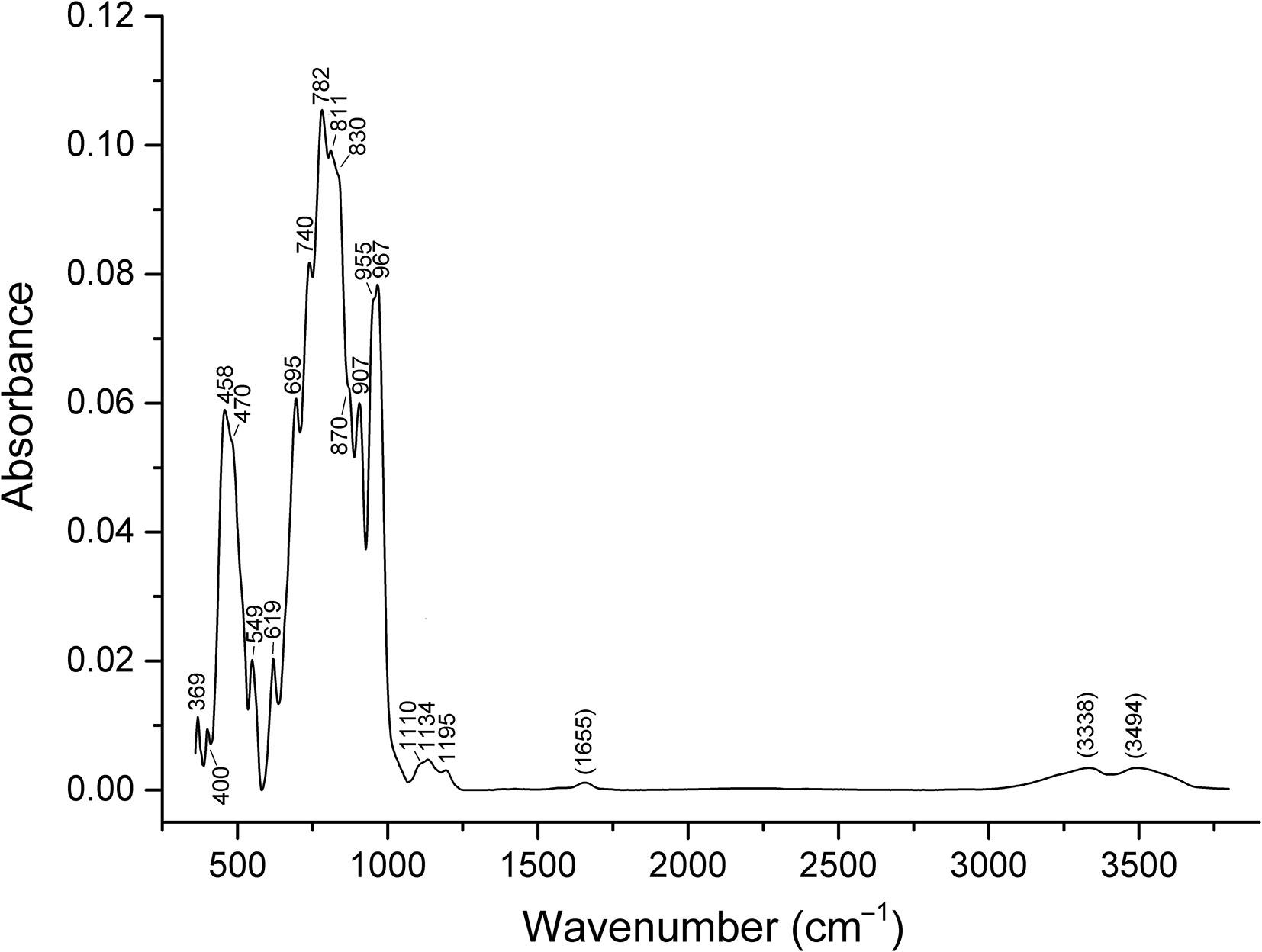
The infrared (IR) absorption spectrum of magganasite (Fig. 3) was obtained using an ALPHA FTIR spectrometer (Bruker Optics) with a resolution of 4 cm–1. A total of 16 scans were obtained. Preliminarily, the sample was powdered, mixed with anhydrous KBr and pelletized. The IR spectrum of an analogous pellet of pure KBr was used as a reference.
Infrared spectrum of magganasite. Wavenumbers of bands corresponding to water present in the sample (see text) are given in parentheses.

The splitting of the bands of As–O stretching vibrations in the range 690–970 cm–1 reflects the presence of non-equivalent and strongly distorted AsO4 tetrahedra in the crystal structure of magganasite. In such cases, As–O stretching vibrations cannot be divided into symmetric and asymmetric ones (Dultz et al., Reference Dultz, Quilichini, Scott and Lehmann1975). The doublet 955+967 cm–1 corresponds to As–O stretching vibrations with a significant contribution of the As1–O2–Fe2 and As3–O12–Fe1 fragments with the shortest As–O bonds (1.634 and 1.630 Å, respectively) and relatively short Fe–O bonds (1.851 and 1.921 Å, respectively). The band at 907 cm–1 is tentatively assigned to stretching vibrations involving the As2–O5–Cu fragment with a somewhat longer As–O bond (1.669 Å) and the shortest Cu–O bond (1.920 Å).
In the range of 360–620 cm–1, overlapping bands of Fe3+–O- and Cu–O-stretching and O–As–O bending vibrations are observed. In particular, by analogy with the synthetic analogue of yaroshevskite Cu9O2(VO4)4Cl2 (Siidra et al., Reference Siidra, Vladimirova, Tsirlin, Chukanov and Ugolkov2020), the bands at 619 and 549 cm–1 may correspond to stretching vibrations in which a major part of energy is concentrated on the shortest Cu–O5 and Cu–O3 bonds whereas other Cu–O and Fe–O bonds contribute to the absorption at ∼460 cm–1. However, admixed SO42– anions and Ti–O bonds can absorb IR radiation with the wavenumber of 619 cm–1.
The weak bands at 1110, 1134, and 1195 cm–1 correspond to asymmetric stretching vibrations of SO4 tetrahedra that are present in the mineral as a minor impurity (see below). The weak bands at 1655, 3338 and 3494 cm–1 are due to water impurity (adsorbed water and/or inclusions of a hydrous mineral).
The IR spectrum of magganasite is unique and can be used for the identification of this mineral. The absence of bands in the range from 1200 to 1600 cm–1 in the IR spectrum of magganasite indicates the absence of carbonate, orthoborate and nitrate groups.
Chemical composition
The chemical composition of magganasite was studied by electron probe microanalysis using a Jeol JSM-6480LV scanning electron microscope (SEM) equipped with an INCA-Wave 500 wavelength-dispersive spectrometer (Laboratory of Analytical Techniques of High Spatial Resolution, Dept. of Petrology, Moscow State University), with an acceleration voltage of 20 kV, a beam current of 20 nA, and a 3 μm beam diameter. The chemical data in wt.% and the used probe standards are reported in Table 2. Contents of other elements with atomic numbers >6 were below detection limits.
Chemical composition of magganasite

* Averaged for 15 spot analyses. **Atoms per formula unit calculated on the basis of 13 O atoms per formula unit. S.D. – standard deviation.
The empirical formula calculated on the basis of 13 O atoms per formula unit (apfu) is (Cu1.22Al0.06Cr0.02Fe3+2.52Ti0.18)Σ4.00(As2.91S0.05Si0.02P0.01V0.01)Σ3.00O13. The perfect stoichiometry of the empirical formula calculated by the anionic method confirms that all Fe is trivalent.
The simplified formula of magganasite is Cu(Fe3+,Cu,Ti,Al)3O[(As,S)O4]3. The idealized formula is CuFe3+3O(AsO4)3 which requires CuO 11.98, Fe2O3 36.08, As2O5 51.94, total 100 wt.%.
X-ray crystallography and crystal structure determination details
Powder X-ray diffraction (XRD) data for magganasite (Table 3) were collected with a Rigaku R-AXIS Rapid II single-crystal diffractometer equipped with cylindrical image plate detector (radius 127.4 mm) using Debye-Scherrer geometry, CoKα radiation (rotating anode with VariMAX microfocus optics), 40 kV, 15 mA, and exposure 15 min. The angular resolution of the detector is 0.045°2θ (pixel size 0.1 mm). The data were integrated using the software package Osc2Tab (Britvin et al., Reference Britvin, Dolivo-Dobrovolsky and Krzhizhanovskaya2017). The triclinic unit cell parameters calculated from the powder XRD data are: a = 5.18(1), b = 9.65(2), c = 9.69(2) Å, α = 82.06(5), β = 78.85(4), γ = 79.90(5)° and V = 464.7(6) Å3.
Powder X-ray diffraction data (d in Å) of magganasite

* For the calculated pattern (calculated using the WinXPOW v. 2.2 software) only reflections with intensities ≥1 are given; **for the unit-cell parameters calculated from single-crystal data. The strongest reflections are marked in boldtype.
Single-crystal XRD studies of magganasite, including the obtaining of the dataset used for the structure determination, were carried out at room temperature using an Xcalibur S diffractometer equipped with a CCD detector (MoKα-radiation). More than a hemisphere of three-dimensional data was collected. Data reduction was performed using CrysAlisPro Version 1.171.39.46 (Rigaku Oxford Diffraction, 2018). The data were corrected for Lorentz factor and polarization effects. The crystal structure was solved by direct methods and refined using the SHELX software package (Sheldrick, Reference Sheldrick2015) to R = 0.0609 for 1987 reflections with I > 2σ(I). The crystal data and the experimental details are presented in Table 4, atom coordinates and thermal displacement parameters in Tables 5 and 6, selected interatomic distances in Table 7 and bond valence calculations in Table 8. The crystallographic information files have been deposited with the Principal Editor of Mineralogical Magazine and are available as Supplementary material (see below).
Crystal data, data collection information and structure refinement details for magganasite

* w = 1/[σ2(F o2) + (0.0383P)2]; P = ([max of (0 or F o2)] + 2F c2)/3
Coordinates and equivalent displacement parameters (U eq, in Å2) of atoms in magganasite

* U iso; ** ‘S’ in fact means S + minor Si, P and V; *** ‘Ti’ in fact means Ti + minor Al and Cr.
Anisotropic displacement parameters of atoms in the structure of magganasite

Selected interatomic distances (Å) in the structure of magganasite

Bond valence calculations for magganasite. Bond-valence parameters were taken from Gagné and Hawthorne (Reference Gagné and Hawthorne2015)

Discussion
The crystal structure of magganasite (Fig. 4) is unique. It is based on the polyhedral ribbons elongated along the a axis and built by two zig-zag chains of edge-sharing Fe2- and Fe3-centred octahedra linked via dimers of edge-sharing Cu-centred distorted tetragonal pyramids. These dimers also share common edges with the octahedra belonging to the chains (Fig. 5a). The neighbouring ribbons are linked via dimers of edge-sharing Fe1-centred octahedra (Fig. 5b). The Fe2 and Fe3 octahedra belonging to the ribbons and the Fe1-centred octahedra share common vertices to form the octahedral pseudo-framework. AsO4 tetrahedra reinforce the linkage between the ribbons and share all oxygen vertices with Me-centred polyhedra (Me = Fe3+, Cu2+).
The crystal structure of magganasite projected along the a axis. The unit cell is outlined (drawn using Diamond, version 3.2k).

The ribbon built by Fe3+-centred octahedra and Cu2+-centred tetragonal pyramids (a) and the pseudo-framework built from Me-centred (Me = Fe, Cu) polyhedra (b) in the structure of magganasite (drawn using Diamond, version 3.2k).

The structure of magganasite was studied on a crystal slightly enriched by Ti and Cu admixtures, that is Cu1.38 and Ti0.32 in apfu, in comparison with the average composition of the mineral reported in Table 2, Cu1.22 and Ti0.18 in apfu. The structure refinement was made ignoring minor (< 0.2 wt.% i.e. < 0.03 apfu) admixtures Zn, Cr, Si, P, and V and the following crystal chemical formula was obtained from the structure data: CuCuFe1(Fe0.68Ti0.32)Fe2(Fe0.62Cu0.38)Fe3(Fe0.99Al0.01)O[As1–3(As2.94S0.06)O12] (Tables 4 and 5).
The trivalent state of iron in magganasite (Table 2) is clearly confirmed by interatomic distances Fe1,2,3–O (Table 7), bond valence sums (BVS, in valence units) for all Fe sites (Table 8) and the empirical formula calculation (see above). This is in a good agreement with strongly oxidizing conditions of the mineral formation in the Arsenatnaya fumarole (Pekov et al., Reference Pekov, Koshlyakova, Zubkova, Lykova, Britvin, Yapaskurt, Agakhanov, Shchipalkina, Turchkova and Sidorov2018a, Reference Pekov, Agakhanov, Zubkova, Koshlyakova, Shchipalkina, Sandalov, Yapaskurt, Turchkova and Sidorov2020c). Calculation of the distortion index in the octahedra was performed using the VESTA 3 program (Momma and Izumi, Reference Momma and Izumi2011) and showed that Fe3-centred octahedron has the lowest value of the distortion index (0.035) whereas Fe2- and Fe1-centred octahedra are characterized by higher values: 0.050 and 0.054, respectively. This, together with refined number of electrons (e ref = 27.66 with the Fe scattering curve used for the refinement) and the lowest BVS value (2.52 vu) for the Fe2 site (Table 8), undoubtedly confirmed that all Cu2+ excess over 1 apfu occurs at Fe2 (Table 5). The highest BVS value (3.31 vu) for the Fe1 site (Table 8), the lowest refined number of electrons (e ref = 24.39), and a high value of the distortion index demonstrated that admixed Ti4+ occurs in Fe1. For the Fe3 site, BVS = 2.98 vu (Table 5) and e ref = 25.92; taking into account that admixed Cu and Ti occur in the Fe2 and Fe1 sites, respectively, we concluded that Fe3 is populated almost exclusively by Fe3+.
Thus, magganasite is unique in terms of crystal chemistry; no data on a structurally related mineral or synthetic compound has been found in literature and databases. The only known H-free natural arsenate with only Cu and Fe as species-defining metal cations, auriacusite CuFe3+O(AsO4), a member of the olivenite group (Mills et al., Reference Mills, Kampf, Poirier, Raudsepp and Steele2010) differs from magganasite in stoichiometry, symmetry, unit-cell data and crystal structure, as well as in genesis: auriacusite occurs in the oxidation zone of sulfide ores. Beershevaite CaFe3+3O(PO4)3, a recently discovered mineral from paralavas of the Hatrurim formation, Israel (IMA2020-095a: Britvin et al., Reference Britvin, Murashko, Krzhizhanovskaya, Vapnik, Vlasenko, Vereshchagin, Bocharov and Vasiliev2021) is a Ca-Fe3+ phosphate with the same type of formula as magganasite CuFe3+3O(AsO4)3, however, these minerals are different in symmetry, unit-cell metrics and crystal structure.
Supplementary material
The supplementary material for this article can be found at https://doi.org/10.1180/mgm.2025.10141.
Acknowledgements
We thank M. Akasaka and two anonymous referees for their valuable comments. The mineralogical and crystal chemical studies of magganasite were supported by the Russian Science Foundation, grant no. 25-17-00005. The IR spectroscopic investigation was performed in accordance with the state task, registration number 124013100858-3. The powder XRD study was performed at the Center for X-Ray Diffraction Research of the Science Park of St. Petersburg State University within the framework of project 125021702335-5.
Competing interests
The authors declare none.