Introduction
Strawberries are an important horticultural commodity in the United States. In 2018, farmers in the United States produced strawberries on 19,920 ha, with an estimated value of more than $2.6 billion (USDA 2018). Florida strawberry production in 2018 was $281 million, produced on 3,970 ha, and was primarily concentrated in Hillsborough County (USDA 2018). Strawberries are produced using a raised-bed, fumigated, drip-irrigated plasticulture system. In Florida, strawberries are grown with two rows per bed, and transplanting typically begins in late September to late October (Whitaker et al. Reference Whitaker, Boyd, Peres, Noling, Renkem, Vallad, Smith, Dittmar and Freeman2017).
In plasticulture, weeds typically emerge either between the rows (row-middles) or atop the bed within the planting holes, except for nutsedges (Cyperus spp.), which penetrate the plastic mulch. The most problematic weeds within Florida strawberry production include Carolina geranium, black medic (Medicago lupulina L.), purple nutsedge (Cyperus rotundus L.), yellow nutsedge (Cyperus esculentus L.), and goosegrass [Eleusine indica (L.) Gaertn.] (Webster Reference Webster2014). POST row-middle weed management involves broad-spectrum herbicides (glyphosate and paraquat) as well as herbicides to target broadleaves (acifluorfen and carfentrazone) and grasses (sethoxydim and clethodim) (Whitaker et al. Reference Whitaker, Boyd, Peres, Noling, Renkem, Vallad, Smith, Dittmar and Freeman2017). Glufosinate use is also being sought for row-middles in Florida (Sharpe and Boyd Reference Sharpe and Boyd2019).
POST chemical weed management options for use atop the cropping bed are limited, with clopyralid for controlling broadleaves and acetyl CoA carboxylase inhibitor herbicides (clethodim, sethoxydim, and fluazifop-p-butyl) for grasses (Whitaker et al. Reference Whitaker, Boyd, Peres, Noling, Renkem, Vallad, Smith, Dittmar and Freeman2017). Clopyralid is safe for use atop strawberry plants across a wide range of cultivars, sizes, and doses (Boyd and Dittmar Reference Boyd and Dittmar2015, Figueroa and Doohan Reference Figueroa and Doohan2006, Hunnicutt et al. Reference Hunnicutt, MacRae, Dittmar, Noling, Ferrell, Alves and Jacoby2013a, Reference Hunnicutt, MacRae and Whitaker2013b, McMurray et al. Reference McMurray, Monks and Leidy1996, Sharpe et al. Reference Sharpe, Boyd, Dittmar, MacDonald and Darnell2018a). For control of black medic, resistance risks were identified due to late application timings when black medic was larger and more tolerant to clopyralid, and when the growing strawberry plant could shield it from incoming spray (Sharpe et al. Reference Sharpe, Boyd and Dittmar2016, Reference Sharpe, Boyd, Dittmar, MacDonald, Darnell and Ferrell2018b, Reference Sharpe, Boyd, Dittmar, MacDonald, Darnell and Ferrell2018c). Although earlier clopyralid applications and increased application volumes were pursued as a way to gain short-term control (Sharpe et al. Reference Sharpe, Boyd, Dittmar, MacDonald and Darnell2018a, Reference Sharpe, Boyd, Dittmar, MacDonald, Darnell and Ferrell2018b), these measures do not effectively eliminate the resistance risk because of the reliance on a single mode of action (Norsworthy et al. Reference Norsworthy, Ward, Shaw, Llewellyn, Nichols, Webster, Bradley, Frisvold, Powles, Burgos, Witt and Barrett2012).
It is desirable to identify additional modes of action to alleviate resistance concerns to rotate, mix, or use sequentially atop the strawberry bed for control of problematic weeds. Some sulfonylurea herbicides have demonstrated safety on other broadleaf vegetables typically grown in plasticulture, such as tomatoes to halosulfuron, trifloxysulfuron, nicosulfuron, and rimsulfuron (post-directed) (Boyd and Dittmar Reference Boyd and Dittmar2018; Jennings Reference Jennings2010); bell pepper to imazosulfuron (Pekarek et al. Reference Pekarek, Monks, Jennings and Hoyt2013); and cantaloupe to halosulfuron (Norsworthy and Meister Reference Norsworthy and Meister2007). Many of the sulfonylurea herbicides, including halosulfuron, also have POST activity on nutsedges (Blum et al. Reference Blum, Isgrigg and Yelverton2000; Grichar et al. Reference Grichar, Besler and Brewer2003). Strawberry growers do not currently have a suitable POST product for use during production. Carolina geranium is a problematic weed currently escaping control in strawberry production and would be a target for POST control, but little is known regarding sulfonylurea herbicide efficacy against this weed. Therefore, the objective of the research was to evaluate several commercially available sulfonylurea chemistries for strawberry crop tolerance and for efficacy against Carolina geranium.
Materials and Methods
Experiments were conducted at the Gulf Coast Research and Education Center in Balm, FL (27.76° N, 82.22° W). Separate experiments were conducted for strawberry and Carolina geranium. Experiments for each species were conducted twice. Two separate structures were used to replicate the experiments spatially. The first structure was a shade house, with water supplied to plants by overhead irrigation. The second structure was a greenhouse with water delivered through drip irrigation. Both structures had shade cloth installed. The amount of available photosynthetically active radiation was reduced by 67% in the greenhouse and 41% in the shade house. The greenhouse had solid walls, and temperature fluctuated between 20 C and 30 C. The shade house did not have solid walls and was influenced by the daily air temperature, which during the experiment averaged 20 C, an overall minimum of 2 C, and an overall maximum of 32 C.
Strawberry plants (Sensation™ ‘Florida 127’) were transplanted on October 15, 2018 into 3.8-L pots filled with potting soil (75% to 85% Canadian sphagnum peat moss, perlite, vermiculite, dolomite limestone, calcitic limestone) (Speedling Peat-Lite Mix; Speedling Inc., Ruskin, FL) and fertilized with controlled-release fertilizer (14-14-14) (5 g pot–1) (Osmocote; Everris NA, Inc., Dublin OH). Potting soil was selected as an enhanced root growth environment within constricted space, as opposed to sand, to facilitate better growth in the greenhouse. Carolina geranium seedlings (three- to five-leaf stage) were transplanted from the field on November 20, 2018, into similarly assembled pots. These timings correspond to when strawberry plants are transplanted for commercial production in Florida and when Carolina geranium emerges in the field, respectively.
The experimental design was a randomized complete block with four blocks. The blocking factor was the plant size at the time of herbicide application. Herbicide treatments are detailed in Table 1. Herbicide doses were determined by consulting labels for standard dose rates for weed control in registered crops. Although halosulfuron is widely registered for many vegetable crops, it was not included because of strawberry crop injury observed elsewhere (Manning and Fennimore Reference Manning and Fennimore2001). Due to Carolina geranium transplanting death, only the first five treatments were applied. Herbicide treatments were applied on January 29, 2019. Herbicides were applied using a handheld CO2-pressurized sprayer (Bellspray, Opelousas, LA) equipped with a single-nozzle boom and an 8002EVS nozzle (TeeJet Technologies, Wheaton, IL). The application pressure was 241 kPa, the application volume was 187 L ha–1, and the boom was held at 50 cm above the ground. A nonionic surfactant was added to each spray mix (2.5 ml L–1, Activate Plus; WinField United, St. Paul, MN). At the time of application, strawberry plants were on average 21 and 20 cm tall with 19 and 17 leaves, for the shade house and greenhouse runs, respectively. Carolina geranium plants were, on average, 6 and 7 cm tall, with 21 and 35 leaves, for the shade house and greenhouse runs, respectively. The herbicide application was done outside the structures, and the plants were returned after they had dried.
Herbicide treatments applied to strawberry and Carolina geranium within protected environments, in Balm, FL, in 2019.

The response variables were damage and biomass. Strawberry damage was measured by the degree of epinasty—specifically, downward-oriented leaves and reddening of the stem and the abaxial leaf venation—on a percentage scale where 0 was no damage, 90% was complete epinasty and reddening of the vegetative growth; 100% represented complete plant death. Carolina geranium damage was measured by the degree of stunting, chlorosis, and necrosis occurring on the plants, where 0 was no damage and 100% was complete plant death. Damage was measured at 3, 10, 17, and 31 DAT. Biomass was destructively harvested at 31 DAT, dried for 11 d at 55 C, then weighed and the resultant weight recorded.
Data were subjected to ANOVA using the GLIMMIX procedure in SAS (version 9.4; SAS Institute, Cary, NC). Trial runs were analyzed separately. The blocking factor was considered a random variable. Repeated-measures analysis for the damage response variable was conducted by specifying the RANDOM statement and using the autoregressive (1) covariance structure. Data assumptions of constant variance and normality were checked, and data were transformed using square root transformations when necessary to ensure that assumptions were met. Means separation analysis was conducted using Tukey’s honest significant difference test (α = 0.05). Least square means are presented where applicable and were back-transformed when necessary. Transformed data included Carolina geranium damage in the shade house and Carolina geranium biomass in the greenhouse.
Results and Discussion
Strawberry
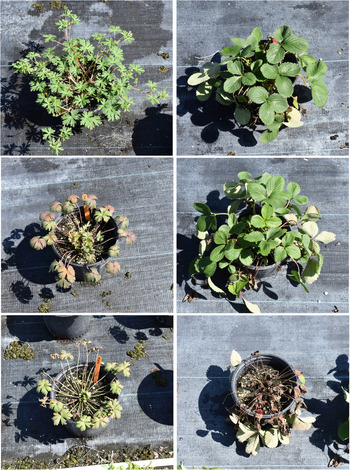
No significant degree of necrosis was observed in the strawberry plants within the study period. Plants exposed to the selected sulfonylurea treatments, except for foramsulfuron, expressed a high level of epinasty and discoloration, but necrosis had not manifested by the trial end (Figure 1). A greater duration may have resulted in development of necrosis, but further study is required.
Impact of sulfonylurea chemistries on Carolina geranium (left) and strawberry (right) in Balm, FL, in 2019. Top row, nontreated; middle row, foramsulfuron; bottom row, flazasulfuron. Images were taken at 31 d after treatment.

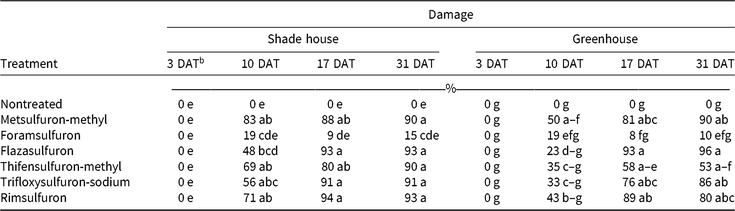
There was an interaction between herbicide treatment and measurement date on strawberry damage for both runs (P < 0.0001). This interaction was characterized by a lack of damage at the first timing (3 DAT), a relatively rapid onset of maximum damage (10 DAT) for both metsulfuron-methyl and thifensulfuron-methyl for both trials, an intermediate onset of maximum damage for trifloxysulfuron-sodium and rimsulfuron (10 and 14 DAT for the shade house and greenhouse, respectively), and a relatively slower onset of damage (17 DAT) for flazasulfuron (Table 2). Foramsulfuron damage to strawberry plants was relatively minimal, with maximum damage at 10 DAT (19%) and was 10% to 15% by 31 DAT across both runs. All other herbicides demonstrated too much damage on strawberry plants to be acceptable for future testing.
Strawberry damage over time in response to various sulfonylurea herbicide treatments, conducted in protected environments in Balm, FL, in 2019.a
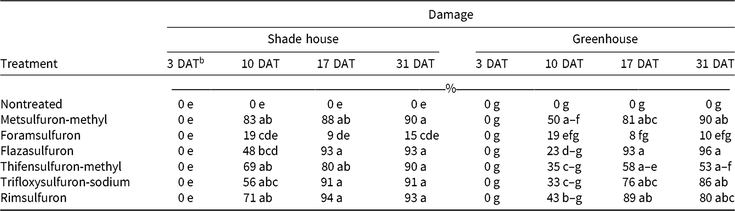
a Different letters between cells within each run (either shade house or greenhouse) indicate a significant difference using Tukey’s honest significant difference test (α = 0.05). Values presented are least square means.
b Abbreviations: DAT, days after herbicide treatment.
To the authors’ knowledge, this is the first published report of the effect of multiple sulfonylurea chemistries on strawberry. Overall, sulfonylurea chemistries, except for foramsulfuron, induced a strongly epinastic effect, where the upper leaf surface became oriented toward the ground (Figure 1, bottom row). The typical purple coloration associated with WSSA Group 2 chemistry was demonstrated on the underside of the strawberry stems and leaf veins, particularly on the leaf surface nearest the petiole. Plants suffering from these symptoms remained in this capacity until the end of the study period. Field observations have demonstrated that strawberry plants undergo heavy epinasty and new leaves grow deformed and upright after sulfonylurea exposure, with the overall plant habit not recovering (NS Boyd, personal observation).
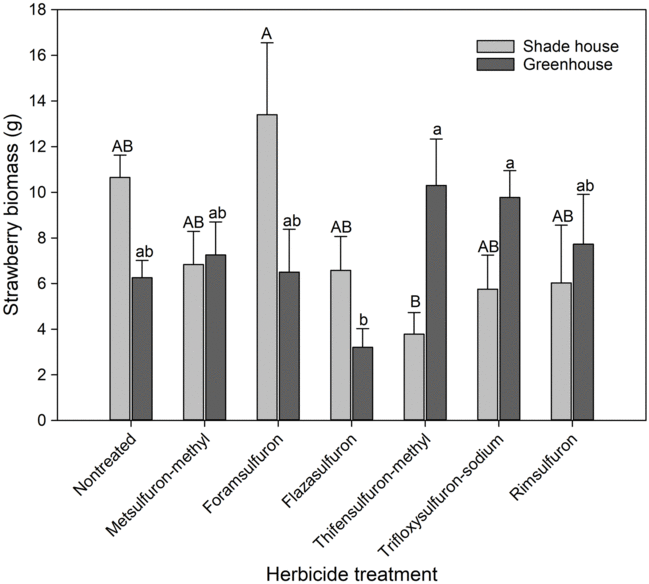
Strawberry biomass at the end of the experiment was affected by the herbicide treatments for both the shade house (P = 0.0142) and greenhouse (P = 0.0172); however, no treatments reduced the strawberry biomass compared to controls (Figure 2). Overall, with the exception of foramsulfuron, all other herbicide treatments induced unacceptable damage to strawberry plants. Strawberry plants’ response to foramsulfuron is promising as a potential new chemistry for use POST atop the crop. Further study is required in the field to examine doses and adjuvants. The other sulfonylureas studied may be suitable as an alternative mode of action to paraquat for strawberry termination and end-of-season weed control. Further research could investigate doses and adjuvants necessary to enhance strawberry termination and efficacy on problematic weeds such as nutsedges, black medic, and goosegrass.
Resultant strawberry biomass in response to various POST applications of sulfonylurea chemistries in protected environments in Balm, FL, in 2019. Rates: metsulfuron-methyl at 4 g ai ha–1, foramsulfuron at 15 g ai ha–1, flazasulfuron at 53 g ai ha–1, thifensulfuron at 4 g ai ha–1, trifloxysulfuron-sodium at 8 g ai ha–1, and rimsulfuron at 35 g ai ha–1. Values are the sample mean, and error bars represent the standard error of the mean. Capital letters refer to the run conducted in the shade house, and lowercase letters indicate the run conducted in the greenhouse. Different letters between treatments within each run represent a significant difference (α = 0.05).

Carolina Geranium
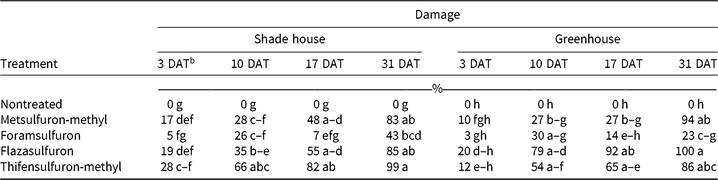
For Carolina geranium damage, there was an interaction between herbicide treatment and measurement date for both the shade house (P = 0.0001) and greenhouse (P = 0.0269). This interaction was characterized by an early development of damage (by 3 DAT) in the shade house for metsulfuron-methyl, flazasulfuron, and thifensulfuron-methyl but not in the greenhouse (Table 3). By 10 DAT, damage had consistently developed across both runs for all herbicides, with maximum damage demonstrated for flazasulfuron, foramsulfuron, and thifensulfuron-methyl. By 17 DAT, metsulfuron-methyl damage reached a maximum. Metsulfuron-methyl, flazasulfuron, and thifensulfuron-methyl consistently provided ≥83% damage by 4 wk after treatment to Carolina geranium applied POST.
Carolina geranium damage over time in response to various sulfonylurea herbicide treatments, conducted in protected environments in Balm, FL, in 2019.a

a Experiment 1 was conducted in a shade house, and experiment 2 was conducted in a greenhouse. Different letters between cells within each experiment indicate a significant difference using Tukey’s honest significant difference test (α = 0.05). Values presented are back-transformed least square means for the shade house and least square means for the greenhouse.
b Abbreviations: DAT, days after herbicide treatment.
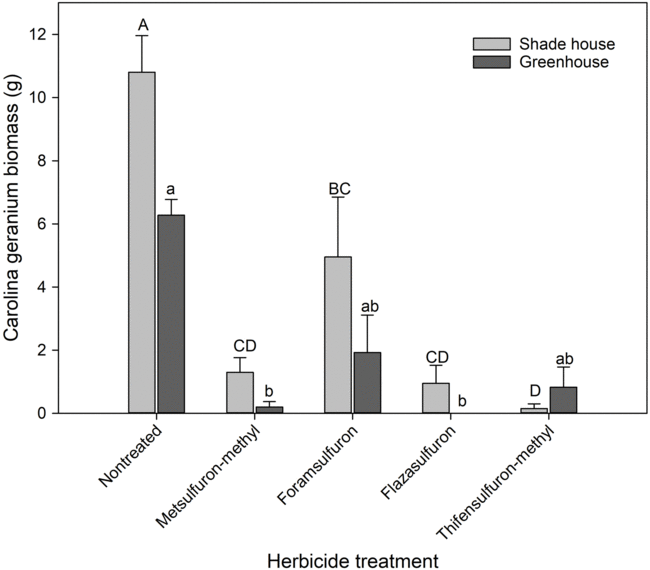
Carolina geranium biomass at the end of the experiment was affected by herbicide treatments for both the shade house (P < 0.0001) and the greenhouse (P < 0.0072). Metsulfuron-methyl and flazasulfuron consistently reduced Carolina geranium biomass across both studies (Figure 3). Thifensulfuron-methyl showed inconsistent results between runs; it demonstrated substantial Carolina geranium biomass reductions in the shade house, whereas in the greenhouse environment it did not reduce biomass compared to the nontreated check. This may be a consequence of the greater light availability in the shade house compared to the greenhouse, resulting in increased Carolina geranium growth for controls. Foramsulfuron also demonstrated inconsistencies similar to those with thifensulfuron-methyl between runs. Foramsulfuron was not as effective as thifensulfuron-methyl in the shade house.
Resultant Carolina geranium biomass in response to various POST applications of sulfonylurea chemistries in protected environments in Balm, FL, in 2019. Rates: metsulfuron-methyl at 4 g ai ha–1, foramsulfuron at 15 g ai ha–1, flazasulfuron at 53 g ai ha–1, thifensulfuron at 4 g ai ha–1. Values are the sample mean, and error bars represent the standard error of the mean. Capital letters refer to the run conducted in the shade house, and lowercase letters indicate the run conducted in the greenhouse. Different letters between treatments within each run represent a significant difference (α = 0.05).

Foramsulfuron was the only sulfonylurea chemistry evaluated that did not evoke strong epinasty in the strawberry plants; therefore, it holds potential for POST applications atop the strawberry bed. Unfortunately, foramsulfuron only suppressed Carolina geranium. The differences between runs, particularly increased damage and reduced biomass, may be due to increased light in the shade house. Field conditions would probably provide conditions more similar to the shade house than the greenhouse, meaning that mere suppression may be the result.
Clopyralid is a registered POST broadleaf herbicide for use atop strawberry beds that has demonstrated crop safety across a wide variety of locations, cultivars, rates, and timings (Boyd and Dittmar Reference Boyd and Dittmar2015, Figueroa and Doohan Reference Figueroa and Doohan2006, Hunnicutt et al. Reference Hunnicutt, MacRae, Dittmar, Noling, Ferrell, Alves and Jacoby2013a, Reference Hunnicutt, MacRae and Whitaker2013b, McMurray et al. Reference McMurray, Monks and Leidy1996, Sharpe et al. Reference Sharpe, Boyd, Dittmar, MacDonald and Darnell2018a). Clopyralid controls a variety of broadleaf weeds, but it provides only suppression of Carolina geranium (Anonymous 2011). Mixtures or sequential applications of clopyralid and foramsulfuron may be a viable option for strawberry production to control Carolina geranium but require further study for both crop tolerance and weed efficacy.
Overall, strawberry plants were highly susceptible to various sulfonylurea chemistries except for foramsulfuron. Foramsulfuron did induce a low degree of damage by 10 DAT (<20%), but plants appeared to recover by 31 DAT (10% to 15% damage). Results for strawberry tolerance to foramsulfuron were consistent for both runs, which varied in environmental conditions including temperature, available light, and humidity. Considering the degree of damage that occurred in protected environments, it is possible that less damage may be observed during field evaluation. Current results are valuable in demonstrating foramsulfuron safety on the vegetative stage of the strawberry plant. Further study should be conducted during strawberry plasticulture field production on foramsulfuron crop safety when applied atop the crop, particularly with regard to berry yield. Formulations, surfactants, environment, timing, and dose may all affect strawberry tolerance and could be optimized for application atop the crop to minimize damage.
Carolina geranium showed stunting in response to foramsulfuron and high susceptibility to metsulfuron-methyl, flazasulfuron, and thifensulfuron-methyl. The latter three herbicides may be useful in row-middles where herbicides are typically applied with a curtain sprayer, and in the postharvest portion of the production cycle depending on replant intervals. Strawberry termination is performed using paraquat. Additional modes of action may be necessary to control herbicide-resistant weeds at the season end, such as paraquat-resistant goosegrass (Buker et al. Reference Buker, Steed and Stall2002) and paraquat-tolerant ragweed parthenium (Parthenium hysterophorus L.) (Fernandez et al. Reference Fernandez, Odero, MacDonald, Ferrell and Gettys2015); the evaluated sulfonylurea chemistries may represent just such mode-of-action alternatives. Additionally, given the strawberry crops’ ability to shield weeds from incoming applications (Sharpe et al. Reference Sharpe, Boyd, Dittmar, MacDonald, Darnell and Ferrell2018b), additional field testing on weed efficacy during the production cycle is necessary.
Acknowledgments
The authors thank Christy Wilt and Betty Hamm for their technical assistance. This research received no specific grant from any funding agency, commercial, or not-for-profit sectors. No conflicts of interest have been declared.