There is a deeply rooted belief in the traditional practice of not machine or hand milking camels without the presence of their young (Costa and Reinemann, Reference Costa and Reinemann2003; Kaskous and Abdelaziz, Reference Kaskous and Abdelaziz2014) because the presence of the calf is considered imperative for milk ejection. Indeed, in new large–scale intensive systems such as in the Emirates and Saudi Arabia, calves and she-camels are allowed together during machine milking (Juhasz and Nagy, Reference Juhasz, Nagy, Nagy, Huszenicza and Juhasz2008; Ayadi et al., Reference Ayadi, Aljumaah, Musaad, Samara, Abelrahman, Alshaikh, Saleh and Faye2013), to induce the milk ejection reflex and limit stress. Additionally, in most countries, camels reared in traditional farming systems are milked by hand (Alhadrami, Reference Alhadrami, Rosati, Tewolde and Mosconi2003; Wernery, Reference Wernery2006) but after or in parallel with calf suckling until the milk ejection (teats swelling) is observed (Kaskous and Abdelaziz, Reference Kaskous and Abdelaziz2014). Nevertheless, it may be possible to milk by hand and without the presence of the calf (Caja et al., Reference Caja, Salama, Fathy, El-Sayed and Salama2011). In this case, hand massaging is recommended to enhance milk ejection (Costa and Reinemann, Reference Costa and Reinemann2003).
Only a little information is available about milking management of dairy camels in comparison to the considerable number of experiments conducted on milking management of dairy cattle, sheep, and goats (Wernery et al., Reference Wernery, Juhasz and Nagy2004; Hammadi et al., Reference Hammadi, Atigui, Ayadi, Barmat, Belgacem, Khaldi and Khorchani2010). Furthermore, these publications remain descriptive and based essentially on behavioural observations, morphological traits and on various analyses of milk components and production (Kaskous, Reference Kaskous2018). Until now, it has never been proven that the practices of hand or machine milking with the young beside their mother give better physiological milk ejection stimulation than milking without the young present. To evaluate milking management practices and to help the better setting-up of milking machines and equipment, evaluation of functional and physiological reactions of camels to differing stimulation during suckling and milking is needed. Some recent works are more analytical with descriptions of milk flow patterns during various milking managements or machine settings (Atigui et al., Reference Atigui, Hammadi, Barmat, Farhat, Khorchani and Marnet2014a; Moashi et al., Reference Moashi, Musaad and Faye2015). Nevertheless, without machine milking or because of important interactions between teat canal characteristics and machine settings with milk flow, milk flow recording alone cannot assess the actual quality of milk ejection stimulation, and physiological indicators are required. Oxytocin (OT) is released after udder/teat stimulation (Ely and Petersen, Reference Ely and Petersen1941). As for all neuroendocrine reflexes, the stimulation of the paraventricular and supraoptic nuclei in the hypothalamus results mainly in peripheral nerve stimulation. It has been verified that a higher tactile stimulation intensity around milking in cows resulted in a higher release of OT in the blood (Weiss et al., Reference Weiss, Dzidic and Bruckmaier2003). Therefore, optimizing udder/teat stimulation but also general animal stimulation could be useful to improve milk ejection and milk production of camels because of the galactopoietic capabilities of OT (Lollivier et al., Reference Lollivier, Guinard-Flament, Ollivier-Bousquet and Marnet2002). Such impacts have been already demonstrated (Marnet et al., Reference Marnet, Combaud, Le Du and Dano1996; Billon et al., Reference Billon, Marnet, Maugras, Tancin, Mihina and Uhrinca2005) where effects of pulsation rate and vacuum level on OT release and milk production in ewes and goats respectively were shown. Additionally, OT release could be regulated at the central level during acute stress in concert with catecholamines, β-endorphin and CORT release (Gorewit and Aromando, Reference Gorewit and Aromando1985; Song et al., Reference Song, Crowley and Grosvenor1988; Bruckmaier et al., Reference Bruckmaier, Schams and Blum1993). Another specific inhibition of OT release could be induced by maternal behaviour (Marnet and Negrão, Reference Marnet and Negrão2000; Hernandez et al., Reference Hernandez, Serafin, Terrazas, Marnet, Kann, Delgadillo and Poindron2002; De Passillé et al., Reference de Passillé, Marnet, Lapierre and Rushen2008, in ewes, goats, and cows respectively) making milk ejection incomplete when animals are milked in a mixed system of suckling and milking. Such results raise questions about how camels, which are recommended to be milked with their calves, will react physiologically to mixed management practices of suckling and milking and to milking without young beside them.
CORT is also released after a suckling or milking episode in other species (Marnet and Negrão, Reference Marnet and Negrão2000; Lupoli et al., Reference Lupoli, Johansson, Uvnäs-Moberg and Svennersten-Sjaunja2001; Negrão and Marnet, Reference Negrão and Marnet2006), probably to improve function of the mammary gland especially during lactogenesis. Indeed, CORT seems to be important in the reduction of mammary epithelial cell tight junction leakiness in the udder of dairy cows (Bernier-Dodier et al., Reference Bernier-Dodier, Girard, Talbot and Lacasse2011; Stelwagen and Singh, Reference Stelwagen and Singh2014) and in amplifying effect of prolactin (Houdebine, Reference Houdebine1986). But elevated CORT is also considered a good index of the reaction of animals to environmental challenges (Bruckmaier and Wellnitz, Reference Bruckmaier and Wellnitz2008). For example, elevated plasma CORT concentrations in unfamiliar surroundings in dairy cows were described (Bruckmaier et al., Reference Bruckmaier, Schams and Blum1993). In addition, when cows adapted to new surroundings, the concentrations of these hormones decreased (Bruckmaier et al., Reference Bruckmaier, Pfeilsticker and Blum1996). How camels would react (more stress or classical stimulation for lactation maintenance) to new machine milking management without the calf present, compared to suckling or hand-milking management with simultaneous suckling in familiar surroundings, remains to be evaluated.
This work aimed to compare the OT and CORT release patterns in camels between exclusive suckling by their calves, considered as the reference of milk ejection stimulation, and milking by hand with simultaneous calf suckling or during machine milking in parlour without their calf's presence, to better evaluate the relative efficiencies of these different milking management practices.
Materials and methods
Ethics of experiments
The experimental conditions of the present work complied with the European Directive 2010/63/EU on the protection of animals used for scientific purposes.
Animals and management
Six multiparous (BW 439.0 ± 35.7 kg; age 13.7 ± 5.9 years, between their 2nd and 6th lactation) Maghrebi camels (Camelus dromedarius) in early lactation, and nursing only one calf, were used during this investigation. Animals were housed together under an intensive production system at the experimental farm of the Arid Regions Institute (IRA, Chenchou, Tunisia). Camels were fed twice a day with 4 kg of oat hay, 4 kg of alfalfa hay, 8 kg of fresh alfalfa, and 2 kg of commercial concentrate while water was offered ad libitum. The experiment was conducted in calm and familiar surroundings without any disturbance to avoid stress and possible perturbation of milk ejection kinetics (Atigui et al., Reference Atigui, Marnet, Naziha, Khorchani and Hammadi2014b).
The study was carried out over three successive periods. Measurements commenced 88.1 ± 7.2 d after parturition with a 7 d period (suckling), where calves suckled the mammary gland as done from birth, freely and alone without intervention of the worker during the day. During the night (from 16 : 00 h to 8 : 00 h), mothers and calves were housed in separate areas to avoid direct access to the udder but maintaining olfactory, auditory and visual contact as had been the situation since the 6th weeks of lactation. In the morning, mothers and calves were reunited and blood sampling was done during the first suckling episode after reunification. Two suckling episodes per camel were studied on the 3rd to 5th day of this period. During the following 7 d period (hand milking), the management of young and mothers remained the same but she-camels were trained to become accustomed to human contact at the udder and hand milked in the familiar resting area, in the presence of the calf to induce milk ejection. Hand milking was always done on two quarters on one side of the udder while the two other quarters were reserved for the calf suckling during milking. Measurements were done on the 11th to 13th days of the experiment. The third period (machine milking) began in the third week and 4 additional weeks of training was done to machine milking without young beside the mother, before our measurements. During this period, she-camels were machine milked by the same milker in a newly designed Herringbone Parlor (2 × 3) with Flaco© equipment. After entering the milking parlour, the milking routine was limited to a rapid and dry cleaning of udders with hand and quick attachment of milking clusters to better evaluate the stimulation done by milking machine alone (and not due to manual stimulation). The machine was set according to the recommendations of Atigui et al. (Reference Atigui, Marnet, Barmat, Khorchani and Hammadi2015) for camel machine milking i.e. 60 pulsations/min and 60% ratio using a vacuum of 48 kPa. She-camels were milked twice a day. They were then reunited with calves with the opportunity for them to suckle for a half hour after milking to allow better emptying of the udder and to maintain stimulation of lactation in she-camels. Then she-camels spent the remaining time with their calves beside them in separated areas, with the availability of olfactory, visual and auditory contact but without any access to udder and possibility of suckling. The milkings evaluated were the morning milkings (3 camels recorded on day 1 and 3 other camels recorded on day 2 with the complete sequence repeated one time 2 d later).
Blood sampling
Before parturition, she-camels were accustomed to various and frequent manipulations by herders and researchers including selection and movement to the milking sites, restraint and blood sampling from the jugular vein to reduce future stress of manipulations during our measurements. Our previous trials showed no differences in OT and CORT releases in accustomed animals, when blood was collected with indwelling catheters fitted some days before under local anaesthesia via a trocar and protected by an adhesive bandage around the neck, compared with needle venipuncture made only two different times during the kinetics (small needles are let in the jugular vein except for the last point). Consequently, we used needles for taking blood sample kinetics measurements to avoid perturbations in parturition and first period of nursing when we needed to fit catheters. We collected samples before, during and after the suckling or milking episode at −1, −0.5, 0, 0.5, 1, 2, 3, 5, 10, 15, and 30 min from the beginning of the stimulation (Time 0 is the beginning of suckling for both suckling and hand-milking with suckling, or attachment of the teat cups for machine milking).
Immediately after blood collection into chilled heparinized tubes (LIHEPARIN 68 IU, 4 ml VacuTest Kima S.r.l; Italy), tubes were placed in iced water to avoid OT degradation and quickly transported to the laboratory where they were centrifuged at 2600g for 15 min at 4°C. The plasma samples collected were stored at −20°C until hormone assays were performed.
Hormone assays
For OT determination, we used a sensitive and specific enzyme immunoassay (Marnet et al., Reference Marnet, Volland, Pradelles, Grassi and Beaufils1994) recently adapted to camels (Marnet et al., Reference Marnet, Portanguen, Atigui and Hammadi2018 and detailed in online Supplementary file). For this OT assay, the limit of detection was 4.5 pg/ml and the B/Bo at 50% (E.D.50) was 208.7 pg/ml. The intra-assay CV ranged from 20.74% (15.6 pg/ml) to 7.85% (1 ng/ml). The inter-assay CV was of 9.22% at E.D.50.
For CORT assays, we used the same methodology as already validated and described in Atigui et al. (Reference Atigui, Marnet, Barmat, Khorchani and Hammadi2015) with some adjustments. The limit of detection was 112.0 pg/ml and the B/Bo at 50% (E.D.50) was 641.6 pg/ml. The intra-assay CV ranged from 18.85% (99.7 pg/ml) to 7.08% (1.562 ng/ml). The inter-assay CV was 7.54% at E.D.50.
Other measurements
The duration of suckling and milking episodes as well as the presence and time of swelling of teats were recorded during all experimental episodes of suckling and milking.
Calculations and statistical analysis
The total hormone quantity released over the 30-min period was approximated as the area under the curve after subtracting the basal level estimated on mean sample concentrations at −60 and −30 s. In the case of OT release before the beginning of suckling or milking episodes (if the concentrations of these samples appeared significantly higher to the last points of the kinetic), the two last points of the kinetics were used as a reference for the basal level. Basal and maximum hormone concentrations, as well as the time of maximum concentration, were also measured on each kinetic, averaged, and compared between managements. Because OT concentration data were non-normally distributed (Shapiro–Wilk test) they were analysed with the PROC GLIMMIX procedure of ANOVA using log link for Poisson data. The model included the general mean, time of blood sampling, management and time*management as the fixed variables, and camel identity and residual error as the random variables. The post-hoc mean comparison test was used for mean comparison. All given estimates are presented as ln-transformed least-squares means (LSM) ± standard errors (sem).
For CORT concentrations, the PROC MIXED procedure of ANOVA with repeated measures was used. The model included the general mean, the random effect of animal, the fixed effects of management (exclusive suckling; hand-milking and machine milking), time and their interactions and the residual error. Results are represented as least-square means ± standard error.
All analyses were performed using SAS Software (SAS version 9.4, SAS Inst. Inc., Cary, NC). Significance was declared as P < 0.05.
Results
Ot and CORT release patterns
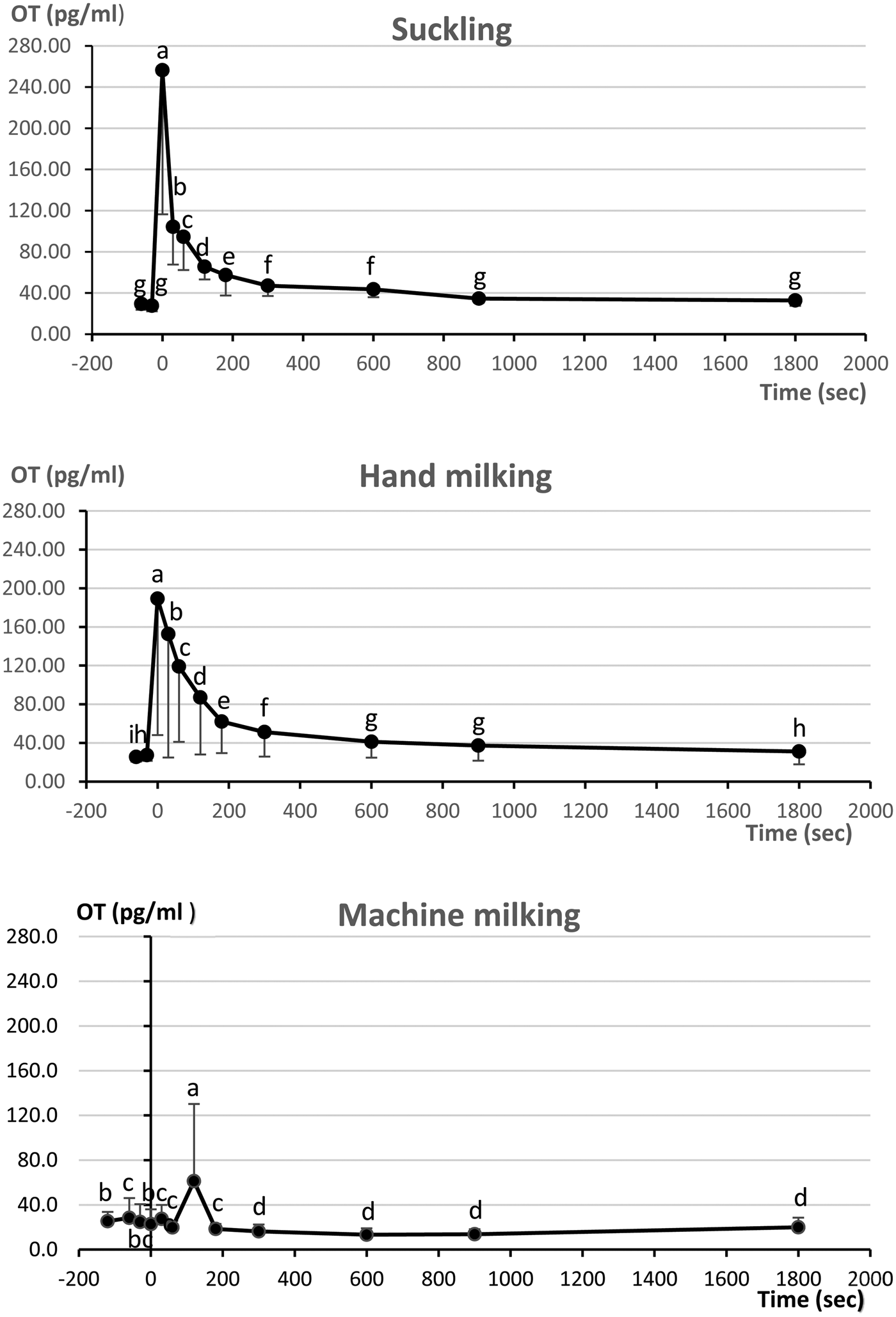
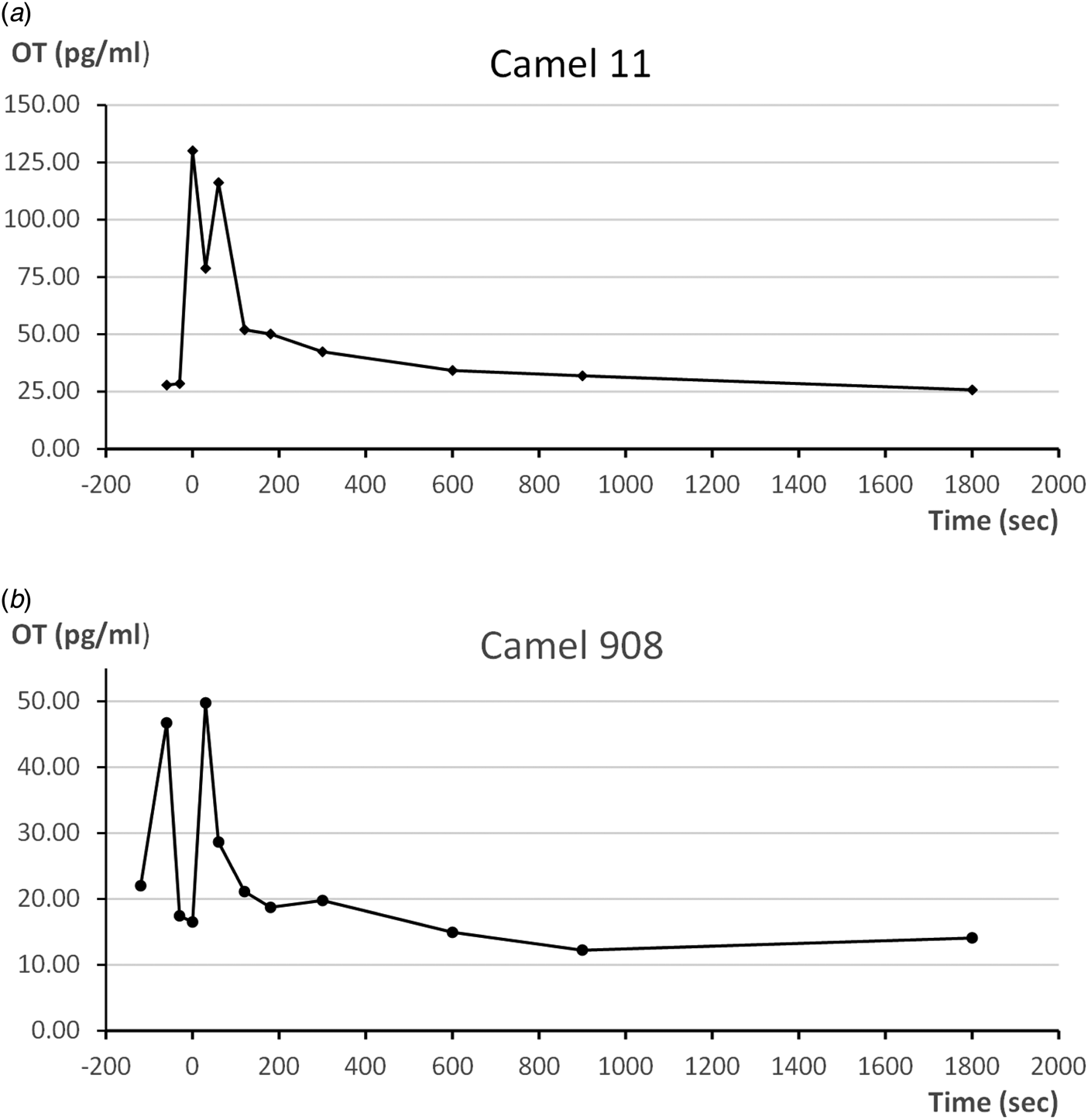
All camels showed a significant release of OT during exclusive suckling episodes as well as during hand-milking with calves' suckling (Fig. 1a and 1b). This was also the case during machine milking episodes (Fig. 1c) except for one milking episode in one camel. For the two managements that included suckling, OT concentrations showed a sharp increase to reach a mean maximum concentration at around 32.5 to 35 s after the beginning of suckling, to return to basal level after 5 min i.e. approximately just after the end of suckling or hand-milking (measured at 250.3 ± 17.5 s and 268.9 ± 17.5 s, respectively). Teat swelling was observed in all animals at a mean delay of 62.4 ± 15.1 s and 71.8 ± 15.1 s, respectively. Two of the six camels showed bimodal OT release in the first minute of suckling (Fig. 2a).
Average plasma OT concentration patterns during Suckling, Hand-Milking + Suckling and Machine Milking episodes in camels.
Different superscripts refer to significant differences between samples' concentrations in the profile (n = 12). Time zero corresponds to beginning of suckling or of teat cup attachment for milking managements.

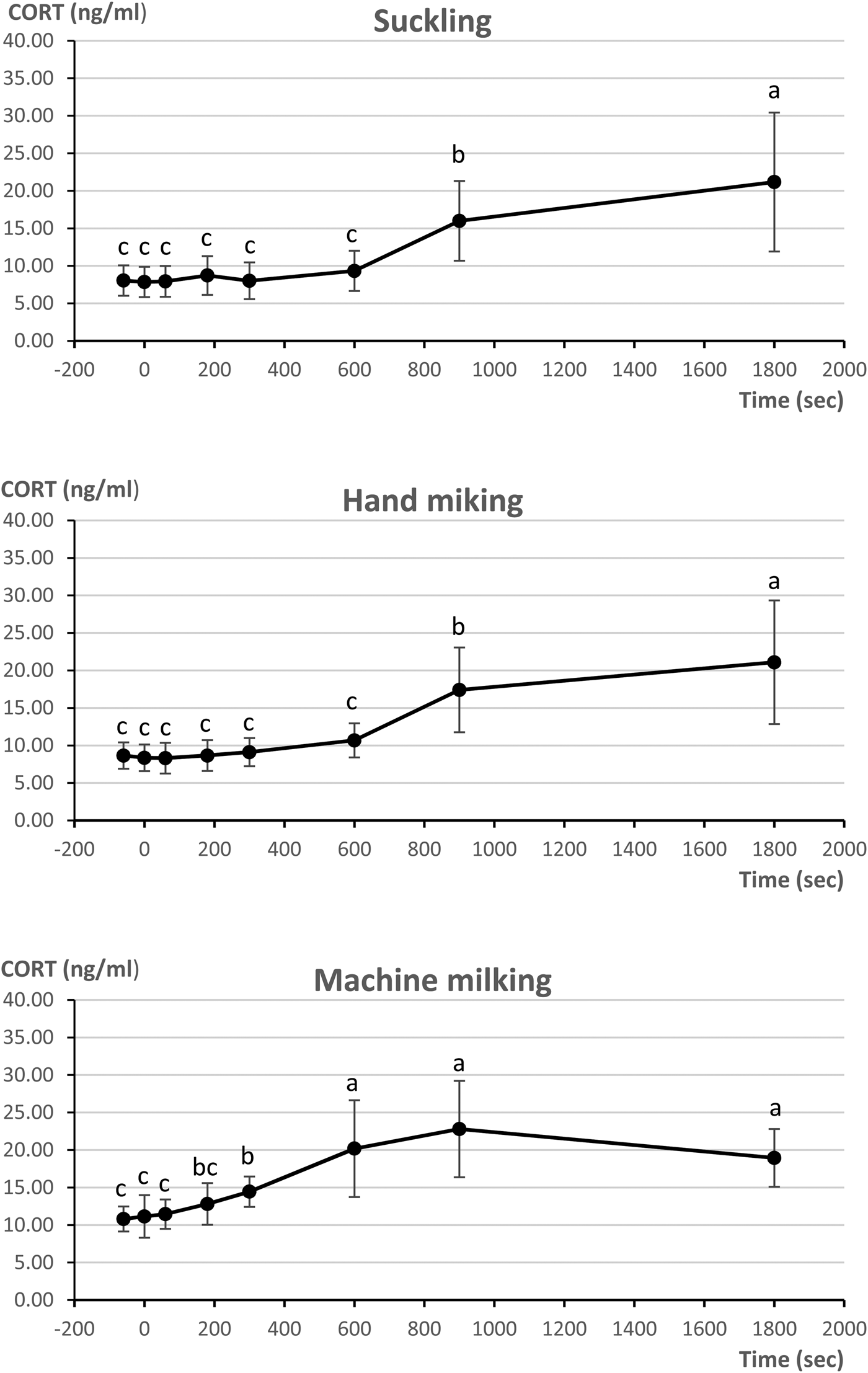
Average plasma CORT concentration patterns during Suckling, Hand-Milking + Suckling and Machine Milking episodes in camels: Different superscripts refer to significant differences between samples' concentrations in the profile (n = 12). Time zero corresponds to beginning of suckling or of teat cup attachment for milking managements.

In contrast, during machine milking, all OT plasma concentrations and total OT quantities released were significantly lower compared with other managements (Table 1). Oxytocin levels increased more slowly and reached their maximum later (63 ± 18.6 s) and returned to basal levels just after this time, even though the machine milking was completed later, at 287 ± 19.2 s. Despite these low OT discharges, we observed teat swelling in the majority of she-camels at around 93.7 ± 16.6 s, i.e. around 40 to 20 s later related to other managements. This difference was not statistically different. This management also induced bimodal OT releases in two camels (Fig. 2b) but with a specific pattern showing a peak of OT concentration before teat cup attachment, followed by another one after teat cup attachment.
Average plasma OT discharge parameters during suckling, hand milking + suckling and machine milking episodes in camels

Area under the curves (AUC) give an estimate of the total quantity of hormone released throughout the 30 min of sampling.
Data are means ± sem from 6 camels and 2 episodes per management, independent of the time of sampling. Superscripts show significant differences between managements.
CORT release patterns (Fig. 3) showed a classical shape with a significant increase of plasma concentration between 10 and 15 min with a continuous increase until 30 min, except for machine milking management where CORT levels decreased again between 15 and 30 min. There was no difference between CORT level and patterns between suckling and hand-milking together with suckling (Table 2). Nevertheless, CORT levels before machine milking episodes were significantly higher than for other managements and there was a non-significant numerical increase in the total quantity of CORT released. Post hoc mean comparison tests showed a significantly higher total quantity of CORT released with exclusive machine milking management compared to exclusive suckling management (Table 2).
Example of bimodal oxytocin concentration patterns during suckling (a) and machine milking (b) episodes in 2 representative camels. Time zero correspond to beginning of suckling or of teat cup attachment for milking managements.

Average plasma CORT discharge parameters during suckling, hand milking + suckling and machine milking episodes in camels

Area under the curve (AUC) give an estimate the total quantity of hormone released throughout the 30 min of sampling.
Data are means ± sem from 6 camels and 2 episodes per management, independent of the time of sampling. Superscripts show significant differences between managements.
It is notable that the individual kinetics did not all show exactly the same shapes and concentration levels between camels and managements, and this variability creates slight differences between the average values of the times to peak concentrations and the maximum and minimum concentrations, independent of time, reported in Table 1 and the values observed on curves reported in Fig. 1 that show the average concentrations by sampling time.
Discussion
Our experiment confirms that OT was released in all camels with no difference in peak level, time of peak or total quantity released, during exclusive suckling and hand milking with simultaneous suckling. All of these OT discharges showed the classical pattern of release of other ruminants (having the same amplitude and duration). Nevertheless, we recorded a quicker release and a maximum level reached between 32.5 and 35s as compared to a maximum of OT level between 30 s to 2 min reported in various other species (Bruckmaier et al., Reference Bruckmaier, Ritter, Schams and Blum1994 in goats; Bruckmaier and Blum, Reference Bruckmaier and Blum1996 in dairy cows; Marnet et al., Reference Marnet, Negrão and Labussière1998, in dairy ewes; Negrão and Marnet, Reference Negrão and Marnet2006 in zebus-gyr cows). Rather than being species specific, this slightly early discharge could be a facilitated OT (conditioned) release resulting from our protocol that needed more time for the pre-suckling blood sampling, before gathering calves and waiting mothers. There was also some variability between the timing of first blood sampling and evaluation of the actual first suckling activity of calves which may have contributed to the slightly different release patterns observed between camels.
The presence of milker and contact to the udder did not modify OT release patterns nor the basal CORT level and total CORT release patterns induced by hand-milking. That supports that the mothers were not stressed by human presence even in these experimental conditions with additional possible perturbations due to blood sampling. We cannot prove the actual efficiency in milk harvesting of this management because part of the milk was consumed by the calves and not measured here. Nevertheless, a correct milk harvesting was probable according to the good OT release and the ease of the hand-milking process which lead to a real milk ejection verified by teat cistern swelling observation, lack of aggressive reactions and lack of external signs of stress (urination, shouting, abrupt movements in the mother). Hand-milking alone is known to produce a lower quality of stimulation in cows, leading to lower OT release by comparison to suckling (Bruckmaier and Blum, Reference Bruckmaier and Blum1996). Hence, this makes this management of simultaneous hand-milking and suckling a good system to overcome this disadvantage and better stimulate camel. Nevertheless, the milk collection for human consumption is reduced with this management due to calf milk consumption.
After habituation of our she-camels to milking in the milking parlour and separation from their calves for four weeks, we observed the same calm behaviour of she-camels in the parlour and no more abnormal stress-related CORT levels. We recorded also an apparent milk let-down as observed by teat swelling after 93.7 ± 16.6 s and a milk harvesting considered as normal (3 to 4 kg/camel/d). Nevertheless, she-camels showed clear inhibition and reduction of OT release during machine milking and one she-camel had totally blocked OT release during one episode. The maximum OT release also arrived later, as seen in machine milked cows without pre-stimulation (massaging, cleaning, fore-stripping) (Bruckmaier and Blum, Reference Bruckmaier and Blum1996). Note that our milking process only allowed a very short and dry bare hand cleaning of the teats before cluster attachment. Thus, this OT release resulted mainly from the machine stimulation and our results could signify that our machine stimulation could be improved. The settings of vacuum and pulsation parameters were previously established in this flock (Atigui et al., Reference Atigui, Marnet, Barmat, Khorchani and Hammadi2015) using a portable bucket milking machine that differs from the newly designed milking parlour and machine used in this trial. That suggests a probable need for equipment tailoring to animals (liner adaptation, pulsators, and vacuum regulation). Because of its high sensitivity and proportionality to stimulation efficiency, OT measurement appears clearly a good tool to help us in the design of better milking management and milking machine operation settings. Manual udder stimulation was tested as being an important addition to help manual milking without the calves (Caja et al., Reference Caja, Salama, Fathy, El-Sayed and Salama2011). This could be explored further by testing OT response to different forms and durations of teat/udder pre-stimulation before milking as done by Ayadi et al. (Reference Ayadi, Musaad, Aljumaah, Matar and Faye2016) for milking the difficult to milk camels.
The maternal bond resulting from our mixed system of milking and suckling could have had a greater effect on the clear inhibition of OT release observed than that of the effect of the low quality of stimulation given by our milking machine. This physiological adaptation is well known to specifically inhibit OT release in maternal animals whilst not affecting other hormones such as prolactin and CORT (Marnet and Negrão, Reference Marnet and Negrão2000; Hernandez et al., Reference Hernandez, Serafin, Terrazas, Marnet, Kann, Delgadillo and Poindron2002; De Passillé et al., Reference de Passillé, Marnet, Lapierre and Rushen2008). Such inhibition could result in milk retention in the udder during machine milking during this mixed management as already observed by these authors and explained by the selectivity (for its own young) component of maternal behaviour that tries to avoid the theft of milk by alien young. Finally, camels showed exactly the same physiological reactions to exclusive suckling, hand-milking with suckling and machine milking as described in other non-selected ruminants like Gyr cows (Negrão, Reference Negrão2008). However, the more important observation was that the reduced OT release at machine milking nevertheless nearly always allowed a milk ejection. It might not be optimal, but it showed that adaption to machine milking without calf stimulation could occur and be maintained and probably improved after complete weaning when OT release could become uninhibited. It is very challenging to manage machine milking together with the presence of the young in large scale milking parlours. It is now important to establish if OT release could be fully restored and milk ejection optimized during exclusive milking after complete weaning in camels, as is the case in dairy ewes (Negrão and Marnet, Reference Negrão and Marnet2003).
Some camels showed bimodal releases (Fig. 3b) as occasionally observed in goats (McNeilly, Reference McNeilly1972; Bruckmaier et al., Reference Bruckmaier, Ritter, Schams and Blum1994). The first peak of OT release before teat cup attachment suggests that this pattern could be induced by the machine milking and sampling managements we used. Despite a period of adaption to this milking routine, it was necessary to modify the normal routine of direct entry in the parlour and immediate cluster attachment to give sufficient time to sample blood at pre-milking times. It is possible that these she-camels had facilitated or conditioned OT release while waiting to be milked. If true, it could be an indication that good training and conditioning, could improve their milking ability.
We do not think our camels were stressed by this mixed management. There are only a few publications around milking in this species. Similar to our findings, Atigui et al. (Reference Atigui, Marnet, Barmat, Khorchani and Hammadi2015) reported CORT levels peaked (between 14 to 19 ng/ml) 12 min after machine milking with different settings. They defined camels as stressed when higher levels of CORT ranging between 40 and 60 ng/ml occurred. That was observed in only one animal showing clear signs of fearfulness (agitation, groaning, kicking, defaecation). Otherwise, highly stressful conditions, such as transportation in trucks, induced very large elevations of CORT in camels [between 88.32 ± 19.4 to 152.4 ± 25.18 ng/ml depending on the length of travel (El Khasmi et al., Reference El Khasmi, Chakir, Bargaa, Barka, Lektib, Najia, Belhouari and Faye2015) or 5.13 at rest to 104.65 ng/ml after transportation (Hammadi et al., in preparation)]. During more physiological adaptations, CORT increased in camels from basal levels around 21.9 ± 1.0 ng/ml to more than 121.6 ± 5.4 on the day of parturition or increased from 37.1 ± 1.4 ng/ml 1 d before weaning to 48.0 ± 1.5 and 69.5 ± 1.9 ng/ml at weaning and 3rd day after weaning (Mohamed, Reference Mohamed2006). If we measured significantly higher basal CORT levels before machine milking (10.49 ± 0.92 ng/ml) than before suckling (7.12 ± 0.85 ng/ml) these levels did not seem comparable to stress-induced CORT releases reported above and the variations we measured remained in the normal range of basal level variability for days or weeks with metabolic adaptation to lactation. Moreover, in Holstein cows managed in classical farm conditions, the basal levels (8−11 ng/ml) and levels after stimulation (around 40 ng/ml) recorded around milking were comparable to ours (Lupoli et al., Reference Lupoli, Johansson, Uvnäs-Moberg and Svennersten-Sjaunja2001; Negrão et al., Reference Negrão, Porcionato, de Passillé and Rushen2004) and reinforce the idea of a lack of induction of stress with our management of the camels. Additionally, if camels were chronically stressed, we expected to see a reduced reaction to stimulation as a result of classical down-regulation of CORT release after repeated and high ACTH level stimulation. This was not the case with a slightly higher total CORT released during machine milking than during suckling episodes. We just observed a reduction of plasma CORT concentration between 15 and 30 min when a ‘normal’ suckling CORT induced release lasted longer with a max at, or after, 30 min. If not linked to stress, this shorter CORT release could suggest a lower stimulation by our milking machine, which needs to be further tested and optimized as proposed above.
In conclusion, this work describes the first measurements of OT release during suckling and milking in camels. The OT release patterns recorded during suckling and hand milking with suckling were close to those recorded in other ruminants as well for global plasma concentrations and profiles. This study also revealed a reaction classically observed in other ruminants exclusively machine milked when young were separated from their mothers, with a specific inhibition of OT release occurring despite CORT release being unchanged. The presence of the young is necessary to restore the OT release and confirms the soundness of the practice of manual milking with calves beside them or suckling their mothers as used in traditional camel farm management. Whilst the OT release in machine milked camels was reduced, milk ejection did occur and it remains possible that the milking machine setting could be further optimized for a better stimulation of milk ejection. More investigations are required to determine if OT release can be totally restored during exclusive machine milking after weaning and total separation of calves. Measurement of OT release patterns is a powerful tool to evaluate the quality of stimulation during milking.
Supplementary material
The supplementary material for this article can be found at https://doi.org/10.1017/S0022029921000522.
Acknowledgements
This work was partially funded by the IRESA (Ministry of Agriculture, Water Resources and Fisheries, Tunisia) through the MECAMEL Project: Promotion de la mécanisation de la traite chez les petits éleveurs des chamelles laitières. We would like to thank all contributors and particularly Mr. Khediri, Mr Saafi, Khalfalli and Radhouani (for expert animal care and management in the experimental station in Chenchou, IRA, Medénine, Tunisia) and the members of the INRA/Institut agro PEGASE laboratory for the warm welcome, enzyme immunoassay of our samples and first data analyses. Our special thanks to the University of Sousse and to the ‘Institut des Régions Arides’ for financial assistance and to IRESA for financial support of the PhD research training period in France and to Dr Adrian Molenaar from AgResearch, Palmerston North, New Zealand for expert revision of our English language. This research was presented at the 8th IDF International Symposium on sheep, goat and other non-cow milk held as a virtual online meeting November 4th−6th, 2020