Initially proposed as a reconceptualization of maternal sensitivity, mind-mindedness (MM) refers to the caregiver’s tendency to attribute mental states to their infant, treating them as a whole person with an internal mind of his or her own, as opposed to simply an object with needs to be met (Meins, Reference Meins1997). The observational approach to measuring MM assesses caregivers’ unprompted tendencies to comment on the internal state of their infant during real time, play interactions (Meins et al., Reference Meins, Fernyhough, Fradley and Tuckey2001); reflecting the capacity to “tune in” to the inner world of thoughts, experiences, or feelings, of their infant. Meins and colleagues (Meins et al., Reference Meins, Fernyhough, de Rosnay, Arnott, Leekam and Turner2012; Meins & Fernyhough, Reference Meins and Fernyhough2015) have operationalized MM as dimensional. Appropriate MM refers to mental state comments that appear to be congruent with the infant’s experience or behavior, whilst nonattuned MM refers to mental state comments that appear to be incompatible with, or misinterpretations of, the infant’s experience or behavior (Meins & Fernyhough, Reference Meins and Fernyhough2015).
These two dimensions of MM (appropriate and nonattuned) appear to contribute independently to mother–infant attachment and maternal sensitivity (Meins et al., Reference Meins, Fernyhough, de Rosnay, Arnott, Leekam and Turner2012; Zeegers et al., Reference Zeegers, Colonnesi, Stams and Meins2017). For example, a recent meta-analysis found nonattuned MM to be more strongly associated with parent–infant insecure attachment than appropriate MM, while only appropriate MM shared significant links with maternal sensitivity (Zeegers et al., Reference Zeegers, Colonnesi, Stams and Meins2017). In addition, MM comments can be further considered with respect to valence: the focus on the infant’s positive or negative/neutral mental state (Meins & Fernyhough, Reference Meins and Fernyhough2015). Demers et al. (Reference Demers, Bernier, Tarabulsy and Provost2010a, Reference Demers, Bernier, Tarabulsy and Provost2010b) have argued this may be particularly important to consider when studying at-risk caregivers.
The MM literature has principally focused on examinations of appropriate MM comments to the exclusion of nonattuned MM comments, given that the latter are observed far less frequently during mother–infant interactions, at least within the majority of existing research involving nonclinical samples (Arnott & Meins, Reference Arnott and Meins2007; Kirk et al., Reference Kirk, Pine, Wheatley, Howlett, Schulz and Fletcher2015; McMahon & Bernier, Reference McMahon and Bernier2017). The present study similarly focuses on an examination of appropriate MM. Furthermore, whilst appropriate MM has been extensively linked to positive child developmental outcomes, principally in relation to theory of mind (Bernier et al., Reference Bernier, McMahon and Perrier2017; Lundy, Reference Lundy2013), associations with adverse child developmental outcomes have only recently garnered research attention (see McMahon & Bernier, Reference McMahon and Bernier2017; Zeegers et al., Reference Zeegers, Colonnesi, Stams and Meins2017 for review).
A small body of emerging evidence has examined the impact of MM on children’s later behavioral difficulties; however, the strength and direction of associations have been found to vary across studies and family and child risk moderators. Moreover, although some evidence has demonstrated that MM is cross-sectionally (Camisasca et al., Reference Camisasca, Procaccia, Miragoli, Valtolina and Di Blasio2017; McMahon & Meins, Reference McMahon and Meins2012; Walker et al., Reference Walker, Wheatcroft and Camic2012) and longitudinally (Demers et al., Reference Demers, Bernier, Tarabulsy and Provost2010b) linked with maternal parenting-specific distress (PD), the moderating role of PD on the relationship between earlier MM and later child behavioral difficulties is less well known.
Hence, the aim of the present study was to investigate the longitudinal links between observationally measured appropriate MM at 10 months and preschool children’s subsequent internalizing (emotional and peer) and externalizing (conduct and hyperactivity) behavioral problems at 51 months, and whether maternal experiences of PD at 36 months may alter any associations between MM and child behavior. The valence of the MM comments was also given descriptive attention in order to shed more nuanced light onto the MM construct.
Maternal mind-mindedness and child behavior
One adverse child development domain concerns internalizing and externalizing behavioral problems: the former characterized by over-inhibited symptoms of anxiety, withdrawal, and dysphoria, and the latter defined by disinhibited symptoms of impulsivity, aggression, and disruptiveness (Achenbach & Edelbrock, Reference Achenbach and Edelbrock1978). Recognition of these early difficulties is important, as they have been repeatedly found to predict later development of adolescent and adult psychopathology (Lancefield et al., Reference Lancefield, Raudino, Downs and Laurens2016).
Theoretically, it is proposed that MM offers a working model that aids children in their capacity to self-regulate their emotions and behavior (Sharp & Fonagy, Reference Sharp and Fonagy2008). A caregiver’s appropriate comments on their child’s mental state may proffer a verbal scaffold of thinking about self and other which, over time and various interactions, comes to be internalized by the child (Fernyhough, Reference Fernyhough2008). This internalization of mentalization capacity is hypothesized to provide the child with the tools to effectively work through challenging emotional experiences, thus facilitating greater self-understanding and self-regulation and fewer behavioral problems (Fernyhough, Reference Fernyhough2008).
It has also been suggested that caregivers who are more oriented toward their child’s mental state may be less prone to experience instances of challenging behavior as difficult, given their propensity to consider the thoughts and feelings that may underlie their child’s actions (McMahon & Bernier, Reference McMahon and Bernier2017). Furthermore, such caregivers may have enhanced capacity for deescalating heightened emotional or behavioral experiences, thus contributing to more positive parent–child interactions (McMahon & Bernier, Reference McMahon and Bernier2017).
Differential associations among high-risk populations
Research with more diverse populations has begun to identify differential associations of MM with child outcomes, such that greater MM may not always have a “blanket” positive effect. Meins et al. (Reference Meins, Centifanti, Fernyhough and Fishburn2013) found that appropriate MM comments at 8 months predicted fewer internalizing and externalizing behavior problems at 44 months, but only for low socioeconomic status (SES) families, controlling for child gender and language, and maternal depression, social support, and sensitivity. The authors argued that MM may play a protective role in adverse family contexts, reducing negative parent–child interactional patterns and hence children’s maladaptive behaviors. However, Centifanti et al. (Reference Centifanti, Meins and Fernyhough2016) tracked these same children and found that appropriate MM comments were unrelated to children’s externalizing problems at 61 months and did not predict impulsive traits at 10 years indirectly through theory of mind. Lower MM was, however, indirectly linked to child self-reported callous, unemotional traits via a high-risk context of suboptimal emotion recognition skills at 51 months (Centifanti et al., Reference Centifanti, Meins and Fernyhough2016).
Parental mental health difficulties can also constitute a high-risk environment. Investigating the impact of caregiver mood on MM, a meta-analysis reported that “the existing evidence suggests that appropriate MM probably relates, to a degree, to current mood” (McMahon & Bernier, Reference McMahon and Bernier2017, p. 18). Links between appropriate MM and current depressive symptoms have been reported as absent (Barreto et al., Reference Barreto, Fearon, Osório, Meins and Martins2015; Demers et al., Reference Demers, Bernier, Tarabulsy and Provost2010b; Meins et al., Reference Meins, Centifanti, Fernyhough and Fishburn2013; Walker et al., Reference Walker, Wheatcroft and Camic2012) or significantly negative (Lok & McMahon, Reference Lok and McMahon2006; Milligan et al., Reference Milligan, Khoury, Benoit and Atkinson2015; Rosenblum et al., Reference Rosenblum, McDonough, Sameroff and Muzik2008; Schacht et al., Reference Schacht, Hammond, Marks, Wood and Conroy2013). Bigelow et al.’s (Reference Bigelow, Beebe, Power, Stafford, Ewing, Egleson and Kaminer2018) longitudinal study found that mothers at risk of depression when their infants were 6 weeks old used significantly fewer appropriate MM comments; however, this negative association was nonsignificant at the infant age of 4 and 12 months. Moreover, lower appropriate MM has been found in maternal caregivers with a diagnosis of Borderline Personality Disorder (BPD; Schacht et al., Reference Schacht, Hammond, Marks, Wood and Conroy2013), Autism Spectrum Disorder (ASD; Kristen et al., Reference Kristen, Rossmann and Sodian2014), and concomitant hyperarousal symptoms from birth trauma (Camisasca et al., Reference Camisasca, Procaccia, Miragoli, Valtolina and Di Blasio2017).
As noted previously, PD has been found to share both cross-sectional (Camisasca et al., Reference Camisasca, Procaccia, Miragoli, Valtolina and Di Blasio2017; McMahon & Meins, Reference McMahon and Meins2012; Walker et al., Reference Walker, Wheatcroft and Camic2012) and predictive negative associations (Demers et al., Reference Demers, Bernier, Tarabulsy and Provost2010b) with appropriate MM, such that mothers who engaged in more appropriate MM experienced less PD. However, most studies to date have focused purely on the main-effect associations between contextual factors and MM, with only one examining these constructs in regard to their interactive associations with child behavioral difficulties. Easterbrooks and colleagues (Reference Easterbrooks, Crossman, Caruso, Raskin and Miranda-Julian2017) conducted a longitudinal study of MM and later child behavioral problems with adolescent mothers. While they found no direct associations between appropriate MM at 12 months and children’s behavioral problems and competence one year later, maternal Post Traumatic Stress Disorder (PTSD) diagnosis was a significant moderator. In contrast to the previous findings in which the theorized positive impact of appropriate MM on lessening behavioral difficulties was found only in higher risk circumstances (Colonnesi et al., Reference Colonnesi, Zeegers, Majdandžić, van Steensel and Bögels2019; Meins et al., Reference Meins, Centifanti, Fernyhough and Fishburn2013), Easterbrooks et al. (Reference Easterbrooks, Crossman, Caruso, Raskin and Miranda-Julian2017) found the positive association was significant only among the low-risk mothers with no diagnosis of PTSD.
Interestingly, in the sample of mothers at greater risk (partial PTSD symptoms), higher appropriate MM was, in fact, related to increased behavior difficulties (Easterbrooks et al., Reference Easterbrooks, Crossman, Caruso, Raskin and Miranda-Julian2017). The authors hypothesized that, in instances when maternal caregivers were experiencing distress and the associated hyperarousal and hypervigilance of PTSD, they may become hyperfocused on their own and their child’s inner mental state in ways that are experienced as dysregulating by the child (Easterbrooks et al., Reference Easterbrooks, Crossman, Caruso, Raskin and Miranda-Julian2017). Also, Easterbrooks et al. queried whether the mothers who had PTSD may have made more neutral/negative as opposed to positive appropriate MM comments; however, no conclusions were possible as the valence of the MM comments was not examined.
Larkin et al. (Reference Larkin, Hayiou-Thomas, Arshad, Leonard, Williams, Katseniou, Malouta, Marshall, Diamantopoulou, Tang, Mani and Meins2020) cross-sectionally investigated the relations between appropriate MM and parenting stress in parents of children from 24 months of age with Attention Deficit Hyperactivity Disorder (ADHD), ASD, Down syndrome, 22q11.2 Deletion Syndrome and typically developing (TD) children. Parents of children with ADHD were more distressed and made more appropriate MM comments, in particular negatively valenced comments, than the children with ASD, Down syndrome, or who were TD. Given that ADHD is largely defined by overt behavioral difficulties (American Psychiatric Association, 2013), the parents in this sample may have been overly focused on their child’s adverse thoughts, feelings, and motivations, possibly in an attempt to regulate their child’s challenging behavior.
Taken together, the small body of findings offers mixed support for the theoretically expected link between higher appropriate MM in predicting better child behavioral adjustment. However, family risk contexts such as poverty, adverse mental health, or high stress experienced by the family system may disrupt the comprehensive beneficial effects predicted of MM, although the exact nature and direction of these disruptions remains unclear. Understanding specific associations of MM with child behavioral problems and how these might be moderated by risk can help inform future MM interventions among clinical populations (e.g., Schacht et al., Reference Schacht, Meins, Fernyhough, Centifanti, Bureau and Pawlby2017).
Two studies (Dollberg et al., Reference Dollberg, Hanetz-Gamliel and Levy2020; Walker et al., Reference Walker, Wheatcroft and Camic2012) have investigated explanatory pathways using the interview measure of MM in which parents are asked to “describe your child.” As with the observational measure, MM comments are coded from the parent’s transcribed narrative, although the appropriate or nonattuned nature of these comments cannot be determined. Likely related to this, research has demonstrated the correlation between observational and interview measures of MM is small (r = .20) and suggestive of extensive differences between the two approaches (McMahon et al., Reference McMahon, Camberis, Berry and Gibson2016). Walker et al. (Reference Walker, Wheatcroft and Camic2012) found the theorized link (higher MM, fewer child behavioral difficulties) in the community sample, but not the clinical sample of mothers. Dollberg et al. (Reference Dollberg, Hanetz-Gamliel and Levy2020) found that higher general anxiety in mothers and fathers was associated with greater child externalizing problems, but not internalizing problems. Further, maternal MM buffered the negative link between anxiety and externalizing behaviors (Dollberg et al., Reference Dollberg, Hanetz-Gamliel and Levy2020). Further research is needed to understand whether coding for appropriate MM comments – within the observational MM context – may help to better understand the impact of MM on child outcomes among at-risk families.
The present investigation
Given the smaller body of research into these issues and the mixed pattern of results thus far, research questions rather than directional hypotheses were posed for the present study. Specifically, the aim of the present investigation was to investigate whether: (a) observationally measured appropriate MM at 10 months was associated with child internalizing (emotional problems and peer problems) and externalizing (conduct problems and hyperactivity) difficulties at 51 months; (b) maternal PD at 36 months was related to child internalizing and externalizing problems at 51 months; (c) whether maternal PD moderated any relationship between early MM and later child behavioral problems; and (d) the nature of any descriptive differences in the valence (positive or negative/neutral) of appropriate and nonattuned MM comments considered at low, moderate, and high levels of maternal PD. In addition, extant research shows differences in MM as a function of parental SES and education (McMahon & Bernier, Reference McMahon and Bernier2017; Meins et al., Reference Meins, Centifanti, Fernyhough and Fishburn2013) and culture (Dai et al., Reference Dai, McMahon and Lim2020; Hughes et al., Reference Hughes, Devine and Wang2018; Wang et al., Reference Wang, Zhu and Wang2017), and associations of temperament with child conduct (Gagné et al., Reference Gagné, Bernier and McMahon2018). Therefore, family factors (maternal socioeconomic classification [SEC], ethnic group, and verbosity) and child temperament were controlled for.
Mothers’ 3- and 10-month Edinburgh Postnatal Depression Scale (EPDS; Cox et al., Reference Cox, Holden and Sagovsky1987) total scores were utilized to obtain a targeted sample of mothers with both elevated and nonelevated depressive symptomology. It should be noted that both maternal depression and PD have been used in the literature as indicators of maternal well-being or mental health. However, their measurement in the current study serves distinct purposes. Elevated depression symptoms during infancy was used to ensure that the purposive sample had clinical relevance. In contrast, PD refers to parenting specific distress and is highly correlated with unhelpful parenting behaviors that predict poorer child outcomes. While PD certainly occurs at higher levels among clinical populations (particularly among parents of children with physical and mental health difficulties; Cousino & Hazen, Reference Cousino and Hazen2013; Martin et al., Reference Martin, Papadopoulos, Chellew, Rinehart and Sciberras2019; Sultan et al., Reference Sultan, Leclair, Rondeau, Burns and Abate2016; Yorke et al., Reference Yorke, White, Weston, Rafla, Charman and Simonoff2018), it is not a measure of maternal mental health per se. Variation in PD is also observed within healthy population cohorts (Palmer et al., Reference Palmer, Graff, Jones, Murphy, Keisling, Whitaker, Wang and Tylavsky2018). PD was therefore used in the current study as a continuous variable (measured in the later preschool period) to examine moderating relationships with MM and child outcomes.
Method
Participants and procedure
Data in the present study were a subset of a larger research project, the Families, Children, and Child Care (FCCC) study (N = 1201), the full methodological details of which are discussed elsewhere (Malmberg et al., Reference Malmberg, Davies, Walker, Barnes, Sylva, Stein and Leach2005). For the present study, additional ethical approval for the current data access, coding, and analysis was provided by the University of Wollongong HREC. Inclusion of mother–child dyads was restricted to the London sample (n = 600) of the larger FCCC data set as significant differences were found between recruitment sites in terms of socioeconomic disadvantage, with the London site displaying greater socioeconomic variability (Malmberg et al., Reference Malmberg, Davies, Walker, Barnes, Sylva, Stein and Leach2005). Within the London sample, only participants with filmed observations of mother–child play interactions at 10 months who also had available data across the key measures of interest at 3, 10, 36, and 51 months (n = 379) were eligible for inclusion
A purposive subsample that reflected variability with respect to maternal experience of PD was selected for transcription and coding. Mothers’ EPDS (Cox et al., Reference Cox, Holden and Sagovsky1987) total scores at 3 and 10 months were utilized to obtain a targeted sample that included mothers with both elevated (a total EPDS score of 13 or more; National Institute for Health and Care Excellence [NICE], 2014) and nonelevated (a total EPDS score between 0 and 12) depressive symptomology. A total of 30 mothers with who had elevated EPDS total scores at 3 or 10 months were included in the present study, following the exclusion of four mothers who spoke in a language other than English during their videotaped interactions. A further 61 dyads with nonelevated EPDS scores, videotaped interactions, and available data across key measures were randomly selected for inclusion, resulting in a final sample of 91.
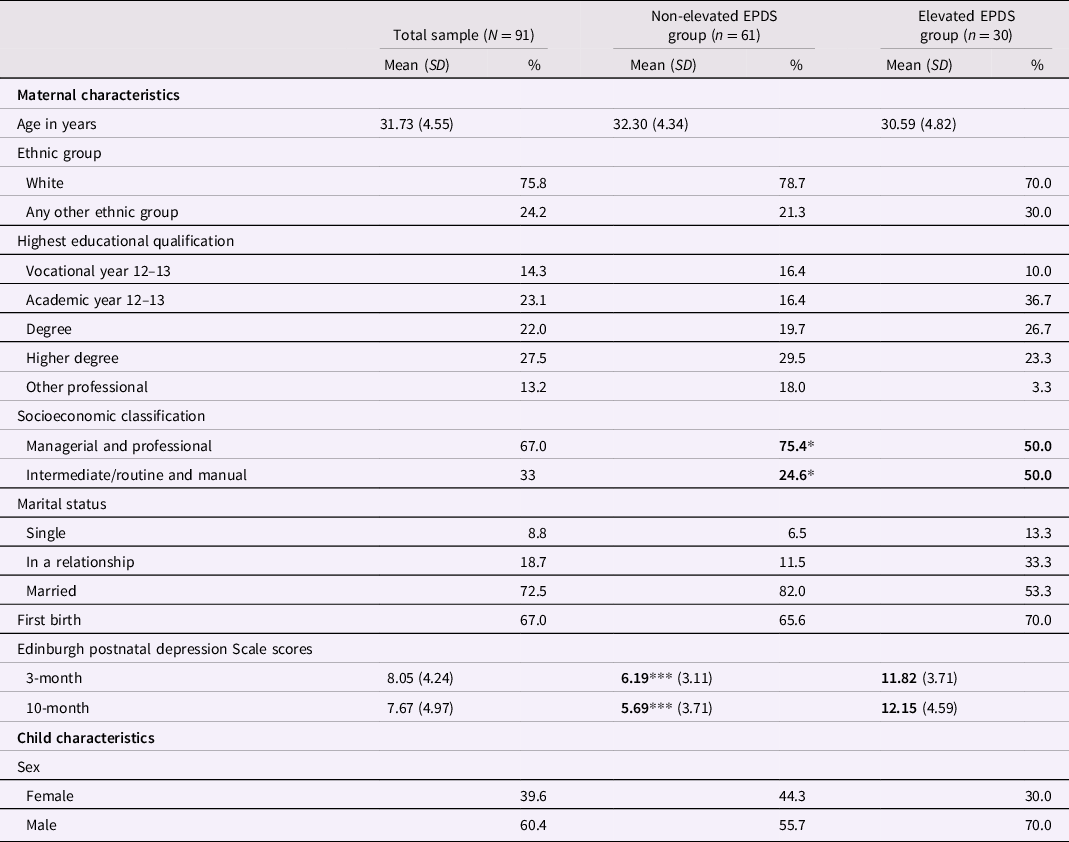
Demographic information for the total sample, and the elevated and nonelevated EPDS groups are presented in Table 1. Mothers were aged between 17.91 and 41.39 years of age (M = 31.73, SD = 4.55), and the majority (75.8 %) indicated their ethnic group was White. All mothers had completed school to at least Year 12 of Sixth Form/College, with 49.5% having completed a university degree or above. The majority of mothers (67%) were employed in a managerial or professional occupation, 12.1% in an intermediate occupation, and 15.4% in a routine or manual occupation. Mothers were predominantly married (72.5%) or in a relationship (18.7%), with 67% of mother–child dyads involving a first birth. Of the child participants, 39.6% were female and 60.4% were male.
Demographics for the total sample and elevated and nonelevated Edinburgh postnatal depression scale score groups

Note. Numbers in bold were significantly different between groups.
***p < .001, *p < .05.
Nonparametric Mann–Whitney U tests revealed significant differences across elevated and nonelevated EPDS groups. More mothers within the nonelevated EPDS group reported a higher socioeconomic class than did mothers within the elevated EPDS group (z = 2.411, p = .016). Furthermore, as expected, mothers in the nonelevated EPDS group reported significantly lower 3-month (z = −5.171, p = <.001) and 10-month (z = −5.427, p = <.001) EPDS scores than mothers in the elevated EPDS group.
Measures
Demographic characteristics
At 3 months, data were collected on child gender, and maternal age, ethnic group, highest level of equational qualification, SEC (Rose & Pevalin, Reference Rose and Pevalin2003), marital status, and child parity.
Edinburgh postnatal depression scale
At 3 and 10 months, the 10-item Edinburgh Postnatal Depression Scale (EPDS; Cox et al., Reference Cox, Holden and Sagovsky1987) was utilized as a screening tool to identify symptoms of emotional distress in mothers during the postnatal period. Mothers responded to the items (e.g., I have been anxious or worried for no good reason) in relation to how they felt over the past 7 days on a 4-point Likert scale ranging from 0 (no/not at all/never) to 3 (yes/most of the time/always). A total EPDS score ranging from 0 to 30 was created by summing the individual item scores, with higher scores representative of greater emotional distress. Scores of 13 or more indicate that the likelihood of depression is high. Although other cutoffs have been used, the cut-off score of 13 or more has demonstrated the strongest sensitivity (0.83) and specificity (0.90) for depression (NICE, 2014). The psychometric properties of the EPDS, including its reliability (α range > .80; in excess of .70 criteria [Tabachnick & Fidell, Reference Tabachnick and Fidell2019]), construct validity, and criterion validity against diagnostic reference standards, have been extensively supported in many cultures and languages (Hewitt et al., Reference Hewitt, Gilbody, Mann and Brealey2010; Martin & Redshaw, Reference Martin and Redshaw2018; Small et al., Reference Small, Lumley, Yelland and Brown2007).
Infant characteristics questionnaire: Fussy/difficult subscale
Maternal perceptions of child temperament were measured at 10 months using the short form of the fussy/difficult (F/D) subscale of the Infant Characteristics Questionnaire (ICQ; Bates et al., Reference Bates, Freeland and Lounsbury1979). Bates and colleagues found this subscale explained the most variance in mothers’ experiences of their child’s temperament, had the most stable reliability across time, and was most convergent with previously validated measures of temperament. Mothers rated the nine items (e.g., How much does your baby cry and fuss in general?) on a 7-point Likert scale from 1 to 7, with the lower anchors reflective of an optimal temperamental trait, and the higher anchors reflective of a more difficult temperamental trait. A mean score with a possible range from 1 to 7 was calculated for the subscale, with higher scores representative of a greater level of perceived difficulty in dealing with the described behavior. Previous research has found the fussy/difficult factor to demonstrate good internal consistency reliability (α = .76; Helle et al., Reference Helle, Hillesund and Øverby2018), above the generally accepted Cronbach’s alpha value of .70 or above (Tabachnick & Fidell, Reference Tabachnick and Fidell2019).
Parenting stress index short form: Parental distress subscale
Maternal PD was assessed at 36 months using the Parental Distress (PD) subscale of the Parenting Stress Index Short Form (PSI-SF; Abidin, Reference Abidin1995). The PD subscale measures experiences of distress directly related to child rearing: postnatal depression; impaired perceived parenting competence; restriction of life roles; interpersonal conflicts with the child’s other parent; and lack of social supports. Mothers were asked to respond to the 12 items (e.g., since having this child, I feel that I am almost never able to do things that I like to do) on a 5-point Likert scale ranging from 1 (strongly disagree) to 5 (strongly agree), with higher scores reflective of greater levels of maternal parenting distress. Scores on the subscale were summed to create a total score, with a possible range of 12–60. Scores within the 15th to 80th percentile are considered typical, scores at or above the 85th percentile (raw score ≥ 35) are clinically significant (Abidin, Reference Abidin1995). The PD subscale of the PSI-SF has well established internal consistency (α = .90) and construct and criterion validity (Abidin, Reference Abidin2012; Barroso et al., Reference Barroso, Hungerford, Garcia, Graziano and Bagner2016; Haskett et al., Reference Haskett, Ahern, Ward and Allaire2006; Reitman et al., Reference Reitman, Currier and Stickle2002).
Mind-mindedness
At 10 months, mothers were instructed to “play as they normally would” during semi-structured 7.5 minute, videotaped play interactions. Dyads were given a specific toy to play with every 2.5 minutes: stacking rings; a shape sorter; and a musical toy. All speech directed to the infant during the videotaped interactions was transcribed verbatim by the researcher into individual comments or “idea units,” based on temporal (one second pause) or semantic discontinuities (Meins & Fernyhough, Reference Meins and Fernyhough2015). The filmed observations were then viewed alongside the transcripts in order to identify and code mind-minded (MM) comments as appropriate or nonattuned (Meins & Fernyhough, Reference Meins and Fernyhough2015).
Appropriate MM comments were those that included (a) an explicit mental-state term to represent what the infant may be thinking, feeling, or experiencing; (b) a link between the infant’s internal mental state with related past or future events; (c) a suggestion of new activities that the infant may like given a pause in the play interaction; and (d) speech meant to be spoken by the infant (Meins & Fernyhough, Reference Meins and Fernyhough2015). Contrastingly, nonattuned MM comments were those that attributed an internal state to the infant that appeared to contrast with their current behavior. For example, the mother saying to the infant “you like those rings don’t you” as the infant is shaking the rings would be an example of an appropriate mind-minded comment. Alternatively, the same comment would be coded as nonattuned if the infant was crawling away from the rings.
Appropriate and nonattuned comments were further coded for their valence as positive (e.g., commenting on an infant’s liking of the rings) or negative (e.g., commenting on an infant’s disliking of the rings). Due to the small number of nonattuned and negatively valenced MM comments, these scores were not able to be used in the final moderation analyses, however, they are retained here as they provide more nuanced descriptive information regarding the nature of comments made. Frequency scores for the total number of positive and negative appropriate and nonattuned MM comments made, and for the total number of comments or idea units spoken during the interaction in order to control for maternal verbosity, were recorded for each mother in the study.
MM was coded as per the Meins and Fernyhough (Reference Meins and Fernyhough2015) coding manual by the researcher, and a randomly selected 25% of the videotaped interactions was coded by a second researcher. Interrater reliability for coding MM comments as appropriate (positive or negative) and nonattuned (positive or negative) was κ = .79, representing substantial agreement between coders (Cohen, Reference Cohen1960; McHugh, Reference McHugh2012). All disagreements in coding were reviewed and discussed until a consensus was reached.
Strengths and difficulties questionnaire
Mothers reported on their child’s behavioral difficulties at 51 months, which were assessed using the four negative behavioral attributes subscales of the Strengths and Difficulties Questionnaire (SDQ; Goodman, Reference Goodman1997). The four dimensions measured internalizing difficulties: (a) emotional problems (five items; e.g., nervous or clingy in new situations) and (b) peer problems (five items; e.g., rather solitary, prefers to play alone) and externalizing difficulties: (c) conduct problems (five items; e.g., often loses temper) and (d) hyperactivity (five items; e.g., constantly fidgeting or squirming). Mothers were asked to rate the 20 items on a 3-point Likert scale from 0 (not true) to 2 (certainly true), considering their child’s behavior over the past month. Total subscale scores were calculated by summing the items, each of which could range from 0 to 10, with higher scores indicative of greater perceived child behavioral difficulties. The SDQ is an extensively validated instrument, having demonstrated sound internal consistency (McDonald’s ω range = .70–.86) and test–retest reliability (McDonald’s ω range = .77–.89), construct and criterion validity, and measurement invariance (Goodman & Goodman, Reference Goodman and Goodman2009; Stone et al., Reference Stone, Janssens, Vermulst, Maten, Engels and Otten2015).
Statistical analyses
Preliminary analyses
Assumptions and descriptive statistics. IBM SPSS Statistics 26 (IBM Corp, 2019) was used for all analyses. Prior to the main analyses, data were screened to check the assumptions of normality, linearity, and homoscedasticity (Hayes, Reference Hayes2018). Sample demographics were obtained for the total sample, and elevated and nonelevated EPDS groups. One-way analysis of variance (ANOVA) with post hoc testing, considered robust to violations of normality (Tabachnick & Fidell, Reference Tabachnick and Fidell2019), was used to ascertain any significant differences between low, moderate, and high maternal PD groupings on measures of maternal MM, and child temperament and behavior.
Demographic differences. Correlational, nonparametric Mann–Whitney U tests (given the potential impact of instances of nonnormality on t-test outcomes with smaller group sizes [Kim & Park, Reference Kim and Park2019]) and one-way ANOVAs were utilized to determine any differences per maternal age, ethnic group, educational qualification, SEC, marital status, and child parity and sex across MM constructs. These analyses were to aid in the selection of covariates to be included in the moderation analyses, to avoid any multicollinearity between variables, or excessive inclusion of variables given the smaller sample size of the study.
Correlational analyses. Given the possible impact of nonnormal data on correlational analyses (Bishara & Hittner, Reference Bishara and Hittner2015), both Spearman’s r (nonparametric) and Pearson’s r (parametric) correlations between MM constructs and maternal PD, and child temperament and behavioral outcomes were calculated. As the size and direction of the correlations were almost identical across methods, only Pearson’s correlations are reported.
Moderated regression analyses
The PROCESS macro version 3.5 for SPSS (Hayes, Reference Hayes2018) was used to conduct the moderation analyses. As the PROCESS procedure recommends the routine use of a heteroscedasticity-consistent covariance estimator, which does not assume homoscedasticity (Hayes, Reference Hayes2018), the HC4 (Cribari-Neto) estimator was used in the present study (Hayes & Cai, Reference Hayes and Cai2007). Also, PROCESS uses bias-corrected bootstrapping of 5000 samples for the calculation of model coefficients, which maximizes power and is robust to violations of normality and Type II error (Hayes, Reference Hayes1996). Recent simulation studies (Yzerbyt et al., Reference Yzerbyt, Muller, Batailler and Judd2018) have shown that bootstrapping methods can achieve sufficient power for conditional indirect effects with a smaller sample sizes, with N < 100 found to have power ≥ .80 and medium effect sizes.
Four moderation analyses were conducted with appropriate MM at 10 months as the predictor, maternal PD at 36 months as the moderator, and each four of the child behavioral difficulty domains (emotional problems, peer problems, conduct problems, and hyperactivity) at 51 months as the outcomes. The Johnson–Neyman approach (Johnson & Neyman, Reference Johnson and Neyman1936), extended by Bauer and Curran (Reference Bauer and Curran2005), was used in PROCESS to probe any significant interactions. This approach allowed the moderator to remain continuous, rather than being transformed into an artificially discrete variable through the use of arbitrary cutoff values, enhancing statistical power and the likelihood of discerning true effects (West et al., Reference West, Aiken and Krull1996). Specifically, the Johnson–Neyman approach determines the points or regions of significance along a continuous moderator where the relationship between the independent and outcome variable changes from being statistically significant to nonsignificant or vice versa. Hence, the values for low, moderate, and high maternal PD groups at which any significant effects are found are presented in the results section.
Despite proportion scores (e.g., MM appropriate comments/idea units) being used as the predominant approach in the MM literature, the MM coding manual (Meins & Fernyhough, Reference Meins and Fernyhough2015) permits researchers to utilize a frequency measure of MM, as long as verbosity is included as a covariate. This latter approach was used in the present study as propensity scores are bounded by a finite range and thus often possess a nonstandard distribution (Lesaffre et al., Reference Lesaffre, Rizopoulos and Tsonaka2007). In addition, more contemporary MM research (Easterbrooks et al., Reference Easterbrooks, Crossman, Caruso, Raskin and Miranda-Julian2017) has also favored the use of frequency MM scores. Other sociodemographic covariates were also included based on prior research (Dai et al., Reference Dai, McMahon and Lim2020; Gagné et al., Reference Gagné, Bernier and McMahon2018; Meins et al., Reference Meins, Centifanti, Fernyhough and Fishburn2013) and the results of the preliminary analyses in the present study.
Results
Preliminary analyses
Assumptions and descriptive statistics. Skewness and kurtosis values fell outside the normal range of ±2 (Gravetter & Wallnau, Reference Gravetter and Wallnau2014) for ethnic group and nonattuned MM constructs, and marital status showed evidence of positive kurtosis. Shapiro–Wilk tests of normality indicated nonnormal distributions for the majority of variables, although P-P plots did not reveal any drastic deviations. As such, analyses were conducted using bootstrapping within PROCESS, which is robust to nonnormality (Hayes, Reference Hayes2018). Scatterplots revealed that predictors and outcomes shared approximately linear relationships, thus meeting the required linearity assumption (Hayes, Reference Hayes2018). Plots of residual values indicated the data were homoscedastic; although the use of the HC4 (Cribari-Neto) heteroscedasticity-consistent covariance estimator ensured robustness against heteroscedasticity.
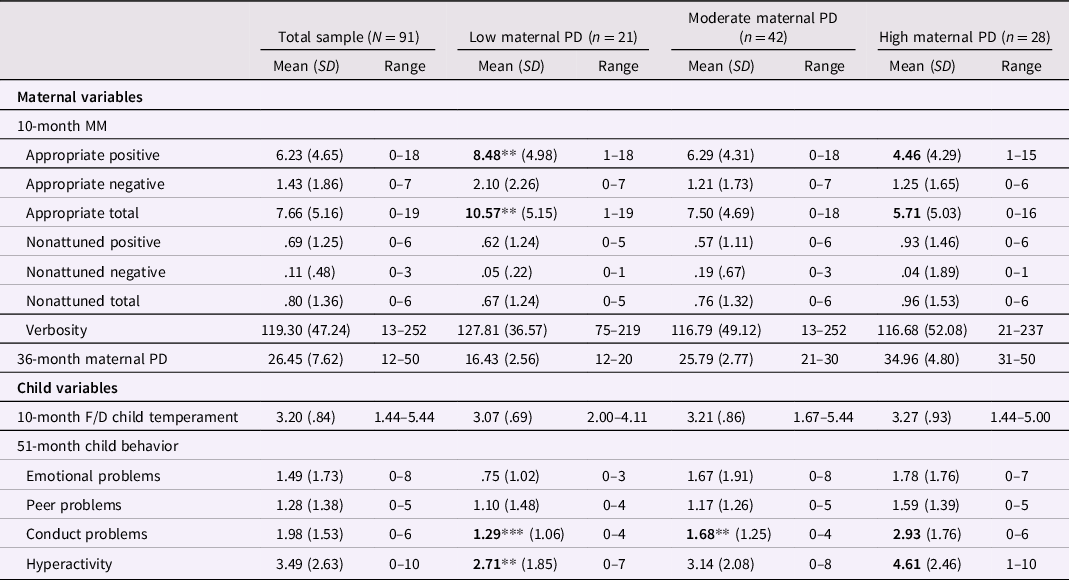
Sample descriptive statistics are presented for the total sample, and low, moderate, and high maternal PD in Table 2. Overall, mothers spoke between 13 and 252 units of speech and made more appropriate MM comments (M = 7.66, SD = 5.16) than nonattuned MM comments (M = .80, SD = 1.36). Maternal PD scores were within the normal range for the total sample (M = 26.45, SD = 7.62) but ranged from 16.43 (SD = 2.56) to 34.96 (SD = 4.80). Mother’s ratings of the difficultness of their child’s temperament ranged from 1.44 to 5.44. Mean subscale scores for each of the child behavioral problem outcomes as measured by the SDQ indicated that hyperactivity was most frequently endorsed by the total sample (M = 3.49, SD = 2.63), with levels of emotional, peer, and conduct problems less frequently endorsed.
Factor means, standard deviations, and ranges for the total sample and low, moderate, and high maternal parental distress groups

Note. MM = mind-mindedness; PD = parental distress; F/D = fussy/difficult; means in bold were significantly different between groups.
***p < .001, ** p < .01.
One-way ANOVAs with post hoc comparisons revealed that mothers who reported low PD at 36 months made significantly more total appropriate MM comments at 10 months (M Diff = 4.86, p = .003, 95% CI [1.48, 8.23]) and significantly more positively valenced MM comments at 10 months (M Diff = 4.01, p = .007, 95% CI [0.94, 7.08]) than mothers with high maternal PD. Mothers in the low PD grouping (M Diff = −1.64, p < .001, 95% CI [−2.60, −0.68]) and mothers in the moderate PD grouping (M Diff = −1.25, p = .001, 95% CI [−2.06, −0.43]) reported significantly fewer child conduct problems at 51 months than mothers in the high PD group. Mothers in the low PD grouping also reported significantly lower levels of child hyperactivity at 51 months than mothers in the high PD grouping (M Diff = −1.89, p = .009, 95% CI [−3.37, −0.41]). There were no significant differences between maternal PD groupings on total, positively valenced, or negatively valenced nonattuned MM and verbosity at 10 months, infant F/D temperament at 10 months, or child emotional or peer problems at 51 months.
Demographic differences. Pearson correlation revealed that maternal age was not significantly related to appropriate and nonattuned MM constructs (total, positively valenced, negatively valenced, and verbosity). Nonparametric Mann–Whitney U tests revealed significant differences across ethnic groups. Mothers who indicated their ethnic group was White (appropriate positive M = 6.91, SD = 4.57; total appropriate M = 8.58, SD = 5.00) made significantly more appropriate positive (z = 452.500, p = .004) and total appropriate (z = 424.000, p = .002) MM comments than mothers who indicated that they belonged to the “Any other” ethnic group (appropriate positive M = 4.09, SD = 4.34; total appropriate M = 4.77, SD = 4.68). There were no significant differences across child parity or sex for MM constructs.
One-way ANOVA with post hoc testing revealed significant differences for highest educational qualification. Mothers who completed a higher degree (M = 8.80, SD = 5.33) made significantly more appropriate positive MM comments than mothers who completed a Bachelor degree (M = 4.35, SD = 3.048; M Diff = 4.45, p = .009, 95% CI [0.71, 8.19]), or completed the academic high school track (M = 4.76, SD = 3.96; M Diff = 4.04, p = .022, 95% CI [0.35, 7.73]). Moreover, mothers with a higher degree (M = 10.32, SD = 5.01) made significantly more total appropriate MM comments than mothers who had completed the academic high school track (M = 5.81, SD = 4.93; M Diff = 4.51, p = .025, 95% CI [0.33, 8.69]).
In terms of SEC, nonparametric Mann–Whitney U tests revealed that mothers in a managerial role made significantly more appropriate positive MM comments than mothers in professional or routine/manual roles (M = 6.23, SD = 4.65; M = 1.33, SD = .47; z = 652.000, p = .026). There were no significant differences between marital status groupings on MM constructs.
Given the significant correlation between maternal highest educational qualification and SEC (r = .59), only one of these variables was selected for inclusion as a covariate in the subsequent moderation analyses to avoid issues of multicollinearity. SEC was selected given its higher correlation with appropriate total MM, alongside maternal ethnic group and verbosity.
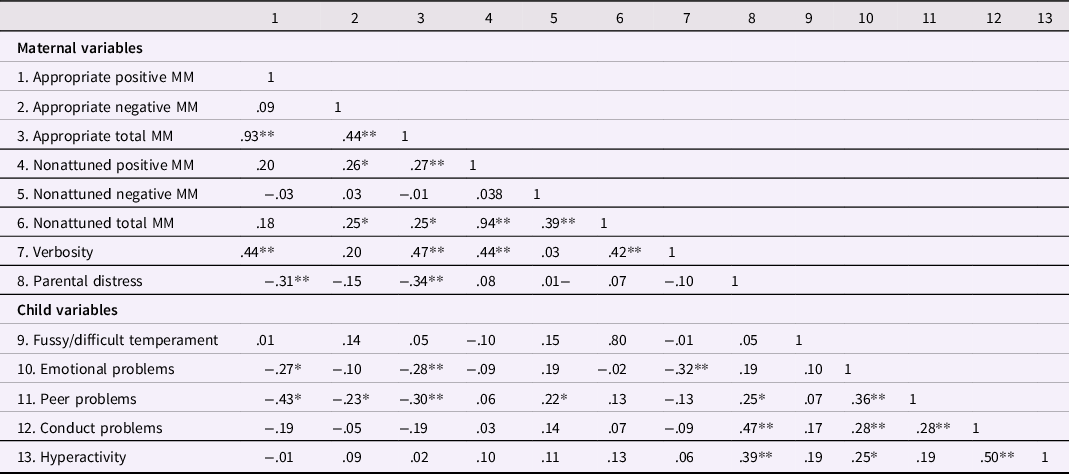
Correlational analyses. Correlational analyses in Table 3 showed mothers’ appropriate positive MM and appropriate total MM comments at 10 months were significantly negatively correlated with maternal PD at 36 months (r = −.31 and −.34) and with child emotional (r = −.27 and −.28) and peer problems (r = −.43 and −.30) at 51 months. Nonattuned negatively valenced MM at 10 months was significantly positively related to child peer problems at 51 months (r = .22). Although none of the 10-month MM constructs were found to be related to child F/D temperament, the latter was included as a covariate in the analyses involving child conduct problems, consistent with prior research (Gagné et al., Reference Gagné, Bernier and McMahon2018). Maternal PD at 36 months was significantly positively correlated with child conduct problems (r = .47), followed by hyperactivity (r = .39) and peer problems (r = .25) at 51 months.
Bivariate zero-order correlations between mind-mindedness constructs, maternal parental distress, and child temperament and behavioral scores

Note. MM = mind-mindedness.
** p < .01, *p < .05.
Moderated regression analyses
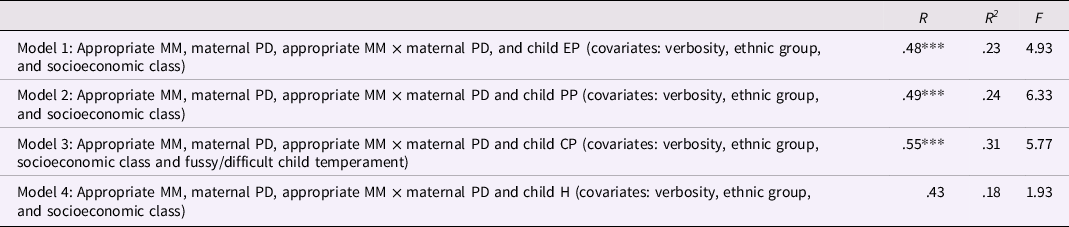
As shown in Table 4, the overall model results for three of the four moderated regression analyses were significant. Specifically, models one to three demonstrated that the variance in child behavioral difficulties across emotional, peer and conduct problems at 51 months was significantly explained by the combination of total appropriate MM at 10 months, maternal PD at 36 months, their interaction, and the covariates (maternal verbosity, ethnic group, and SEC for emotional and peer problems and child F/D temperament for child conduct problems specifically). This combination of constructs significantly accounted for 23% of the variance in child emotional problems, 24% of the variance in child peer problems, and 31% of the variance in child conduct problems. The 18% of variance explained in hyperactivity at 51 months by the combination of constructs was not significant.
Overall model results for moderated regression analyses

Note. MM = mind-mindedness; PD = parental distress; EP = emotional problems; PP = peer problems; CP = conduct problems; H = hyperactivity.
***p < .001.
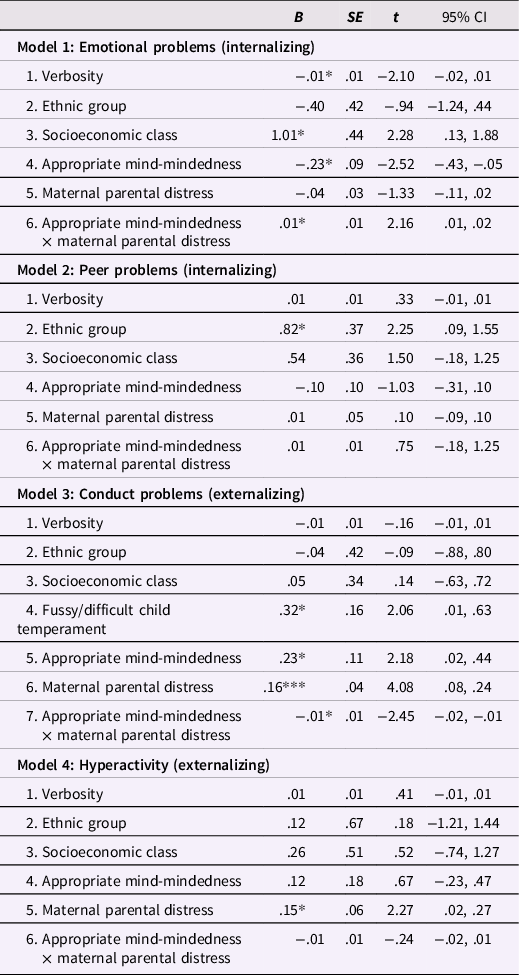
Maternal mind-mindedness and child behavior. Table 5 presents the results of the moderated regression analyses. The results revealed a significant negative main effect association between appropriate MM at 10 months and children’s later emotional problems at 51 months (B = −.23, SE = .09, p = .01) and a significant positive association with children’s later conduct problems (B = .23, SE = .11, p = .03) at 51 months. Higher appropriate MM was associated with lower emotional problems scores, but higher conduct problems scores. Appropriate MM at 10 months was not a significant predictor of children’s peer problems or hyperactivity at 51 months. Nonattuned MM at 10 months was not a significant predictor of children’s emotional problems, peer problems, conduct problems, or hyperactivity at 51 months.
Moderated regression analysis results with attuned and non-attuned mind-mindedness (predictors), maternal parental distress (moderator), and child behavioral difficulties (outcomes)

***p < .001, **p < .01, *p < .05.
Maternal parental distress and child behavior. Maternal PD at 36 months was a significant predictor of children’s conduct problems (B = .16, SE = .04, p < .001) and hyperactivity (B = .14, SE = .06, p = .03) at 51 months. Higher maternal PD scores were associated with higher conduct problems and hyperactivity scores. There were no significant main effect relationships between maternal PD at 36 months and children’s emotional or peer problems at 51 months.
Covariates and child behavior. Verbosity was significantly associated with children’s emotional problems at 51 months (B = −.01, SE = .01, p = .04), with more idea units spoken related to less emotional difficulties. SEC was significantly related to children’s emotional problems at 51 months (B = 1.01, SE = .44, p = .03), such that lower socioeconomic class was associated with more emotional problems. Ethnic group was significantly related to children’s peer problems at 51 months (B = .82, SE = .37, p = .03), with membership of the “Any other” ethnic group associated with higher later child peer problems. In model three, higher child F/D temperament at 10 months was associated with greater children’s conduct problems at 51 months (B = .32, SE = .16, p = .04).
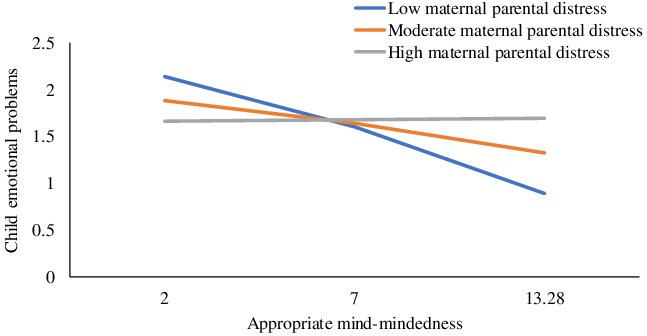
Interaction effects. The significant main effect relationship between appropriate MM at 10 months and children’s emotional problems at 51 months was qualified by a significant two-way appropriate MM × maternal PD interaction (B = .01, SE = .01, p = .03, R 2change = .03). Controlling for maternal verbosity, ethnic group, and SEC, the Johnson–Neyman technique revealed that children’s later emotional problems were lower as early appropriate MM was higher among mothers who experienced low PD, as represented by the significant region of scores from 12.00 to 19.36 values of maternal PD. Early appropriate MM did not significantly impact children’s later emotional problems when mothers reported experiencing moderate or high PD. The interaction is depicted visually in Figure 1.
A graph of the interaction between appropriate mind-mindedness, maternal parental distress, and child emotional problems.

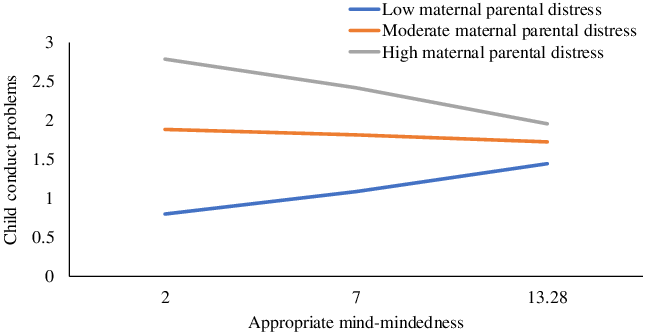
The significant unique associations found between appropriate MM at 10 months, maternal PD at 36 months, and the covariate child F/D temperament at 10 months and children’s conduct problems at 51 months were also qualified by a significant two-way interaction between appropriate MM and maternal PD (B = −.01, SE = .01, p = .02, R 2change = .06). Holding constant the covariates of maternal verbosity, ethnic group, SEC, and child F/D temperament, the Johnson–Neyman approach revealed a significant slope for high maternal PD. Specifically, children’s later conduct problems were lower as early appropriate MM was higher among mothers with higher maternal PD scores between 34.36 and 50. Early appropriate MM did not significantly relate to children’s later conduct problems when mothers reported experiencing low or moderate PD. A visual representation of the interaction is presented in Figure 2.
A graph of the interaction between appropriate mind-mindedness, maternal parental distress, and child conduct problems.

The interaction between appropriate MM at 10 months and maternal PD at 36 months was not a significant predictor of children’s peer problems or hyperactivity at 51 months.
Discussion
This prospective, longitudinal study investigated associations between appropriate MM in infancy and children’s preschool internalizing and externalizing behavioral difficulties, and whether experiences of maternal PD influenced these relationships.
Direct associations
Findings to date regarding the direct associations between appropriate MM and adverse child behavioral outcomes are limited in scope and mixed in outcome (McMahon & Bernier, Reference McMahon and Bernier2017; Zeegers et al., Reference Zeegers, Colonnesi, Stams and Meins2017). The current findings indicated differential directions of relationships, with MM effects dependent on the internalizing or externalizing domain of child behavioral problems, similarly to recent findings from Colonnesi et al. (Reference Colonnesi, Zeegers, Majdandžić, van Steensel and Bögels2019) and Larkin et al. (Reference Larkin, Hayiou-Thomas, Arshad, Leonard, Williams, Katseniou, Malouta, Marshall, Diamantopoulou, Tang, Mani and Meins2020). Indeed, the present investigation found support for the theorized adaptive function of mothers’ accurate comments on their infant’s mental state for children’s internalizing emotional problems, such that appropriate MM appears to be facilitative for children whose behavior is characterized by isolation and withdrawal to their inner world (Zilanawala et al., Reference Zilanawala, Sacker and Kelly2019). In contrast, mothers’ greater use of appropriate MM in infancy was seen to exacerbate maternal self-report of later child externalizing conduct problems, behavior that is characterized by projection and overt displays of challenging behaviors (Zilanawala et al., Reference Zilanawala, Sacker and Kelly2019).
Interestingly, maternal PD at 36 months shared significant positive main effect associations with externalizing but not internalizing behavior at 51 months. These findings are complementary to and extend upon existing literature (Dollberg et al., Reference Dollberg, Hanetz-Gamliel and Levy2020; Easterbrooks et al. Reference Easterbrooks, Crossman, Caruso, Raskin and Miranda-Julian2017; Larkin et al., Reference Larkin, Hayiou-Thomas, Arshad, Leonard, Williams, Katseniou, Malouta, Marshall, Diamantopoulou, Tang, Mani and Meins2020). It may be the case that mothers whose children are perceived to display more overt, obvious, and detectable behaviors from infancy are experienced as more challenging than those exhibiting withdrawn, internalized behaviors, leading to greater maternal experiences of distress. Such distress may then predict or exacerbate later child externalizing behavior difficulties. This explanation is supported by the significant main effect association found between child F/D temperament measured at 3 months and children’s later conduct problems. However, significant interactions between appropriate MM and maternal PD moderated some associations between early appropriate MM and children’s later behavioral problems in the present study and further clarified these main effect findings.
Moderated associations
Among mothers with low PD, higher appropriate MM predicted significantly lower child internalizing emotional problems, whereas for those mothers experiencing moderate or high PD, appropriate MM was not associated with internalizing emotional problems. These aforementioned findings were complementary to those of Easterbrooks et al. (Reference Easterbrooks, Crossman, Caruso, Raskin and Miranda-Julian2017), the only other study to date to investigate the moderating impact of maternal adverse mental health on the expected associations between observationally measured appropriate MM and children’s behavioral difficulties.
Essentially, the theoretically predicted adaptive impact of appropriate MM (Fernyhough, Reference Fernyhough2008; Sharp & Fonagy, Reference Sharp and Fonagy2008) was found in the context of low maternal distress. Furthermore, the vast majority of appropriate MM comments made by mothers in this study were positive in their valence. Mothers’ accurate attunement to their infant’s mental states and experiences facilitated greater emotional regulation, likely via more positive mother–child interactions and the provision of a verbal scaffold that brings the child’s inner world out, enabling more effective processing of their emotions (Fernyhough, Reference Fernyhough2008; Sharp & Fonagy, Reference Sharp and Fonagy2008).
For mothers who experienced moderate or high maternal PD, the theorized buffering effect of appropriate MM on children’s internalizing emotional problems was not found. Mothers experiencing high PD also made fewer appropriate MM comments overall. It may be that mothers experiencing their own PD have a greater focus on their own internal experience and withdraw from interactions with their infant as has been demonstrated in research on maternal depression (Beebe et al., Reference Beebe, Jaffe, Buck, Chen, Cohen, Feldstein and Andrews2008; Field, Reference Field2010; Lovejoy et al., Reference Lovejoy, Graczyk, O’Hare and Neuman2000). As such, the experiences of the internalizing child and distressed parent may mirror one another and further reinforce retreat into an internal world.
In the present study, maternal PD also moderated the association between early appropriate MM and later child externalizing conduct problems. Specifically, among mothers with high PD, higher appropriate MM predicted significantly fewer child externalizing conduct problems. For those mothers experiencing low or moderate PD, appropriate MM was not associated with externalizing conduct problems. These findings appear, at first glance, to run counter to research that has shown maternal depression and parenting distress to be linked to adverse child outcomes (Gitlin & Pasnau, Reference Gitlin and Pasnau1989; Murray & Cooper, Reference Murray, Cooper, Murray and Cooper1997) and negatively to MM (Demers et al., Reference Demers, Bernier, Tarabulsy and Provost2010b; Lok & McMahon, Reference Lok and McMahon2006; Milligan et al., Reference Milligan, Khoury, Benoit and Atkinson2015; Rosenblum et al., Reference Rosenblum, McDonough, Sameroff and Muzik2008; Schacht et al., Reference Schacht, Hammond, Marks, Wood and Conroy2013) and used to support the notion that adverse mental health experiences may thus attenuate the caregiver’s capacity to be mind-minded (Bigelow et al., Reference Bigelow, Beebe, Power, Stafford, Ewing, Egleson and Kaminer2018). However, the drawing together of the elements of appropriate MM, maternal PD, and child behavioral outcomes in a single study may have clarified these main effect associations.
Mothers experiencing high PD in our sample made significantly fewer appropriate MM comments than mothers experiencing low PD. Yet, this lower level of MM may have been experienced as more appropriate by infants/children, and thus facilitated the beneficial effects of MM in reducing externalizing problems. Furthermore, given that the present sample was not a clinical population, mothers may have been experiencing a tolerable level of distress (Shonkoff et al., Reference Shonkoff, Boyce and McEwen2009) that served to orient and sensitize them to their infants’ inner mental world, producing an appropriate and adaptive level of appropriate MM.
Conversely, mothers who were less distressed perhaps had the emotional space in which to become hypermind-minded or hyperattuned to their child’s mental state and experience, in a positive attempt to regulate their child’s emerging externalizing conduct problems. Indeed, this may be especially so given that externalizing problems are, by definition, more disinhibited, disruptive, and noticeable to caregivers and others (Zilanawala et al., Reference Zilanawala, Sacker and Kelly2019). Child difficult temperament at 10 months was linked with significantly greater child conduct problems in the present study. Mothers experiencing minimal PD may take up an ‘emotion coaching’ position in an attempt to foster self-regulation in their child. However, this hyper mind-mindedness appears to be ineffective in reducing their conduct problems.
Using the representational measure of MM, Bernier and Dozier’s (Reference Bernier and Dozier2003) research found that too much focus on a child’s mental state, beyond what might be age appropriate, was associated with lower maternal and infant attachment security. Similarly, research with adolescents and adults with BPD suggests that impairments in social cognition are more likely to reflect hypermentalizing about others in relationships (a construct closely related to mind-mindedness; Sharp & Fonagy, Reference Sharp and Fonagy2008) than hypomentalizing (Sharp & Vanwoerden, Reference Sharp and Vanwoerden2015). In the present study, the majority of appropriate MM comments were positive, suggesting that perhaps even when MM comments are appropriate and positively focused, there is a “tipping point” at which a hypervigilance to or hyperfocus on a child’s mind becomes ineffective, particularly in the case of externalizing conduct problems.
Strengths and limitations
This study had a number of strengths. First, the use of a prospective, longitudinal design permitted a more rigorous analysis of the predictive pathways posed by the research questions. Second, the study utilized well established, reliable, and valid measures of maternal and child functioning, including both internalizing and externalizing difficulties. Third, the use of the observational measure of MM drawn from real-time mother–infant interactions as opposed to the interview measure, was appropriate for the age of the infants involved and permitted researcher judgment of the accuracy of MM comments. Lastly, the present study attempted to address the calls for future research (McMahon & Bernier, Reference McMahon and Bernier2017; Zeegers et al., Reference Zeegers, Colonnesi, Stams and Meins2017) by moving beyond main effect analyses and considering more complex moderating associations and the positive and neutral/negative valence of representations.
There were also some limitations that must be considered when interpreting the current findings. The data were collected in the early 2000s, so the findings should be considered in light of their correspondence to more recently collected information as it emerges within the literature. Another limitation may be the smaller number of preschool aged children with borderline and abnormal behavior scores on the SDQ, and mothers with PD scores above the clinical cutoff of the 85th percentile. Although the study met power requirements for the overall sample, and continuous variables rather than clinical cutoffs were used, there were likely power issues within these subsamples. Lastly, the present study employed maternal self-report, so the results are restricted to maternal perceptions of child difficulties.
Implications and conclusions
The findings from the present study demonstrated that the impact of appropriate MM on the internalizing or externalizing presentation of children’s behavioral difficulties was moderated by maternal experiences of PD. Promising intervention research demonstrates that MM can be modified both within community (Larkin et al., Reference Larkin, Oostenbroek, Lee, Hayward and Meins2019) and clinical samples (Schacht et al., Reference Schacht, Meins, Fernyhough, Centifanti, Bureau and Pawlby2017). The moderation effects shown here and in extant research indicate that MM interventions may need to be targeted in a more nuanced way, in order to best facilitate children’s emotional and behavioral development. The current research suggested that some contexts (e.g., low parent distress and child internalizing behaviors) may benefit from higher levels of appropriate MM, while others may benefit from moderate levels of appropriate MM (e.g., high parent distress and child externalizing behaviors).
Future research should consider increased sample sizes to enable the inclusion of more explanatory constructs that have been particularly associated with MM within the one model (e.g., attachment, sensitivity, and risk) so that a more wholistic theoretical model of MM can be explicated (McMahon & Bernier, Reference McMahon and Bernier2017). Further longitudinal studies involving clinical samples are needed to explicate the impact of psychosocial risk on the relationship between MM and important child developmental outcomes.
Acknowledgments
Data for this study were drawn from the Families, Children, and Child Care (FCCC) study, funded by the Tedworth Charitable Trust and the Glass-House Trust. The FCCC study was led by Dr. Penelope Leach and Professor Jacqueline Barnes in London and by Professor Alan Stein, Professor Kathy Sylva and Dr. Lars-Erik Malmberg in Oxford. Thank you to the mothers, children, and their families who participated in the study.
Author contributions
LH conceived the research questions, coded and analysed the data and wrote the manuscript. AB supported research question design, conducted coding reliability and contributed to the manuscript. MT supported research question design and contributed to the manuscript. JB contributed to the original design of the FCCC study and contributed to the manuscript.
Funding statement
This project was funded by the Tedworth Charitable Trust and the Glass-House Trust.
Conflicts of interest
None.