INTRODUCTION
Non-melanoma skin cancer (NMSC) is the most common cancer, with more than 1 million cases diagnosed annually.Reference Miller, Alam, Andersen, Berg, Bichakjian, Bowen, Cheney, Glass, Grekin, Kessinger, Lee, Liegeois, Lydiatt, Michalski, Morrison, Nehal, Nelson, Nghiem, Olencki, Perlis, Rosenberg, Shaha, Urist, Wang and Zic1 Basal cell carcinoma (BCC) accounts for 80% of NMSC, with the remainder predominantly squamous cell carcinoma (SCC).Reference Halperin, Perez and Brady2 Skin involving the head and neck is most common, accounting for 80% of all lesions.Reference Harrison, Sessions and Hong3 Most patients diagnosed with NMSC are treated at early stages (T1N0M0). Treatment options include surgery, cryotherapy, topical chemotherapy, Moh’s surgery, and radiotherapy.Reference Locke, Karimpour, Young, Lockett and Perez4–Reference Ashby, Smith, Ainslie and McEwan7 Radiotherapy techniques used have included superficial photons and electrons,Reference Locke, Karimpour, Young, Lockett and Perez4 3D conformal, and intensity-modulated radiation therapy (IMRT). Each of the above treatment modalities carries a 90–95% cure rate when used as indicated by tumor size, histology, and location.Reference Halperin, Perez and Brady2 Although efficacious, treatment approaches must be individualised to achieve an acceptable cosmetic and functional outcome.
T2–T4 lesions may present a unique treatment challenge. Examples of such lesions are shown in Figure 1. Surgical resection with acceptable cosmetic outcomes is often difficult. This is attributed to lesion size, location, and histology at presentation, and consideration of patient age and surgical expertise. Many lesions are more deeply infiltrating than perceived at presentation, which may require the surgeon to perform a more extensive resection requiring a complicated reconstruction. Some lesions are suspected to be involved or in close proximity to critical structures or normal anatomic structures rendering them unresectable. If attempted, cosmetic outcomes are sometimes unfavourable and complete resection is often unachievable.Reference Papadopoulos, Frantzoglou, Chrisostomidis, Konofaos, Frangoulis and Barlas8 This may lead to an increase in morbidity to the patient and necessitate adjuvant therapy.
Locally advanced NMSC cancer lesions of the (a) ear (b) infra-orbital skin (c) posterior leg (d) face and nose.

Radiotherapy is an effective treatment for all stages of NMSC, with cure rates ranging from 50 to 100%.4–7, 9–11 Advantages of radiotherapy as opposed to surgery include sparing the patients from adverse cosmetic outcomes, and it is safer for poor operative candidates.Reference Tsao, Tsang, Liu, Panzarella and Rotstein5 Radiotherapy can potentially offer many patients approximately equivalent cure rates with less morbidity compared with surgery.Reference Halperin, Perez and Brady2 In this report, we reviewed and analyzed our institutional outcomes of patients treated with radiotherapy for T2–T4 NMSC. We aimed to determine our treatment efficacy, toxicity, and role of various radiotherapy methods.
METHODS AND MATERIALS
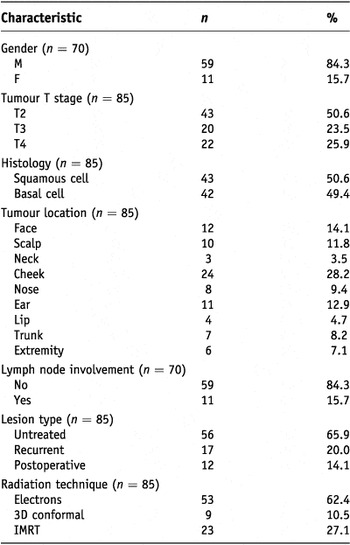
After institutional review board approval, we retrospectively reviewed the records of 70 patients treated with radiotherapy from 2004 to 2010. Eighty-five lesions were staged as T2–T4 NMSC according to the American Joint Committee on Cancer (AJCC) 6th edition,Reference Greene12 which was the guideline during this period. Table 1 shows patient characteristics.
Patient, lesion and treatment characteristics

All patients received a CT scan to evaluate extent of tumour, presence of bony erosion and nodal involvement. Nine patients (12.9%) received a PET scan, with standard uptake values from 2.9 to 10.7 at the primary tumour site. One patient received an MRI to evaluate soft tissue and nerve involvement.
Twelve lesions (14.1%) had nodal involvement prior to radiotherapy. Five of these lesions were untreated, four were recurrent, and three were post-operative. All lesions were of SCC histology. Tumour stages for these lesions included T4 (4), T3 (4) and T2 (4). Imaging analysis established the presence and extent of nodal disease in the patients for radiotherapy planning, allowing appropriate nodal coverage. Radiotherapy doses were 50–56 Gy (1.65–2.0 Gy fractions) for prophylactic nodes and 60–66 Gy (1.8–2.0 Gy fractions) for involved nodal levels. Eight of these lesion courses (66.7%) were treated with IMRT, three with 3D conformal, and one with electrons.
Eleven T4 lesions (12.9%) had known bony erosion by surgical pathology, imaging analysis, or both. Five of these lesions were untreated, four were recurrent, and two post-operative. Histologies included SCC (6) and BCC (5), and all tumours originated in the head and neck.
Five patients (5.9%) received chemotherapy in their treatment course. Three were treated with concurrent chemoradiation with cisplatin, and two received post-radiotherapy chemotherapy. Three lesions were T4, and one each was T2 and T3. Four lesions had SCC histology. One patient had bone and nodal involvement, another had bone involvement only, and the third had nodal disease. The other two patients received chemotherapy following disease recurrence after radiotherapy or for persistent residual disease at radiotherapy completion. For patients receiving concurrent chemoradiation, the decision to use chemotherapy was attributed to the advanced degree of disease at presentation.
Regarding the 17 recurrent lesions, 15 (88.2%) had a history of prior surgery. One had prior radiotherapy at another facility, and another had prior cryotherapy. Twelve had prior surgery with clear margins, and three had electrodessication. Duration from prior therapy to radiotherapy presentation ranged from 2 to 180 months for recurrent patients (mean 57 months) but varied according to previous therapy. Patients failing non-surgical interventions recurred less than 12 months as opposed to surgery which ranged from 1 to 15 years.
Regarding the 12 post-operative lesions, all were referred following inadequate resection. All lesions had positive (6) or close (<1–2 mm) (6) surgical margins. Three had perineural invasion, and two had bone involvement. The most common locations included the ear (4) and cheek (4).
All radiotherapy treatments were administered with the use of a Varian (Varian Medical Systems, Palo Alto, CA) linear accelerator. Electron therapy was most common (53 lesions, 62.4%) radiotherapy technique. Each lesion was clinically simulated, and blocking was achieved by cerrobend casting. Gross tumour volumes (GTV) were outlined and expanded from 1.5 to 2.5 cm based upon tumour location and histology. Electron energy varied from 6 to 9 MeV depending upon the depth of tumour invasion on CT. Twenty-three lesions (27.1%) were treated with IMRT using 6 MeV photons. All IMRT patients had CT simulation and achieved immobilization with a thermoplastic mask. Contouring of the GTV and expansion for microscopic extension (1–2.5 cm expansion of GTV) was performed. Blocking was achieved by a multi-leaf collimator (MLC). Nine lesions (10.5%) received 3D conformal radiotherapy. Planning was performed using an opposed or wedged pair of photon beams and energy 6 MeV. Blocking was achieved by a MLC and a thermoplastic mask for immobilization. The median treatment length for all patients was 6.4 weeks (range 3.1–10.8 weeks).
Patients were assessed weekly and at completion of radiotherapy by the radiation oncologist. The presence of acute reactions was documented. Follow-up was performed by the radiation oncologist and referring physician at monthly intervals. If recurrence was suspected, biopsy was ordered to confirm or exclude recurrent disease. Median follow-up was 20 months (range 2–56 months). Follow-up is defined as the duration from radiotherapy completion to last follow-up or death.
Statistical analysis was performed using Fisher’s Exact Test and chi-square contingency tables; significance was for p values ≤ 0.05.
RESULTS
Patient results
At analysis, 43 patients (65.2%) were alive, and 40 (93.0%) have no clinical or radiographic evidence of disease (NED) following completion of all therapy. The other three living patients had recurrent disease. All three of these patients declined further therapy. Of these 40 NED patients, 36 (90.0%) required no additional therapy following radiotherapy. The other four patients underwent successful surgical salvage. Twenty-seven patients had died, and 10 deaths (37.0%) were attributed to local and systemic progression (median follow-up 13.2 months, range 5–44 months). Ten deaths were attributed to unrelated medical co-morbidities, two deaths were due to other malignancies (ovarian and pancreatic), and one from acute reactions following radiotherapy. Of the 12 patients who died of non-NMSC related issues, 11 (91.7%) were known to have local control (median follow-up 16.5 months, range 2–46 months).
Lesion category results
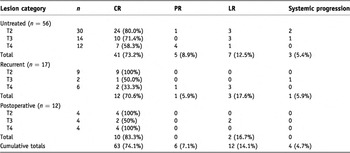
Table 2 summarizes lesion categories with T stage and clinical outcomes following radiotherapy. Overall, 63 lesions (74.1%) achieved a complete response (CR) to radiotherapy alone. CR is defined as a complete resolution of disease determined clinically and/or radiographically. Eighteen lesions (21.2%) achieved either a partial response (PR) or local recurrence (LR) following radiotherapy. Four lesions were found at follow-up to have systemic progression of disease. PR is defined as a clinical and/or radiographic determination of residual tumour at radiotherapy completion, and LR is defined as clinically and/or radiographically detected tumour after radiotherapy completion and initial clinical CR. Of the previously untreated lesions, 41 lesions (73.2%) achieved a CR, 12 lesions (21.4%) either a PR or LR, and 3 (5.4%) had systemic progression. Of the recurrent lesions, 12 (70.6%) achieved CR, 4 (23.5%) PR or LR, and 1 (5.9%) had systemic progression. For post-operative lesions, 10 (83.3%) achieved CR and 2 (16.7%) had an LR.
Lesion categories and T stages correlated with clinical outcomes following RT

Regarding lesions not achieving CR following radiotherapy, 6 (33.3%) had a PR and 12 (66.6%) experienced an LR. Five of the six PR lesions were T4, and the other was T2. Of the PR T4 lesions, three underwent salvage—two with chemotherapy and one by surgery. Both salvage techniques for the lesions were unsuccessful and the patients died of disease progression. The other two T4 lesions had no further therapy. The T2 PR lesion had salvage surgery and achieved NED.
Of the 12 LR lesions, 5 were T3, 4 were T4, and 3 were T2. Three of the four T4 LR lesions were recurrent; the other was an untreated lesion. The duration from radiotherapy completion to LR determination for the T3 and T4 lesions was less than 12 months (median 4 months, range 1–12 months). Salvage therapy for these T4 lesions was surgical resection in three lesions with NED achieved in two. The other T4 lesion received no further therapy. The five T3 LR lesions were untreated (three lesions) and post-operative (two lesions). One post-operative lesion received chemotherapy and surgical salvage following recurrence; however, systemic progression ensued. Three lesions elected no further therapy. Another T3 LR nose lesion had rhinectomy and achieved NED. The three T2 LR lesions were untreated lesions and all underwent successful surgical salvage. Recurrence time in these lesions was 5, 20 and 26 months. Two of these patients are alive with NED, and the other died due to systemic progression.
Untreated lesions had a 73.2% CR response to radiotherapy. Twelve (21.4%) had a PR or LR following radiotherapy. Eight of these lesions received surgical salvage (six lesions) or chemotherapy (two lesions). Both lesions receiving chemotherapy were T4 lesions and salvage was unsuccessful. Five of six surgical salvages were successful to achieve NED. The one unsuccessful surgical salvage attempt was a T4 lesion. Overall survival (OS) for these untreated lesion patients was 60.4% and disease-free survival (DFS) was 80%.
Recurrent lesions had a 70.6% CR rate, with four T4 patients achieving PR or LR. Two of these non-CR patients underwent successful surgical salvage; the other two patients had no further therapy. DFS and OS in this group was 82.4% and 76.4%, respectively. Only one patient died of systemic progression which was a T3 lesion.
Post-operative lesions achieved an 83.3% CR rate, and two T3 lesions experienced LR. One LR patient elected salvage surgery but still developed metastatic disease. The other patient declined further therapy. DFS and OS was 81.8% and 45.5%, respectively. Five post-operative patients had died, of which two deaths were attributed to systemic disease progression.
Tumour T stage results
There were 43 T2 lesions (50.6%), with 26 BCC (60.5%) and 17 SCC (39.5%). Overall NED in these lesions was 95.3%, with 86% achieving CR after radiotherapy. Three lesions recurred, and one experienced a PR. These four lesions were all successfully salvaged with surgery. Two patients not achieving NED died from systemic progression. DFS and OS were 90.9% and 75.8%, respectively. Eleven deaths were due to non-NMSC causes.
There were 20 T3 lesions (23.5%), with 14 SCC (70%) and 6 BCC (30%). Overall NED for these lesions was 70%, with 65% achieving CR after radiotherapy. Five lesions recurred and two underwent salvage surgery. Only one salvage patient achieved NED. The other patients had no further therapy. Two patients died of systemic progression and one patient died of acute radiotherapy toxicity. DFS and OS were 77.8% and 61.1%, respectively.
There were twenty-two T4 lesions (25.9%), with 12 SCC (45.5%) and 10 BCC (54.5%). Overall NED for these lesions was 68.2%, with 59.1% achieving CR after radiotherapy. Nine lesions experienced a PR or an LR. Salvage therapy included surgery (three lesions) and chemotherapy (two lesions). The other four patients had no further treatment. Successful surgical salvage was achieved for two lesions, both of which were recurrent following radiotherapy. Only one salvage patient achieved NED, the other developed nodal involvement after surgical salvage. The other PR and LR patients elected no further therapy. Five patients died of local regional failure and systemic progression. Two other patients died on non-NMSC-related issues. Both DFS and OS were 63.6%.
Histological results
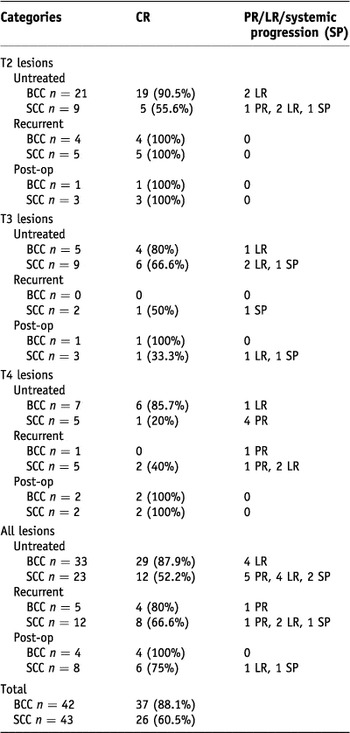
Forty-three lesions (50.6%) were SCC and 42 (49.4%) were BCC. Table 3 summarizes outcomes following radiotherapy by histology and T stage. Thirty-seven (88.1%) and 26 (60.5%) lesions of all BCC and SCC achieved a CR to radiotherapy alone. BCC was more likely to achieve CR to radiotherapy alone than SCC for all tumour T stages and lesion categories. Post-operative lesions were most likely to not require additional therapy after radiotherapy (83.3%), followed by untreated (73.2%) and recurrent (70.6%) lesions. All lesions which had systemic progression were SCC, and the most common failure pattern for BCC was local. Lesions not achieving CR were more commonly SCC (77.3% of non-CR lesions).
Clinical outcomes categorized by T stage, lesion category and histology

Lesion results by radiotherapy technique
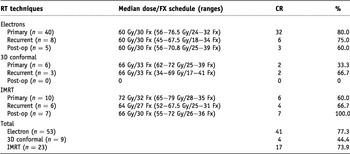
Table 4 shows radiotherapy techniques with lesion categories and achievement of CR. Electron therapy was the most successful technique, accounting for 77.3% of lesions achieving a CR. IMRT was also successful at 73.9% of treated lesions. The use of each radiotherapy technique per lesion T stage was 34, 11, and 8 for T stages T2, T3, and T4 treated with electron therapy, respectively. Also 2, 4, and 3 lesions staged T2-T4 treated with 3D conformal radiotherapy. And 7, 5, and 11 T2-T4 lesions treated with IMRT. The majority of 3D conformal treatments on T3 and T4 lesions were administered prior to the use of IMRT in our institution.
Achievement of CR categorized by RT technique, treatment course and lesion category

Nodal disease results
Twelve lesions (14.1%) had nodal disease at presentation. All nodal disease patients achieved no recurrence of disease in the neck following radiotherapy. Tumour control rates by T stage are discussed separately above. One patient with nodal disease had systemic progression. No differences in control were determined amongst the various radiotherapy techniques. DFS and OS for these patients was 66.7% and 50%, respectively.
Radiotherapy complications
Toxicity grading was according to the RTOG criteria. All radiotherapy patients experienced Grade I erythema skin reaction at the treatment site. Grade I dry desquamation occurred in 33%, and Grade III moist desquamation occurred in 20% of all lesions. For lesions within 2 cm of the orbit, 13% experienced Grades I–II orbital inflammation/conjunctivitis. Grades I–II acute mucositis occurred in 12.8%. Other acute reactions included Grade I changes in skin pigmentation (4%), ear pain (3%), and xerostomia (3%), Grade II dysphagia (3%) and Grade IV skin ulceration (3%). One death occurred 2 months following radiotherapy completion (with IMRT); death was attributed to severe dysphagia, esophagitis, mucositis, and failure to thrive following radiotherapy completion.
Long-term complications occurred in 10 patients (14.3%). Four patients experienced delayed wound healing and closure over the lesion site. Four patients experienced significant skin fibrosis, scaring, and contraction. One patient developed profound hearing loss, and one developed a sino-cutaneous fistula necessitating surgical repair.
Prognostic factors
Prognostic factors were evaluated for radiotherapy to achieve CR in all of the above categories. Significant factors included basal cell histology (p value = 0.005) and tumour stage T2 (p value = 0.01).
DISCUSSION
There is little published information regarding radiotherapy for patients with T2–T4 NMSC. Our data show an 82.4% achievement of NED to radiotherapy and salvage therapy, with a CR of 74.1% with radiotherapy alone. Overall responses to radiotherapy were not statistically significant between lesion categories; however, post-operative lesions (83.3%) achieved CR greater than untreated (73.2%) or recurrent (70.6%) lesions. BCC was significant (p = 0.005) for radiotherapy to achieve CR in all categories. Lower T stage was significant for CR (T2 p = 0.01). More frequent incidence of LR, PR, and systemic progression occurred with increasing T stage.
Little data are reported regarding IMRT for NMSC. In our series, IMRT was used in 27.1% of lesions and in 66.7% of lesions with nodal involvement. Many of these IMRT courses were for more locally invasive T3 and T4 lesions. These courses would have been more difficult for electrons due to irregular surface planes, asymmetric tumour depth, or tumour invasion near or including bone. In our treatment planning, IMRT allowed higher dose escalation compared with conventional or electron beam plans with reduced normal tissue toxicity. For these same reasons, IMRT was advantageous when nodal coverage was required.
Mendenhall reported on 100 T2, T3, and T4 lesions treated with radiotherapy and surgical salvage.Reference Mendenhall, Parsons, Mendenhall and Million10 These results showed untreated lesions with a 93%, 83% and 54% initial control and recurrent lesions 100%, 72% and 29% for the respective tumour stages. Our control rates are lower but similar to these results with initial CR rates of 80%, 71% and 58.3% for untreated lesions and 100%, 50% and 33% for recurrent lesions. Post-operative lesions were not evaluated in Mendenhall’s manuscript, while in our series it was the group most likely to achieve CR following radiotherapy (100%, 50% and 100%). It was suggested in this prior series, however, that an approach to improve the probability of local control in T4 lesions would be to combine surgery with post-operative radiotherapy. A report of SCC of the nasal vestibuleReference Wallace, Morris, Kirwan, Amdur, Werning and Mendenhall6 reported that all of the eight T4 patients approached with surgery followed by radiotherapy achieved local control of disease. Our post-operative data are consistent and supportive of this approach when appropriate based on patient surgical candidacy, and an acceptable functional and cosmetic outcome can be achieved.
Locke reported on 170 T2–T4 lesions of which 61.8% were T2 lesions.Reference Locke, Karimpour, Young, Lockett and Perez4 The manuscript reported a 90–100% local control for untreated BCC and 33–89% local control for recurrent BCC. It showed a 75–86% local control for untreated SCC lesions and 50–88% control for recurrent SCC. Our data showed lower but similar findings for untreated and recurrent BCC (80–90.5% and 40–66.7%, respectively). However, our SCC local control was notably lower (20–66%) for untreated lesions and more similar (40–100%) for recurrent lesions. Untreated lesions fared better than recurrent lesions in Locke’s series (89–95% vs. 68–86%). Our results showed 80–88% and 52–67%, which again is slightly lower. Our post-operative lesion results showed 75–100% CR for both histologies, again showing a greater control rate following surgical resection.
IMRT for skin lesions of the head and neck and with nodal disease can be used effectively with greater dose escalation and less toxicity compared with conventional techniques, analogous to other reports.Reference Chen, Li and Farwell13–Reference Bhide and Nutting14 Many lesions, due to location, bone invasion, nodal involvement, or surface geometry and depth extension are technically challenging for superficial or conventional techniques to provide adequate dose coverage and spare normal structures. In such patients, we propose the utilisation of IMRT should be considered.
Comparison of our results to any published data series not employing a formal staging system such as the AJCC system is difficult. Any attempt at comparisons of data amongst series reported with different staging systems is not always straightforward. The AJCC system 6th editionReference Greene12 is primarily based on the lesion size and the invasion of subcutaneous tissues and bone. The AJCC staging manual 7th editionReference Edge15 is different in regards to large and locally advanced NMSC. In the 7th edition, lesion size is limited to T2 regardless of size. Invasion of deep extra-dermal structures, with the exception of bone is negated from the classification system altogether. Involvement of the mandible, orbit, temporal bone and maxilla would now be classified as T3 as opposed to T4. T4 lesions are now much rarer in terms of the diagnosis. Any attempt to retrospectively apply the 7th edition staging classification to the cases staged using the 6th edition would significantly alter our results. Such a comparison will be the subject of future investigations as this is beyond the scope and purpose of this article.
The study’s retrospective nature, limited sample sizes for the selected tumour stages and histologies, various radiotherapy approaches and duration of follow-up limit its definitive conclusiveness. The limited number of published reports pertaining to T2–T4 NMSC and the heterogeneity of the lesions due to the various classification systems makes comparisons to previous reports difficult. Further follow-up and research is necessary to confirm our preliminary findings.
Conflicts of interest
None.