Introduction
Today, the relocations of the Ahiarmiut from Ennadai Lake between 1950 and 1958 are considered to be a failure that caused great distress to the native population. Tester and Kulchyski (Reference Tester and Kulchyski1994) and Marcus (Reference Marcus1995) have examined thoroughly the policies of the Canadian administration and documented the main events in the relocations. By the term ‘administration’ we refer to the most important agencies acting on behalf of the federal government, notably the Department of Indian and Northern Resources (DIANR) and the Royal Canadian Mounted Police (RCMP). Even if there existed considerable differences between and within these various agencies, all shared common values with respect to the necessity to assume responsibility for the well being of the native people. But the perspectives of the Ahiarmiut themselves were never discussed in any detail. So far, little attention has been paid to the lasting effects of these relocations on the Ahiarmiut population. In 2003 we organised a workshop with Ahiarmiut elders on ‘Survival and Angakkuuniq’ in Arviat (Nunavut). In the course of this workshop the Ahiarmiut elders Job and Eva Muqyunnik, Luke and Mary Anautalik reflected on the events that almost fifty years ago had disrupted their lives and that still affected them. The four Ahiarmiut participants in the workshop asked us whether we would be prepared to organise a further workshop at Ennadai Lake on their first relocations. Such a workshop in situ would enable them to return to their homeland and come to terms with the events of the past. Moreover, it would provide them with an opportunity to transfer their knowledge and love of the land to their families and descendants, a process that had already started in 1985 during a first trip to Ennadai Lake (see Belsey Reference Belsey1985a, Reference Belsey1985b, Reference Belsey1985c). We agreed to look for funding to organise such a workshop in situ, at Ennadai Lake. As the costs of such a workshop would be high we agreed with the Sivullinuut society in Arviat to apply to the department of Culture, Language, Elders and Youth of the Nunavut Government (CLEY) as well as to the Social Sciences and Humanities Research Council of Canada (SSHRC) for funding. The Sivullinuut society was successful in obtaining the funding, but as they were not sure whether the additional funding would be forwarded, they decided to spend the money on a workshop on another project. Once we had succeeded in obtaining funding for the Ennadai workshop, the CLEY money was no longer available, and the SSHRC grant was insufficient to cover the costs of transporting the elders by plane from Arviat to Ennadai Lake. Thus it proved to be impossible to realise the workshop in situ. Therefore, the Ahiarmiut elders agreed to hold the workshop in Arviat from 1 May to 5 May 2006.
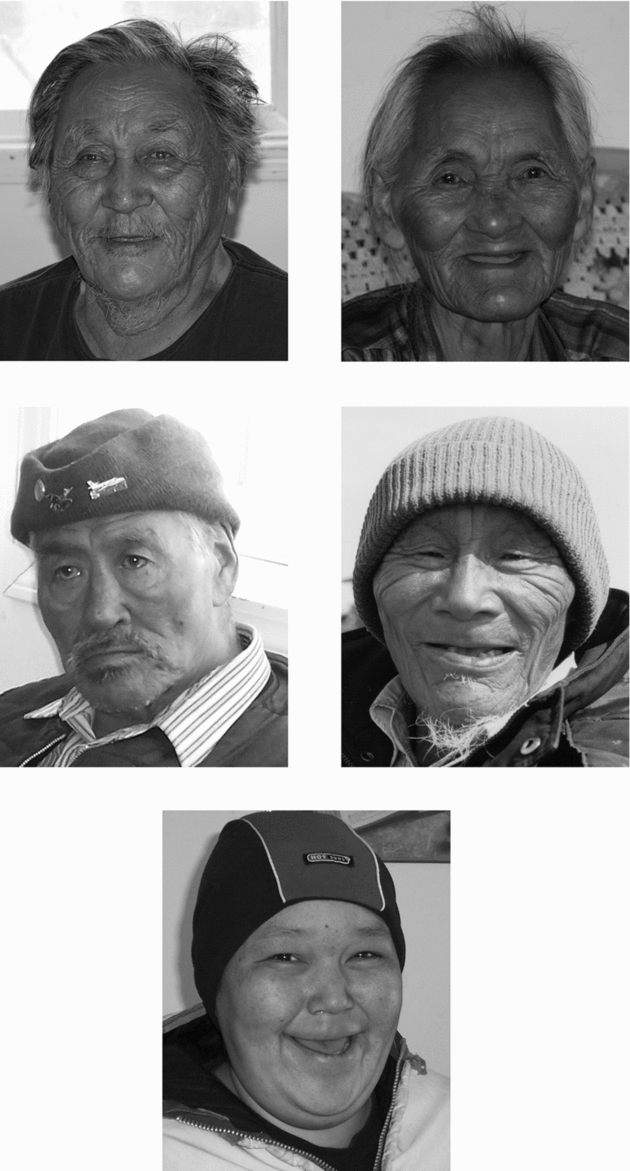
The participants in the workshop were all Ahiarmiut living in different communities. Eva Muqyunnik, Job Muqyunnik, Mary Anautalik, John Aulatjut, Silas Ilungiyajuk, Geena Aulatjut lived in Arviat. Andrew Alikashuak came from Whale Cove, and Mary Whitmore from Churchill. Annie Seewoe and Luke Anautalik from Arviat were invited but were unfortunately unable to participate because of their physical condition. David Serkoak from Iqaluit was also invited but could not come because of obligations in Cambridge Bay. Frédéric Laugrand and Jarich Oosten acted as facilitators of the workshop and Atuat (Mary Thompson) from Arviat took care of the coordination and organisation of the workshop as well as the interpretation. She also provided us with opportunities to interview non Ahiarmiut elders such as James and Helen Konek.
The facilitators had first studied the relevant documents that were available in the RCMP, Army and DIANR archives in Ottawa. Some of these documents are used in this paper and in order to avoid mistakes we have retained the original spelling of the Inuit names as they appear in the various sources. The workshop was set up in an anthropological perspective focusing on the Ennadai Lake relocation and Ahiarmiut culture and history. During a week, all sessions were audiotaped and videotaped. We agreed with the members of the workshop to make the results of the workshop first available to David Serkoak and the participants in the workshop. This paper presents a historical overview of the results of the archival research as well as testimonies of Ahiarmiut elders. It points out congruent points and discrepancies between the views of the administration and those of the Ahiarmiut. It was not always easy to match the archival dates to the recollections of the elders. The Ahiarmiut elders have vivid recollections of their experiences, but little interest in the dates. Our attempts to date their experiences always led to intensive discussions between the elders themselves and the results were often inconclusive.
The relocations
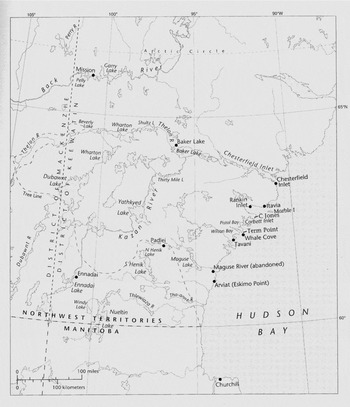
The literature on the Ahiarmiut relocations consists mainly of a few chapters in Tamarniit by Frank Tester and Peter Kulchyski (Reference Tester and Kulchyski1994) and a few chapters in Relocating Eden, by Alan Marcus (Reference Marcus1995). This literature can be supplemented with extensive archival material, and more documents may become available in the future. Neither books nor archival sources give much scope to the Ahiarmiut perspectives. These studies focus on two relocations: the relocation to Nueltin Lake in 1950 and the relocation to Henik Lake in 1957. The Ahiarmiut point out that there were more relocations as the Ahiarmiut were relocated to Arviat from Henik Lake and from Arviat to Whale Cove and Rankin Inlet. In this paper we will mainly focus on the first three relocations: from Ennadai Lake to Nueltin Lake, from Ennadai Lake to Henik Lake and from Henik Lake to Arviat (Eskimo Point) (Fig. 1).
Map of the area in which the relocations took place (from Tester and Kulchyski Reference Tester and Kulchyski1994).

Caribou and Ahiarmiut cultural and historical traditions are not yet well documented in the ethnography.
In the early 1920s the fifth Thule expedition visited the area. One of the goals of the expedition was to assess the origins of the Eskimos and test Steensby's hypothesis that the Inuit had originated on the Barren Grounds in the Kivalliq. Kaj Birket-Smith (Reference Birket-Smith1929: 168), one of the members of the expedition, studied the origins of the Caribou Inuit that were considered at this time as the most primitive Inuit group. Birket-Smith thought they originated from the Padlei area and represented the original inland caribou hunting Inuit. Marcus (Reference Marcus1995: 128) suggested that the Ahiarmiut had migrated from the coast to the inland in the middle of the 19th century, but unfortunately he does not provide sources to corroborate his argument. Csonka (Reference Csonka1992: 17) also refers to a collective move but he remains cautious. He quotes Burch's theory according to which Ahiarmiut may have come from the western Arctic during the 18th century. As the history of the Ahiarmiut group is complex, a discussion of these issues is beyond the scope of this paper. Some historical data are given by Hearne (Reference Hearne and Glover1958), Tyrrell (Reference Tyrrell1894, Reference Tyrrell1897, Reference Tyrrell1975), Turquetil (Reference Whitmore1904, Reference Turquetil1907, Reference Turquetil1912a, Reference Turquetil1912b, Reference Turquetil1926, Reference Turquetil1986–1987), Mallet (Reference Mallet2000), Gabus (Reference Gabus1940, Reference Gabus1940–1941, Reference Gabus1944), Michéa (Reference Michéa1949, Reference Michéa1952), Steenhoven (Reference Steenhoven1957, Reference Steenhoven1958, Reference Steenhoven1962) and Harper (Reference Harper1964) but the most complete reference remains the ethnohistorical contribution made by Csonka (Reference Csonka1995).
The Ahiarmiut have been an inland people for at least several generations and their cultural traditions show that they were perfectly adapted to the inland life and do not indicate that they may have been a coastal people. Csonka suggests that the Ahiarmiut may have been reduced from about 450 people before the 1920's to about sixty people in the 1940’s. This is consistent with patterns of population decrease described elsewhere among Inuit groups. However, in assessing the decrease of the population some caution is advised. Notions of decline were spread among Inuit (who assumed their ancestors were more numerous and more powerful) and white people who assumed that the decline and finally even the complete disappearance of Inuit under the impact of civilisation was unavoidable (see Oosten and others Reference Oosten, Laugrand and Remie2006). Despite the various starvations they had to face during the 19th century, Csonka (Reference Csonka1992: 17) indicates that the Ahiarmiut population probably increased considerably until the beginning of the 20th century. Apparently, this process only ceased between 1915 and 1925, when a series of starvations affected the Caribou Inuit (see Burch Reference Burch, Morrison and Wilson1986: 129; Csonka Reference Csonka1992: 18–19).
These groups always had to deal with hardships. Csonka (Reference Csonka1995) shows that Ahiarmiut like many north American Indians never interacted as harmoniously with their environment as is commonly believed. Periods of abundance alternated with periods of scarcity of game and sometimes even starvation. Csonka quotes a policeman based in Eskimo Point who stated in 1926, just after a starvation period: ‘Inuit did not appear to treat the starvation question seriously. . . . to speak of starvation to them appeared to be by no means a matter of great importance’ (quoted by Csonka Reference Csonka1992: 19). White people, were often puzzled by the capacity of Inuit to endure periods of starvation. In the 19th as well as in the 20th century, outside observers always tended to perceive Inuit to be in a state of need. In the archival sources we used for this paper, such a perception is continuously expressed. The main arguments proposed in the archival sources and documents for the relocations are formulated in economic terms. Many sources assume that the hunting opportunities at Ennadai Lake were insufficient and that therefore the Ahiarmiut had to be relocated to an area that provided better opportunities. However, the relocations to Nueltin Lake and Henik Lake both proved to be complete failures. The Ahiarmiut themselves maintain that Ennadai Lake was an excellent hunting area and failed to understand why they were relocated. The Department of Northern Affairs and National Resources (DNANR) and the RCMP argued that the Ahiarmiut were becoming increasingly dependent on outside assistance. Various trading agencies had been present in the area, but in most cases the amount of trade seems to have been insufficient to maintain a permanent trading post. The trading post of Revillon Frères at Ennadai Lake was abandoned in the early 1930's (see Mallet Reference Mallet2000) and the Hudson's Bay Company trading post at Nueltin Lake was abandoned in 1941 (Tester and Kulchyski 1993: 208). Even if considerable trade with individual trappers and traders (see Csonka Reference Csonka1995) continued, the administration assumed that the Inuit would soon disappear with the closing of these trading posts. This idea strengthened their conviction of the need to move the Ahiarmiut from Ennadai Lake at a time when the army began to use that place as a radio station.
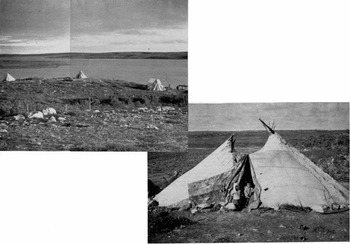
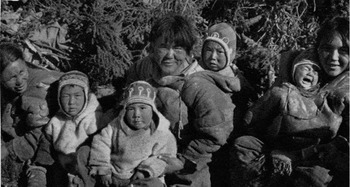
In 1949, the Canadian Army Signal Corps built the radio station at Ennadai Lake (Marcus Reference Marcus1995: 129). The Ahiarmiut elders describe the building of the radio station as an enjoyable time and appreciated trade with the personnel of the radio station. At the time Inuit were increasingly using western technology and depended on trade for guns, ammunition, tea, tobacco and other goods. Oral sources suggest that Inuit usually were able to have a good life at Ennadai Lake, but there were occasional periods of starvation and relief. Relief supplies, notably buffalo meat, were sent in 1948 and 1949. Various factors appear to have contributed to the decision to relocate the Ahiarmiut. The administration repeatedly expressed its fear that the Inuit would become dependent on relief. In the 1940's the dominant view in the administration was that Inuit would lose their capacity to survive independently if they came into close contact with white communities for too long. The decision to remove the Ahiarmiut from Ennadai Lake was therefore an unavoidable consequence of the foundation the radio station. The Ahiarmiut themselves (Figs. 2, 3) were unaware of these implications and were not informed of them by the administration.
The Nueltin lake relocation, 1950. Owlijoot's camp and his tent. Photograph taken by G. van den Steenhoven.

A group of Ahiarmiut. At left is Elisapee Nutaraluk with her son Tommy Owlajoot. In the centre is Mary Qahuq Miki with her son David Serkoak on her back and her other son Silas Ilungijajuk in front. On the far right is Mary Anautalik with her son John. Photograph taken by G. van den Steenhoven.

The Nueltin Lake relocation, 1950
The relocation to Nueltin Lake was badly prepared and executed as was made clear by the director of Northern Affairs, Ben G. Sivertz, in a memorandum to the deputy minister dated 9 March 1959.
A seemingly fortunate solution appeared on the scene. Sigurdson and Martin, of Churchill, proposed to establish a commercial fishery under the title of Nueltin Lake Fish Products at Nueltin Lake, approximately 50 to 75 miles from Ennadai Lake. Even though there was not a concentration of Eskimos at the lake, the company advised that ‘[t]he lake was capable of providing a livelihood for every Eskimo from Baker Lake southwards’. It was prepared to hire Eskimos for putting up buildings, then have them participate in the fishing operation under the direction of experienced fishermen who would teach them how to fish and fillet. The operation would earn cash and food for the Ennadai Lake people. The relocation proposal was met with favour by the Department of Fisheries, the RCMP and the Northwest Territories Administration, Department of Resources and Development (Sivertz Reference Sivertz1959a).
In the early summer of 1950, 47 Eskimos were airlifted from Ennadai Lake to Nueltin Lake as arranged by the Department of Resources and Development. By Christmas they had all wandered back to their old hunting grounds at the radio station. The project had failed and for good reasons.
The company had run into financial problems, transportation difficulties and lacked facilities for storing fish while awaiting shipment to Churchill. They concluded that they could not operate economically and closed down operations before the end of the summer. Secondly the government's plans on paper, had omitted the inclusion of an interpreter to explain to the Eskimos why they were being moved, the work that the company had expected of them, and the overall benefits to themselves in the company of the commercial fishery. This unfortunate omission was our fault and a considerable factor in the project's failure. It was reported that one Eskimo said they were being moved because they were without food and the white man was going to fish for them. Further factors were that this people had traditionally been caribou hunters and they missed the hunting to which they were accustomed. Bush was not as favourable as tundra, fish was no food substitute for caribou (Sivertz Reference Sivertz1959a).
The participants in the workshop recalled that their possessions at Ennadai Lake were destroyed and that they were transported without any provision to Nueltin Lake. They were transported to an island in the lake where only trees provided some cover. They had no food and no adequate equipment. Job Muqyunnik recalls:
I am going to tell you now about the saddest time of my life. It was around May in 1949. The Qallunaat came to the weather station there at Ennadai Lake. They had a large vehicle up there. This bulldozer came to our tent. The driver told us to leave our tent so we went out. He went back to his vehicle and drove over our tent, back and forth. He broke everything we had. He drove over them and destroyed everything. That was the hardest time of my life because we didn't have anything to survive with anymore. There was a yellow two-engine plane. The person who destroyed our tent told us to get on the plane. Louis Voisey was our interpreter. He couldn't do anything to help so I am not going to accuse him or anything like that. He told us to get on the plane. This man had a stick and he would do this to each one of us. Without saying anything he directed us to the plane. We couldn't speak his language. This was the first time we saw this Qallunaaq. We didn't know their boss. He was saying something. He said that we were garbage. That's all I remember. He said that everything was garbage. He took us to the island by plane. He found the biggest island in that area. We had nothing, not even a cup or a knife, nothing. No axe, nothing at all. He dropped us at this island. We spent a long time at that island. There were a whole bunch of us. There were us men, and our wives. They started to cry, knowing that they might not survive. We spent eight months walking around that island. Then we went back to Ennadai Lake on foot (Muqyunnik, J. Reference Muqyunnik2003).
Frank Cunningham, director of Northern Affairs and National Resources at the time, reports in a memorandum dated 31 August 1954 to the deputy minister that equipment and instruction were inadequate.
It was difficult to know how to urge and instruct the Eskimo to do things that would alleviate the famine, for example new fishnets were sent to the Eskimo last year. These are now reported to be torn and useless. In addition, the fish are said to be deep in the lake. There would seem little doubt that materials for mending nets, instruction in the work and long lines to reach to the bottom of the lake would have enabled the Eskimos to continue to catch fish (Cunningham Reference Cunningham1954b).
The Ahiarmiut elders related that they were not allowed to take any of their belongings with them and that they were not provided with any means of subsistence.
Job Muqyunnik stated as follows.
We waited over there to have our belongings to be brought, but we had no axes, no knives what so ever. No place to sleep. We would just lie down on the ground, still waiting for the plane to bring back our belongings but they never did. So we slept on the rocks for many nights, thinking that our belongings would be brought back to us. But they never did. A few of us didn't even have mittens. And after some time some women start to cry. They would cry because they had nothing to live, nothing to survive on (Muqyunnik, J. Reference Muqyunnik2005).
Fortunately some help and materials were provided by Indians in the area and a trader called Bill Black. Andrew Alikashuak recalled.
Each morning we would get up and there would be nothing. The only shelter we would have was the pieces of trees put together as shelter. We would lay on the ground and sleep with no pillow or whatsoever or blanket to cover us. [. . .] I remember it was very dark in that place at night. I saw a person walking toward me and I thought it was Anautalik, because I called Anautalik my aqatik, but it was not Anautalik, it was the Indian. I couldn't communicate with him even though he stopped in front of me, I couldn't speak with him. Even if he spoke English or his language I couldn't understand. There was no way of communicating. So he pointed to a tent. My mother was there. I was given some kind of biscuits I thought that was a lot of food. At least I ate something.
I remember that, after we walked for about one month, my father couldn't get up anymore. So he would tell us what to do since he couldn't get around anymore. He would tell me and my mother what to do and we would follow his instructions. We would put the net out to fish, if we were lucky we might get one fish and we would take it back to my father. We would cut the fish in such small pieces that we could eat one piece everyday [. . .]. We survived by cutting the fish into small pieces so at least we could chew something (Alikashuak Reference Alikashuak2005).
Mary Anautalik recalled how several elders died because of the cold.
Because it was springtime, when we got there, we used trees as shelters, because we didn't have anything else. Because we didn't have a tent or any kind of shelter we started to get sick. We had a cold, we didn't have medical help so we started to get sick after two to three weeks.
We were sick, because we didn't have a tent, so one by one, we started to have a cold. Because everybody got sick that time, four of the elders died that time.
It hurts to remember when those four elders died. We couldn't even find a box to put them into when they died. So we buried them on the ground. We had to just leave them there. It was not our fault. We didn't have any choice but to leave them.
It was because of our parents’ ability that we were able to go back to our homeland, because of the way they could survive. It was only through their help that we were able to go back to our land (Anautalik, M. Reference Anautalik2005).
The Ahiarmiut drifted back to Ennadai Lake within a few months. Eva Muqyunnik recalled.
It was in the fall. We didn't have any dogs. So we dragged everything we had. We walked, we started walking back to Ennadai Lake. It took us about three months from the time we were taken there to go back to Ennadai Lake. It must have been around Christmas time when we got back. We would not have survived, none of us would had survived if we stayed where we were taken too. When we got back to Ennadai Lake, it took us 3 months. Once we got there, there were plenty of animals again: caribou, fish, so we had plenty to eat once we got back to our home land (Muqyunnik, E. Reference Muqyunnik2005).
Alikashuak related that it took his family six months to make the trip back to Ennadai.
I think it must have taken six months for my family to walk back to Ennadai Lake. Muqyunnik and Anautalik saw us coming from a distance. So they came to meet us since we were all weak from starvation. And that is all I can remember.
I forgot to mention that when we were walking back to Ennadai Lake, I was about eight years old. My mother gave birth to a little girl. She didn't survive since my mother was already very weak from starvation. She was between my brother and my sister but she did not survive. (Alikashuak Reference Alikashuak2005)
The Ahiarmiut had suffered considerable hardships at Nueltin Lake and on the trip back. These recollections from the elders are congruent with written sources as an RCMP report noted that Gleason Ledyard, an Evangelical missionary, had advised the police that the Ahiarmiut did not like Nueltin Lake saying that it was strange to them and inadequate for hunting (see Steenhoven Reference Steenhoven1955; Rowley Reference Rowley1956 in Marcus Reference Marcus1995: 135). The matter would have rested there, if the government had not planned a second relocation.
The preparation of the Henik Lake relocation 1954–1956
In 1954, the weather station was taken over from the Canadian Army Signal Corps by the Department of Transport air radio branch. In the summer of 1954 a serious problem emerged when the RCAF indicated that they did not wish to continue to supply the Ahiarmiut with food and take out their furs as had been customary during the last three years. Cunningham stated in a letter to the RCMP commanding officer in Ottawa, dated 25 August 1954:
[a]s you also know, a recent Cabinet directive prohibits the RCAF from undertaking work for civilian departments except in emergencies or where no commercial carrier is prepared and able to do work. As Mr. Cantley advised Staff Sgt. Kearney by telephone on Friday last, however, the RCAF have now consented to continue the arrangement of carrying supplies from Churchill to the Eskimos at Ennadai Lake on an availability basis. In other words, they will take such supplies on planes going into that area whenever there is space available but special flights will not be made (Cunningham Reference Cunningham1954a).
Cunningham sets out his policy in the same letter.
From the experience we have had with these people during the past two or three years, we are inclined to think that they are beginning to rely more and more on outside assistance and are not exerting themselves as much as they might do, in obtaining and laying up a sufficient amount of food. We intend, therefore to investigate this situation more fully later in the year, with a view to deciding whether it is worthwhile to continue to maintain this small community at Ennadai Lake or whether we should not make an attempt to have these people moved to an area where they could be more closely supervised and where they would be nearer to a trading post. . .We feel however that the present arrangement calls for too great an expenditure of time and money and accomplishes little except to barely keep this small isolated group alive. We have always considered it a temporary arrangement and feel now that that we should take steps to more adequately take care of this group (Cunningham Reference Cunningham1954a).
A week later in a memorandum to the deputy minister dated 31 August 1954, Cunningham suggests: ‘[i]t may be possible, however, to interest them in moving to the vicinity of Padlei or Eskimo Point where they used to trade in earlier years, but this is something which we intend to enquire into as opportunity offers during the coming winter’ (Cunningham Reference Cunningham1954b).
In a memorandum in June 1955 (quoted in Marcus Reference Marcus1995: 139), Cunningham pointed out to Henry Larsen of the RCMP that the free servicing of Ennadai would subject the government to increasing criticism from air carriers and traders. He stated ‘. . .I don't think the government should give undue consideration to the imagined convenience of this small and perverse group of ex-Padleimiuts who have apparently become used to and fond of free help from the Ennadai radio station.’ The notion of perversity probably refers to sexual relationships that had developed between Inuit women and the staff of the radio station. The notion of ex-Padleimiuts probably relates to Birket-Smith's conjecture that the Ahiarmiut may originally have come from the Padlei area.
The question to what extent starvation was really occurring was already a point of controversy at the time. Cunningham reported in his memorandum to the deputy minister of 31 August 1954 that:
[i]n a signal received from the army station at Ennadai through the Edmonton Command, it was stated that the Eskimo had been starving; that their general condition was poor, especially the children that they were contracting all sorts of disease and that twelve had been evacuated for hospital treatment. Indian Health Services at our request inquired concerning this report and received a telegram from the Winnipeg Regional Superintendent that reports of starvation at Ennadai were without foundation and that the only cases reaching hospital were ordinary medical ones. Indian Health Services believe that the Superintendent's report may not be based on the latest information and are making further enquiry (Cunningham Reference Cunningham1954b).
Cunningham's memorandum clearly shows that the idea of relocation was primarily conceived to solve the problem of the assumed dependency of the Ahiarmiut on the weather station. This dependence was thought economically and morally to be unacceptable.
The issue of starvation was as this stage not yet central to the argument. In his memorandum to the deputy minister dated 31 January 1956 he states with respect to starvation: ‘[d]espite this, there is nothing to indicate that there has been any major catastrophe among these people during the past fifty years’ (Cunningham Reference Cunningham1956).
The main issue at the time was, therefore, less starvation than the costs and the assumed dependency of the Ahiarmiut on the weather station. A solution was found in the appointment of a Northern Service Officer (NSO) to relieve the burden of the weather station. An explicit request for such an officer was formulated in a letter dated 20 October 1954 by (?) De Niverville on behalf of the deputy minister of transport, requesting the appointment of an Indians affairs agent to handle ‘the Eskimo problem’ (De Niverville Reference De Niverville1954). William G. Kerr was appointed and received his instruction from Sivertz, then chief of the Arctic division. In the letter dated 3 November 1954, it is stated:
[i]t seems evident that we shall have to make some arrangement for the care of this small group. It is scarcely justified to set up full trading facilities in this isolated area but I would like to see what can be done on a cooperative basis. The solution might be to transfer this people to Padlei where they were at one time or to Eskimo point. It is just possible that some of them might be employed at Churchill. Probably the best approach at the moment would be to discuss the subject with them at length over a period of some days and preferably leaving them to talk it over among themselves for a couple of weeks. Their cooperation is essential. It will no doubt be difficult to make them understand that plane service cannot be supplied free as a continuing thing. In order to discuss these matters fully, it will be desirable for you to engage a competent interpreter at Churchill (Sivertz Reference Sivertz1954b).
But Kerr soon developed his own views. Instead of supporting a move to Padlei, he suggested that a small store or a comparable facility would be opened at Ennadai Lake (Sivertz Reference Sivertz1955b). On 28 April 1955, Sivertz (Reference Sivertz1955c) sent a letter to P.A.C. Nichols, HBC manager in Winnipeg, stating that many caribou skins were wasted that could be sold at a trading post if it were available. Could the HBC open a trading post at Ennadai Lake? Nichols answered on 6 May 1955 that this was economically not feasible. He suggested that the Ahiarmiut should be moved to Padlei. That trading post had become ‘a losing proposition because of its greatly reduced native population.’ He proposed that HBC agent Henry Voisey of the Padlei trading post would assist in the operation (Nichols Reference Nichols1955b). Sivertz agreed and asked Kerr on 17 May 1955 to persuade the Ahiarmiut to move to Ennadai Lake (Sivertz Reference Sivertz1955d).
Through Voisey, the HBC was now involved in the process as an interested party. Among the elders in Arviat today, the reputation of Voisey remains controversial. According to James Tuungaujaq Konek (Reference Konek2006), Voisey was pretty rough with his clients. If they came for assistance he turned them away or told them to go fishing even if there was no fish in the lakes nearby. He never let Inuit enter his house. Leo Ahmak (Reference Ahmak2006) confirmed that Henri Voisey looked down on Inuit, especially the Ahiarmiut. The Ahiarmiut elders themselves, however, do not speak negatively about Voisey.
At that time, Sivertz informed Kerr that he was not enthusiastic about his proposition to open a small store at Ennadai. He reiterated that the solution was to persuade the Ahiarmiut to go nearer to Padlei. He informed Kerr of Nichols’ offer to involve Voisey in the matter. Kerr visited the Aharmiut on 2 July 1955, but he did so without Voisey as engine trouble prevented the aircraft from picking him up. And Kerr reported: ‘[t]he natives were in apparently good health and their dogs were tied up and in excellent condition’ (Kerr Reference Kerr1955b). He raised the matter of the relocation with Ahiarmiut.
Through Ohoto, they replied that the Padlei district, where most of them had been, was a poor country for game and that they would be hungry there. They were in familiar country at Ennadai and happy there. They said that if they had some ammunition and enough tea and tobacco it would be sufficient to make them contented and that they did not want the Government to do ‘[t]oo much work for them’. The whole discussion was carried on in amiable manner by both sides (Kerr Reference Kerr1955b).
He concluded his memorandum in a positive vein:
I cannot help but admire these Eskimo who want to live their own mode of life and are confident of surviving on their own hunting ability rather than on relief rations. The Police, the present staff of the Ennadai radio Station and myself all think they should be encouraged to continue as they are (Kerr Reference Kerr1955b).
This point of view was confirmed by Sgt. JA, Rothery of the RCMP who accompanied Kerr on the trip stating in a letter dated 4 July 1955, ‘Mr. Kerr was able to discuss with the natives the proposal to move to Padlei but they all refuse to do so and are apparently determined to remain on their hunting grounds’ (Rothery Reference Rothery1955).
In a memorandum dated 25 August 1955 to Sivertz, Kerr (Reference Kerr1955c) confirmed, ‘[t]hey were in good health and were obtaining plenty of fish and sufficient caribou meat from the small herds still in their district.’ A memorandum of a police patrol to Kerr dated 30 September 1955 confirmed that ‘[s]ufficient caribou are being taken to supply all present needs and a number of surplus skins were brought out and turned over to Mr. Kerr who is arranging for payment of the same’ (Cunningham Reference Cunningham1955).
In 1955, James Houston spent a few weeks among the Ahiarmiut. In his report he described Ahiarmiut life, observed that they provided moral support to the whites of the radio station and commented that ‘the least likely solution seems to move them’ (Houston Reference Houston1955; quoted in Tester and Kulchyski Reference Tester and Kulchyski1994: 215). Geert van den Steenhoven spent several weeks with the Ahiarmiut in the autumn. He gave extensive descriptions of the life in the camp of Owlijoot and at the time everything seemed fine (Steenhoven Reference Steenhoven1956, Reference Steenhoven1962: 12; Marcus Reference Marcus1995: 32).
However, in the winter of 1955–1956 the situation deteriorated. Cunningham reported to the deputy minister on 31 January 1956 as follows.
All Eskimos were reported to be in a good health but apparently the main herd of caribou had not passed through the district last fall and only a few had been obtained. However, issues of buffalo meat from the Department of Transport's freezer have been made to the Eskimo. This meat was sent in to Ennadai Lake nearly two years ago to be held for an emergency such as this. Possibly due to the Eskimo being short of dog feed they had not ventured too far afield and very little fur was brought out to be sold in the usual manner and the proceeds used to purchase winter supplies. As this group has considerably family allowance credits, the next flight planned for February will take in family allowance supplies and goods purchased from the limited proceeds of the trapping. Sufficient ammunition is on hand and with the supplies they have now received, together with what will be going in, plus what they will earn during the rest of the winter they will have little difficulty in remaining self-supporting (Cunningham Reference Cunningham1956a).
However, in a memorandum to Sivertz dated 26 April 1956, J.P. Richards of the Arctic division sketched a much gloomier image of the situation at Ennadai Lake. ‘The natives were ill clothed and they were unable to fend for themselves. They said they were hungry and they looked to be. All seemed to be suffering from heavy colds. The morale and the condition of these natives was so low that they were incapable of making sustained effort in their own behalf’ Richards (Reference Richards1956a). This negative perception of the natives is well illustrated by an anecdote relating that Mr. Southall had given the natives ‘300 lbs. of ham that had been condemned because it turned rancid. In reply to a query he said that some of the local dogs had been given the worst of meat to make reasonably sure that the bulk of it was safe to hand to the natives. He said the natives seemed to take it with relish’. Continuing Richards (Reference Richards1956a) argued, ‘[t]he distressing situation at Ennadai Lake is attributable to no small degree to lack of supervision and guidance of the local natives. They are now low in morale and spirit, but the male members of the group appear to be capable of better effort.’ Why this specific reference to ‘the male members of the group’? In the Arviat workshop, the Ahiarmiut elders suggested that the sexual relationships that developed between the men at the radio station and the Ahiarmiut women played a part in the decision to relocate them. One of the elders who wishes to remain anonymous, observed:
We wonder what was the real purpose of this Ahiarmiut relocation. [. . .] We know those Qallunaat were using two women, and had sex with them, living with them. In fact one of them asked a woman to have sex with him and tried to get after her but she didn't want to be involved with those Qallunaat. Perhaps that was one of the reasons why we were relocated and put on an island. I don't know, I am just wondering because there was something unpleasant at that time when the Qallunaat were using these women. It might not be the main point, but I just wanted to get it out of my chest because during all those years, it bothered me.
The problem of sexual relationship may be behind Richards's assessment. Richards stated, ‘[t]here is uniform agreement that these natives should be moved to a location where wildlife is more abundant and that they must be given proper supervision them to become re-established elsewhere.’ He emphasised the tremendous costs of relief supply and pointed out that Kerr and Cpl W. Gallagher were strongly in favour of this position. By that time the position of Kerr seems to have been changing. According to Richards, Kerr reported on 6 April 1956 that all Eskimos were in good health, particularly the children suggesting that there were no problems. However, Marcus (Reference Marcus1995: 143) quotes from a memorandum dated from 28 March 1956 in which Kerr stated that after speaking with Voisey, he had changed his mind and now advocated a transfer of the Ahiarmiut to Padlei. Richards suggested that the relocation would be proposed to the Ahiarmiut as soon as possible by Kerr and the senior representative of the RCMP at Churchill. ‘If there is no valid objection to the move, these officers might submit suggestions as to how it should be carried out and estimate of the cost involved.’ Richards sees no need for consent by the Ahiarmiut, but Sivertz is more careful. From the beginning of the discussion of relocation he has expressed the opinion that the cooperation of Ahiarmiut is required for the relocation.
In a memorandum dated 7 May 1956, Sivertz (Reference Sivertz1956a) supports Richards’ proposal and suggests the assignment of Douglas Wilkinson to this job and move to Kerr to Frobisher Bay. He does not give any other argument than that Wilkinson would like the job, and apparently he thinks that Wilkinson is more suitable for it than Kerr. A meeting took place on the transfer of the Ennadai Lake people in Ottawa on 3 May 1956. The meeting was attended by Cunningham, Robert A. Phillips, James Cantley, Alex Stevenson, and James Richards, all Canadian civil servants. It was agreed that Wilkinson would be established at Baker Lake or another convenient point. Kerr was to be called to Ottawa immediately for a meeting to discuss all factors involved in the proposed move of the Ennadai Lake natives. On 4 June 1956 Kerr attended a meeting with Cunningham, Phillips, (?) Doyle and Richards. The outcome of the latter meeting was that Kerr would remain in Churchill. It was also decided that the Kivalliq area would now be divided into two zones, the southern part, including Ennadai and Padlei would continue to be administered by Kerr, the northern zone by Wilkinson. Considering Sivertz's proposal we may infer that Kerr had to prove that he really was the man for the job. The relocation itself was no longer a point of discussion. What was lacking was the approval of Ahiarmiut themselves. Kerr may have agreed to obtain it.
After this meeting Kerr proved himself to be a loyal supporter of the idea of relocation. In a letter to Nichols dated 25 June 1956 Cunningham explained that Lewis Voisey, a resident of Eskimo Point would be employed in the capacity of supervisor to live with and assist the natives in becoming established at the new location (Cunningham Reference Cunningham1956b).
Kerr went to Ennadai Lake on 2 August 1956. In his letter to Sivertz of 3 August 1956, he reported that ‘[w]hile at Ennadai lake I held a conference with the heads of the 15 Eskimo families located there and with . . . Voisey as interpreter’ (Kerr Reference Kerr1956a). Kerr explained that the gist of his argument was as follows.
Last year, as in other years, there had been no Caribou and they had been hungry without skins for clothing. We had brought food to them but this would not always be possible as we had many Eskimo to look after and the Plane would not be available when the Eskimo were in trouble again at Ennadai Lake. The Radio Station was not a Trading Post and there was Food only for the men who worked there. This year the Radio Station men had been good men and had shared some of their food with the Eskimo, but next year there might be only enough for the Station and the new Men would not want to give it to the Eskimo if they were hungry, for they might have to go hungry themselves. It might happen that next year, too, there would not be any Caribou and they would be hungry again and I could not get the Plane to come and help them because I had to visit many other Eskimo. As their Friend I did not want them to be hungry and so I would like them to be in a place where they could obtain ‘Whiteman's’ food themselves when Game was scarce so that their Wives and Children would not go hungry. This food could be obtained by them putting out many traps and bringing the pelts of the animals they obtained to the Trading post and that each man would get the entire benefit of what he had trapped and not have it used for the benefit of the whole band as at present. As their Friend I would only advise them to go to a district that would be for their good. Henik Lake was suitable place and they would not have to leave their own type of country but only to another part of it. If they were willing to move to Henik Lake we would take them there by Airlift. But if they left Ennadai they were not to move back unless the Government agreed, otherwise we could not promise to help them as in the past (Kerr Reference Kerr1956a).
Kerr relates that he showed the Ahiarmiut a map of Henik Lake. ‘They were evidently satisfied with the place selected and immediately started to tell Mr. Voisey and myself of all the fishing places and the good camping sites. Without exception they were all in favour of going to Henik Lake and said they would not return to Ennadai unless they talked it over with the Government first’ (Kerr Reference Kerr1956a). He also stated: “I would emphasize that the conference was held in a friendly atmosphere and the decision of the Eskimo was reached by themselves and no threats or coercion was used’ (Kerr Reference Kerr1956a). Kerr returned to Churchill that same day.
Today, the Ahiarmiut elders deny that such a meeting ever took place. According to them they were never informed of the plans to relocate them to Henik Lake. This is consistent with contemporary testimonies. Oulijoot, the leader of the Ennadai people, and his wife stated, ‘[w]e didn't know we were moving (to Henik Lake) till just before we went. Henri Voisey told us the day before. He didn’ t give any reasons.’ (This sentence is quoted in appendix B (page 4) to a memorandum written by Sivertz to the deputy minister dated 28 March 1958: see Sivertz Reference Sivertz1958a). As Oulijoot and his wife were recognized as leaders by the Ahiarmiut (see the reports by Steenhoven Reference Steenhoven1957, Reference Steenhoven1958, Reference Steenhoven1962) there is no chance that they would not have been aware of such a meeting if it had taken place.
Also, why would the Ahiarmiut agree to go to Henik Lake if they knew perfectly well that it was not good for caribou hunting as indicated by Ohoto in 1955? His assessment is confirmed by Oulijoot and his wife who stated in 1958, ‘[w]e never got any caribou this side of Ennadai. We had a net out but could only catch one fish. There was enough ammunition but no caribou. We don’ t know why the caribou didn't come – but there never was much caribou around Henik Lake’ (Sivertz Reference Sivertz1958a).
Kerr does not specify who the heads of the 15 families were. He must have been aware that Inuit leaders such as Pongalaaq and Oulijoot were the men he should deal with, but he did not mention their names whereas he did specify the name of Ohoto in his report of July 1955.
Clearly Kerr was quite eager to obtain unanimous approval from the Inuit specifying that the Inuit made their own decisions without any external coercion or threat. However, the gist of his arguments as presented in his letter to Sivertz is full of implicit threats and it is hard to assume that Ahiarmiut would have missed that point. Voisey may also have played a part in the process in his role as interpreter.
Marcus (Reference Marcus1995: 207) suggests that already at the time serious doubts about the consensual nature of the relocation existed. Thus Graham Rowley stated in a memorandum to R.G. Robertson that ‘it appeared unlikely that the move was really accepted by them’ (Tester and Kulchyski Reference Tester and Kulchyski1994: 228; Marcus Reference Marcus1995: 207–208). He also refers to a memorandum of Larsen to the commissioner in 1959 in which Larsen points out that ‘the failure to obtain informed consent had been a flaw in the planning’ (Marcus Reference Marcus1995: 208).
However that may be, once Kerr reported that he had obtained permission from the Ahiarmiut group, an important obstacle to the relocation had been removed and the operation could now go ahead. Sivertz immediately took action to arrange that a RCAF plane would transport the Ahiarmiut in August, but due to mechanical failure of the plane intended for the operation the relocation was delayed to the spring of 1957. According to Kerr (Reference Kerr1956c) in his memorandum of 21 September the Ahiarmiut were glad that the project had been postponed. They were all in good health and appeared happy.
The relocations to Henik Lake 1957 and to Eskimo Point (Arviat) 1958
On 10 May 1957 the first group of Ahiarmiut was relocated and on 24 May the Department of Northern Affairs and National Resources proudly announced in a press release, ‘Eskimos fly to new hunting grounds’. ‘A community of some of Canada's most primitive citizens has moved – but they did it the modern way. Eskimo hunters and huskies left their ancient ways for a day to travel in the comfort of an aircraft to new hunting grounds.’ And it concluded, ‘[t]his not the first time that Eskimo hunters and their families have volunteered to leave their home because game was scarce. For the same reason, Eskimos from the east coast of Hudson Bay were moved to Cornwallis and Ellesmere islands in 1953. If the success of these earlier settlers is any guide, the Ennadai Eskimos can hope to find relative prosperity in their new surroundings’ (Department of Northern Affairs and National Resources 1957).
The public was informed that the Ennadai people had been relocated and provided with food for a month and ammunition for the summer and new tents. Today, the Ahiarmiut elders, however, relate that they had to leave most of their equipment behind and especially missed their caribou skins at Henik Lake.
Eva Muqyunnik related as follows.
Once we got to this new camp, we didn't have those caribou skins, caribou clothing anymore. There were just the white man's food, blankets, things that couldn't really help us to survive. No caribou skin, no sleeping mat whatsoever. Once again we had left our belongings. That is why it was much harder to survive at Henik Lake.
Once again we moved to this new place. We were used to burn wood in a stove to keep warm but we were not used to having a Coleman stove. We were not used to this new equipment that they gave us. Therefore we were like kids learning all over again with this new equipment. Because we have survived on caribou skins, caribou clothing, wood stoves. We were used to all these things, but we were not used to that brand new equipment, store bought food. We had a hard time surviving because in that area there were no small animals such as ptarmigan and rabbits we could find. So therefore once again we were having a hard time. It makes me wonder why this had to happen. Why all the relocation all over again. What was the purpose of it? Was it abuse? Are they mad at us? What is happening? All that comes to my mind.
In Ennadai Lake there were plenty of animals but in Henik Lake, like it is said in the papers, there was only white man's food. But that didn't last us very long because it was very little. After that, the food was gone right away. So after that we went hungry again. There was no fish around in this new location, and the family was so large. My mother-in-law, Nutaraaluk, had ten children. Beside those ten children there was the rest of the family to feed. Every time Muqyunnik and Anautalik got a ptarmigan or a rabbit, that one bird was divided among 10 children. We each had a little piece since it had to last. We all had to eat, even if there was so many of us.
It was in winter. It came to a time when we had to burn the skin by removing the hair of the skin and eat the hide, because there was no food.
Once in this second camp, in the place called Haningajualaq at Henik Lake, it was the worst winter because we were all starving. And we would go to Henry Voisey's camp for food. But he would not give us any.
It was during the time that my father in law, Aulatjut, myself and my baby Tablu stayed in bed all day and night to keep warm, to survive. That was the hardest time that winter because the weather was very cold.
My baby was new-born. I would try to feed him but I had no milk at all. So we had a hard time. There was no food at all for us, not even for the new-born to have milk from me (Muqyunnik E. Reference Muqyunnik2005).
Kerr was present at the relocation on 10 May but did not stay for long. He stated that he intended to leave Voisey with the Inuit but decided not to do so ‘as it is evident the Eskimo would not spread out over the country as long as a Whiteman was camped with them and, to them, a certain source of food supply. Leaving them for the present would force them to display some initiative and force them to supply their own needs, as they did before they began hanging around the radio station at Ennadai Lake’ (Kerr Reference Kerr1957b). Instead he decided to send Voisey in the autumn to supervise the Ahiarmiut. In total, 59 Inuit were relocated (see Marcus Reference Marcus1995: 230–231 for a detailed list).
The Ahiarmiut immediately found life at Henik Lake very hard. Oulijoot described this to Farley Mowat, a well known Canadian author who made two trips in the Arctic in 1947–1948 and created considerable trouble for the Northern administration when he published his book Peoples of the Deer in 1952 in which he declared that the Ahiarmiut were neglected by the Canadian government and were approaching extinction.’
We were surprised when the white men told us this was a good place for caribou, for we knew it was a hungry country. All the same it was the right time for the deer to come north and we needed meat. The food that had been left for us only lasted a few days. Our people were hungry and they ate a lot.
The white men had made us pitch the tents under a big hill. We knew this to be an evil place but we let the tents stay there for a while and took our rifles and went looking for deer trails and crossing places. We found no trails. We knew there had not been any deer in this place for a long time because there were no old trails. After a while we came back to the tents and we decided to move because we were afraid of the hill spirits.
We knew we could not go back to our own country, but we thought if we Went a little way to the west we might find level ground where the deer might pass. Some of the people would not move, because they said it was no use. So they stayed at the camp the white men had chosen for us. They were Pommela, Alekahaw and Onekwaw. All the rest of us walked for a day to the southwest until we had crossed the big hills and reached some little lakes where we could see flat country to the west. Here we set up our camps. There was lots of wood here, and we had fires, but we had no food. There were some ptarmigan but not enough to be much use. We tried to fish in the lakes, but the ice was thick (it would then have been from six to eight feet in thickness), and when we had cut through it we did not catch any fish by jigging. I do not think there were any fish in those lakes.
It was on the second day after we had come to Henik that we moved to the new place. While we were making the new camp we heard some airplanes flying to the southwest and Anoteelik thought they were landing. So he and Mounik and another walked that way. They found some white men with a big camp, and with a tractor, and one of the white men gave them some food.
The next day all the men walked to that camp and they gave us food again, but they did not have very much to give us.
One day Alekahaw arrived at our camp and said that Pommela had died and That he had starved to death. He said there was nothing to eat at the first camp and so he had come to see if there was food where we were. We did not have any food, for no deer had come at all and we could not get any fish.
Some thought we ought to walk back to our own country but it was too far when the children were hungry, and anyway the white men had told us we had to stay where we were.
One day a white man from the camp came to visit us with Anoteelik. He slept with us and went back the next day. He said he would send a message that we were hungry and that some food would be brought in. Nothing happened for a long time. We were all hungry, but the white men at the camp could not give us much food. Mostly we stayed in the tents and some people wished they had run away and hidden when the plane came to Ennadai to take us away (Mowat [Reference Mowat1959] Reference Mowat1995: 188–189).
According to Mowat this white man was P. Lynn who reported the plight of the Ennadai Lake Inuit to the RCMP constable in Churchill who informed the authorities about Lynn's report.
Kerr visited the Ennadai Lake people again on 5 June 1957 and found that the caribou had not been seen, but that they obtained fish enough. Pongalak, who had been an important leader, had died in May (Kerr Reference Kerr1957c). In a memorandum dated 8 August, Kerr (Reference Kerr1957e) reports the arrest of Ohoto and Muqyunnik on 6 August 1957 for theft of supplies and equipment from the camp of the Sherrit-Gordon Morning Corporation at Bray Lake on 6 June 1957.
Job Muqyunnik recalled,
I was one of the people who got arrested because there were three of us. What really happened is that three of us got arrested. There was Uutuq, Ayaut and myself. Ayaut's wife had two small boys (and Kukijuaq) who were crying for food. The children were crying for food and we had been hunting for nine days without seeing any caribou. When we got to the building, Ayaut broke the lock of the building to feed the children. Later on, we found out that we were breaking the law. All we took was opened flour, a half bag of flour and a piece of lard cut in half. That's all we took, and that's how we got arrested. The food we took was on a table (Muqyunnik J Reference Muqyunnik2005).
The two men were taken to Eskimo point (now Arviat). The arrests immediately affected their families. Eva Muqyunnik reported that after Muqyunnik had been arrested by the RCMP, and while he was in custody, Eva had a baby.
It was during the time when there was absolutely no food. Because he was one of the hunters they had a very hard time. For up to five days they hardly had anything to eat. Even though they went to the post in Padlei, they were refused twice. So they had nothing to eat. Because they were so hungry, they burned the skin [of a caribou], the hair, so they could eat the hide, so they had something to eat (Muqyunnik E. Reference Muqyunnik2005)
Today, the Ahiarmiut elders maintain that Ohoto (Uutuq) and Muqyunnik committed the theft because there was already starvation and that they only took a very limited quantity of food. However, the two Ahiarmiut were considered as ‘ringleaders’ (see Phillips Reference Philipps1957a) and were duly prosecuted. Unfortunately Ohoto became blind as a result of his detainment. Mary Whitmore related that Muqyunnik told her how her father became blind. When they were in jail, the RCMP made them work, carrying heavy rocks to the beach area. They were working on this big piece of rock when accidentally a splinter hit his eye and he became blind. After that, he went to the hospital and came back again but he never saw again. She said, ‘I am glad to know that because I've been wondering all those years. My mother was not even told what happened to my father. [. . .] Years later, back in Arviat, because my father was blind, he couldn't see, he froze to death near the community. Every time I see the little ditch he died in, it reminded me of him all over again. [. . .] I have this in my chest for so many years and I finally got rid of it’ (Whitmore Reference Whitmore2005).
Kerr reports that the Eskimo were shooting caribou in small numbers and catching sufficient fish. They were not hungry and in good health (Kerr Reference Kerr1957a).
In the mean time Voisey was brought in to prepare the Ennadai people for the winter. Later, on 16 March 1958 Kerr reported, in a memorandum to the chief of the Arctic division,
In the first part of September I brought Lewis Voisey to Henik Lake, where he set up camp. He stayed with the Eskimos and supervised and prodded them into putting up fish and instructing them on catching and properly repairing caribou meat for storage for winter use. He was instructed to place special emphasis on saving all suitable caribou skins and the making of winter clothing for all. I then left for Ottawa on ‘leave’ and at the completion of it I was posted to Rankin Inlet. Mr. Voisey was brought out from Henik Lake just before ‘freeze up’ in early October, as his supplies were depleted and there was no other accommodation for him for the coming winter outside of a tent (Kerr Reference Kerr1958d).
Thus the Ahiarmiut, pretty much in the same condition, were left on their own.
Douglas Wilkinson (Reference Wilkinson1957) reported on 25 September 1957 that Voisey was not too hopeful about the adequacy of the future food supply of the group. If a large herd would not wander into the area, they would be without winter food. Wilkinson thought they would require assistance. On 8 October 1957, Phillips requested Wilkinson to ‘confer with Mr, Voisey and if necessary, with the local representative of the RCMP and take steps to ensure that the condition of these natives will be kept under observation, and if conditions deteriorate, arrangements will be made to provide them with essential supplies’ (Philipps Reference Philipps1957b).
Ahiarmiut elders recall the starvation of that winter. Mary Anautalik related that she told her husband, Luke Anautalik, that her father could no longer get up.
Anautalik said to me ‘I will go to Padlei to see if they give us some food. While I'm gone, why don't you take skin down and remove the hair, chew the hide and put it in his mouth to see if he would chew it.’ [. . .] I did what Anautalik asked me to do. So I grabbed a big piece of hide from the covers, removed the hair and I chewed it a long time, and when it was good and wet I put it into his mouth, my father's mouth, and he swallowed it. At least he had something in his stomach. (Anautalik Reference Anautalik2005)
Alikashuak related:
I remember my father told us that he would go out fishing. It was cold outside, and stormy. The wind was coming from the north, so you can imagine how cold it was. My mother knew there was no food. She tried to breast feed us one by one. First of all, she tried to breast feed me, and then after me it would be my brother Andy, after Andy it was my little sister Eva. When she realised she couldn't breast feed us, she cut the soles of the kamik, both of them and burned them so we had something to chew on (Alikashuak Reference Alikashuak2005)
Mary Anautalik related that her little sister died, because her mother was unable to breastfeed her.
Even though my mother tried to breast feed her, she couldn't feed her so she died. I was the one who look after the body as well. So it has been very hard for me. I have never seen my father having so much hard time else then that time when he couldn't get up. He was always able to do something, always able to hunt. My little sister would have been adult just like us, only a bit younger than me. But she never had a chance to grow up because we were relocated to a different place. Perhaps if we had stayed in Ennadai Lake, she would have survived. Because we would have enough food and know what to do (Anautalik Reference Anautalik2005).
By December 1957 the Canadian authorities were aware that the caribou had not come and that the Ahiarmiut therefore were in serious trouble. Their response was to revive the discourse on the incapacity of the Ennadai people to take care of their own life. On 3 December Kerr (Reference Kerr1957f) observed, ‘I do not think that I, or anyone else, could get them to shake of their lethargy about providing for themselves. They will agree to follow any program to better themselves that is suggested to them and then go back to their former ways and blithely forget their promises.’ He agreed with Gallagher that they should be put under permanent supervision and proposed to locate them in the Churchill area and integrate them in a wage earning economy. At the same time, 3 December Cpl Gallagher proposed to move the Ennadai Lake people to Tavani, north of Eskimo Point. This place had several advantages for example ‘[t]here are only few vacant buildings throughout the Tavani district with no food caches etc. thereby removing the temptation to commit theft which is now present in the Henik Lake area.’ And he added ‘[t]he writer feels that these Eskimos are not suited to live without supervision on the land and as yet are not ready or adaptable for life in or near a settlement such as Rankin Inlet or Eskimo Point, but at a location as Tavani they would be much more accessible should opportunity arise and where patrols at least monthly could be made to their camps’ (Gallagher Reference Gallagher1957). Among contemporary Inuit elders, Gallagher was thought to be harsh towards the Inuit. Some elders state that he had a reputation for sexual abuse of Inuit women and left several children who are still alive in Arviat and was known to look down on the Ahiarmiut. The reports speak well of him and he seems to have been devoted to his job, but he may have taken quite some liberties in the community that was entrusted to him.
Unfortunately, the proposals by Kerr and Gallagher contain no suggestions how to deal with the increasing starvation at Henik Lake. They seem aware that things are going wrong at Henik Lake but appear too busy with their visions of the future to concern themselves with what was happening at the present.
Rowley, who travelled extensively in the Arctic, seems to have been better aware of these problems. In a memorandum to the director of Northern Affairs, Phillips comments on the notes the director made of Rowley's views:
1. He thinks these people have been moved too much, and that their decision to move – to Ennadai – to Nueltin – to Henik – was probably because they regarded it as a command of the white man
They have now lost leadership, lost confidence and are afraid – This is reason for theft.
2. It is no good morning to Tavani – a strange and unwelcome land
They are not ready to go to Churchill
They like Ennadai and probably would drift back if left to themselves.
3. What is need now is some person to go among them as an N.S.O. staying for three or four years and -dedicated -like a missionary – at their preferred location at Ennadai (Phillips Reference Philipps1958a).
Rowley was probably thinking of Steenhoven. In 1981 he pointed out that Steenhoven had ‘suggested to the administration that they return to the area they knew, and he offered to go live with them to see that they prospered and to summons help if it were needed’ (Rowley Reference Rowley, Remie and Strijbosch1981: 227). However, the administration rejected the proposal.
Phillips commented: ‘I cannot agree with this solution. Our entire policy of Arctic development must rest upon sound economic foundations. I think it would be folly to encourage people to move to an area where we know that there is not a solid economic basis for their future lives’ (Philipps Reference Philipps1958a).
Rowley's assessment of leadership agrees with that of the Ahiarmiut elders. They explain that at Henik Lake traditional leadership patterns broke down and sharing stopped. The position of a leader was to an important extent based on his knowledge of the land and the game. In an unfamiliar area where the game was not available leadership became pointless and everyone tried to survive in his own way.
But in January 1958 the situation only worsened. Job Muqyunnik gave an account of the death of Qajait in January 1958.
Once I got into the igloo, I saw him lying down inside. He had his hood up, his face was covered with his hood. So I opened the hood. He opened his eyes. I tried to talk to him but he couldn't answer, because he was starving. He was not able to get up and talk anymore. I removed my outer coat, put him inside and took him to Padlei. It was 2 o'clock when I left there.
When I left at 2 o'clock that afternoon, we arrived at 10 pm in the evening. But before getting into Eskimo Padlei, I stopped three times to rest. I didn't have any dogs, but I was pulling him with me. Once in a while I would stop, and feel his mouth to make sure he was still alive. Every time I moved my hand and touch his mouth, he would move his mouth. He did that twice. First, I stopped at the lake, and then I went up the hill. Just before going down from the hill, I touched his mouth again to make sure he was still alive. Just before reaching the Eskimo Padlei, it was not very far anymore, probably the distance of the water reservoir, just west of us, before moving on to start walking there again, although it was very close to the building, I touched his mouth again. But this time it was cold and he was not moving his mouth anymore. I knew that he had died. So I stopped, and just rested right beside my little qamutik.
Because I knew he had died and the buildings were very close, I left him at the qamutik and him, and I ran. Because in those days I ran, I could go around very actively. So I ran to Henry Voisey's place, to the building, and told them what happened.
Once I got into Henry Voisey building, there was still light in the building. I knew they were up. So I knocked on the door, and Henry opened it. And I told him that I found Qajait but that he had died on the way. I told him that he almost got up to here but finally died. I told him that. He opened the door and asked me to come to him. He took me to a room and told me that I had killed Qajait. ‘You have killed him, so I have to call the RCMP.’ And then he put me in the room in front of the table and closed the door and nailed it. He told me that he was going to call the RCMP thinking I had killed Qajait.
The next day, Henry Voisey and an RCMP agent took me to the body. They held my arm all the way to the body, fearing I would run away and thinking that I killed him. Once they got there, the RCMP agent had a knife and he cut the coat all the way down, and studied the body to see if there were any marks. After he did that, knowing that there was no mark, the RCMP agent put down his head and stayed there for a while.
When the RCMP cut up the clothing in front all the way down, you could see Qajait's body had turned all black. It was just bones, there was no meat. He died of starvation.
After that they put the body up where there was a piece of wood. They put it on top of that to keep it off the ground. After they did that, we had tea, and Henry Voisey kept asking me where I started to walk from, where I came from and how long it took me to walk to Padlei. I kept telling him that I left at 2 o'clock in the afternoon that day in January and got there that evening, at 10 pm. He kept saying I was lying. All that time he told me I was lying. Right beside him was the RCMP agent who was continually moving his head, knowing that he agreed with Henry. They didn't believe me. After a while, Henry said, ‘Why don't we check your footprints to make sure you are telling the truth? Let's follow your footprints to make sure you are telling the truth. From here to the place you started walking.’
We kept following my footsteps. Once in while I would look back to the RCMP agent who was following us. Every time I looked back, he would shook his head at me. All that time Henry was asking, ‘Where is the place. Where is the place. Are we there yet. Are we close now?’ We kept walking until we got to this igloo that was partly made. At sun down we finally reached it. We finally got there. Once we got there, I guess they finally believed me, that I walked all the way from that partly made iglu to the buildings. Once we stopped there, we made tea and I was fed. We ate, but Henry Voisey didn't even eat himself. He was suddenly very busy picturing the sled and all that.
When we went back to Padlei, Henry told me to sleep over at Qarjuk's place. He told me to come back in the morning.
The next day I went back to Henry Voisey's place. Once I got there, the RCMP agent gave me a piece of paper and he told me, ‘Give this paper to Henry.’ So I did. When I gave the paper to Henry, he said, ‘Let's go to the store.’
After going to the store, I went back to the buildings. Just before I started walking home again, to my camp, Henry Voisey told me ‘Tell everybody to come to my camp, to Padlei. Anybody you see along the way, tell them to come to Padlei.’ It was at that time that we were relocated to Arviat. (Muqyunnik J. Reference Muqyunnik2005)
The administration was not sure how to deal with the situation. On 4 February 1958, Phillips, chief of the Arctic division, informed NSO officer Kennedy that he did not wish to move the people now, anticipating a study of the Northern Research Centre (Phillips Reference Philipps1958b).
On 6 February 1958, G.D. Ruttan of Sherrit Gordon Mines reported a new break in (Ruttan Reference Ruttan1958a) and NSO officer Robert Kennedy replied to Ruttan on 13 February, 1958 explaining,
[t]he people at Oftedal Lake are not a representative group of Eskimos, They together with a few other small bands living on the barrens, constitute the last remaining examples of ‘primitive’ Eskimos. They are, for the most part ‘pagans.’ Almost exclusively, they depend upon the migrating caribou herds to provide them with meat for food and with skins and sinews for clothing. The caribou herds, as you must know, have declined drastically during the last few years. This year there have been no caribou in the Oftedal Lake area and this has meant much hardship and misery for the Eskimos. I do not wish to excuse their conduct but it maybe that prolonged hunger will often dull a man's conscience (Kennedy Reference Kennedy1958a).
But Kennedy was well aware that things had gone astray at Henik Lake. In a memorandum to Phillips dated 13 February 1958 he states.
From what I can gather conditions are serious both at Oftedal Lake and at Padlei. Almost every family is receiving relief rations either as such or in the disguise of increased family allowance benefits. Two men of the Padlei group have died of frostbite and exposure during the past month. Another has been brought here to hospital in an extremely emaciated condition (Kennedy Reference Kennedy1958b).
On 14 February, news of the murders at north Henik Lake, usually referred to as the Kikkik case, reached the Department of Northern Affairs and National Resources from Supt. Larsen of the RCMP.
For your information the Eskimos concerned are the Ennadai Lake Eskimos who were moved from Ennadai Lake last year to North Henik Lake and it appears that this move has not proven very successful, and we are recommending to the Department of Northern Affairs and National Resources that they consider the recommendation and of the NCOI/C Eskimo Point Detachment to move these Eskimos from Henik Lake to Eskimo Point as soon as possible in order that they can be given proper supervision and guidance (Larsen Reference Larsen1958).
Phillips contacted Kerr who sent the following telegram on 15 February 1958.
Arrived Eskimo Point today stop proceeding Henik tomorrow stop preliminary police investigation discloses evidence of dementia praecox among Eskimo concerned stop sufficient country produce in district for needs of Eskimo stop no question of starvation involved stop will take necessary action for welfare of all concerned (Kerr Reference Kerr1958d).
On February 17, 1958 Richards informed Phillips that the relocation to Eskimo Point had started. He related that, according to Kerr, the Eskimo did not suffer from lack of food but from mental depression (Richards Reference Richards1958a). In his memorandum of 23 February 1958, Kerr reported that 33 people had been relocated to Arviat and that ten more would be brought from Padlei. In this memorandum Kerr defends his policy pointing out,
These would have to be moved either this year or, the most, next year. In spite of all the help given them, they were incapable of looking after themselves without supervision. It was only a question of time before they would have to be guided into the inevitable wage economy that will replace their old mode of life.
As they are at present, bewildered by events, they had to be brought out of their area. Beset by their many taboos and superstitions, they cannot seem to grasp the need for saving from the plenty of today for the famine of tomorrow.
Henry Voisey, post manager at Padlei, and who has dealt with the Padlei Eskimos of the same stock, for over fourteen continuous years has stated that he can do nothing with the Henik Lake Eskimos. It is not that they are stubborn or resistant to White Man's guidance and advice, but rather that they appear to be confident that food and shelter will be provided without any effort on their part (Kerr Reference Kerr1958a).
Thus Kerr puts the blame firmly on the Ennadai people, especially on their attitude to life. With regard to their condition he observes rather surprisingly, ‘[t]hey are all in good health and their appearance other than their clothes, is that of well-fed people. The children, especially, appear robust and vigorous.’ Apparently Kerr denied that starvation that was going at Henik Lake. But he was very well aware that things went terribly wrong and that questions would be asked. He states,
I still am convinced that the moving of the Eskimos from Ennadai Lake to Henik Lake was sound basically and justified, present events not withstanding.
Our division, basing their approval on my recommendation, perhaps will have to face some criticism for the move. I fully accept all personal responsibility for moving the Eskimos from Ennadai Lake and if there is any blame to be assessed, it is mine alone. I would recommend the same action again under similar circumstances (Kerr Reference Kerr1958a).
In his memorandum he states,
[t]he Eskimo, with their full consent, were moved to Henik Lake by the RCMP aircraft in May 1957. These Eskimos according to them had previously hunted in the Henik Lake area and were pleased that the country had been selected for them. The Eskimos had been allowed to discuss the move among themselves and make their own decision (Kerr Reference Kerr1958a).
The tone of this statement is already something different from that adopted in his memorandum of 4 August (Kerr Reference Kerr1957d), suggesting that the Inuit were given the chance to reject the proposal of relocation. The tendency to put the blame on the Ahiarmiut was also clearly expressed in a letter from Phillips to Ruttan on 25 February 1958, qualifying the Ahiarmiut as ‘with a few other small bands living on the Barrens, . . . the last remaining examples of truly primitive Eskimos.’ He explained to Ruttan,
[f]rankly, we are exceedingly disturbed by what has taken place. Outright vandalism has rarely, if ever, been associated with the Eskimo people in any part of the Arctic. Murders have occurred before, but with this group they may well be a reflection of some deep malaise. What this wrong is, we do not yet know. Neither do we know the underlying causes of their behaviour. It may result in part from a history of inbreeding; it may in part be a reflection of the disturbing influences that have come into their lives in the past twenty years or it may come from a powerful malcontent in the group provoking the others. Whatever it is, we are determined to find the causes of this trouble and after careful study to take appropriate remedial action (Phillips Reference Philipps1958c).
On 7 March, Richards (Reference Richards1958b) responded to Kerr that he needed not be afraid that the responsibility would fall on him and asked him to explore what Voisey had been doing since he left Henik Lake in the autumn of 1957. Further inquiries were made into the activities of Voisey, and it soon became clear that he had no further doings with the Ahiarmiut at Henik Lake. Neither had Kerr who was on leave in Ottawa for most of the time during the winter of 1957–1958 (September-February). Kerr continued to defend his position arguing in a memorandum dated 20 March 1958.
All the deaths, with the exception of possibly 2, could have occurred in any area of the North where Eskimos are congregated, irregardless of food shortage or other allied conditions. The unfortunate part is that the deaths all occurred within a short space of time and would give the impression that a major catastrophe has happened and was directly connected with living conditions at Henik Lake (Kerr Reference Kerr1958e).
However, the administration as well as the general public were soon convinced that a major disaster had happened and it was especially the Kikkik case that created this impression.
Ootuk, stepbrother of Kikkik and her husband Hallauk were camping with their children at North Henik Lake. Ootuk's son had already died of starvation. Ootuk shot Hallauk while he was jigging for fish on the lake. Then Kikkik and Ootuk fought with each other. Kikkik told one of her children to give her a knife and she stabbed Ootuk who was trying to shoot her. Kikkik then went with her five children to Padlei. They met some other people on the way to Padlei but could not keep up with them. They told them to wait in an igloo while they continued to Padlei. They waited for five days. Then Kikkik decided to leave two children behind. She buried them in a caribou sleeping bag in the snow, and with the other three went on to Padlei. The others had already reached Padlei. The manager there warned the RCMP in Arviat and Cpl Callagher and Constable Laliberte chartered an aircraft to search for the survivors. They found Kikkik and her children, not far from Padlei. When Kikkik told them her other children were dead they went to look for them and found the igloo with one of the children dead and the other one alive. This case received much attention in the international press. A trial started on 14 April 1958 at which Kikkik was acquitted from murder on both charges.
The case of Kikkik received attention as the predicament of a terrible choice a woman might have to make in extreme conditions. Dorothy Eber (Reference Eber1997) discussed the case in her book Images of Justice. The actions of Kikkik were seen in the perspective of starvation. The killing of Ootuk was assessed as self defence. The leaving of her children behind as a choice a woman might have to make in the terrible conditions of starvation. That this starvation was by no means a natural phenomenon, but the result of a relocation of the Ahiarmiut to another area by the Government hardly was given any attention. Thus the trial deflected the attention of the general public from the relocation to the individual case of Kikkik. After her trial she settled in Arviat. But what happened to the other survivors?
In 1958, they were flown into Arviat and housed in the RCMP garage. Their caribou skin clothes were taken away and destroyed because they were infested by lice. The relocated ones then received Qallunaat clothing. Today, the Ahiarmiut elders relate that they were bewildered by what happened.
They received buffalo meat. During the night they looked for warmth in a room where the stove was. There was an explosion, covering them all with smoke and soot. Even today some elders wonder whether that was an attempt to destroy them. Mary Anautalik reflected,
‘[o]nce we went to bed at the RCMP garage, everybody went to sleep. But in a little room there was a furnace. During that night, when we got in there it was nice and warm but during the night, the furnace blew up and there was dust all over the place, including our eyes, our faces our ears. People were not treated well. I can't help but wonder why did it happen that night? Was it planned to get rid of us?’ (Anautalik Reference Anautalik2005).
Clearly Ahiarmiut had lost all confidence in the RCMP. They felt completely unwelcome and badly treated. Mary Anautalik (Anautalik Reference Anautalik2005) related how Cpl Gallagher interrupted a drum dance they wished to organise when they were celebrating their return, because they were making too much noise. Gallagher attempted to break the drum on his knee and struck it on the head of an elder woman. Finally an old woman handed him a knife so he could destroy the drum. It was hard for the elders not to assume that the white people wished their culture and traditions destroyed. They were sent out of the community carrying all their belongings and one of the women who was pregnant, miscarried as a consequence. Mary Anautalik (Reference Anautalik2008) relates that when they were allowed to return they were received better.
Their culture was officially declared dead. In 1958 Walter Rudnicki reported in his report of field trip to Eskimo Point:
[t]he Ahearmiut as Rasmussen knew them, and more recently Steenhoven, are no more. This is a reality confronting both those who wished to see this culture preserved and those who are left with the problem of a new life for the survivors.
The last of the Ahearmiut are living in six igloos beside the policeman's house at Eskimo Point. They no longer have dogs, sleds, kayaks or any other of the accoutrements of a way of life on the land. With no more caribou to hunt, they no longer have any aim in life. Their present existence is based on only one awareness – that they are absolutely dependent on the white man (Rudnicki Reference Rudnicky1958).
But the white people had no place for them in Arviat. From Arviat they were moved by ship first to Whale Cove and a few months later to Rankin Inlet (see Tester and Kulchyscki Reference Tester and Kulchyski1994: 274 ff. for the Whale Cove Relocation). The Ahiarmiut had lost complete control over their lives. Most of them ended up in Rankin and remained there for a few years. In the 1960's most of the Ahiarmiut returned, first to Whale Cove, then to Arviat. But the scars of the relocations remained and they never received any explanation or apology from the Government.
Discussion
The Ahiarmiut never understood why they were relocated. During the Arviat workshop they often raised that question (see Fig. 4 for photographs of source of the participants in the workshop as well as of Luke Anautalik, one of the Ahiarmiut elders, a year before his death). Mary Aunatalik (Aunatalik Reference Anautalik2005) stated:
I am wondering what the purpose of the relocation was. Was it because they wanted our land, because they wanted the land for themselves, or was it because we were just in the way? These are questions that came up to our mind when we think about relocations.
Eva Muqyunnik related:
I am also wondering because one summer while the Ahiarmiut were visiting Ennadai Lake, one of the ladies who could speak English came to me and said: ‘Can I tell you something?’ And I said ‘Yes, please tell me’. ‘Do you know that it is stated in a letter that the Ahiarmiut are just seekers of food. They want food all the time. They are nothing but trouble, they are always after food’ (Muqyunnik E. Reference Muqyunnik2005).
Job Muqyunnik suggested,
[i]t seems that in those days, the Qallunaat living at the weather station, would come to us wanting to sleep with our wives. When we refused them, then the trouble seemed to start from there. Maybe that's one of the reasons because they couldn't use our women. Things started to get complicated then. Once we make it clear to them that we would not share our women with the Qallunaat men, it started to get difficult after that. When we were going to their camp to trade, even before we got to their place they would go outside and signal us to go away (Muqyunnik, J. Reference Muqyunnik2005).
Job Muqyunnik (top left) and Eva Muqyunnik (top right) now living in Arviat, Nunavut. Andre Alikashuak (centre left) now living in Whale Cove, Nunavut. Luke Anautalik (centre right) in Arviat, a year before his death in 2006. Geena Aulatjut (bottom) one of the younger Ahiarmiut participating in the workshop from Arviat, Nunavut.
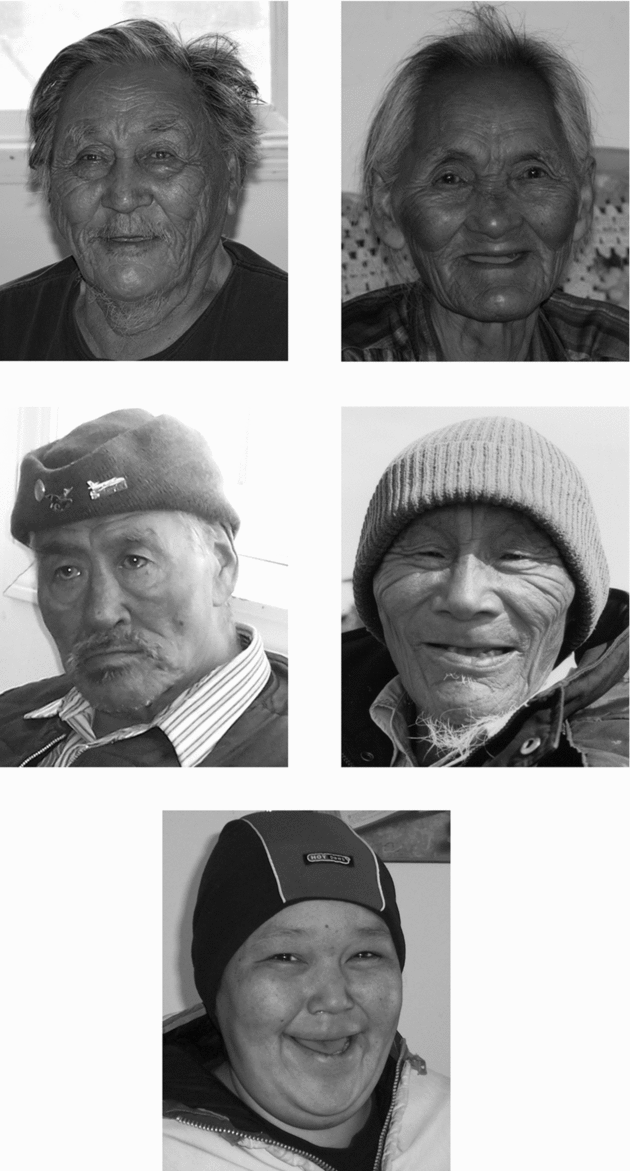
Thus the Ahiarmiut elders still speculate about the reasons why they were relocated as no satisfactory explanation was ever given to them,
The decision for the relocation was made in Ottawa, and Sivertz, first as chief of the Arctic division, later as director of the DNANR, skilfully executed it and defended it. The relocation was mainly founded on economic and moral considerations. The administration considered the Ahiarmiut to be a primitive people that should be integrated into Canadian society. Their existence should have a sound economic base. They were considered as a ‘primitive’, ‘lazy’ and ‘indolent’ people with ‘loose morals.’ For that reason they should be removed from the weather station. Their presence resulted in undesirable relations between Ahiarmiut women and the crew of the weather station and as elsewhere, for example in Frobisher Bay, they were not supposed to remain there in contact with the forces. The Ahiarmiut group was to be moved to an area where they could be guided and supervised. The fact that the Ahiarmiut considered the Ennadai Lake as their home and an excellent hunting area did not affect this point of view in the least. The issue whether they should be transported to an area where they could not rely on support and should be able to provide for themselves or be integrated in modern Canadian economy and removed to a community such as Churchill remained an matter of debate.
In his negative assessment of the Ennadai Lake area Sivertz (Reference Sivertz1959a) relied on the popular books of Mowat and not on the careful ethnographic descriptions of Steenhoven that were also made available to the DNAND. Mowat wrote extensively about the Ahiarmiut (Mowat 1951, Reference Mowat1959a, 1959b, Reference Mowat2000) but many of these texts remain controversial. Steenhoven provides a much more favourable image of life in the Ennadai Lake area (see also Laliberte Reference Laliberte1955). In selecting Henik Lake the administration completely disregarded Ahiarmiut views of the area. They were convinced that they were in the position to make a more adequate assessment of the hunting potential of an area than the native people themselves. The illusion that the white man had to instruct the Ahiarmiut where and how to hunt is a recurrent element in the archival documents.
Thus Lt. Col. Grant observed:
[t]he extremely primitive existence led by the natives and the almost sub-human level of intelligence displayed by the group made them very susceptible to epidemics and famines. They came in time to depend almost entirely on the station personnel, who regularly inspected them for injury or disease, told them when and where to hunt and fish, and acted as agents to dispose of any furs caught during the winter (Grant Reference Grant1958).
The administration at the time was insufficiently aware that hunting knowledge of the land has to be built over time. When the Ennadai people were relocated to Henik Lake, their primary asset, the knowledge of the land of Ennadai Lake, lost its relevance. They had to explore a largely unknown area.
Helen Agaaqtuq Konek (Reference Konek2006) who grew up at Henik Lake related that there is plenty of game around Henik Lake, but one has to know the land to locate it and to hunt it. One has to know where the good fishing spots are, where the caribou crossings are etc.
The administration had always claimed that the Ahiarmiut needed supervision and guidance, but exactly on this point it failed utterly. Some visits were made during the summer, and Voisey spent a month in September and was then airlifted out because he was out of supplies. After that nobody made any attempt to supervise or guide the Ahiarmiut or even to assess the situation. Kerr had taken his leave in Ottawa. The Ahiarmiut frequently visited Voisey in Padlei, and it is unlikely that he was unaware of their predicament. However, he saw no need to inform the authorities until it was too late. By that time the DNANR realised that they had completely failed in supervising the process and they attempted to find out what Voisey had been doing.
Fortunately for the Department public attention switched to the Kikkik case that became a strong public image of the inherent problems of primitive life. Thus Bishop Marsh related that in 1958, for example, Joyce Marlow, wife of the Eskimo Point missionary-in-charge (and later appointed as nurse there), wrote that much witchcraft and superstition prevailed among the Eskimos of Ennadai Lake, some 250 miles west. She wrote:
[e]ight men had died in a week because of taboos imposed by the witch doctor. He had said they couldn't eat certain foods and as these were the only foods available, the men died of starvation. The trouble did not end there. The witch doctor had demanded a fish from an Eskimo. As the fish was all he had for himself and his family, the man refused and turned away. At this point the witch doctor shot him in the back. Not content with killing the man, he decided to kill the man's wife too. He approached her igloo. He tried to shoot the wife, but the shot missed her and in the struggle that followed, the witch doctor himself was stabbed to death. The poor woman was distraught and didn't know what to do. She decided she would try to walk to the nearest trading post several miles away, which was an impossible feat to undertake in bad weather, without food, and with her five children. She set off and after some time realized the impossibility of the task, especially as two of the young children were holding them all back. She must have thought that is was better for a few of them to get to the post rather than have them all die. Whatever prompted her, she disposed of two of her children (aged four and six years) who were causing the hold up. She buried them alive, wrapping them first in caribou skins and placing them deep in the snow. She then set off again with the other children, but was met by the police. Having heard of the eight men who had originally died, the police were making their investigations. The woman told them her story and reported that two of her children had died on the way. The police searched for the bodies and discovered that the (six-year-old) girl buried was still alive. The mother had to be put on trial, however, and after some time was finally acquitted. The rest of the Ennadaimiuts were brought to Eskimo Point to be under police supervision (Marsh Reference Marsh and Marsh1991: 139–140).
This account is to some extent fictitious as there was no relationship between the deaths of starvation we referred to in this report and the killings connected to the Kikkik case (for more details on this trial, see Marcus Reference Marcus1995: 153–178). The Ahiarmiut elders did not discuss these killings with us as they took part in another area and they had not personally witnessed them. In our interviews Job and Eva Muqyunnik strongly denied that there were any rules prohibiting them from fishing and up to this day the question of rules has remained a sensitive issue among the Ahiarmiut. The idea that the Ahiarmiut themselves were to some extent to be blamed seems to be at the root of this perception of Ahiarmiut rules and unfortunately the failure of the relocation itself was never satisfactorily investigated.
The relocation experiment was intended to improve the situation of the Ahiarmiut. It implied a structural conflict between native Inuit culture and modern Canadian society. Native culture was only to be tolerated to the extent that it allowed itself to be integrated in the encompassing framework of Canadian society. The existence of a primitive society living of the land, cut off from the rest of Canadian society was unacceptable. The famous Life publication of 1956, depicting the Ahiarmiut as a stone age people (see Marcus Reference Marcus, King and Lidchi1998) as well as Mowat's books played an important role in the creation of the image of the Ahiarmiut as a primitive people bound for extinction.
In his memorandum of 9 March 1959 Sivertz explains that the image of the ‘noble savage’ should be rejected:
Their inability to provide for themselves without the shattering catastrophes that have kept their numbers low through death-rates and infant mortality that shock civilized people, clearly show that we cannot afford a ‘laissez-faire’ attitude. Experience has shown that there is strong need for close supervision, technical assistance and well planned education (Sivertz Reference Sivertz1959a).
The perceptions of the administration and Inuit with regard to starvation also appear contradictory. The administration emphasised the occasional periods of starvation and the relief that had to be provided. Ahiarmiut describe Ennadai Lake as an excellent hunting area that provided sufficient animals for them to survive. These conflicting visions are not based on different perceptions of facts, but on different values. The Ahiarmiut were a nomadic hunting people, and they knew that incidental periods of starvation where unavoidable but part of their lives. Stories of starvation are part and parcel of their cultural heritage (see Csonka Reference Csonka1992, Reference Csonka1995). Even in the best hunting area the game may fail to appear. This is a fact of life and does not in the least affect their positive assessment of the Ennadai Lake area. For the administration, however, starvation was unacceptable, especially if it would become known internationally.
This conflict of views is clearly expressed by Sivertz in his memorandum of 9 March 1959. ‘Frequent cases of starvation among the Eskimos are historical fact and, in the past, have been accepted as part of their way of life. However, in these times, starvation is not longer acceptable (Sivertz Reference Sivertz1959a). The consequence of this position was that either the administration would have to continue to provide assistance in times of scarcity, or to force the Ahiarmiut to give up their nomadic hunting life. The former option was unacceptable for economic as well as ideological reasons and therefore the latter was gradually implemented even though it implied a destruction of Ahiarmiut culture, traditions and ways of life. The Ahiarmiut were given no choice and the agreement that was suggested in documents only existed on paper. The federal government took over control of the life of the Ahiarmiut and in doing so destroyed the structure of their society. Muqyunnik related:
The government took over the leadership, they took the power. It's like taking the power from the leaders, from our parents. Because we no longer had any power, we just did what ever the government told us to do. Looking back at the time I became an adult, I started to think about what it was like for my parents and other Ahiarmiut. Once the government started taking control over Ahiarmiut, the hardship seemed to start. (Muqyunnik, J. Reference Muqyunnik2005)
He observed that the destruction of Ahiarmiut leadership and the fragmentation of Ahiarmiut society that it entailed also terminated the tradition of sharing food, a central value of Inuit society,
Because the life changed completely, we didn't have a real leader any more. The government started to lead us instead of our leader. Everything changed. When everything changed we no longer lived like we did in Ennadai Lake. People started to have a hardship. In fact, four people died Pongalaq, Qajait, Angatarjuaq and Angmak died of starvation. [. . .] back in Ennadai Lake people were sharing whatever they had. But once they were moved to Ennik Lake they were no longer sharing everything they had. They were each looking after their own family. Life changed. Therefore, some people died of starvation. (Muqyunnik Reference Muqyunnik2005)
Up to this day the memories of the relocations have continued to put a shadow over the lives of the Ahiarmiut elders. There are only a few Ahiarmiut elders left who participated in the relocations as adults. They wish to preserve the cultural and historical traditions of the Ahiarmiut and pass them on to the next generations. The 2005 workshop allowed them to share their experiences with younger people and helped elders as well as youngsters come to terms with the hardships of the past.
Acknowledgements
We presented a first draft of the results of this study at the 15th International Inuit Studies Conference in Paris, on 27 October 2006. We thank our colleagues Yvon Csonka and Peter Kulchyski for their comments after the presentation of our paper. We also wish to thank the Social Sciences and Humanities Research Council of Canada (SSHRC) for providing us with financial support. Finally, we are grateful to Marco Michaud, an MA student from Laval University who helped us in the archival research as well as to the elders who shared so much of their knowledge with us. The writers have greatly benefited from a perusal of the following contemporary sources in addition to those specifically referred to in the text: Curwin (Reference Curwin1988); Fitzsimmons (Reference Fitzsimmons1957, Reference Fitzsimmons1958, Reference Fitzsimmons1959); Gallagher Reference Gallagher1959a, Reference Gallagher1959b); Hunt (Reference Hunt1959); Kennedy (Reference Kennedy1958c); Kerr (Reference Kerr1954, Reference Kerr1955a, Reference Kerr1956b, Reference Kerr1958b, Reference Kerr1958c); Larsen (Reference Larsen1955); Nichols (Reference Nichols1955a); Oswalt (Reference Oswalt1961); Philipps (Reference Philipps1958d, Reference Philipps1958e, Reference Philipps1958f); Richards (Reference Richards1956b, Reference Richards1956c); Robertson (Reference Robertson1954); Serkoak (no dateReference Serkoak); Sivertz (Reference Sivertz1954a, Reference Sivertz1955a, Reference Sivertz1956c, Reference Sivertz1956d, Reference Sivertz1958b, Reference Sivertz1959b); Stevenson (Reference Stevenson1958a, Reference Stevenson1958b, Reference Stevenson1958c). In the references all sources are quoted as they appear in the original text.