Implications
The genes Hepatocyte nuclear factor-1 alpha (HNF1A), Hepatocyte nuclear factor-1 beta (HNF1B) and HNF4A have been proposed as candidate genes for human type 2 diabetes. The associations between these genes and obesity-related traits including fat deposition and total lipid percentage were investigated in pigs. The single-nucleotide polymorphisms within the porcine HNF1A gene were found to be significantly associated with the above fat traits, loin muscle area and muscle glycogen metabolism as well, implying that the HNF1A gene may have multiple genetic effects. No significant association was observed for HNF1B and HNF4A. Therefore, the HNF1A gene could be considered as a candidate for marker-assisted selection to improve meat production traits in pigs.
Introduction
The hepatocyte nuclear factors (HNFs), phylogenetically unrelated, are predominantly expressed in the liver, gut, kidney and pancreatic β cells, and play crucial roles in the regulation of tissue-specific expression of certain genes (Ktistaki and Talianidis, Reference Ktistaki and Talianidis1997; Costa et al., Reference Costa, Kalinichenko, Holterman and Wang2003). Three HNF genes, including Hepatocyte nuclear factor-1 alpha (HNF1A), Hepatocyte nuclear factor-1 beta (HNF1B) and HNF4A, have been identified as promising candidate genes underlying maturity-onset diabetes of the young (MODY), which is a monogenic form of non-insulin-dependent type 2 diabetes (T2D) and is characterized by early age diabetes mellitus and defective insulin secretion. The functions of the HNF1A, HNF1B and HNF4A genes are interconnected. The HNF1A gene can first activate transcription of HNF4A through its P2 promoter, and in turn the HNF4A gene triggers the transcription of HNF1A. The HNF1A and HNF1B genes bind together as a heterodimer and then activate numerous genes involved in glucose sensing and insulin secretion (Ryffel, Reference Ryffel2001; Rowley et al., Reference Rowley, Staloch, Divine, McCaul and Simon2006; Rhoads and Levitsky, Reference Rhoads and Levitsky2008).
The HNF1A gene (known as transcription factor-1, hepatic, TCF1) is a homeodomain transcription factor that can bind to DNA as a homodimer or a heterodimer with the HNF1B gene, another homeodomain transcription factor. The mutations in HNF1A are responsible for type 3 MODY (MODY3), a severe form of diabetes, and account for approximately half of the MODY cases (Yamagata et al., Reference Yamagata, Oda, Kaisaki, Menzel, Furuta, Vaxillaire, Southam, Cox, Lathrop, Boriraj, Chen, Cox, Oda, Yano, Le Beau, Yamada, Nishigori, Takeda, Fajans, Hattersley, Iwasaki, Hansen, Pedersen, Polonsky and Bell1996b; Ryffel, Reference Ryffel2001; Ellard and Colclough, Reference Ellard and Colclough2006). The HNF1B gene (known as TCF2) is linked to a rare case of type 5 MODY (MODY5), accounting for about 1% of MODY cases and also relevant to other non-diabetic renal diseases (Horikawa et al., Reference Horikawa, Iwasaki, Hara, Furuta, Hinokio, Cockburn, Lindner, Yamagata, Ogata, Tomonaga, Kuroki, Kasahara, Iwamoto and Bell1997; Ryffel, Reference Ryffel2001). The HNF4A gene (known as TCF14) is a member of the steroid–thyroid hormone receptor superfamily and it interacts with regulatory elements in promoters and enhancers of the genes involved in cholesterol fatty acid and glucose metabolism. The mutations in the HFN4A gene result in type 1 MODY (MODY1) that could explain 5% of MODY cases (Yamagata et al., Reference Yamagata, Furuta, Oda, Kaisaki, Menzel, Cox, Fajans, Signorini, Stoffel and Bell1996a; Ryffel, Reference Ryffel2001; Ellard and Colclough, Reference Ellard and Colclough2006).
The pig has experienced long-term artificial selection on reduced fat percentage and high-growth rate, and has long been considered as an ideal animal model for obesity research since it has numerous anatomical and physiological characteristics and phenotypes of fat deposition similar to humans. Preliminary studies on the swine genome have revealed that it is more highly similar to humans than rodents (Wernersson et al., Reference Wernersson, Schierup, Jørgensen, Gorodkin, Panitz, Staerfeldt, Christensen, Mailund, Hornshøj, Klein, Wang, Liu, Hu, Dong, Li, Wong, Yu, Wang, Bendixen, Fredholm, Brunak, Yang and Bolund2005; Hart et al., Reference Hart, Caccamo, Harrow, Humphray, Gilbert, Trevanion, Hubbard, Rogers and Rothschild2007). We have found that genes involved in obesity-related phenotypes in humans, such as the melanocortin-4 receptor (MC4R) and high-mobility group AT-hook 1 (HMGA1) genes, were associated with fatness traits in pigs (Kim et al., Reference Kim, Larsen, Short, Plastow and Rothschild2000; Kim et al., Reference Kim, Thomsen, Bastiaansen, Nguyen, Dekkers, Plastow and Rothshild2004). Most recently, transcription factor-7-like 2 (TCF7L2) and fat mass and obesity-associated (FTO) genes implicated in T2D in different human cohort studies have been found to be associated with fat and growth rate traits in pigs (Fontanesi et al., Reference Fontanesi, Scotti, Buttazzoni, Davoli and Russo2008; Du et al., Reference Du, Fan, Zhao, Amoako and Rothschild2009; Fan et al., Reference Fan, Du and Rothschild2009). Due to the significance of the HNF1A, HNF1B and HNF4A genes on MODY development and their possible roles on insulin and insulin-like growth factor (IGF) pathways, we selected them as candidate genes for fatness and other related traits in pigs, so as to identify genetic markers suitable for marker-assisted selection programs to aid in improving meat production traits.
Material and methods
Animals and traits
DNA samples were obtained from the Iowa State University Berkshire and Yorkshire (B × Y) intercross breed resource family, which had been constructed for quantitative trait loci (QTL) mapping for growth, carcass composition and meat-quality traits (Malek et al., Reference Malek, Dekkers, Lee, Baas and Rothschild2001a). Briefly, two F0 Berkshire sires were crossed with nine F0 Yorkshire dams to produce nine F1 litters, and then eight sires, and 26 dams from these F1 litters were selected and crossed to produce 515 F2 animals.
The analyzed traits in the study comprised five fatness-related traits, namely backfat on the sites of the lumbar, 10th rib and last rib, average backfat and total lipid percentage (TLP), loin muscle area (LMA) and three muscle glycogen metabolism measures, namely average content of glycogen (AVGGG), lactate (AVLAC) and glycolytic potential (AVGP) of the loin at 48 h post mortem. LMA and glycogen metabolism traits were chosen because we hypothesized that the studied HNF genes are involved in the insulin and IGF pathways (Kitanaka, Reference Kitanaka2008), and they may be associated with muscle growth traits simultaneously. The details of these trait measurements have been described by Malek et al. (Reference Malek, Dekkers, Lee, Baas and Rothschild2001a and Reference Malek, Dekkers, Lee, Baas, Prusa, Huff-Lonergan and Rothschild2001b).
Genetic variants discovery and genotyping
Human HNF1A, HNF1B and HNF4A transcript sequences (Ensembl transcript IDs: ENST00000257555, ENST00000225893 and ENST00000316099, respectively) retrieved from the Ensembl database (http://www.ensembl.org/index.html) were used as entries to search for homologous pig sequence (http://www.ncbi.nlm.nih.gov/projects/genome/guide/pig). The pig genome sequence fragments showing more than 80% identity with the entry sequences were obtained. The pairs of primers were designed for PCR amplification of these genes from pig genomic DNA. PCR products were commercially sequenced (DNA facility, Iowa State University, Ames, IA, USA). The sequences were integrated into one whole sequence by using the Ensemble option of Sequencher software 4.6 (Gene Codes, Ann Arbor, MI, USA), which showed 99% similarity with the blasted pig genome sequences. The ensemble sequences of the porcine HNF1A, HNF1B and HNF4A genes have been deposited in GenBank of the National Center for Biotechnology Information (NCBI; accession numbers: FJ973575, FJ968727 and FJ968728, respectively).
Genetic variant discovery was implemented by sequencing pooled PCR products that were amplified from DNA of 11 F0 animals from the B × Y population. The sequences were the input into the Sequencher software 4.6 (Gene Codes) and then searched for variants. PCR primers were redesigned to facilitate genotyping of the identified variants with the PCR restriction fragment length polymorphism (PCR-RFLP) technique.
Linkage mapping and QTL analysis
Human HNF1A, HNF1B and HNF4A genes are located at HSA12q24.2, HSA 17cen-q21.3 and 20q12-q13.1, respectively, and these locations correspond to SSC14, 12 and 17 in the pig (https://www-lgc.toulouse.inra.fr/pig/compare/compare.htm). One SNP chosen from each gene was used for linkage mapping in the B × Y population. The mapping procedures were performed with two-point linkage analyses using an improved CRIMAP (version 2.5, Green et al., Reference Green, Falls and Crooks1990) developed by Evans I. and Maddox J. (personal communication). The QTL analyses were performed using online GridQTL (http://www.gridqtl.org.uk/; Seaton et al., Reference Seaton, Hernandez, Grunchec, White, Allen, De Koning, Wei, Berry, Haley and Knott2006). The impact of HNF1A was determined by including the selected SNP genotypes and haplotypes in the model as fixed effects. In the model, sex and slaughter year were used as fixed effects and carcass body weight as a covariate (Malek et al., Reference Malek, Dekkers, Lee, Baas and Rothschild2001a).
Association analyses of single marker and haplotype
The association analyses between single markers and the fatness traits and LMA were performed using the MIXED model procedures (SAS 9.0; SAS Institute, Cary, NC, USA). In this model, sex, slaughter date and marker genotypes were considered as fixed effects, dam (litter) as a random effect and carcass body weight as a covariate. The model for three glycogen-metabolism traits was similar to the above, but it included an additional fixed effect of the genotype of PRKAG3 (protein kinase AMP-activated-γ 3 subunit) Ile199Val mutation, as described by Malek et al. (Reference Malek, Dekkers, Lee, Baas, Prusa, Huff-Lonergan and Rothschild2001b). The PRKAG3 Ile199Val had been considered as one of the causative mutations affecting the glycogen content in the muscle and the resulting meat quality (Ciobanu et al., Reference Ciobanu, Bastiaansen, Malek, Helm, Woollard, Plastow and Rothschild2001).
Haplotype analyses for multiple SNPs within the HNF1A gene and graphical representation of the linkage disequilibrium (LD) structure as measured by r 2 were performed with the Haploview software (version 3.32; Barrett et al., Reference Barrett, Fry, Maller and Daly2005). Haplotypes were obtained for each animal using the PHASE computer program (version 2.1; Stephens et al., Reference Stephens, Smith and Donnelly2001). The association analyses between different copy numbers (0, 1 and 2) of certain haplotypes and traits were implemented using the MIXED procedure of SAS as mentioned above.
In addition, combined association analyses were carried out to explore the possible interaction between the SNPs. The model was similar to that for single-marker association analysis, but the interaction between the SNPs was added as a fixed effect.
Results
Genetic variants within HNF genes
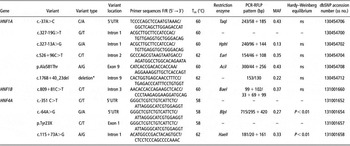
In total, six genetic variants including five SNPs and one deletion were identified in the porcine HNF1A gene. The SNP c.1741G>A could result in a non-synonymous mutation p.Ala581Thr. The variant c.1768+40_23del that occurred in intron 9 could introduce a new splicing donor site, as predicted by NNSPLICE online (http://www.fruitfly.org/seq_tools/splice.html). In the HNF4A gene, four SNPs were detected and c.69C>T caused a synonymous mutation p.Tyr23X. Only one intronic SNP was found in the HNF1B gene. According to structures of human HNF1A and HNF4A proteins, both exonic mutations p.Ala581Thr and p.Tyr23X are located in transactivation domains (Ellard and Colclough, Reference Ellard and Colclough2006). All of the variants have been deposited into the dbSNP of NCBI with the accession numbers shown in Table 1.
Detailed information about the identified variants from porcine HFN1A, HNF1B and HNF4A genes

HFN1A = Hepatocyte nuclear factor-1 alpha; HNF1B = Hepatocyte nuclear factor-1 beta; RFLP = restriction fragment length polymorphism; MAF = minor allele frequency.
*The sequence of deletion fragment: 5′-GGGAGCAAGGTATGCCCAGCAGA-3′.
PCR-RFLP genotyping was developed for seven SNPs given the availability of commercial restriction enzyme and distinct genotyping patterns (Table 1). The genotyping of HNF1A c.1768+40_23del was distinguished by the length differences of PCR fragments. In the B × Y pig population, minor allele frequencies of all variants were >0.05. Both SNPs from the HNF4A gene were not in Hardy–Weinberg equilibrium (P < 0.01).
Linkage mapping and QTL analysis
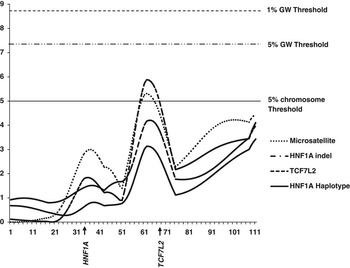
The SNPs HNF1A c.327-13A>G, HNF1B c.809+81C>T and HNF4A c.115+73A>G were chosen for linkage mapping of the genes studied, and these genes were assigned to SSC14, 12 and 17 (Table 2), respectively, which were in agreement with the comparative chromosomal locations of human homologous genes. In the recently released Sus scrofa Build 9 (http://uswest.ensembl.org/Sus_scrofa/Info/Index), the HNF1A and HNF4A genes are located at 41 030 504 bp on SSC14 and 48 531 bp on SSC17, respectively, while HNF1B has yet to be mapped. In the previous QTL studies using the B × Y pig family, a QTL related to last rib backfat at the chromosomal threshold was mapped around 68 cM on SSC14 (Malek et al., Reference Malek, Dekkers, Lee, Baas and Rothschild2001a), where the TCF7L2 (known as TCF4) gene was located (Du et al., Reference Du, Fan, Zhao, Amoako and Rothschild2009). There was no QTL for other fatness and LMA traits on these regions. As the genotype of HNF1A c.1768+40_23del and haplotypes were included as individual fixed effects in the model separately, the F-value peaks for last rib backfat dropped at both 33 cM and 67 cM, where HNF1A and TCF7L2, respectively, were located (Figure 1). When fitting in the haplotype effect, the peaks dropped further.
The linkage mapping results of the porcine HNF1A, HNF1B and HNF4A genes using the Iowa State University Berkshire × Yorkshire pig population

HFN1A = Hepatocyte nuclear factor-1 alpha; HNF1B = Hepatocyte nuclear factor-1 beta; SNP = single-nucleotide polymorphism.
The F-value plots for quantitative trait loci (QTL) analysis related to last rib backfat with the genotypes of c.1768+40_23del and haplotypes of the HNF1A gene as fixed effects in the model, as well as the genotype of c.646C>T in the TCF7L2 gene. Chromosome-wise F-statistic thresholds at the 5% level is 5.08, and the F-statistic thresholds at the 5% and 1% genome-wise level are 8.22 and 9.96, respectively (Malek et al. Reference Malek, Dekkers, Lee, Baas and Rothschild2001a and Reference Malek, Dekkers, Lee, Baas, Prusa, Huff-Lonergan and Rothschild2001b).

Association analyses of single marker and haplotype
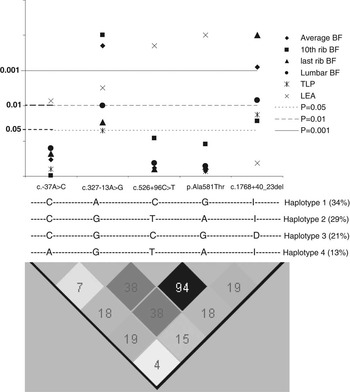
The results of the association analyses between single markers and traits are shown in Supplementary Table 1 and Figure 1. In the HNF1A gene, c.327-13A>G in intron 1 was highly significantly (P < 0.01) associated with average backfat, 10th rib backfat, lumbar backfat and LMA, and it was significantly (P < 0.05) associated with last rib backfat and TLP. The c.1768+40_23del in intron 9 was not only significantly (P < 0.05) associated with four backfat traits, but also significantly (P < 0.05) associated with TLP and the three glycogen metabolism traits. Interestingly, all of the variants except c.1768+40_23del were highly significantly (P < 0.01) associated with LMA, and the SNP p.Ala581Thr within exon 9 was very highly significantly (P < 0.0001) associated with LMA. Although only two kinds of genotypes were detected for HNF1A c.-37A>C within 5′UTR, it was highly significantly (P < 0.01) associated with LMA, AVGP and AVLAC. For the HNF1B and HNF4A genes, there was no significant association between the identified SNPs and traits (data were not shown).
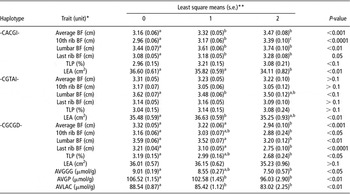
Haplotype analyses and graphical representation of LD structure for the HNF1A gene are shown in Figure 2. These SNPs did not have strong or highly significant LD relationships (r 2 > 0.8) except between c.526+96C>T and p.Ala581Thr that are located in intron 2 and exon 9, respectively. The SNPs c.327-13A>G and c.526+96C>T were about 300 bp apart, but they did not show high LD. The same was also the case for p.Ala581Thr and c.1768+40_23del. Four major haplotypes accounting for 97.72% of all animals were obtained as follows: haplotype 1, -CACGI- (34.14%, I indicates insertion and D indicates deletion); haplotype 2, -CGTAI- (29.45%); haplotype 3, -CGCGD- (21.59%); and haplotype 4, -AGTAI- (12.54%). The results of the association analyses for the first three haplotypes are shown in Table 3. For haplotype 1, which was distinguished from other haplotypes by c.327-13A>G, animals carrying fewer copy numbers of this haplotype had significantly reduced backfat and higher LMA. For haplotype 3, which was different from the others by c.1768+40_23del, animals carrying more copy numbers of this haplotype had significantly less backfat and lower glycogen metabolism measures. Haplotype 2 was different from the former two haplotypes by c.526+96C>T and p.Ala581Thr with the individuals with one or two copy numbers of this haplotype having higher LMA than those without this haploptype.
Associations of single markers and haplotype construction of five HNF1A variants in the pig. The x axis indicates single-nucleotide polymorphism (SNP) IDs and y axis indicates P-values between single marker and the analyzed traits. Black boxes indicate r 2 thresholds (value of 1, completely in linkage disequilibrium (LD) and value of 0, completely not in LD) between 0.8 and 1.0, and light boxes indicate r 2 thresholds <0.80.

Associations of copy numbers of certain HNF1A haplotypes with the studied traits in Berkshire × Yorkshire pig resource population

*Average BF = average backfat; 10th rib BF, lumbar BF and last rib BF = backfat on the sites of the 10th rib, lumbar and last rib; TLP = total lipid percentage; LMA = loin muscle area; AVGGG, AVLAC and AVGP = average content of glycogen, lactate and potential of the loin at 48-h post mortem.
**The values bearing different superscripts differ significantly (P < 0.05) from each other. The values 0, 1 and 2 represent the number of haplotypes that animals carried.
Conditional association analyses between HNF1A c.327-13A>G and c.1768+40_23del were implemented (Supplementary Table 2). No significant interaction was observed between these two SNPs with fatness and glycogen metabolism traits, but a significant interaction for LMA was found. The significant level of association between c.327-13A>G and last rib backfat was reduced, and that of c.1768+40_23del and 10th rib backfat also inclined. In the earlier study, the SNP c.646C>T (dbSNP accession number: ss99307224) in exon 8 of TCF7L2 on SSC14 was found to be associated with backfat traits (Du et al., Reference Du, Fan, Zhao, Amoako and Rothschild2009), and the linkage distance between the genes TCF7L2 and HNF1A were around 34 cM (data were not shown), and therefore, conditional association analyses between this SNP and the above two HNF1A SNPs were implemented. No obvious interaction effect between SNPs were observed. However, the significant level of association of TCF7L2 c.646C>T with backfat traits was reduced. HNF1A c.327-13A>G was still significantly or suggestively associated with backfat traits, and HNF1A c.1768+40_23del was significantly associated with two backfat traits. LD analysis showed that there was no strong LD between these two genes (r 2 < 0.1) using Haploview software (Barrett et al., Reference Barrett, Fry, Maller and Daly2005).
Discussion
More than 200 exonic SNPs and truncating mutations have been identified in the human HNF1A gene and they are distributed throughout all of the 10 exons (Ryffel, Reference Ryffel2001; Winckler et al., Reference Winckler, Burtt, Holmkvist, Cervin, de Bakker, Sun, Almgren, Tuomi, Gaudet, Hudson, Ardlie, Daly, Hirschhorn, Altshuler and Groop2005; Ellard and Colclough, Reference Ellard and Colclough2006). The HNF1 protein is composed of three major domains, that is, dimerization domain (encoded by exon 1), DNA-binding domain (encoded by exons 2 to 4) and transactivation domain (exons 6 to 10). It has been investigated that the number of variants located in these domains were similar, but the first two had higher numbers of missense mutations and the third had higher numbers of truncation mutations (Ryffel, Reference Ryffel2001; Ellard and Colclough, Reference Ellard and Colclough2006). In addition, the HNF1A gene encodes for three variant isoforms, which are possibly relevant to the relatively high-mutation occurrences in the first six exons (Bellanné-Chantelot et al., Reference Bellanné-Chantelot, Carette, Riveline, Valéro, Gautier, Larger, Reznik, Ducluzeau, Sola, Hartemann-Heurtier, Lecomte, Chaillous, Laloi-Michelin, Wilhem, Cuny, Duron, Guerci, Jeandidier, Mosnier-Pudar, Assayag, Dubois-Laforgue, Velho and Timsit2008). In this study, only one missense mutation p.Ala581Thr was identified in exon 9, and no mutation was detected in the first six exons. These results imply that evolutionary pressure on the HNF1A gene might be different between humans and pigs and clearly pigs have been under possibly stronger selection pressure for fatness. In humans, there was no mutation site at p.Ala581, but at its adjacent position 583, p.Arg583Gly and p.Arg583Gln were discovered and p.Arg583Gly was not a CpG mutation while p.Arg583Gln was (Ellard and Colclough, Reference Ellard and Colclough2006).
No strong LD (r 2 > 0.8) was observed among the analyzed variants in the porcine HNF1A gene except between c.526+96C > T and p.Ala581Thr. It was a bit surprising, but it suggested that additional mutations between these two genes are worth further mining in order to clarify whether there are additional LD blocks in this long region. The association analysis from both single markers and haplotypes indicated that the HNF1A gene may have multiple genetic effects and exert different roles on the insulin and IGF pathways, as it showed a significant association with both fatness and muscle growth-related traits. The p.Ala581Thr was very highly significantly associated with LMA. The c.327-13A>G in intron 1 was significantly associated with four backfat traits and intramuscular fat content. The c.1768+40_23del was significantly associated with backfat and glycogen metabolism measures. These three variants can be considered as important ones and validations of their associations are needed in other populations with larger size and various genetic backgrounds.
The conditional association analysis between two HNF1A SNPs significantly associated with backfat showed that there was no obvious interaction effect. The significant level of association of c.327-13A>G with last rib backfat was reduced and the c.1768+40_23del was no longer associated with 10th rib backfat. It can be speculated that the HNF1A gene might exert its function through variants at different sites and the significance of mutation positions in the first two domains are the same as those occurring in the third domain in pigs.
The exact molecular mechanisms of MODY3 caused by the HNF1A gene are still being studied (Weedon and Frayling, Reference Weedon and Frayling2007; Rhoads and Levitsky, Reference Rhoads and Levitsky2008). The HNF1A gene acts as a key transcription factor involved in the regulation of genes critical for the liver, pancreas and kidney, such as the Insulin and IGF1 genes (Kitanaka, Reference Kitanaka2008). The HNF1A gene knockout mice appeared to have severe reduction in the insulin secretary response and had high-density lipoprotein cholesterol metabolism (Shih et al., Reference Shih, Bussen, Sehayek, Ananthanarayanan, Shneider, Suchy, Shefer, Bollileni, Gonzalez, Breslow and Stoffel2001). The mutations in humans could bring about reduced insulin secretion and eventually impaired glucose tolerance and frank diabetes (Rhoads and Levitsky, Reference Rhoads and Levitsky2008). Recently, the HNF1A gene was found to regulate the expression of growth hormone-responsive genes, indicating that it might be associated with postnatal body growth and development (Lin et al., Reference Lin, Hu and Lee2008). The HNF1A gene regulated the expression of miRNA194, which is usually highly expressed in different intestinal epithelial cells, and possibly involves the activation of specific pathways such as Notch and Wnt (Hino et al., Reference Hino, Tsuchiya, Fukao, Kiga, Okamoto, Kanai and Watanabe2008). Interestingly, the mutation types of HNF1A variants were possibly relevant to the diagnosis age of obesity patients, and those carrying the variants that occurred in the DNA-binding domains were clinically diagnosed 2 years earlier than those with variants occurring in the transactivation domain (Harries et al., Reference Harries, Ellard, Stride, Morgan and Hattersley2006; Bellanné-Chantelot et al., Reference Bellanné-Chantelot, Carette, Riveline, Valéro, Gautier, Larger, Reznik, Ducluzeau, Sola, Hartemann-Heurtier, Lecomte, Chaillous, Laloi-Michelin, Wilhem, Cuny, Duron, Guerci, Jeandidier, Mosnier-Pudar, Assayag, Dubois-Laforgue, Velho and Timsit2008), which showed that the mutations that occurred in the first two domains are more important. In this study, p.Ala581Thr was in exon 9 that encodes the third function domain and the c.1768+40_23del in intron 9 could generate the new donating receptor for transcript splicing. It suggested that both mutations in the transactivation domain and the truncating mutations in the intron were important in pigs. It is worth noting that the insertion mutation was only found in the two Berkshire pig founders that are well-known for high levels of intramuscular fat and pork quality, while it was not found in the nine Yorkshire founder females, a leaner breed.
The HNF1A gene was mapped close to SWC6 on SSC14. There was one QTL for last rib backfat mapped around SW55 on SSC14 in B × Y family, approximately 30 cM away from the HNF1A gene. However, in numerous other studies, QTL associated with backfat and LMA were mapped between 30 and 40 cM on SSC14 (http://www.animalgenome.org/QTLdb/pig.html; Rohrer and Keele, Reference Rohrer and Keele1998; de Koning et al., Reference de Koning, Rattink, Harlizius, Groenen, Brascamp and van Arendonk2001; Paszek et al., Reference Paszek, Wilkie, Flickinger, Miller, Louis, Rohrer, Alexander, Beattie and Schook2001; Dragos-Wendrich et al., Reference Dragos-Wendrich, Sternstein, Brunsch, Moser, Bartenschlager, Reiner and Geldermann2003). In addition, the TCF7L2 gene was mapped between SW77 and SW55 on SSC14, and it was significantly associated with backfat traits (Du et al., Reference Du, Fan, Zhao, Amoako and Rothschild2009). The conditional association analyses exhibited no obvious interactions between TCF7L2 and the other two interesting SNPs within HNF1A. However, TCF7L2 c.646C>T was no longer associated with backfat traits, and c.327-13A>G and c.1768+40_23del in HNF1A were significantly associated with backfat traits and glycogen metabolism measures, respectively. Furthermore, QTL analysis using the genotype of HNF1A c.1768+40_23del and haplotypes as fixed effects suggested that this gene had significant effects on SSC14, where two possible QTL associated with last rib backfat trait were mapped. Similarly, the TCF7L2 gene had an effect on the first QTL region but no effect on the second region. These results implied that the effects of TCF7L2 and HNF1A on fatness may be independent, and that the HNF1A gene has a stronger effect on backfat.
In contrast to the HNF1A gene, less numbers of genetic variants were found in the human HNF1B gene, and most of the mutations were restricted to the DNA-binding domain (Ryffel, Reference Ryffel2001). In this study, only one SNP was identified in intron 2 of the porcine HNF1B gene. Quite a number of genetic variants have been identified in the human HNF4A gene (Ellard and Colclough, Reference Ellard and Colclough2006), and in the pig four SNPs including one synonymous mutation p.Tyr23X were found. However, no significant association with the analyzed traits was observed for these two SNPs. Because of the limited sample size and the background of the studied population, which was based on 11 founders from two genetically divergent breeds, the discovery of additional SNPs and association of HNF1B and HNF4A with the analyzed traits are needed.
Acknowledgments
This study was funded in part by the National Pork Board, State of Iowa and Hatch funding, and the College of Agriculture and Life Sciences.