Implications
Utilization of N from diets based on alfalfa silage (AS) may be improved by including carbohydrates that are highly fermented in the rumen. Roasting of dry corn has decreased NH3 in ruminal in vitro incubations compared with unroasted dry corn. In agreement with small responses in milk production in previous trial only minor effects on ruminal digestion and microbial synthesis were observed in lactating cows fed roasted corn and AS. More fiber was digested ruminally in cows fed alfalfa ensiled in the O2-limiting silo, which might reflect an improved fermentation than when compared with in the bag and bunker silos.
Introduction
Three of the most common silo types used in the United States are tower, bunker and pressed bag silos. Recently, improved chemical composition, lower losses during ensiling and greater digestibility of fiber were reported in two trials with dairy cows fed second-cutting alfalfa ensiled in an O2-limiting tower silo compared with ensiling in bag and bunker silos (Krizsan et al., Reference Krizsan, Broderick, Muck, Promkot, Colombini and Randby2007; Broderick and Muck, Reference Broderick and Muck2009). Generally, alfalfa silage (AS) is characterized by high concentrations of total CP and nonprotein N (NPN). The NPN in AS is rapidly degraded to NH3 in the rumen; improved conversion of this NPN to microbial CP could be achieved by increased supply of fermentable energy, due to reduced NH3 absorption across the ruminal epithelium or increased use of rumen recycled urea-N (Lapierre and Lobley, Reference Lapierre and Lobley2001). Roasting of dry corn has decreased NH3 concentration in ruminal in vitro incubations compared with unroasted dry corn (Krizsan et al., Reference Krizsan, Broderick, Muck, Promkot, Colombini and Randby2007; Sveinbjörnsson et al., Reference Sveinbjörnsson, Murphy and Udén2007). These results suggested that feeding roasted corn could increase microbial utilization of the NPN in AS. On the other hand, other data revealed no difference in ruminal NH3 concentrations and no indication of altered microbial CP synthesis from urinary excretion of purine derivatives in lactating cows fed roasted compared with unroasted dry corn (Krizsan et al., Reference Krizsan, Broderick, Muck, Promkot, Colombini and Randby2007). These results were unexpected as the dry heat processing of roasting has been reported to gelatinize corn starch (Reeve and Walker, Reference Reeve and Walker1969) and thereby increase ruminal starch digestion. Differences in total purine : N ratios between fluid (FP) and particulate phase bacteria in the rumen indicate the importance of using separate microbial references associated with particulate and fluid digesta when estimating total microbial outflow (Craig et al., Reference Craig, Brown, Broderick and Ricker1987; Cecava et al., Reference Cecava, Merchen, Gay and Berger1990). Purine derivative excretion is an indirect method that does not account for these differences. Some purine derivatives also may be of dietary origin, and excretion route may vary with the nutritional and physiological status of the animal (Chen et al., Reference Chen, Hovell, Ørskov and Brown1990; González-Ronquillo et al., Reference González-Ronquillo, Balcells, Belenguer, Castrillo and Mota2004). Thus, relative differences between dietary treatments in microbial CP flow may not be detected using this method. Moreover, results from the lactation trial were not completely explained: total tract digestibility of ADF, milk fat concentration and yield of fat and fat corrected milk were all higher for cows fed alfalfa ensiled in the O2-limiting tower silo than for cows fed alfalfa from either the bag or bunker silos (Krizsan et al., Reference Krizsan, Broderick, Muck, Promkot, Colombini and Randby2007).
The objectives of this experiment were to use omasal sampling to measure the effects and interactions between feeding alfalfa ensiled in O2-limiting tower, bag or bunker silos, supplemented with either ground-shelled corn (GSC) or roasted GSC (RGSC), on ruminal digestion and microbial CP yield in lactating dairy cows.
Material and methods
Animal management, experimental design and diets
This experiment, which was conducted in parallel with a larger lactation trial (Krizsan et al., Reference Krizsan, Broderick, Muck, Promkot, Colombini and Randby2007), used six multiparous early lactation Holstein cows, averaging (mean ± s.d.) 642 ± 75 kg of BW, 83 ± 20 days in milk and 42 ± 11 kg milk/day at the start of the study. All cows were fitted with 10-cm ruminal cannulas (Bar Diamond Inc., Parma, ID, USA). The cows were housed in tie stalls, had free access to water throughout the experiment and were offered feed once daily at 1200 h; orts were recorded once daily and feeding rate adjusted to yield orts of ∼10% of intake. All cows were injected with bovine somatotropin (500 mg of Posilac; Monsanto, St. Louis, MO, USA) beginning on day 1 of the experiment and at 14-day intervals throughout. Care and handling of the animals were conducted according to guidelines approved by the Research Animal Resource Center of the UW-Madison.
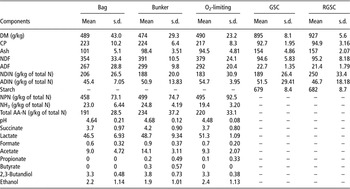
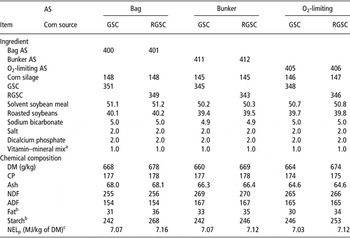
The six diets were fed in a 3 × 2 factorial arrangement of treatments and consisted of AS ensiled in bag, bunker or O2-limiting tower silo, each fed with GSC or RGSC in a cyclic change-over design (Davis and Hall, Reference Davis and Hall1969) with five 21-day periods. Alfalfa (Medicago sativa) was harvested in 2004 as second cutting and ensiled in the three different silos: bag (AgBag Systems Inc., St. Nazianz, WI, USA), bunker or O2-limiting tower silo (Harvestore; Engineered Storage Products Company, DeKalb, IL, USA). The corn grain fed in this experiment was either unroasted or roasted using a mobile system consisting of a propane-fired roaster with an approximate flame temperature of 650°C (Roast-A-Matic, Schnupp's Grain Roasting Inc., Lebanon, PA, USA). The temperature of the corn kernels was 135°C when exiting the roaster. The experimental diets were fed as total mixed rations (TMRs). Chemical compositions of the silages and the dry corn sources are given in Table 1. Dietary ingredient composition (from 60°C dry matter (DM) determinations) and chemical composition are presented in Table 2. Composition of diets was calculated from the chemical composition and proportion of DM of each dietary ingredient. Silage DM concentration was not corrected for volatile losses during oven drying. Intake of DM was computed based on 60°C DM determinations for TMR and orts of composited samples from last week in each period. Other details of this trial and lactation performance of all cows fed the experimental diets have been described in a previous paper (Krizsan et al., Reference Krizsan, Broderick, Muck, Promkot, Colombini and Randby2007).
Composition of alfalfa silages and ground corn (g/kg of DM unless otherwise specified)

DM = dry matter; GSC = ground-shelled corn; RGSC = roasted GSC; NDIN = neutral detergent-insoluble N; ADIN = acid detergent-insoluble N; NPN = nonprotein N; Total AA-N = total amino acid N.
Composition of experimental diets (g/kg of DM unless otherwise specified)

DM = dry matter; AS = alfalfa silage; GSC = ground-shelled corn; RGSC = roasted GSC.
aProvided (per kg of diet DM): 56 mg of Zn, 46 mg of Mn, 22 mg of Fe, 12 mg of Cu, 0.9 mg of I, 0.4 mg of Co, 0.3 mg of Se, 6440 international units (IU) of vitamin A, 2000 IU of vitamin D, and 16 IU of vitamin E.
bAverage concentrations calculated from samples of the total mixed ration analyzed during each period.
cNELp = Net energy for lactation at production levels of intake. Computed according to National Research Council (NRC, 2001) using composition above and tabulated values of lignin. Diet neutral detergent-insoluble N were calculated using analyzed and NRC (2001) tabulated values. Total digestible nutrients (TDN) at production level of intake for each diet was computed from TDN at maintenance level of intake using the relationship between feeding level as multiple of maintenance and the decrease in dietary TDN per unit of multiple of maintenance in NRC (2001).
Sampling procedures and preparation of digesta samples
Each experimental period lasted 21 days with the last 7 days used for sample collection. Data on DM intake are from days 15 to 21. Continuous infusion of the markers YbCl3 (2.3 g/day of Yb), CoEDTA (2.8 g/day of Co) and 10% atom excess (15NH4)2SO4 (Sigma Aldrich (Isotec), Miamisburg, OH, USA) (215 mg/day of 15N) were started on day 16 in each period, following a priming dose of 4 l of the marker solution (providing 4.1 g of Yb, 3.4 g of Co and 313 mg of 15N) given via the ruminal cannula. Before starting the infusion of 15N in every period, a sample of whole ruminal contents was taken from each cow and stored at −20°C for later determination of 15N background. Marker infusions were continued until the last digesta sample was collected on day 21. The markers were dissolved in distilled water and the infusion was conducted using two syringe pumps (model 33; Harvard Apparatus Inc., Holliston, MA, USA). The infusion started 60 h in advance of the first digesta sample collection in all periods to allow uniform distribution of 15N from incorporation of 15NH3 in the ruminal microbial pools (Broderick and Merchen, Reference Broderick and Merchen1992). Digesta flow entering the omasal canal was estimated using a triple marker method (France and Siddons, Reference France and Siddons1986). Indigestible NDF (iNDF), which was mainly associated with the large particle (LP) fraction (Ahvenjärvi et al., Reference Ahvenjärvi, Vanhatalo, Shingfield and Huhtanen2003); Yb, which was concentrated in the small particle (SP) digesta phase; and Co, which marked the FP (Udén et al., Reference Udén, Colucci and Van Soest1980) were used in combination to calculate digesta flow. The omasal sampling technique developed by Huhtanen et al. (Reference Huhtanen, Brotz and Satter1997), as modified by Ahvenjärvi et al. (Reference Ahvenjärvi, Vanhatalo, Huhtanen and Varvikko2000), was used to collect four daily samples at 2-h intervals over three consecutive days to represent the 24-h feeding cycle. The collection of samples from the omasal canal started at 0000 h on day 19 and finished at 2200 h on day 21. At each sampling time, a 325-ml digesta sample was collected and divided into two subsamples as follows: 200 ml from each time point was pooled to yield a 2.4 l omasal composite sample, which was stored at −20°C, and 125 ml from four daily collections, which were pooled and kept in a refrigerator to yield a 500-ml digesta sample, one from each of the three digesta collection days.
The 2.4 l pooled omasal samples were thawed at room temperature and separated into the three digesta phases: LP, SP and FP. Samples were initially filtered through one layer of cheesecloth (American Wiper & Supply Co., Milwaukee, WI, USA) and the retained particulate matter was defined as the LP phase. The filtrate was centrifuged at 1000 × g for 5 min at 5°C, the supernatant was decanted and defined as the FP, whereas the remaining pellet represented the SP phase. The separated digesta phases were frozen until freeze-dried and ground. The LP and SP phases were ground through a 1.0-mm screen (Wiley mill; Arthur H. Thomas, Philadelphia, PA, USA). All FP samples were ground with mortar and pestle. At the end of each of the three sampling days, bacteria were isolated from the 500-ml composites made from digesta collected from the omasal canal of each cow. The procedure for bacterial isolation was that described by Reynal et al. (Reference Reynal, Broderick and Bearzi2005). Liquid-associated bacteria (LAB) were isolated by filtration through two layers of cheesecloth and differential centrifugation. Particle-associated bacteria (PAB) were detached from the particulate matter retained on the cheesecloth plus the pellet from the 1000 × g centrifugation using 350 ml of cold 0.9% (wt/vol) NaCl solution containing 0.1% (vol/vol) Tween 80; the PAB samples were held at 4°C over night. To harvest PAB, the filtrate was subjected to the same differential centrifugation procedure as used for LAB. The resulting LAB and PAB pellets were stored at −20°C until freeze dried. Separate LAB and PAB composites were made by pooling equal amounts of sample DM from each cow over the three sampling days.
iNDF and chemical analyses
iNDF was determined by in situ incubation of triplicate SP samples (3 g/bag) and duplicate LP and TMR samples (1 g/bag). Samples were weighed into pre-weighed polyester bags with pore size of 6 μm and a pore area equal to 5% of the total surface (Sefar Nitex 03–6/5; Sefar America Inc., Depew, NY, USA). The bags were incubated for 288 h in the rumens of two lactating cows, removed from the rumen, rinsed with water and then analyzed for NDF concentration using heat stable α-amylase and sodium sulfite (Mertens et al., Reference Mertens, Allen, Carmany, Clegg, Davidowicz, Drouches, Frank, Gambin, Garkie, Gildemeister, Jeffress, Jeon, Jones, Kaplan, Kim, Kobata, Main, Moua, Paul, Robertson, Taysom, Thiex, Williams and Wolf2002) in an Ankom 200/220 Fiber Analyzer (Ankom Technology Corp., Fairport, NY, USA). Concentrations of Co and Yb were analyzed in FP, SP, LP and infused marker solutions from every period by direct current plasma emission spectroscopy (Combs and Satter, Reference Combs and Satter1992; SpectraSpan V; Fison Instruments, Valencia, CA, USA). The preparation of samples for analysis by direct current plasma emission spectroscopy followed the procedure described by Reynal et al. (Reference Reynal, Broderick and Bearzi2005). On the basis of the concentrations of Co, Yb, and iNDF in LP and SP and of Co and Yb in FP, DM from freeze-dried FP, SP and LP were recombined in the correct proportions to reconstitute the omasal true digesta flowing out of the rumen. SP and LP were mixed in the correct proportions based on the markers to yield a 1.5-g sample that was ground through a 0.5-mm screen with a Udy Cyclone Sample mill (Udy Corporation, Fort Collins, CO, USA) and defined as SP + LP.
The freeze-dried, reconstituted digesta samples were further analyzed for DM, organic matter (OM), NDF, ADF, N, starch and NH3. Background samples of ruminal digesta, LAB, PAB, FP and the combined SP + LP samples were analyzed for nonammonia N (NAN) and 15N atom percent. DM concentration was determined by oven drying at 105°C for 4 h and ash concentration by combustion at 550°C for 16 h. Concentrations of NDF and ADF were determined sequentially (Van Soest and Robertson, Reference Van Soest and Robertson1985). Total N concentration was determined using a Leco combustion analyzer (Leco FP-2000 N Analyzer; Leco Instruments Inc., St. Joseph, MI, USA). Starch concentration was analyzed according to a modification of the enzymatic method of Bach Knudsen (Reference Bach Knudsen1997) as described previously (Krizsan et al., Reference Krizsan, Broderick, Muck, Promkot, Colombini and Randby2007). Extracts of the reconstituted digesta samples were analyzed for NH3 and total amino acids using flow-injection analysis (Dual-Channel QuikChem 8000 FIA, Lachat Instruments, Milwaukee, WI, USA). The extracts were prepared by adding 10 ml of a Na-citrate buffer with pH adjusted to 2.2 to 0.5 g of sample; after mixing, samples were held at 39°C for 30 min, and centrifuged at 15 000 × g for 15 min at 4°C. The supernatants were stored at −20°C until analyzed. Concentration of NAN and abundance of 15N were analyzed with an ECS 4010 (Costech Analytical Technologies Inc., Valencia, CA, USA) elemental combustion system interfaced with a Delta Plus XP mass spectrometer (Thermo Finnigan, San Jose, CA, USA). Samples containing about 100 μg of N were weighed to the nearest microgram into 5 × 8 mm tin capsules (Elemental Microanalysis Ltd, Okehampton, UK). Ammonia was volatilized in a 60°C oven over night by adding 50 μl of 72 mM K2CO3 solution to each capsule. Samples were analyzed in duplicate with samples containing similar 15N enrichments analyzed as groups, separated by blanks, to avoid 15N carryover between samples. In addition, DM and ash concentrations were determined as described for the composite LAB and PAB samples.
Calculations
Ruminal nutrient flow was calculated using the chemical composition of the reconstituted omasal digesta samples and DM flows at the omasal canal (France and Siddons, Reference France and Siddons1986). Flow of OM was not corrected for volatile fatty acid flow (Ahvenjärvi et al., Reference Ahvenjärvi, Vanhatalo, Huhtanen and Varvikko2000). NAN in omasal samples was calculated by difference between total N and NH3-N. Total NAN flow was assumed to be composed of LAB and PAB NAN, plus NAN nonmicrobial N. The LAB NAN flows were calculated from 15N enrichment of FP above background, divided by 15N enrichment of LAB above background, and multiplied by the NAN FP flow. The same calculation was performed for NAN flows for PAB except that 15N enrichment above background in SP + LP and NAN flows of SP + LP were used, assuming that extracted PAB were representative of bacteria flowing with the SP + LP phase. The NAN nonmicrobial N flow was calculated as the difference between total NAN flow and total microbial NAN flow.
Statistical analysis
All data were analyzed as a cyclic change-over design (Davis and Hall, Reference Davis and Hall1969) using the MIXED procedures of SAS (2003) by the following model:

where Yijklm = dependent variable, μ = overall mean, Ci∼N(0,  ) is the random effect of cow i, Pj = effect of period j, Sk = effect of silage type k, Tl = effect of roasting treatment l, STkl = interaction between silage type k and roasting treatment l, and eijklm∼N(0,
 ) is the random residual error. There were missing observations on two different cows, one in period 4 and one in period 5. This generated slightly higher s.e. for intake, flow and digestion data of DM, OM, NDF and ADF when diets were based on AS from the bag fed with GSC compared with the other experimental treatments. We experienced very low or negative flow of some nutrients for the cow in period 4 and these were then defined as missing observations. The cow in period 5 suffered from loss of appetite, which generated low digestion data. Values were defined as statistical outliers when more than 2 s.d. away from the mean. Mean separation was done by least significant difference to test for differences among and between treatments.
Results
Intake and ruminal digestibility
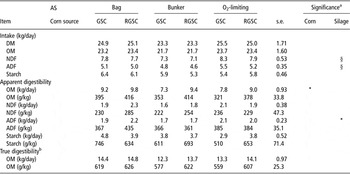
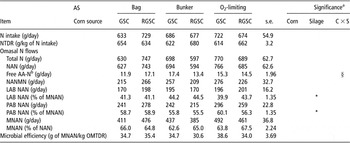
Results for intake and ruminal digestibility traits are presented in Table 3. No significant interactions between storage structure of dietary alfalfa and corn type were detected (P ⩾ 0.16); therefore, only main effects are presented in Table 3. DM intake was not different (P ⩾ 0.23) among treatments, averaging 24.5 kg/day across diets. Intake of NDF and ADF were, respectively, 1.0 and 0.6 kg/day higher (P ⩽ 0.02) for cows fed AS stored in the O2-limiting tower silo compared with AS stored in the bunker silo. OM apparently digested in the rumen was 1.3 kg/day higher (P ⩽ 0.04) in cows fed RGSC than in cows fed GSC diets (Table 3). Mean ADF apparently digested in the rumen for cows fed diets with AS from bag, bunker and O2-limiting tower silo was 2.1, 1.7 and 2.1 kg/day, respectively, and was lower in cows fed AS from the bunker silo (P ⩽ 0.03). No effect (P = 0.51) on ruminal starch digestibility was observed with roasting treatment of the dry corn in this trial. Few significant responses of dietary treatments on ruminal N metabolism were detected in this trial (Table 4). The only significant dietary effect on omasal flow of N fractions that was observed was an alteration of the proportions of NAN contributed by LAB and PAB in total microbial NAN due to dietary AS source (P = 0.04; Table 4). Omasal outflow of amino acid-N tended (P = 0.08; Table 4) to be significant for the interaction term. Remaining traits were not affected by main effects of dietary treatments or interaction between them.
Effects of AS storage structure and roasting of dry corn on nutrient intake and rumen digestibility

AS = alfalfa silage; GSC = ground-shelled corn; RGSC = roasted GSC; DM = dry matter; OM = organic matter.
aP-values indicated by §P < 0.10, *P < 0.05. The interaction between corn type and silage source was not significant for any trait (P ⩾ 0.16).
bRumen digestibility of OM corrected for flow of microbial OM.
Effects of AS storage structure and roasting of dry corn on N intake and flow of N fractions at the omasal canal

AS = alfalfa silage; GSC = ground-shelled corn; RGSC = roasted GSC; C × S = interaction between corn type and silage source; NTDR = N truly digested in the rumen; NAN = nonammonia; AA = amino acid; NANMN = nonammonia nonmicrobial N; LAB = liquid-associated bacteria NAN; PAB = particle-associated bacteria NAN; MNAN = total microbial NAN; OMTDR = organic matter truly digested in the rumen.
aP-values indicated by §P ⩽ 0.10, *P < 0.05.
bFree AA, mmol × (40.3 mg of N/mmol of total free AA; Broderick, Reference Broderick1987).
Discussion
Dietary effects on intake and ruminal digestibility
DM losses and lactate to acetate ratio of alfalfa ensiled in the O2-limiting tower silo was lower compared with the two other storage structures (Krizsan et al., Reference Krizsan, Broderick, Muck, Promkot, Colombini and Randby2007). This suggested that a somewhat improved fermentation occured in that silo. Otherwise, there were only small differences among the AS. The net energy for lactation (NEL) allowable milk at the mean intake of 24.5 kg/day was estimated to be 40 kg/day (NRC, 2001), suggesting that energy supply exceeded that required for production of ∼38 kg/day of milk. Moreover, cows were generally fed large amounts of starch daily (⩾ 5.3 kg/day) and the dry corn was finely ground. There were small differences in particle size distribution (Krizsan et al., Reference Krizsan, Broderick, Muck, Promkot, Colombini and Randby2007) and mean particle size (567 v. 477 μm) between GSC and RGSC. These factors, rather than the absence of an effect of roasting treatment on the availability of rumen fermentable carbohydrates, could explain the lack of dietary effects in this trial.
Ljøkjel et al. (Reference Ljøkjel, Harstad, Prestløkken and Skrede2003) observed reduced ruminal degradation with a heat treatment for barley grain at treatment temperatures of 100°C and 125°C, but treatment at 150°C increased in situ rumen degradation of starch. These authors concluded that heat treatment under certain conditions can reduce ruminal degradability of starch by making the protein matrix more resistant to proteolysis but, at higher heat input, swelling and gelatinization of the starch granules likely will increase fracturing of the protein matrix. Several studies support the idea that increased ruminal starch degradation of corn can result from roasting (Felsman et al., Reference Felsman, Harvey and Barrick1972; Costa et al., Reference Costa, Jensen, Harmon and Norten1976 and Reference Costa, Jensen, Harmon and Norten1977). However, the slight improvement in OM digested in the rumen in cows fed RGSC was consistent with the small increases in yield of milk protein and lactose observed in the previous production trial (Krizsan et al., Reference Krizsan, Broderick, Muck, Promkot, Colombini and Randby2007).
Previously, the only effect detected on digestibility due to corn roasting was a slight decrease of 19 g/kg in total tract digestibility of NDF (Krizsan et al., Reference Krizsan, Broderick, Muck, Promkot, Colombini and Randby2007). Decreased ruminal fiber digestion has been observed with increased intake of rapidly fermentable carbohydrates or with enhanced processing of corn (Overton et al., Reference Overton, Cameron, Elliottt, Clark and Nelson1995; De Visser et al., Reference De Visser, Klop, Van der Koelen and Van Vuuren1998). No effect of the roasting treatment was observed on ruminal NDF digestibility in the present trial (P ⩾ 0.50). However, estimates of ruminal NDF digestibility were low in this study. Relating NDF digested in the rumen to total tract digestion of NDF (see Krizsan et al., Reference Krizsan, Broderick, Muck, Promkot, Colombini and Randby2007) indicated that on average only 56% of total tract NDF digestion occurred in the rumen. This is much lower than the 80% and 95% of the total tract fiber digestion derived from pooled data analyses reported by Titgemeyer (Reference Titgemeyer1997) and Huhtanen et al. (Reference Huhtanen, Ahvenjärvi, Broderick, Reynal and Shingfield2010). However, the proportions of ruminal to total tract digestibility of ADF and starch of 83% and 76% across all diets supported the validity of the flow data observed in this trial. The low estimates of ruminal NDF digestibility seemed to arise from high NDF values in the reconstituted omasal samples. The ratio between concentrations of NDF : ADF in omasal and fecal samples were, on average, 1.9 and 1.6, respectively. Dietary NDF : ADF ratios averaged 1.6 in this trial. It would be expected that there was little difference in hemicellulose and cellulose digestibility between omasum and rectum when sulfite has been included in the NDF analysis (some N can be digested in the lower tract bound to hemicelluloses rather than cellulose). Ahvenjärvi et al. (Reference Ahvenjärvi, Vanhatalo, Huhtanen and Varvikko2000) experienced problems when analyzing NDF concentrations in the SP phase isolated from omasal digesta samples. They observed a much higher NDF : ADF ratio in the SP than in the LP (8.5 v. 2.0) and estimated NDF concentration in SP from ADF concentration, assuming the same NDF : ADF ratio as in LP. In this study, the isolated phases from the omasal digesta were reconstituted to a representative sample rather than analyzed separately. However, ∼25% of the DM in reconstituted digesta samples was from SP and, although much smaller than the ratio deviation reported by Ahvenjärvi et al. (Reference Ahvenjärvi, Vanhatalo, Huhtanen and Varvikko2000), could still account for the differences in NDF concentration in the reconstituted omasal samples. Recalculating NDF concentrations in the reconstituted omasal samples assuming the same NDF : ADF ratio in omasal and fecal samples yielded more realistic estimates of ruminal to total tract NDF digestibility that averaged 82% across all experimental diets in this trial.
In the previous trial, yields of fat-corrected milk and fat were increased by 1.7 and 150 g/d, and milk fat content was increased by 0.3 percentage unit, when cows were fed the diet based on AS from the O2-limiting tower silo (Krizsan et al., Reference Krizsan, Broderick, Muck, Promkot, Colombini and Randby2007). This production response is consistent with the increased ruminal digestibility of ADF in this study. Although ruminal ADF digestibility was not different between AS from bag and O2-limiting silos in the present trial, the 0.4 kg/day greater amount of ADF digested would have provided (0.4 × 18.4) 7.4 MJ/day more digestible energy on AS from O2-limiting tower silo compared with the bunker silo. This would have supplied ∼3.1 MJ/day more NEL (NRC, 2001). The 2.6 kg/day of fat-corrected milk (assuming 30 g/kg of protein and 49 g/kg of lactose) would have contained 7.5 MJ NEL. Thus, 0.4 kg digested ADF would supply 41% of the required NEL and much of this apparent effect is unaccounted for. Total tract digestibility of ADF was also higher for cows fed diets based on AS ensiled in the O2-limiting tower silo compared with diets containing AS from the two other silos (Broderick and Muck, Reference Broderick and Muck2009).
Ruminal outflow of N fractions
A positive effect on N balance, due to lower urinary N excretion, was observed on diets containing AS from the O2-limiting tower silo compared with AS ensiled in bag and bunker silos (Broderick and Muck, Reference Broderick and Muck2009). This effect, plus improved chemical composition and reduced total DM losses during ensiling (Krizsan et al., Reference Krizsan, Broderick, Muck, Promkot, Colombini and Randby2007), suggested that greater recovery of better quality silage occurred when alfalfa was ensiled in the O2-limiting tower silo. Initial degradation of protein in ensiled forages is mainly caused by plant enzymes, a process that is prolonged by the presence of oxygen in the silo (McDonald et al., Reference McDonald, Henderson and Heron1991). The alfalfa ensiled in the different silos in this trial was harvested from the same fields and was of the same maturity. Further, the proportion of NPN in total N was relatively low and the variation was small among the silages (Krizsan et al., Reference Krizsan, Broderick, Muck, Promkot, Colombini and Randby2007). Nonprotein N can account for as much as 75% to 87% of the total N in AS (Muck, Reference Muck1987). A higher proportion of PAB in total bacteria in omasal contents could suggest an augmentation of bacterial colonization of feed particles. The proportion of PAB was higher for AS ensiled in the O2-limiting tower and bag silos, which also had more ADF digested in the rumen.
Microorganisms utilizing cellulose and hemicelluloses as energy substrates grow slowly and use NH3 as their primary N source (Russell et al., Reference Russell, O′Connor, Fox, Van Soest and Sniffen1992). Atasoglu et al. (Reference Atasoglu, Newbold and Wallace2001) estimated that 80% or more of the N incorporated by ruminal cellulolytic bacteria in vivo was derived from ruminal NH3, but overall bacterial growth was stimulated when peptides or amino acids were included in the growth medium. It is implicit that the bacteria fermenting the slowly degraded carbohydrate fraction would be found primarily in the PAB fraction. On the other hand, microorganisms that ferment starch, pectin and sugars grow more rapidly and, although they can also use NH3, utilize greater proportions of amino acids and small peptides as N sources (Russell et al., Reference Russell, Sniffen and Van Soest1983 and Reference Russell, O′Connor, Fox, Van Soest and Sniffen1992). However, the small shift in proportion of microbial NAN from PAB to LAB observed when cows were fed bunker AS is difficult to explain from compositional data of the silages.
Huhtanen et al. (Reference Huhtanen, Rinne and Nousiainen2008b) reported adverse effects on milk protein yield with increased soluble N in silage-based diets, an effect that was almost completely related to the proportion of NH3-N in silage-soluble N. The extensive and rapid degradation of protein in the silo as well as in the rumen has suggested that matching ruminal release of energy and N may improve N efficiency. Diets based on AS have shown increased milk and milk protein yield when fed with more rapidly fermentable carbohydrates in the diets (Ekinci and Broderick, Reference Ekinci and Broderick1997) or when the ratio of fermentable energy was adjusted to match rumen degradable protein (Vagnoni and Broderick, Reference Vagnoni and Broderick1997; Broderick, Reference Broderick2003). A meta-analysis of production trials indicated that increased supplementation of starch or nonfiber carbohydrates in grass silage-based diets did not support improved N efficiency of milk protein production (Huhtanen et al., Reference Huhtanen, Nousiainen, Rinne, Kytölä and Khalili2008a). However, type of supplemented starch (i.e. rapidly or slowly fermented in the rumen) was not distinguished in this study, which may account for the overall weak relationship. The difference in NPN among the dietary sources of AS in our case was small and diets provided similar amounts of rapidly fermentable carbohydrates; an effect on ruminal N metabolism that would be further associated with improved responses in milk production would not likely be detected in this trial.
Conclusions
Roasting of corn increased the amount of OM apparently digested in the rumen. However, no corresponding increases in ruminal starch digestibility, or effects on ruminal outflow of N fractions, were detected. Greater ADF digestion on AS from the O2-limiting tower silo could partly explain the higher yields of fat and fat-corrected milk observed on that treatment in the previous production trial, but does not explain why this response was not seen for cows fed AS from the bag silo. Greater proportions of microbial CP formed in the rumen came from PAB, and less from LAB, in cows fed alfalfa ensiled in the O2-limiting tower or bag silos, but increased outflow of total microbial CP was not detected on these two diets. The small increases in yield of milk protein and lactose observed in the previous production trial in cows fed diets containing roasted corn may have occurred because of greater supply of fermentable substrates.
Acknowledgments
The authors would like to express their gratitude and most respectable thanks to the late Dr Santiago Reynal for his contribution to this study during the stay of SJK at the US Dairy Forage Research Center, Madison, WI, USA, to Wendy Radloff for all her help with sampling and especially for laboratory analyses, and to Antonio Faciolá and José Lebovich for assisting with sampling and sample preparation.