The discursive turn in policy analysis
During recent decades, there has been an increasing expression of interest in the study of policy as discourse. Such interest has manifested itself in the advocacy and use of broad Foucauldian approaches – that is, approaches that focus on both text and ‘con-text’ in the construction of policy (Fairclough, Reference Fairclough, Wetherell, Taylor and Yates2001; Greener, Reference Greener2004; Scrase and Ockwell, Reference Scrase and Ockwell2010; Shaw, Reference Shaw2010) – as well as of more specific forms of discourse analysis that concentrate directly on features of rhetoric (Majone, Reference Majone1989; Rein and Schön, Reference Rein, Schön, Fischer and Forester1993; Russell et al., Reference Russell, Greenhalgh, Byrne and McDonnell2008), and especially argumentation (Fischer, Reference Fischer2003; Fischer and Forrester, Reference Fischer and Forrester1993), narrative (Kaplan, Reference Kaplan1986; Roe, Reference Roe1994), or semantics (Iannantuono and Eyles, Reference Iannantuono and Eyles1997, Reference Iannantuono and Eyles1999). A key assertion in the work of such writers is that language matters, and that the ways in which policy problems and their solutions are ‘framed’ (Garvin and Eyles, Reference Garvin and Eyles2001; Yanow, Reference Yanow2000) in discourse are key to understanding what does and what does not get done in action. For Fischer (Reference Fischer2003) especially, policy analysts need to explain how the ‘empirical’ (what people do) is embedded in the normative – that is, in the realm of political and cultural values and assumptions. Indeed, to those who have taken the discursive turn, there is no useful division to be drawn between the supposedly ‘real’ world of doing and the immaterial world of talk and text, for it is in language that policy is made.
This paper is primarily concerned with the language of policy documents in the field of health care. The substantive focus is on a comparative study of UK health policy documents (N = 20) as produced by the various assemblies, governments and executives of England, Scotland, Wales, and Northern Ireland during the period 2000–09. The paper examines the content and substance of such documents, and the ways in which they framed problems, facts and solutions affecting the provision of health care to the respective regional or national populations of the UK. The paper is also concerned with developing a robust method for analysing policy as discourse; that is to say a method that can meet acceptable social scientific standards of validity and reliability; standards that can stand firm against any charge that a discursively based strategy for policy analysis is over-reliant on subjective interpretation.
In an editorial on the nature of discourse analysis, Van Dijk (Reference Van Dijk1997: 50) stated that, ‘[a]n analysis of discourse is a scholarly analysis only when it is based on more or less explicit concerns, methods or theories’. And as is clear from our opening paragraph, in the realm of discourse there is a wide variety of potential analytical strategies that can be adopted and used. In this paper only one of those strategies is attended to – narrative policy analysis. As we indicate in the next section, it is not currently clear how a narrative policy analysis (or, indeed, many other forms of discursively centred policy analysis) might meet all of the conditions referred to by Van Dijk. By examining the features and structure of health policy in the four constituent countries of the UK during the era of ‘New Labour’, we aim to demonstrate how that may be done and what the consequences of so doing can be.
Policy as narrative
Though firmly based in the world of literary theory, narrative method has been widely used for both the collection and the analysis of data concerning ways in which individuals come to perceive and understand various states of health, ill‐health and disability (Frank, Reference Frank1995; Hydén, Reference Hydén1997). Narrative techniques have also been adapted for use in clinical contexts and allied to concepts of healing (Charon, Reference Charon2006). In both social scientific and clinical work, however, the focus is invariably on individuals and on how individuals ‘tell’ stories of health and illness. Yet it is clear that narratives can also belong to collectives − such as political parties, ethnic and religious groups and governments. In the latter case, there is a need to collect and analyse data that are dispersed across a wider range of materials than can be obtained from the personal interview. It is in this broader context of studying ‘collectives’ that writers such as Fischer (Reference Fischer2003), Kaplan (Reference Kaplan1986), and Roe (Reference Roe1994) have demonstrated how narrative method can be applied to the analysis of animal rights and environmental policies, local and national health service policies and even national budgets.
An extension of the concept of narrative to policy discourse is undoubtedly useful (Newman and Vidler, Reference Newman and Vidler2006), but how might such narratives be analysed? What strategies can be used to unravel the form and content of a narrative, especially in circumstances where the narrative might be contained in multiple (policy) documents, authored by numerous individuals and published across a span of some years, rather than in a single unified text such as a novel? Roe, unfortunately, is not in any way specific about analytical procedures – apart from offering the useful rule to ‘never stray too far from the data’ (Reference Roe1994: xii). That is not to say that there are no strategies for analysing narratives. Czarniawska (Reference Czarniawska2004) reviews all of the important conceptual frames that have informed narrative analysis. Yet most strategies eschew an explicit concern with issues relating to the validity or reliability of the interpretative processes that necessarily accompany a study of ‘storylines’. Indeed, those who take the post-modern turn place emphasis on the ‘fabrication’ of interpretation, on multiple ‘readings’ of the same text, and the fluidity of meaning within and between texts (DeVault, Reference DeVault1990). In this paper, however, the intention is to emphasise the need for the potential replication of any given interpretation. To that end, it outlines a novel strategy that combines techniques of linguistically (rule) based content analysis with a theoretical and conceptual frame that enables us to unpick, identify and, to a certain extent, visualise the core features of policy narratives.
As already suggested, narratives can unfold across many media and in numerous arenas – speech and action, as well as text. Here, however, the focus is solely on official government documents. (All of the documents used in the analysis are listed in the bibliography, and all are freely available at various – government – www locations.) The question is: How can these documents be analysed in a narrative frame?
Theoretically, and following Aristotle (1995), we can say that all narratives contain at least three basic features – a storyline or plot, a set of characters and a chronology (beginning, middle and an end). Characters are ordinarily thought of as active individuals (Little Red Riding Hood, or Oliver Twist and the like), but in social scientific terms it is usually more productive to think of functioning agents – such as ‘the government’, ‘the Scottish people’, ‘the NHS (National Health Service)’ and so forth – rather than acting individuals. Indeed, it was in this broader context that the French literary theorist Greimas (Reference Greimas1970) invented the concept of ‘actant’ so as to refer to the range of physical, ideational and human agents that function within any plot. The use of the latter term serves to sharpen our understanding on the ways in which concepts, institutions, ‘markets’ and even physical geography (cf. Moon and Brown, Reference Moon and Brown2000) can influence the direction of unfolding events every bit as much as conscious human subjects. By adopting such a perspective, one can, for example, argue that ‘choice’, ‘equity’, ‘partnership’, ‘responsiveness’ and ‘performance’ might serve as actants in a policy story, and in the remainder of the paper we will be able to judge how that view can assist analysis.
To be interested in a narrative is therefore to be interested in character as well as plot, and one obvious strategy for analysis would be to begin by identifying the building blocks (characters or actants) out of which storylines are assembled and then to examine how the building blocks are linked – one to the other. The problem is how to identify such building blocks and the links between them in a manner that can be replicated (that is, rendered ‘reliable’) by others.
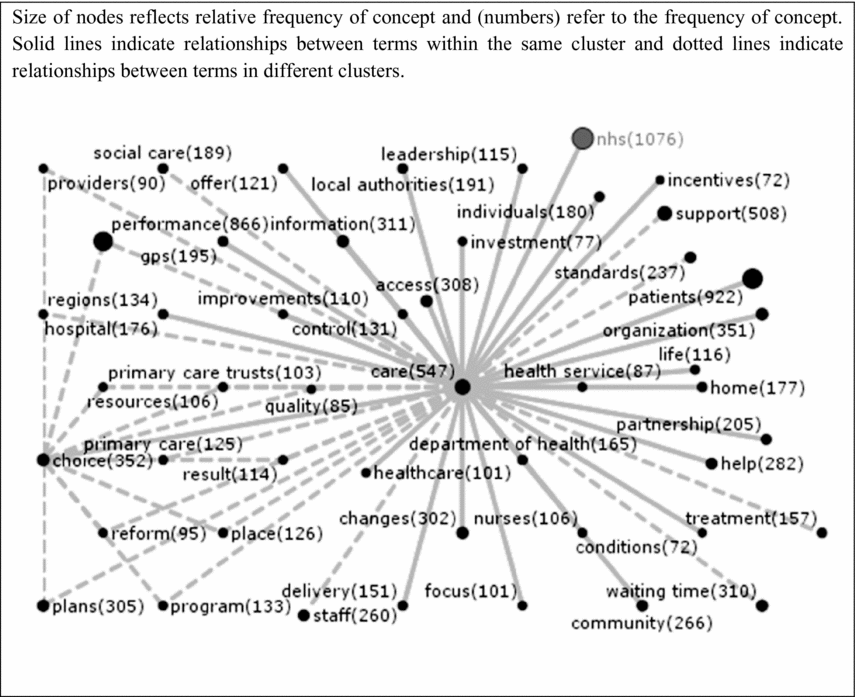
In much qualitative work (including narrative analysis), there is always a temptation to select items, themes and elements that fit with any given line of analysis and to ignore data that either contradict or run counter to the analysis – though qualitative researchers consistently try to confront such problems of bias in various ways (see, for example, Mays and Pope, Reference Mays and Pope2000). For this study, the problem of concept selection was confronted by using automated text-mining techniques (SPSS, 2007). The latter begin by providing the researcher with an initial list of concepts based on the lexicon of the text, but which can be weighted according to word frequency, and which take account of elementary word associations. For example, learning disability, mental health and performance management indicate three concepts and not six words. Using such procedures on the aforementioned documents gives the researcher an initial grip on the most important concepts in the set of documents for each country – many of these are as indicated in Figures 1–4. And a distinct advantage of using this approach is that it is based on the deployment of algorithms rather than the proclivities of the researcher – that is, the algorithms highlight (or downplay) aspects of the text according to clearly defined rules.
Concept cluster for ‘care’ in six English policy documents

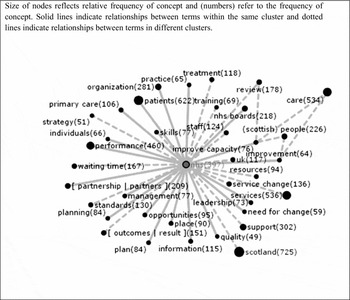
Concept cluster for NHS in four Scottish policy documents

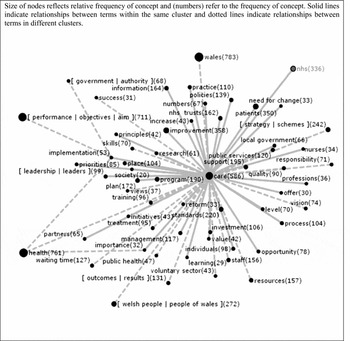
Concept cluster for ‘care’ in five Welsh policy documents

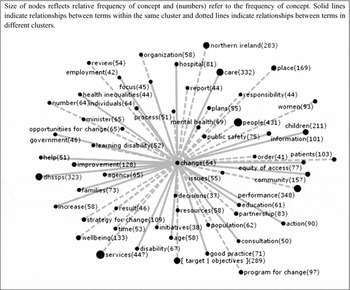
Concept cluster for ‘change’ in five Northern Ireland policy documents

It is at once interesting to note that not every one of the ‘actants’ thus identified appears in each of the first four figures. ‘Scotland’, ‘Wales’ and ‘Northern Ireland’ are the most noticeable in this regard, but concepts such as ‘choice’, ‘mental health’ and ‘disability’ also appear irregularly. On the other hand, a number of the actants are common to all groupings – ‘change’, ‘improvement’, ‘partnership’ or ‘partners’ and ‘performance’ are examples.
Characters or actants do not, of course, exist in isolation. Automated text-mining procedures are therefore designed to trace links and connections between textual elements – to recognise concept clusters. (Figures 1–4 are visualisations of such clusters). Cluster representation is dependent on the deployment of similarity or co-occurrence algorithms (see, for example, SPSS, 2007: 183). By using such techniques, it is not only possible to get a grip on the frequency with which the concepts appear in the collected texts, but also on how concepts co-occur within documents and what the strength of co-occurrence might be. In terms of Figures 1–4, the size of the individual nodes is proportional to the frequency with which the term or concept appears in the data set as a whole. In addition, the figures indicate a measure of co-occurrence of word pairs in the documents. (The thickness of the lines is proportional to the similarity values as calculated by the algorithm referred to above.) So the diagram informs us about what appears in the documents, how what appears is linked and what the strength of that link might be. In the case of Figures 1–4 (but not Figure 5), the co-occurrence value is nearly always one because although the data set stretches across twenty documents, the document N for each individual country is small – just four in the case of Scotland, for example. (A co-occurrence value of one suggests that the relevant terms co-occur in all documents. In a larger sample of documents, however, co-occurrence values would vary between zero and one.) Nevertheless, the diagrams not only provide a visual frame in terms of which concepts are located, but also serve as a check on, and to some extent validation of, the interpretations of the researcher. For example, one might argue that talk about markets or health inequality is a dominant feature of a given discourse or narrative, but its assumed significance may not be substantiated by the documentary analysis. (The method is based on what is written rather than on what people might wish to amplify.) The downside of the procedure is that the researcher has little influence as to what is and what is not included in the clusters. One cannot, for example, insist on producing an ‘NHS’ cluster, and no one cluster can incorporate all of the major concepts.
Occurrence of key concepts in 20 UK health policy documents by country/year of publication

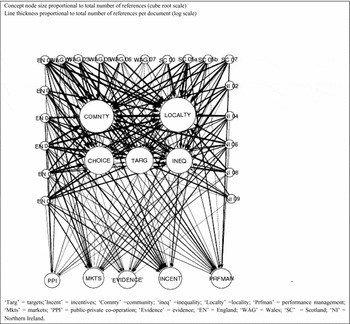
It is for this reason that a further stage of analysis is required – as represented in Figure 5. Figure 5 has been drawn using social network software. It adds to our analysis in a number of ways. In the first instance, it enables us to zoom-in on specific terms such as ‘choice’, ‘market’ and ‘inequality’ and compare their relative weight in the semantic mix. (Note that the automated analysis is unlikely to give emphasis to concepts that appear rarely in the text such as, say, ‘public–private partnership’ and ‘quasi-market’.) Second, it adds a dynamic edge to the analysis in so far as it represents a chronological unfolding of emphasis. That is to say, it links the appearance of terms and concepts to year of publication and to the individual countries. (It may be useful to emphasise at this point that the data for Figure 5 have had to be scaled – using cube roots and logs – so as to cope with the extensive variation in the number of citations given to the selected terms.)
Of course, none of this tells us about plot – the analysis so far merely points to the key characters, their relative importance and what relationships might hold between them. So having outlined the base techniques used to identify the essential components of the four policy narratives, it is now necessary to sketch out their substantive form.
The NHS and the English patient
It may be useful to note that in matters of narrative Aristotle recommended brevity – deftly summarising the whole of the Odyssey in just seven lines (1995: 91). In what follows, we attempt – albeit somewhat weakly – to emulate that example. The citations are of Department of Health publications (by year) as listed in our reference list. This selection is not intended to be exhaustive, but merely illustrative of the contexts in which the various elements of the story unfold. We begin with a narrative for England. This English narrative, as with those for the other UK countries, is constructed as if it were based on emerging (rather than a past) documentation.
The advent of the NHS in 1948 was a ‘seminal event’ (DH, 2000: 8), but under successive Conservative administrations the NHS was seriously underfunded (DH, 2006: 3). The (Labour) government will invest (2000), or already has (2003: 4) invested extensively in infrastructure and staff and the NHS is now on a ‘journey of major improvement’ (DH, 2004a: 2). But ‘more money is only a starting point’ (DH, 2000: 2) and the journey is far from finished. Continuation requires some fundamental changes of ‘culture’ (DH, 2003: 6). In particular, the NHS remains unresponsive to patient need. A ‘“one size fits all” approach is neither responsive, equitable nor person-centred’ (DH, 2003: 17). Overall, the NHS is a 1940s system operating in a twenty-first century world (DH, 2000: 26). Change is therefore needed across the ‘whole system’ (2005: 3) of care and treatment.
Above all, we have to recognise that we ‘live in a consumer age’ (DH, 2000: 26). People's expectations have changed dramatically (DH, 2006: 129) and people want more choice, more independence and more control (DH, 2003: 12) over their affairs. Patients are no longer, and should not be considered as, ‘passive recipients’ of care (2003: 62); they need to be actively ‘involved’ in their treatments (DH, 2003: 38; 2005: 18), and engaged in a partnership (DH, 2003: 22) of respect with their clinicians. Furthermore, most people want a personalised service ‘tailor made to their individual needs’ (DH, 2000: 17, 2003: 15, 2004a: 8, 2004b: 36, 2006: 83); ‘A service which feels personal to each and every individual within a framework of equity and good use of public money’ (DH, 2003: 6).
To advance the necessary changes, ‘patient choice’ needs to be and ‘will be strengthened’ (DH, 2000: 89). ‘Choice’ must be made to ‘happen’ (DH, 2003), and it must be ‘real’ (DH, 2003: 3, 2004a: 11, 2005: 20, 2006: 4). Indeed, it must be ‘underpinned’ (DH, 2003: 7), and ‘widened and deepened’ (DH, 2003: 6) throughout the entire system of care.
If ‘we’ expand and underpin patient choice in appropriate ways and engage patients in their treatment systems, then levels of patient satisfaction will increase (DH, 2003: 39), and their choices will lead to a more ‘efficient’ (DH, 2003: 5, 2004a: 11, 2006: 16) and ‘effective’ (DH, 2003: 62, 2005: 8) use of resources. Above all, the promotion of choice will help to drive up ‘standards’ of care and treatment (DH, 2000: 4, 2003: 12, 2004a: 11, 2005: 7, 2006: 3). Furthermore, the expansion of choice will serve to negate the effects of the ‘inverse care law’, whereby those who need services most tend to get catered for the least (DH, 2000: 107, 2003: 5, 2004b: 105, 2006: 63), and it will thereby help in moderating the extent of health inequalities in the society in which we live. ‘We need to develop an NHS that is both fair to all of us, and personal to each of us’ (DH, 2003: 5).
We can see how most – though not all – of the elements of Figure 1 are knitted together in this brief narrative. Certainly, the majority of the key actants are visible in our concept web. In particular, the figure is suggestive of strong links between ‘care’ and ‘choice’, and how partnership, performance, investment and improvement have a prominent profile (cf. Calnan and Gabe, Reference Calnan and Gabe2001). There are of course some elements of the semantic web that have a strong profile (in terms of node size and links), but to which we have not referred – primary care and waiting times are two such examples. The appearance of ‘incentives’, ‘control’ and ‘result’ are, as anyone well versed in English health care policy would know, also suggestive of a target-driven narrative (Bevan and Hood, Reference Bevan and Hood2006) that we have not explored. However, by rendering the excluded as well as included elements of the policy story visible, the semantic web begins to provide a degree of verification of the narrative as told herein, as well as on the scope of its coverage. Above all, it demonstrates clearly the range of things (actants) that are drawn into the policy rhetoric.
A policy for the Scottish people
Note how in the first narrative there was no particular mention of the nation to which the proposed health service reforms were to apply (though ‘England’ does of course appear in the wider documentation). Yet, when it comes to Scotland, there can be little doubt that one of the key actants in the policy documentation is Scotland itself, and especially ‘the people of Scotland’ or ‘the Scottish people’. So where ‘choice’ is often positioned as a driving force for change in the English system of care and treatment, that role is taken over by the perceived and future health of the ‘Scottish People’ in the Caledonian system. (In what follows, SE refers to Scottish Executive and SG to Scottish Government publications.)
In terms of health indicators and compared with other European countries, Scotland is ‘losing ground’ (SE, 2005b: 84). In 1950, Scotland was in the top half of European countries in terms of mortality and now it tends to lie at the bottom of European league tables, (SE, 2005b: 2, 15, 18; SG, 2007: 19, 23, 56). The population is, ‘ageing faster and dying quicker than any other industrial nation’ (SE, 2005a: vii).
Given that Scotland needs to cast off the mantle of being ‘the sick man of Europe’ (SE, 2005a: 3), ‘we’ (the Scottish people) must improve (a) our health and (b) our system of health care, so that Scotland may have a health service ‘we can be proud of’ (SE, 2005b: 5), and certainly as good as that in other ‘industrial nations and other European countries’ (SE, 2005b: 18).
In both instances, this requires a shift, or change, of culture – on behalf of (a) professionals who work in the NHS and (b) the lay public. This shift of culture ought to take a specifically Scottish form, involving values of togetherness (SE 2000: 3), mutuality (SG, 2007: preface), co-ownership (SG, 2007: 3), partnership (SE, 2005a: 62) and involvement (SE 2000: 19; 2005a: 60), as well as a collective approach (SE, 2005a: 2).
That is why this document sets out a new vision for the NHS. That vision is based on a shift from the current position where we see people as ‘patients’ or ‘service users’, to a new ethos for health in Scotland that sees the Scottish people and the staff of the NHS as partners, or co-owners, in the NHS. I [Nicola Sturgeon, Cabinet Secretary for Health and Wellbeing] want us to move to a more mutual NHS where partners have real involvement, representation and a voice that is heard. (SG, 2007: iv–v)
The change in culture will bring about new ways of working (within the NHS) and behaving (on behalf of the population). The NHS must remove barriers to participation (SE, 2005b: SG, 2007: 66), and its staff need to work across barriers to improve services (SE, 2000: 8, 12; SE, 2005b: vi; SG, 2007: 6). In addition, the citizens of Scotland need to take greater responsibility for their own health (SE, 2004: 5; 2005a: 5; 2007: 15). Those at risk of early death must be persuaded to change their behaviours (SE, 2005b: 10; SE, 2005a: 48).
Ultimately, the basic ‘ethos’ (SE, 2005a: 9), the ‘core’ (SE, 2005b: 12) or ‘founding’ (SG, 2007: v) values and services of the NHS need to be re-configured so as to ‘develop options for change with people, not for them’ (SE, 2005a: 5). Finally, the ‘author’ states, ‘We believe that co-operation and collaboration both across NHS Scotland and between NHS Scotland and its partners, is a more effective means of driving change than internal competition’ (SG, 2007: 12).
The essential elements of this over-arching narrative are clearly evident in the concept cluster for ‘NHS’ in Figure 2. Most notably both ‘Scotland’ and the ‘Scottish people’ appear here, together with ‘need for change’, ‘partnership’, ‘improvement’, ‘performance’ and ‘care’. Once again there are some prominent nodes or actants to which we have not referred (for example, waiting times), but the concept web in that respect serves as a check on the degree to which our selected narrative is inclusive or otherwise of the major elements (characters) in the policy story.
A plan made in Wales
As is the case with the Scottish policy documents, the Welsh Assembly Government (WAG) documents place a heavy emphasis on the idea of nationhood and the role that the NHS, as well as health and care in general, can play in renewing and regenerating the ‘social fabric’ of a ‘small’ nation (WAG, 2001: 5, 2005: 45, 2006: 45). Indeed, the politicians who introduce the various documents underline how they are ‘determined’ ‘to put Wales first in all our thinking and our policy making’ (WAG, 2001: 2), and to make policies for ‘the people of Wales’ (WAG, 2005: 10).
Compared with the Scottish story, the opening gambit of the Welsh narrative puts greater emphasis on the role of the National Assembly (NA) in planning and executing the necessary changes (WAG, 2005: 11, 2001: 4).
The NHS in Wales is broken. Years of underfunding and the damage (WAG, 2001: 4) caused by the previous (UK Conservative) government need to be confronted, and the health care system ‘renewed’ and ‘repaired’ (WAG, 2001, 2–5). ‘[W]e inherited services overburdened . . . and needing fundamental change to meet the challenges of the 21st century’ (WAG, 2005: 10). Now, health and social care services ‘stand at a critical point in their history’ (WAG, 2005: 1), and acute services are stressed and overburdened. Above all, there is inadequate capacity in the system (WAG, 2003: foreword). ‘Capacity’ must be increased, improved, enhanced (WAG, 2006: 7–10), widened and developed (WAG, 2003: 4, 90).
In addition, organisational reform is ‘vital’ (2003 foreword), but will not be easy, and must be based on developing ‘joint’ working (WAG, 2001: Ch.4; 2003: 30; 2005: 22; 2006: 5, 9) – between NHS professionals; between health and social care services; between the NHS and the people of Wales and between the NHS and the National Assembly. Old boundaries need to be broken down and crossed (WAG, 2006: 4; 2003: 2). In all cases, the ‘citizens’ of Wales and their needs must be ‘put first’ (WAG, 2006, Ch. 2; 2001: 70).
The re-design of services and their reform have to be planned carefully (WAG, 2006: 9) – capacity planning, workforce planning, financial and operational planning all need to be considered (WAG, 2003), and the Assembly needs to ‘drive’ the plan(s) forward (WAG, 2001: 2; 2005: 28). The NA must also set standards and then monitor and evaluate the reforms. ‘Performance management’ will be a key driver for change (WAG, 2005: 31). ‘Targeted continuous performance improvement’ will be the central to success (WAG, 2005: 15; 2001: 50) – and ‘good performance’ will need to be rewarded (WAG, 2005: 36).
All of this will be achieved by ‘adopting Welsh solutions to meet Welsh challenges’ (WAG, 2005: 45); by adopting policies that match ‘the core beliefs of the people of Wales’ (WAG, 2007: 3). The plans are ‘presented by an Administration with a positive and distinctive vision for the Wales of the future’ (WAG, 2001: 2), and are designed so that ‘Wales will have a world class health and social care service in a healthy, dynamic country’ by 2015 (WAG, 2005: 72).
Once again, it is not difficult to see how this narrative ties together almost all of the actants appearing in the concept web of Figure 3. In particular, the figure illustrates how ‘Wales’, ‘the people of Wales’ (‘the Welsh people’), ‘the NHS’, ‘the Assembly’ and its ‘government’, together with ‘improvement’, ‘performance’ and ‘evaluation’ are linked in a semantic web that underpins the story of progress that was outlined above.
Northern Ireland: the health and wellbeing of the public
The history of Northern Ireland is marked by a lack of consensus concerning the nature and legitimacy of Northern Ireland as a state. Given that history there is not the same sense of common ‘nationhood’ in Northern Ireland as there is in England, Wales or Scotland. So the concept of Northern Ireland (usually referred to as ‘here’) emerges in a different political frame from concepts of ‘Scotland’ or ‘Wales’. In addition, it is important to note that the political structures of Northern Ireland changed markedly during the period 2000–09. At times, the region was run by ‘direct rule’ (that is, by London-based politicians) and it was they who prefaced publications such as A Healthier Future (DHSSPS, 2004). At other times, Northern Ireland was governed by an Assembly that was variously sitting and then suspended (2002–07). When the Assembly was active, official documents were prefaced by Northern Ireland politicians of very different hues. And given these various turns, it can be difficult to identify a single and consistent narrative at work. Indeed, it is feasible to suggest (on the basis of the concept analysis) that there are probably two very different, though overlapping, over-arching narratives in these documents. One is a technocratic, managerial narrative (cf. Greer, Reference Greer2004) about the need to re-organise services and make them more ‘efficient’. The other is a ‘health of the public’ narrative with a relatively strong focus on the somewhat ill-defined concept of ‘wellbeing’ (evident in Figure 4). More interestingly, what our analysis does identify is a much wider focus on ‘health’ than is evident in the documentation from the other UK countries. The constructed narrative takes the following form.
NI has experienced political troubles for many decades. It has also, ‘suffered a series of economic and social problems associated with societal conflict . . . these factors have contributed to a legacy of poor physical and mental health and a lack of social wellbeing in comparison to the rest of the UK and other EU countries’ (DHSSPS, 2004: 12; see also DHSSP, 2002: 10).
We need to improve health and wellbeing in the widest sense of those terms, and we can do this mainly by attempting to change the health behaviour of the NI population (vis-à-vis their nutrition, exercise, tobacco and alcohol consumption) (DHSSPS, 2002, Ch.13). Above all, however, ‘If we are to improve our health and wellbeing, each of us must take personal responsibility, within our individual circumstances, to make it happen’ (2004: 12). As far as the public health is concerned, there is an overwhelming need to tackle prevailing patterns of deprivation and social exclusion (DHSSPS, 2002, 2004). And all policies must be ‘rolled out’ across various community and organisational divides (sectarian divides are not explicitly mentioned in the documents, but concepts of ‘locality’ and ‘community’ are often used as surrogate pointers to sectarian divisions).
On an organisational front, services need to be re-organised and improved so as to work in a more ‘efficient’ manner (DHSSPS, 2009). Change is essential, but it needs to be ‘citizen’ centred (DHSSPS, 2004: 45), and sensitive to the needs of local communities and local areas.
If we do these things, then in twenty years time the health and wellbeing of the people of Northern Ireland will be amongst the ‘best in Europe’ (2004: 37, 2002: 14), if not the best in the world (2004: 22).
Once again, we can see most if not all of the elements of such a narrative in the cluster graph (Figure 4). Within the cluster – balanced as it is between ‘care’ and the ‘DHSSPS’ – we see for the first time concepts such as ‘equity’, ‘wellbeing’ and ‘disability’ appearing in addition to ‘women’, ‘mental health’ and ‘public safety’. The significance of ‘change’ is echoed in at least four of the visible nodes.
‘Reading’ policy narratives
The narratives as outlined above comprise a structure in terms of which key values, assumptions and ideologies are connected. The building blocks of that structure can to a certain extent be visualised as a web or network (as in Figures 1–4), and the automated process is clearly capable of revealing the strength and importance of, say, ‘the nation’ in the design and presentation of health care policy (and, by contrast, the relative dearth of references to, say, ‘evidence’ or ‘audit’). However, if we wish to make direct comparison of the relative strengths of specific concepts (say ‘markets’, ‘choice’ and ‘nation’), and get a grip on how any such concepts impact on policy language over time, then an unmediated and automated approach to analysis is insufficient – we have to select, to focus and to re-draw. Figure 5 is a result of just that and it was drawn using social network software. The nodes are, on the one hand, the twenty key documents organised by nation and year of publication and, on the other hand, an array of purposely selected concepts. The concept node size is proportional to the citation count in the twenty documents (the country/year nodes are merely set at a notional value of one). The line thickness is proportional to the strength of the co-occurrence between the document and the concept. It is immediately clear that concepts such as ‘community’ and ‘locality’ have a far stronger presence in the documentation of all nations (across the years) than do concepts such as ‘incentives’, ‘markets’, ‘private–public co-operation’ and ‘performance’. In some cases, such as, say, ‘incentives’ and ‘public–private co-operation’, there is either no visible link between the concept and the documentation or only faint traces of a link (for example, no link for Northern Ireland in the case of incentives and weak links for Scotland and Wales in the case of public–private partnerships). ‘Choice’ is evidently a strong and persistent theme in the English documentation. Interestingly, Figure 5 fails to indicate any radical rupture or revolution in the concept base over the selected time-frame or, indeed, by nation. Naturally, there is an element of ebb and flow in the extent to which concepts such ‘evidence’ and ‘targets’ appear in the documentation (see, for example, the trace for these concepts against the Welsh documents), but the rhetoric of ‘evidence’ and ‘targets’ is nevertheless present in all countries and (intermittently) across the time period. The same can be said for most of the other concepts. This perhaps is somewhat supportive of Majone's (Reference Majone1989) claim (drawn from the study of mainly Dutch, French and German policy-making processes) that most long-term policies are anchored in a relatively stable cultural milieu that allows for only small incremental changes over time.
Naturally, in comparing the national narratives we must remember that official documents constitute only one genre of discourse, and that policy is also represented in political speeches, interviews, Parliamentary debates, press releases, off-the-record briefings, media reports and the pamphlets produced by policy think tanks and some academics. Arguably, the official documents are produced to promote and support favoured narratives rather than to open a space for public discussion. In Fairclough's (Reference Fairclough, Wetherell, Taylor and Yates2001) terms, the policy documents are ‘non-dialogic’. Nevertheless, there is a surprising degree of overlap in the content of the various UK narratives that may lead us to question whether policy divergence has been overstated. Thus, all of the narratives highlight the need for ‘change’ in general and a ‘change of culture’ in particular. They also emphasise the necessity to re-organise services, to monitor performance, to develop ‘partnerships’, to adapt and adjust services to the ‘needs’ of a consumerist population and so forth. And nowhere is a system of health care that is free to all at the point of delivery questioned. One might begin to suspect, then, that what we are dealing with here is little more than a writing of four gospels on a common theme, or what Freud (Reference Freud and Strachey1961: 78) referred to as the ‘narcissism of minor differences’; that is, an attempt by national and regional neighbours to over-emphasise small differences in order to underline national distinctiveness. What does appear to differ from one nation to another is the symbolic mesh and rhetoric in terms of which the ‘need for change’ and for re-organisation is justified.
At the substantive level, then, the results presented here hopefully serve to contribute to a number of debates – such as those concerning, say, the ‘convergence hypothesis’ (Blank, Reference Blank2006; Saltman, Reference Saltman1997) – the key contention of which is that health care policy and systems in the advanced industrial world are converging. Alternatively, Greer (Reference Greer2004, Reference Greer2009) and Hughes and Vincent-Jones (Reference Hughes and Vincent-Jones2008) have suggested that there is evidence of divergence in UK health policy since the initiation of New Labour devolution policies in 1997. This may in part have involved a projection of future change past an implementation stage that is still unfolding. Interestingly, the ways in which Greer (Reference Greer2004) characterises the respective points of difference – English policy shaped by ideas about markets, Scotland's shaped by medical professionalism, Welsh policy distinguished by an emphasis on localism and that of Northern Ireland by permissive managerialism – are not fully reflected in these data. Nevertheless, in all four countries it is clear that health policies are being used to improve and advance the ‘health of the nation’ in many more ways than that phrase might at first suggest. Above all, we see perhaps how the policies on offer are built around what Anderson (Reference Anderson1983) famously referred to as ‘imagined communities’ – chimerical entities that are variously endowed with histories, destinies and needs. Compared with the NHS of an earlier age we can clearly see territorial and cultural tropes inscribed into the respective policy narratives (cf. Moon and Brown, Reference Moon and Brown2000). The rational, consumer- and choice-oriented homunculi of the English documentation is perhaps a good example of this, but the co-operative and mutually oriented Scotsperson and the ‘engaged’ Welsh and Irish citizens are sometimes fashioned equally well. No doubt further evidence for or against these various hypotheses will emerge out of the actions of the current UK (coalition) government – the first policy output of which was embodied in their programme for government (Cabinet Office, 2010).
Conclusions
In their reflections on methodological approaches to health policy analysis, Walt et al. (Reference Walt, Shiffman, Schneider, Murray, Brugha and Gilson2008), emphasise the relative dearth of literature on how to do policy analysis. In their subsequent review, they highlight the complex nature of the policy-making environment – containing as it does, institutions, organisations, ideas and human actors – and the problems associated with studying all such components in the policy-producing process. In this paper, we have focussed on the discursive frames in terms of which policy is set in documentation. It may, of course, be argued that a focus on the institutional and organisational ‘reality’ of the policy world would have thrown up rather different narratives; that what people say (or write) and what they do, often diverge. That may well be, yet as Fischer (Reference Fischer2003), Fischer and Forester (Reference Fischer and Forrester1993), Rein and Schön (Reference Rein, Schön, Fischer and Forester1993) and others such as Garvin and Eyles (Reference Garvin and Eyles2001) have argued, what people do always has to be explained, justified and framed in socially and culturally appropriate terms. In that respect, discourse is not merely an add-on to the policy process – mere steam from the policy-making machinery – rather ‘[d]iscourse . . . does more than reflect a social or political “reality”; it actually constitutes much of the reality that has to be explained’ in the first place (Fischer, Reference Fischer2003: vii–viii). That is our justification for focussing on the linguistic and narrative contexts in which UK health care policy has been structured during the first decade of the twenty-first century.
On a methodological note, we would argue that linguistic-based content analysis of the kind we have undertaken is essential for capturing the complexity of policy stories that extend across many (often large and complex) documents and different years of publication. Above all, the procedure serves to highlight the mix of factors and influences that are called upon in the construction of policy. It further enables the presentation of data in such a way that readers can to a certain extent verify the strengths (and weaknesses) of the overall analysis – with regard to claims concerning, say, the presence, absence or relative importance of key ideas and concepts. Readers can also ‘see’ how the different components of any one story might fit together, and get a sense of what has been excluded from the narrative as well as what has been included. It is in those respects that the proposed analytical method is sensitive to the demands that discourse analysis – in all of its forms – be cognisant of standards of reliability, validity and (potential) replication.
Acknowledgements
The impetus for the ideas in the paper arose in the context of a UK NHS (SDO) funded project on patient choice policies in the four constituent countries of the UK (Reference 08/1718/149). The Northern Ireland Centre of Excellence in Public Health, at Queen's University, provided facilities for the automated text analysis. We gratefully acknowledge both sources of support.