Natural disasters in the form of hurricanes and tropical storms affect the United States on an annual basis. 1 Severe storms can result in large-scale evacuations, either mandatory or voluntary. Understanding and predicting evacuation patterns and behaviors are important for informing preparedness activities for hurricanes, tropical storms, and other disasters.
Characteristics of large-scale evacuations have been examined previously, including factors related to evacuation decision-making and the use of mandatory evacuation orders.Reference Fothergill 2 - Reference Perry and Lindell 18 However, studies of associations between sociodemographic factors and the decision to evacuate have produced mixed findings. Quarantelli’s seminal 1980 review of disaster studies included evacuations caused by natural and human-induced disasters.Reference Quarantelli 11 In this review, families with children were more likely to evacuate, and not surprisingly, all family members tended to pursue the same course of action, that is, entire households either evacuated or sheltered in place. No consistent association was identified between other demographic elements and disaster behavior. A review of evacuations due to 12 hurricanes occurring during 1961-1989 reported that demographics accounted for limited variation in evacuation rates.Reference Baker 3 Other studies reported significant associations between evacuation and 2 demographic characteristics: gender and homeownership status. Bateman and Edwards reported that women are more likely than men to evacuate during a hurricane.Reference Bateman and Edwards 4 Smith and McCarty confirmed this finding and also showed that homeownership has a negative association with evacuation.Reference Smith and McCarty 9
Hurricane Sandy, a category 3 hurricane at its peak and the second most costly hurricane in US history, made landfall in New Jersey on October 29, 2012. 19 Certain coastal jurisdictions in New Jersey were under mandatory evacuation orders, which were issued October 27, 2012. 20 The purpose of this analysis was to characterize evacuations as a result of Hurricane Sandy in New Jersey and to examine factors associated with the decision to evacuate. This study reports timing of evacuation and whether having select medical conditions is associated with evacuation. This work has the advantage of including data from a substantial number of adults who were living outside of jurisdictions under mandatory evacuation orders during the storm, thereby allowing insight into evacuations occurring in these areas. The ultimate goal of this study was to inform emergency management partners about evacuation patterns in New Jersey; this information can be used to optimize future emergency preparedness and response efforts.
METHODS
Data from the 2014 New Jersey Behavioral Risk Factor Survey (NJBRFS) were analyzed. This survey is part of the larger, nationwide Behavioral Risk Factor Surveillance System (BRFSS) coordinated annually by the Centers for Disease Control and Prevention (CDC). BRFSS is a national survey of US adults conducted by telephone by use of random-digit dialing for both landlines and cellular telephones. Analysis of BRFSS data requires complex weighting methodology to account for its survey design. Data were weighted by iterative proportional fitting (raking); detailed information about BRFSS and its survey design and weighting methodology can be found on the CDC’s website. 21
In 2014, just over 1 year after the hurricane’s landfall, multiple questions about New Jersey residents’ experience with Hurricane Sandy were added to NJBRFS, collectively referred to as the “Sandy module.” The full 2014 NJBRFS questionnaire can be found online. 22 Sandy module questions were related to 4 content areas as follows: access to medical care, environmental exposures, evacuation, and mental health. The analysis conducted for this article used NJBRFS data from sociodemographic and health-related questions and Sandy module questions related to evacuation.
In addition to analyzing demographic information obtained from NJBRFS data, we determined the proportion of survey respondents living in municipalities throughout the state that were heavily impacted by Hurricane Sandy.
Level of storm impact at the municipality level was obtained from prior work that used data concerning Hurricane Sandy’s economic and physical impacts, specifically, the number of days without power, municipal assistance from the Federal Emergency Management Agency, and commercial and residential damage.Reference Hoopes Halpin 23 Municipalities throughout the state were assigned a community hardship index score (1-100) in that study. We used this information to order municipalities by their index score and group them into quintiles on the basis of total state population. The bottom 3 quintiles of municipalities had hardship index scores that clustered, whereas the top 2 quintiles had more widely distributed scores. Municipalities in the bottom 3 quintiles were considered “less-impacted,” whereas those in the top 2 quintiles were considered “heavily impacted.”
The total number of evacuees was calculated by applying the proportion of the survey population who evacuated to the total 2014 New Jersey adult population, obtained from US Census Bureau data. 24 The proportions of evacuations occurring before, during, and after Hurricane Sandy and the duration of time away from home were examined. Survey questions did not specify precise timeframes for the terms before, during, and after; interpretation of these were left to survey respondents. We also compared sociodemographic characteristics and health-related conditions among adults who evacuated at different times.
Evacuation rates among adults living in heavily impacted and less-impacted municipalities were determined. Additionally, the proportion of survey respondents living in municipalities under mandatory evacuation orders and those not under mandatory orders at the time of the storm, along with associated evacuation rates for these groups, were calculated. The proportion of adults who were living in municipalities subsequently designated to be heavily impacted was calculated for each of these groups. A Rao-Scott chi-square test was used to compare these proportions.
By using univariate logistic regression for the entire survey population, the following factors were evaluated for their association with the decision to evacuate: age, gender, race, education level, marital status, income, having children, homeownership status, length of time residing in the home, and residence in a municipality heavily impacted by the storm. Associations between evacuation and certain self-reported comorbidities, including angina or coronary heart disease, history of myocardial infarction, history of stroke, asthma, kidney disease, diabetes, depression, and presence of ≥1 of these conditions, were also tested. Univariate analysis was also performed for adults living in heavily impacted municipalities.
Multivariable logistic regression models were developed as follows: initial models included all factors having a P value ≤0.25 in univariate analysis when tested for association with the decision to evacuate. Age and race were also included in the models, although these variables did not consistently have P values ≤0.25. Backward selection was used to eliminate variables with the highest P values. The final multivariable models contained only variables with P values ≤0.05. Odds ratios (ORs) and 95% CIs for univariate and multivariable analysis were calculated using Wald statistics. Analyses were performed for the entire survey population and for those living in heavily impacted municipalities. All analyses were conducted by using SAS 9.3 (SAS Institute, Inc, Cary, NC) survey procedures. This work was reviewed for human subjects’ protection by CDC and determined to be nonresearch; the work was also reviewed and approved by the Rutgers University Institutional Review Board.
RESULTS
A total of 13,045 adults were interviewed as part of the 2014 NJBRFS; a total of 2141 responses were excluded from analysis because the Sandy module questions were not answered. Therefore, data from 10,904 respondents were analyzed. The most common reason the Sandy module was not completed was that the respondent had ended the survey before being asked the Sandy module questions.
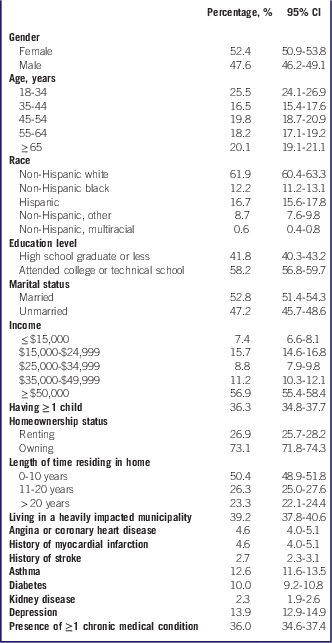
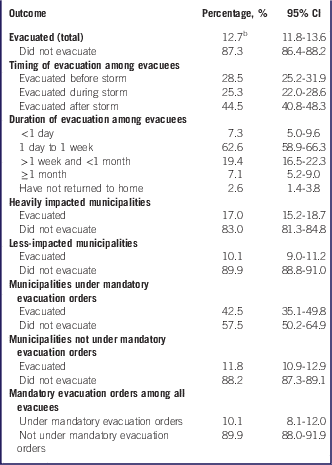
Table 1 displays demographic characteristics of survey respondents. An estimated 39.2% (95% CI: 37.8%-40.6%) of respondents were living in municipalities heavily impacted by the storm. Table 2 describes evacuations as a result of Hurricane Sandy. Across the entire state, 12.7% (95% CI: 11.8%-13.6%) of respondents evacuated their homes. Applying this percentage to the 2014 adult population of New Jersey (6,950,000), approximately 880,000 adults evacuated. Among all evacuees, the greatest proportion, 44.5% (95% CI: 40.8%-48.3%), left their homes after the storm; 28.5% (95% CI: 25.2%-31.9%) and 25.3% (95% CI: 22.0%-28.6%) left before and during the storm, respectively. The majority of all evacuees were away from their homes between 1 day and 1 week (62.6%; 95% CI: 58.9%-66.3%).
Characteristics of 2014 New Jersey Behavioral Risk Factor Survey Respondents Answering Hurricane Sandy Module Questions (n=10,904)Footnote a

a Percentages and confidence intervals are weighted estimates calculated by using standard Behavioral Risk Factor Surveillance System weighting methodology. 21
Characterization of Evacuations Related to Hurricane Sandy in New JerseyFootnote a

a Percentages and confidence intervals are weighted estimates calculated by using standard Behavioral Risk Factor Surveillance System weighting methodology. 21
b Applying this percentage to 2014 US Census Bureau data for the entire New Jersey adult population, which correlates to approximately 880,000 adult evacuees throughout the state.
Demographic characteristics of adults evacuating before, during, and after the storm were similar overall with a few exceptions. Adults who evacuated after the storm more often had a higher education level (65.0% [95% CI: 59.4%-70.6%] attended college or technical school) than that of adults who evacuated before (52.7%, 95% CI: 45.9%-59.5%) and during (52.5%; 95% CI: 44.8%-60.2%) the storm. After-storm evacuees also had higher income (62.5% [95% CI: 56.7%-68.4%] with annual income ≥$50,000) than that of before-storm (50.2%; 95% CI: 42.9%-57.7%) and during-storm (41.7%; 95% CI: 33.7%-49.7%) evacuees. Both during- and after-storm evacuees were more likely to be female (61.9%; [95% CI: 54.7%-69.2%] and 62.6% [95% CI: 56.9%-68.3%], respectively) than before-storm evacuees (52.2%; 95% CI: 45.3%-59.1%). Conversely, before-storm evacuees more often lived in municipalities under mandatory evacuation orders (20.5%; 95% CI: 16.5%-24.4%) than did during-storm (6.4%; 95% CI: 2.6%-10.2%) and after-storm (5.9%; 95% CI: 3.1%-8.7%) evacuees.
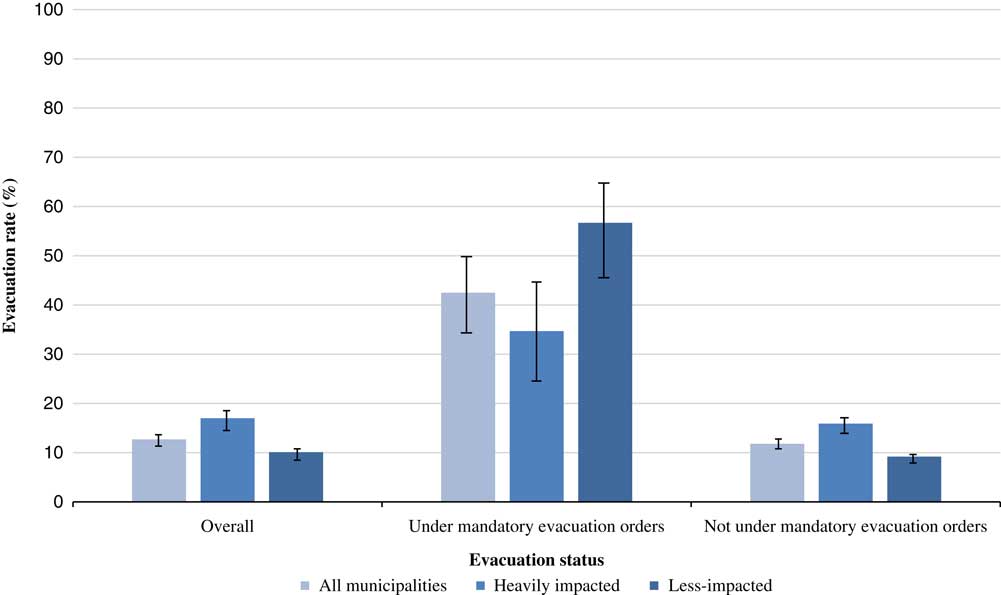
Among adults living in heavily impacted municipalities, 17.0% (95% CI: 15.2%-18.7%) evacuated, whereas 10.1% (95% CI: 9.0%-11.2%) of adults living in less-impacted municipalities evacuated. Among all New Jersey adults, 3.0% (95% CI: 2.6%-3.5%) were living in municipalities that were under mandatory evacuation orders at the time of the storm. Among NJBRFS respondents living in such municipalities, 42.5% (95% CI: 35.1%-49.8%) evacuated, compared with 11.8% (95% CI: 10.9%-12.9%) among adults not under mandatory evacuation orders (Table 2). Overall, 10.1% (95% CI: 8.1%-12.0%) of all evacuees were under mandatory evacuation orders. Figure 1 summarizes evacuation rates stratified by mandatory evacuation status and Hurricane Sandy impact level.
Hurricane Sandy Evacuation Rates in New Jersey by Mandatory Evacuation Status and Storm Impact Level.

Among NJBRFS respondents living in municipalities under mandatory evacuation orders, 64.4% (95% CI: 59.3%-69.6%) were living in municipalities subsequently designated to be heavily impacted; in contrast, 38.3% (95% CI: 36.9%-39.7%) of those living in municipalities not under mandatory evacuation orders were living in municipalities subsequently designated to be heavily impacted (P <0.0001). Among those living in municipalities not under mandatory evacuation orders that were later determined to be heavily impacted, 15.9% (95% CI: 14.1%-17.7%) evacuated (Figure 1).
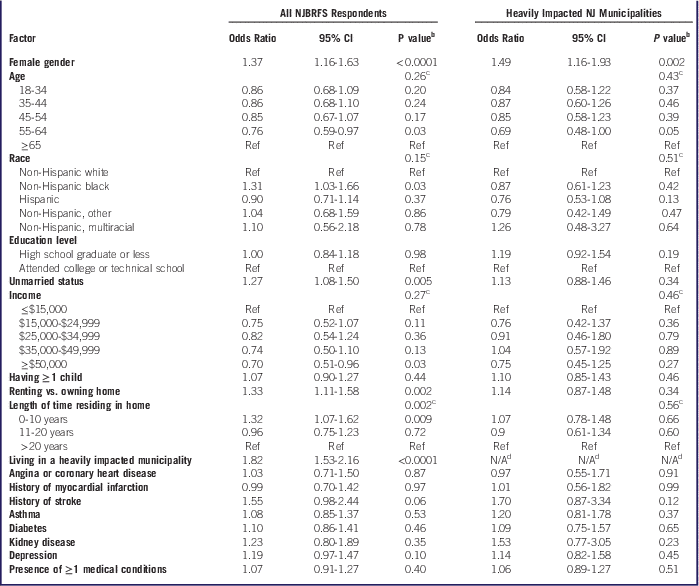
Table 3 displays the results of the univariate analysis of select demographic and health-related factors for their association with the decision to evacuate for all survey respondents and for the subgroup living in heavily impacted municipalities. Female gender, unmarried status, renting as compared to owning a home, residing in the home for 0 to 10 years as compared to >20 years, and residence in a heavily impacted municipality as compared to a less-impacted municipality were factors significantly associated with evacuation among all respondents. Of these factors, the strongest predictor of evacuation for the entire population was residence in a heavily impacted municipality (OR: 1.82; 95% CI: 1.53-2.16). Among the subpopulation of adults living in a heavily impacted municipality specifically, the only demographic or health-related factor significantly associated with the decision to evacuate was female gender (OR: 1.49; 95% CI: 1.16-1.93).
Univariate Analysis of Select Demographic and Health-Related Factors for Association with Hurricane Sandy Evacuation in New JerseyFootnote a

a Abbreviation: NJBRFS, New Jersey Behavioral Risk Factor Survey.
b P values ≤0.25 were incorporated into the initial multivariable model.
c Overall P value for variable.
d Not applicable because population restricted to those living in heavily impacted municipalities.
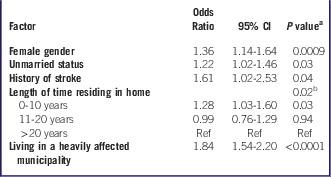
In a multivariable logistic regression model for the entire population, 5 factors were identified as significantly associated with the decision to evacuate in the final model, including female gender (OR: 1.36; 95% CI: 1.14-1.64), unmarried status (OR: 1.22; 95% CI: 1.02-1.46), residence in the home for 0 to 10 years (OR: 1.28; 95% CI: 1.03-1.60), and residence in a heavily impacted municipality (OR: 1.85; 95% CI: 1.55-2.20) (Table 4). Among the chronic disease conditions examined, only history of stroke was associated with evacuation (OR: 1.61; 95% CI: 1.02-2.53). In the multivariable logistic regression model for the subpopulation of adults living in heavily impacted municipalities specifically, only female gender remained significant in the final model (with the same OR and 95% CI as the univariate analysis).
Multivariable Analysis of Demographic and Health-Related Factors for Association with Hurricane Sandy Evacuation Among Entire New Jersey Behavioral Risk Factor Survey Population

a The final multivariable model shown here included only variables with P values ≤0.05 after backward selection. Wald 95% confidence intervals are presented.
b Overall P value for variable.
DISCUSSION
This analysis reports that approximately 13% of the New Jersey adult population (approximately 880,000 persons) evacuated their homes because of Hurricane Sandy according to the 2014 NJBRFS. For comparison, based upon previous evacuation reports and historical census data, approximately 9% of the total population evacuated from Florida, Georgia, South Carolina, and North Carolina when Hurricane Floyd struck the East Coast in 1999; approximately 12% of the total population from Louisiana, Mississippi, and Alabama evacuated during Hurricane Katrina in 2005; and approximately 7% of the total population from Texas and Louisiana evacuated for Hurricane Rita in 2005. 25 - 29
We determined that the greatest proportion of adults who evacuated did so after the storm. Evacuees were most commonly away from their homes between 1 day and 1 week, indicating that the majority of adults were displaced for a relatively limited period, a duration that resembled the 1988 Hurricane Gilbert evacuation in Cancun, Mexico.Reference Aguirre 30 Adults with a higher education level and income were more likely to evacuate after the storm than earlier. This is perplexing, as one might have expected that adults with a higher socioeconomic status would have had the ability to access alternative living arrangements before the storm. A complex analysis that includes subject-level factors such as risk perception and personal resilience is likely needed to understand this phenomenon; unfortunately, such data were not available in this study.
As might be expected, a higher proportion of residents living in heavily impacted municipalities evacuated, compared with residents living in less-impacted municipalities. A separate, more limited survey of New Jersey residents regarding their experiences related to Hurricane Sandy reported similar higher evacuation rates among shore-community residents.Reference Burger and Gochfeld 31
Only 3% of New Jersey adults were under mandatory evacuation orders at the time Hurricane Sandy struck; we estimate that 43% of these adults evacuated. Two prior surveys of New Jersey residents after Hurricane Sandy have also reported compliance rates with mandatory evacuation orders.Reference Abramson, Van Alst and Merdjanoff 32 , 33 One study estimated that one-third of survey respondents under mandatory evacuation orders complied with such orders, whereas the other study reported a 60% compliance rate. The survey did not specifically ask why people chose to evacuate versus stay at home; therefore, the motivations for specific actions cannot be assessed. It is possible that some people under mandatory evacuation orders were not aware of the evacuation status of their particular jurisdiction, as discussed below.
Among the 97% of residents living in municipalities not under mandatory evacuation orders, approximately 12% reported evacuating. The phenomenon of persons not in a mandatory evacuation zone evacuating has been discussed in other studies of disaster-related evacuation.Reference Perry 14 , Reference Fairchild, Colgrove and Jones 34 - Reference Sorensen and Mileti 36 A detailed description of evacuation behavior after Hurricane Rita in Texas, which included this phenomenon, was reported by Stein et al.Reference Stein, Dueñas-Osorio and Subramanian 37 In that study, 47% of respondents who resided outside the mandatory evacuation zone reported evacuating. One possible reason persons not residing in an area under mandatory evacuation might evacuate is a heightened perception of risk associated with natural disasters specifically or of risk generally. Another possibility is that persons were simply unaware whether they resided in an area under mandatory evacuation. In the Hurricane Rita study, fewer than 50% of persons surveyed were aware of their neighborhood’s evacuation status.
Among residents living in municipalities under mandatory evacuation orders, a significantly higher proportion, 64%, were living in municipalities subsequently designated as heavily impacted, compared with residents living in municipalities not under mandatory evacuation orders, among whom only 38% were living in municipalities subsequently designated as heavily impacted. However, among this specific group, namely, those who were living in municipalities not under mandatory evacuation orders but which were subsequently found to be heavily impacted, 16% evacuated, indicating that they likely had compelling reasons to evacuate even though they were not living in a mandatory evacuation zone.
Among the entire population, multiple factors were significantly associated with the decision to evacuate, including gender, marital status, homeownership status, shorter length of time residing in the home, and residence in a heavily impacted municipality. However, among adults living in heavily impacted municipalities specifically, only gender was significantly associated with evacuation. A potential explanation for this is that in heavily impacted municipalities, those factors that might have caused some adults to remain at home were overridden by safety concerns; these safety concerns might have prompted a higher percentage of adults in heavily impacted municipalities to evacuate, thus eliminating associations between presence or absence of certain factors and evacuation. Of note, age, race/ethnicity, and income were not found to be associated with evacuation.
Multivariable logistic regression analysis for the entire population demonstrated that female gender, unmarried status, length of time residing in the home, and living in a heavily impacted municipality were significantly associated with the decision to evacuate. Among the chronic disease conditions examined, history of stroke was also associated with evacuation. Adults who had lived in their homes for a longer duration (>20 years) might have felt greater attachment to their residence or had more at stake financially, and therefore were less likely to evacuate. Regarding the finding that adults with a history of stroke were more likely to evacuate, a possible explanation is that such adults were concerned about mobility during and after the storm and were thus inclined to evacuate to a safer location.
This analysis was subject to certain limitations. First, the survey was conducted during 2014, more than 1 year after Hurricane Sandy made landfall in October 2012; therefore, the results are subject to recall bias. Next, BRFSS is a survey of noninstitutionalized adults; thus, children and certain groups of adults, including those in nursing homes and residential facilities, are excluded from the survey, and results cannot be extrapolated to these groups. Also, because the survey did not ask respondents for specific reasons why people did or did not evacuate, the precise motivating factors in decision-making, particularly why a person might have evacuated before, during, or after the storm, cannot be described. Additionally, in the regression analyses, all evacuations were considered to be one outcome regardless of the timing of evacuation; differences in demographic and health factors associated with evacuation at specific time points were not analyzed.
Importantly, this survey did not specifically ask respondents whether they were living in the same location in New Jersey at the time of Hurricane Sandy as they were at the time of survey administration; therefore, the possibility exists that certain respondents might have been living in a different municipality at the time of Hurricane Sandy than that used for analysis in this study. Of note, respondents who were not living in New Jersey at the time of Hurricane Sandy would not have been asked the Sandy module questions and were excluded from analysis.
Finally, this study was focused on residents in the state of New Jersey. It is difficult to know how well the findings from this work would translate to other states and jurisdictions with different topographies and where severe hurricanes have a history of making landfall on a more frequent basis.
This study highlights the fact that evacuations in response to hurricanes can involve hundreds of thousands of people and identifies factors likely to be associated with evacuation. Understanding evacuation behavior can allow emergency management partners to conduct targeted or specific messaging campaigns to its residents and can aid these agencies in efficient and orderly management of the evacuation process. Targeted messaging could occur, for example, through use of social media or other venues. Estimating evacuation volume and timing based on prior experience could aid with logistical planning for traffic, shelter preparation, and other aspects of evacuation.
CONCLUSIONS
We estimate that nearly 1 million New Jersey residents evacuated their homes as a result of Hurricane Sandy in 2012; the largest number of adults evacuated after the storm, and most evacuees were away from their home for only a short time, 1 day to 1 week. Adults living in municipalities under mandatory evacuation orders evacuated at a higher rate. However, the majority of New Jersey residents who evacuated were not living in municipalities under mandatory evacuation orders, and approximately 90% of evacuees were living outside the mandatory evacuation zone at the time they evacuated, indicating that such evacuations were an important Hurricane Sandy-related phenomenon in New Jersey. This study also reported that certain demographic factors were associated with the decision to evacuate. This information can be used in preparing for future natural disasters that require large-scale evacuation. It can also be used to help direct future research into the subject of disaster evacuation.
Acknowledgments
The authors thank Dr Kenneth O’Dowd for help in designing the Sandy module, coordination of survey administration, and methodological assistance; Drs Michael Gronostaj and Barbara Montana and Ms Teresa Hamby for their review of this manuscript; and Dr Donna Brogan for methodological assistance.
Funding
This study was supported in part by the Centers for Disease Control and Prevention Public Health Preparedness and Response Research to Aid Recovery from Hurricane Sandy grant (# CDC RFA-TP-13-001).
Disclaimer
The findings and conclusions in this report are those of the authors and do not necessarily represent the official position of the Centers for Disease Control and Prevention.