





Impact statement
In the context of the now extensive epidemiological literature describing the prevalence of late life depression and comorbid non-communicable diseases (NCDs) among older adults in low-resource settings in the Global South, the Ziba Ufa pilot study is a novel attempt to develop a psychological intervention to address these issues. The impact of this intervention on the health and well-being of older adults may be significant.
The findings from this pilot study have an impact on the design and analyses of future implementation research in this area. Designing and testing interventions that address complexity and comorbidity in older adults must consist of culturally appropriate content, relevant to the population. Although there are multiple recent systematic reviews addressing the policies, health system interventions, models of care, guideline availability, adherence and implementation of NCD prevention and management in Africa, the lifestyle recommendations themselves are still based on Western, Educated, Industrialised, Rich and Democratic (WEIRD) (Henrich et al., Reference Henrich, Heine and Norenzayan2010) populations. The relevance and applicability of lifestyle advice to African populations reflecting their food systems, economic realities, social norms and everyday living conditions remains a notable gap in the literature. The impact of using relevance as a starting point to drive the optimisation of intervention development will lead to actionable advice and acknowledgement of protective behaviours.
This study also has an impact on the approach to qualitative analysis in this field; using participants’ feedback about the perceived relevance of lifestyle advice ensures the inclusion of older adults’ experiences in intervention development, and goes beyond pre- and post-intervention biomedical markers of disease control or symptom improvement.
Introduction
Approximately 77% of global deaths from NCDs take place in low-middle-income countries (LMICs), three-quarters of which take place after the age of 60 years and before the age of 70 (Arokiasamy et al., Reference Arokiasamy, Uttamacharya, Jain, Biritwum, Yawson, Wu, Guo, Maximova, Espinoza, Salinas Rodríguez, Afshar, Pati, Ice, Banerjee, Liebert, Snodgrass, Naidoo, Chatterji and Kowal2015). The effects of globalisation in sub-Saharan Africa (SSA) have led to an increase in life expectancy, urbanisation and shifts in sociocultural factors, which have increased the frequency of risk factors for NCDs in older adults (Miranda et al., Reference Miranda, Kinra, Casas, Davey Smith and Ebrahim2008). In Tanzania, NCDs have increased significantly, accounting for 33% of mortality in the country (Kagaruki et al., Reference Kagaruki, Karoli, Rutahoile, Chillo, Mutagaywa, Banduka, Majaliwa, Nyarubamba, Mtumbuka, Mallya, Mutalemwa, Bazzanin, Soka, Agnes, Urasa, Magoma, Kazingo, Ammi, Donald, Mwenesano, Kilonzo, Mori, Ramaiya and Mary2025), and there are crucial weaknesses in outpatient services for NCDs, with facilities, guidelines, equipment and drug supplies often inadequate, and management, training and reporting systems weak (Peck et al., Reference Peck, Mghamba, Vanobberghen, Kavishe, Rugarabamu, Smeeth, Hayes, Grosskurth and Kapiga2014).
The burden of NCDs is mainly attributable to modifiable behavioural risk factors, including tobacco use, unhealthy diet, physical inactivity and harmful use of alcohol; therefore, many NCDs are preventable (World Health Organization, 2013). These risk factors are exacerbated by poor mental health; older adults with depression have a higher risk of developing NCDs and NCDs are a risk factor for depression. Due to a rapidly ageing population in SSA, the burden of NCDs and depression is therefore an increasing public health issue (Global Burden of Disease Collaborative Network, 2020). However, a systematic policy review of diet and physical activity for prevention of NCDs in LMICs found that only 14 (12%) out of 116 countries proposed a policy that addressed fat and salt consumption, fruit and vegetable intake and physical activity, and 29 (25%) out of 116 countries had a policy that addressed only one of these risk factors (Ndubuisi, Reference Ndubuisi2021).
NCD education and behavioural change techniques are almost all based on clinical guidance developed for WEIRD populations in high-income countries (Nadal et al., Reference Nadal, Angkurawaranon, Singh, Choksomngam, Sadana, Kock, Wattanapisit, Wiwatkunupakarn and Kinra2024), and may lack relevance and transferability to some non-WEIRD populations in LMICs (Negussie et al., Reference Negussie, Addissie, Work and Girma2023). Relevance is whether an intervention, body of evidence or recommendation, is applicable or meaningful to a particular population or context (Green and Glasgow, Reference Green and Glasgow2006). Although there is consensus that healthy lifestyle recommendations for NCDs are biologically universal; the same behaviours (poor diet, physical inactivity and smoking/drinking) are NCD risk factors for any global population, there is emerging evidence that interventions need substantial cultural modification despite relying on similar biological principles (Gurven and Lieberman, Reference Gurven and Lieberman2020). If your daily sugar consumption is only from sugar added to tea, rather than desserts and processed food, and if your entire life depends on manual labour, including not even sitting down to go to the bathroom, then is generic advice to reduce sugar from your diet and increase physical activity relevant to you? Lifestyle recommendations from HICs often fail at NCD prevention in LMICs because they ignore rapid urbanisation, informal employment, food insecurity and environmental constraints (Miranda et al., Reference Miranda, Barrientos-Gutiérrez, Corvalan, Hyder, Lazo-Porras, Oni and Wells2019).
Relevance of recommendations to a population is needed to develop appropriate interventions, which fit the routines, beliefs and practices of a particular group (Proctor et al., Reference Proctor, Silmere, Raghavan, Hovmand, Aarons, Bunger, Griffey and Hensley2011). An intervention might be relevant (a high proportion of a community smokes) but not appropriate (a cessation program is conducted in a visible location in the centre of the village), or not relevant (smoking rates are low) but the intervention is appropriate (uses peer support).
Interventions for non-communicable diseases are increasingly implemented and evaluated in sub-Saharan Africa (Katende et al., Reference Katende, Nalweyiso, Nabulime, Nakuya, Mubiru, Sekitoleko, Baisley, Nyirenda and Grosskurth2023). However, in Tanzania, there is a paucity of literature on interventions for NCD management, especially those designed for older adults at risk with comorbid conditions such as depression. Tanzanian studies have shown that interventions should increase NCD knowledge and also consider the socio-economic determinants driving prevalence (Kagaruki et al., Reference Kagaruki, Karoli, Rutahoile, Chillo, Mutagaywa, Banduka, Majaliwa, Nyarubamba, Mtumbuka, Mallya, Mutalemwa, Bazzanin, Soka, Agnes, Urasa, Magoma, Kazingo, Ammi, Donald, Mwenesano, Kilonzo, Mori, Ramaiya and Mary2025).
A systematic review of 10 RCTs of diabetes education programs in high-income countries (HICs), including a minority ethnic group, found that culturally appropriate education was more effective than usual education in improving HBA1c measures and knowledge in the short term, but that the ‘dose’ of education or degree of reinforcement needed is not yet clearly defined (Hawthorne et al., Reference Hawthorne, Robles, Cannings-John and Edwards2010). It is unclear what the dose of health education and the relevance of specific areas of healthy lifestyle advice is important to consider for older adults in Tanzania in wealthier regions that have been exposed to more urbanisation and education, such as the Kilimanjaro region in the north-eastern part of the country.
The Ziba Ufa (‘Repair the Crack’) intervention is a hybrid model of problem-solving therapy (PST) and healthy lifestyle advice to improve the self-management of depression and NCDs, originally developed in India by Dias et al. (Reference Dias, Azariah, Anderson, Sequeira, Cohen, Morse, Cuijpers, Patel and Reynolds2019). Through a consultation phase with local clinicians and academics, the healthy lifestyle advice was modified at face value to match the ethnicity and cultural context of life in Tanzania, and is presented in the form of a pictorial flipchart. A pilot study to assess the acceptability and feasibility of the adapted Ziba Ufa intervention was conducted and is published elsewhere (Walker et al., Reference Walker, Robinson, Mhando, Paddick, Boshe, McAllister-Williams, Eliamini, Sakanda and Walker2025). This study is novel because it is the first known attempt to develop a psychosocial intervention specifically for older adults (aged 60 years and above), with depression and NCDs. In Tanzania, due to the very major treatment gap for late life depression (Mlaki et al., Reference Mlaki, Asmal, Paddick, Gray, Dotchin and Walker2021), and incomplete services for the management of NCDs in primary and secondary care (Tani et al., Reference Tani, Osetinsky, Mhalu, Mtenga, Fink and Tediosi2024), this study seeks to address this gap.
The purpose of the current study was an exploratory analysis of the relevance of the Ziba Ufa healthy lifestyle advice for a small group of Tanzanian older adults with NCDs and depression.
We asked two research questions:
-
1. Is the healthy lifestyle advice in Ziba Ufa clinically relevant to the behavioural risk factors for NCDs in this sample of Tanzanian older adults?
-
2. Is the healthy lifestyle advice in Ziba Ufa perceived as relevant by participants, and considered worth acting upon?
Clinical relevance is the extent to which the advice addresses the participant’s identified health risks or needs, and this can be measured by conducting a local needs assessment. Personal or perceived relevance is the extent to which participants consider the advice meaningful and worth acting upon, and this can be measured by either whether it aligns with stakeholder priorities, or if it receives at least 75% agreement from key stakeholders that it addresses an important unmet need (Green and Glasgow, Reference Green and Glasgow2006). We describe possible clinical relevance using baseline needs assessment data of self-reported NCDs and behavioural risk factors, and possible perceived relevance using qualitative feedback from participants post-intervention. This intervention could be used in a full-scale trial to test a hypothesis that relevant advice is needed to develop an appropriate intervention, which is more likely to be adopted by participants.
Methods
Design
A single-group pilot study was conducted to investigate the relevance of the healthy lifestyle advice to this small sample of Tanzanian older adults, delivered as part of the Ziba Ufa intervention. Quantitative survey data were collected at baseline to address research question 1, and qualitative data were collected post-intervention to address research question 2.
Setting
The Ziba Ufa pilot study was conducted in four clinical sites in the Kilimanjaro region of Tanzania: one rural primary care, two secondary care (a rural district and urban regional referral hospital) and one tertiary care hospital: Kilimanjaro Christian Medical Centre (KCMC) in Moshi. Tanzanian patients commonly receive their routine care for hypertension and diabetes in secondary or tertiary care settings due to primary care services often being under-resourced (Chimhutu et al., Reference Chimhutu, Tjomsland and Mrisho2019) and are typically seen by clinical officers. Adults over 60 years can receive free healthcare if they are registered for the state insurance card.
Participant identification
We undertook opportunistic sampling of adults aged ≥60 years attending the outpatient clinic for routine physical NCD care. It was not an inclusion criterion to have an NCD on the basis that some presenting conditions may be chronic but not World Health Organisation (WHO) defined NCDs such as ulcers or arthritis, or communicable diseases like tuberculosis and HIV. Although this sampling approach led to selection bias towards individuals already engaged in services, this was chosen to allow the potential for a sustainable scale-up of the screening and intervention in the future, by embedding recruitment in routine care.
Those who provided informed consent were screened for depression symptoms using the Mini International Neuropsychiatric Interview (MINI) 7.0 (Sheehan, Reference Sheehan2014) and the Maddison Old Age Scale for Identifying Depression (MOSHI-D) (Howarth-Maddison et al., Reference Howarth-Maddison, Gamassa, Safic, Andrea, Urasa, Walker, Gray, Haule, Dotchin and Paddick2020); full details on screening procedures are published elsewhere (Walker et al., Reference Walker, Robinson, Mhando, Paddick, Boshe, McAllister-Williams, Eliamini, Sakanda and Walker2025). Table 1 shows the inclusion and exclusion criteria.
Inclusion and exclusion criteria for the Ziba Ufa pilot study

Table 1. Long description
The table is divided into two main columns.
Inclusion criteria column:
1. Mild to moderate depression (3 to 8) on the M O S H I dash D, a locally validated late life depression screening questionnaire.
2. Physical, cognitive and behavioural ability to travel to clinic and take part in the intervention.
3. Participation would not interfere with routine medical care.
Exclusion criteria column:
1. Acute medical illness such as infection.
2. Severe frailty defined as inability to walk.
3. Screen positive (less than or equal to 7) for dementia on the I D E A 6 Item, a locally validated dementia screening questionnaire.
4. Suicidal ideation on the M I N I 7 dot 0.
5. On antidepressant medication.
6. Severe sensory impairment that would impair participation.
The target sample size of 32 participants was based on the recommendation by Browne for designing pilot study sample sizes with a minimum of N = 30 (Browne, Reference Browne1995). Once it was decided to have four study sites, a total of 30 participants divided by four sites resulted in 7.5 clients per site/counsellor, so this was rounded up to eight (8 × 4 = 32).
Training of counsellors
Four Ziba Ufa counsellors were recruited, one in each of the four study sites, all employed as healthcare workers (three nurses and one junior doctor; all female). They completed Ziba Ufa training over 2 months in person and were supervised by LM. They were reimbursed a small wage for their role.
Measures
World Health Organisation STEPwise approach to NCD risk factor surveillance (WHOSTEPs)
The WHOSTEPs is a standardised method for collecting, analysing and disseminating data on key NCD risk factors globally, originally developed in 2002 (WHO, 2002) and modified extensively since (Riley et al., Reference Riley, Guthold, Cowan, Savin, Bhatti, Armstrong and Bonita2016). The survey uses a range of self-response formats and covers history of disease and key behavioural risk factors, including tobacco use, alcohol use, exercise and diet, as well as key biological risk factors, including overweight or obese, raised blood pressure and raised blood glucose. It also obtains information surrounding the time of diagnosis as well as whether the patient had seen a traditional healer or taken herbal remedies for their NCD. These sections had been previously translated into Kiswahili for use in a national NCD surveillance study in Zanzibar, and were kindly shared by the author (Jorgensen et al., Reference Jorgensen, Hedt, Omar and Davies2020).
Height and weight data were obtained through examination of recent data (within 3 months) in the health booklets in which participants record their health measurements, and the BMI was calculated according to these data. No other biomarker data were collected from participants, either from their records or new samples.
Study intervention
Ziba Ufa consists of 6 weekly sessions of PST and health education delivered in routine healthcare clinics for NCDs by current healthcare workers trained as counsellors. There was one counsellor per site, and all four counsellors attended the same training together, and then received further training and weekly supervision from the clinical psychologist (LM) at Kilimanjaro Christian Medical University College (KCMUCo). During this training, a set of Session Checklists were developed for items to be delivered at each session of PST, in order to standardise the delivery of the intervention. However, no fidelity assessment was undertaken due to participants and counsellors declining recorded observation of sessions.
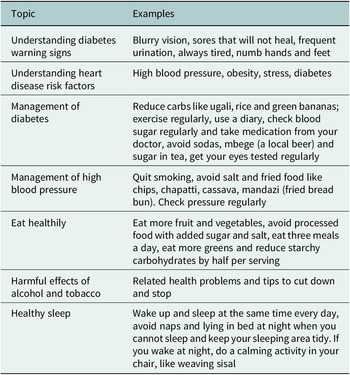
The Ziba Ufa intervention materials consist of the Ziba Ufa Counselling Manual, used to train and guide the counsellors, and the Ziba Ufa Flipchart, a pictorial resource to teach healthy lifestyle advice for NCDs and stress management techniques. The illustrations used in the Flipchart show Tanzanian elders, cultural scenes and food, such as ugali, a commonly eaten carbohydrate in Tanzania. Both were translated and printed in Kiswahili. The healthy lifestyle advice for hypertension and diabetes consisted of the sections shown in Table 2, with features that were made specific to Tanzanian settings highlighted in italics. For further detail on the Ziba Ufa intervention, please see Walker et al. (Reference Walker, Robinson, Mhando, Paddick, Boshe, McAllister-Williams, Eliamini, Sakanda and Walker2025).
Healthy lifestyle advice in the Ziba Ufa Flipchart

Table 2. Long description
The table consists of two columns: Topic and Examples.
* Row 1: Topic is Understanding diabetes warning signs. Examples include blurry vision, sores that will not heal, frequent urination, always tired, and numb hands and feet.
* Row 2: Topic is Understanding heart disease risk factors. Examples include high blood pressure, obesity, stress, and diabetes.
* Row 3: Topic is Management of diabetes. Examples include reducing carbs like ugali, rice, and green bananas; regular exercise; using a diary; checking blood sugar; taking medication; avoiding sodas, mbege (local beer), and sugar in tea; and regular eye tests.
* Row 4: Topic is Management of high blood pressure. Examples include quitting smoking; avoiding salt and fried foods like chips, chapatti, cassava, and mandazi; and regular pressure checks.
* Row 5: Topic is Eat healthily. Examples include eating more fruit and vegetables, avoiding processed food with added sugar and salt, eating three meals a day, and reducing starchy carbohydrates by half.
* Row 6: Topic is Harmful effects of alcohol and tobacco. Examples include related health problems and tips to cut down and stop.
* Row 7: Topic is Healthy sleep. Examples include consistent sleep schedules, avoiding naps, keeping the sleeping area tidy, and doing calming activities like weaving sisal if awake at night.
Post-intervention follow-up interviews
A short, contextually relevant interview topic guide was developed and iteratively reviewed by the study team to ask participants about taking part in the Ziba Ufa intervention. Participants were asked whether they had undertaken any of the lifestyle advice and made any changes in their diet, exercise and sleep habits. Interviews with participants were conducted by the lead research assistants, who had prior research experience conducting interviews. They received additional training in conducting exit interviews for retrospective intervention evaluation through role plays. Participants were assured that their data were confidential and not reported back to their counsellor.
Study procedures
At each site, eight eligible participants were recruited and asked to complete the WHOSTEPs survey on NCD surveillance. They were then allocated to the counsellor at their study site and received 6 weekly sessions of Ziba Ufa at their routine healthcare clinic. Participants were given travel money for each session. Within 1 month after completion of the intervention, participants were asked to complete a follow-up interview in clinic.
Data analysis
-
1. Descriptive statistics were used to present data on socio-demographic and WHOSTEPs survey data.
-
2. Relevance of the healthy lifestyle advice to the study participants was determined based on the prevalence of WHOSTEPs risk factors, but no specific thresholds were used due to none existing in the literature. The research team, PI and Co-I’s, including Tanzanian clinicians, then conducted a discussion of these findings using contextualised knowledge of social, medical and cultural factors in Tanzania to make context-dependent judgements about the clinical relevance of the risk factors. These exploratory analyses are context-dependent judgements as there is no fixed epidemiological threshold for relevance; they will therefore indicate preliminary relevance that would need to be established in a much bigger sample.
-
3. A frequency count analysis of the exit interviews was used in order to indicate whether participants were acting upon the main areas of the healthy lifestyle advice (Diet, Exercise and Sleep). Transcripts were analysed by counting the occurrences of when participants said they made a lifestyle change (‘Actions’) and the times when they said what they had been advised to do (‘Words’). These occurrences are then summarised as a frequency distribution across each area, which is visualised in Figure 1. A discussion of these findings was conducted with the counsellors and research team about whether this was a useful indicator of perceived relevance of the advice relative to the clinical need of the participant.
Lifestyle advice on diet, exercise and sleep.

Figure 1. Long description
The infographic features a header with the word ACTIONS on the left in green and WORDS on the right in green, separated by a small V in a circle. It is divided into three horizontal sections.
* Diet section: The center label is Diet. On the left under Actions, there are 6 apple icons and a quote about eating small portions of rice or ugali with vegetables and fruits. On the right under Words, there are 10 apple icons and a quote about being advised to stop eating salty food and avoid too much oil.
* Exercise section: The center label is Exercise. On the left under Actions, there are 4 icons of people running and a quote about stretching ten times and massaging legs with oil to reduce pain. On the right under Words, there are 5 icons of people running and a quote about being told to do small activities like fetching water.
* Sleep section: The center label is Sleep. On the left under Actions, there are 11 Z z icons and a quote about sleeping at 9 p m and waking at 6 a m to feel less tired. On the right under Words, there are 2 Z z icons and a quote about being told to sleep at noon due to problems falling asleep.
Recordings of the interviews were transcribed verbatim by the research assistants and anonymised to maintain confidentiality. Translation into English was carried out by two independent forward translators fluent in English and Kiswahili. They compared their versions to identify discrepancies, use of ambiguous or vague wording and accuracy. A final version of the transcript in English was developed with the original translators by a research staff member (WE) fluent in English and Kiswahili languages, and then back-translated. This analysis was led by SW but discussed and reviewed with the local clinical experts.
Statistical methods
Statistical analysis was conducted using Microsoft Excel 2010 and IBM SPSS Statistics version 28.0.0.0 (190).
Missing data analysis
Missing Value Analysis showed that for demographic variables, missing data ranged from 0 to 20%. Little’s Missing Completely At Random (MCAR) test was not significant (p = 1.000), indicating that the data were missing completely at random. For the categorical variables, the missing data proportions ranged between 5.7% and 54%. Missing value analysis showed that for BMI, height and weight, data were missing for 11 participants (34%), and 36% overall on the WHOSTEPs. Data patterns showed extensive missing data on the WHOSTEPs physical activity variable, with >80% missing, which may have been due to difficulty of use and lack of clarity on how to classify exercise types, according to the research assistants. Based on the advice by Bennett, multiple imputation methods should be used where more than 10% of cases contain missing data and under the assumption that these missing values are Missing at Random (MAR), because this can lead to bias in the statistical results (Bennett, Reference Bennett2001). Some of the missing data relating to the NCD questions (coded as Not Known) can be classified under the missing data mechanism Missing Not at Random (MNAR) (Little, Reference Little and Rubin2019); it may be that depressed patients struggling with management of NCDs were less likely to know key details about their NCD status (such as blood glucose). On the other hand, respondents’ scores may be biased towards better scores than true scores in the general population. These data were not replaced, and pairwise deletion was used for analyses involving this variable.
Results
A total of 157 attendees across the four NCD clinics were screened, 32 were enrolled in the Ziba Ufa pilot study and 24 completed a follow-up interview. The mean age of those enrolled was 66.73 years (SD = 5.93), and 20 (63%) of the sample were female. Twenty (63%) were educated to the secondary level, 16 (50%) were married, 12 (38%) were widowed and 28 (88%) were literate and from urban areas. All participants had —mild-to-moderate depression symptoms, as measured by the MOSHI-D. Further demographic details on the sample and enrolment rates are available in Walker et al. (Reference Walker, Robinson, Mhando, Paddick, Boshe, McAllister-Williams, Eliamini, Sakanda and Walker2025).
Based on self-report responses to the WHOSTEPs questions on NCD disease history, all 32 participants had an NCD. Table 3 shows a summary of the disease history, management and lifestyle advice previously received by participants.
WHOSTEPs baseline data on hypertension and type 2 diabetes disease history, management and lifestyle advice received (total sample N = 32)

Table 3. Long description
The table is organized into five main sections.
1. Ever tested: For hypertension, 88 percent (28) said yes and 6 percent (2) said no, with a mean B P reading of 146 forward slash 85 and an I Q R of 140 forward slash 80. For type 2 diabetes, 50 percent (16) said yes and 44 percent (14) said no, with a mean F B G reading of 11.6 and an I Q R of 11.1.
2. Diagnosis: 88 percent (28) were diagnosed with hypertension and 44 percent (14) with type 2 diabetes. 34 percent (11) had both. Over half of each group (54 percent for hypertension and 57 percent for diabetes) were diagnosed in the last 12 months.
3. Comorbid conditions: 100 percent (32) have depression. Communicable diseases include H I V (2) and Tuberculosis (1). Other physical illnesses include ulcers (1) and arthritis (1).
4. Treatment: 22 percent (7) were prescribed one hypertension medication and 41 percent (13) were prescribed more than one. For diabetes, 16 percent (5) were prescribed one medication, 22 percent (7) more than one, and 9 percent (3) were prescribed insulin. 75 percent of the hypertension group and 87 percent of the diabetes group had taken medication in the last 2 weeks. Traditional healers were seen by 34 percent (hypertension) and 22 percent (diabetes).
5. Previous lifestyle advice: Dietary advice was received by 63 percent (hypertension) and 47 percent (diabetes). Weight loss advice by 41 percent and 31 percent. Smoking cessation advice by 38 percent and 25 percent. Exercise advice by 56 percent and 47 percent.
BP, blood pressure; FBG, fasting blood glucose; IQR, interquartile range.
It was unclear whether any of the healthy lifestyle advice they had already received from healthcare services had been adopted and whether it contributed towards their current behaviour.
-
1. Is the healthy lifestyle advice in Ziba Ufa clinically relevant to the behavioural risk factors for NCDs in this sample of Tanzanian older adults?
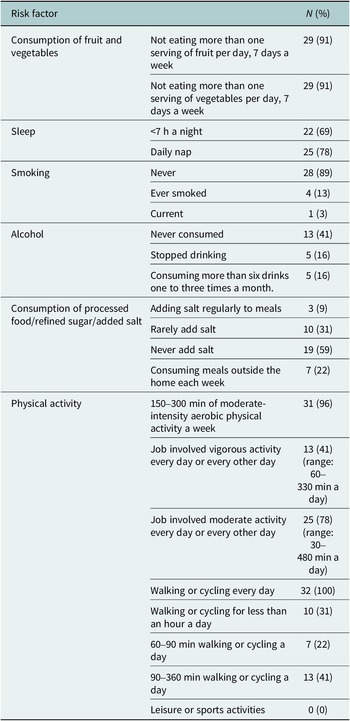
Height and weight data were available for 21 participants, of whom 12 (57%) had a BMI in the obese category (>30); therefore, advice to lose weight was considered appropriate. The findings from the WHOSTEPs survey are presented in Table 4, showing the number of participants who self-reported engaging (or not engaging) in that behavioural risk factor.
WHOSTEPs data on baseline modifiable risk factors for NCDs in the Ziba Ufa pilot study sample (N = 32)

Table 4. Long description
The table consists of three columns: Risk factor, specific sub-category, and N (percentage).
* Consumption of fruit and vegetables: 29 (91 percent) do not eat more than one serving of fruit per day, and 29 (91 percent) do not eat more than one serving of vegetables per day.
* Sleep: 22 (69 percent) get less than 7 hours a night, while 25 (78 percent) take a daily nap.
* Smoking: 28 (89 percent) never smoked, 4 (13 percent) have ever smoked, and 1 (3 percent) is a current smoker.
* Alcohol: 13 (41 percent) never consumed, 5 (16 percent) stopped drinking, and 5 (16 percent) consume more than six drinks one to three times a month.
* Consumption of processed food, refined sugar, or added salt: 3 (9 percent) add salt regularly, 10 (31 percent) rarely add salt, 19 (59 percent) never add salt, and 7 (22 percent) consume meals outside the home each week.
* Physical activity: 31 (96 percent) perform 150 to 300 minutes of moderate-intensity aerobic activity weekly. 13 (41 percent) have jobs with vigorous activity (60 to 330 minutes a day), and 25 (78 percent) have jobs with moderate activity (30 to 480 minutes a day). 32 (100 percent) walk or cycle every day, with durations ranging from less than an hour (31 percent) to 90 to 360 minutes (41 percent). 0 (0 percent) engage in leisure or sports activities.
Of the participants who reported consuming meals outside the home each week, they explained this was either rice and beans, or occasionally a fried snack (fried bun or samosa) from a ‘mama kona’, a lady selling home-cooked hot food on a street corner. Some responses provided conflicting answers: only one participant reported doing any activity that made them short of breath, despite 40% saying they did vigorous activity every day.
The study team’s context-dependent judgement and discussion of these findings agreed by consensus that advice in the Ziba Ufa health education to lose weight, increase fruit and vegetable consumption and ways to improve sleep hygiene for better sleep quantity and quality were relevant to this study sample. However, advice to stop smoking and drinking (light to moderate drinking, not binge drinking), to avoid processed food with refined sugar and added salt and to do more physical activity, including sports or exercise for leisure, were less relevant to this study sample.
Approximately half of participants had been recently diagnosed in the last 12 months, which may explain why they were engaged in healthcare services.
-
2. Is the healthy lifestyle advice in Ziba Ufa perceived as relevant by participants, and considered worth acting upon?
The count analysis of the qualitative feedback from post-intervention interviews with participants (N = 24) is shown in Figure 1. Each individual icon represents a ‘count’; a time in an interview where a participant referred to either an Action or Words relating to sleep, diet or exercise. A quote that was broadly representative of all the counts in each section was chosen to illustrate the qualitative content. Each icon in each section represents a different participant.
Figure 1 illustrates the count frequency, that in the 24 participants who completed an exit interview, the most acted-upon advice (number of icons for Action) was on sleep (N = 11, 46%), and the least (number of icons for Action) was exercise (N = 4, 17%). Exercise had the fewest overall counts (N = 9, 38%) and mainly described stretching and domestic tasks. In addition to these three areas, one participant said they had stopped smoking. One participant said they had made no changes at all. Ten out of the 11 quotes on actions taken to implement the sleep advice referred to adopting a sleep routine of going to bed and waking up at the same time every day, by setting alarms on mobile phones. The count analyses were discussed with the counsellors and research team, and were understood to partly reflect participants’ experiences of relevant advice to their problems. Figure 1 was viewed as a helpful way to illustrate feedback to both participants and wider collaborators, compared to providing quotes and themes alone.
Discussion
Due to limited literature on NCD prevalence and risk factors in older adults in Tanzania, and the very small sample size of the current study, these findings cannot be fully contextualised or compared to national data. For example, a study of the prevalence of obesity among a general adult population in urban Tanzania was estimated in 2020 to be between 30% and 37% (Pallangyo et al., Reference Pallangyo, Mkojera, Hemed, Swai, Misidai, Mgopa, Bhalia, Millinga, Mushi, Kabeya, Omar, Kaijage, Mulashani, Mosha, Mwapinga and Janabi2020); in this study, it was 57% (out of 21 participants), but this may be because prevalence is higher than 60%.
Exploratory observations about the clinical relevance of the findings point to a possible mismatch between some variables; most participants in the current study were overweight or obese, but reported doing more than the WHO-recommended amount of physical activity a week (and did none in leisure time). Individuals who live in poverty live in a ‘physical activity paradox’ (p1) (Ramírez-Vélez and Silva, Reference Ramírez-Vélez and Silva2023), in which high levels of compulsory activity are required in poor conditions in relation to work or transport, while levels of physical activity are low during leisure time. There is now evidence that the benefits of physical activity for better health are largely seen in leisure activity, rather than work (Holtermann et al., Reference Holtermann, Schnohr, Nordestgaard and Marott2021). Given participants in the current study also reported low intakes of processed food, refined sugar and added salt compared to older adults in HICs, future research should investigate the aetiology of obesity in older adults with high physical activity and similar dietary patterns, in order to make relevant recommendations for weight loss in LMIC settings.
In this study, over half the participants said they had seen local healers and just under a quarter used herbal medicine to manage their NCDs, while also taking their prescribed medication. The Flipchart should include education about how this may not lead to effective disease management and can have adverse outcomes (Hughes et al., Reference Hughes, Aboyade, Beauclair, Mbamalu and Puoane2015), and dispel common misconceptions about hypertension and diabetes. Additionally, 16% of this sample were described as binge drinkers (more than four drinks a day, three times a week), so education about this topic in older adults is important to include too.
The perceived relevance findings about what healthy lifestyle advice participants acted upon are consistent with the limited literature in Tanzania, including a study of NCD knowledge and behaviour change in the general adult population, which showed that despite sufficient NCD risk knowledge, incongruent lifestyle practices persist, suggesting that awareness of NCDs and their risks may influence motivation for change but may not necessarily result in lifestyle modification (Pallangyo et al., Reference Pallangyo, Komba, Mkojera, Mfanga, Mmari, Kailembo, Bhalia, Aloyce, Matemu, Faraji, Keria, Waane and Kisenge2024).
Participants reported getting an average of 6 h a night, which is less than the advised amount for this age group in the United States (7–9 h) (National Institute on Ageing, 2020). The count analysis showed that the sleep hygiene advice was acted upon more than the diet and exercise advice. This may be because the instruction on implementing a sleep routine was clear, easier to do than changing diet and exercising, did not require additional resources, and the benefits were felt quickly. There is extensive evidence on the effectiveness of behavioural interventions to improve sleep in older adults in HICs, and impact on NCDs and mood, but very limited data in LMIC populations (Giebel et al., Reference Giebel, Shrestha, Reilly, White, Zuluaga, Saldarriaga, Liu, Allen and Gabbay2022). A clearly defined behavioural task, like going to bed and waking up at the same time every day, may be easier to act upon rather than a wide range of behavioural changes in a broad category such as diet and exercise.
Participants may have self-reported acting on the exercise advice less because they reported already being physically active. However, it may also be because cultural norms in LMICs encourage older adults to be more sedentary (Stone et al., Reference Stone, Patel, Drake and Gayle2006), and neighbourhoods tend to have lower walkability and there are fewer spaces for exercise than in HICs (Oyeyemi et al., Reference Oyeyemi, Kolo, Rufai, Oyeyemi, Omotara and Sallis2019). Figure 1 is an oversimplification of the qualitative data, and is not reflective of participants’ nuanced behaviour, motivations or of the contextual determinants in their environments.
However, it is unclear why the diet and physical activity advice was acted upon less. In general, a lack of a diverse diet of fruit and vegetables, low alcohol and tobacco consumption and high activity levels may be due to poverty (Kobayashi et al., Reference Kobayashi, Frank, Riumallo-Herl, Canning and Berkman2019), so these participants may not have had the resources to increase their consumption of diverse fruit and vegetables. Qualitative feedback indicated that changing diet and exercise were not perceived as ‘behaviours to change’ in general; the Lancet Commission on reframing NCDs for the poorest billion, launched in 2015, was premised on the notion that they are more likely to be the result of infections and harmful environments than behavioural risk factors (Bukhman et al., Reference Bukhman, Mocumbi and Horton2015). These factors were not explored in the current study, but should be addressed in future work.
Counsellors reported that for some participants there may have been too few sessions (only six), or low social support from family and friends, transport and other costs and beliefs about the causes of illness and lifestyle change (Murray et al., Reference Murray, Craigs, Hill, Honey and House2012), that affected the ability to act upon the advice. Involving family to help increase the perceived relevance of advice, and make a plan to act upon it, may be needed due to the importance of family systems in African culture, and collective decision-making processes (Aubel and Chibanda, Reference Aubel and Chibanda2022).
The content in the Ziba Ufa Flipchart was delivered using a didactic approach, in which the recipient plays a passive role. An intervention for the self-management of hypertension and diabetes for older adults in the community in Zimbabwe found that community delivery through ‘client experts’, those who learnt how to manage their condition well, was more important than extensive cultural modification of the content (Kamvura et al., Reference Kamvura, Turner, Chiriseri, Dambi, Verhey and Chibanda2021). An implementation study of patient education for diabetes in South Africa found that delivery through groups created the proximity to other patients who could motivate each other, and share feasible ways of changing behaviour, which resulted in less resistance to change (Mash and Cairncross, Reference Mash and Cairncross2023).
Future research, including a full-scale trial of the Ziba Ufa intervention, should seek to investigate whether relevant and adopted lifestyle advice causes improvements in the control of NCDs, by including the collection of biomarkers pre and post-intervention. Seeing a change in biomarker results may also be a helpful motivating factor for participants to see the benefit of behaviour change. This may also have important implications for dementia prevention in LMIC settings (Rosenberg et al., Reference Rosenberg, Mangialasche, Ngandu, Solomon and Kivipelto2020).
Limitations
As a single-group pilot with no control group and a very small non-random sample size (n = 32), these exploratory findings cannot be generalised to the broader Tanzanian population. Participants were opportunistically recruited in NCD clinics and therefore showed selection bias towards already being engaged with healthcare services; future work should recruit from a community sample who are not engaged in care.
We have chosen to measure relevance and present the results as context-dependent judgements by the study team; we fully acknowledge the lack of a standardised definition of relevance, lack of a validated measure of relevance and the oversimplification of the qualitative data in the visualisation presented in Figure 1. The exploratory nature of the use of the count analysis resulted in methods which are not easily reproducible.
The validity of our findings is severely limited by other aspects of our methodology, such as interviewer and translation bias in both the WHOSTEPs and interview transcripts. We also did not conduct a fidelity assessment of the intervention due to major cultural issues with participants’ and counsellors’ acceptability of observation and discussion of session content.
All the data collected in the pilot study is self-reported, which may lead to over or underestimation of behavioural risk factors and reporting of changes post Ziba Ufa intervention. Participants may have social desirability bias, where they wanted to report their healthy lifestyle behaviours more favourably than was the case. Further research should incorporate observations from family members who live with the participant to triangulate self-report data.
Some items on the WHOSTEPs survey did not translate well into Kiswahili, such as distinguishing between light, moderate and vigorous physical activity, which is likely to have resulted in a lack of clarity about meaning. This was despite previous validation work by the team in Zanzibar who originally translated the survey.
We did not standardise, measure or compare the participants’ home environments or socio-economic status, which are likely to be important mediating factors when interpreting these results. It is also possible that low mood affected the way participants perceived lifestyle behaviour change tasks; negative cognitive bias (but not attentional or memory bias) has been shown to affect interpretation of tasks in late life depression (Baruch et al., Reference Baruch, Behrman, Wilkinson, Bajorek, Murphy and Browning2021).
Conclusions
This single-group pilot study explored the relevance of healthy lifestyle advice in a very small sample of Tanzanian older adults with NCDs and depression. Sleep advice was both clinically relevant and acted upon, and may be perceived as relevant, but dietary and physical activity advice was acted upon less, perceived as less relevant, despite being clinically relevant. While we cannot infer anything about the appropriateness of the Ziba Ufa intervention from these findings, further research in a bigger, more representative sample is needed to better understand the role of relevance in behaviour change in elderly non-WEIRD populations.
Open peer review
To view the open peer review materials for this article, please visit http://doi.org/10.1017/gmh.2026.10320.
Acknowledgements
The authors acknowledge the DIL study team: Professor Charles Reynolds III, Dr. Amit Dias, Dr. Jen Morse, Dr. Alex Cohen and Miriam Sequeira.
Author contribution
S.W.: Conception, design and coordination of project, processing, analysis and interpretation of data and lead writer of the manuscript. L.R.: Primary supervisor overseeing conception and design of the project. Critically interpreted data, revised and approved manuscript and fully accountable for work. R.H.M-W.: Supervisor overseeing conception and design of project. Critically interpreted data, revised and approved the manuscript and was fully accountable for the work. S-M.P.: Supervisor overseeing conception and design of project. Critically interpreted data, revised and approved the manuscript and was fully accountable for the work. L.M.: Co-investigator, lead clinical supervisor on pilot study, led training and supervision of counsellors, conducted exit interviews with counsellors and interpreted thematic analysis codes and findings. Revised and approved the manuscript and was fully accountable for the work. W.E.: Lead research assistant, obtained informed consent, acquisition of all data (interviews and surveys), translation of all study documents, led communication with study counsellors and led data entry. Revised and approved the manuscript and was fully accountable for the work. L.S.: Deputy lead research assistant, obtained informed consent, acquisition of all data (interviews and surveys) and data entry. Revised and approved the manuscript and was fully accountable for the work. R.W.: Supervisor who established and is responsible for the partnership between Tanzanian partner institutions and overseeing conception and design of the project. Critically interpreted data, revised and approved the manuscript and was fully accountable for the work. The manuscript has been read and approved by all the authors. The requirements for authorship have been met for each author, and each author believes the manuscript represents honest work.
Competing interests
The authors declare the following financial interests/personal relationships, which may be considered as potential competing interests: RHMW was supported by the National Institute for Health and Care Research (NIHR) Newcastle Biomedical Research Centre (BRC). SMP reports a relationship with the Medical Research Council that includes funding grants. SMP reports a relationship with the Alzheimer’s Association that includes travel fees. LM reports a relationship with the World Bank that includes funding grants.
Data availability statement
The data that support the findings of this study are available from the corresponding author (SRW) upon reasonable request.
Ethics and approvals
Kilimanjaro Christian Medical Centre (KCMC) and Kilimanjaro Christian Medical University College (KCMUCo) in Moshi, Tanzania, were the local partner organisations. This research was given ethical approval for participation and publication by the following Institutional Review Boards: (1) Faculty of Medical Sciences Ethics Committee, Newcastle University, UK (2110/9862/2020); (2) College Research Ethics Review Committee, KCMUCo, Tanzania (2518); and (3) Medical Research Coordination Committee, National Institute of Medical Research, Tanzania (NIMR/HQ/R.8a/Vol. IX/3810). The study procedures were conducted in accordance with the Helsinki Declaration of 1975, revised in 2003.
Funding statement
This work was supported by an Education, Science, Publications and Research Initiative (ESPRI) small grant from the Ageing Section of the World Psychiatry Association (awarded to SW in 2021).
This research was also supported by the UK National Institute for Health and Care Research (NIHR) Newcastle Biomedical Research Centre awarded to the Newcastle upon Tyne Hospitals NHS Foundation Trust, Newcastle University and Cumbria, Northumberland, Tyne and Wear Foundation Trust (NIHR203309).




 Open access


Comments
No accompanying comment.