Introduction
In forest ecosystems, interactions among plants, insects, and vertebrates form complex trophic networks that go far beyond the traditional predator–prey or pollinator–plant dynamics. One such example is honeydew, a carbohydrate-rich secretion produced by scale insects (Hemiptera superfamily Coccoidea), mainly consisting of photosynthetic derivatives with a low protein concentration (Grant and Beggs Reference Grant and Beggs1989). These insects insert their stylets into the phloem cells of host plants to extract sap, often ingesting more carbohydrates than they can assimilate. The excess sugars are excreted through waxy anal tubes (Dungan and Kelly Reference Dungan and Kelly2003). This sugary excretion, released as droplets near the insect’s body, can accumulate on plant surfaces or around the insect itself (Gaze and Clout Reference Gaze and Clout1983). These deposits create favourable conditions for the growth of sooty mould fungi (Capnodiaceae), which form black-coloured colonies on leaves and branches, potentially interfering with plant photosynthesis (Latta et al. Reference Latta, Gamper and Tietz2001).
Honeydew production represents an ecological opportunity that may drive mutualisms and nutrient cycling (Moir et al. Reference Moir, Brennan, Koch, Majer and Fletcher2005). Most studies on honeydew consumption focus on the mutualistic relationship between ants and Hemiptera (e.g., Bach Reference Bach1991; Gullan Reference Gullan, Ben-Dov and Hodgson1997; Way Reference Way1963). However, various animals, including arthropods and vertebrates, have also been described as honeydew consumers (Cortés et al. Reference Cortés, Igua-Muñoz and Morales2024; Moir et al. Reference Moir, Brennan, Koch, Majer and Fletcher2005 and references therein). Honeydew can be a key dietary component for nectarivorous and frugivorous birds, particularly during periods of flower and fruit scarcity (Gamper and Koptur Reference Gamper and Koptur2010; Feinsinger Reference Feinsinger1976; MacNally and Timewell 2005), and this opportunistic food resource can influence the abundance of its consumers (Gaze and Clout Reference Gaze and Clout1983). The selection of this resource may be related to its high sugar content, which provides a substantial energetic reward (Pyke Reference Pyke1978; Schaefer et al. Reference Schaefer, Schmidt and Bairlein2003). Studies have shown that birds can discriminate between food sources with different caloric values, favouring those that maximise energy intake efficiency (Schaefer et al. Reference Schaefer, Schmidt and Bairlein2003). Thus, honeydew may be strategically exploited by species with high metabolic demands, serving as a viable alternative when traditional food sources are limited by seasonal fluctuations.
Research on avian honeydew consumption has been limited, with studies conducted in Australia (Paton Reference Paton1980), New Zealand (Beggs and Wardle Reference Beggs, Wardle, Allen and Lee2006; Gaze and Clout Reference Gaze and Clout1983), Costa Rica (Jiron and Salas Reference Jiron and Salas1975), Colombia (Koster and Stoewesand Reference Koster and Stoewesand1973), the Dominican Republic (Latta et al. Reference Latta, Gamper and Tietz2001), and Mexico (Gamper and Koptur Reference Gamper and Koptur2010; Lara et al. Reference Lara, Martínez-García, Ortiz-Pulido, Bravo-Cadena and Córdoba-Aguilar2011). In Brazil, documentation of birds feeding on honeydew is scarce. In southern Santa Catarina, ten bird species, including two hummingbirds, were observed feeding on honeydew, predominantly from Mimosa scabrella (Leguminosae; Mimosoideae) (Reichholf and Reichholf Reference Reichholf and Reichholf1973; Sick Reference Sick1988). Additionally, in southeastern Minas Gerais, eight new bird species were recorded consuming honeydew from Pseudopiptadenia leptostachya (Fabaceae), with notable descriptions of feeding behaviours and resource defence strategies (Teixeira and Azevedo Reference Teixeira and Azevedo2013).
Here, we describe avian consumption of honeydew produced by scale insects (Stigmacoccus paranaenses, Stigmococcidae) on Inga spp. trees in the southeastern Brazilian Atlantic Forest. We investigate temporal patterns of bird visitation, focusing on both daily and seasonal variation in visitation frequency, which may be influenced by air temperature, seasonality, honeydew sugar concentration, and species-specific foraging behaviour.
We hypothesize that: (1) there are pronounced differences in honeydew consumption among bird species, with higher visitation rates expected from those whose diets are primarily frugivorous or nectarivorous, seeking high-energy resources; (2) bird activity peaks in the early morning hours, as a result of both temporal variation in food supply (Herrera Reference Herrera1990) and intrinsic behavioral patterns observed in diurnal birds (Farine and Lang Reference Farine and Lang2013; Mallon et al. Reference Mallon, Tucker and Beard2020; McNamura et al. Reference McNamara, Houston and Lima1994); (3) visits are expected to be more frequent during the driest months, when food sources, such as fruits and arthropods, tend to decrease in tropical forests (StilesReference Stiles1985; Wolda Reference Wolda1988); (4) visitation is expected to increase with honeydew sugar concentration, based on the premise that birds selectively exploit food sources with higher energetic rewards, related to maximising energy intake (Gaze and Clout Reference Gaze and Clout1983; Schaefer et al. Reference Schaefer, Schmidt and Bairlein2003). To test this, we compared bird visitation frequency to measurements of sugar concentration (% Brix) in honeydew samples collected throughout the day.
Methods
Study area
Field studies were carried out from September 2016 to September 2017 in Carlos Botelho State Park (CBSP) (24°06’55“–24°14’41”S and 47°47’18“–48°07’17”W), a protected area of 37,644 ha, including a steep mountainous terrain, with elevations between 30 and 1000 m above sea level (Antunes et al. Reference Antunes, Silva, Matsukuma, Eston and Santos2013; Lima et al. Reference Lima, Dittrich, Souza, Salino, Breier and Aguiar2011) (Figure 1). CBSP has a humid tropical climate; February is the warmest month (with temperatures reaching 25–28 °C in lowland areas and 19–23 °C on the plateau), and July is the coldest month (from 17 to 19 °C in the lowlands and 11 to 15 °C at higher elevations). On average, lowlands maintain annual temperatures between 21 °C and 23 °C, while the plateau ranges from 15 °C to 19 °C. Rainfall is concentrated from September to February, peaking between December and January. The drier season occurs from June to August, although humidity remains relatively high due to the influence of the Atlantic Forest (Fundação Florestal Reference Florestal2008). The predominant vegetation in CBSP is the rainforest, varying along the altitudinal gradient between dense lowland (0–50 m), dense submontane (5 1–500 m), and montane (501–1000 m) (Fundação Florestal Reference Florestal2008; Kronka et al. Reference Kronka, Nalon and Matsukuma2005).
Location of Carlos Botelho State Park, in the state of São Paulo, Brazil.

Field survey of infected trees
The search for infested trees was guided by prior field observations made by one of the authors (AJP), who had previously identified the presence of honeydew-producing insect infestations during opportunistic walks along trails and unpaved roads within the park. These initial observations, conducted informally over multiple seasons, indicated recurring infestations in specific areas, particularly near forest edges, ponds, and human-modified zones. Based on this prior knowledge, systematic surveys were later carried out targeting locations where infested trees had previously been detected, increasing the likelihood of encountering active infestations and allowing for a more efficient assessment of host occurrence and spatial distribution. All trees were adults, with an approximate height ranging from 5 to 8 m.
To determine whether a tree was infested, we searched for characteristic signs, including black spots on the trunks and branches—indicative of fungal colonies—and white, hair-like anal tubes (Figure 2). Infestation was detected in 25 out of 85 observed Inga trees (29.4%), primarily near forest edges, around ponds, and within CBSP facilities from March to October, and absent from November to February. Among the infested trees, 11 were identified as Inga vera, five as Inga sessilis, and four as Inga edulis (Fabaceae), while four could not be identified at the species level.
Scale insect Stigmacoccus paranaenses (Coccidae) secreting honeydew droplets through its waxy anal tube on an Inga tree observed in Carlos Botelho State Park, southeastern Brazil. Note the sooty mould fungi (Capnodiaceae) colonising the honeydew deposits at the base of the tree branches, resulting in a characteristic blackened appearance. Photo: R. S. Capelão.

Scale insects and honeydew
Adult females and cysts of scale insects were collected and identified as S. paranaenses. The identification slides were deposited in the Museum of Entomology Prof. Ramiro Gomes Costa, part of the Agricultural Research Foundation (FEPAGRO) in Rio Grande do Sul, Brazil. S. paranaenses has previously been recorded in the southern states of Paraná, Santa Catarina, and Rio Grande do Sul, on Inga spp. (Fabaceae), Schizolobium excelsum (Fabaceae), and Mimosa scabrella (Mimosaceae) (Wolff et al. Reference Wolff, Witter and Lisboa2015). Our study presents the first record of S. paranaenses in the state of São Paulo.
To detect variation in honeydew sugar concentration, five anal tubes were randomly selected among the 25 focal trees where this resource was present, and secreted droplets were collected through capillary tubes (5 μl) (Lara et al. Reference Lara, Martínez-García, Ortiz-Pulido, Bravo-Cadena and Córdoba-Aguilar2011) at 6 am, 10 am, 2 pm, and 6 pm at 15-day intervals from March to October 2016. The volume was measured, and we estimated the sugar concentration through the Brix scale (Lara et al. Reference Lara, Martínez-García, Ortiz-Pulido, Bravo-Cadena and Córdoba-Aguilar2011), using a portable optical refractometer, model Instrutherm RT-280.
To estimate the effect of air temperature on bird visitation, we used data on temperature (°C) from the São Miguel Arcanjo Automatic Surface Observation Weather Station. This station, established on 16 August 2006, is located at a latitude of −23.852022°S and −48.164817°W, and an elevation of 676 m. The data were obtained from the National Institute of Meteorology (INMET) (2023). We downloaded these variables from the weather station, which recorded data every 15 days from 6:00 am to 6:00 pm throughout the study period.
Birds
After detecting the seasonal time of honeydew presence (i.e., from March to October), we conducted focal full-day observations (6:00 am–6:00 pm, uninterrupted) to quantify bird use of honeydew over two consecutive days at 15-day intervals throughout the study period, totalling 359 hours. For each visit to the honeydew (a bird probing an anal tube), we recorded species identification, date, and hour of day. Scale insects were observed to infest only trunks and branches. Consequently, birds feeding on the foliage and displaying more aggressive or abrupt behaviour were assumed to be foraging on arthropods and were therefore not recorded. Since birds were not individually banded, the same individual may have visited multiple times, and, to avoid this bias, each bird detection was considered a single visit. Nomenclature for bird species followed Pacheco et al. (Reference Pacheco, Silveira and Aleixo2021). Trophic niche was determined based on the global Avonet database (Tobias et al. Reference Tobias, Sheard and Pigot2022).
Temporal variation in honeydew use by birds was analysed both throughout the day and across the year. The number of visits per species was compared at 2-hour intervals to assess differences in foraging activity. Monthly comparisons of visitation were conducted to detect temporal differences in resource use. All direct visual observations were performed at 5 m from the focal tree, using binoculars and photographic documentation.
Data analysis
To perform the statistical analyses, we merged the visitation dataset with environmental variables such as ambient temperature and honeydew volume, which were recorded independently and were not available for all time points or locations. This merging process resulted in a reduced dataset with a considerable number of missing values (NAs), as many visitation events lacked complete associated environmental data. Because our modelling approach using glmmTMB requires complete cases, rows with missing values were automatically excluded. Consequently, the final dataset used in the models comprised approximately 20% of the original visitation records.
We used a generalised linear mixed model (GLMM) with a negative binomial distribution (nbinom2) and a log link function to investigate the factors influencing the number of visits to Honeydew. The response variable was the number of visits, and the fixed explanatory variables included month/year, time of day (2-hourly intervals), honeydew sugar concentration, and ambient temperature. We also attempted to quantify honeydew volume using the same procedure; however, volume was not systematically evaluated because the amount of honeydew obtained was extremely low and inconsistent across most time points, often insufficient for reliable quantification. Furthermore, we did not isolate individual tubes to prevent consumer access, which likely reduced the measurable secretion and further compromised the volume estimate. Bird species were included as a random intercept to account for variation across sampled species. The dataset was pre-processed by standardising column names, removing missing values (NAs), and ensuring the correct formatting of all variables. We checked for multicollinearity among predictors, and the final model included four fixed effects. An alternative model using a zero-inflated negative binomial distribution was also tested but did not improve model fit based on AICc.
Residual patterns were evaluated through simulation-based diagnostics, overdispersion tests, and outlier detection (DHARMa package) (Hargit Reference Hartig2022). Marginal effects of the predictors were estimated and plotted as predicted response values (ggpredict function from the ggeffects and ggplot2 packages) (Whickham 2016). All figures were exported in high resolution (ggsave function). Analyses were performed in RStudio v. 2024.12.1.563 (R Core Team 2024).
Results
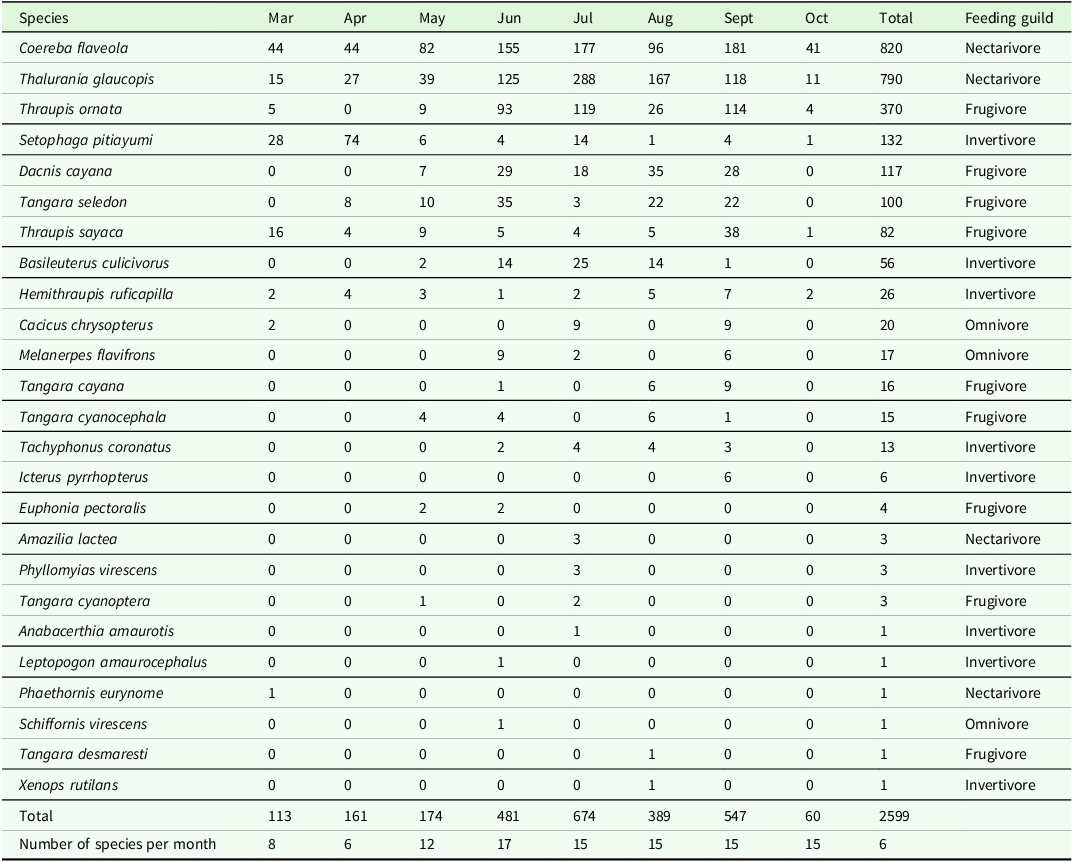
A total of 2599 bird visits to honeydew were recorded, involving 25 species. The most frequent species were Coereba flaveola, Thalurania glaucopis, and Thraupis ornata (Table 1; Figure 3). Together, these three species accounted for 76.2% of the bird visits. In addition to differences in visitation frequency, we also observed clear seasonal variation in species richness. Between May and September (the drier months), 12–17 bird species were recorded feeding on honeydew per month. In contrast, from October to April, monthly species richness ranged from 6 to 8 species. After filtering, 523 observations were used for modelling. The inclusion of species as a random intercept was justified by the estimated variance (0.503), confirming interspecific variation in visitation rates (Table S1 ).
Bird species with the number of monthly visits to honeydew in Carlos Botelho State Park, São Paulo, Brazil, between 2016 and 2017

Golden-chevroned tanager (Thraupis ornata) foraging on honeydew in Carlos Botelho State Park, southeastern Brazil. Photo: R. S. Capelão.

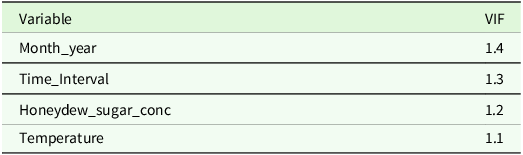
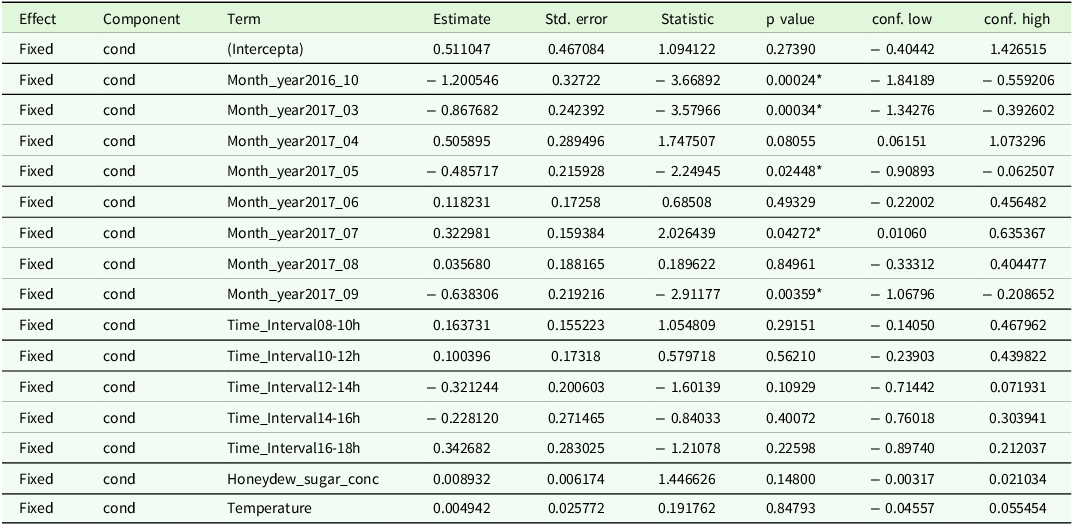
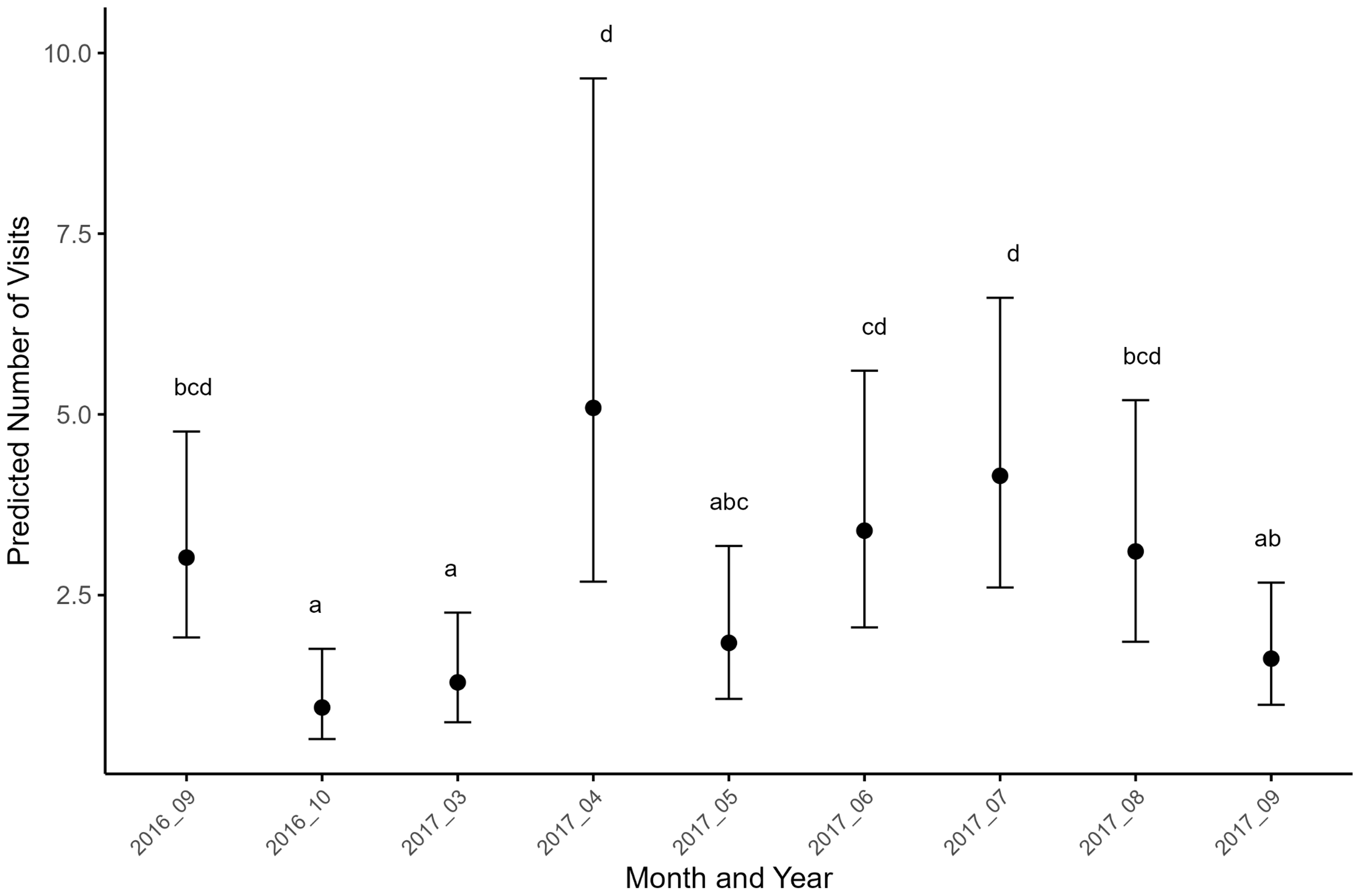
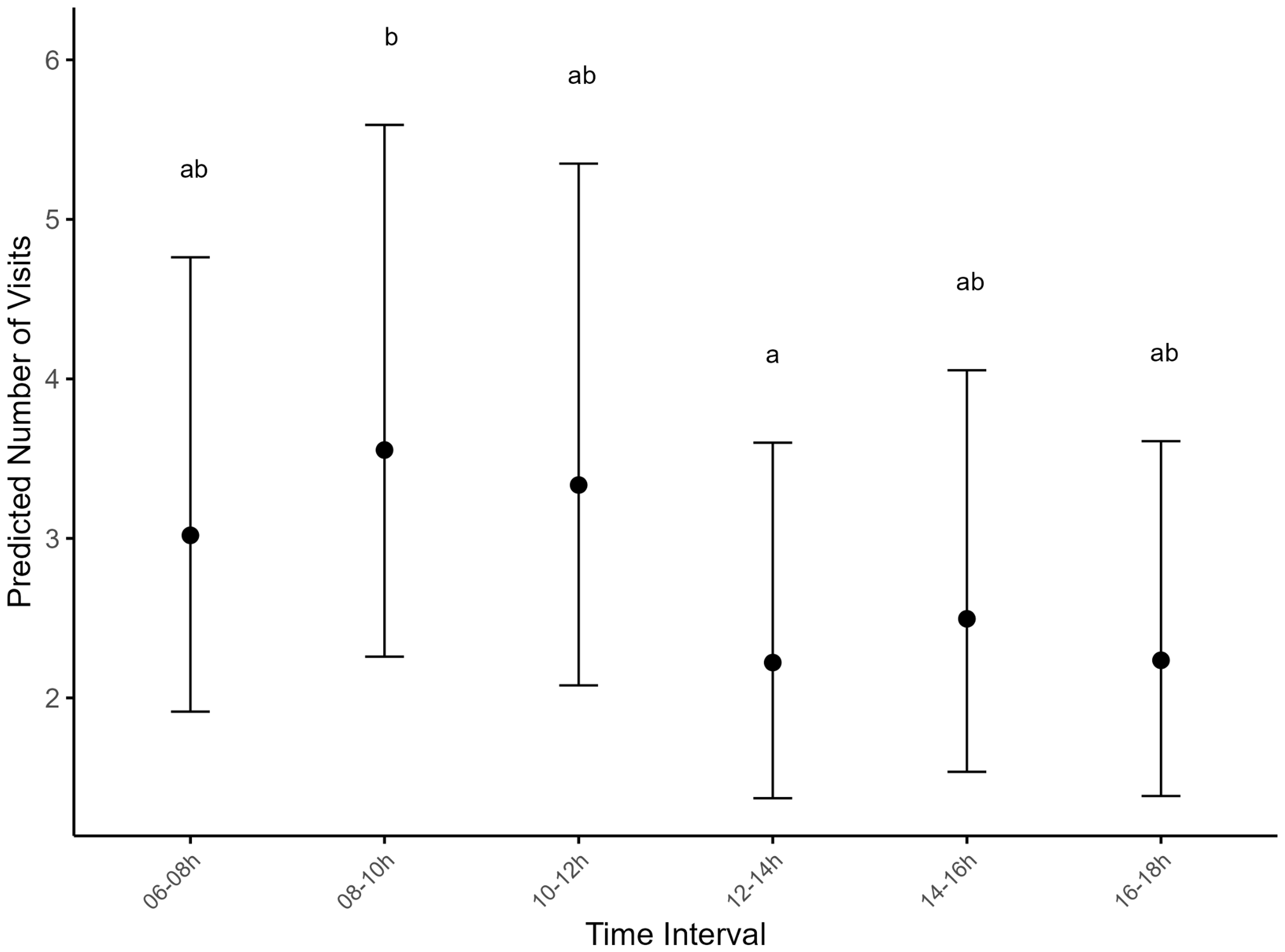
There was no evidence of collinearity among the predictor variables (Table 2). The seasonal variable (Month_year) significantly affected visitation frequency ( Table 3), with peaks in July 2017 (Estimate = 0.322, p = 0.043) and a positive trend in April 2017 (Estimate = 0.50, p = 0.08; n.s.). In contrast, visitation dropped significantly in October 2016 (p < 0.001), March (p < 0.001), May (p = 0.024), and September 2017 (p = 0.003), indicating temporal variation in resource use (Figure 4). Time intervals did not show statistically significant effects (Figure 5); therefore, we cannot confirm temporal variation in honeydew exploitation. Honeydew sugar concentration did not have a positive effect on visitation (mean = 24.91; Estimate = 0.0089; p = 0.148). Ambient temperature also had no detectable effect (p = 0.848).
Variance Inflation Factors (VIF) for the fixed effects included in the final GLMM. All values were below 2 (no multicollinearity among predictors)

Fixed effects from the generalised linear mixed model (GLMM) assessing the predictors of bird visits to honeydew sources in Carlos Botelho State Park, São Paulo, Brazil

Month_year: categorical variable indicating the sampling month and year, used to assess seasonal variation in visitation frequency (2016–2017).
Time_Interval: a categorical variable representing five two-hour intervals during the day (08–10h, 10–12h, 12–14h, 14–16h, and 16–18h), used to evaluate diel patterns of activity.
Honeydew_sugar_conc: continuous variable representing the sugar concentration in honeydew samples (% Brix), reflecting the energetic quality of the resource.
Temperature: continuous variable indicating ambient temperature (°C) during observation.
The response variable was the number of visits by birds, and species identity was included as a random intercept to account for variation among species. Significant predictors are indicated with asterisks according to standard thresholds.
Monthly variation in bird visitation rates to honeydew sources at Carlos Botelho State Park, southeastern Brazil. Values represent predicted means (± 95% CI) from a GLMM model with species as a random effect. Different letters above bars indicate significant differences among month-year combinations based on Tukey’s HSD post hoc test (α = 0.05).

Daytime variation in bird visitation rates to honeydew sources at Carlos Botelho State Park, southeastern Brazil. Values represent predicted means (± 95% CI) from a GLMM model with species as a random effect. Different letters above bars indicate significant differences among time intervals based on Tukey’s HSD post hoc test (α = 0.05).

Residual diagnostics revealed acceptable dispersion (dispersion = 2.87, p = 0.06) and low occurrence of outliers, supporting the reliability of the fitted model (Supplementary Material 1). Despite the limited number of statistically significant predictors, the results reveal consistent seasonal and species-level patterns in honeydew use by Atlantic Forest birds.
Discussion
This study demonstrates that honeydew produced by S. paranaenses is exploited mainly by frugivorous and nectarivorous birds, especially C. flaveola, T. glaucopis, and T. ornata. This supports hypothesis 1, which predicted higher visitation rates by species that typically forage for high-energy food sources. The predominance of these guilds is consistent with previous findings from tropical systems, where honeydew may function as a supplementary resource during periods of flower and fruit scarcity (Gamper and Koptur Reference Gamper and Koptur2010). The use of honeydew as a food resource by birds has been documented across different ecological contexts, typically associated with guilds of high-energy food sources, such as frugivores and nectarivores (Gamper and Kotpur Reference Gamper and Koptur2010; Teixeira and Azevedo Reference Teixeira and Azevedo2013). In temperate environments, such as Fagus-dominated forests in New Zealand, honeydew represents an important dietary component, particularly for resident bird communities with specialised foraging habits, where continuous year-round use has been recorded (Beggs and Wardle Reference Beggs, Wardle, Allen and Lee2006; Gaze and Clout Reference Gaze and Clout1983). Similarly, in temperate and tropical forests, honeydew has been linked to trophic compensation during seasonal shortages of fruit and floral resources, reinforcing its role as an energetic supplement (Lara et al. Reference Lara, Martínez-García, Ortiz-Pulido, Bravo-Cadena and Córdoba-Aguilar2011; Teixeira and Azevedo Reference Teixeira and Azevedo2013).
Hypothesis 2, predicting peak activity in the early morning, was not supported. The highest visitation occurred between 08:00h and 12:00h; however, the time intervals were not statistically significant in the model. Additionally, we could not measure honeydew production or volume, and although visitation tended to peak in the morning, this may reflect general circadian foraging patterns rather than preferential selection of honeydew (McNamara et al. Reference McNamara, Houston and Lima1994).
We found evidence of seasonal variation in bird visitation, confirming hypothesis 3; visitation was higher in the dry season, particularly in July. Visitation patterns appear to be influenced by climatic seasonality. Lower frequencies were observed during the peak rainy season (e.g., October 2016 and March 2017), likely reflecting greater availability of alternative food sources. In contrast, visitation peaked in April and July 2017, which correspond to transitional or dry periods, suggesting that birds may rely more heavily on honeydew when other resources become scarce. In addition to changes in visitation frequency, we also observed seasonal variation in species richness. The number of bird species feeding on honeydew peaked in June, with 17 species recorded, and remained relatively high between May and September (12–17 species). On the other hand, only 6–8 species were observed using the resource in the wetter months. This pattern also suggests that honeydew may serve as a complementary resource for a broader set of species during periods of reduced availability of fruits, flowers, or insects, supporting its role as a seasonal fallback energy source. Studies in the southeastern Atlantic Forest have shown that the flowering of many tree species occurs at the beginning of the rainy season, while fruiting takes place throughout the year, including during the dry months (Morellato et al. Reference Morellato, Talora, Takahasi, Bencke, Romera and Zipparro2000). This suggests a potentially greater availability of nectar during the rainy season, which could reduce birds’ reliance on alternative resources such as honeydew, whereas in the dry season, this sugary exudate may become more important. Additionally, infestation was detected only from March to October and was absent from November to February (see Methods).
Hypothesis 4 was also not supported by our data. Although the model has suggested a small positive relationship between sugar concentration and visitation frequency, the effect was not statistically significant (p = 0.148), revealing that this factor does not explain variation in visitation rates. One possibility is that birds using honeydew do not forage solely based on energetic optimisation (McWhorter and López-Calleja Reference McWhorter and López-Calleja2000), especially if alternative food sources are also available. Another explanation may be that the sugar concentration of honeydew is consistently high enough to exceed a minimum threshold of acceptability, beyond which birds no longer discriminate. In our study, honeydew sugar concentration averaged 24.91%, with most values above the acceptability threshold reported for hummingbird-pollinated flowers (i.e., 23–23.2%; Baker Reference Baker1975; Pyke and Waser Reference Pyke and Waser1981). Alternatively, birds may be constrained by other factors such as territoriality or access limitations that decouple foraging decisions from resource quality. Behavioural models and empirical studies show that access limitations, memory-based foraging routes, and dominance interactions can decouple visitation patterns from resource richness or composition (Clayton and Dickinson Reference Clayton and Dickinson1998; Leighton et al. Reference Leighton, Drury and Small2024; Márquez-Luna et al. Reference Márquez-Luna, Lara, Corcuera and Valverde2019). It is also worth noting, however, that morning foraging patterns have been documented in other trophic systems, such as hummingbird–flower interactions in the Atlantic Forest (e.g., Nieto Reference Nieto, Wüest and Graham2023; Silva and Piratelli Reference Silva and Piratelli2014). In the first study, activity was concentrated in the early hours of the day, likely in response to a combination of resource availability and intraspecific competition. Future research may investigate whether there is functional convergence in the use of floral and exudate resources by nectarivorous bird species.
Unlike previous descriptive studies conducted in Brazil (Teixeira and Azevedo Reference Teixeira and Azevedo2013), we incorporate a quantitative approach, modelling behavioural and environmental effects. However, some limitations should be acknowledged, as the number of visits used in the modelling represents filtered data (see Methods), which may have reduced statistical power.
From a conservation perspective, the results of this study highlight the relevance of poorly understood trophic pathways in the foraging ecology of Atlantic Forest birds. The association between Inga species and coccids may provide important trophic support, mainly during periods of resource scarcity. In fragmented landscapes, such as most of the Atlantic Forest, the maintenance or introduction of native plant species that may host honeydew-producing insects—such as certain Inga species—may support additional trophic interactions that are rarely considered in restoration planning. By providing an alternative carbohydrate source during periods of floral or fruit scarcity, these interactions can help sustain some bird functional groups, thereby enhancing ecological complexity and resilience in restored areas.
Supplementary material
To view supplementary material for this article, please visit https://doi.org/10.1017/S0266467425100308.
Acknowledgements
RSC thanks Coordenação de Aperfeiçoamento de Pessoal de Nível Superior (#1586584) for the grant; AJP thanks Conselho Nacional de Desenvolvimento Científico e Tecnológico (#316032/2023-09) for the grant. The authors thank Parque Estadual Carlos Botelho and Fundação Florestal de São Paulo for permits and access to the study area and ICMBio for permission to collect biological samples (permit no. 54596-1). The authors also thank Vera R. A. Wolff for identifying the scale insect; Fiorella F. M. Capelo for identifying Inga species; Maria V. Urso-Guimarães for identifying other insects; Carlos O. A. Gussoni, César Cestari, and Mercival Francisco for suggestions on the early version of this manuscript; Laboratório de Sementes e Mudas (LASEM)/UFSCar for the equipment; and all colleagues of Laboratório de Ecologia e Conservação (LECO/UFSCar Sorocaba) for helping to develop this research.
Financial support
RSC was supported by CAPES—Coordenação de Aperfeiçoamento de Pessoal de Nível Superior (#1586584); AJP was supported by CNPq—Conselho Nacional de Desenvolvimento Científico e Tecnológico (#316032/2023-09).
Competing interests
The authors declare none.