Introduction
Growing evidence indicates that psychological distress is associated with dysregulated immune, neuroendocrine and haemostatic responses, which in turn may increase individuals' risk for a wide variety of adverse health events. Psychological distress has been linked prospectively with an increased risk for diseases such as atherosclerosis and stroke (Kubzansky et al. Reference Kubzansky, Cole, Kawachi, Vokonas and Sparrow2006; Steptoe, Reference Steptoe and Steptoe2006; Irwin & Miller, Reference Irwin and Miller2007), a relationship particularly well established in coronary heart disease (CHD) patients (Barth et al. Reference Barth, Schumacher and Herrmann-Lingen2004) and middle-aged healthy people (Rugulies, Reference Rugulies2002). Mental distress is accompanied by activation of the innate immune system, resulting in increased monocyte production of the pro-inflammatory cytokines interleukin (IL)-6 and tumour necrosis factor (TNF)-α and upregulation of the acute phase response with increased synthesis of fibrinogen and C-reactive protein (CRP) by the liver (Black & Garbutt, Reference Black and Garbutt2002). Circulating levels of inflammatory cytokines, CRP and fibrinogen have been shown to correlate with symptoms of depression and anxiety in several studies (von Känel et al. Reference von Känel, Mills, Fainman and Dimsdale2001; Pitsavos et al. Reference Pitsavos, Panagiotakos, Papageorgiou, Tsetsekou, Soldatos and Stefanadis2006; Matthews et al. Reference Matthews, Schott, Bromberger, Cyranowski, Everson-Rose and Sowers2007; Ranjit et al. Reference Ranjit, Diez-Roux, Shea, Cushman, Seeman, Jackson and Ni2007; Davidson et al. Reference Davidson, Schwartz, Kirkland, Mostofsky, Fink, Guernsey and Shimbo2009), although there have also been negative findings (Steptoe et al. Reference Steptoe, Kunz-Ebrecht and Owen2003; Schroeder et al. Reference Schroeder, Borner, Gutknecht, Schmid, Saner and Kohler2007; Pan et al. Reference Pan, Ye, Franco, Li, Yu, Wang, Qi, Gu, Pang, Liu and Lin2008). These inflammatory proteins play a central role in atherogenesis and are implicated in the relationship between psychiatric distress and CHD (von Känel et al. Reference von Känel, Mills, Fainman and Dimsdale2001; Steptoe & Brydon, Reference Steptoe, Brydon and Ader2007).
The association between psychological distress and inflammatory responses in young, healthy populations is less well characterized, and life-course models for the development of psychological disorder and hyper-inflammatory processes are poorly understood. It remains unclear how early in life the relationship between psychological factors and inflammation emerges. In an effort to better understand these associations, we examined the relationship between psychological distress and the inflammatory factors fibrinogen and CRP in a nationally representative sample of young English adults, controlling for potentially confounding factors such as adiposity (Elovaino et al. Reference Elovainio, Keltikangas-Järvinen, Pulkki-Råback, Kivimäki, Puttonen, Viikari and Raitakari2006). We hypothesized that young individuals scoring high on distress would have elevated circulating levels of these factors, and that effects would be independent of adiposity and other covariates.
Method
Study design and participants
The Health Survey for England (HSE) is a large, nationally representative annual cross-sectional study designed to monitor health trends in the non-institutionalized population of England's adults and children. Details of HSE 2006 methodology are available elsewhere (Department of Health, 2004; Craig & Mindell, Reference Craig and Mindell2007). Ethical approval for the 2006 survey was obtained from the London Multi-centre Research Ethics Committee (MREC).
Data were collected during two home visits. A trained interviewer collected information about participants' sociodemographics, health behaviours, medical history, psychosocial characteristics, and basic anthropometry. During a subsequent nurse visit, information was collected on medication use, waist and hip circumference, and blood pressure. Non-fasting venous blood samples were also obtained from adults (⩾16 years) and analysed for (among other biomarkers) plasma fibrinogen, high sensitivity CRP (hsCRP) and high density lipoprotein (HDL) cholesterol. Fibrinogen and hsCRP levels were collected in 2006 as markers of risk for CHD, which was the focus of the HSE 2006.
For this study, data from young adults (aged 16–34 years) were analysed. This age group includes those who provided blood samples but were young enough to be predominantly healthy, with few of the chronic conditions common in older populations. Analyses were based on a maximum of 1338 participants; analytic size varied slightly because of missing data for some participants on certain variables. For the HSE 2006 survey overall, 61% of adults residing in eligible households agreed to be interviewed, 45% agreed to the nurse visit, and 33% provided a blood sample. Among young adults, who form the focus of this study, 45% provided a valid blood sample (48% refused).
Sociodemographic and psychological measures
Race/ethnicity was classified as White, Indian/Asian, Black, or Other; Whites were the reference group. Alcohol use was defined as the number of days the participant had drunk alcohol in the past week, with 0 as the reference category; smoking status was defined as never, ex-occasional, ex-regular, or current smoker, with never-smokers as the reference group. Body mass index (BMI; weight in kg divided by height in m2), was classified as <19, 19–24.9, 25–29.9 or ⩾30, with the 19–24.9 group as the reference category. Physical activity was a composite score ranging from 1 to 5, with 1 (vigorous activity three times per week plus moderate activity five times per week) corresponding to the highest level of activity and 5 (inactive) corresponding to the lowest. The highest-activity group formed the reference category. Medication use was an indicator variable for use of any prescription medications, with non-users as the reference group. Use of hormonal contraceptives was similarly defined. Socio-economic status (SES), defined by the Registrar General's employment categories collapsed for convenience, was measured in two ways, individual and head-of-household (HOH) social class, as nearly 20% of the sample were under 20 years of age and likely to be living as a dependent. For both variables, the highest-SES group formed the referent.
Psychological distress was assessed using the 12-item version of the General Health Questionnaire (GHQ-12), a screening questionnaire validated within the UK and internationally (Goldberg et al. Reference Goldberg, Gater, Sartorius, Ustun, Piccinelli, Gureje and Rutter1997). The GHQ has been found to correlate highly with diagnosed depression and anxiety disorders and chronic stress (Furukawa et al. Reference Furukawa, Kessler, Slade and Andrews2003; Grano et al. Reference Grano, Keltikangas-Jarvinen, Kouvonen, Virtanen, Elovainio, Vahtera and Kivimaki2007). It consists of questions regarding recent behavioural and psychological functioning (e.g. ‘Have you recently felt constantly under strain?’), to which the respondent answers how well that statement describes them now in contrast to their ‘usual’ level of functioning. Total scores ranged from 0 to 12, with respondents scoring ⩾4 considered to have clinically relevant mental distress, and higher scores indicating increasing psychological distress. The validity of this cut-off has been demonstrated in studies comparing the performance of the GHQ-12 against standardized psychiatric interviews, including in UK populations (Goldberg & Williams, Reference Goldberg and Williams1988), and validity does not seem to differ by age group (Goldberg et al. Reference Goldberg, Gater, Sartorius, Ustun, Piccinelli, Gureje and Rutter1997).
Biological measures
All blood analytes for the HSE 2006 were analysed at the Royal Victoria Infirmary laboratory in Newcastle upon Tyne, UK. Fibrinogen was measured in citrated plasma; coagulation assays were performed on an Organon Teknika MDA 180 analyser using a modification of the Clauss method. Valid fibrinogen samples had a coefficient of variation averaging 8.1%. Observed values ranged from 0.7 to 5.9 g/l. Sample results were normally distributed and fibrinogen was treated as a continuous variable in all analyses. ‘Elevated’ fibrinogen was defined as having a fibrinogen level in the highest quartile of the sample. hsCRP was measured in serum with latex-enhanced nephelometry. The hsCRP test more accurately detects lower concentrations of the protein than does the standard test, making it useful for predicting a healthy individual's risk for cardiovascular disease. Samples had a coefficient of variation averaging 5.9%. As values >10.0 mg/l probably indicate systemic inflammation due to physical illness, observations with hsCRP values >10.0 mg/l were dropped (n=66). HDL cholesterol level was measured directly in serum (no precipitation) using an Olympus 640 analyser.
Statistical analysis
We used multiple linear regression to estimate the association of GHQ-12 score with fibrinogen and hsCRP as continuous variables, adjusting for potentially confounding factors (see Table 1). hsCRP values were skewed and log-transformed for analyses. Covariates were entered in three sequential nested models for each outcome. For fibrinogen, model 2 contains key demographic variables in addition to GHQ score, model 3 adds physiological characteristics along with smoking, medication and alcohol use, and model 4 adds social class, marital status and physical activity variables. The model 4 additional covariates have been previously reported as being associated with psychological distress and the two inflammatory markers, so although they were not associated with either outcome in this analysis (either in bivariate or multivariate models), they were retained to allow for examination of their effects. However, physical activity was entered into the hsCRP model 3 as the two variables were associated in bivariate analyses. R 2 values were used to assess model goodness of fit. All calculations were performed using Stata version 11.0 (StataCorp, USA).
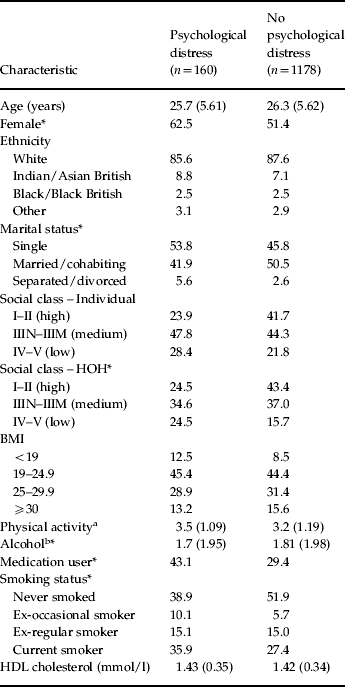
Characteristics of HSE 2006 adults (aged 16–34 years) with and without current psychological distress

HSE, Health Survey for England; HOH, head of household; BMI, body mass index; HDL, high density lipoprotein.
Values given as percentage or mean (standard deviation).
a Physical activity score range 1–5 (1: 20 min of vigorous activity three times a week and 30 min of moderate activity five times a week; 2: 20 min of vigorous activity three times a week only; 3: 30 min of moderate activity five times a week only; 4: lower but active; 5: inactive).
b Alcohol use defined as the number of days participant drank alcohol in the past week (range 0–7).
* Difference between the groups is significant (p<0.05).
We used the HSE survey weights, with Stata's ‘svy’ command, in all analyses. These weights adjust for the selection of households interviewed, non-response bias among individuals at the household level, and population profile of the sample that agreed to provide a blood sample. The results can be interpreted to reflect UK Office for National Statistics (ONS) 2005 mid-year population estimates. We tested for interaction effects between GHQ score and sex, BMI, smoking, alcohol use, and medication use. No interaction terms were significant. All reported p values are two-sided, and p<0.05 was considered statistically significant.
Results
A total of 1338 participants aged 16 to 34 years had both a valid fibrinogen blood sample result and an hsCRP level ⩽10.0 mg/l, and were included in the final analysis. The average age of the participants was 26.3±5.6 years. Nearly 12% of participants (n=160) had GHQ-12 scores ⩾4, indicating the presence of significant psychological distress. There were no significant differences between those with and without psychological distress in terms of age, ethnicity, BMI, HDL cholesterol, physical activity or alcohol use (Table 1). However, those with a GHQ-12 score ⩾4 were more likely to be female (p<0.001), users of prescription medication (p<0.001), current smokers (p<0.003), single or separated/divorced (p<0.02), and of low SES (p<0.03). Fibrinogen and hsCRP were highly correlated (r=0.466, p<0.001).
Comparison of sociodemographic and risk factors between participants with and without valid blood samples indicated that they were mostly similar, although those without a valid sample were slightly more likely to be female, white, and single (p<0.05; results not shown).
Predictors of fibrinogen
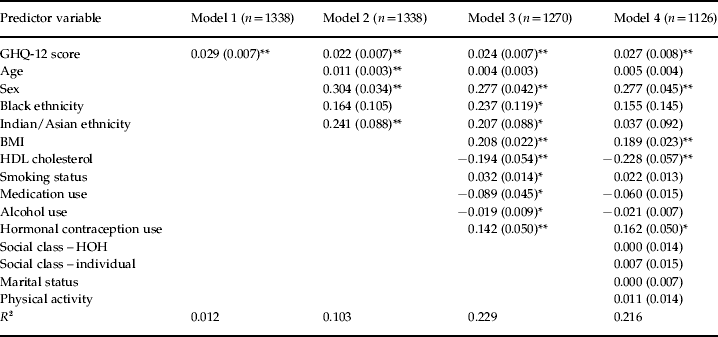
Elevated fibrinogen levels were detected in 159 participants (12%). The percentage of participants with elevated fibrinogen differed significantly by sex: 16.5% of women, but only 6.4% of men, had fibrinogen scores in the highest quartile. Table 2 summarizes the results of the multiple linear regression analyses predicting fibrinogen.
Linear regression models predicting plasma fibrinogen level

GHQ-12, 12-item version of the General Health Questionnaire; BMI, body mass index; HDL, high density lipoprotein; HOH, head of household.
Values given as β (standard error).
* p<0.05, ** p<0.01.
Model 1 shows the bivariate association between GHQ-12 score and fibrinogen level. Psychological distress is a highly significant predictor of fibrinogen (β=0.029, p<0.01) and accounts for a small proportion of the variance (R 2=0.012). In model 2, controlling for age, sex and ethnicity reduces the magnitude of the association very slightly, but it remains significant (β=0.022, p<0.01). In this model, significant associations with fibrinogen level were found for sex, age, and Indian/Asian ethnicity, but not for Black ethnicity. In model 3, HDL cholesterol, BMI, smoking status, medication use, hormonal contraceptive use, and alcohol use were added to the regression model; each of these covariates was significantly associated with fibrinogen. GHQ-12 score also remained a significant predictor of fibrinogen, and the R 2 value increased to 0.229. Finally, in model 4, individual and household social class and also marital status and physical activity were added as covariates. None of these factors were significantly associated with fibrinogen level. Although their inclusion rendered non-significant many of the other covariates' associations with fibrinogen, GHQ score remained a significant predictor. Using logistic regression to analyse elevated fibrinogen as a dichotomous outcome (Table 4), or using a GHQ-12 score variable dichotomized into <4 versus⩾4, did not change the results. Because the R 2 value for model 4 indicated that it explained a lesser percentage of the variance in fibrinogen levels, we consider that model 3 is the most suitable and parsimonious model to use when interpreting the effect of psychological distress on fibrinogen.
We subsequently stratified our analyses to examine whether the results differed by gender and age groups. When stratified by age groups (16–25 and 26–34 years), the significant effect of GHQ score on fibrinogen remained only among the 16–25 group (β=0.039, p=0.001), although the effect for the older group was trending in the same direction (β=0.016, p=0.076). This did not seem to be due to higher average GHQ-12 scores among the younger group. Similarly, models stratified by sex indicated that the effect in men may explain a large proportion of our results; the coefficient for GHQ-12 score among men was 0.0275 (p=0.002), whereas in women it was 0.0188 (p=0.105). However, the interaction term for sex×GHQ score was not significant (p=0.392).
Predictors of CRP
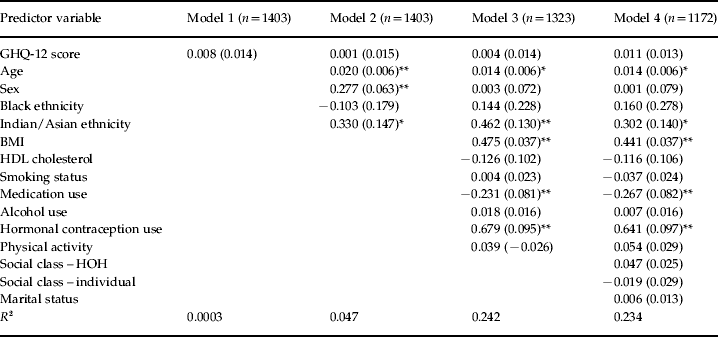
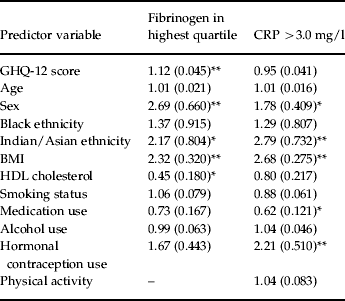
In contrast with the fibrinogen results, psychological distress was not associated with hsCRP in either bivariate or adjusted analyses (Table 3). This finding did not differ by sex, although women were more likely to have elevated hsCRP levels. hsCRP was significantly predicted by age, sex, BMI, HDL cholesterol, physical activity level, Indian/Asian ethnicity, and medication and hormonal contraceptive use in bivariate analyses; however, the relationships with factors other than age, BMI, Indian/Asian ethnicity, and medication and contraceptive use failed to reach significance in the most parsimonious fully adjusted model (model 3). Analysing hsCRP as a categorical variable (where hsCRP >3.0 mg/l was the outcome of interest) with logistic regression (Table 4), or with GHQ-12 score dichotomized into <4 versus⩾4, did not change the results. To assess whether GHQ score predicted hsCRP levels differently according to body mass, as some researchers have found (Miller et al. Reference Miller, Stetler, Carney, Freedland and Banks2002), we stratified the regression model by BMI (<25.0 v. ⩾25.0). The results for psychological distress were essentially the same, although coefficients for certain of the covariates changed. The final model accounted for 24.2% of the variance in log hsCRP level.
Linear regression models predicting log C-reactive protein level

GHQ-12, 12-item version of the General Health Questionnaire; BMI, body mass index; HDL, high density lipoprotein; HOH, head of household.
Values given as β (standard error).
* p<0.05, ** p<0.01.
Logistic regression models predicting C-reactive protein (CRP) and fibrinogen (dichotomized) levels

GHQ-12, 12-item version of the General Health Questionnaire; BMI, body mass index; HDL, high density lipoprotein.
Values given as odds ratio (standard error).
* p<0.05, ** p<0.01.
Discussion
Using a large, nationally based cross-sectional sample, we found that current psychological distress positively and significantly predicted plasma fibrinogen levels in young healthy English adults. This association, although modest, remained significant after controlling for a wide range of potential confounders and intermediating factors. Regression analyses indicated that fibrinogen levels increased by approximately 2.4% for every 1-point increase in GHQ-12 score; a score of 12 (indicative of severe psychiatric distress) corresponded to a more than 20% increase in fibrinogen over that of an individual scoring 0 on the psychiatric distress scale. The results differed slightly by age and sex, with men and individuals aged 16–25 years demonstrating stronger magnitudes of association. This sex difference accords with some previous research that has found significant relationships between psychological disorder and fibrinogen only in males (Kudielka et al. Reference Kudielka, Bellingrath and von Känel2008), although the finding is not universal (Panagiotakos et al. Reference Panagiotakos, Pitsavos, Chrysohoou, Tsetsekou, Papageorgiou, Christodoulou and Stefanadis2004; Matthews et al. Reference Matthews, Schott, Bromberger, Cyranowski, Everson-Rose and Sowers2007). Our finding of higher fibrinogen levels among women is consistent with a recent meta-analysis that indicated that fibrinogen is generally modestly higher in females (Fibrinogen Studies Collaboration, 2007).
These results correspond with findings from earlier cross-sectional studies demonstrating a positive association between psychological distress and fibrinogen, although the use of differing measures of psychological distress prevents direct comparison of the magnitudes of effect. Depressive symptoms have been found to predict circulating fibrinogen levels in healthy middle-aged US women (Matthews et al. Reference Matthews, Schott, Bromberger, Cyranowski, Everson-Rose and Sowers2007), in a representative sample of the population of Attica, Greece (Panagiotakos et al. Reference Panagiotakos, Pitsavos, Chrysohoou, Tsetsekou, Papageorgiou, Christodoulou and Stefanadis2004), and in young New Zealand adults (Danese et al. Reference Danese, Moffitt, Pariante, Ambler, Poulton and Caspi2008), although part of this particular relationship was explained by the higher levels of inflammation in depressed individuals who were maltreated as children. In another study, healthy middle-aged adults with high state anxiety were found to have fibrinogen levels 44% higher than non-anxious individuals (Pitsavos et al. Reference Pitsavos, Panagiotakos, Papageorgiou, Tsetsekou, Soldatos and Stefanadis2006). Similarly, vital exhaustion has been shown to independently predict circulating fibrinogen concentrations in men (Kudielka et al. Reference Kudielka, Bellingrath and von Känel2008) and post-traumatic stress disorder (PTSD) symptom severity was positively associated with fibrinogen levels in a study of young adult PTSD patients, a relationship partly explained by depression and anxiety measures (von Känel et al. Reference von Känel, Hepp, Buddeberg, Keel, Mica, Aschbacher and Schnyder2006). However, findings demonstrating a positive relationship between psychological distress and fibrinogen are not universal (Doulalas et al. Reference Doulalas, Rallidis, Gialernios, Moschonas, Kougioulis, Rizos, Tselegaridis and Kremastinos2006; Schroeder et al. Reference Schroeder, Borner, Gutknecht, Schmid, Saner and Kohler2007; Nabi et al. Reference Nabi, Singh-Manoux, Shipley, Gimeno, Marmot and Kivimaki2008; Pan et al. Reference Pan, Ye, Franco, Li, Yu, Wang, Qi, Gu, Pang, Liu and Lin2008) and one recent study found an inverse association between depression and fibrinogen in CHD patients (Whooley et al. Reference Whooley, Caska, Hendrickson, Rourke, Ho and Ali2007). The explanation for these inconsistencies is not clear, but may relate to differences in the measures of psychological distress used, the population under investigation, and/or sample size.
The pathways mediating the association between distress and fibrinogen remain unclear. Psychological stress activates the hypothalamic–pituitary–adrenal (HPA) axis, resulting in elevations in circulating glucocorticoids (Hayley et al. Reference Hayley, Poulter, Merali and Anisman2005), and recent research has suggested that HPA activity may drive fibrinogen synthesis (von Känel et al. Reference von Känel, Mausbach, Kudielka and Orth-Gomér2008). Stress and depression are also accompanied by heightened sympathetic nervous activity and decreased parasympathetic tone (Gorman & Sloan, Reference Gorman and Sloan2000), with some research suggesting that such reductions in parasympathetic tone may promote increases in fibrinogen (Carney et al. Reference Carney, Freedland, Stein, Miller, Steinmeyer, Rich and Duntley2007). It is also conceivable that IL-6 may mediate this relationship. IL-6 is the principal inducer of fibrinogen synthesis during the acute phase response (Castell et al. Reference Castell, Gómez-Lechón, David, Fabra, Trullenque and Heinrich1990), and circulating IL-6 levels are elevated in some depressed patients and chronically stressed individuals (Raison et al. Reference Raison, Capuron and Miller2006).
There was no observed association between psychological distress and hsCRP in this population, even when stratified by sex or BMI (Miller et al. Reference Miller, Stetler, Carney, Freedland and Banks2002; Liukkonen et al. Reference Liukkonen, Silvennoinen-Kassinen, Jokelainen, Räsänen, Leinonen, Meyer-Rochow and Timonen2006). Our negative findings are in contrast to some previous studies that have found significant associations between mental distress and elevated hsCRP in young populations (Danner et al. Reference Danner, Kasl, Abramson and Vaccarino2003; Ford & Erlinger, Reference Ford and Erlinger2004; Suarez, Reference Suarez2004). However, Nazmi et al. (Reference Nazmi, Oliveira and Victora2008) found no association between CRP and minor psychiatric disorder in a representative sample of healthy young Brazilian adults, and in a sample of young adults from a National Health and Nutrition Examination Survey (NHANES), only recurrent depression was associated with elevated CRP, and then only among men (Ford & Erlinger, Reference Ford and Erlinger2004). A recent meta-analysis of six studies examined the link between major depression and CRP and found a fairly robust relationship in men, but an inconsistent one in women (Howren et al. Reference Howren, Lamkin and Suls2009). However, BMI explained a large part of this association, and other covariates were not included in the meta-analytic model; the authors additionally noted the probable presence of publication bias. These contradictory findings highlight the need for further investigation of this association.
Fibrinogen and CRP are both acute phase proteins and inflammatory markers. However, there is no known direct pathway between them and therefore we do not necessarily expect them to be causally linked. If the acute phase response is the mechanism directly mediating the relationship between psychological distress and fibrinogen, then a relationship between psychological distress and CRP might also be expected. However, other studies have also reported associations between psychosocial stress and fibrinogen but not CRP in humans. For example, a recent study found that job stress was associated with elevated plasma fibrinogen in Japanese men, independently of CRP (Hirokawa et al. Reference Hirokawa, Tsutsumi and Kayaba2008). Similarly, higher morning serum cortisol levels (a marker of chronic stress) predicted higher serum fibrinogen in women with stable coronary artery disease, independently of CRP (von Känel et al. Reference von Känel, Mausbach, Kudielka and Orth-Gomér2008). This suggests that stress may influence fibrinogen and CRP through distinct, albeit potentially related, pathways.
hsCRP was not associated with smoking in either bivariate or multivariate models in this sample, even among heavy smokers. The reasons for this are unclear, given that hsCRP levels are widely found to increase with smoking. However, not all studies have found a significant association between smoking status and hsCRP, especially in young populations (Tracy et al. Reference Tracy, Psaty, Macy, Bovill, Cushman, Cornell and Kuller1997; Nazmi et al. Reference Nazmi, Oliveira and Victora2008; O'Loughlin et al. Reference O'Loughlin, Lambert, Karp, McGrath, Gray-Donald, Barnett, Delvin, Levy and Paradis2008). The lack of association in our sample did not differ by gender, and it is not known what factors may explain these discrepancies.
We observed significantly higher fibrinogen levels among Indian/Asian and Black individuals, and higher hsCRP levels among Indian/Asian individuals. Such higher average levels could have clinical importance for these minority populations. One meta-analysis indicated that fibrinogen levels were on average higher among Black and Asian individuals (Fibrinogen Studies Collaboration, 2007), although the one study we know to have examined ethnic differences in fibrinogen levels in the UK (Cook et al. Reference Cook, Cappuccio, Atkinson, Wicks, Chitolie, Nakandakare, Sagnella and Humphries2001) found inconsistent results.
As with all cross-sectional studies, these findings cannot be interpreted causally. The directionality of the observed association remains unclear (Gimeno et al. Reference Gimeno, Kivimäki, Brunner, Elovainio, De Vogli, Steptoe, Kumari, Lowe, Rumley, Marmot and Ferrie2008), and an underlying, unidentified disease process could be responsible for both distress and inflammation. Additionally, we lacked data on the type of medication participants were taking and on any substance abuse. The very slight change in magnitude of the GHQ score coefficient from model 1 to model 3, however, suggests that medication use was not a significant confounder. The study was also limited by the small number of inflammatory measures collected, and by lack of information about the childhood experiences of participants.
Advantages of the study include its investigation of the association between negative affective state and inflammatory markers in a young, representative, and predominantly healthy population whose health profiles are unlikely to be subject to the sorts of confounders present in older subjects, and also our use of a general measure of psychological distress to explore these effects and our ability to control for a wide range of covariates.
The presence of elevated fibrinogen levels among psychologically distressed individuals in a young, healthy population could indicate clinically significant increased risk of future adverse health events, particularly if such inflammation was chronic. Evidence from several large prospective epidemiological studies demonstrates that plasma fibrinogen levels independently and positively predict future risk of CHD, stroke and non-vascular mortality in healthy, middle-aged adults (Koenig, Reference Koenig2003; Fibrinogen Studies Collaboration, 2005). Our current results suggest that psychological distress may negatively impact inflammatory processes in young adulthood, well before the onset of chronic health problems such as hypertension, cardiovascular disease and cancer, and thus potentially play a role in their development.
Acknowledgements
We thank three anonymous reviewers for their helpful comments on an earlier version of this manuscript. This work was supported by the British Heart Foundation, UK.
Declaration of Interest
None.