INTRODUCTION
Largely because of pressures from the legal and regulatory environment, many large organizations have made efforts to implement policies and programs aimed at fostering ethical behavior in organizational members (Weaver, Treviño, & Cochran, Reference Weaver, Treviño and Cochran1999). These ‘ethical infrastructures’ (Tenbrunsel, Smith-Crowe, & Umphress, Reference Tenbrunsel, Smith-Crowe and Umphress2003) contain both formal and informal elements: ethical codes and policies, communications, training, control systems, sanctions, and rewards on the formal side, and attention to ethical climates and organizational cultures on the informal. Firms use formal or informal control systems depending on the existing relationship between managers and employees.
The above-mentioned relationship between managers and/or employees and the firm is traditionally understood as involving a conflict of interests, where the interests of the top managers and/or employees (as agents) differ from those of stockholders (as principals) (Jensen & Meckling, Reference Jensen and Meckling1976). The model of man that underlies agency theory is an individualist model that assumes individuals have bounded rationality, are opportunistic, and pursue their own interests (Eisendhardt, Reference Eisendhardt1989). Firms design and implement formal organizational control systems to avoid non-ethical behavior by employees.
In contrast to agency theoryFootnote 1 , stewardship theory assumes that people are not motivated by individual goals but behave as stewards whose interests are aligned with the objectives of the organization, which include growth in sales, profitability, innovation, international expansion, and the firm’s reputation (Davis, Schoorman, & Donaldson, Reference Davis, Schoorman and Donaldson1997). According to this theory, some agents are likely to pursue the interests of the organization even when these conflict with their own interests (Donaldson & Davis, Reference Donaldson and Davis1991; Fox & Hamilton, Reference Fox and Hamilton1994; Davis, Schoorman, Mayer, & Tan, Reference Davis, Schoorman, Mayer and Tan2000). In this case, because most employees behave honestly and ethically, formal organizational control systems will not be necessary in order to control behavior, informal systems being sufficient.
These informal systems are comprised of common values, beliefs, and traditions that direct the behavior of group members (Ouchi, Reference Ouchi1977).
Informal systems within organizations are the dominant influence on behavior when ethical issues are resolved (Falkenberg & Herremans, Reference Falkenberg and Herremans1995). In this way, a steward relationship between managers and employees promotes ethical behavior in organizations more than an agency relationship.
In the particular case of the family firm, some debate exists about the ability of agency theory to explain the relationships that are established. Corbetta and Salvato (Reference Corbetta and Salvato2004) propose stewardship theory as an alternative perspective to agency theory in family firms. One of their main arguments is that the owning family has a crucial impact in shaping the ‘model of man’ prevailing within the organization, whether the self-serving, economically rational man of agency theory, or stewardship theory’s self-actualizing, collective-serving man.
Altruism is an important element for explaining relationships in family firms because it is considered a resource based on the family that encourages members to put the firm’s objectives before their own objectives (Zahra, Reference Zahra2003). From the stewardship perspective, altruism implies an unselfish concern and devotion to others without expecting a return (Corbetta & Salvato, Reference Corbetta and Salvato2004). The level of altruism will affect the levels of organizational commitment among family members, and empirical evidence suggests that a strong affective commitment to the firm among family members can create an affective response from organizational members (Zahra, Hayton, Neubaum, Dibrell, & Craig, Reference Zahra, Hayton, Neubaum, Dibrell and Craig2008), which helps align the interests and needs of those members with those of the organization. Thus, higher levels of affective organizational commitment increase the probability that employees will make an effort on behalf of the organization (Zahra et al., Reference Zahra, Hayton, Neubaum, Dibrell and Craig2008) and will behave as stewards instead of agents in their relationship with the managers. According to Barsade (Reference Barsade2002), the affective response is caused by social contagion.
Davis, Allen, and Hayes (Reference Davis, Allen and Hayes2010) found that family member employees perceive significantly more commitment, trust, and stewardship in family firm leadership and perceive less agency than non-family members, so suggesting that blood is indeed thicker than water. Do employees of non-family firms have the same perceptions as non-family employees of family firms? Can any differences be found that cause differing behavior? Which type of firm is more ethical? If the (closer) relationships of family member employees in family firms can be compared with blood, and the (more distant) relationships of employees in non-family firms to water, which is thinner, are the relationships of non-family employees in family firms somewhere in between? What would be the effects of these differences on the behavior of non-family employees – and would their behavior be more or less ethical than that of employees in non-family firms?
The lack of empirically tested responses to the above questions represents a significant gap in our understanding, which this research will address by looking specifically at differences between non-family employees in family firms and employees of non-family firms, and their perceptions of stewardship. The main aim is to analyze whether family firms are better incubators for ethical behavior than non-family firms.
For this purpose, we compare between family and non-family firms the factors listed by Davis, Schoorman, and Donaldson (Reference Davis, Schoorman and Donaldson1997) as necessary for the relationship between the owner family and non-family employees to be a principal–steward relationship. These factors are psychological (motivation, identification, and use of power) and situational (management philosophy and organizational culture).
This work is structured in five sections following on from this introduction. The next section describes the theoretical framework from which we start to formulate our research hypotheses; the one after that outlines the methodology used, while the one following that presents the most significant results; the penultimate section offers a discussion of the results. Finally, the last section offers the main conclusions, as well as the limitations and future lines of research.
THEORETICAL BACKGROUND
Many researchers have noted the impact of multiple aspects of organizational contexts on ethical behavior by individuals (Treviño, Weaber, & Reynolds, Reference Treviño, Weaber and Reynolds2006). Ethical culture has been defined as a slice of the organizational culture that influences employees’ ethical behavior through formal and informal organizational structures and systems (Treviño, Reference Treviño1990).
Treviño, Butterfield, and McCabe (Reference Treviño, Butterfield and McCabe1998) used both constructs to study the influence of the ‘ethical context’ of an organization on attitudes and behaviors related to ethics. In this way, the ethical behavior of another person serves as an influential role model for an individual’s own ethical behavior. A recent qualitative study by Weaver et al. (2005) indicated multiple aspects of a person’s behavior that can lead others to consider that person to be an ethical role model. Importantly, the ethical role modeling relationship requires relatively close interaction with the role model; despite organizational efforts to highlight a management stance toward ethics, the role models people look to tend to be those with whom they have close working relationships (Walker, Pitts, Hennig, & Matsuba, Reference Walker, Pitts, Hennig and Matsuba1995).
From a stewardship perspective, these close working relationships are based on a model of man, a steward, whose behavior is the result of the conviction that acting in the interests of the organization and the group will yield the steward more utility than individualistically pursuing their own interests (Dicke & Ott, Reference Dicke and Ott2002). The steward’s behavior aligns with the interests of the organization. Indeed, they make every effort to achieve the goals of the organization (Davis, Schoorman, & Donaldson, Reference Davis, Schoorman and Donaldson1997). The motivation of their behavior is that pro-organizational actions will offer them more utility than opportunistic or individualistic actions (Martínez & Fernández, Reference Martínez and Fernández2007). This anti-egotistical behavior is not irrational as stewards try to adopt the most favorable decisions for the collective well-being of their organizations (Donaldson, Reference Donaldson2005).
Thus, this theory accepts that people can make choices in their behavior (opportunistic vs. cooperative) and holds that stewards – here, non-family employees – choose to align themselves with the objectives of the principal (Lane, Cannella, & Lubatkin, Reference Lane, Cannella and Lubatkin1998). A close alignment between the values of the steward and those of their organization leads the steward to take decisions in the interests of the organization (Wasserman, Reference Wasserman2006) and assume a higher level of organizational commitment (Uhlaner, Floren, & Geerlings, Reference Uhlaner, Floren and Geerlings2007).
In the specific case of the family firm, the owner family exerts a strong influence on all the antecedents of organizational behavior, whether psychological or situational. Consequently, the owner family exerts an important influence on the prevailing model of man in this type of firm through the role played by family goals, altruism, trust, sentiments, and emotions – as well as through the effect of all these factors on relational contracts (Corbetta & Salvato, Reference Corbetta and Salvato2004).
Whether the contractual relationship established between the owner family and the non-family employees evolves toward an agency relationship or a steward relationship will also be determined by the series of aspects that were mentioned above (employee training, design of broader jobs with more responsibilities, informal and flexible working environment). According to Miller, Le Breton-Miller, and Scholnick (Reference Miller, Le Breton-Miller and Scholnick2008), family firms stress these aspects more strongly than non-family firms.
The main arguments of stewardship theory and agency theory differ in a number of dimensions. Specifically, the dimensions can be characterized as either psychological or situational factors. The psychological factors that must be considered are motivation, identification, and use of power, while the situational factors are management philosophy and organizational culture (Davis, Schoorman, & Donaldson, Reference Davis, Schoorman and Donaldson1997).
Psychological factors
The fundamental difference between agency and stewardship theories with respect to psychological factors lies in their conceptions of the model of man. Stewardship theory does not accept the idea of behavior being based on economic rationality (homo economicus). The stewardship concept is more humanistic and is based on the idea that human beings need to progress from their current situation and attain higher levels of achievement and realization.
Motivation
The motivation of the steward in steward relationships is based on internal factors such as growth opportunities, achievement, affiliation, recognition, responsibility, and self-realization, rather than external factors as occurs in agency relationships.
Stewardship theory is based on a management philosophy in which short-term profits are not paramount and the strategic focus is more long term (Eddleston, Kellermanns, & Zellweger, Reference Eddleston, Kellermanns and Zellweger2008). This long-term orientation has been described as a resource that is unique to family firms (Sirmon & Hitt, Reference Sirmon and Hitt2003), and is associated with a concern to ensure the continuity of the firm (Miller & Le Breton-Miller, Reference Miller and Le Breton-Miller2005). Some studies indicate that the continuity objective may encourage employees to contribute to the firm’s health by creating an organization consisting of motivated, capable, and loyal employees (Beehr, Drexler, & Faulkner, Reference Beehr, Drexler and Faulkner1997; Davis, Schoorman, & Donaldson, Reference Davis, Schoorman and Donaldson1997; Arregle, Hitt, Sirmon, & Very, Reference Arregle, Hitt, Sirmon and Very2007).
Mayfield and Mayfield (Reference Mayfield and Mayfield2002) show how the leader’s communication skills can generate loyalty among employees, as the leader’s discourse at any moment in time can boost employee motivation. Thus, motivating language offers a practical strategic path for improving employee loyalty through speeches (Mayfield & Mayfield, Reference Mayfield and Mayfield2002).
Consequently, loyalty is an indicator that is related to the psychological factor ‘motivation,’ and the variable is useful for determining whether the relationship between the owner family and the non-family employees in family firms is closer to a principal–steward relationship than the relationship between the owners and employees in non-family firms. A number of studies find high levels of loyalty among employees of family firms (Ward, Reference Ward1988; Ward & Aronoff, Reference Ward and Aronoff1991; Tagiuri & Davis, Reference Tagiuri and Davis1996; Neubauer & Lank, Reference Neubauer and Lank1998). The first research hypothesis of this work is as follows:
Hypothesis 1: Non-family employees of family firms show higher levels of loyalty than employees of non-family firms.
Identification
Identification with the organization, and more specifically with its mission, vision, and objectives, is another psychological determinant of the development of a steward relationship. Stewardship theory holds that people with a high level of identification with the organization in which they work are more likely to behave as stewards in their relationship with the principal than people with a lower level of identification.
The level of identification with the organization is considered one of the antecedents of organizational commitment in its affective dimension (Meyer & Allen, Reference Meyer and Allen1991; Meyer, Becker, & Van Dick, Reference Meyer, Becker and Van Dick2006). Mowday, Steers, and Porter (Reference Mowday, Steers and Porter1979: 27) define organizational commitment as ‘the relative strength of an individual’s identification with and involvement in a particular organization.’ Conceptually, the variable can be characterized by at least three factors: a strong acceptance of the organization’s objectives and values; a willingness to make considerable efforts in favor of the organization; and a strong desire to remain a member of the organization.
According to stewardship theory, the conditions that are expected to be associated with family firms include high levels of identification with and commitment to the firm in the family (Zahra et al., Reference Zahra, Hayton, Neubaum, Dibrell and Craig2008). Evidence also exists that members of family firms are more committed to their organizations than those of non-family firms (Beehr, Drexler, & Faulkner, Reference Beehr, Drexler and Faulkner1997). Likewise, Zahra et al. (Reference Zahra, Hayton, Neubaum, Dibrell and Craig2008) indicate that a culture of commitment to the business on the part of the family also contributes to a strong organizational identity around which the family firm and its employees can build an enduring relationship. High levels of identification with the firm in the family will conceivably lead to high levels of identification among the employees, as a strong affective commitment toward the firm in the family can generate an affective response among employees (Zahra et al., Reference Zahra, Hayton, Neubaum, Dibrell and Craig2008).
Finally, authors such as Moscetello (Reference Moscetello1990), Adams, Tashchian, and Shore (Reference Adams, Tashchian and Shore1996), and Kets de Vries (Reference Kets De Vries1993) find high levels of identification among the employees of family firms. The second hypothesis follows on from this:
Hypothesis 2: Non-family employees of family firms show higher levels of identification than employees of non-family firms.
Use of power
Pfeffer (Reference Pfeffer1992: 30) defines power as ‘the potential ability to influence behavior, to change the course of events, to overcome resistance, and to get people to do things that they would not otherwise do.’ Thus, the type of power used by the principal in a relationship in an organization strongly contributes to the evolution of this relationship into either a steward or agency relationship. The different types of power fall into two generic categories: institutional (or organizational) and personal (Gibson, Ivancevich, & Donnelly, Reference Gibson, Ivancevich and Donnelly1991). Institutional power is attributed to the principal in function of their position in the organization. In contrast, personal power is related more to the so-called expert power and referent power. The principal uses personal power as a consequence of their personal characteristics, achievements, and experience rather than of their position in the organization.
Thus, relationships in which the principal normally uses personal power to exert influence are more likely to evolve toward a principal–steward relationship, while relationships in which the principal uses institutional power are more likely to evolve toward a principal–agency relationship.
Whatever the type of relationship, it can be said that the principal assumes the role of the leader who exercises power to influence the relationship. Considering the dichotomy transactional versus transformational leadership, the type of leadership exercised in principal–steward relationships will be transformational because these leaders use personal power to influence them, while transactional leaders use institutional power.
Most theoretical models developed before transformational leadership theory approach the exercise of leadership in organizations as a process of interchange aimed at achieving each party’s own objectives – termed transactional leadership by Burns (Reference Burns1978). Followers are rewarded by the transactional leader when they manage to achieve the agreed objectives; and the leader guides them so that they can accomplish their goals, monitors their performance, and applies the appropriate corrective measures when the established standards are not met (Bass, Reference Bass1999; Bass & Steidlmeier, Reference Bass and Steidlmeier1999).
In contrast, transformational leaders inspire their followers to put aside their personal interests for the sake of the collective (Eddleston, Reference Eddleston2008), and address the real needs of their followers (Venkat, Reference Venkat2003). Leaders who address the real needs of their followers have more power over their followers (Venkat, Reference Venkat2003).
According to Bass (Reference Bass1985), what characterizes transformational leaders is their ability to articulate a vision, instill a sense of value, respect, and pride, attend to their followers’ needs and personal growth, stimulate creativity, and achieve the desired behavior in their subordinates. All this generates enthusiasm, high morale, and optimism. In the same sense, according to Venkat (Reference Venkat2003), ‘transformational leadership alters and elevates the motives, values, and goals of followers through the vital teaching role of leadership, enabling leaders and followers to be united in the pursuit of higher goals.’ Thus, a founder who is a transformational leader is able to establish a common purpose, identity, and shared sense of destiny among family members that helps to create positive family cultures that embody commitment, stewardship, and strategic flexibility (Eddleston, Reference Eddleston2008).
In the family firm, research comparing transactional versus transformational leadership and their possible consequences is very limited, but authors such as Ibrahim and Ellis (Reference Ibrahim and Ellis1994) and Tagiuri and Davis (Reference Tagiuri and Davis1996) stress the existence of shared beliefs, values, and a shared vision as one of the strong points of family firms compared with non-family firms. A transformational leader is more likely to be ultimately responsible for this situation than a transactional leader. On the basis of the above, the third hypothesis is as follows:
Hypothesis 3: The leadership exercised in family firms is more transformational than that of non-family firms.
Situational factors
Unlike the psychological factors, which are closely linked to the conception of the model of man, situational factors focus more on the aspects characterizing the environment of the organization in which the steward relationship occurs. As mentioned above, the most important factors of this type are management philosophy and organizational culture.
Management philosophy
According to Lawler (Reference Lawler1986, Reference Lawler1992), management philosophy can be of two types – control oriented or involvement oriented – with its orientation toward risk being determinant. With a control-oriented philosophy highly risky situations are resolved by developing strong and rigid control mechanisms. In contrast, with a philosophy oriented toward trust in the employees and their involvement, in which workers are given more autonomy and responsibility when carrying out their work, employees are incentivized to innovate and assume risks without fear of losing their jobs or harming their professional or personal situation in the firm (Zahra et al., Reference Zahra, Hayton, Neubaum, Dibrell and Craig2008).
Stewardship theory is more applicable in organizations in which the lack of control encourages trust as a basis for collective work and promotes high levels of internal motivation (Wasserman, Reference Wasserman2006). According to this theory, any form of direct or indirect control may lower steward motivation, which negatively affects their pro-organizational behavior in the short and long term (Corbetta & Salvato, Reference Corbetta and Salvato2004).
Stewardship theory assumes that if no divergences exist between the interests of the principal and the agent then there is no agency problem, and consequently no need for control mechanisms (Davis, Schoorman, & Donaldson, Reference Davis, Schoorman and Donaldson1997b). Clearly, involvement-oriented management philosophies encourage people to behave more like stewards, while control-oriented management philosophies encourage them to behave more like agents.
Only one work deals with involvement in the family firm (Moscetello, Reference Moscetello1990), and this author argues that there is a high degree of involvement among the employees in this type of firm. In contrast, there is rather more literature on trust in the family firm. Both theoretical and empirical studies (e.g., Goffee & Scase, Reference Goffee and Scase1985; Ward & Aronoff, Reference Ward and Aronoff1991; Aronoff & Ward, 1995; Adams, Tashchian, & Shore, Reference Adams, Tashchian and Shore1996; Tagiuri & Davis, Reference Tagiuri and Davis1996) suggest that a high level of trust exists among the employees of family firms. Steier (Reference Steier2001) considers that trust is an important source of competitive advantage for family firms as it helps reduce transaction costs. In turn, LaChapelle and Barnes (Reference LaChapelle and Barnes1998) indicate that it is very important to achieve a high level of trust in relationships with non-family employees if the family firm is to perform well and survive.
On the basis of the above reasoning, the fourth and fifth hypotheses are as follows:
Hypothesis 4: Non-family employees of family firms show higher levels of involvement than employees of non-family firms.
Hypothesis 5: Non-family employees of family firms show higher levels of trust than employees of non-family firms.
Organizational culture
Some cultural aspects, such as individualism versus collectivism and power distance, may influence whether an agency or steward relationship is formed. These factors are two of Hofstede’s (Reference Hofstede1980, Reference Hofstede1991) dimensions. Hofstede shows that regions and countries can be described using these and other cultural dimensions.
The individualism/collectivism dimension focuses on the existence of specific differences between individualists and collectivists. Collectivists have a very positive attitude toward the achievement of harmony in groups and the avoidance of conflict and confrontation. Each individual is considered an integral part of the group, and relationships are created from the perspective of the long run and continuity. The collectivist orientation potentially yields a higher average level of group cohesion (Wu, Neubert, & Yi, Reference Wu, Neubert and Yi2007).
From the stewardship perspective, the literature has identified a series of aspects (such as concern for employee training, the design of broader jobs with more responsibility, and greater job flexibility) as elements that create an optimal group cohesion in which organization members work together for a common objective (Miller, Le Breton-Miller, & Scholnick, Reference Miller, Le Breton-Miller and Scholnick2008). In consequence, steward relationships are more likely in collectivist cultures than in individualist cultures.
On the basis of the above, group cohesion could be a valid indicator of whether the culture is more collectivist in family firms than in non-family firms. In principle, the interactions between the members of a collectivist family are reciprocally altruistic, which normally leads to higher levels of cohesion and lower levels of conflict in relationships between members (Kellermanns & Eddleston, Reference Kellermanns and Eddleston2004).
With regard to group cohesion in family firms, it is necessary to look indirectly in the literature as to whether leadership is more transformational in family firms. According to Fiol, Harris, and House (Reference Fiol, Harris and House1999), leaders described as charismatic, transformational, or visionary have positive effects on their organizations and followers in terms of both firm performance and levels of satisfaction, commitment, and identification. In addition, and according to social identity theory and self-categorization theory, the social groups with which a person identifies are key determinants of the level of group cohesion (Smith, Murphy, & Coats, Reference Smith, Murphy and Coats1999). Thus, trust, cooperation, and friendship among group members also indicate a high level of cohesion (Andrews, Kacmar, Blakely, & Bucklew, Reference Andrews, Kacmar, Blakely and Bucklew2008).
The penultimate hypothesis follows:
Hypothesis 6: Non-family employees of family firms show higher levels of group cohesion than employees of non-family firms.
The power distance dimension assumes that differences in individual power are more tolerated in some cultures than in others (Hofstede, Reference Hofstede1980, Reference Hofstede1991). In a culture with considerable power distance, members accept that individuals with less power are dependent on the more powerful, as well as the accompanying status symbols and privileges.
Organizations are decentralized in cultures with little power distance, decision making is more consultative and participatory, and salary differences are minimal. Thus, individuals are more likely to develop steward relationships in such cultures than individuals in cultures with substantial power distance, who tend to develop agency relationships.
According to stewardship theory, organization members are collectivist, pro-organizational, and trustworthy. The theory also stresses a participatory framework in decision-making and a long-term orientation (Davis, Schoorman, & Donaldson, Reference Davis, Schoorman and Donaldson1997a). These factors encourage employees to identify with the firm, so they are pushed to pursue organizational goals, solve organizational problems, and overcome barriers that prevent the successful completion of tasks (Davis, Schoorman, & Donaldson, Reference Davis, Schoorman and Donaldson1997a).
In the specific case of interest here, both theoretical and empirical studies (e.g., Goffee & Scase, Reference Goffee and Scase1985; Hall, Reference Hall1988; Daily & Dollinger, Reference Daily and Dollinger1992; Poza, Reference Poza1995; Poza, Alfred, & Maheshwari, Reference Poza, Alfred and Maheshwari1997) suggest that family firms have much more flexible structures, and are consequently more participatory. Managers who wish to achieve and sustain greater flexibility need to ensure the involvement of different organizational members and their active participation in the decision-making process (Zahra et al., Reference Zahra, Hayton, Neubaum, Dibrell and Craig2008). On the basis of the above, the final research hypothesis in this work follows:
Hypothesis 7: Non-family employees of family firms show higher levels of participation than employees of non-family firms.
Summing up, confirming these seven research hypotheses would mean that with respect to psychological factors (motivation, identification, and use of power) and situational factors (management philosophy and organizational culture) the family firm facilitates the existence of principal–steward relationships between owners and non-family employees more than the non-family firm. Both the owner family and the non-family employees understand the relationship between them to be what Davis, Schoorman, and Donaldson (Reference Davis, Schoorman and Donaldson1997a) define as a principal–steward relationship. It would imply that family firms are better incubators for ethical behavior than non-family firms.
These seven hypotheses can be classified in function of whether they concern the behavior of the owner family (as principal) or that of the non-family employees (as agents or stewards). Thus, Hypotheses 3, 4, and 5 consider the aspects transformational leadership, involvement, and trust, respectively, which are related to the behavior of the owning family in a steward relationship. In addition, Hypotheses 1, 2, 6, and 7 consider the aspects loyalty, identification, group cohesion, and participation, respectively, which concern the behavior of the non-family employees in this type of relationship.
METHOD
Procedure
For the purpose of the current research, we distinguish between and obtain information from both family and non-family firms and ensure a sufficient number of observations in both groups.
We first decided what we meant by ‘family firm’ for this research. We consider a family firm to be ‘a firm in which the members of a single family have a sufficient stockholding to dominate the decisions taken by the owners’ representative body, whether this has a formal or legal character or in contrast is informal, and in which moreover there is a desire or intention to maintain the business in the hands of the following family generation’ (Vallejo, Reference Vallejo2005).
According to Vallejo (Reference Vallejo2005), this desire or intention to maintain the business in the hands of the following family generation exists when: an effective generational handover has occurred (transference of the majority of the shares that provide control over the ownership of the firm to a family member, or to another succeeding family generation or generations); or, no effective generational handover having occurred, members of at least two different generations of the same family are working together, regularly, and continuously – the owner of the controlling share of the capital and another individual or individuals; or without this situation of working together, members of the succeeding generation are conscientiously preparing themselves to join the family business in the future; or when no such members are doing that (e.g., when the owner family has very young children), the family generation running the business explicitly demonstrates its interest or wish that the firm should remain in family hands in the succeeding generation.
We decided to structure the questionnaire in two parts: one for employees and the other for executives or owners. Clearly, to avoid bias as much as possible, the variables of loyalty, identification, leadership, involvement, trust, group cohesion, and participation would have to be measured in employees not belonging to the owner family. Analogously, the descriptive variables needed to identify whether the firm is a family or a non-family firm were more appropriately observed in family members – or failing this, in executives who enjoy the maximum trust of the owner family – as they were more likely to be able to give informed responses.
Given the cultural nature of the variables we needed to measure, we needed to interview various employees (three would be a reasonable number) for a firm to be an object of study. By interviewing various employees, we could ensure a more objective evaluation of the observable variables (the risk being that responses would be biased if only one respondent participated because some of the questions may cause embarrassment). With two respondents, there is a risk that the responses could show conflicting perceptions. At least one more interview seemed necessary to obtain a more accurate perception of the cultural variables. Despite the difficulty of obtaining three interviews in the same firm, we decided this would be the best option – and that more than three interviews would probably not be possible. To examine as accurately as possible the above-mentioned cultural variables, participants in the survey must have been working in the firm for at least 5 years, so that they were socialized with the organizational culture of the firm.
To avoid, as far as possible, the incidence of exogenous variables that might influence the measures of interest – and more importantly, avoid variables that might have a heterogeneous influence among the various firms – we decided to do our field work in the automobile distribution sector (specifically in the automobile dealer subsector). This subsector has a number of desirable characteristics.
First, the firms are of similar size. Various authors note the influence of firm size on organizational culture (Gordon, 1991; Chatman & Jehn, 1994; Cartwright & Gale, 1995). In view of the cultural nature of many of the variables, it was necessary to limit the influence of firm size as far as possible.
Second, the environment has a homogenous influence. Normally, and analogously to the situation described above, another highly significant variable is the sector of activity. Authors such as Gordon (1991), Phillips (1994), Chatman and Jehn (1994), and Christensen and Gordon (1999) demonstrate the influence that the sector of activity has on organizational culture and on its levels (artifacts, values, and assumptions). Thus, similarly to the case of size, we also consider that limiting the analysis to a single sector of activity will reduce the effect of this variable. The activity of firms from the automobile sector is closely linked and is strongly influenced by the activity of the manufacturers, as well as by the strong sensitivity of automobile demand to economic changes. The result is a very homogenous population of firms that are affected by variations in the environment in a very similar way.
Third, it is easy to find both family and non-family firms. Aspects such as the relative youth of the automobile dealer sector in Spain, along with the absence of a manufacturing activity capable of developing business activity, have contributed to this situation. In older sectors, especially in manufacturing, the experience and know-how accumulated over time and through successive family generations may be the origin of competitive advantage, and so it is logical to find these sectors dominated by family firms. In fact, experience and accumulated know-how are frequently advanced as advantages for family firms compared to non-family firms (Kets de Vries, Reference Kets De Vries1993, Reference Kets De Vries1996; Leach, Reference Leach1993; Ginebra, Reference Ginebra1997; Donckels & Lambrecht, Reference Donckels and Lambrecht1999). This is not the case in the automobile dealer sector, as it is a service sector; and hence by choosing this sector as the population object of study we largely ensure that the sample we eventually acquire consists of family and non-family firms.
Sample
We did not intend to estimate parameters in this research, but rather find differences in values between family and non-family firms. Information was collected from dealerships linked to FACONAUTO (Spanish Federation of Automobile Dealer Associations), which consists of 1,704 dealers. Specifically, following the advice of the chairman of this organization, we opted to include in the survey only those firms registered in the annual congress of the federation (611 firms). This choice would further help to limit the influence of the size variable, as most of the dealers who attend the congress are large firms and involved in the evolution and problems of the sector.
Each congress member received a franked envelope containing a copy of the questionnaire for the owners or trusted top managers, and three post-paid envelopes containing questionnaires directed at employees not linked to the owning family. In this way, we avoided, as far as possible, the bias resulting from a lack of sincerity provoked by employee fears that the owner would have access to their responses, as each employee would mail their completed questionnaire directly to the researcher.
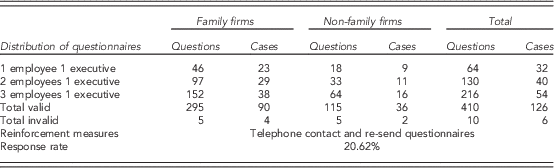
Table 1 shows the distribution of the final sample, as well as the data collection period and the reinforcement measures used to incentivize responses.
Sample characteristics

A response rate of 20.62% was obtained. The total sample consisted of 410 valid questionnaires from 126 different firms (90 family firms and 36 non-family firms). Of the 410 valid questionnaires, 295 were from the 90 family firms and 115 were from the 36 non-family firms. According to the European Union definitionFootnote 2 , most of the firms in the sample are small- to medium-sized firms. Some 98% have fewer than 250 employees, 90% have a turnover of less than €50 million, and 96% have a balance sheet total of less than €43 million.
We structured Table 1 according to whether we received questionnaires from: one executive and one employee; one executive and two employees; or one executive and three employees in each family or non-family firm.
The distribution of our sample between family firms (71.4%) and non-family firms (28.6%) is in line with the situation found by the Spanish Family Firm Institute, which estimates the percentage of family firms in the Spanish economy at 80%.
Measures
To measure identification, involvement, and loyalty we used the Buchanan (Reference Buchanan1974) scales, which have Cronbach’s α coefficients of 0.86, 0.84, and 0.92, respectively. To measure trust, we used the Cook and Wall (Reference Cook and Wall1980) scale, which has Cronbach’s αs of 0.85 and 0.80 in two studies. Participation was measured using the Vroom (Reference Vroom1960) scale with a Cronbach’s α of 0.85, while group cohesion was measured using Beehr’s (Reference Beehr1976) scale, whose author does not give a Cronbach’s α value. Finally, we measured leadership using the Carless, Wearing, and Mann (Reference Carless, Wearing and Mann2000) scale, which has a Cronbach’s α of 0.93.
Once the provisional structure of the questionnaire was complete, we verified reliability, concise parameterization, individual item reliability and validity, in order to demonstrate its utility and precision as a measuring instrument (Appendix shows the definitive version of the questionnaire). To verify these properties, we used a total of 58 questionnaires that we received after distributing the pilot questionnaires.
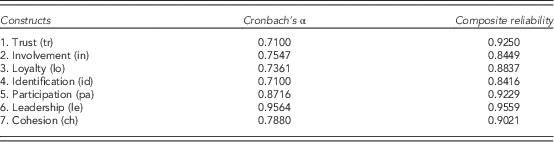
The reliability test was carried out using the Cronbach’s α and composite reliability coefficients, as recommended by Nunally (Reference Nunnally1987), Peterson (Reference Peterson1994), and Vernette (Reference Vernette1995), whereby a scale is reliable when the Cronbach’s α and composite reliability coefficients are ≥0.7. Table 2 shows the definitive values for these coefficients.
Construct reliability

As it was not possible to find a combination of items from the involvement scale used with a Cronbach’s α≥0.7, we decided to substitute this for another scale that had been used with Spanish firms and had obtained acceptable Cronbach’s α values. Specifically, the Lodhal and Kejner (Reference Lodahl and Kejner1965) reduced scale of 6 items was used. The reliability of this scale measured through the Cronbach’s α ranges from 0.62 to 0.93 (González & De Elena, Reference González and De Elena1999). Moreover, Gónzález-Roma, Espejo, and Hernández (Reference Gónzález-Roma, Espejo and Hernández1994) use this reduced version with a sample of 298 employees from Spanish firms and obtain a Cronbach’s α of 0.80.
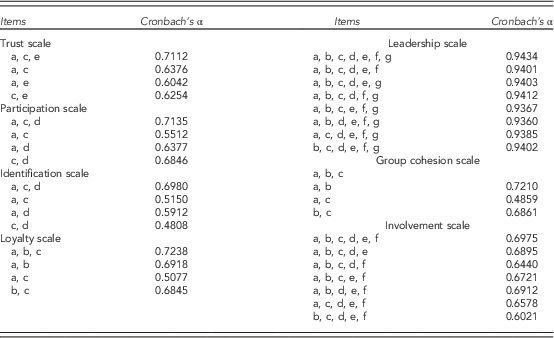
With regard to the concise parameterization or simplicity, we can confirm that the scales in question comply with this requisite because eliminating any of the items in each scale reduces the Cronbach’s α (as Table 3 demonstrates).
Concise parameterization of scales

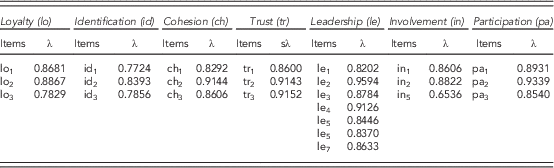
Table 4 shows the results of individual item reliability. This property was evaluated examining the loadings (λ) or simple correlations of the items or indicators on their respective constructs or factors (trust, loyalty, participation, group cohesion, leadership, involvement, and identification). For this purpose, Chin and Frye’s (Reference Chin and Frye1998) statistical program partial least square-Graph (PLS-Graph version 2.91.03.04) was used. Individual item reliability is considered adequate when an item has a factor loading ‘λ’ >0.7 (Carmines & Zeller, Reference Carmines and Zeller1979).
Individual item reliability

All the items in the measurement scales have loading values ‘λ’ of at least 0.7 except ‘in5.’ Nevertheless, this item, with loading value ‘λ’ of 0.6536, is very close to the recommended minimum value 0.7, so we decided to maintain it as a measurement item for its variable.
To determine the validity of the scales used, we evaluated the content validity and the concept or construct validity. The content validity was verified by the source of the scales, which have been validated and used by their authors and other researchers. The concept or construct validity in its convergent and divergent (or discriminant) aspect was evaluated using the Chin and Frye (Reference Chin and Frye1998) statistical program PLS-Graph version 2.91.03.04.
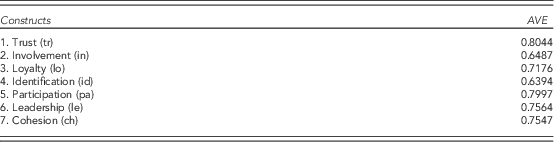
To evaluate the convergent validity, we examined the average variance extracted (AVE), created by Fornell and Larcker (Reference Fornell and Larcker1981). For convergent validity to exist, this indicator should take on values ≥0.5. In Table 5, we report the AVE values and show that all the scales comply with the requisite of convergent validity.
Convergent validity

AVE=average variance extracted.
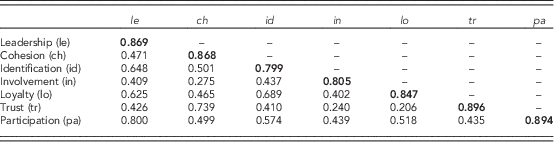
Finally, to assess divergent validity AVE should be greater than the variance shared between the construct and other constructs in the model (i.e., the squared correlation between two constructs). For adequate divergent validity, the diagonal elements should be significantly greater than the off-diagonal elements in the corresponding rows and columns (Barclay, Higgins, & Thompson, Reference Barclay, Higgins and Thompson1995). Similarly, the divergent validity can be assessed by demonstrating that simple correlations between two constructs are lower than the squared root of the AVE indicator. In Table 6, we show the values resulting from these calculations. All the scales comply with the requisite of divergent validity, following the criterion specified by Barclay, Higgins, and Thompson (Reference Barclay, Higgins and Thompson1995) for whom a scale has divergent validity if, substituting the squared root of the AVE values for all the coefficients on the main diagonal of the correlation matrix, these square roots are higher than any other values in the same file or column.
Divergent validity

RESULTS
This section presents the results obtained from testing the hypotheses of this work. To test the hypotheses we used the Mann–Whitney U test for two independent samples and a one-factor analysis of variance.
We used non-parametric statistics and analysis of variance as a consequence of the ongoing controversy about the analysis of ordinal variables. There are various approaches in analyzing ordinal variables. One approach suggests that it is possible to apply parametric statistics to analyze ordinal variables. Another approach suggests that it is not possible to apply parametric statistics to analyze ordinal variables and that non-parametric statistics should be applied. Accordingly, we decided to apply both parametric and non-parametric statistics (Kampen & Swyngedouw, Reference Kampen and Swyngedouw2000; Harwell & Gatti, Reference Harwell and Gatti2001).
To ensure that we could proceed with the tests, we previously carried out the following transformations on the variables. For the variables whose measuring scales formed part of the employee questionnaire we obtained one, two, or even three different responses from the same firm – so a series of new variables representing the mean value of the responses on each of the items was created.
For all the variables, we also calculated new variables whose values would be the mean of the scores of each item in all the scales across all the firms (family and non-family firms).
As the transformations of the variables described above might influence the consistency of the results eventually obtained with respect to the existence of statistically significant differences between family and non-family firms in terms of the cultural variables considered, we decided to carry out a series of additional analyses to verify this consistency.
Thus, we first applied the Mann–Whitney U test for two independent samples, taking as independent variables the family nature or otherwise of the firm, and as dependent variables the standard deviation of each of the items observed among the employees (with the intention of deciding if the results could vary in function of whether the information obtained came from one, two, or three employees). The results of this test reveal that at a significance level of .001 no statistically significant differences exist in the standard deviations of each item in function of whether the firms are family firms or not.
The results of the second test (the Kruskal–Wallis for K independent samples) using as independent variables the number of employees responding in each firm (one to three), and as dependent variable the scores of each of the items used to observe the cultural aspects in question, reveal that at a significance level of .001 no statistically significant differences exist in the perceptions of the different employees (maximum three) interviewed in each firm for each item used to measure these values (a total of 28).
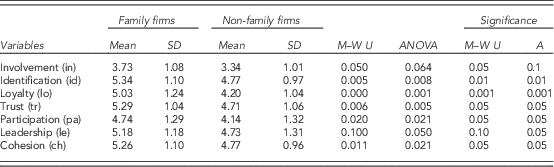
Subsequent to the necessary transformations, Table 7 shows the results after applying the Mann–Whitney U and analysis of variance tests to determine if there are variable-by-variable differences between family and non-family firms.
Differences between family and non-family firms

M–W U=Mann–Whitney U; ANOVA=analysis of variance.
As Table 7 shows, all seven of the hypotheses (H1–H7) are confirmed, which means that in family firms non-family employees show higher levels of loyalty (H1), identification (H2), involvement (H4), trust (H5), group cohesion (H6), and participation (H7), and the leadership is more transformational (H3).
The confirmation of all the proposed hypotheses enables us to say that in family firms the relationship established between the owning family and non-family employees tends to be more a principal–steward relationship than the relationship found in non-family firms. For this reason, family firms are better incubators for ethical behavior than non-family firms.
DISCUSSION
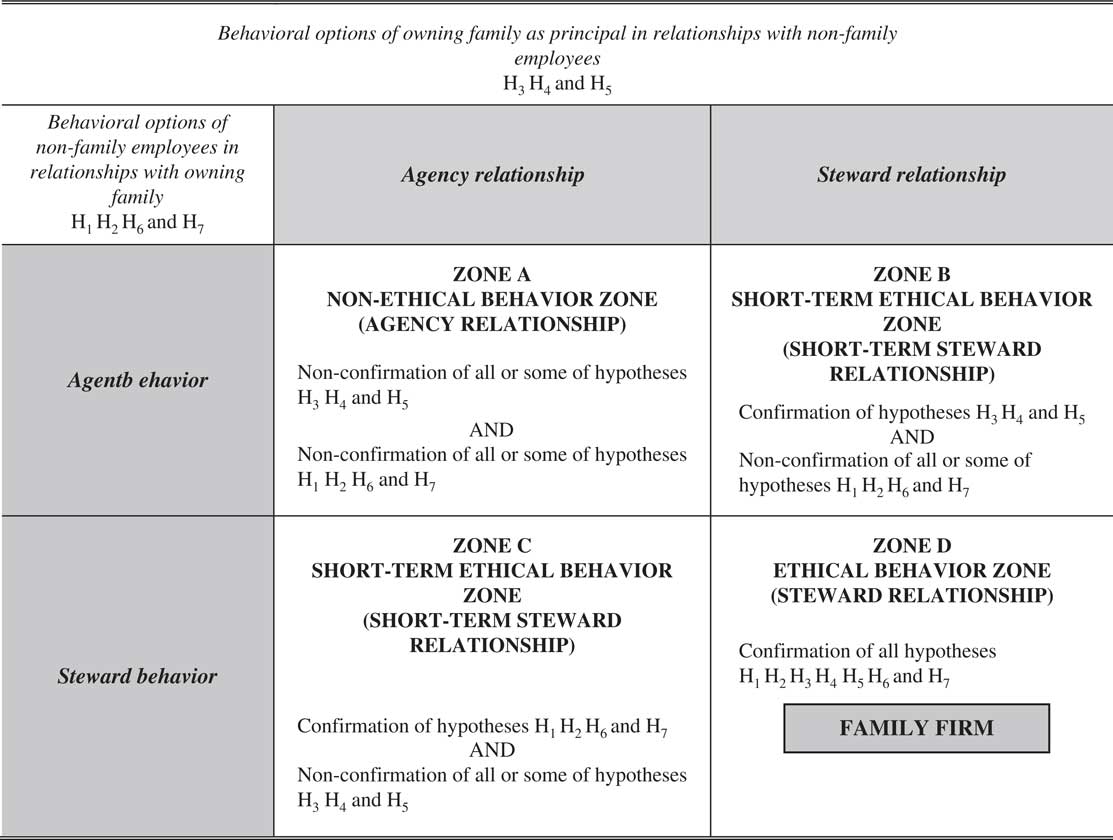
The psychological and situational factors that Davis, Schoorman, and Donaldson (Reference Davis, Schoorman and Donaldson1997a) identify as differential dimensions of agency and steward relationships make it more likely that in family firms the relationships between the owner family and the non-family employees will be of the principal–steward type, rather than the principal–agent type. The reason for this lies in the attitude of both parties. By looking at the discussion in the theoretical section about the hypotheses concerning the behavior and attitudes of the owner family/principal (H3–H5) and those concerning the behavior and attitudes of the non-family employees/agents or stewards (H1, H2, H6, and H7), it can be seen that the Davis, Schoorman, and Donaldson (Reference Davis, Schoorman and Donaldson1997a) model characterizes the relation between the owner family and the non-family employees as a principal–steward relationship (zone D in Figure 1).
Ethical behavior model in family firm
Source. Davis, Schoorman, and Donaldson (Reference Davis, Schoorman and Donaldson1997) and the authors
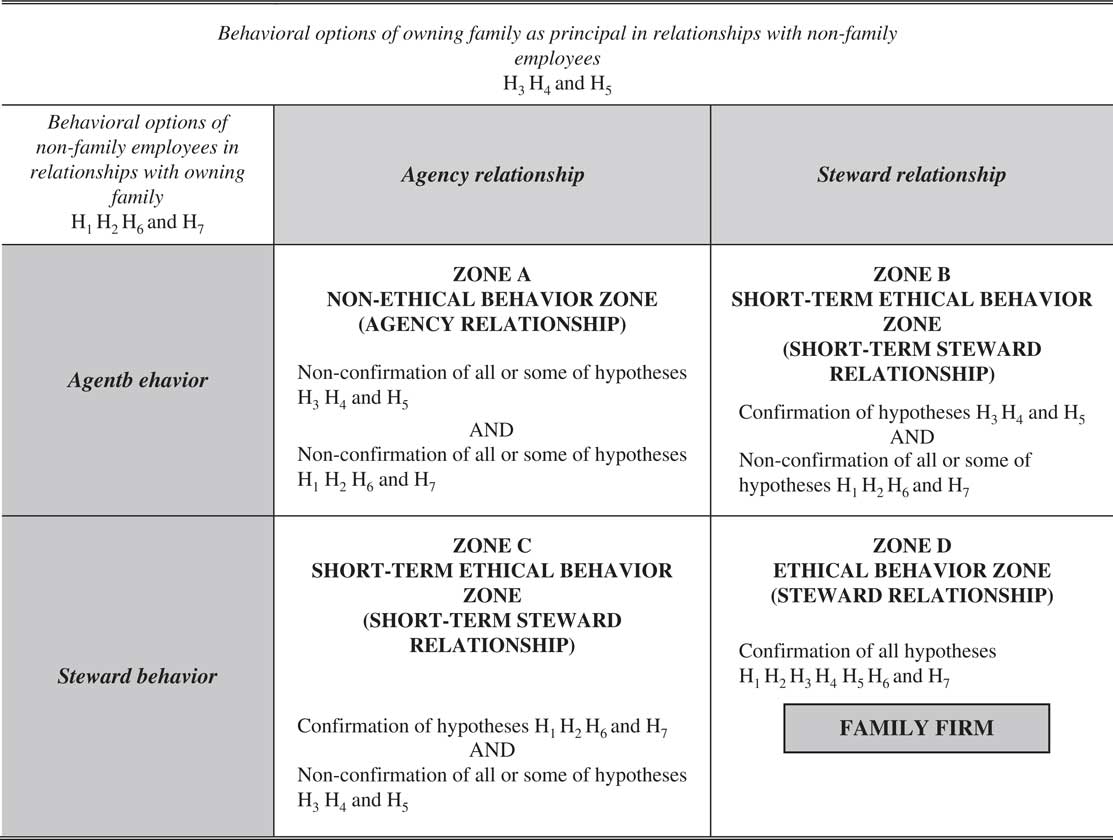
Zone D is clearly an ethical behavior zone and can be called the family firm zone. In this zone, the behavior of both owner family and non-family employees encourages the existence of a principal–steward relationship. A principal–steward relationship can be generated in which the owner family accepts that the management should be oriented toward achieving the involvement (H4) and trust (H5) of the employees. At the same time, the leadership exercised is transformational (H3), in other words, based more on personal power than on institutional power. Finally, the non-family employees show high levels of loyalty (H1), identification (H2), group cohesion (H6), and participation (H7). This situation will facilitate the establishment of lasting relationships between both stakeholders given that their behavior is not opportunistic, egotistical, or individualistic. As a consequence, formal systems of control are not necessary to guarantee ethical behavior.
The relationships understood and maintained in the sense described in zone D contribute to reducing or eliminating the cost of ethical failures. In this sense, Thomas, Schermerhorn, and Dienhart (Reference Thomas, Schermerhorn and Dienhart2004) describe the potential business costs of ethical failures on three levels. The level 1 costs of ethical failure concern stakeholders of whom executives are most keenly aware: themselves, their company, and the government. These are the costs of fines and penalties following lawsuits or convictions that arise from ethical failures. Level 2 costs are primarily administrative in nature: the ‘clean-up’ costs. These include attorney and audit fees, investigative costs, and the cost of remedial actions, and are frequently buried within the general costs of doing business. Level 3 costs are the most difficult to quantify. They include customer defection, reputation loss, morale loss, employee and government cynicism, and, ultimately, increased government regulation.
In addition, principal–steward relationships have positive effects on family firms as they ensure a group of loyal and talented employees to keep the firm afloat (Miller & Le Breton-Miller, Reference Miller and Le Breton-Miller2006); attract high-quality and talented people because the working conditions act as a market signal that attracts this type of candidate (Williams & Bauer, Reference Williams and Bauer1994); facilitate strategic flexibility in response to changes in the environment, as employees will be more willing to take risks and explore new strategic options (Zahra et al., Reference Zahra, Hayton, Neubaum, Dibrell and Craig2008); and guarantee the continuity or longevity of the firm (Miller, Breton-Miller, & Scholnick, Reference Miller, Le Breton-Miller and Scholnick2008). In short, the firm will be able to maximize its full potential (Arthurs & Busenitz, Reference Arthurs and Busenitz2003) and achieve superior performance (Davis, Schoorman, & Donaldson, Reference Davis, Schoorman and Donaldson1997a; Dvir, Eden, Avolio, & Shamir, Reference Dvir, Eden, Avolio and Shamir2002; Eddleston & Kellermanns, 2006).
In contrast, if some or all of the hypotheses had not been confirmed, the resulting relationships would correspond to those of zones A, B, or C in the Davis, Schoorman, and Donaldson (Reference Davis, Schoorman and Donaldson1997a) model (see Figure 1).
Zone A is a clear non-ethical behavior zone. Behavior in this zone implies that the owner family and the non-family employees encourage the existence of an agency relationship between them, with some or all of the hypotheses concerning the behavior of the owner family being rejected, along with some or all of the hypotheses concerning the behavior of the non-family employees. The owner family might exercise a transactional leadership based on imposition and institutional power, or favor a management not oriented to involving the employees, or not oriented to achieving their trust, or several of these behaviors simultaneously. In turn, the employees could behave individualistically or their behavior could have external motivations. They would show low levels of loyalty, or identification, or group cohesion, or participation, or several of these simultaneously. Consequently, this would be an agency relationship founded on a management philosophy oriented toward formal systems of control and minimization of agency costs.
The other two zones (B and C) represent a situation in which the behavior of one of the parties (owner family or non-family employee) encourages the existence of an agency relationship between them, while the other encourages a steward relationship. They are short-term ethical behavior zones. In both cases, only the hypotheses determining the behavior of the participant who encourages a steward relationship would be confirmed in their entirety. In the short run, the result would be a steward relationship, but this would evolve toward an agency relationship in the medium to long term because one of the parties would adopt an individualistic orientation.
Thus, when the party whose behavior promotes the existence of a steward relationship is the employee (zone C), only H1, H2, H6, and H7 would be confirmed in their entirety. In this situation, the employee would show high levels of loyalty (H1), identification (H2), group cohesion (H6), and participation (H7). In contrast, the non-confirmation of some or all of the hypotheses determining the owner family’s behavior (H3–H5) would mean that the management is not oriented to achieving the involvement of the employees (H4), or gaining their trust (H5), or the leadership is transactional (H3), or several of these behaviors simultaneously. The non-family employee would then be unlikely to behave as a steward beyond the short term as the owner family’s attitude would result in strong control mechanisms that would end up frustrating and de-motivating the employee. In these circumstances, in the medium to long term the employee would begin to behave as an agent, and so the potential relationship between the owner family and the non-family employees would eventually become an agency relationship. This reasoning enables us to consider zone C as a non-ethical behavior zone.
When only the owner family’s behavior encourages the existence of a steward relationship (zone B) only H3–H5 would be confirmed in their entirety. The owner family would adopt a management philosophy oriented to gaining the trust (H4) and involvement (H5) of the employees and its leadership would be transformational (H3). The non-confirmation of some or all of the hypotheses determining non-family employee behavior (H1, H2, H6, and H7) would mean that the employees are not loyal (H1), or do not identify with the firm (H2), or lack group cohesion (H6), or show low levels of participation (H7), or various of these simultaneously. In this situation, the owner family (principal) would be unlikely to see its contractual relationship with the non-family employees as a steward relationship beyond the short run because of the individualistic and opportunistic attitude of the employees, who are behaving more as agents than stewards. In the medium to long term the owner family would feel disappointed, and would consequently begin to apply control mechanisms, use its institutional power, and exercise a transactional leadership. Thus, the potential contractual relationship between the owner family and the non-family employees would eventually become an agency relationship, and like zone C, zone B would become a non-ethical zone.
CONCLUSIONS, LIMITATIONS, AND FUTURE LINES OF RESEARCH
This study’s main contribution to the literature is its finding that family firms possess certain characteristics compared with non-family firms that make them better incubators for ethical behavior. The behavior of the owner family and non-family employees encourages the existence of principal–steward relationships in these firms rather than principal–agency relationships.
With regard to the performance of family firms, the current findings show that it would be counter-productive to try to orient or redirect the relationships between the owner family and the employees toward an agency relationship. Doing this would harm the owner family in two ways. First, the family would be foregoing the performance-maximizing effects of the steward relationship; and second, the family would be encouraging the negative effects of an agency relationship that neither party wants, as the employees would feel mistreated by the principals (the owner family). If the family firm can establish steward relationships, the owners should take advantage and orient their human resource management accordingly.
In addition, family firms – in comparison to non-family firms – are better able to face and respond to increasing pressures from stakeholders (including stockholders, communities, and governments) to manage employee behavior in ways that will reduce illegal and unethical conduct by individuals.
Another important conclusion of this work is its contribution to the field of ethics in family firms, starting from two theories widely accepted in the field of business administration. A common complaint about research on family firms to date is that the theory lacks solidity. Clearly, confirmation of the utility of stewardship theory as a theoretical framework to explain ethical behavior in family firms, through the analysis of the relationships between owner families and their employees, would help establish this necessary solidity. In addition, most work on stewardship theory and family firms has focused on how family relationships (ownership structure, management, culture, etc.), either agency or steward, could affect the family firm, and specifically its performance (Kellermanns & Eddleston, Reference Kellermanns and Eddleston2004; Eddleston & Kellermanns, 2006; Miller & Le-Breton-Miller, 2006; Westhead & Howorth, Reference Westhead and Howorth2006; Zahra et al., Reference Zahra, Hayton, Neubaum, Dibrell and Craig2008).
Finally, we emphasize in the ‘Methodology’ section that most of the family businesses studied are small or medium in size. Consequently, the main results and conclusions obtained in this work can also be extended to micro and small- and medium-sized businesses. Therefore, despite the lack of a specific empirical comparison, it would not be unreasonable to think that micro, small, and medium enterprises are better incubators for developing ethical behavior than large firms. New studies to test the existence of such differences in terms of size would be an interesting line of future research.
This research work has a number of limitations, which should be considered when interpreting its findings. The most significant are as follows.
The need to obtain information from employees (who may have felt insecure from the labor perspective) could have led to a bias toward high scores on various scales. This would diminish the authenticity and hence the meaning of the results. This is true despite the fact that during the design of the data collection instrument and in the subsequent field work, we took all feasible measures to minimize the risk of this happening.
We established the concept and criteria employed to determine whether a firm is a family firm or not (in view of the lack of unanimity in the scientific community as to what the concept means and which characteristics distinguish a family from a non-family firm).
Finally, some of the scales used to measure the variables are relatively small, as it was important to use the shortest possible questionnaire to encourage a high response rate despite the quantity of variables included and the use of normal mail to send the questionnaire. This may have increased the measurement error.
A number of possible lines of research lead on from the current work. It would be interesting to investigate the reasons for the existence of higher levels of loyalty, identification, involvement, trust, group cohesion, and participation in family firms, as well as for the transformational leadership exercised. Future research should investigate how and why the family nature of the firm leads to a greater intensity of this set of characteristics in family firms.
It would also be interesting to study family conflicts – a constant threat to the firm’s survival – from the perspective of stewardship theory. It is necessary to understand the critical aspects in intergenerational conflicts, as well as in the conflicts between the owner family and their non-family employees, to generalize stewardship theory in the field of the family firm.
Finally, another line of research following on from the current work would be to generalize its findings by replicating the study in other industries.
ACKNOWLEDGEMENT
We would like to thank Santander Bank for its finnancial support, this research and publication wouldn’t have been possible without it. Thanks to all our collegues of the Cátedra Santander of Family Firm of the University of Jaén (Spain) for their day-by-day collaboration and support too.
APPENDIX
EMPLOYEES’ QUESTIONNAIRE:
-
A) The respondents were requested to indicate their level of agreement/disagreement with each of the following assertions on a Likert scale of 1–7 points, with 1 representing total disagreement and 7 total agreement.
Group cohesion
-
a) Work colleagues defend each other from criticism by people from outside the firm.
-
b) If I have difficulties in work, I am convinced that my colleagues will try to help me.
-
c) I consider the majority of people with whom I work are friends as well as colleagues.
Participation
-
d) Most managers in my firm are used to asking employees for their opinions in order to resolve problems that arise when carrying out their tasks.
-
e) In my firm we are constantly encouraged to inform a superior of any suggestion we might have for improving a work position, activity, or product.
-
f) In general, people who ask questions and have new ideas are highly valued and supported in this firm.
Trust
-
g) I think the majority of my workmates are sincere and do what they say they will do.
-
h) I think the majority of my workmates are highly qualified to do their jobs well.
-
i) I think the majority of my workmates carry out their tasks even when the supervisors are not present.
Identification
-
j) If I had to start my working life again, I would like to work in this firm.
-
k) When I chat with my colleagues about the firm we almost always say bad things about it.
-
l) I would advise anybody looking for work not to work in this company.
Loyalty
-
m) I think I would be more satisfied in any other firm doing exactly the same work that I do now.
-
n) If another firm offered me more money for doing the same type of work, I would almost certainly accept.
-
o) In general, I feel that anybody working in this firm would like to work here until retirement.
Involvement
-
p) The greatest satisfactions in my life come from my work.
-
q) The most important things that happen to me have to do with my work.
-
r) I am very much a perfectionist in my work.
-
s) I live, eat, and breathe for my work.
-
t) I am very involved with my work.
-
u) Most things in life are more important than work.
-
-
B) Leadership
To measure the transactional/transformational leadership respondents were requested to indicate their level of agreement/disagreement with each of the following assertions on a Likert scale of 1–7 points, with 1 representing total disagreement and 7 total agreement
The owners-managers or executives of this firm:
-
a) Transmit a positive and clear vision of the future of the firm.
-
b) Treat the staff personally, supporting, and encouraging their professional promotion.
-
c) Give encouragement and recognize staff achievements.
-
d) Promote trust, involvement, and cooperation among staff members.
-
e) Encourage staff to think of new methods of resolving problems and question traditional methods.
-
f) Are clear with respect to their values and lead by example.
-
g) Instill pride and respect for others and have won my respect for being highly skilled.
-
OWNERS/EXECUTIVES’ QUESTIONNAIRE