Patients with single ventricle physiology who have completed staged Fontan palliation lack a sub-pulmonary pumping chamber leading to impaired venous return to the heart. This limits their ability to increase cardiac output during exercise, especially in the presence of ventricular systolic or diastolic dysfunction. Reference Goldberg, Avitabile, McBride and Paridon1 These patients also frequently have impaired cardiac, pulmonary, and hepatic function that results in adverse outcomes such as an increased risk of hospitalisation, cardiac transplantation, and mortality. A primary predictor of these adverse outcomes is poor cardiopulmonary fitness as measured by cardiopulmonary exercise stress testing. Reference Diller, Giardini and Dimopoulos2–Reference Ohuchi, Negishi and Noritake5 Multiple studies have demonstrated that cardiopulmonary fitness measured via peak oxygen consumption is significantly lower in those with single ventricular physiology compared to healthy peers. Reference Hebert, Jensen and Mikkelsen6,Reference Paridon, Mitchell and Colan7
Ventricular function and deformation are important determinants of cardiac output, which should impact peak oxygen consumption. Strain analysis provides insight into mechanical discoordination and electro-mechanical dyssynchrony, which can adversely affect cardiac output and lead to poor outcomes in the single ventricle population. Reference Ishizaki, Nagao and Shiina8–Reference Rosner, Khalapyan and Pedrosa11 However, the relationship between echocardiographic measures of ventricular function and deformation and peak oxygen consumption has not been well studied in the Fontan population. Previous studies have demonstrated modest correlations between peak oxygen consumption and traditional echocardiographic markers of diastolic dysfunction Reference Goldstein, Connor, Gooding and Rocchini12 as well as tricuspid annular systolic excursion. Reference Goldberg, French and Szwast13 The purpose of this study is to evaluate the associations between peak oxygen consumption and echocardiographic measures of ventricular function/deformation, including ventricular global longitudinal strain, discoordination, and dyssynchrony in a sample of children and adolescents with single ventricular physiology following Fontan palliation.
Materials and methods
Study population
This is a single centre, cross-sectional study that prospectively recruited patients with single ventricular physiology post-Fontan palliation from 12/2015 to 1/2017. Children and adolescents aged 8–21 years were eligible for the study. Patients were excluded if they had inadequate echocardiographic acoustic windows to make basic measurements, had physical disabilities limiting their ability to perform a peak cardiopulmonary exercise test, were on beta-blocker therapy, or were <132 cm tall, which represents the minimum height required to use the cycle ergometer. This study was approved by the Institutional Review Board and assent/consent was obtained for all patients.
Echocardiography
Echocardiograms were performed immediately prior to the exercise stress test using the GE Vivid E9 (GE Healthcare, Milwaukee, Wisconsin, United States of America). Two-dimensional, colour, and spectral Doppler measurements of all chambers and valves, as well as tissue Doppler at the annulus (Fig 1), were obtained. E and A waves were measured on a pulse wave Doppler and reported for the dominant atrioventricular valve. Tissue Doppler derived e’ and measurements for the Tei index Reference Khoo, Smallhorn, Kaneko, Myers, Kutty and Tham14 were reported at the lateral annulus of the dominant ventricle. Systolic duration (ejection time + isovolumic time) to diastolic duration (total cycle length – systolic duration) ratios were calculated on lateral tissue Doppler for the dominant ventricle. Annular plane excursion was measured at the lateral annulus of the dominant ventricle for single left ventricular or single right ventricular morphologies. In biventricular morphology, the average value of the annular plane excursion for both lateral annuli was reported. Qualitative ventricular function and atrioventricular valve regurgitation (for both valves if two were present) were graded as normal, mild, moderate, or severe. A single observer (SG) who was blinded to exercise and clinical data performed these two-dimensional and Doppler echocardiographic measurements.
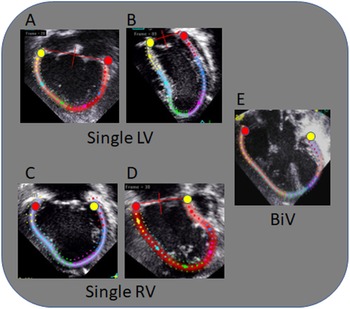
Examples of strain tracking region of interest and tissue Doppler sampling location for the various single ventricular morphologies represented in this study. The red dot shows the prescribed tissue Doppler imaging sampling location of the dominant ventricular annulus, and the yellow locates the other sampling location (septal versus non-dominant ventricle). Single LV: A) with no substantial RV mass and B) with a hypoplastic RV and no ventricular septal defect. Single RV: C) with no substantial LV mass and D) with a hypoplastic LV, no ventricular septal defect, and no outflow. Biventricular anatomy: E) with a right dominant unbalanced atrioventricular septal defect.

Echocardiographic two-dimensional speckle tracking global strain analysis
One cardiac cycle of the “4-chamber” equivalent apical view was analysed off-line for two-dimensional speckle tracking strain on GE EchoPAC (PC version BT13) after direct image transfer to EchoPAC at acquired frame rates (51–82 frames per second). A single experienced reader (DF) performed all strain analyses blinded to all other study data. The single ventricular endocardial border was traced in end-systole for longitudinal speckle tracking. The full thickness region of interest was adjusted to exclude the pericardium and papillary-chordal structures over one cardiac cycle. The strain wall tracking methodology used in this study has been used previously by multiple groups. Reference Rosner, Khalapyan, Dalen, McElhinney, Friedberg and Lui10,Reference Rosner, Khalapyan and Pedrosa11,Reference Campbell, Quartermain and Cohen15 In patients with only one ventricle and no visible mass from the hypoplastic/absent ventricle, only two walls were capable of being measured (A and C in Fig 1). In those with ventricular mass from two ventricles and an unrestrictive ventricular septal defect, the left and right ventricular lateral walls were tracked in this protocol (E in Fig 1) and the septum was excluded. In patients with one severely hypoplastic ventricle, an intact ventricular septum, and no significant outflow, the dominant ventricular wall and septum were tracked (B and D in Fig 1). In general, if a non-restrictive ventricular septal defect was present, the septum was not tracked.
The adequacy of segmental strain tracking was automatically detected by the software and visually confirmed in the six segments. Segments were excluded for persistent inadequate tracking. Strain analysis was included if four or more segments were adequately tracked. The QRS reference was placed at the onset of the QRS to ensure consistency and inclusion of early pre-ejection events. Global longitudinal strain based on the “length of a line” method was reported. Global longitudinal systolic strain rate and global longitudinal early diastolic strain rate were also measured. Systolic longitudinal strain measures (global longitudinal strain and strain rate) are negative by convention, and larger negative numbers represent better function (e.g., global longitudinal strain of −22% is indicative of better function than −12%). Global longitudinal early diastolic strain rate is positive by convention.
Echocardiographic speckle tracking discoordination and electro-mechanical dyssynchrony strain analysis
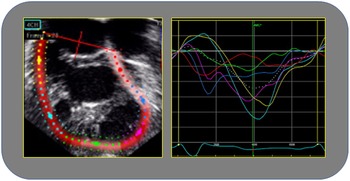
Discoordination is a non-specific measure of mechanical abnormalities in the timing of regional contraction of a ventricle that can be a result of multiple factors. Discoordination is measured quantitatively by evaluating regional time to peak strain differences within a ventricle. In contrast, the electro-mechanical dyssynchrony pattern identifies a specific subset of discoordination with mechanical dyssynchrony caused by an underlying electrical activation delay. This strain pattern identifies paradoxical regional wall motion within the ventricle consistent with an underlying activation delay. Reference Forsha, Risum and Barker9,Reference Forsha, Risum and Smith16,Reference Risum, Jons and Olsen17 Time to peak strain was measured in each of the six segments, and time to peak discoordination index was calculated as the standard deviation of the time to peak strain measure for those segments. Reference Moiduddin, Texter and Zaidi18 Time to peak discoordination index >30 ms has been defined as abnormal in adults with normal cardiac anatomy. Reference Gorcsan, Abraham and Agler19 No threshold of abnormal coordination has been defined in the Fontan population. The strain electro-mechanical dyssynchrony pattern analysis (Fig 2) was used to identify patients meeting criteria of early aborted contraction in the basal septum (or non-dominant ventricular basal wall closest to the atrioventricular node) with paradoxical early systolic stretch and late peaking contraction in the delayed dominant lateral wall as previously published in two-ventricular anatomies Reference Forsha, Risum and Barker9,Reference Forsha, Risum and Smith16,Reference Forsha, Slorach and Chen20 and in the Fontan population. Reference Rosner, Khalapyan, Dalen, McElhinney, Friedberg and Lui10
The strain pattern of electro-mechanical dyssynchrony in hypoplastic left heart syndrome with early aborted contraction in the septal segments (red/dark blue) and early stretch and late contraction in the RV lateral segments (yellow, light blue).

Cardiopulmonary exercise test
Cardiopulmonary exercise testing was performed within 1 hour following the echocardiogram on an upright cycle ergometer (LODE, Groningen, The Netherlands) using the James cycle protocol consisting of 3-minute stages, resistance increments based on body surface area, and standard pedal cadence of 60–80 revolutions per minute. Reference James, Kaplan, Glueck, Tsay, Knight and Sarwar21 A Parvo Medics TrueOne 2400 breath-by-breath metabolic system (Salt Lake City, Utah, United States of America) with appropriately sized Hans Rudolph oronasal facemask and two-way non-rebreathing valve (Kansas City, Kansas, United States of America) was used for continuous measures of oxygen consumption during exercise. Oxygen consumption was averaged every 30 s throughout the exercise test. Patients were encouraged to exercise until they self-terminated the study due to their own sense of fatigue. Exercise was considered peak if the respiratory exchange ratio was ≥1.0 and patients were unable to maintain at ≥60 revolutions per minute pedal cadence consistent with prior methodology in the Fontan population. Reference Stocker, Neidenbach and Fritz22 The patient’s data were excluded from this study if the patient failed to meet peak exercise criteria.
Relative measures of peak oxygen consumption (ml/kg/minute) were used rather than percent predicted peak oxygen consumption for two primary reasons. First, normative data used for calculating percent predicted peak oxygen consumption are derived from populations of youth with normal cardiac anatomy, and peak oxygen consumption is known to trend differently with age in the Fontan population during childhood and adolescence compared to their normal peers. Reference Pate, Wang, Dowda, Farrell and O.'Neill23–Reference Giardini, Hager, Pace Napoleone and Picchio25 Thus, the use of percent predicted peak oxygen consumption in the Fontan population may bias outcomes in patients in later adolescence. Second, the use of percent predicted oxygen consumption would limit the sample size, as norms for percent predicted peak oxygen consumption are unavailable in those >18 years of age. As a result, a statistical approach was applied to control for differences in peak oxygen consumption based on age and sex.
Statistical analysis
Descriptive statistics were reported using mean, standard deviation, and proportions to summarise the data after testing for normalcy of the data. Group comparisons of continuous variables were made using t-tests. Categorical variables were compared between groups using Fisher’s exact tests. Relationships between continuous variables were analysed using Pearson or Spearman correlations and univariate modelling. Multivariate modelling was used to look for independent relationships between those variables found to have a significant relationship with peak oxygen consumption on univariate analysis while controlling for age and sex. A significance level of 0.05 was used, and all analyses were done using SAS version 9.4 (SAS Institute Inc., Cary, North Carolina, United States of America).
Results
Demographics and ventricular morphology
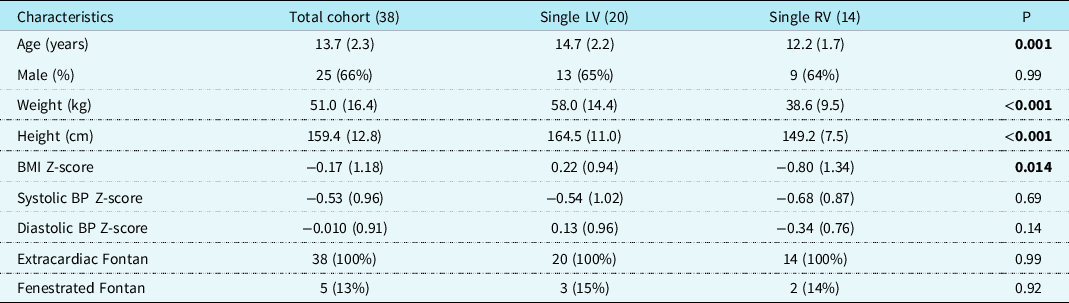
Of the 43 patients, five (12%) were excluded: one withdrew prior to data collection, one had inadequate echocardiographic windows, two were excluded due to study protocol deviations (echo images were inadvertently deleted from the machine prior to transfer to EchoPAC), and one for failing to meet peak exercise criteria (respiratory exchange ratio = 0.98). Thus, 38 children and adolescents met exercise and echocardiography inclusion criteria with a mean age of 13.7 ± 2.3 years and a minor male predominance (n = 25, 66%). Data on demographics and cardiac anatomy for the study cohort are reported in Table 1. For this study population, body mass index was in the normal range (body mass index z-score −0.17 ± 1.18) as was blood pressure (systolic blood pressure z-score −0.53 ± 0.96; diastolic blood pressure z-score −0.010 ± 0.91). Twenty patients (53%) were classified as having dominant left ventricle anatomy, 14 had dominant right ventricle anatomy (36%), and four had biventricular anatomy (11%). The patients with dominant left ventricle consisted of eight (21%) with double inlet left ventricle and severe right ventricular hypoplasia, nine (24%) with tricuspid atresia, and three (8%) with tricuspid and pulmonary atresia. Those with a dominant right ventricle consisted entirely of hypoplastic left heart syndrome or variants with severely hypoplastic left ventricle. The biventricular group (two with unbalanced atrioventricular septal defect and two with ventricular septal defect, transposition of the great arteries, and straddling atrioventricular valve) was not included in sub-group comparisons due to the small sample size.
Demographics and cardiac data for the total cohort and comparison between single LV and single RV sub-groups reported at mean (standard deviation) or n (%). Left ventricle (LV); right ventricle (RV); body mass index (BMI); blood pressure (BP).

Feasibility of echocardiographic measurements
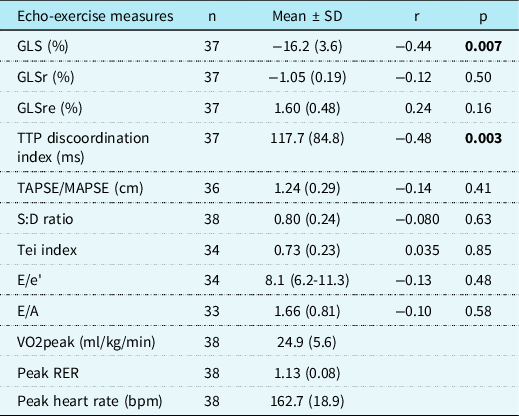
The number of echocardiograms in which each measurement was made successfully is shown in Table 2. Only a single study was inadequate for strain measurements. Four studies did not have adequate tissue Doppler imaging obtained. In five studies, there was either fusion of the E and A waves (n = 4) or an inadequate spectral Doppler imaging for E and A wave measurement (n = 1).
Total cohort echocardiographic and exercise measures with the relationship between echocardiographic measures and peak oxygen consumption (VO2peak) on univariate analysis. Standard deviation (SD); global longitudinal systolic strain (GLS); global longitudinal systolic strain rate (GLSr); global longitudinal early diastolic strain rate (GLSre); time to peak discoordination index (TTP index); milliseconds (ms); tricuspid (or mitral) annular plane systolic excursion (TASPE/MAPSE); systolic to diastolic duration ratio (S:D).

Exercise and echocardiographic measurement relationships
The mean cohort peak oxygen consumption was 24.9 ± 5.6 ml/kg/minute at a respiratory exchange ratio of 1.13 ± 0.08 and a mean peak heart rate of 162.7 ± 18.8 bpm. Atrioventricular valve regurgitation was none (n = 30; 79%), mild (n = 5; 13%), or moderate (n = 3; 8%) and was not correlated with peak oxygen consumption (r = –0.256, p = 0.121). Echocardiographic data are provided, along with their relationship to peak oxygen consumption, in Table 2. Global longitudinal strain is correlated with peak oxygen consumption (r = –0.435; p = 0.007); greater (negative) strain correlates with higher peak oxygen consumption values. Neither global longitudinal systolic strain rate nor global longitudinal early diastolic strain rate was correlated with peak oxygen consumption. Qualitative ventricular function was normal in 34 patients (89%), mildly diminished in three (8%), moderately diminished in one (3%), and was not correlated with peak oxygen consumption (p = 0.80). The time to peak index demonstrated that ventricular discoordination was correlated with lower peak oxygen consumption (r = –0.48, p = 0.003). The strain pattern that specifically identifies electro-mechanical dyssynchrony was present in four patients (11%) and was associated with lower peak oxygen consumption (electro-mechanical dyssynchrony group peak oxygen consumption 17.9 ± 8.8; non-electro-mechanical dyssynchrony group peak oxygen consumption 25.6 ± 4.7 ml/kg/minute; p = 0.008). After removing those with electro-mechanical dyssynchrony, the remainder of the cohort continued to demonstrate discoordination (time to peak discoordination index 92.4 ± 44.1 ms). Multivariate modelling showed that global longitudinal strain (Beta −0.53, p = 0.024), time to peak discoordination index (Beta −0.026, p = 0.007), and electro-mechanical dyssynchrony strain pattern (Beta −6.46, p = 0.11) predicted peak oxygen consumption (r2 = 0.43, p = 0.021) independently of age and sex.
Comparison of measurements by ventricular dominance
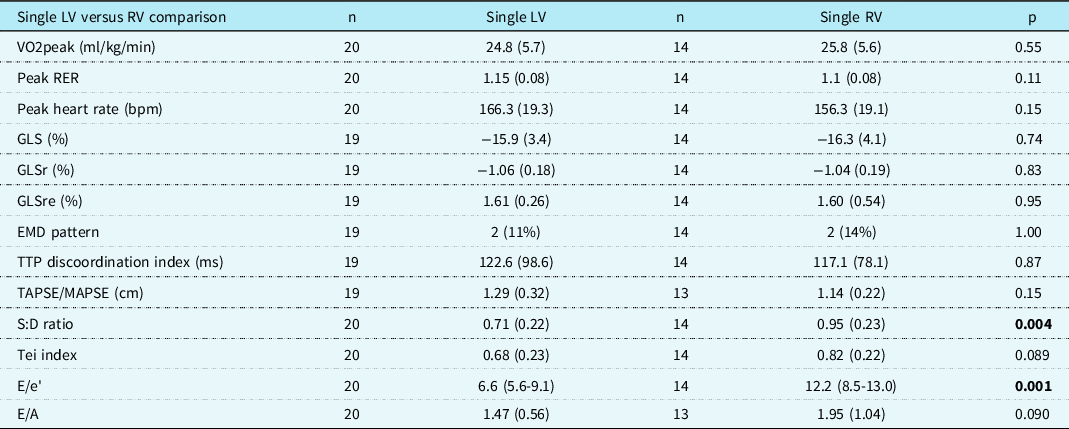
There was no significant difference in peak oxygen consumption by ventricular dominance (single left ventricle 24.8 ± 5.7, single right ventricle 25.8 ± 5.6, biventricular 22.2 ± 5.7 ml/kg/minute; p = 0.547). Measurements were compared between those with a dominant left ventricle and dominant right ventricle (Table 3). The single right ventricle group was younger and had a lower body mass index z-score than the single left ventricle group. Strain indices, qualitative systolic function (p = 0.68), atrioventricular valve regurgitation (p = 0.15), and exercise test variables were not different between groups. The systolic to diastolic ratio (p = 0.004) and E/e’ (p = 0.001) were elevated in the dominant right ventricle group.
Between-group differences comparing the single LV and single RV groups. The four patients with biventricular anatomy were not included in this analysis due to the small sample size of that subgroup. Peak oxygen consumption (VO2peak); left ventricle (LV); right ventricle (RV); respiratory exchange ratio (RER).

Discussion
Summary of main findings
In this cohort of children, adolescents, and young adults with Fontan circulation, strain measures of single ventricle function, discoordination, and electro-mechanical dyssynchrony were feasible and associated with peak oxygen consumption independent of age and sex. To our knowledge, this is the first study to report independent relationships between strain measures of generalised discoordination, electro-mechanical dyssynchrony, and global longitudinal strain with peak oxygen consumption in this population.
Relationship between peak oxygen consumption and ventricular functional measures in the single ventricle population
Patients with Fontan palliation generally have an impaired peak exercise capacity (low peak oxygen consumption) compared to peers with normal cardiac anatomy. Reference Fernandes, Alexander and Graham4,Reference Ohuchi, Negishi and Noritake5,Reference Paridon, Mitchell and Colan7 Additionally, poor clinical outcomes such as hospitalisation, transplant, increased incidents of cardiac comorbidities, and mortality have been correlated with impaired exercise capacity in children, adolescents, and adults with Fontan circulation. Reference Goldberg, Avitabile, McBride and Paridon1–Reference Ohuchi, Negishi and Noritake5 Researchers hypothesise that peak exercise capacity is impaired in this population due to multiple physiologic limiters including ventricular dysfunction. Reference Goldberg, Avitabile, McBride and Paridon1
Prior to the availability of strain analysis, quantitative assessment of single ventricular function was limited. Most echocardiographic measurements cannot be universally applied in the single ventricle population due to the variability of ventricular anatomic morphologies. A growing body of literature has explored single ventricular strain analysis across various ventricular morphologies in the Fontan population. Reference Rosner, Khalapyan, Dalen, McElhinney, Friedberg and Lui10,Reference Rosner, Khalapyan and Pedrosa11,Reference Ghelani, Harrild, Gauvreau, Geva and Rathod26,Reference Steflik, Butts and Baker27 Ventricular global longitudinal strain has been correlated with exercise capacity in other CHD populations Reference Alghamdi, Mertens, Lee, Yoo and Grosse-Wortmann28 and predicts poor outcomes in Fontan populations. Reference Ishizaki, Nagao and Shiina8,Reference Colquitt, Loar, Morris, Feagin, Sami and Pignatelli29,Reference Forsha, Li, Joseph, Kutty and Friedberg30 However, only one other study Rato and colleagues studied the relationship between novel speckle tracking derived assessment of global longitudinal strain and peak oxygen consumption. In a small cohort of young adults with Fontan circulation, the authors observed a correlation between atrial strain and peak oxygen consumption; however, no correlations between ventricular strain and peak oxygen consumption were reported. Reference Rato, Mendes, Sousa, Lemos, Martins and Anjos31 Our current study demonstrates a correlation between superior single ventricular function by global longitudinal strain and higher peak oxygen consumption. The modest strength of the relationship (r = −0.44, p = 0.007) is to be expected given the complex interplay of the physiologic systems involved with exercise (cardiac, pulmonary, muscle, blood flow, etc.), all of which may be altered or impaired in those with single ventricular physiology. Regression modelling demonstrates that global longitudinal strain is an independent predictor of peak oxygen consumption when controlling for age and sex.
The global longitudinal strain observed in our cohort is slightly lower than accepted normal values. The values are consistent with the normal or mildly diminished qualitative single ventricular function present in 38/39 (97%) of the cohort. Outside of global longitudinal strain, neither qualitative function nor other quantitative functional variables (including echocardiographic measures of diastolic measures) correlate with peak oxygen consumption. A small study has previously reported an association between tissue Doppler assessment of diastolic dysfunction and peak oxygen consumption in a Fontan population, Reference Goldstein, Connor, Gooding and Rocchini12 which is not reproduced in this study. We conclude in those with Fontan physiology, global longitudinal strain appears to be a useful tool to quantitatively measure function that can be universally applied to various single ventricular anatomies and is correlated with peak oxygen consumption, a clinical surrogate outcome marker for this population.
Relationship between discoordination/dyssynchrony and peak oxygen consumption in the single ventricle population
One goal of this study was to differentiate between generalised discoordination (time to peak index) versus the specific entity of electro-mechanical dyssynchrony utilising the strain pattern that identifies paradoxical regional wall motion within the ventricle consistent with an underlying activation delay. Reference Forsha, Risum and Barker9,Reference Forsha, Risum and Smith16,Reference Risum, Jons and Olsen17 Previous studies have demonstrated the presence of increased discoordination Reference Rosner, Khalapyan and Pedrosa11,Reference Friedberg, Silverman, Dubin and Rosenthal32 and electro-mechanical dyssynchrony Reference Forsha, Risum and Barker9,Reference Rosner, Khalapyan, Dalen, McElhinney, Friedberg and Lui10 in the Fontan population, which leads to wasted ventricular work that does not contribute to ejection. Given the poor cardiac reserve in the Fontan population, any perturbation of ventricular synchrony leading to wasted work has the potential to lead to poor outcomes. In this study, both discoordination and electro-mechanical dyssynchrony are independently predictive of peak oxygen consumption when controlling for age and sex-related differences in aerobic capacity. The modest r2 in the model again points to the complexity of the determinants of peak oxygen consumption.
The 11% incidence of electro-mechanical dyssynchrony is similar to the 15% with this pattern reported by Rosner et al Reference Rosner, Khalapyan, Dalen, McElhinney, Friedberg and Lui10 in adolescents and adults with Fontan. Only four patients in this study have electro-mechanical dyssynchrony, so the relationship between this strain pattern and aerobic capacity must be confirmed in future studies. However, these limited data lend credence to another prior study reporting that an asynchronous contraction strain pattern is associated with adverse cardiac events in the Fontan population. Reference Ishizaki, Nagao and Shiina8 In the clinical care of patients with single ventricular physiology, abnormal ventricular mechanics may identify a higher risk group for poor outcomes.
Differences in functional measures between the single left ventricle and single right ventricle sub-groups
In our sample, those with a single right ventricle were slightly younger and leaner (lower body mass index z-score) than those with a single left ventricle. We did not observe any between-group differences comparing single left ventricle versus single right ventricle sub-groups in systolic function, discoordination, electro-mechanical dyssynchrony, or peak oxygen consumption. E/e’ was elevated in the single right ventricle group. A prior study has reported a modest correlation between E/e’ and catheter-derived ventricular end-diastolic filling pressure in the single ventricle population. Reference Menon, Gray and Tani33 As a measure of combined systolic and diastolic ventricular function, Reference Friedberg and Silverman34 the systolic to diastolic ratio demonstrated slightly better combined function in the single left ventricle group than in the single right ventricle group. In our study, there were too few biventricular patients to draw conclusions on this group. These findings suggest that diastolic function may be different in the single right ventricle compared to the single left ventricle, a hypothesis that could be more comprehensively evaluated with invasive assessment.
Limitations
Our sample is relatively small, which limits the generalizability of our conclusions as well as the ability to perform sub-group analyses. Most of this study population has near-normal global longitudinal strain and degree of atrioventricular valve regurgitation; future studies should evaluate these relationships with peak oxygen consumption in Fontan patients with more significant ventricular and valvular dysfunction.
Conclusion
In this post-Fontan sample of children and adolescents, strain measures of global longitudinal strain, discoordination, and electro-mechanical dyssynchrony correlate with and are independently associated with peak oxygen consumption when controlling for age and sex. This finding demonstrates the importance of coordinated ventricular mechanics in this vulnerable population with limited cardiac reserve. This study also highlights the relationship of strain measures with peak oxygen consumption, a surrogate outcome marker, across a cohort that includes dominant right ventricular, left ventricular, and biventricular anatomies with single ventricular physiology. The findings in this study suggest that ventricular mechanics contribute to the efficiency of the Fontan circulation and point to a potential role for strain imaging as part of the clinical assessment. Future studies are necessary to confirm these results in a larger sample that includes more patients with significant ventricular and valvular dysfunction.
Acknowledgements
We thank the Medical Writing Center at Children’s Mercy Kansas City for editing this manuscript.
Financial support
This research received no specific grant from any funding agency, commercial, or not-for-profit sectors.
Conflicts of interest
None.
Ethical standards
The authors assert that all procedures contributing to this work comply with the ethical standards of the relevant national guidelines on human experimentation and with the Helsinki Declaration of 1975, as revised in 2008, and have been approved by the institutional committees (Children’s Mercy Kansas City Institutional Review Board).