Introduction
Capgras syndrome is characterized by the recurrent and transient belief that a person, usually someone closely related, has been replaced by an imposter. The imposter usually has features that are very similar to those of the original person, although subtle physical differences are used to differentiate the original person from the imposter (Todd et al., Reference Todd, Dewhurst and Wallis1981; Frazer and Roberts, Reference Frazer and Roberts1994). Initially, Capgras was described in psychiatric diseases, including paranoid schizophrenia (Merrin and Silberfarb, Reference Merrin and Silberfarb1976) and schizoaffective disorder (Haslam, Reference Haslam1973). Capgras syndrome has also been reported in neurodegenerative diseases such as Alzheimer's disease (Cummings et al., Reference Cummings1987) and Dementia with Lewy Bodies (DLB) (Roane et al., Reference Roane1998). Capgras syndrome in patients without a neurodegenerative disease typically occurs at a younger age and can be associated with psychiatric disease, cerebrovascular events, and illicit drug use (Josephs, Reference Josephs2007). To date, it is unclear whether there are differences between Capgras syndrome as it occurs in neurodegenerative compared with non-neurodegenerative diseases (Josephs, Reference Josephs2007).
The etiology and pathogenesis of Capgras syndrome is not yet fully understood. Capgras has been associated with diffuse brain lesions, focal right hemispheric pathology (Weinstein and Burnham, Reference Weinstein and Burnham1991), and anatomic disconnection of temporal and limbic regions functionally from a damaged frontal lobe (Fienberg and Roane, Reference Fienberg and Roane2005). Psychodynamic theories posit that Capgras syndrome may be due to anxiety-induced regression of cognitive and emotional functioning, pathological splitting of internalized object representation, inadequately repressed conflicting or ambivalent feeling toward the implicated person, or the projection of negative emotion arising from the conflicting feelings (Bourget and Whitehurst, Reference Bourget and Whitehurst2004). However, there is still no single theory or hypothesis that can explain Capgras syndrome in the context of neurodegenerative disease.
Capgras syndrome in DLB nearly always coexists with visual hallucinations (Josephs, Reference Josephs2007). The prevalence of Capgras syndrome in DLB reported in one study was 16.6% (Harciarek and Kertesz, Reference Harciarek and Kertesz2008). Half of these cases had an isolated Capgras syndrome and while the other half were accompanied by phantom boarder phenomena (Harciarek and Kertesz, Reference Harciarek and Kertesz2008). Hallucinations and misperceptions are common in DLB, often associated with Lewy body pathology in the amygdala, parahippocampus and inferior temporal lobe, and may involve disrupted cortical connections between the occipital and temporal lobes (Harding et al., Reference Harding, Broe and Halliday2002). Prosopagnosia, the inability to recognize faces, is another perceptual disorder common in neurodegenerative disease also associated with occipitotemporal pathology (Barton, Reference Barton2011). This study reviews the characteristics of DLB patients with Capgras syndrome compared to DLB patients without Capgras syndrome and its potential impact on DLB caregivers.
Methods
Study participants
Participants were drawn from a consecutive series of referrals to the Pearl I. Barlow Center for Memory Evaluation and Treatment, a dementia specialty practice at New York University Medical Center, from August 2010 to August 2011. Assessments were completed by a multidisciplinary team of a neurologist, geriatric psychiatrist, geriatric nurse practitioner, social worker, and psychometrician. We identified 11 cases of DLB with Capgras syndrome (DLB-C) and 44 cases of DLB without evidence of Capgras syndrome, evaluated during the study period. No patient-informant dyad contributed more than one observation to the dataset.
Clinical evaluation
The neurologist conducted independent semi-structured interviews with the patient and a knowledgeable collateral source, usually the spouse or close family member (Carr et al., Reference Carr, Gray, Baty and Morris2000). The diagnosis of DLB was made based on the clinical interview, physical examination, and cognitive evaluation in accordance with the 2005 revised version of DLB Consortium Criteria for the clinical diagnosis of probable DLB (McKeith et al., Reference McKeith2005). The diagnosis of Capgras syndrome was made based on a clinical interview with the informant in accordance with the Diagnostic and Statistical Manual – IV TR (American Psychiatric Association, 1994).
The Clinical Dementia Rating (CDR) was used to determine the presence or absence of dementia and to stage its severity (Morris, Reference Morris1993). The CDR rates cognitive function in each of six categories (memory, orientation, judgment and problem solving, and performance in community affairs, home and hobbies and personal care). A global CDR 0 indicates no dementia. CDR 0.5 represents questionable or very mild dementia; CDR 1, 2, or 3 corresponds to mild, moderate, or severe dementia (Morris, Reference Morris1993). The sum of CDR boxes (CDR-SB) provides a quantitative expansion of the CDR ranging from 0 (no impairment) to 18 (maximum impairment) (Morris, Reference Morris1993).
All patients underwent clinical neuroimaging with non-contrast MRI or CT. These were not research-grade scans and no quantitative measurements are available. The senior author (James E. Galvin) reviewed all films to provide a qualitative rating of atrophy, vascular burden, and white matter disease. These variables were not included in the analyses since images were collected in a non-standardized fashion.
Caregiver evaluation
Psychosocial evaluations were completed by each caregiver to determine the presence of non-cognitive symptoms observed in the patient and to assess the impact of these symptoms on the caregiver. The Neuropsychiatric inventory (NPI-Q) (Kaufer et al., Reference Kaufer2000) assessed behavior and mood, the Mayo Sleep Questionnaire (MSQ) (Boeve et al., Reference Boeve2011) assessed the presence of parasomnias (including REM sleep behavior disorder), the Mayo Fluctuation Questionnaire (MFQ) (Ferman et al., Reference Ferman2004) assessed the presence of cognitive fluctuations, and the Epworth Sleepiness Scale (Johns, Reference Johns1991) assessed daytime sleepiness. In addition, caregivers completed the Zarit Burden Inventory (Herbert et al., Reference Herbert, Bravo and Preville2000) to evaluate for caregiver burden and the PHQ-9 (Kroenke et al., Reference Kroenke, Spitzer and Williams2001) to assess caregiver depression.
Neuropsychological evaluation
Each patient was administered a 30-minute test battery at the time of the office visit to assess their cognitive status. The psychometrician was unaware of the diagnosis, presence or absence of Capgras, or the CDR. A brief global assessment was performed using the Mini-Mental State Exam (MMSE) (Folstein et al., Reference Folstein, Folstein and McHugh1975). The test battery also included measures of episodic memory (Wechsler Memory Scale Logical Memory-Story A (Wechsler, Reference Wechsler1987)); Hopkins Verbal Learning Task – immediate and delayed recall and cued recognition (Brandt et al., Reference Brandt, Corwin and Krafft1992); semantic memory (Animal Fluency (Troyer et al., Reference Troyer1998)); 15-item Boston Naming Test (MacKay et al., Reference MacKay, Connor and Storandt2005); and working memory (Digit span forward and backward task (Conway et al., Reference Conway2005)). Three timed measures addressed psychomotor, visuospatial, and executive abilities: Wechsler Adult Intelligence Scale Digit Symbol (Wechsler, Reference Wechsler1955), and Trail Making A and B (Reitan, Reference Reitan1958). Construction was assessed with the Clock Drawing Task (Borson et al., Reference Borson1999). Mood was assessed with the Hospital Anxiety Depression Scale (Snaith, Reference Snaith2003) that provides subscale scores ranging from 0 to 21 with scores greater than 7 supporting the presence of depression or anxiety. Not all patients were able to complete all parts of the battery and few patients were able to complete the Trail Making B tasks (not shown in results).
Statistical analysis
Statistical analysis was performed using IBM SPSS v20 (Armonk, NY) and R program for Statistical Computing (http://www.r-project.org/). Descriptive statistics were used to report the demographic and clinical characteristics of the patients, informants’ ratings, CDR, CDR-SB, and neuropsychological test results. Independent sample t-tests were used for continuous data and χ2 analyses were used for categorical data. Primary comparisons were made between 11 DLB-C cases and 44 DLB cases without Capgras; p-values less than 0.05 were considered statistically significant. We also examined the possible interactive effects between anxiety and antidepressant use, hallucinations and cholinesterase inhibitor use, and hallucinations and neuroleptic use; none were significant. In an exploratory fashion, we examined the clinical characteristics associated with Capgras syndrome, accepting an elevated false-positive rate (p < 0.2) in the modeling. Two statistical models were performed. First, stepwise logistic regression was performed with variables with p-values less than 0.2 to determine which clinical features predicted the presence of Capgras with odds ratios (OR) reported. Logistic regression analysis is based on an assumption that the asymptotic distribution of parameter estimates is Gaussian. However, we anticipated that the finite sample distribution of log(OR) estimates based on our small sample might not be Gaussian. Therefore, we also performed non-parametric bootstrap analyses to approximate the distribution of parameter estimates by an empirical distribution of the observed data reporting the Log(ORs) and confidence intervals (CI). We examined variables with p-values less than 0.2 based on 1,000 bootstrap samples.
Results
Patient characteristics
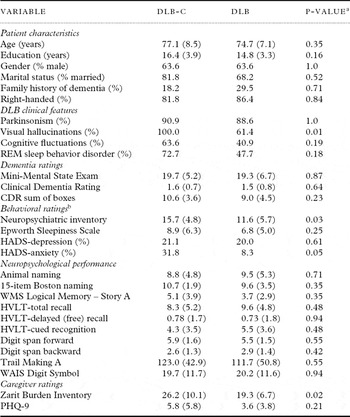
Fifty-five patients are included in this report with a mean age of 75.22 ± 7.4 years and 15.2 ± 3.4 years education. Men comprised 64% of the sample, 71% were married and 85% were right-handed. Informants included spouses (69%), adult children (24%), or paid caregivers (7%). Demographic data from 11 DLB-C and 44 DLB cases are shown in Table 1. There was no difference in age or education between DLB-C and DLB patients. Patients with Capgras were more likely to have visual hallucinations (p = 0.01). Global dementia ratings were not different between DLB-C and DLB. There were no differences between groups on any of the neuropsychological tests.
Patient characteristics

Means (SD); ap-values derived from t-tests for continuous variables and χ2 tests for categorical variables; bNeuropsychiatric Inventory and Epworth Sleepiness Scale are completed by caregiver; HADS is completed by the patient.
DLB-C: Dementia with Lewy Bodies with Capgras syndrome; DLB: Dementia with Lewy Bodies without Capgras; mini-PPT: Mini-Physical Performance Test; CDR: Clinical Dementia Rating; PHQ: Personal Health Questionnaire; WMS: Wechsler Memory Scale; HVLT: Hopkins Verbal Learning Task; WAIS: Wechsler Adult Intelligence Scale.
Behavioral ratings
We found that the DLB-C group had significantly higher scores on the NPI-Q (15.7 ± 4.8) compared to the group without Capgras (11.6 ± 5.7, p = 0.03). DLB-C patients endorsed more symptoms of anxiety on the Hospital Anxiety and Depression Scale (p = 0.05) but no differences were seen in self-reported depression symptoms. Caregivers of patients with Capgras syndrome had higher caregiver burden on the Zarit Burden Inventory (26.2 ± 10.1) compared with caregivers of patients without Capgras syndrome (19.3 ± 8.4, p = 0.02).
Medications
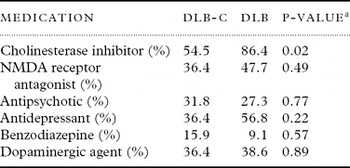
Medication usage by patients is documented in Table 2. At the time of initial evaluation, 80% of patients had been started on cholinesterase inhibitors; however, DLB-C patients were more likely to have discontinued their use (p = 0.02). No differences were noted for NMDA-receptor antagonists, antipsychotics, antidepressants, benzodiazepines, or dopaminergic agents.
Medication usage

aχ2.
DLB-C: Dementia with Lewy Bodies with Capgras syndrome; DLB: Dementia with Lewy Bodies without Capgras; NMDA: N-Methyl-D-aspartate.
Clinical features associated with Capgras syndrome
Exploratory analyses were conducted to examine clinical features associated with the presence of Capgras. In a stepwise logistic regression using clinical variables that showed trends (p-values < 0.2), the only clinical feature associated with Capgras syndrome in DLB was self-reported anxiety (OR = 10.9; 95% CI = 2.6–47.6). Bootstrap analyses demonstrated that visual hallucinations (log(OR) = 18.3; 95% CI = 17.95, 19.28) and self-reported anxiety (log(OR) = 2.9; 95% CI = 0.312, 20.24) were significantly associated with Capgras (p < 0.05), while REM sleep behavior disorder (log(OR) = 1.67; 93% CI = 0.02, 2.34) and non-usage of cholinesterase inhibitors (log(OR) = 1.73; 93% CI = 0.025, 3.28) were marginally associated with Capgras in DLB (p = 0.07).
Discussion
We found that Capgras syndrome was common in DLB. DLB-C patients were more likely to have visual hallucinations, their caregivers tended to report more symptoms of cognitive fluctuations and REM sleep behavior disorder, and patients reported more symptoms of anxiety. The presence of Capgras significantly increased caregiver burden and led to the caregiver (typically the object of the delusion) to express more depressive symptoms. The single best predictor of Capgras in DLB was the presence of anxiety with a tenfold increased risk. While DLB is typically more common in men (Rosenberg et al., Reference Rosenberg2001), we found no gender preference for Capgras.
The clinical features of DLB include cognitive fluctuations, recurrent visual hallucinations and spontaneous features of parkinsonism (McKeith et al., Reference McKeith2005). We found a strong relationship between Capgras and visual hallucinations; however, there was no relationship between the presence of parkinsonism and Capgras. These data agree with a previous study that also found 100% co-occurrence of visual hallucinations and Capgras syndrome in DLB (Josephs, Reference Josephs2007). Our results suggest that visual hallucination and Capgras syndrome may have a related etiopathogenesis.
It is not surprising that the DLB-C had higher NPI-Q scores. The NPI-Q covers a range of neuropsychiatric and behavioral symptoms, and Capgras syndrome has been associated with several neuropsychiatric symptoms, including delusions, anxiety, irritability, agitation, and motor disturbances (Cummings et al., Reference Cummings1987; Josephs, Reference Josephs2007). Indeed, patient self-reported anxiety was the strongest feature associated with the presence of Capgras. As a result, the caregiver who is often the target of the delusion and spends most of the time with the patient, reports significant burden and emotional strain related to this behavior as demonstrated in the higher scores on the Zarit Burden Inventory.
DLB caregivers experience significant burden and distress. Caregivers reported the highest burden when describing the impact of providing care on their personal lives, health, and emotional well-being with spouses reporting higher burden than non-spouse caregivers (Galvin et al., Reference Galvin2010a). Three dimensions of burden in DLB caregivers have been described: role strain, personal strain, and worry about performance (Leggett et al., Reference Leggett2011). We previously reported that DLB caregiver burden correlated strongly with mood (anxiety, depression, and apathy), delusions, hallucinations, and sleep disturbances (Galvin et al., Reference Galvin2010a; Leggett et al., Reference Leggett2011). We also previously reported that increased caregiver burden led to feelings of social isolation and lack of understanding and adequate support from family, friends, or healthcare providers (Galvin et al., Reference Galvin2010a). Indeed, the diagnostic challenge of DLB may only heighten this sense of isolation and burden (Galvin et al., Reference Galvin2010b).
We did not find differences in neuropsychological performance across semantic, episodic, or working memory, attention, psychomotor, executive, visuospatial, or constructional praxis in DLB-C patients compared with DLB without Capgras. This conflicts with a previous report that greater impairment in executive abilities is usually present in Capgras patients (Bourget and Whitehurst, Reference Bourget and Whitehurst2004). Global dementia ratings as measured by the MMSE, CDR, or CDR-SB were not different between groups. It should be noted, however, that few patients were able to complete the more complex tasks of the battery such as the Trail Making B (only 17/55 could attempt the task).
Our study has limitations. The small sample may limit the power to detect statistical differences on clinical features using parametric techniques. We attempted to correct for this by performing bootstrap analyses. Both models (Logistic Regression and Bootstrap) support the main group effects demonstrated in Table 1 that visual hallucinations and anxiety are key clinical features associated with Capgras and that we did not miss other associated features because of a lack of power. The patients were referrals from community practices to a specialty clinic and the senior author is a recognized expert in the area of DLB. This may have led to a referral bias with more severely affected patients or those refractory to usual care being included in this study. However, we chose to use consecutive patients to limit the effects of referral bias and the extensive work-up demonstrated that the groups were well balanced in terms of demographic characteristics, neuropsychological performance, and dementia severity (median CDR 1, median MMSE 21 suggesting most patients were in mild to moderate stage of disease). The treatment of Capgras syndrome in DLB patients may be complicated because DLB patients may have adverse reactions to neuroleptic medication (McKeith et al., Reference McKeith2005). Cholinesterase inhibitors are frequently used and may possess some ability to reduce psychiatric symptoms (Bourget and Whitehurst, Reference Bourget and Whitehurst2004), although in the present study this course of action was apparently not well tolerated. A final limitation is the absence of biological markers of disease. It is possible that DLB-C has a different pathologic burden than patients without Capgras such as increased cerebrovascular disease or concurrent Alzheimer's disease, although qualitatively there were no differences noted on the patients’ clinical imaging studies in this study.
Caregivers of DLB patients experience significant burden that may be heightened by cognitive, functional, and behavioral problems, a sense of isolation, and challenges with the diagnostic experience (Galvin et al., Reference Galvin2010a; Reference Galvin2010b; Leggett et al., Reference Leggett2011). Capgras syndrome, when present, significantly increases caregiver burden and distress. Early appreciation of DLB and Capgras syndrome may afford the opportunity to alleviate caregiver uncertainty, permit intervention by using both pharmacologic and non-pharmacologic approaches, and allow for future planning for the long-term care of patients and improving the well-being of their caregivers.
Conflict of interest
None.
Description of author’ roles
James Galvin designed the study; Papan Thaipisuttikul, Yael Zweig, Ashita Gurnani, and James Galvin collected the data; Papan Thaipisuttikul drafted the manuscript; Yael Zweig, Iryna Lobach, and James Galvin edited the manuscript; and James Galvin and Iryna Lobach were responsible for statistical design and carrying out the statistical analyses.
Acknowledgments
This report was supported by grants from the National Institute on Aging (P30 AG008051 and R01 AG040211), New York State Department of Health, and Michael J Fox Foundation.