Introduction
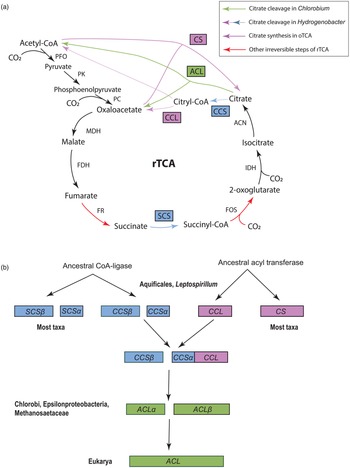
The tricarboxylic acid (TCA) cycle is a well-known metabolic pathway, widely distributed among aerobic organisms that produces reduced electron carriers and is an integral part of aerobic respiration. In most organisms the TCA runs exclusively in the oxidative direction. However, it was long known that some of the enzymes of the oxidative TCA cycle (oTCA) can catalyse their respective reverse reactions. In 1966, Evans et al., observed the presence of a unique carbon fixation pathway in a photosynthetic bacterium Chlorobium thiosulfatiphilum that results in incorporation of four molecules of carbon dioxide during a full cycle. This cycle, reductive TCA (rTCA), shares most of its reactions with oTCA, except three reactions that are catalysed by different enzymes. These rTCA-specific reactions are: (i) citrate cleavage into oxaloacetate and acetyl-CoA, catalysed by ATP-citrate lyase (ACL); (ii) fumarate-succinate conversion by fumarate reductase (FR); and (iii) succinyl-CoA to 2-oxoglutarate by ferredoxin-dependent 2-oxoglutarate synthase (FOS) (Buchanan et al., Reference Buchanan, Sirevåg, Fuchs, Ivanovsky, Igarashi, Ishii, Tabita and Berg2017). Of these reactions, citrate cleavage is particularly interesting since it is the branching reaction of the autocatalytic cycle, as defined by Peng et al., Reference Peng, Plum, Gagrani and Baum2020, that produces two oxaloacetate molecules per round (Fig. 1(A)).
Overview of the rTCA and citrate cleavage in prokaryotes. (A) Scheme of the reductive TCA cycle illustrating two known mechanisms of citrate cleavage into oxaloacetate and acetyl-CoA: two enzyme CCS/CCL system as in Hydrogenobacter and one-step ACL reaction in Chlorobium (Berg, Reference Berg2011). Examples of enzymes capable of catalysing these reactions are noted above or below the arrows. (B) Scheme of evolution of CCS, CCL, ACL, SCS and CS illustrating a sequence of fusions as proposed by Aoshima (Reference Aoshima2007) and expanded by our analyses. Abbreviations: CCS, citryl-CoA synthase; CCL, citryl-CoA lyase; ACL, ATP citrate lyase; PFO, pyruvate ferredoxin oxidoreductase; PK, pyruvate kinase; PC, phosphoenolpyruvate carboxylase; MDH, malate dehydrogenase; FDH, fumarate dehydratase; FR, fumarate reductase; FOS, ferredoxin 2-oxoglutarate synthase; IDH, isocitrate dehydrogenase; ACN, aconitase.

After its discovery (Evans et al., Reference Evans, Buchanan and Arnon1966), the rTCA cycle remained poorly studied and known only from a handful of bacterial clades. It was described from anoxygenic green sulphur bacteria, such as Chlorobium (Tang and Blankenship, Reference Tang and Blankenship2010), epsilon, delta and alpha Proteobacteria (Schauder et al., Reference Schauder, Widdel and Fuchs1987; Hügler et al., Reference Hügler, Wirsen, Fuchs, Taylor and Sievert2005; Williams et al., Reference Williams, Zhang, Scott and Bazylinski2006), Nitrospira (Bar-Even et al., Reference Bar-Even, Noor and Milo2012) and in bacteria from the order Aquificales (Hügler et al., Reference Hügler, Huber, Molyneaux, Vetriani and Sievert2007). The latter group is especially interesting, since one of the key steps of rTCA – citrate cleavage, is performed differently than in Chlorobium (Aoshima et al., Reference Aoshima, Ishii and Igarashi2004). As summarized in Fig. 1(A), Chlorobium uses a larger enzyme, ATP citrate lyase (ACL; EC 2.3.3.8), which is composed of two subunits, to catalyse the citrate cleavage into oxaloacetate and acetyl-CoA (Aoshima, Reference Aoshima2007). The citryl-CoA intermediate never leaves the ACL enzyme during this reaction. Aquificales, in contrast, have two separate enzymes: citryl-CoA synthetase (CCS; EC 6.2.1.18), which produces citryl-CoA from citrate, and citryl-CoA lyase (CCL; EC 4.1.3.34), which cleaves citryl-CoA (Aoshima et al., Reference Aoshima, Ishii and Igarashi2004). CCL and CCS were shown to be homologous to different subunits of ACL (Aoshima, Reference Aoshima2007), implying that the bacterial ACL enzyme evolved by gene fusion with CCS large subunit being equivalent to ACL small subunit and CCS small subunit and CCL fusing into ACL large subunit (Fig. 1(B)).
ACL, CCS and CCL proteins are known to share some homology to two other TCA enzymes – succinyl-CoA synthetase (SCS) and citrate synthase (CS). According to Aoshima (Reference Aoshima2007) and Becerra et al. (Reference Becerra, Rivas, García-Ferris, Lazcano and Peretó2014), the SCS small subunit shares regions of homology to the CCS small subunit and part of the ACL large subunit. Similarly, the SCS large subunit is homologous to the CCS large and ACL small subunits and CS shares homology to CCL and part of the ACL large subunit. These homologies indicate a possibility of common descent for at least three rTCA enzymes, as illustrated in Fig. 1(B). Taxonomic surveys suggest that citrate cleavage is by far the least common rTCA reaction among prokaryotes with the incomplete cycle (Aoshima, Reference Aoshima2007). Most eukaryotes, on the other hand, possess an ACL enzyme used to synthetize acetyl-CoA from citrate, even while there is no evidence of rTCA operating in this group (Chypre et al., Reference Chypre, Zaidi and Smans2012).
Carbon fixation pathways often operate in coordination with phototrophic pathways, as evident in Cyanobacteria with the Calvin-Benson cycle or Chlorobi with the rTCA, as these cycles require reduced electron carriers (Bar-Even et al., Reference Bar-Even, Noor and Milo2012). It was proposed earlier in the Purple Earth hypothesis that retinal-based phototrophy, common in various groups of microbes such as Haloarchaea, could have been significantly more common prior to emergence of chlorophyll-based photosynthesis. The hypothesis further proposes that the spectral characteristics of chlorophyll-based photosystems might have resulted due to competition for wavelengths with Haloarchaea or other organisms using bacteriorhodopsin-like proteins (DasSarma and Schwieterman, Reference DasSarma and Schwieterman2021). Bacteriorhodopsins are light-activated proton pumps that were shown to be ancient and spectrally tuned to absorbing green light (Sephus et al., Reference Sephus, Fer, Garcia, Adam, Schwieterman and Kacar2022). However, unlike most modern phototrophs that possess mechanisms for carbon fixation, extant Haloarchaea appear to lack any carbon fixation pathways. Indeed, the complete rTCA cycle specifically is currently unknown in any Archaea and most autotrophic members of this group use Wood-Ljungdahl pathway for fixing atmospheric carbon dioxide (Berg et al., Reference Berg, Kockelkorn, Ramos-Vera, Say, Zarzycki, Hügler, Alber and Fuchs2010). Crenarchaeote Thermoproteus neutrophilus was described as capable of citrate cleavage and the entire rTCA pathway (Beh et al., Reference Beh, Strauss, Huber, Stetter and Fuchs1993); however, this was later disproven (Becerra et al., Reference Becerra, Rivas, García-Ferris, Lazcano and Peretó2014). In most Archaea, many of the key rTCA enzymes are missing and therefore, Archaea are frequently overlooked in the studies of rTCA evolution. However, at least one archaeal group, Haloarchaea, possesses all rTCA enzymes but one – the enzyme for citrate cleavage. This is one of the most complete rTCA pathways in any archaeon.
Yet, despite being absent from Archaea, multiple studies suggest an ancient origin of rTCA, implying it might even be a primordial carbon fixation pathway in early organisms (Muchowska et al., Reference Muchowska, Varma, Chevallot-Beroux, Lethuillier-Karl, Li and Moran2017; Nunoura et al., Reference Nunoura, Chikaraishi, Izaki, Suwa, Sato, Harada, Mori, Kato, Miyazaki, Shimamura and Yanagawa2018). This has gained support by evidence that many rTCA reactions can occur non-enzymatically (Zubarev et al., Reference Zubarev, Rappoport and Aspuru-Guzik2015), leading many to suspect that the Last Universal Common Ancestor (LUCA) was capable of autotrophic carbon fixation via the rTCA (Sutherland, Reference Sutherland2017; Wimmer et al., Reference Wimmer, Vieira, Xavier, Kleinermanns, Martin and Preiner2021). Since the rTCA shows stoichiometric autocatalysis, producing two oxaloacetate molecules per cycle, and given that autocatalytic cycles might have allowed primordial heritability and responses to selection, the rTCA has been implicated as playing a key role in the origin of life (Wächtershäuser, Reference Wächtershäuser1988; Smith and Morowitz, Reference Smith and Morowitz2016).
Despite the centrality of rTCA in theories of life's origin, the scattered distribution of rTCA among modern organisms presents a problem. Here we used a large-scale phylogenetic analysis of ACL, CCS, CCL and their homologues SCS and CS to further our understanding of the evolution of this rare metabolic pathway and evaluate the pathways genesis. Our results have several major implications for the evolution of autotrophy, but the abundance of horizontal gene transfers (HGTs) makes it uncertain whether the rTCA might have been active in LUCA.
Methods
Sequence retrieval
All amino acid sequences included in this study were obtained from NCBI GenBank database following BLAST searches of representative CCS, CCL, ACL, SCS and CS sequences in all major phyla of Bacteria and Archaea with a 30% identity cutoff. Enzyme identification of selected sequences was verified phylogenetically – that is, the largest monophyletic group that includes all examples of a respective enzyme (CCS, CCL, ACL, SCS or CS) previously characterized in the literature is labelled as these representative enzymes.
Sequence analysis
Multiple amino acid sequence alignments were performed in NGPhylogeny software using MAFFT with default settings and BMGE curation (Lemoine et al., Reference Lemoine, Correia, Lefort, Doppelt-Azeroual, Mareuil, Cohen-Boulakia and Gascuel2019). Tree inference was also conducted in NGPhylogeny with FastTree with LG and a gamma distribution for site-to-site rate heterogeneity (selected according to the Bayesian information criterion) with 1000 bootstrap replicates and midpoint rooting. Phylogenies were visualized and edited in the Interactive Tree of Life (Letunic and Bork, Reference Letunic and Bork2021). We conducted an extensive review of properties of taxa included in this study using KEGG Pathway database (Kanehisa and Goto, Reference Kanehisa and Goto2000) and literature, cited in the Supplemental Table 1.
Results and discussion
Diversity of modern prokaryotes capable of citrate cleavage and rTCA
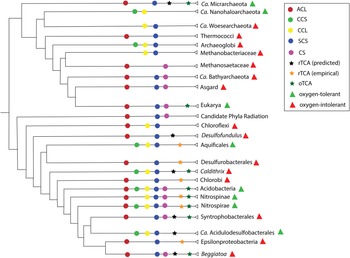
We conducted phylogenetic analysis with the citrate cleavage enzymes and their TCA homologues from a wide variety of bacterial and archaeal clades and examined the ecology of these clades. Our phylogenies support the homology between ACL and CCS/CCL complex first proposed by Aoshima, Reference Aoshima2007. Additionally, recent advances in metagenomic studies and microbial systematics allowed us to identify and analyse significantly more potential homologues of these enzymes than done by Aoshima, Reference Aoshima2007 and Becerra et al., Reference Becerra, Rivas, García-Ferris, Lazcano and Peretó2014. Particularly, we found for the first time, homologues of CCS in several groups of Acidobacteria, Deltaproteobacteria, Caldithricales and DPANN Archaea and homologues of ACL in Asgard Archaea, Bathyarchaeota and various bacterial clades (see Fig. 2 and Supplemental Table 1). Some groups, such as Methanobacteria possess only a CCL enzyme, homologous to better characterized CCL of Aquificota and Leptospirillum.
Phylogenetic distribution of citrate cleavage enzymes and associated traits in taxa included in this study. Tree topology is based on the tree of life phylogeny from Hug et al. (Reference Hug, Baker, Anantharaman, Brown, Probst, Castelle, Butterfield, Hernsdorf, Amano, Ise and Suzuki2016).

Aoshima, Reference Aoshima2007 proposed that the ACL enzyme resulted from a fusion between a CCS subunit and CCL, resulting in one-step catalysis of citrate cleavage into oxaloacetate and acetyl-CoA without releasing a citryl-CoA intermediate. Subsequently, two subunits of ACL – one derived from a fusion between CCS ß and CCL and the other from CCS α, fused again forming a one-subunit ACL enzyme (see Fig. 1(B)). While the latter event likely only happened once, since a one-subunit ACL can only be found in eukaryotes (Chypre et al., Reference Chypre, Zaidi and Smans2012), the transition from CCS/CCL to ACL is less clear. These enzymes are generally poorly characterized, known mostly from environmental metagenomic studies and only a few type strains. CCS/CCL system is relatively well described only from Aquificales (Aoshima et al., Reference Aoshima, Ishii and Igarashi2004) and some members of Nitrospirae, such as Leptospirillum (Bar-Even et al., Reference Bar-Even, Noor and Milo2012), albeit our survey uncovered other homologies in DPANN Archaea, including Nanohaloarchaea, Methanobacteria, Theionarchaea, Deltaproteobacteria, Caldithrix and others, and multiple homologies for ACL enzymes. While few of these taxa contain all of the necessary TCA enzymes, we found several new taxa that could theoretically be capable of complete rTCA, at least based solely on bioinformatic evidence. They include specifically, Ca. Micrarchaeota, Beggiatoa, Ca. Acidulodesulfobacterales, Syntrophobacter, Desulfofundulus and Theionarchaea (see Supplemental Table 1 for an overview of enzyme presence in these taxa). Some of these enzymes are incorrectly annotated in GenBank as either SCS or CS despite being monophyletic with CCS or CCL respectively, as shown by our phylogenetic analyses (data not shown). Specifically, these include sequences from Nanohaloarchaea and other DPANN Archaea and Candidate Phyla Radiation Bacteria (Fig. 2 and 3; specific examples are identified in the Supplemental Table 1).
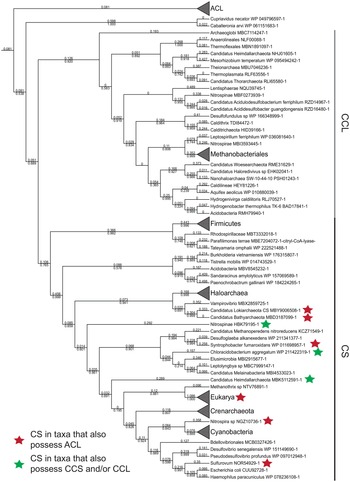
Phylogenetic tree of 111 retrieved sequences of CS and CCL (maximum likelihood; 1000 bootstraps). Bootstrap values in fractions and branch length labelled on the top and bottom of the branches respectively. Taxa that have representatives with both CS and citrate cleavage enzymes are marked with stars. Major monophyletic groups are collapsed for simplicity.

Additionally, the studied citrate-cleaving taxa exhibit remarkable metabolic diversity (Fig. 4 and 5), contrary to what is usually suggested about modern rTCA distribution (Berg, Reference Berg2011). Surprisingly, many CCS/CCL-possessing taxa were oxygen-tolerant (either aerobic or microaerophilic). A possible explanation for this could be due to easier regulation of oxidative and rTCA cycles when oxygen is present, since the CCS/CCL reaction releases citryl-CoA unlike the reverse CS reaction. This finding is inconsistent with the notion of rTCA representing an ancestral carbon fixation way, due to lack of oxygen on early Earth prior to the Great Oxygenation Event (Bar-Even et al., Reference Bar-Even, Noor and Milo2012). However, few of identified taxa in both CCS/CCL and ACL groups exhibit a complete rTCA cycle, hindering further examination of the connection between rTCA evolution and global oxygenation. An alternative plausible explanation for these findings is that during the CCS/CCL and ACL divergence, TCA was not cyclical in its modern form or that citrate cleavage reaction was involved in different ancient biochemical pathways. An additional complicating factor may have been the proposed horizontal transfer of aerobic respiration genes in some extant lineages (Kennedy et al., Reference Kennedy, Ng, Salzberg, Hood and DasSarma2001; Ward et al., Reference Ward, Li-Hau, Kakegawa and McGlynn2021).
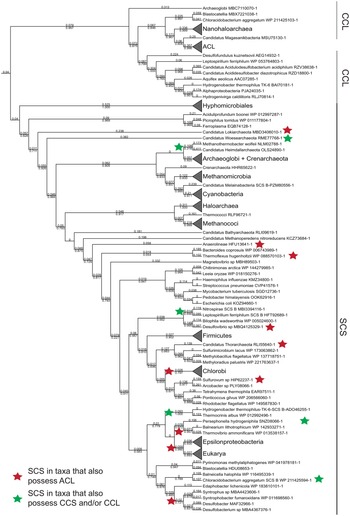
Phylogenetic tree of 151 retrieved sequences of CCS and SCS β subunits (maximum likelihood; 1000 bootstraps). Bootstrap values in fractions and branch length labelled on the top and bottom of the branches respectively. Taxa that have representatives with SCS and citrate cleavage enzymes are marked with stars. Major monophyletic groups are collapsed for simplicity.

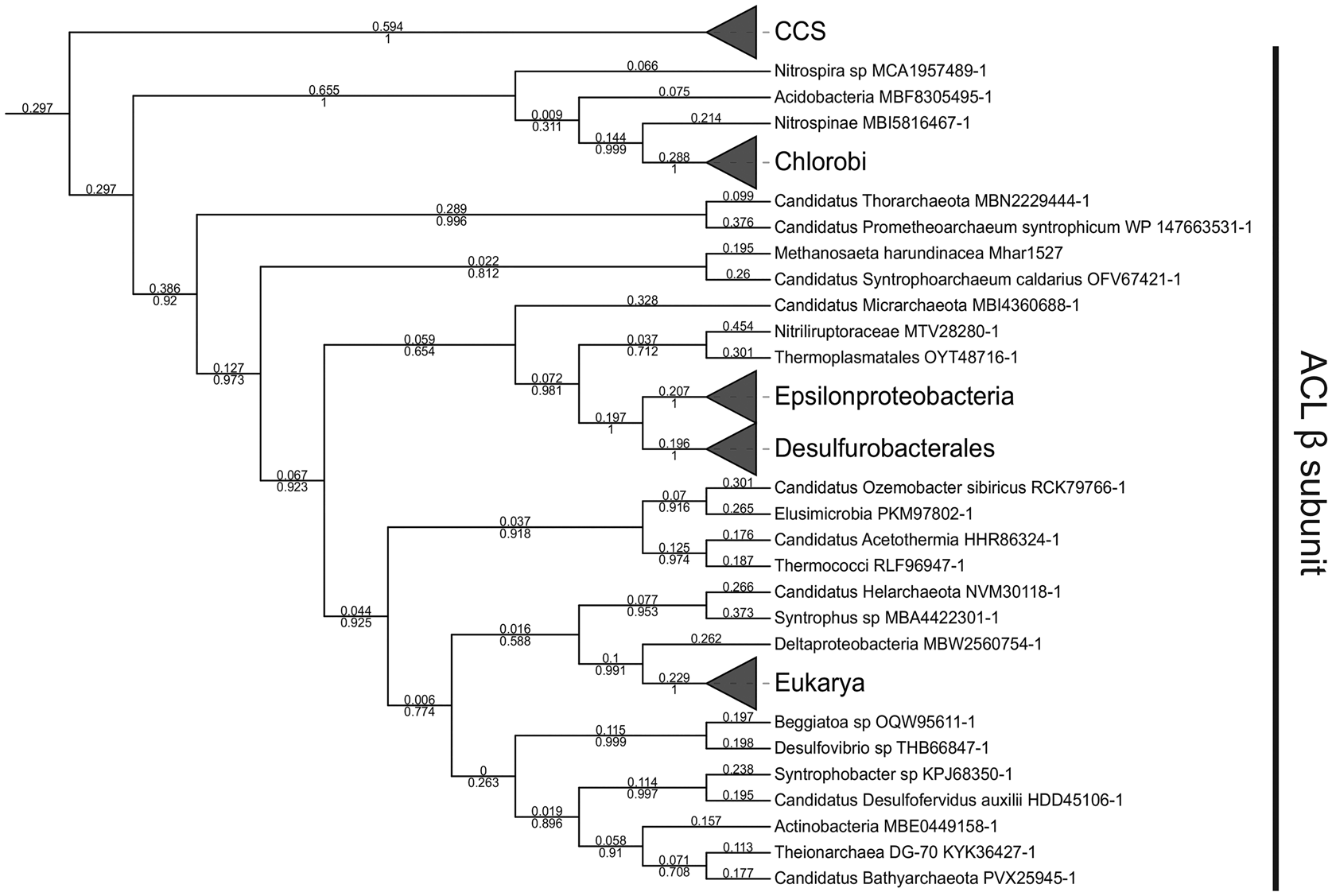
Phylogenetic tree of 39 retrieved sequences of the ACL β subunit (maximum likelihood; 1000 bootstraps). Bootstrap values in fractions and branch length labelled on the top and bottom of the branches respectively. Major monophyletic groups are collapsed for simplicity.

Patchy distribution of rTCA is due to HGTs, not multiple losses
To address the distribution of rTCA in detail, we examined phylogenetic distribution of SCS and CS – homologues of citrate-cleaving enzymes that also catalyse other TCA-related reactions. We did not find any patterns congruent with the published species trees in the phylogeny of CS (Fig. 2), an enzyme that is generally unique to oTCA, and is also known to catalyse citrate cleavage with a ferredoxin cofactor in Thermosulfidibacter takaii (Nunoura et al., Reference Nunoura, Chikaraishi, Izaki, Suwa, Sato, Harada, Mori, Kato, Miyazaki, Shimamura and Yanagawa2018) and Hippea maritima (Steffens et al., Reference Steffens, Pettinato, Steiner, Mall, König, Eisenreich and Berg2021). This is likely due to abundant HGTs in the evolutionary history of this enzyme. On the other hand, homologues SCS and CCS catalyse relatively simple thermodynamically favourable reactions compared to citrate synthesis (for succinyl-CoA synthesis ΔG° = −1.2 kJ mol−1 and for citryl-CoA synthesis ΔG° = −5.9 kJ mol−1 according to eQuilibrator web server, Flamholz et al., Reference Flamholz, Noor, Bar-Even and Milo2012) and both reactions are necessary for a complete rTCA cycle. Interestingly, in our phylogeny, SCS from most otherwise unrelated Bacteria capable of citrate cleavage with either CCS/CCL or ACL form a monophyletic group (Fig. 3). These groups include Aquificota, Chlorobi, Epsilonproteobacteria and various Deltaproteobacteria and Acidobacteria in which we found homologues of citrate-cleavage enzymes. This finding can be interpreted by the respective bacterial lineages obtaining their SCS and CCS or ACL from single linked HGT events since genes for these and other TCA-related enzymes are often located in close proximity to each other in the genomes (according to our searches of these enzymes in the SynTax database, Oberto, Reference Oberto2013). These results are congruent with the explanation of patchy distribution of rTCA through abundant HGTs rather than multiple gene loss events, as was previously suggested (Aoshima et al., Reference Aoshima, Ishii and Igarashi2004).
The deepest evolutionary relationships of these enzymes are difficult to elucidate with bioinformatic tools alone. However, our ecological and phylogenetic comparisons described above, seem to broadly indicate that a complete rTCA cycle in modern taxa might be a relatively recent evolutionary innovation due to abundant HGTs. Since SCS is also involved in oTCA, the possibility of the complete TCA cycle being a late evolutionary innovation in either direction is certainly worthy of further investigation. In fact, a connection between evolution of TCA and relatively late events such as eukaryogenesis or Great Oxygenation Event was previously raised by Ryan et al., Reference Ryan, Frezza and O'Neill2021. Since we found ACL in multiple clades of Asgard Archaea, it is logical to assume that eukaryotic ACL is derived from their Asgard ancestors rather than an alphaproteobacterial mitochondrial endosymbiont. Significantly, however, amino acid sequences from eukaryotic ACL proteins do not form a monophyletic group with their Asgard homologues (Fig. 4), potentially implicating further unidentified HGT events either in Eukarya or stem Asgard Archaea.
Cyanobacterial SCS originated from an archaeal HGT
A major implication of our findings is that the evolution of enzymes catalysing different steps of the TCA cycle – a ubiquitous metabolic pathway in modern life, was riddled with HGTs. Particularly with SCS, our phylogeny suggests that Cyanobacteria/Melainabacteria clade obtained their SCS from a group of thermophilic Archaea, possibly Methanomicrobia, through HGT (Fig. 3). Cyanobacteria belonging to various orders and Melainabacteria make a monophyletic group with Crenarchaeota and two euryarchaeote groups, Methanomicrobia and Archaeoglobi. These three major archaeal clades occupy distant positions in most phylogenetic analyses of Archaea (Matte-Tailliez et al., Reference Matte-Tailliez, Brochier, Forterre and Philippe2002). However, they share similar ecologies, largely being thermophilic. A notable exception is Methanomicrobia – some representatives are only moderately thermophilic (Battumur et al., Reference Battumur, Lee, Bae and Kim2019), while some genera, such as Methanosaeta and Methanothrix lack the SCS enzyme. Interestingly, this is not the only example of an HGT event from Archaea to Cyanobacteria. For instance, structural maintenance of chromosomes (SMC) genes were shown to be transferred from methanogens (Soppa, Reference Soppa2001). The SMC transfer event was used to constrain the evolutionary timeline for Cyanobacteria and methanogenic Archaea (Wolfe and Fournier, Reference Wolfe and Fournier2018), while the HGT of SCS enzymes could be potentially used to resolve cyanobacterial evolution even further since it occurred prior to Cyanobacteria/Melainabacteria divergence. More studies on TCA-related genes are necessary to identify a specific donor group for the SCS gene among Archaea.
An interesting common feature of all of these clades – thermophilic Archaea, Cyanobacteria and Melainabacteria is the incompleteness of their TCA cycles (Slobodkina et al., Reference Slobodkina, Allioux, Merkel, Cambon-Bonavita, Alain, Jebbar and Slobodkin2021). Modern Cyanobacteria lack oxoglutarate dehydrogenase (OGDH), a key TCA enzyme that converts 2-oxoglutarate into succinyl-CoA, and instead utilize a succinic semialdehyde shunt (Steinhauser et al., Reference Steinhauser, Fernie and Araújo2012). A possible explanation for this unique version of the TCA cycle is its connection to nitrogen metabolism through succinic semialdehyde amination to produce gamma aminobutyric acid (Zhang et al., Reference Zhang, Qian, Chang, Dismukes and Bryant2016). Additionally, replacing succinyl-CoA with succinic semialdehyde as a TCA cycle intermediate decreases cumulative free energy and therefore increases forward flux through the cycle (Thomas et al., Reference Thomas, Jaramillo-Riveri, Baxter and Cannon2014). While the succinic semialdehyde shunt bypasses succinyl-CoA as an intermediate in the TCA cycle, SCS is still retained in Cyanobacteria likely due to succinyl-CoA being one of the key biochemical precursors, being necessary for synthesis of several amino acids. Melainabacteria and Archaeoglobi lack most of the TCA enzymes, including OGDH and there is no evidence of succinic semialdehyde being produced instead (Di Rienzi et al., Reference Di Rienzi, Sharon, Wrighton, Koren, Hug, Thomas, Goodrich, Bell, Spector, Banfield and Ley2013). Furthermore, Crenarchaeota lack OGDH but instead use a ferredoxin-dependent enzyme to catalyse succinyl-CoA synthesis (Hallam et al., Reference Hallam, Mincer, Schleper, Preston, Roberts, Richardson and DeLong2006).
Possibility of rTCA operation within syntrophic consortia
Metabolisms of sympatric microbial taxa are often interdependent, as exemplified by numerous examples of interspecies exchange of metabolites, also known as syntrophy (Morris et al., Reference Morris, Henneberger, Huber and Moissl-Eichinger2013). Most well-known examples of syntrophy usually involve transfer of small molecules, such as hydrogen or formate (Hattori et al., Reference Hattori, Luo, Shoun and Kamagata2001); however, syntrophic transfers of larger molecules that are part of key metabolic pathways, such as carbon fixation, remain largely unexplored. Out of the taxa included in this study, Haloarchaea and their symbiotic counterparts, Nanohaloarchaea, are some of the most interesting in this regard. Both groups are adapted to highly saline environments; however, Nanohaloarchaea exhibit significant genomic and metabolic reduction. Phylogenetic relationships of Nanohaloarchaea are also unclear, with their placement in DPANN super-phylum being challenged by Aouad et al., Reference Aouad, Taib, Oudart, Lecocq, Gouy and Brochier-Armanet2018. On the other hand, Haloarchaea have been suggested to have evolved from a lineage of methanogenic Archaea (Nelson-Sathi et al., Reference Nelson-Sathi, Sousa, Roettger, Lozada-Chávez, Thiergart, Janssen, Bryant, Landan, Schönheit, Siebers and McInerney2015). Modern methanogens often couple methanogenesis to carbon fixation pathways, specifically the Wood-Ljundahl pathway (Borrel et al., Reference Borrel, Adam and Gribaldo2016); however, extant Haloarchaea are exclusively heterotrophic and utilize bacteriorhodopsins, light-harvesting proton pumps for phototrophic energy generation, which unlike the chlorophyll-based photosynthesis photosystems, are not involved in redox processes (DasSarma and Schwieterman, Reference DasSarma and Schwieterman2021).
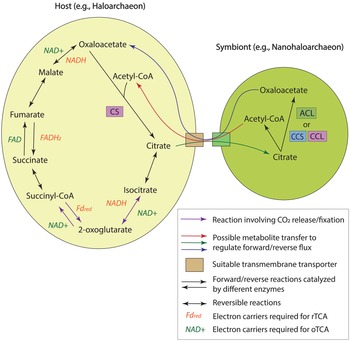
An interesting issue raised is that extant Haloarchaea, one of the most prominent modern groups that use retinal-based proton pumps, have not yet been shown to fix carbon. However, one carbon fixation pathway in Haloarchaea is almost complete – the rTCA. Haloarchaea possess all necessary enzymes for rTCA with the exception of an enzyme for citrate cleavage. Haloarchaea are also known to engage in intimate symbioses with Nanohaloarchaea, as was recently shown for the relationship between Candidatus Nanohalobium and Halomicrobium (La Cono et al., Reference La Cono, Messina, Rohde, Arcadi, Ciordia, Crisafi, Denaro, Ferrer, Giuliano, Golyshin and Golyshina2020) and Candidatus Nanohaloarchaeum and Halorubrum (Hamm et al., Reference Hamm, Erdmann, Eloe-Fadrosh, Angeloni, Zhong, Brownlee, Williams, Barton, Carswell, Smith and Brazendale2019). Out of all rTCA enzymes we found Nanohaloarchaea, including Candidatus Nanohalobium and Candidatus Nanohaloarchaeum, to possess only two, CCS and CCL, indicating these organisms are capable of citrate cleavage. This raises the tantalizing possibility that Haloarchaea and Nanohaloarchaea together may be able to couple retinal-based proton pumping to carbon fixation via the rTCA (Fig. 6). Along similar lines, Methanomicrobia which often lack ACL, are known to engage in syntrophic relationships with at least one Asgard Archaeon, Prometheoarchaeum syntrophicum (Imachi et al., Reference Imachi, Nobu, Nakahara, Morono, Ogawara, Takaki, Takano, Uematsu, Ikuta, Ito and Matsui2020). Since we found that most Asgard phyla possess ACL, the syntrophic consortium might be able to perform the complete rTCA. Likewise, Deltaproteobacteria from Syntrophobacterales possess ACL and are involved in hydrogen syntrophy with archaeal methanogens (Harmsen et al., Reference Harmsen, Van Kuijk, Plugge, Akkermans, De Vos and Stams1998). Consequently, these findings require further in vivo investigations.
Schematic depiction of possible syntrophic operation of the TCA cycles between a host and a symbiont, such as a Haloarchaeon and Nanohaloarchaeon (Hamm et al., Reference Hamm, Erdmann, Eloe-Fadrosh, Angeloni, Zhong, Brownlee, Williams, Barton, Carswell, Smith and Brazendale2019; La Cono et al., Reference La Cono, Messina, Rohde, Arcadi, Ciordia, Crisafi, Denaro, Ferrer, Giuliano, Golyshin and Golyshina2020). Electron carriers required in either oxidized or reduced form for either oTCA or rTCA reactions are noted (Fdred, reduced form of ferredoxin).

Inter-symbiont gene transfer is known for another archaeal association – a Crenarchaeote Ignicoccus hospitalis and a member of the DPANN superphylum Nanoarchaeum equitans (Podar et al., Reference Podar, Anderson, Makarova, Elkins, Ivanova, Wall, Lykidis, Mavromatis, Sun, Hudson and Chen2008). Multiple studies of this association have shown consistent protein and metabolite transfer between the two partners to compensate for shortcomings of their individual metabolomes (Giannone et al., Reference Giannone, Huber, Karpinets, Heimerl, Küper, Rachel, Keller, Hettich and Podar2011), showing that a similar system is theoretically possible for a Nanohaloarchaeon and a Haloarchaeon or a member of Methanomicrobia with its bacterial or archaeal symbiotic partner. Both Nanohaloarchaea and Haloarchaea possess copies of genes of various transporters capable of moving small metabolites across the membrane, such as the major facilitator superfamily transporters (Quistgaard et al., Reference Quistgaard, Löw, Guettou and Nordlund2016).
Syntrophic separation of oxidative and reductive fluxes through the TCA cycle
Inter-symbiont transfers of enzymes or metabolites can form a basis for many syntrophic associations. However, CO2-fixing reactions in particular are very thermodynamically challenging and may require over-reduction of electron carriers or switching to carriers with lower reduction potential, such as ferredoxins, implicated in rTCA (Bar-Even et al., Reference Bar-Even, Noor and Milo2012). An excess of electrons can be hard to come by without the presence of multiple specialized oxidative pathways. Plants and other organisms using Calvin-Benson cycle possess light-activated photosystems capable of reducing NADP, while most Archaea lack systems of comparable efficiency. Hence, different groups of organisms use different strategies to regulate fluxes through TCA reactions, for example, with CS capable of catalysing citrate cleavage dependent on CO2 availability in H. maritima (Steffens et al., Reference Steffens, Pettinato, Steiner, Mall, König, Eisenreich and Berg2021) and T. takaii (Nunoura et al., Reference Nunoura, Chikaraishi, Izaki, Suwa, Sato, Harada, Mori, Kato, Miyazaki, Shimamura and Yanagawa2018). However, splitting the operation of rTCA cycle into two syntrophic cells might be beneficial to allow for regulation of both forward and reverse fluxes through the cycle with lesser dependence on environmental conditions or availability of reduced electron carriers, which can be either produced in oxidative reactions or consumed in the reductive ones (Fig. 6). The citrate cleavage reaction is a particularly good candidate for such syntrophic regulation since it is far less energetically expensive than direct CO2 fixation reactions.
In present day well-characterized Haloarchaea, despite not providing direct electron sources, retinal-based photosystems do effectively supply other sympatric microorganisms with proton gradients and could be viewed as an efficient tool for a mutualist. Moreover, regarding their ancient origins and possibly wider distribution (DasSarma and Schwieterman, Reference DasSarma and Schwieterman2021), it is plausible that ancestral retinal-phototrophic Archaea could have obtained necessary electrons through syntrophy with microorganisms possessing more diverse oxidative pathways, such as sulphide or nitrite oxidation, metal oxidation or even water splitting. The syntrophic electron transfer process itself is a relatively conserved process, that could occur in several ways – either through multi-heme cytochrome c networks, reduction-oxidation of extracellular Fe/Mn (Shi et al., Reference Shi, Dong, Reguera, Beyenal, Lu, Liu, Yu and Fredrickson2016) or hydrogen/formate generation (Nobu et al., Reference Nobu, Narihiro, Hideyuki, Qiu, Sekiguchi, Woyke, Goodwin, Davenport, Kamagata and Liu2015). Multi-heme cytochromes c may be absent in Haloarchaea, but are present in related methanogens (Kletzin et al., Reference Kletzin, Heimerl, Flechsler, van Niftrik, Rachel and Klingl2015). Interestingly, modern Haloarchaea do possess formate dehydrogenase and interspecies formate transfer is a common feature of syntrophic relationships of methanogens (Hattori et al., Reference Hattori, Luo, Shoun and Kamagata2001). For example, this is a proposed method of syntrophy for methanogens aggregating with a recently cultured P. syntrophicum (Imachi et al., Reference Imachi, Nobu, Nakahara, Morono, Ogawara, Takaki, Takano, Uematsu, Ikuta, Ito and Matsui2020).
The role of syntrophy and symbioses in the early evolution of life is frequently overlooked. In fact, such an ecosystemic approach can be extended to the origins of life as a whole, suggesting a heterogeneous population of proto-organisms prior to LUCA with high levels of metabolic specialization and reliance on obligate symbioses. This is essentially a continuation of the theory of autonomous functional systems suggesting heterogenous molecular populations in the early prebiotic chemistry (Ruiz-Mirazo et al., Reference Ruiz-Mirazo, Briones and de la Escosura2017) and synergistic selection theory implying the importance of synergy in the early evolution of life (Corning and Szathmáry, Reference Corning and Szathmáry2015). Syntrophy in modern microbes is significantly more common than anticipated (Morris et al., Reference Morris, Henneberger, Huber and Moissl-Eichinger2013) and may rapidly evolve to provide significant benefits (Hillesland and Stahl, Reference Hillesland and Stahl2010). It was also demonstrated that syntrophy emerges spontaneously within complex metabolic networks (Libby et al., Reference Libby, Hébert-Dufresne, Hosseini and Wagner2019) and that syntrophic cooperation can be robust to the presence of selfish mutants (Boza et al., Reference Boza, Barabás, Scheuring and Zachar2023). This idea would be interesting to explore further, because it is supported by several features of life on Earth, such as abundance of nano-prokaryotes (DPANN and Candidate Phyla Radiation clades), late origins of intracellular membranes or abundance of Fe-S proteins and Ni-Fe hydrogenases in LUCA (Sutherland, Reference Sutherland2017).
Conclusions
In this study we aimed to understand the evolution of rTCA cycle, a carbon fixation pathway of major significance to the field of origin of life studies. We show that the strangely sporadic distribution of this pathway in modern microorganisms can be largely explained by abundant HGTs between Archaea and Bacteria and within various bacterial lineages of genes for enzymes catalysing the key citrate cleavage reaction. Additionally, we identify several microbial associations in which rTCA could be performed by syntrophic interactions between partner species. We suggest that evolution of rTCA could have been determined by such interactions within syntrophic consortia to increase metabolic flexibility and ease switching between oxidative and reductive fluxes. We also highlight the importance of an ecological perspective to the question of the origin of life as a whole.
Supplementary material
The supplementary material for this article can be found at https://doi.org/10.1017/S1473550423000095.
Acknowledgements
This research was conducted during Blue Marble Space Institute of Science Young Scientist Program (YSP) in 2021. The authors would like to thank Priya DasSarma for assistance with phylogenetic analysis and members of the DasSarma YSP 2021 group, David Baum, Praful Gagrani and anonymous reviewers for providing helpful feedback on this study and the manuscript. The DasSarma laboratory is supported by NASA Exobiology grant 80NSSC17K0263.
Conflict of interest
None declared.