James Jackson Jarves (1818–1888), American writer, art collector, dilettante, occupies a dignified and conspicuous place in the historiography of American art and art criticism. He is associated with the post-Civil War cosmopolitanism that increased American openness toward international aesthetic trends and promoted a new critical attitude toward the long-standing native bias in favor of verisimilitude and anecdote. Jarves is likewise frequently credited – or blamed – for the decline in popularity of landscape painting as the foremost genre of an American school.Footnote 1 Repeatedly linked to the incipiently modern taste that we associate with the postbellum decades, Jarves stands as a figure who helps to periodize American art, forming part of the narrative of change, dislocation, renewal, modernity that is generally employed to characterize the state of art production and reception after the Civil War. His texts, however, cannot readily be reconciled with his reputation.
This article thus proposes to reread Jarves's writing. Firstly, with an analysis of the methodological principles and rhetorical forms that structure Jarves's often-cited Art-Idea, I will reinterpret his art theory and suggest what were the aesthetic preferences he hoped to foster among Americans, and why. Secondly, the essay will reconsider Jarves's role in present-day historiography of American art. My point will be to argue that certain priorities pervade the subdiscipline, fundamentally determining the relationship between art and society, in which a figure like the reputed Jarves might be desired.
Jarves's role is not based on a long career as an American art critic, or even on his own larger body of art writing. Instead, the current conception of Jarves's contribution to the post-Civil War American art world rests primarily on the six or so chapters devoted to American painting, sculpture, architecture, art institutions and art education in his book The Art-Idea from 1864. This by itself is not problematic; a relevant contribution need not come only from a specialist, or from a certain quantity of words or years devoted to the field.Footnote 2 But I suggest it is significant that the current status of Jarves's writing in American art history requires a fairly selective reading of his criticism. His present reputation rests on at least two assumptions that bear reconsideration. First, there is the supposition of novelty: that Jarves was responsible for bringing forward ideas, if not entirely unique, then at least unfamiliar to his American audience. Jarves's opinions and his fundamental understanding of art and its history, however, were largely conventional and also relied on a structure of aesthetic classification that had long been central to American art criticism. And his call for Americans to look abroad for artistic models perhaps ought to be distinguished for its tone and motivation rather than for its uniqueness.
The second assumption is related, and that is the implicit, if unintentional, dismissal of Jarves's earlier published art books, Art-Hints (1855) and Art Studies: The “Old Masters” of Italy; Painting (1861).Footnote 3 The former consists mainly of the paraphrased positions of then-celebrated authorities, extracted and disordered into a clumsily written manuscript. The latter was written as a primer, meant to guide American audiences through (his notion of) the history and principles of European art, just as his own collection of European pictures was about to make its US debut in New York City.Footnote 4 Both texts are superficially unlike the more sophisticated and assured arguments of 1864, which demonstrate a stylistic facility that was absent in the earlier work. Both can also be seen in direct relation to his ambitions for his private collection: they construct the rationale that would prove the pictures' merits. It is therefore reasonable that these earlier writings have received less attention in the literature on Jarves's contributions to American art criticism. Unlike the later Art-Idea, with its broader scope and more polished style, these earlier books might be construed as the immature and underdeveloped phase of Jarves's career. Or, as works devoted primarily to European art and its prospects in the United States, they might simply appear irrelevant. The earlier texts nonetheless ought to be reinserted into Jarves's legacy. As will be discussed, these publications (particularly Art-Hints) do not differ from the later book with regard to the author's fundamental aesthetic schema and the rhetorical role it served for his American readers. Indeed the less facile nature of the earlier writing helps to demonstrate or clarify the structure Jarves employed for objectifying his opinions – a structure used more subtly, but substantially unchanged, in 1864.
Jarves is certainly also reputed to be a pioneer because of his art collection. It was first shown in the United States in 1861. These early Italian paintings, now owned by Yale University, were acquired primarily in Italy during the decade of the 1850s while Jarves lived in Florence. However much this collection has come to be valued, it cannot be considered the source of Jarves's cosmopolitan influence in the immediate post-Civil War decades. Indeed its foreignness to mid-nineteenth-century Americans, with regard to the styles and techniques it represented, failed entirely to impress Jarves's countrymen. As is clear from his inability to sell the paintings in Boston, New York, and Washington, as well as the negative press surrounding their exhibition, the apparent strangeness of Jarves's paintings served only to reinforce a type of nativism and feed a suspicion toward their owner and apologist.Footnote 5 Jarves's mania for his collection and his acquisitive habit were nonetheless quite significant for their bearing on his approach to art criticism. This influence is in part what the earlier writings demonstrate, and in doing so they provide a slightly different cast to the Jarves of The Art-Idea.
The methodological principles that structure Jarves's arguments, primarily in 1864, but also in his Art-Hints of 1855, have a direct relationship with the aesthetic preferences he hoped to foster among Americans – about European as well as American art. These principles, in my opinion, take shape in two fundamental structural forms. First, there is an overarching theory, which I will identify and analyze. Jarves himself asserted that such an idea structured his approach to art criticism, and cited it as his particular contribution to the field. Specifically, he claimed that art must be understood within its larger social milieu, inside a context of cultural factors.
Second, there is a recurring rhetorical device at the core of Jarves's writing that he employed within his larger approach to evaluate art. Namely, he utilized a dyadic topos of spirituality versus materiality, idealism versus realism. This paradigm for art writing pervaded the discourse and was crucial to the definitions and expectations Jarves and his peers had for art, and it formed a basis for their critical opinions. Jarves's opinions about art and his use of this familiar model were novel only to the degree that, at this specific historical moment, the terms of the discourse were becoming more pronounced, pressured, and debated. Here, too, he is in step with his contemporaries, but his strident language may indicate that a private agenda – to rationalize and elevate the aesthetic type represented by the paintings in his own collection – animated his writing as much as the debates of the others. In fact, I will question if this classificatory model was not even more fundamental to his thinking than his self-styled interest in “social relations.”Footnote 6
I begin with the larger cultural foundation that Jarves considered basic to the understanding of art. He introduced several of the ideas noted above at the close of his first chapter devoted to specific American artists. The chapter is called “Painting and the Early Painters of America. – Benjamin West; Copley; Leslie; Trumbull, Sully; Peale, Stuart; Mount; Vanderlyn, Cole; Washington Allston.” In the concluding paragraph Jarves sought to establish the grounds for commenting on contemporary American art in the chapter to follow. He counseled his audience,
we shall turn in the next chapter to the more copious topic of contemporary art, first asking the reader to keep in mind the high qualities of the artists we take leave of. Note well their gentlemanly repose, quiet dignity, idealization, appreciation of thought and study, and absence in general of the sensational, exaggerated, vulgar, and superficial. They had qualities which ought to have endeared their style to us and made it take root and grow. But there were powerful causes of a political nature at work to strangle its life in its youth. It is gratifying to know that the American school of painting began its career with refined feeling and taste and an elevated ambition, basing its claims to success on high aims in portraiture and historical and imaginative art. It evinced not much love for genre or common subjects, and indulged in landscape only in an ideal sense. This was indeed a lofty inauguration of the art-element, and, considering the limited number of artists and inauspicious condition of the country, one fruitful in fine art. Under similar circumstances no other people can show a better record, certainly not a brighter beginning. Why it failed of making a permanent impression will appear as we go on.Footnote 7
It is evident that Jarves had a preference – a certain manner of art was far more commendable than the form that was to follow it. He does not name or give precise outlines to the artistic form he extols, but the reader is expected to agree with Jarves on the basis of the values listed. A quality that he variously named “idealization,” “thought and study,” “refined feeling,” and “elevated ambition” is invoked repeatedly as the great merit of the early painters. It is opposed just as clearly to what he denominated “sensational, exaggerated, vulgar, and superficial.” He also favored “historical and imaginative art,” and even portraiture, which, like the latter, was undertaken with “high aims.” By contrast he classed genre paintings as “common” and put landscape painting in this same sentence, as a thing to be “indulged in” and then only in its “ideal sense.”
In addition to ordering the genres according to a hierarchy at least as old as Sir Joshua Reynolds, Jarves utilized the rhetorical classification, noted above, that was by that time ubiquitous in American art criticism: the ideal or imaginative versus the real or material.Footnote 8 Permutations of this dualism did not just at this moment dominate American art writing, but had been employed as fundamental points of reference for decades. For Jarves it will remain a cornerstone of his rhetorical structure, and I will consider his particular use of it further on.
I want first to focus on his preferred terms, which are ambiguously or interchangeably references both to a pictorial form and to social class and character. The “gentlemanly repose” and the “quiet dignity” describe the status of the men as well as of their pictures. So too Jarves's use of “idealization” and “absence in general of the sensational, exaggerated” refers to and conflates the characteristics of art and artist. For Jarves, the art and its form are bound to the larger conditions of its producers. Like the obviously disparaged characteristics of the “vulgar, and superficial” that are also (but as yet elusively) tied to their “causes of a political nature,” Jarves related art to certain aspects of its milieu. He tells his readers in The Art-Idea repeatedly, and in various contexts, that the art of any period will respond to the prevailing religious authority and manner of political organization. A very overt and condensed statement of this principle opens his first chapter on American art. The chapter consists of his introductory meditations on the subject, and the title alone alerts us to his concerns. Called “An Inquiry into the Art-Conditions and Prospects of America. – Art Criticism. – Press, People, and Clergy. – Needs of Artists and Public. – American Knownothingism in Art. – Ecclecticism. – The True Path,” it begins with the following summary:
We have now succinctly traced the art-idea in its historical progress and aesthetic development in the civilizations of the Old World to the period of its advent in the New, showing, as we proceeded, that, though the love of beauty is a fundamental quality of the human mind, yet its manifestations in the form of art are checked, stimulated, or modified by the influences of climate, habit, and traditions of race, relative pressure of utilitarian or aesthetic ideas, the character of creeds and tone of religious feeling, and above all by the opposite degrees of freedom of choice and qualities of inspiration permitted to the artist by Pagan, Papal, and Protestant governments.Footnote 9
Jarves's idea of historical progress is a significant one. Instead of perceiving art history as a single and linear tradition, in which all art either succeeded or failed in proportion to its adherence to the given precedent or aesthetic type, he saw the history of art as a more culturally specific phenomenon. Jarves attributed to art changeable and historically determined stylistic traits, endemic to particular places and peoples. Each culture has its own habits, traditions, “tone of religious feeling,” or relative utilitarianism, and this determines the nature of the art it produces. He constructs an art history that is distinctly historicist, a notion of art as bound to relative conditions prevailing in a given culture. To refine it further, his approach might best be defined as a partial or limited historicism since Jarves relies on an idea of absolute truth, with universal quests for beauty, and of fixed poles of spirit and matter between which such beauty is expressed. But the nearness to one or the other of these poles is relative, based on the varying cultural characteristics.
Before looking at this limited historicism more closely and considering those facets of culture that comprise Jarves's notion of art influences, note that this term I use to refer to his method is something of a hybrid, more or less devised and used here for the sake of argument. I take it to designate what I have described above – that Jarves perceived the aesthetic form of all art as bound to (a select group of) cultural factors, while he simultaneously held to the belief in transhistorical standards of beauty, truth, and spirituality. The term is also intended to distance Jarves's theory from any specific philosophical engagement. That is to say, Jarves likely indirectly absorbed Hegelian as well as empiricist notions of history, both of which were then current,Footnote 10 but he was never systematic or overly thoughtful about his application of any existing ideas. He combined or confounded theories, seemingly unaware, to suit his own rhetorical ends.
Limited historicism, then, is the name I want to give Jarves's overall approach to art criticism. It gave structure to the criteria he used for evaluating American art and it systematized his judgments and opinions about it. Though it consisted of an assertion that art was fundamentally an expression, in every era, of the indigenous conditions particular to that time and place, he routinely extracted particular factors from the broader world of the artists that he deemed the influential ones. Which are these, and what is their relation to his opinions about American art?
He emphasized that art responded to “above all … the opposite degrees of freedom of choice and qualities of inspiration permitted to the artist by Pagan, Papal, and Protestant governments.” For Jarves the prevailing religion establishes the aesthetic tone and expressive intent of any epoch's artwork. Government itself – as he implies here with the formula “Pagan, Papal, and Protestant governments” – is likewise central, but it is hardly distinct from (it is literally modified by) these broad religious types. To this basic armature are added corresponding attitudes and tastes of the people in the given times and places. These too are rather broad and reductive and conform to then prevalent notions of types.Footnote 11 In particular, Jarves repeatedly linked sensual excess and despotism to Papal religion and rule, while crediting the Catholic countries where such rule dominated – and he referred predominantly to Italy and Spain – with a true passion for art and beauty. Correspondingly he summarized Protestant people and art as possessing an inherent distaste for all that is not democratic. Such people, however, were hampered by an overly pragmatic and abstemious attitude toward art, with a preference for the mundane in content and form. Here is one example of many:
Catholicism, first in its ignorance, and afterward by selfish policy, aimed at its restriction to a defined, dogmatic, religious expression. But while itself under the impetus of growth and expansion, its art partook of the same partial freedom and noble energy, and to the extent of its liberty strove to be true and spiritual. Unfortunately for its final perfection in this direction, that art, whose varied progress and lofty genius were represented by Giotto, Niccola Pisano, Orgagna …, was degraded into an instrument of state pomp and artistocratic luxury.
…
As soon as Protestant art freed itself from the control of rulers sensual and papal at heart, like the English Stuarts, it identified itself by degrees with the people, assuming their level of thought, and their liking for the homely and common … aesthetic feeling [does not, however,] assume the dignity of a passion … Yet it is slowly making its way to the heart of the multitude … without any need of church or state to interpret or dictate. Catholicism exalted the art-motive, but Protestantism gave it liberty.Footnote 12
Jarves demonstrates that he has borrowed heavily from Ruskinian notions of periodizing and classifying Italian art. This is not my main interest, however. Rather, Jarves shows his coupling of Catholicism and Protestantism with respective tendencies in aesthetic taste, and disparate levels of popular will. Qualities, it ought to be stressed, that he discusses as inevitably or automatically bound to one another, and to the exclusion of myriad others that might equally be used to explain or define a religion's (or an aesthetic's) constellation of attitudes, characteristics, manifestations. With Catholicism is linked “selfish policy” and dogma, under which art was eventually “degraded into an instrument of state pomp and aristocratic luxury.” Its moment of being “true and spiritual” coincided with a brief time of “partial freedom.” On the other hand, liberty is the great contribution of Protestantism. Its art, while “homely and common,” has “freed itself,” and it communicates without “church or state to interpret or dictate.”
However loose, generic, and current his links may have been, they represent an attempt to explain artistic differences based on cultural factors. Or, perhaps, these ostensible cultural influences on art were rather a set of predetermined ideas that Jarves sought to solidify with the putative objectivity of his historicist method. In particular, we might ask if his oppositions between generalized religious and political structures, so rigidly reduced and systematized, were employed foremost as value-laden types meant to classify aesthetic form. This question might alternatively be posed as: which of these came first? Did his aesthetic opinions follow simply from the conclusions of his theory of cultural influence, or did this theory rationalize his preformed artistic judgments? I suggest that the latter might be the more accurate reading. Indeed, I believe his historicist method rationalized both the predetermined ideas about political and religious systems and, even more fundamentally, the formal types he sought to associate with them.
Here the other essential element of Jarves's art theory, the classificatory scheme of the real versus the ideal, becomes integral. This structure seems to me to form Jarves's bridge between broad cultural character and individual formal assessments, and to provide him with ostensibly objective grounds on which to criticize American art and American taste. It is perhaps closest to his actual agenda, to the primary set of opinions that he sought to propagate and justify, opinions to which, I suggest, the rest of his historicist approach was subsequently adapted. The following is a very representative instance of this method of classification. It also demonstrates those opinions that the structure helped to stabilize as the most salient for the evaluation of art. From the chapter on “Art-Conditions and Prospects of America,” Jarves directed his readers by stating,
Certain works of man are a perpetual joy, – the same to-day, and forever, – because they are a revelation from the unseen, and an assertion of the eternal supremacy of spirit over matter. Genius creates, talent constructs. The power of the one is instinctive, a gift from above; of the other, receptive, accumulating by example and training. Hence genius alone gives birth to great, new, or noble work; while simple talent, however clever in execution, often fails from want of intuitive discernment and original thought.Footnote 13
Whatever manifests spirit, according to Jarves, will necessarily be superior to that which he defines as material. (And note that such manifestations are outside, or maybe prior to, history.) The categories have many synonyms in this passage that likewise recur throughout his and his peers' writing, as seen already in the first quotation about the early American painters. “Genius” and “original thought” make “great,” “noble work,” as opposed to “talent” and “training” that may produce something “clever in execution” but inherently faulty because it is based solely on external examples and not on some manner of “revelation.” This fundamental opposition of matter to spirit is spelled out precisely here by Jarves for his readers, proffering the correct definition of art. He suggests that his American audience should bear it in mind when confronted with a work of art and thus avoid erroneous conclusions – particularly about unfamiliar and foreign paintings – that its limited native experience inclines it to develop.
This principle was dear to Jarves. In this same chapter, supposedly dedicated to American art, he reverted to this pet project. The recourse to Italian examples and to “heavenly beings” likely suggests the degree to which his pronouncements on American art never strayed far from his underlying aesthetic bias. He stated,
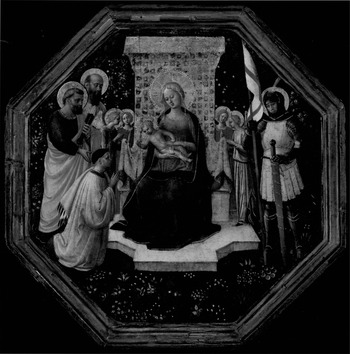
Supernal beings can only be suggested by art, just as they are to our imagination. That artist is most successful in this who best impresses the spectator with the idea of a spiritual being, avoiding all intrusion of technical artifice, or display of anatomical dexterity. Fra Angelico [see Figure 1] is excelled by many a school-boy now in the science of design, yet no artist of any age equals him in the spirituality of his angels and Madonnas, or gives more elevated types of heavenly beings.Footnote 14
Fra Angelico, Italian (Florentine), c.1395/1400–1455, Virgin and Child Enthroned with Saints Peter, Paul, and George(?), Four Angels and a Donor, c.1446–49, tempera on panel, 24·9×24·8 cm. Museum of Fine Arts, Boston. Gift of Mrs. W. Scott Fitz, 14.416. Photograph © 2008 Museum of Fine Arts, Boston

Thus the material aspect of painting is more than simply a secondary consideration; it can actively hinder the representation of the spiritual (and spirit might consist of secular as well as religious ideals). Consequently, a painting's value as art depended, for Jarves, on the palpable presence of an unseeable ideal, made visible by the “genius” or “elevated ambition” of the painter. But all formal considerations or indulgence had to be subordinate to the apt expression of the ideal. The relationship between technique and expression is likened to that which he constructs between matter and spirit; it is antagonistic, or rather it will be antagonistic when a painter shows too much concern for the former. Demonstrations of training, captivating the viewer with dramatic compositions or bold color, flourishes of the brush – all came under the heading of a materialist tendency that is inimical to art.
Art, by this definition, must be evaluated primarily on the basis of its immaterial qualities, its spiritual, imaginative character. The outward form, and most particularly the artist's facility with regard to verisimilitude or dramatic visual appeal, are rendered secondary considerations, or rather considerations that mislead the viewer.
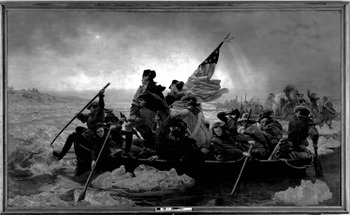
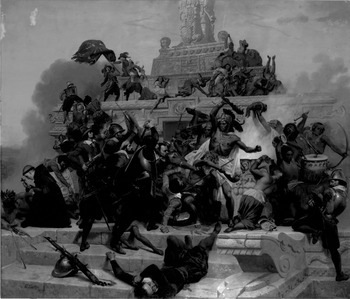
The implications for American art become clearer in another typical example. Using Emanuel Leutze as representative of popular taste,Footnote 15 Jarves opposes the painter's characteristic style to the (elusive) qualities of true art. Leutze “manifests some originality of thought, much vigor,” Jarves allows, but
overmuch dramatic force, and [he] has an abundance of executive skill, but is spasmodic and unequal. Tours de force delight him. He has the vicious coloring of the Dusseldorf school in its fullest extent. The Rotunda painting in the Capitol of the Star of Empire is his most ambitious work. This, the well-known Washington crossing the Delaware, the Storming of the Teocalli at Mexico [see Figures 2, 3], and the portrait of General Burnside are striking examples of his epic style. Bad taste in composition overpowers much that is meritorious in design and execution. Leutze is the Forrest of our painters. Both men are popular from their bias to the exaggerated and sensational, cultivating the forcible, common, and striking, at the expense of the higher qualities of art.Footnote 16
Emanuel Leutze, American, 1816–68, Washington Crossing the Delaware, 1851, oil on canvas, 278·5×647·7 cm. Metropolitan Museum of Art. Gift of John Stewart Kennedy, 1897 (97·34). Image © the Metropolitan Museum of Art

Emanuel Leutze, American, 1816–68, The Storming of the Teocalli by Cortez and his Troops, 1848, oil on canvas, 215×252·9 cm. Wadsworth Atheneum Museum of Art, Hartford, CT. The Ella Gallup Sumner and Mary Catlin Sumner Collection Fund (1985.7).

Leutze's work is dramatic, vicious, exaggerated, and common, among other faults, and popular because of them. Evidently Jarves found much to criticize both in Leutze and in a public who liked such paintings. The “higher qualities of art” are missing from these paintings. But note that so, too, are they absent from Jarves's sentences. In part the (regrettably overpowered) “meritorious … design” and “originality of thought” constitute these so-called higher qualities but, beyond that, specific attributes are not named.
Like so much critical writing from mid-nineteenth-century Americans, those qualities that made art Art are rarely spelled out; they are immaterial, spiritual, ideal. The faults, on the other hand, by the very nature of this dyadic definition of art, are material. They are doubly material, even; the catalogued detractions correspond to Jarves's notion of – and here his cultural explanation contributes – America's overemphasis on “the knowledge which makes her rich and strong, [rather than on] the art that implies cultivation. … Americans calculate, interrogate, accumulate, debate. They yet find their chief success in getting, rather than enjoying; in having, rather than being: hence, material wealth is the great prize of life.”Footnote 17 A populace so inclined, according to Jarves, will have an aesthetic taste for showy display, for “the sensational” and “striking” in painting. Correspondingly, they will have little sympathy for the “elevated” and “spiritual” in art. In fact, such a people will not be able to recognize these qualities, and instead will see only an absence of those material attributes that their culture inclines them to recognize as superior.
Here it is important to observe that Jarves was not alone at this moment in his identification of a surplus materialism in art. From at least as early as 1855 we can read a comparable preoccupation in many art writers. The reception of artists such as Asher Durand and Frederic Church, among others at that time, shows a heightened critical awareness of, or skepticism towards, formal practice that seemed overtly to appeal to the eye alone. Critics were touchy about that which captivated the gaze of the viewer with technical displays of the minutia of the visible world, or with bold effects of color. Increasingly in this decade, critics who had long used the poles of realism and idealism as a fundamental critical tool voiced concerns about the dominance of the real and material side. Now, moreover, they also made a rhetorical relationship between these formal traits and economic meanings of the term “materialism.”
For Jarves, materialism was particularly detrimental, and not simply because it seemed to signal a growing habit among the American audience of conflating value with external appearance. His greater concern was that the public in its grip was unwilling to recognize that the “best artist” is the one who “avoid[s] all intrusion of technical artifice.” Nor would such an audience see, as Jarves had it, the superiority of Fra Angelico, since they would be more captivated by superficial virtuosity of drawing. Jarves's opposition of matter to spirit thus posits the preeminence of paintings whose technical merits will necessarily be misunderstood by those judging according to their culture's materialist standard. He practically courts such misapprehension in order to demonstrate the degree to which an American must remove himself from his native traditions and search for alternate standards in order to understand “true” art.
Jarves's dyadic scheme also freed him from any need to be overly consistent about his likes and dislikes with regard to form within this system. Since it is the unseeable qualities that determine a work's status, Jarves could and did criticize or praise the formal execution of his contemporaries' painting without recourse to a consistent set of stylistic principles or technical guidelines, arguing instead for the presence or absence of the spiritual. The technical and formal were then evaluated for their relative success in the expression of that character which is immaterial. Certainly, this gives enormous authority to the critic as well. And Jarves used it to persuade his American audience to consider materialism (or, more precisely, those forms he termed as such) as distinct, by itself, from true art.
I believe it will by now be evident that Jarves's dualist rhetoric forged a system out of which an apparently objective definition of art could be built, and that such definition was exemplified by his own collection of early Italian paintings. Moreover it demonstrated the weakness of American aesthetic standards. This structural dyad, in my opinion, was the most fundamental aspect and the driving force that determined much of the rest of his art theory. I would like to make a few other observations, separate from the imputation of motives, however present those may be understood to be,Footnote 18 about why I have put so much weight on this aspect of Jarves's art theory. The first concerns his earlier writing, particularly Art-Hints (1855), and the second relates to speculations about the current placement of Jarves in the historiography of American art and art criticism.
With regard to Art-Hints, in many ways all of Jarves's writing works and reworks the same set of ideas. He indicates as much himself. Art-Hints, he claimed, “was written in fervor of a fresh intellectual enjoyment. … The feeling that pervades Art-Idea is identical with that of the former work. Divergencies [sic] of conclusions are owing to deeper investigation and riper judgment”.Footnote 19 Given this, it might seem to be appropriate to skip his earlier, and inferior, attempts, and concentrate instead on the most developed expression. However, it is the continuity, or the similarity of purpose, that makes the earlier work useful. The shrill and unpracticed tone of the writing more clearly reveals Jarves's priorities and makes more obvious the disjunction between his declared project and his actual focus.
That “identical feeling” that Jarves claimed animated his writing was the desire to construct an art theory based on what in Art-Hints he repeatedly called the “twofold nature” of man, his “material and spiritual” makeup. Unlike the text of 1864, in the study from 1855 these categorizations provide the overt organizational scheme to the book. Two of the first five chapters are entitled accordingly, and throughout the other chapters, whose titles might indicate a focus on some other aspect of art, he repeated these divisions with near manic frequency. For instance, in one of the chapters specifically dedicated to “Art in its relation to history” (the concept, remember, that Jarves considered his contribution to the field) he offers very little in the way of history, and in fact restates with only the addition of generic regions, not even place-names, his dualist exposition. The chapter opens with reference to the historic era dated by Jarves as that in which “Michael Angelo [sic] fell after much sullen resistance; Raphael was seduced from his primitive sincerity; Leonardo da Vinci wasted his genius on barren scientific and mechanical experiments.”Footnote 20 He elaborates vaguely on the time period, noting that the “great distinction”
between this age and the preceding, was the centralization of power into the hands of princes. Democratic communities were absorbed into kingdoms; free cities became provincial towns; in fine, the people from citizens became subjects. Whatever of civil and political liberty had existed in Italy, Spain, and France, especially in those countries in which Art had arisen and thrived in the bosom of the people, was now wholly extinguished.Footnote 21
I will return to the mention of democracy, but for now note the very loose and imprecise invocation of (again opposing) concepts as history. My reason for citing this vague periodization is to show the only manner of dating a historical moment that Jarves used to preface a discussion ostensibly dedicated to history. In this case, he wanted to turn to examples beyond Italy, and he defined thus the “northern nations”:
Reason was more powerful than imagination. It sought its action rather in matter or science than in Art. Imagination was indeed vigorous, but manifested itself in ruder forms. Beauty partook of a sterner character. If the passions were violent, reason also was active, and the balance was better preserved.Footnote 22
My intention is not to exasperate the reader by continually revisiting the same point, but to show the obsessive attachment Jarves himself had to this dualist scheme. He seemed unable to prevent himself from returning to it over and over, even when he had appeared, or stated anyway, that he was going to demonstrate art's relation to history.
Further examples would only belabor the idea. As for his reference above to democracy, this too is a recurring theme, and one that seems to give at least some substance to his claims about presenting the “social relations” of art. Political systems are discussed also with reductive and oppositional distinctions. “Democratic communities” contrast kingdoms, citizens contrast subjects, and the former refer to the greatest moment of Italian art – that era just before “Michael Angelo fell” and the decline in art set in.
Most significant, though, is Jarves's inconsistency with regard to the influence on art that the “people,” as free citizens, in “democratic communities” exert. It is very unlike his never-changing stance on the relation of spirit and matter to art. As above, in the context of distinguishing between art's greatest age and its fall, democracy is brought in to define the former, and absolutism the latter. This is one instance of several where Jarves insists that the superior qualities of feeling and truth “had arisen and thrived in the bosom of the people … to whatever end the people bent their energies, they wrought with soul-aroused vigor.”Footnote 23
Likewise, he frequently complained about the charges of antipopulism, or of despotism, that he claimed were “mistaken notion[s] widely disseminated” about Italian medieval art. In a very detailed rebuttal included in The Art-Idea he quoted a passage that was to his mind particularly guilty of this error. It was written by “the Rev. Henry Ward Beecher, at heart a true champion of liberty, but who nevertheless has been inadvertently led into publishing some singular conclusions in regard to Italian medieval art.”Footnote 24 Jarves included in his text an excerpt, from which I extract a few sentences. Beecher is quoted as saying,
In all the Italian schools, not a picture had ever probably been painted that carried a welcome to the common people … in this prodigious wealth of pictures, statues, canvas, and fresco, – I know nothing that served the common people. In art, as in literature, government, government, GOVERNMENT, was all, and people nothing!Footnote 25
Jarves included this passage in order to demonstrate the wrongheadedness of the ideas generally held about the art he championed. His argument with Beecher's understanding was premised on precisely the democratic nature of the moment in question. Jarves asserted that
democratic institutions had the upper hand in Italy, especially in Tuscany, at the epoch which Mr. Beecher denounces. Art decayed as soon as its patronage fell into aristocratic keeping. To be noble in Florence in the days of the Giotteschi was as uncomfortable as to be a Secessionist at the North now. The art of Italy, from its revival in the twelfth century to its prime in the sixteenth, was emphatically the offspring of the feeling and taste of all classes of the people. They created the demand for it, and paid for it most liberally out of their profits in trade.Footnote 26
It was evidently important for both the critics and apologists of this art to stake their claims on the relative democracy of the pictures and their patronage. It is consequently not surprising that Jarves would frequently employ the poles of populism and despotism in his references to the social relations of art. Nor is it surprising that art he defended would be defined as democratic. What is telling, however, is that he was unable to maintain a consistent position with regard to democracy's supposed effects. As we see above, democratic influence is at the core of the superior soul-infused quality of the art of the Italian Middle Ages. But recall that Jarves was quite skeptical about the impact that too much popular will had on the art of his contemporaries in America (and on the that of the variously denominated “Northern peoples,” or “Germanic schools”). In the quotations given in the opening pages of this essay there was an indication that the “quiet dignity” and “gentlemanly repose” of America's early – and finer, according to Jarves – art gave way to something “sensational,” “exaggerated,” and specifically “common”. Indeed the “causes of a political nature” that he invoked to explain the demise of this finer art turned out to be the popular will, the preference for Leutze by a people left to its own materialist proclivities.
Jarves cannot fully reconcile his conflicting desires. He wants to justify true art by locating the origin of genuine spirit among the people, while condemning all manner of despotism, from princely courts and aristocratic patronage to academic method and training. Yet he repeatedly conflates the popular with the disparaged material side of art, with an adherence to base senses. “The failures of America … arise chiefly from commencing at the wrong end … artists too commonly are led by their blind impulses.”Footnote 27 And the “wrong end,” much as Jarves might aver to the contrary, refers not only to the outward aspects of art, but to the bottom of the class structure.
In the 1864 text this ambivalence, though still present, was somewhat reconciled by the rhetoric of American exceptionalism, then steeped in the passions of the Civil War. Jarves could remind his audience, as his previously outlined historical evidence had demonstrated, that democratic cultures tended in aesthetic taste toward “common” and “striking” verisimilitude. But in America a larger destiny for democracy was at hand, and that might point them in a more fitting direction artistically. He predicted that
the future of the art of the intermingling races of a new world, fused into a democracy which is now passing through its gravest struggle for existence [will] reissue, as we believe, the most powerful because the most enlightened, the most peaceful because the most free, and the most influential people of the globe, because having sacrificed the most for justice and liberty.Footnote 28
Thus while Jarves had insinuated that American taste suffered from its popular and democratic roots – by reason of the exceptional character of American democracy fundamentally built on both the “conquest of ideas” and the fusion of “intermingling races” – Americans had reason to rise above such weakness in taste. The solution, not just the problem, was at hand. The spirit of openness in the people “most enlightened” and “most free,” combined with their acquisitive impulses, would teach them to utilize all that is good from other cultures. In a passage that shows the facility he had achieved by 1864, Jarves says this quite directly himself:
We are a composite people. Our knowledge is eclectic. The progress we make is due rather to our free choice and action than to any innate superiority of mind over other nations. We buy, borrow, adopt, and adapt. With a seven-league boot on each leg, our pace is too rapid for profound study and creative thought. For some time to come, Europe must do for us all that we are in too much of a hurry to do for ourselves. It remains, then, for us to be as eclectic in our art as in the rest of our civilization.Footnote 29
This sentiment has long been associated with Jarves. My point is not to take away his authorship of this bold appeal to Americans to look abroad for artistic models, but rather to demonstrate its relation to the underlying structure of his art theory. I submit that first and foremost Jarves constructed a fundamental definition of art that relied on the opposition of matter to spirit, where spirit was the determining, yet immaterial, value, giving considerable authority to Jarves himself to pronounce upon the presence or absence of this elusive quality. His sociopolitical explanation, which he overtly claimed as the substance and core of his method, lacked consistency and was used with conflicting conclusions to validate aesthetic judgments and verdicts on taste that had been already determined. Regardless of democracy's influence, in other words, at heart for Jarves there was an absolute standard of aesthetic taste that was either present or absent among a people.
Finally, the reading of Jarves I present here suggests my skepticism about his role among modern historians of American art. As noted at the outset, his reputation defines him as an agent of change, a critic whose ostensible internationalism, exemplified by the final quotation above, has been thought to mark a shift between antebellum nativist art and postbellum interests in transatlantic cosmopolitan, and modernist aesthetic trends. His art theory and critical interests, however, do not readily fit this model. His classificatory schema is fundamentally traditional, his opinions about European art are frankly derivative, and the majority of his guiding biases were then current. Why, then, does Jarves occupy the art-historical position that he does?
I suggest that his place has to do with current art-historical priorities. Jarves's reputation points on one level to a desire in the subdiscipline of American art history both for a certain kind of definition of innovation and for a search for the innovative itself. The reputed Jarves constructs a figure to whom a narrative of change and disruption can be attached, and which helps to explain or create a trajectory of an incipient modernism in America. It indicates a desire to plot a coherent trajectory and give shape and relation to events within a model of linear progress (where that progress is, however, unconsciously defined according to a modernist paradigm). More importantly, such a figure provides a periodization of art that corresponds to the Civil War, a moment of massive upheaval, seen as transformation in the larger society. The search for such a model is fundamentally premised on a historicist understanding of art's relation to culture; it must express the larger sprit of the times. Marshaling Jarves, writing precisely at the moment of the Civil War, to demonstrate a putatively new attitude toward art proves, quite circularly, that art did indeed begin to shift, to move toward modernism – and that it did so precisely at this moment. A relationship is thus secured between art and the larger society. The transformation of one means the transformation of the other. I do not suggest that such has been the specific intent of scholars discussing Jarves, only that there is perhaps a pervasive sense in the subdiscipline about the nature of American art in which its value is automatically, necessarily, indexical. It is a manifestation of American culture, and more specifically American culture as defined by change, growth, disruption, reintegration. Perhaps, then, Jarves's real legacy is this brand of limited historicism.