By all accounts, there is nothing particularly monumental about the Cedar Creek Earthworks, a Woodland Period (c. ad 1–1550) enclosure found near Windsor, Canada. Consisting of a low semicircular berm with three nodes and surrounded by a shallow ditch, the site does not command attention. Nestled along its eponymous river near a small embayment, about 2 km from the Lake Erie shoreline, it is found on neither headland nor hill. Indeed, apart from its almost imperceptible material profile (lessened to some extent by centuries of erosion), the site is not set apart from its surroundings at all. What is more, whether approached by watercraft or on foot, the site has no clearly defined entrance or focal point. Making one's way over the embankment and across the enclosed space reveals no obvious object of reverence like a mound or cairn. So why, despite these characteristics, would this site be classified by some as a monument?
The term monument is typically used by archaeologists and other heritage professionals to refer to a class of sites encompassing enclosures, standing stones, burial mounds and other related forms, and a burgeoning scholarship on the taxon has developed in recent years (see e.g. Cummings Reference Cummings and Pollard2008; Gillespie Reference Gillespie2013; Knapp Reference Knapp and Kyriatsoulis2009; Osborne Reference Osborne2014; Rowlands & Tilley Reference Rowlands, Tilley, Tilley, Keane, Küchler, Spyer and Rowlands2006; Scarre Reference Scarre and Insoll2011). In some jurisdictions, such as the UK, the term is enshrined in law (e.g. the Ancient Monuments and Archaeological Areas Act 1979), affording a certain legal status to and provisions for the care of such features. In these and other areas, the term may also exist as a convenient shorthand for ancient structures which are artificial, durable and visible. Where Cedar Creek is concerned, assuming its Indigenous builders did not subscribe to a nature|culture dichotomy, the first of these criteria is not met, and in light of the site description provided above, we can hardly assert that the remaining characteristics were considerations in its design. Could we perhaps say, with an etymology that can be traced to the Latin verb monere, meaning ‘to remind’ or ‘to warn’, that Cedar Creek is a monument by virtue of its testimony to the past? We could, but as others would counsel (see e.g. Holtorf Reference Holtorf, Kolen, Renes and Hermans2015; Ingold Reference Ingold2013, 81), to adopt such a position is to suggest a rupture between past and present so complete that monuments serve to arrest artificially and hermetically seal an age on time's arrow. Were we to take a different tack and look for a declaration of the site's ‘true’ meaning or purpose, when it was first constructed ‘in the past’, we would likewise be quickly imperilled. Just as local Indigenous logics work against our separation from the world, so too do they eschew the separation of activities, eliding the spatiality and temporality of the ‘sacred’ and ‘secular’ in the process.
But surely there is something to be said of Cedar Creek's status as a monument vis-à-vis its material presence. Despite the fleeting nature of its various architectural forms, as noted above, could these not be seen as erstwhile mnemonics—the material anchors of past commemorative practices? As some researchers have suggested (see e.g. Ingold Reference Ingold, Arnason, Ellison, Vergunst and Whitehouse2012; Reference Ingold2013; Meskell Reference Meskell, Mills and Walker2008; Pollard Reference Pollard, Mills and Walker2008; Reference Pollard, Alberti, Jones and Pollard2013), we must be careful not to conflate the monument with the ‘memory work’ that occurs at and through such sites. In this way, what matters is how understandings of the past are produced and negotiated through engagement with these places, often in the company of others, whether or not any monumental architectural forms are present. This, in turn, invites a certain concern with the performative dimensions of monument construction and use—how movement, for example, through such spaces leads to dialogical participation rather than didactic instruction, as well as a heightened, somatic awareness of how these places gather together human and non-human elements across space and through time.
This kind of interrogation can be made more robust, I might suggest, through an examination of contemporary commemorative forms known as counter-monuments. Typified through the writings of James Young (Reference Young1992) on holocaust memorialization in Germany, the term was first used to encapsulate a suite of design practices that upended common aesthetic devices utilized during the Nazi era to create and control memory. By employing strategies such as monument negation (inversion), defacement, disappearance and dematerialization, designers sought actively to charge the viewer with the burden of memory work while simultaneously challenging the role of the monument as arbiter of hegemonic historical narratives. Thus, through unconventional techniques of monumentalizing and the use of a ‘relational aesthetic’ of dialogical engagement, counter-monuments work against traditional strategies of remembrance. Additional scholarship on counter-monuments by Young (e.g. Reference Young2000) and others (e.g. Crownshaw Reference Crownshaw2008; Stevens Reference Stevens2009; Stevens et al. Reference Stevens, Franck and Fazakerley2012; Stubblefield Reference Stubblefield2011) has since recognized other examples both within and outside Germany (e.g. Maya Lin's Vietnam Veterans’ Memorial Wall in Washington, DC) as well as other forms such as ‘spontaneous’ and appropriated monuments (e.g. the Flamme de la Liberté in Paris as a memorial to Princess Diana).
While a consideration of contemporary counter-monuments from an archaeological standpoint has been virtually non-existent (see Moshenska Reference Moshenska2010 for a notable exception), their investigation can bear critically on the conceptual underpinnings of the ‘monument’ category as currently applied in archaeology. Indeed, when coupled with a view of monuments that blurs the divide between modernity and antiquity, that does not attempt to freeze the ongoing creation, interpretation and memory of such sites, what we see is an interlacing of human activities and material trajectories—what Ingold (e.g. Reference Ingold2011, 149) would call a ‘meshwork’. In this view, memory work is facilitated not by instruction but by material perdurance (sensu Ingold Reference Ingold2013) that acts as a kind of beacon for experiential engagement. In what follows below, I pursue this avenue of inquiry by further exploring common concepts and features of monument-making before turning my attention to an exploration of counter-monument themes including form, siting, experience and interpretation. I then discuss how such themes were manifest at Cedar Creek and other earthworks dating to the Woodland Period in the central Great Lakes Region.
On the ontological status of traditional monuments
It is widely thought that the construction of monuments allows for historical events to be reified and held fast to material form. Through twin concerns with permanence (often realized in building materials) and commemoration (where the grandiose correlates with importance), monuments offer a pivot around which may turn public ceremonies involving the past. For the influential French historian Pierre Nora (e.g. Reference Nora1989), such pivots act as lieux de mémoire or ‘sites of memory’—physical spaces, as well as concepts, practices and objects, which make apparent certain narratives and views of the nation. These were necessary, Nora (Reference Nora1989, 7) argued, because sources of collective memory, what he called milieux de mémoire, had waned with modernity. Among other things, sites of memory had dissuaded groups from remembering by making such acts conscious and thoroughly circumscribed activities (Nora Reference Nora1989, 11–13). Monuments then, in this vein, act as proxies; where memory work is concerned, they release us from the ongoing responsibility to recall, while serving to fix a particular version of the past in something hardwearing. Yet, as many are aware, the intended messages associated with monuments can be subject to revision (Edmonds Reference Edmonds1999, 134). Consider, for example, the Flamme de la Liberté at Place de l'Alma in Paris. Donated to France in 1987 by the American-owned English-language International Herald Tribune newspaper, this replica of the Statue of Liberty's torch was envisioned as an enduring symbol of the bond between these two nations. With the 1997 death of Diana, Princess of Wales, in a tunnel underneath the monument, the Flamme de la Liberté became an informal beacon for mourning and remembrance far removed from its original connotations. Regarding the flocks of well-wishers who continue to seek out the site as a means of connecting with Diana, anthropologist Guy Lesoeurs notes, ‘[m]ost people who come here think this was built for her’ (Bennhold Reference Bennhold2007, 1).
If appropriation serves to undermine a view of the monument as a kind of bell jar, this erosion is advanced considerably when such features are seen as palimpsests. As Olivier makes clear (e.g. 2004; 2011; see also Dawdy Reference Dawdy2010; Graves-Brown et al. Reference Graves-Brown, Harrison, Piccini, Graves-Brown, Harrison and Piccini2013, 10–12; Harrison Reference Harrison2011; Lucas Reference Lucas2005), vestiges of the past have a profound and direct effect on the present. Unlike historiography's linear gaze, Olivier (Reference Olivier2004, 209–10) argues that the archaeological project constantly contends with the fusion of heterogeneous elements—some past, some contemporary—in the creation of an ‘ever-present’ material world. This should not be confused with the (re)creation of the past in the present, as one might do when constructing archaeological narratives, but rather the notion that the present is fashioned from an endless recurrence of beginnings as recorded in matter. Opportunities emerge, of course, for small differences to accrue and form unique trajectories in time, but all moments of the past are multitemporal. This is because the process of transformation—a provision of the past with the introduction of slight twists—is fundamental to time itself and an inherent part of the material record (see also Hamilakis & Theou Reference Hamilakis, Theou and González-Ruibal2013). Holtorf (Reference Holtorf, Kolen, Renes and Hermans2015) illustrates this point exceptionally well in his discussion of human activities surrounding a rather inconspicuous passage grave near Evora, Portugal. Twelve distinct moments of engagement with the monument are identified, spanning the Neolithic period to the present day, and each is given attention as part of the author's investigation. As Holtorf (Reference Holtorf, Kolen, Renes and Hermans2015, 173) writes, we must try to see ‘the monument as a long-standing time mark referring different people back to a distant past and prompting them to responses of their own, which together amount to a collection of incrementally unfolding meanings’.
Taking stock of these incrementally unfolding meanings requires a not-so-subtle shift in our thinking about the ontological status of monuments. In effect, the essentialist view that these forms act as obstinate mnemonics to the past, while at the same time serving to project that past forward from the interstice of the present, can be challenged by a more constructivist or multitemporal approach that sees the monument defined by its boundless capacity for reinterpretation. Tim Ingold (Reference Ingold2013) suggests we tackle this process of ontological transformation in things through the idea of perdurance rather than endurance. Encompassing Olwig's (Reference Olwig, Jones and Olwig2008) observations regarding the anonymity and ‘anti-monumentality’ of ancient Danish earthen mounds, Ingold develops a contrast between the two positions: endurantists, like essentialists, would claim the identity of the mound is given by its preservation—that it must contain ‘some kernel of meaning that the original mound builders left inside as an enduring record of their lives and deeds’ (Ingold Reference Ingold2013, 80). Perdurantists, however, would see the mound as defined by the ways its properties are altered and amended over time through numerous activities, not all of which are induced by humans. With regard to the Danish mounds, the latter position is embraced by Ingold, not because intentionally introduced cultural materials are elusive (though that would seem to be the case), but for the reason that, as monuments, they have taken shape over time in the persistence of life and welcomed diverse participants in their ‘mounding’. In this way, an archaeology of perdurance involves tracing things along their temporal trajectories from the past to present. This is what makes the monument significant. It perdures or ‘carries on in its own way, and . . . has—or rather is—its own record, of the processes and occurrences that went into its formation’ (Ingold Reference Ingold2013, 81).
The phenomenon and features of counter-monuments
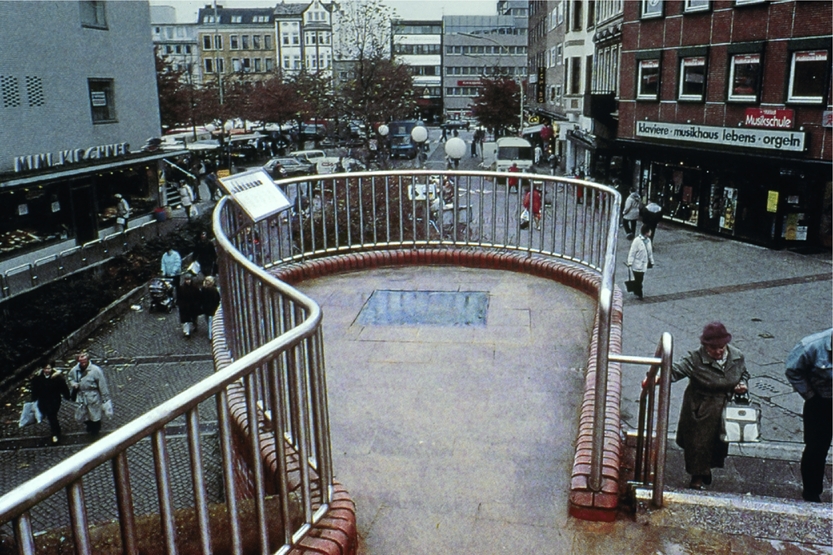
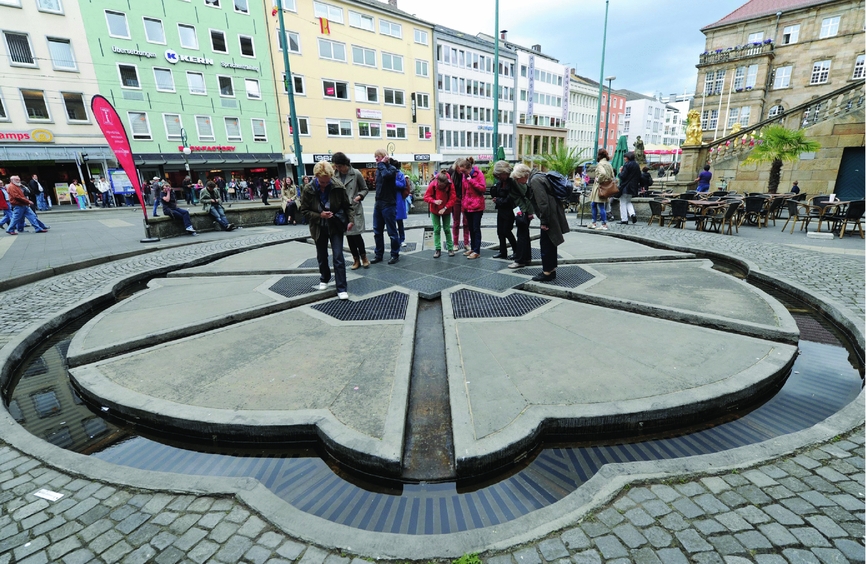
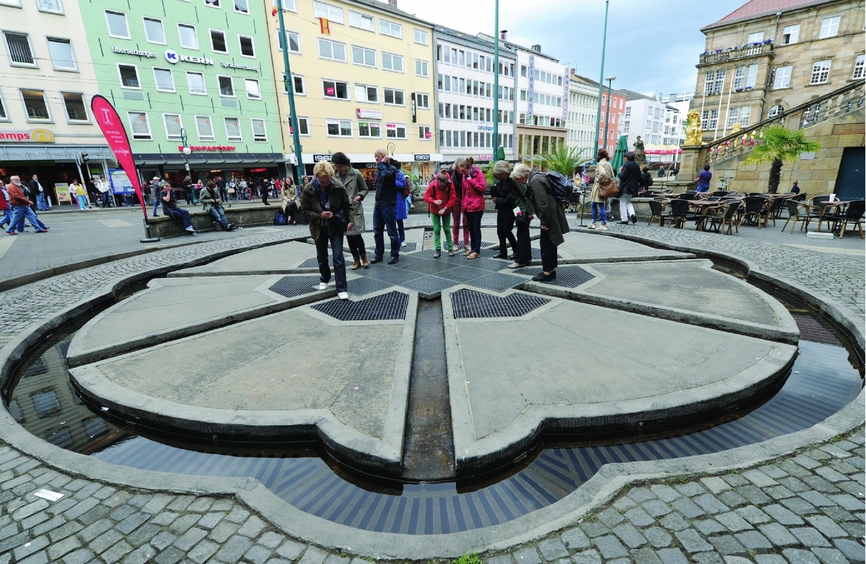
Invitations to participate in the recurrence of the monument, to become bound up in the handiwork of these places like knots in a meshwork of material and temporal trajectories, constitute a major tenet of contemporary commemorative forms known as counter-monuments. As noted by James E. Young (Reference Young1992, 272) in his seminal work on the subject, counter-monuments are intended to disrupt ‘the traditional forms and reasons for public memorial art’ including trappings such as figurativism, durability, grandeur and glorification. Working with a sample of forms that sought to memorialize the Holocaust in 1980s (West) Germany, Young described how themes of disappearance, obliteration and immateriality were being pursued by artists to highlight the untenable links between material form and memorialized past. One of Young's (Reference Young1992) exemplars was a work by Esther Shalev-Gerz and Jochen Gerz entitled The Monument against Fascism (hereafter, MAF) (1986) near Hamburg (Fig. 1). This 12 m tall pillar, coated in a skin of soft lead, was installed on a major street next to a plaque that invited townspeople to write their names on its surfaces as a condemnation of fascism. As the pillar filled with text, it was lowered into the ground to expose new surfaces until ultimately, in 1993, it disappeared completely. All that remains visible today is the top of the column, a small window on its subterranean abode, and a label and image panel that documents its lowerings. Also of note for Young (Reference Young1992) was a ‘negative’ or inverted form monument constructed by Horst Hoheisel in 1987 at the site of the former Aschrott Fountain in Kassel. This neo-Gothic pyramidal fountain and reflecting pool, originally built in 1908 and donated to the city by Jewish entrepreneur Sigmund Aschrott, was demolished by Nazi militants in 1939. Here, Hoheisel reproduced the fountain in concrete before overturning it and sinking it some 12 m below ground. Visitors to the site today are met with the sound of cascading water, an outline of the fountain's base and viewing window, through which the monument may be glimpsed, mirror-like, in a reflecting pool below (Fig. 2).
Esther Shalev-Gerz and Jochen Gerz's Monument against Fascism, Hamburg, Germany. (Photograph: courtesy of Esther Shalev-Gerz.)

The Aschrott Fountain in Kassel, Germany. (Photograph: EPA European Pressphoto Agency b.v./Alamy Stock Photo, https://www.facinghistory.org/resource-library/image/aschrott-fountain)
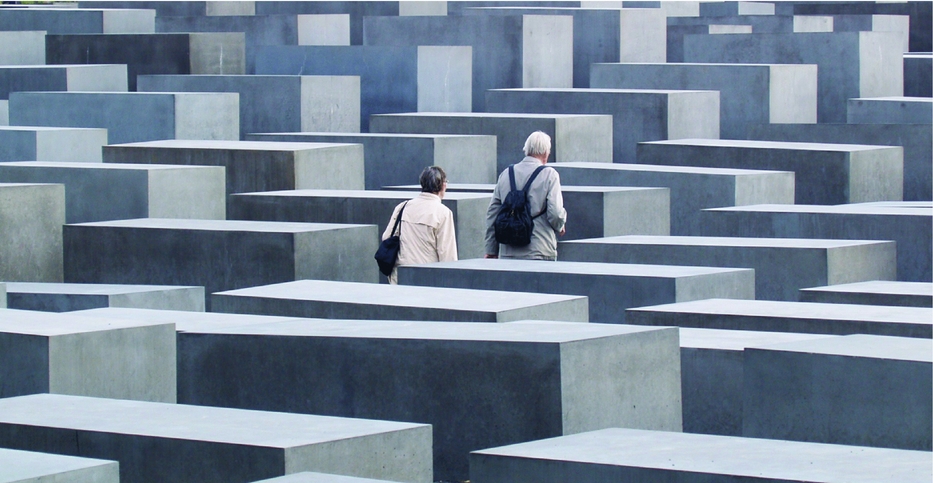
Several noteworthy points of comparison emerge in the study of these and other counter-monuments. First, by seizing upon unconventional materials and techniques of design, as well as notions of ephemerality, counter-monuments eschew established monument forms. A commitment to austere abstraction, rather than figuration, can be seen as a response to the difficulties of memorializing troubling events, as in the case of the MAF, not to mention Maya Lin's Vietnam Veterans Memorial Wall (VVMW) in Washington (DC), built in 1982 as a monolithic slab of black granite. Similarly, through the use of 2711 tightly spaced concrete blocks spread across a 2 ha site, Peter Eisenman's Memorial to the Murdered Jews of Europe (MMJE) in Berlin, built in 2006, not only rejects symbolic representation but actively pushes back against any kind of edifying imperative. As Stevens (Reference Stevens2009, 166) notes, ‘the flatness, solidity and geometric simplicity of the MMJE's sculptural forms prevent the viewer becoming psychologically absorbed in pictorial content and its illusory depth’. Perhaps more significantly, Eisenman arranged the blocks in tall, narrow rows so as to bring about feelings of compression and isolation, forcing visitors to walk in single file with only fleeting glimpses of others (Fig. 3). This, in addition to an uneven ground surface and a slight tilt to some of the blocks, creates an embodied experience quite unlike the detached viewing of more conventional monuments (Stevens Reference Stevens2009, 167; see also Hamilakis Reference Hamilakis2013, 191–4).
An elderly couple walking in the Memorial to the Murdered Jews of Europe, Berlin. (Photograph: Jolove55, Wikimedia Commons, https://commons.wikimedia.org/wiki/File:An_elderly_couple_walking_in_the_Memorial_to_the_Murdered_Jews_of_Europe,_Berlin.jpg)

Absence, in the lack of visual cues and figurative representation, not to mention the dematerialization of forms such as the MAF or the inversion of the Aschrott Fountain, can also be seen as another major theme of counter-monumentality. In the case of the MAF, according to Young (Reference Young1992, 295), absence paradoxically promotes presence because it shifts the burden of memory work from lifeless material form to empowered social agent(s). This idea could also be said to characterize another work described by Young (Reference Young1992, 284–7) that includes a slide projection designed by Norbert Radermacher at the site of a former concentration camp in the Berlin borough of Neukölln. Here, pedestrians walking along an avenue unwittingly activate a projector which beams a text describing the site's wartime use on an adjacent woodlot before coming to rest on the sidewalk below. Passersby are forced to contemplate—to presence an absence—for even the act of looking away is to indulge in a kind of memory work. In a similar fashion, that sense of deliberation is brought to the fore when one examines the Aschrott Fountain, the VVMW, or either of the outdoor pools created in the foundations of the former World Trade Center towers in New York. Those negative spaces or forms provide a focal point for the open-ended memory work of absence. Indeed, as part of an emphasis on the effacement of the material, whether through disappearance, inversion, or immateriality in the case of Radermacher's work, absence becomes a ‘self-standing presence’ (Fowles Reference Fowles, Bille, Hastrup and Sørensen2010, 25) by contesting material form, resisting circumscription, and not without merit, by challenging a narrative set in motion by wrongdoers.
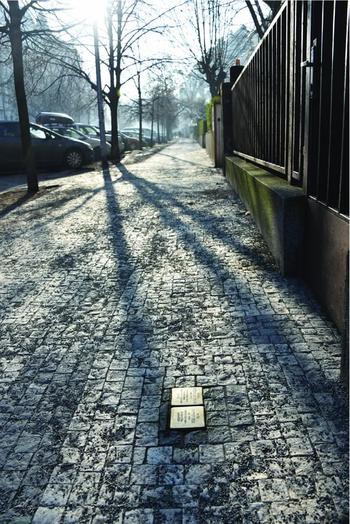
These considerations are also evident in another counter-monument form from Germany, Austria and other European countries. Known as Stolpersteine or ‘Stumbling Blocks’ and designed by artist Gunter Demnig, these small brass plaques have been fitted into pavement stones outside the houses of individuals and families who were killed in the Holocaust (Fig. 4). Now numbering in the tens of thousands, and seamlessly integrated at ground level into the urban fabric of numerous cities, these blocks effectively make absence personal and visible (cf. Belting Reference Belting2005, 312). Yet Stolpersteine serve effectually to illuminate another major theme of counter-monuments, namely a concern with place. While prominence, centrality and visibility are all customary conceits of monument siting, counter-monuments point toward a concern with integration and the everyday. They are more likely to be encountered by chance or along the way, as with the Stolpersteine or Radermacher's slide projection, and in neighbourhoods that lack preferred topographic positions or planning designations (e.g. government/tourist zones). This is certainly true of the MAF, which was located in a rather drab shopping district (Young Reference Young1992, 274). That such transitory spaces of circulation and consumption (what Augé, e.g. Reference Augé1995; Reference Augé1996, would call ‘non-places’) serve particularly well as quarters for counter-monuments is further suggested by the memorials to Diana, Princess of Wales, at the Harrods department store in London. Constructed in 1998 by Harrods then owner Mohamed Al Fayed, father of Diana's companion Dodi Al Fayed, their location in the store's foyers along with an emphasis on the couple's romance hint at a challenge to state-sanctioned narratives and commemorative installations (see Sully Reference Sully2010, 125). But even when they are found in more prominent settings, as in the case of the VVMW or the MMJE, counter-monuments retain a sense of the subversive insofar as they are resistant to delineation, panoptic viewing angles and a commanding presence. In the case of the VVMW, such was its perceived understatement (and lack of discursive framing, among a litany of other concerns) that Frederick Hart's figurative and conventional The Three Servicemen (1984) was added in an adjacent space to effectively serve as a counterpoint or counter-index (Stevens et al. Reference Stevens, Franck and Fazakerley2012, 967).
Stolpersteine for Rudolf Pick and Ruzena Lindtova, Thüringen, Germany. (Photograph: Francisco Peralta Torrejón, Wikimedia Commons, https://de.wikipedia.org/wiki/Datei:Stolpersteine_f%C3%BCr_Rudolf_Pick_und_Ruzena_Lindtova.jpg)

Establishing such forms in everyday locales, while simultaneously tending to issues of scale, materials and proxemics, has also served to underscore the performative and dialogical dimensions of counter-monuments. Whereas orthodox monuments are typically isolated, permanent, and designed with visual (semiotic) cues in mind, counter-monuments steer clear of such qualities in favour of practical, bodily engagement. As noted above, the MAF was incrementally lowered into the ground, 1.5 m at a time, once inscriptions in its soft lead had accumulated. These acts of ‘vandalism’, anathema to most memorializing sensibilities, effectively worked against atrophy by promoting community engagement and, as noted above, encouraging a kind of memory work unscripted by and untethered to material form. In other examples, such as the MMJE, durability may figure prominently in the design, yet the site is unassuming, porous and inviting. Free of signage above ground (a small interpretive centre exists below ground) and lacking a nucleus, visitors are encouraged to move about the stone blocks and engage with the site. For Stevens (Reference Stevens2009, 165–9), these attributes foster unique forms of inquiry and reflexivity that are tempered by the proximity and actions (e.g. talking and moving) of other people. And just as these very public engagements operate along spatial lines, so too are they shaped by ever-changing temporalities. Despite the blocks providing certain material occurrences and affordances that are constant, the voices and movements of visitors are ephemeral and site dependent. They are not part of the memorial object, but produced dialogically within its purview and shaped by its materiality.
This brief review of the concepts and features underpinning the design of contemporary counter-monuments provides a useful context, I believe, for understanding better the construction and use of Woodland Period Indigenous enclosures in the central Great Lakes region. In the remainder of this paper, I return to the Cedar Creek Earthworks mentioned at the outset of this paper for a discussion of its counter-monumentality. By doing so, however, I do not mean to suggest that the sensibilities which guide the creation of present-day counter-monuments mirror those of past Indigenous groups in the region. Indeed, as I argue below, there is an Indigenous logic at work in the formation and use of these sites—one which is regionally specific and born of particular perspectives on the world (see also C. Watts Reference Watts2016). While the foregoing discussion aids analogically in illuminating some of these characteristics, and how our use of the ‘monument’ construct can be seen as lacking, it should not be taken to imply an equivalence in ontological and epistemological positions.
The Cedar Creek Earthworks as ‘counter-monument’
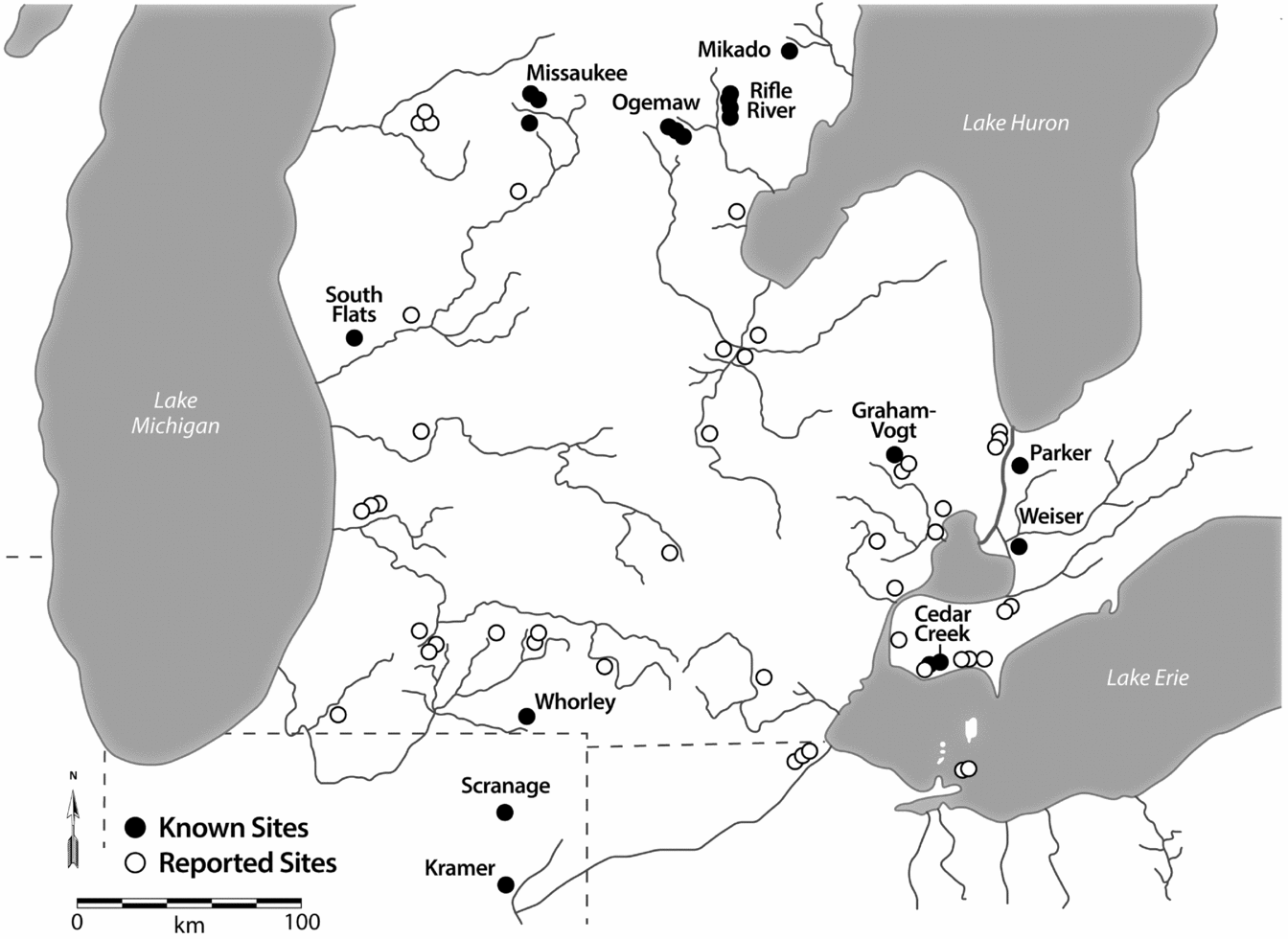
Known for their predominantly oval or semicircular earthen embankments and associated ditch features, Woodland Period enclosures are found throughout Michigan's Lower Peninsula and adjacent sections of southwestern Ontario, northwestern Ohio and northeastern Indiana (Fig. 5). Many of these sites date to a roughly 200-year period between the mid fourteenth and mid sixteenth centuries ad known to archaeologists as the Late Woodland or Late Prehistoric Period. Some sites, such as the semicircular Whorley Earthwork (site code 20BR6) in Branch County, Michigan, which is associated with a radiocarbon date of ad 1080±100, suggest earlier precedents (see Speth Reference Speth1966). Still other sites, such as a conjoined or nested circle and square feature of possible Middle Woodland affiliation in Lenawee County, Michigan (now destroyed: see Hinsdale Reference Hinsdale1931, 27; Zurel Reference Zurel1986, 51–3), and the sprawling Arthursburg Hill (site code 20IA37) Earthworks in Ionia County, Michigan, which has yielded Early Woodland ceramics (see Beld Reference Beld1993), suggest a practice with roots stretching back a millennium.
Known and reported locations of Woodland Period (c. ad 1–1550) earthworks in the central Great Lakes region.

While early accounts characterized these enclosures as fortified villages or encampments, the fact that only a handful contain myriad features and occupational debris implies that many of these sites might instead have served as dance arenas, council circles, deer drive pens, or enclosed gardens (Zurel Reference Zurel1986; Reference Zurel and Halsey1999). Recent work by Howey (Reference Howey2012; see also Howey & O'Shea Reference Howey and O'Shea2006; Milner & O'Shea Reference Milner, O'Shea, Mainfort and Sullivan1998) in northern Lower Michigan asserts that some enclosures in this locale functioned as interstitial ‘safe zones’ where inland foragers could conduct trade and carry out ceremonies with coastal fisher-horticulturalists. Other research conducted by Gaff and Brashler (Reference Gaff and Brashler2011; see also Gaff et al. Reference Gaff, Sherrod and Brashler2013) at the South Flats Earthwork (site code 20MU2) in Muskegon County, Michigan, suggests the modest semicircular enclosure here served similar purposes. Importantly, however, they note that Late Woodland earthworks in the region likely filled many roles, and that each was a product of locally specific historical and cultural contingencies. Although parallels are found between sites, for example in the lack of material culture and paucity of features, ‘individual earthworks easily deviate from the commonly proposed models for their appearance’ (Gaff & Brashler Reference Gaff and Brashler2011, 223).
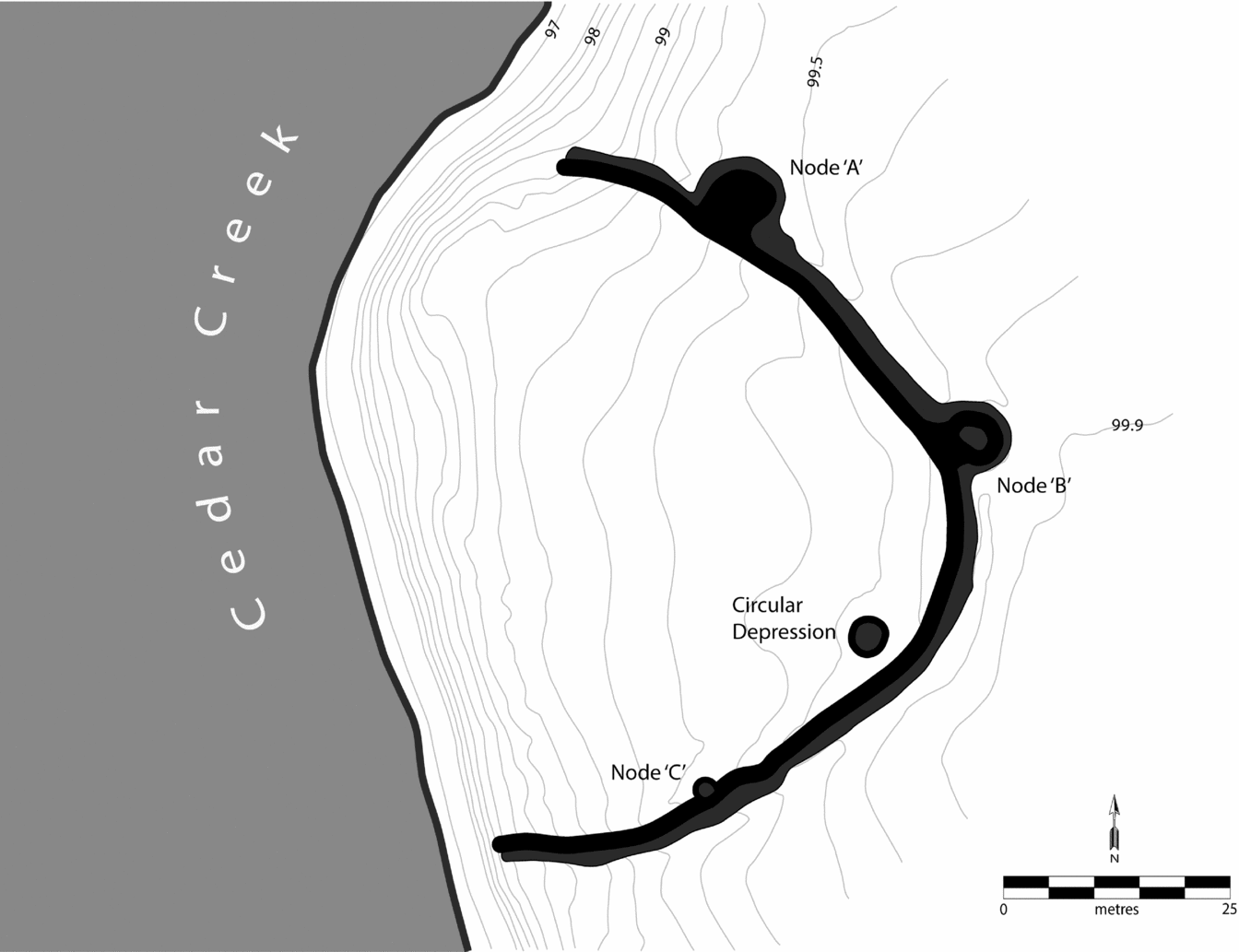
This is certainly the case with the Cedar Creek Earthworks (site code AaHq-2). Located in Essex County, Ontario, near the town of Kingsville, the site consists of an unusual semicircular embankment and ditch feature some 126 m in length, to which have been appended three circular projections or ‘nodes’ (Fig. 6). Enclosed within its roughly 2400 sq. m interior area is a large circular depression approximately 15 sq. m in size and 40 cm in depth. Fieldwork at this site involving magnetometry, shovel test pits and conventional hand excavation of units was carried out by the author in 2013 and to a limited extent in 2016 (see C. Watts Reference Watts2016). Results have been meagre; no subsurface features have been encountered during the various assessments, either within or outside the enclosure. Moreover, of the 121 test pits placed across the site and excavated to sterile subsoil, less than 10 per cent (n = 11) have been found to be positive, with many of these (n = 7) containing nothing more than fire-cracked rock. The excavation of 33 1 sq. m test units in 2013 both inside and outside the embankment revealed some 611 artefacts, 91 pieces of charcoal and one fossilized bone fragment, with fully 80 per cent of the artefact inventory (n = 489) comprised of Late Woodland and possibly Middle Woodland ceramics. With the exception of six ground stone tools, the remainder of the assemblage consists entirely of chipped lithics (n = 120) and includes only one formal tool: a Middle Woodland projectile point. Notably, this point, and other pieces of the chipped lithic inventory, were manufactured on toolstones from central and southern Ohio.
Plan view of the Cedar Creek Earthworks. Elevated areas are shown in black with corresponding subsurface expanses in grey.

Based on these limited results, it would seem that Cedar Creek did not serve as a fortified village. A more likely scenario, given the form and location of the earthworks, the lack of interior subsurface features and remains, as well as an apparent absence of palisading, would be an intermittent use of the site by small groups. But what might it have been used for? Unlike other enclosures in the region, there is no evidence of conical burial mounds either within or adjacent to the site, and no evidence of subsurface mortuary practices has been documented. While the presence of multiple ceramic traditions hints at the possibility of trade (and perhaps even co-occupation by various cultural groups), the lack of cache pits and related features (e.g. conical mounds) suggests a different phenomenon than the one documented by Howey (Reference Howey2012) and Milner and O'Shea (Reference Milner, O'Shea, Mainfort and Sullivan1998) in northern Lower Michigan. As I have argued elsewhere (see C. Watts Reference Watts2016), I believe that construction of the enclosure was undertaken by local communities over a relatively short duration and folded into a settlement system that included nearby habitation locales. In light of the paucity of evidence for occupation, I have suggested that Cedar Creek served as a place of gathering, both in a literal sense—as a locus for large-scale, yet short-term assemblies—but also figuratively, in that the site was brought forward episodically by uniting elements such as earth, sky, water and fire (sensu Heidegger Reference Heidegger1971, 152). This was based on a number of observations including the inordinate amount of fire-cracked rock found at the site, as well as its proximity to the creek and tendency to flood.
Most significant to this argument, however, is the siting of the two large nodes (A and B) and circular depression at Cedar Creek. With the site's location at 41° north, and with the general north–south alignment of the embankment, Node A would have intersected with the setting sun on the summer solstice, while Node B was in line with the setting sun on the vernal and autumnal equinoxes. Furthermore, the circular depression found in the interior of the site would have aligned with the setting sun during the winter solstice (Fig. 7). Standing outside the enclosure to the east, indicated with a star in Figure 7, it would have been possible to observe these fundamental (solar) azimuth angles at dusk, and perhaps record these using markers such as trees, stakes, or posts placed in the site's various features. Although not yet examined, it may be that these and other features (e.g. the smaller, interior-facing node along the enclosure's southern margin) may have been oriented to other sightlines, including lunar events. While such astronomical considerations are largely absent from other earthworks in the region, there are notable analogues to Cedar Creek among the much-celebrated Middle Woodland (Hopewell) geometric enclosures of southern Ohio. It is here, at sites such as High Bank in Ross County, that embankments in the form of a conjoined circle and octagon were aligned not only to summer and winter solstice events, but also to major and minor lunar standstills (see Hively & Horn Reference Hively and Horn1984, S98). At the Newark Earthworks in Licking County, which contains an almost identical circle and octagon feature, various berms were oriented to lunar standstills while nearby hilltops served to record summer and winter solstitial alignments like a ‘solar template on the local terrain’ (Hively & Horn Reference Hively, Horn, Jones and Shields2016, 87; see also Romain Reference Romain2015, 56–7).
Solar azimuth angles at Cedar Creek with potential equinoctial and solstitial feature alignments.

Indeed, additional similarities can be found at these and other Hopewell enclosures, and are worth mentioning in light of the Middle Woodland projectile point and other materials made on Ohio toolstones at Cedar Creek. As Dancey (Reference Dancey, Pauketat and Loren2005, 120–24) and others (e.g. Burks & Cook Reference Burks and Cook2011, 669; Lynott Reference Lynott2015, 140) have noted, Hopewell enclosures can display great variability in form, dimensions, construction practices and building materials. Many of these enclosures also have large depressions that, beyond serving as borrow pits, may have also been pond features. Like Cedar Creek, most are bereft of occupational debris (see e.g. Abrams Reference Abrams2009, 178), and while many occur alongside burial mounds, some sites such as High Bank and perhaps Anderson, also in Ross County, do not contain such features. What is more, even when burial mounds and embankments are found together, as at Mound City in Ross County, the enclosure was constructed sometime after the initial construction of the mounds (and, even then, did not encompass the entire site). Ingold's notion of perdurance seems particularly apt here, especially when we consider that for those Hopewell enclosures that have been trenched, almost all show signs of episodic construction. This can take the form of accretion, as with the layering of different materials at sites such as Newark, but also Fort Hill in Highland County and the Pollock Works in Greene County. At other sites with complex geometric forms, such as those in Ross County, segments appear to have been raised and appended to one another over many generations. Finally, although Cedar Creek is separated from many of these sites by a straight-line distance of some 300 km (200 km in the case of the more northerly Newark Earthworks), not to mention a large body of water in the form of Lake Erie, an attenuated Hopewell presence is known in northern Ohio at, for example, the Esch mounds in Huron County (Prufer & Shane Reference Prufer, Shane III and Brose1976) and the Pumpkin site at the head of Sandusky Bay (Redmond Reference Redmond2007).
Of interest here, however, is not perceived cultural connections between the two regions, but rather the extent to which these sites can be properly regarded as monuments, especially as they are referred to as such in the literature (see e.g. Bernardini Reference Bernardini2004; Howey Reference Howey2012). Although he does not identify them as counter-monuments, Pauketat (Reference Pauketat and Osborne2014) makes a compelling argument against the primarily commemorative or mnemonic function we typically ascribe to Hopewellian and other ‘monuments’ in the Americas. He suggests that monuments here are more properly regarded as ‘portals to other futures and other worlds’ (Pauketat Reference Pauketat and Osborne2014, 432; see also Pauketat Reference Pauketat2013, 59–87). Drawing upon the notion of imaginaries, and thinking of monuments in terms of their ability to mediate, Pauketat (Reference Pauketat and Osborne2014, 434) notes that many ‘monuments’ in North America were built principally to ‘engage the cosmic and the numinous’. That these monuments would not have served as memorials to political leaders is suggested by the lack of an institutionalized hierarchy, and citing later, historic-era Plains and Eastern Woodlands ethnography, Pauketat (Reference Pauketat and Osborne2014, 436) contends that the enclosures of the Hopewell were more likely to have served as a series of axis mundi linking sky and earth, as well as the living and the dead.
Following Pauketat (Reference Pauketat and Osborne2014), and with reference to the features and interpretations suggested above, I would argue that Cedar Creek was erected with similar ‘counter-monumental’ sensibilities in mind, which reveal themselves through a closer examination of the Indigenous logics undergirding construction and use of the site. For one, there is every indication that the semicircular form of the embankment and use of circular nodes (and depressions) are works of abstract rather than figurative expression, unlike, say, the animal effigy mounds of Ohio or the Upper Mississippi River watershed. Such generalization, which can be read as an absence of specific instructional imperatives, would have allowed the earthwork to transcend a representational fixity in space and time, while still adhering to broader ontological principles (e.g. of circularity; see Norton-Smith Reference Norton-Smith2010, 119–33). In this way, engagement with and understanding of the site, while rooted in tradition, would have produced provisional and ongoing understandings in keeping with recombinant kinaesthetic and material entanglements. Lacking a suite of radiocarbon dates, it is impossible to say at present if Cedar Creek was built all at once (it was certainly occupied on more than one occasion, based on the presence of Middle Woodland and Late Woodland materials), but it could be that features such as the nodes and the circular depression were added or reconfigured through successive uses, in response to particular needs. This is noteworthy when we consider that, had permanence and durability been paramount in the site's design, other materials such as stone could have been used to construct or augment the extant forms.
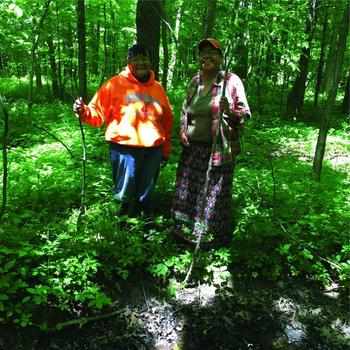
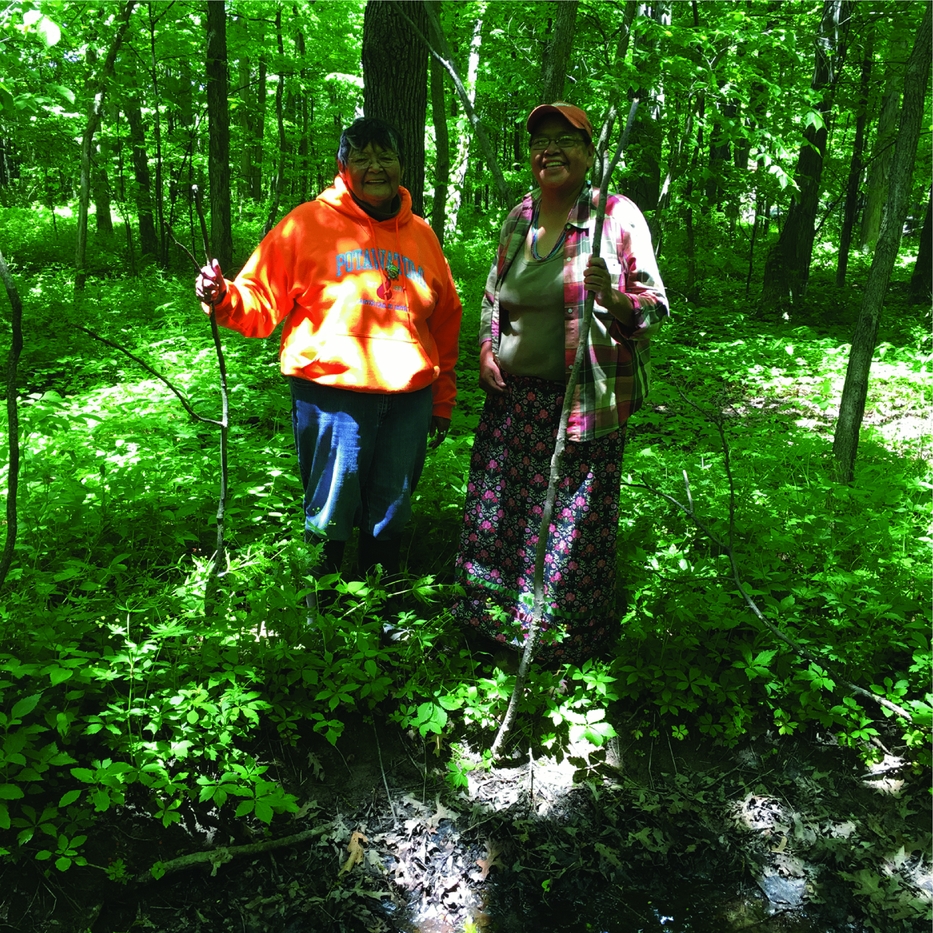
In either case, by virtue of what transpired both within and immediately beyond the enclosure over time—from mundane tasks to the observation and perhaps recording of celestial events—Cedar Creek is perhaps better grasped as perdurant within an ever-changing complex of relations. Just as contemporary counter-monuments can forefront the fleeting and mutable as part of a visitor's embodied movement and interaction with the site, as is the case with Radermacher's work in Neukölln or the MMJE, the complexion of Cedar Creek would have been coloured not simply by its earthen forms and their spatial articulations, but by who was present, what actions were performed and what such practices would disclose about the world. Such complexes, put simply, have both historicity—they appear in particular ways at certain moments in time—and cultural contingency. This comes through clearly in Indigenous scholarship of place (see e.g. Deloria Reference Deloria, Deloria, Foehner and Scinta1999, 54–6; Reference Deloria2001, 21–8; Reference Deloria2003, 65–8; Tuck & McKenzie Reference Tuck and McKenzie2014; V. Watts Reference Watts2013; Reference Watts2016), where intensely personal revelations regarding the interconnections between living things issue from the land itself. Working against Western geographic sensibilities, where ‘place is a comparatively neutral ground upon which history plays out its dramas’ (Fowles Reference Fowles2013, 257), Deloria (Reference Deloria2003, 65–6) notes that important sites ‘were remembered and set aside as locations where, through rituals and ceremonials, the people could once again communicate with the spirits’ (see also V. Watts Reference Watts2013, 23). For Deloria (Reference Deloria2003, 66–7; see also 1998, 2–3), these revelations came about through a temporally specific and intensely personal attunement to place and its inhabitants. Within such an ontological framework, it seems reasonable to assert that Cedar Creek's status as a ‘monument’ was understood not as an ostentatious appeal to past events, but as a magnet for drawing out and assembling such relations in place. This is not merely a lyrical platitude; in tandem with rites and other acts of engagement, the architectural forms of Cedar Creek worked to isolate and make explicit certain ontological orientations against a thoroughly intricate backdrop of interconnections. That this continues today through contemporary Indigenous engagements with the site (Fig. 8), some of which I have been privileged enough to witness, helps to strengthen such a claim and well illustrates this sense of persistence.
Joyce Johnson (left) and Georgina Toulouse (right) of the Bkejwanong (Walpole Island) First Nation visiting the Cedar Creek Earthworks preparatory to a ceremony in June 2016.
It is also worth pointing out, under a more expansive analytical scope, that the assembly of relations at Cedar Creek was (and continues to be) a varied affair. Weathering of the earthen embankments and nodes would have returned soils to the ditch from where they were excavated. The continued growth of the forest around, on top of and within the enclosure would have obscured key features and inhibited mobility. Animals would have made their way up from and across the site's many features. All of these processes continue unabated today. Contrary to the stasis and durability we commonly associate with traditional monuments, here is a place that was, and still is, persistently transformed by agents of movement and change. This sense of dynamism—the very interlacing of human and non-human beings into situated networks of activity—would no doubt have contributed to the site's power and animacy for its past inhabitants. But to assemble the cosmos around a single point, to link together the position of the sun with other worldly events (e.g. seasonality) and forms of life, would have required a regimen of site maintenance in the furtherance of place. Tending to, and perhaps modifying the earthworks over time would have brought Cedar Creek into the fold of a Woodland settlement system that traversed short-term needs and interests.
Accordingly, taking into account the power of the Cedar Creek Earthworks also invites consideration of its place within the broader landscape. As noted in the introduction, the site is not situated on a landform that could be considered prominent or visible from a distance, as is the case with some monument locales. Indeed, as with the counter-monuments documented by Young (Reference Young1992) and the Stolpersteine discussed earlier, Cedar Creek was woven into the everyday fabric of the landscape—the same pleats and folds, if you will, of the vast St Clair Clay Plain that was threaded by waterways and home to numerous campsites, cemeteries and other enclosures. Indeed, while one of only a handful of extant enclosures today, Cedar Creek was in the Woodland period joined by many other earthworks situated along the rivers that empty into Lake Erie (see C. Watts Reference Watts2016). That these sites are found in close proximity to other, more prosaic forms of occupation (e.g. campsites), and, in the case of Cedar Creek and other sites, contain evidence of ordinary activities such as cooking and tool making within their confines, suggests that, just as life is immanent and relationally distributed throughout all manner of worldly phenomena, the boundaries between what we might label ‘sacred’ and ‘secular’ places may be more apparent than real. Eliding such dualisms reveals that sites like Cedar Creek are not insular repositories of ritual import—monuments, in other words, set apart from everyday life and mapped upon an otherwise inert substrate of physical features—but rather foci which gather together relations within a landscape that is always and already ‘alive’ and redolent with meaning.
Conclusions
To conclude, the Cedar Creek Earthworks were not conceived as an anti-hegemonic statement, nor would they have declared themselves as oppositional. They do not distance themselves, formally or experientially, from a class of canonical forms for the purposes of destabilizing established construction techniques or subjects of memorialization. What I offer here, by way of the analogy involving contemporary counter-monuments, is twofold. The first is a means of drawing out flaws with the monument taxon as applied to the earthworks of the central Great Lakes. These sites should not be thought of as completed works of memorialization relegated to a moment in time, but as perduring foci for gathering—as places of correspondence, really, where flows of materials such as humus, soil, wood and stone continually yet distinctively mix with atmospheric processes as well as human and non-human interventions in the site's ongoing transformation (or, as Ingold [Reference Ingold2013, 97–104] might say, ‘transduction’). The analysis of contemporary counter-monuments provides a means of identifying and foregrounding such processes through themes such as abstraction, integration, ephemerality and relationality, among others. That these enclosures might be thought of as emergent and variable fits with what I like to think is the second contribution of this paper, namely a heuristic for approaching Indigenous design considerations and use of earthworks in the region.
Importantly, while not self-contained repositories that work to directly recall persons, events, things and values, sites like Cedar Creek are also places of memory. As Meskell (Reference Meskell, Mills and Walker2008, 235) notes, ‘embodied acts and ritual may be more successful in iterating memory than simply the forging of objects’, and because different actions can be performed, discovered and produced at such sites, through various sensory perceptions, affects, atmospheric conditions, cohabitants, etc., entirely dissimilar memories may be enabled through different engagements with the site (see also Holtorf Reference Holtorf, Kolen, Renes and Hermans2015, 173). As with most present-day counter-monuments, these are relations that would be unmediated by the kinds of strong representational cues that are typical of most traditional monuments. Indeed, as James Young (Reference Young1993, 5) notes, ‘the more memory comes to rest in its exteriorized forms, the less it is experienced internally’.
Acknowledgements
An earlier version of this paper was presented in the session ‘Parsing Posthumanism’ organized by Craig Cipolla and Oliver Harris at the 2017 Theoretical Archaeology Group (North America) meetings in Toronto. The fieldwork described herein was facilitated by a Social Sciences and Humanities Research Council of Canada Postdoctoral Fellowship and the Department of Anthropology at the University of Western Ontario. Their support is gratefully acknowledged, as is the assistance provided by my 2013 Cedar Creek field crew, particularly Chris Dalton, Darryl Dann and Larry Nielsen. Finally, I would like to thank the three anonymous reviewers of this article for their helpful comments and suggestions.