Introduction
Alzheimer's disease (AD) is a neurodegenerative disorder characterized by progressive cognitive impairment, associated with functional decline and severe psychological and behavioral symptoms. Since no cure is currently available for AD, management is aimed at improving quality of life (QoL) by minimizing the symptoms.
Health-related QoL instruments can capture health elements that cannot be detected by standard clinical measures (Rabins, Reference Rabins2007). Consequently, they are being increasingly included in clinical trials (Mack and Whitehouse, Reference Mack and Whitehouse2001). There is some evidence for the efficacy of psychological stimulation and occupational therapy in enhancing patients’ QoL (Graff et al., Reference Graff, Vernooij-Dassen, Thijssen, Dekker, Hoefnagels and OldeRikkert2007; Logsdon et al., Reference Logsdon, McCurry and Teri2007) but there are not consistent results about the effects of antidementia drugs (Raina et al., Reference Raina2008). Perhaps, most of the available treatments improve factors with little impact on QoL or, alternatively, QoL scales lack sensitivity to change. Therefore, recent research has focused on the identification of the main determinants of patients’ QoL as well as the effect of the medications (Matsui et al., Reference Matsui2006; Mougias et al., Reference Mougias, Politis, Lyketsos and Mavreas2011).
The assessment of QoL in AD patients presents conceptual and practical challenges (Rabins, Reference Rabins2007). Although different conceptualizations have been proposed for QoL, consensus exists on some important issues. It is generally accepted that QoL is a multidimensional construct, encompassing both subjective and objective domains. In the field of dementia, one of the most influential conceptual frameworks is that Lawton proposed for frail elderly (Lawton, Reference Lawton1994). He identified four sectors in QoL that relate to each other: behavioral competence, interpersonal environment, psychological well-being, and perceived QoL. Most researchers agree on the higher importance of the subjective aspects of QoL, especially perceived QoL. Objective domains are usually considered as predictors of perceived QoL (Mack and Whitehouse, Reference Mack and Whitehouse2001; Ready and Ott, Reference Ready and Ott2003).
Several studies have shown that mild and moderate AD patients can reliably report their QoL (Logsdon et al., Reference Logsdon, Gibbons, McCurry and Teri2002; Lin et al., Reference Lin Kiat Yap2008; Gómez-Gallego et al., Reference Gómez-Gallego, Gómez-Amor and Gómez-García2012). However, for patients with severe AD, proxy QoL reports or direct observational measures are necessary (Falk et al., Reference Falk, Persson and Wijk2007). It remains unsolved whether these different approaches (self-reports, proxy-reports, observational measures) are interchangeable. Previous studies have reported that patients’ QoL ratings yield higher scores than proxies’ (Logsdon et al., Reference Logsdon, Gibbons, McCurry and Teri2002; Conde-Sala et al., Reference Conde-Sala, Garre-Olmo, Turró-Garriga, López-Pousa and Vilalta-Franch2009). Moreover, the agreement between QoL ratings of patients and proxies is low (Spector and Orrell, Reference Spector and Orrell2006; Bosboom et al., Reference Bosboom, Helman, Eaton and Almeida2012). Hence, it seems probable that the effects of some symptoms and treatments on patients’ QoL vary for the different types of informants and even in the different stages of the disease (Ettema et al., Reference Ettema2005). Proxies for community dwelling patients are close relatives or caregivers whereas they are staff members in residential settings. Most of the studies on the determinants of QoL have considered only two sources of information (patients and caregivers or staff members) and a limited number of predictive variables. This study was conducted to determine the influence of demographic and clinical factors on patients’ QoL as assessed by patients, caregivers, and staff. We examined those clinical factors that were associated with patients’ QoL in previous studies, such as cognitive function, behavioral disturbances, depression, and functional disability (Logsdon et al., Reference Logsdon, Gibbons, McCurry and Teri2002; Banerjee et al., Reference Banerjee2009) and were representative of each of Lawton's conceptual domains of QoL (Lawton, Reference Lawton1994). In addition, we considered two measures of interpersonal environment (caregivers’ burden and distress associated with neuropsychiatric symptoms) and those demographic variables that were related to QoL by others (Banerjee et al., Reference Banerjee2009; Conde-Sala et al., Reference Conde-Sala, Garre-Olmo, Turró-Garriga, López-Pousa and Vilalta-Franch2009; Conde-Sala et al., Reference Conde-Sala, Garre-Olmo, Turró-Garriga, Vilalta-Franch and López-Pousa2010). Based on existing evidence, we hypothesized that patients’ ratings are mainly affected by their mood status and caregivers’ ratings are influenced by their burden.
Methods
Sample
One hundred and two patients, their respective caregivers, and 25 healthcare staff were recruited from eight day-centers in the area of Murcia. The inclusion criteria for the patients were as follows: (a) diagnosis of possible or probable AD consistent with the NINCDS-ADRDA criteria (McKhann et al., Reference McKhann, Drachman, Folstein, Katzman, Price and Stadlan1984), (b) early or middle stages of AD, and (c) residing with a caregiver in a community dwelling. Severity of dementia was rated with the Global Deterioration Scale (Reisberg et al., Reference Reisberg, Ferris, de Leon and Crook1982). Stages 4 and 5 correspond to mild to moderate dementia, respectively. Patients with severe language disturbances were excluded. Caregivers were defined as the main people providing day-to-day care. Staff members were selected for participation among workers who were most familiar with patients. Informed consent was obtained from both patients and proxies. The Bioethics Committee of the University of Murcia approved the study.
Instruments
Outcome measure
Quality of life in Alzheimer's Disease Scale (QoL-AD)
This is a 13-item instrument designed to obtain ratings of patient's QoL from both patients and caregivers (Logsdon et al., Reference Logsdon, Gibbons, McCurry and Teri2002). The scale reflects the perception of important domains of QoL in older adults, such as physical health, psychological status, functional status, interpersonal relationships, and environment. Items are scored on a four-point scale, with 1 being poor and 4 being excellent. Total scores range from 13 (poorest QoL) to 52 (highest QoL). The scale has good reliability and validity when administered to both patients and caregivers in different cultural settings (Lin et al., Reference Lin Kiat Yap2008; Gómez-Gallego et al., Reference Gómez-Gallego, Gómez-Amor and Gómez-García2012).
Explanatory variables
-
• Mini-Mental State Examination (MMSE, Folstein et al., Reference Folstein, Folstein and McHugh1975). The 30-item MMSE was used to assess the patients’ cognitive function. We corrected the raw scores for educational attainment and age as reported by Blesa et al. (Reference Blesa2001).
-
• Functional Activities Questionnaire (FAQ, Pfeffer et al., Reference Pfeffer, Kurosaki, Harrah, Chance and Filos1982). This informant-based survey was used to assess patients’ disability in instrumental activities of daily living (ADL). We used a version with 11 items that were scored from 0 (normality) to 3 (totally unable to perform the activity). The total possible scores range from 0 (independence) to 33 (highest dependence).
-
• Barthel Index (BI, Mahoney and Barthel, Reference Mahoney and Barthel1965). This is a ten-item scale frequently used to measure performance in basic ADL. BI total score was obtained by summing each item score, they range from 0 (highest dependence) to 100 (independence).
-
• Geriatric Depression Scale (GDS, Yesavage et al., Reference Yesavage, BrinK, Rose and Lum1983). The 15-item version of GDS is a self-report questionnaire frequently used to assess depression in elderly people having dementia. Possible scores range from 0 to 15, with higher scores indicating more depressive symptomatology. A cut-off point of ≥5 on the GDS-15 gave optimum performance for the diagnosis of a major depressive episode according to ICD-10 (Almeida and Almeida, Reference Almeida and Almeida1999). In this study, patients were administered GDS in order to assess their psychological well-being. We calculate the internal consistency of the GDS, since in our sample there were patients with MMSE score lower than 11.
-
• Neuropsychiatric Inventory (NPI, Cummings et al., Reference Cummings1994). This is an interview-based instrument that assesses the frequency and severity of 12 neuropsychiatric symptoms: delusions, hallucinations, agitation/aggression, dysphoria/depression, anxiety, euphoria/elation, apathy, disinhibition, irritability, aberrant motor behavior (AMB), night-time behavioral disturbances, and appetite/eating disturbances. Caregivers were asked if a symptom occurred during the last month and if so, they had to rate the severity (from 1 to 3, with 3 being the severest) and the frequency (from 1 to 4, being 4 the commonest). The score of each symptom is obtained by multiplying frequency and severity. The total NPI score is the sum score of all symptoms' scores with a range from 0 to 144. Caregiver distress related of each NPI symptom is rated by the caregiver on a six-point scale from 0 (no distress) to 5 (extreme distress). The total NPI distress score summarizes the respective sub-scales of all 12 domains and range from 0 to 60.
-
• Zarit Burden Inventory (ZBI, Zarit et al., Reference Zarit, Reever and Bach-Peterson1980). This is a 22-item self-administered scale designed to measure subjective burden among caregivers of patients with dementia. Each item is scored on a five-point Likert scale ranging from 0 (never) to 4 (nearly always). Total scores range from 0 (lowest burden) to 88 (highest burden).
Procedures
Demographic information about the participants was collected at the initial assessment. We also tested patients’ cognitive function using the MMSE and recorded patients’ medical data and treatments. Consenting and potentially eligible participants were then separately administered QoL-AD in interview format. Both caregivers and staff members should answer the QoL-AD items from the patients’ perspective. Next, patients were administered GDS, caregivers completed NPI and ZBI, and staff members completed BI and FAQ.
Statistical analysis
First, we calculated the internal consistency of the QoL-AD ratings and identified differences in mean QoL-AD scores between patients (QoL-ADp), caregivers (QoL-ADc), and staff members (QoL-ADs) using the unpaired t-test. Correlations and agreement among three QoL ratings were assessed using Pearson correlation coefficient (r) and intraclass correlation coefficient (ICC).
Since the QoL ratings were supposed to be related to each other, we conducted two multivariate analyses of variance (MANOVA) considering QoL-ADp, QoL-ADc, and QoL-ADs as dependent variables. In the first MANOVA, we considered the demographic variables (patients’ gender, marital status, level of education, and job as well as caregivers’ gender and interpersonal relationship) as independent factors. Except gender and marital status, the independent variables had three levels: patients’ job (unskilled worker, skilled worker, and homemaker), patients’ educational level (≤1 year, 1–8 years, and ≥8 years), and interpersonal relationship (children, spouse, and no relative). Interactions between patients’ gender, patients’ marital status, and caregivers’ gender were tested. The second MANOVA was conducted with the different types of drugs (cholinesterase inhibitors, antidepressants, neuroleptics, and benzodiazepines) as independent variables, with two levels each (taking and not taking). All possible interactions were tested. Bartlett's test of sphericity was calculated for each MANOVA to test whether the correlation matrix was an identity matrix. Subsequent analysis of variance (ANOVA) tests of the effect of group on individual variables were performed only if the MANOVA yielded a significant result. Effect-size estimates (B) for the difference between levels of the independent variable were also calculated. The relations between QoL-AD scores and patients’ age, MMSE, GDS, NPI, FAQ, BI, ZBI, and NPI-distress were evaluated using Pearson's or Spearman's rank correlation coefficients. Multiple linear regression analyses were performed separately for each of the dependent variables (QoL-ADp, QoL-ADc, and QoL-ADs) in order to determine the overall effect of the clinical and demographic factors. First, regression models were obtained for each dependent variable by entering as independent variables those that were found to be significant in the correlation analyses or in the ANOVA tests. Next, successive stepwise models were developed by entering as independent variables only those that were significant in the initial models. Collinearity between explanatory variables was controlled by condition indices, tolerance, and the variance inflation factor (VIF).
Prior to the regression analyses, several diagnostic steps were completed to ensure that the variables met the statistical assumptions of linear regression. Normality was evaluated by comparing the expected normal distribution to the histogram of the residuals for the dependent variable. Linearity and equality of variance were determined by plotting residuals against the predicted values for the dependent variable. The Durbin–Watson test was used to evaluate the assumption of independent errors. A p-value of less than 0.05 was considered as statistically significant. We used SPSS 18.0 software for Windows to perform all the statistical analyses.
Results
Demographic and clinical characteristics of the sample
In our sample, patients had a mean age of 78.09 (SD = 7.02) and were predominantly female (n = 70, 68.62%). Of the patients, 58 were married and 44 were widowed; 47 were homemakers, 32 were specialized workers, and 23 were unspecialized workers. Most of the patients (n = 79, 77.45%) had from 1 to 8 years of education, eight patients had less than a year of education and 15 patients had more than 8 years of education. We observed that 38 patients had mild cognitive impairment (MMSE > 20), 56 moderate cognitive impairment (MMSE = 11–20), and eight severe cognitive impairment (MMSE < 11). The internal consistency of the patients’ reports on GDS was good (Cronbach's α = 0.727). The mean GDS score was 4.84 with standard deviation (SD) of 3.32 and range of 0–14. One-third (35.3%) of the patients had depression (GDS score >5). The mean BI score was 72.84 (SD = 19.29, range = 10–100) and the mean FAQ score was 21.65 (SD = 8.55, range = 2–33), indicating that patients had moderate dependency to instrumental ADL and low dependency to basic ADL. Their mean NPI score and mean NPI distress score were 30.59 (SD = 18.32, range = 5–87) and 16.24 (SD = 9.01, range = 4–34), respectively. The mean age of the caregivers was 58.8 (SD = 15.9, range = 30–85), and 72.5% were women. Our caregivers were spouses (71%), adult children (35.3%), and no relatives (13.7%). The mean age of the staff members was 35.7 years (SD = 6.19, range = 24–50), and 84% were women. Our sample included 18 nurses, five social workers, and two physicians.
Reliability and agreement between QoL ratings
The internal consistency of patients, caregivers, and staff members’ reports on the QoL-AD were good (0.85, 0.84, and 0.91, respectively). The patients’ mean QoL-AD score was 34.92 (SD = 6.48), the caregiver-rated mean score was 29.76 (SD = 4.92), and the staff mean score was 30.27 (SD = 8.15). The differences between the means of patient-rated QoL and caregiver-rated QoL and between the means of patient-rated QoL and staff-rated QoL were both significant (p < 0.001). There were not significant differences between caregivers’ and staff ratings (p = 0.132). Patients’ ratings correlated with caregivers’ (r = 0.563, p < 0.001) and with staff ratings (r = 0.420, p = 0.001). Both proxies’ ratings were also significantly correlated (r = 0.382, p = 0.003). Agreement between patients’ and both proxies’ ratings was low to moderate (ICC-consistency = 0.542 and 0.404, respectively). Agreement between caregivers’ and staff ratings was low (ICC-consistency = 0.347).
Demographic factors
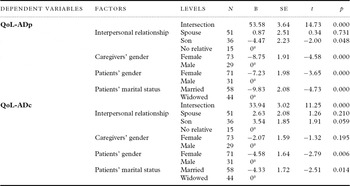
The MANOVA results showed significant differences in patients' and caregivers’ QoL ratings between the levels of the following factors: patients’ gender (Wilks's λ = 0.875; F = 6.757; p = 0.002), patients’ marital status (Wilks's λ = 0.808; F =11.293; p < 0.001), interpersonal relationship (Wilks's λ = 0.735; F = 7.908; p < 0.001), and caregivers’ gender (Wilks's λ = 0.790; F = 12.601; p < 0.001). However, the multivariate effects were non-significant for patients’ job and educational level. No significant interaction between the factors was observed. Bartlett's test of sphericity yielded a significant χ 2 statistic (p < 0.001) for all the models tested. Subsequent ANOVAs for patients’ ratings revealed statistical significance for the main effects of each factor (Table 1). Caregivers’ ratings were significantly different in groups defined by patients’ gender (p = 0.006) and patients’ marital status (p = 0.014). Both patients and caregivers reported a lower QoL for female patients and those who were married, as shown in Table 1. Moreover, the self-ratings of QoL were lower in patients cared for by women or by their children (p = 0.048). Staff ratings were not significantly influenced by any of the considered independent variables (p > 0.05). Patients’ age was not significantly correlated with the ratings of patients, caregivers, or staff (p > 0.05).
Relationship between demographic factors and QoL

B = size effect; SE = standard error; QoL-ADp = patients’ QoL-AD ratings; QoL-ADc = caregivers’ QoL-AD ratings.
Clinical factors
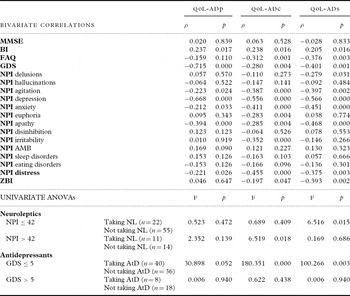
As shown in Table 2, patients, caregivers, and staff ratings correlated significantly with GDS, BI, NPI agitation, NPI depression, NPI anxiety, NPI apathy, and NPI distress. Caregivers’ ratings also correlated negatively with NPI euphoria, NPI irritability, and ZBI. In contrast, staff ratings correlated significantly and negatively with NPI delusions. The most relevant factors were self-rated depression for patients and proxy-rated depression for caregivers and staff.
Relationship between clinical factors and QoL

QoL-ADp = patients’ QoL-AD ratings; QoL-ADc = caregivers’ QoL-AD ratings; QoL-ADs = staff QoL-AD ratings; F = Snedecor's F; ρ = Spearman correlation coefficient; MMSE = Mini-Mental State Examination; BI = Barthel Index; FAQ = Functional Activities Questionnaire; GDS = Geriatric Depression Scale; NPI = Neuropsychiatric Inventory; AMB = aberrant motor behavior; ZBI = Zarit Burden Interview; NL = neuroleptics; AtD = antidepressants.
The results of MANOVA did not show a significant effect for cholinesterase inhibitors or benzodiazepines (test Wilks's λ, p > 0.05). However, it was observed a significant effect of antidepressants (Wilks's λ = 0.846; F = 3.280; p = 0.030) and neuroleptics (Wilks's λ = 0.829; F = 3.652; p = 0.018). Taking antidepressant drugs was related to lower QoL according to caregivers (F = 4.496; p = 0.038) and staff members (F = 6.761; p = 0.012). None of interactions reached significance. The results of Bartlett's test of sphericity for each MANOVA model met the criterion for adequacy. In the subsequent ANOVA, the sample was divided into two groups (cut-off point ≥5) to control for the effect of depression. The effect of antidepressants remained significant in the non-depressive group for patients, caregivers, and staff ratings, with size effects of 2.411, 4.628, and 8.250, respectively (Table 2). Between subjects test results showed that taking neuroleptics was associated with reduced QoL according to staff ratings (F = 4.924; p = 0.031). The sample was divided into two groups to control the effect of NPI scores. The cut-off point was 42 (75th percentile). The effect of neuroleptics remained significant in the low NPI score group with a size effect of 8.200 (Table 2).
Predictors of QoL
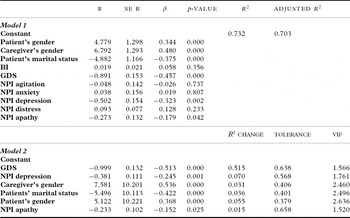
In Table 3 (Model 1) are displayed the results of a multivariate regression analysis (method enter) for QoL-ADp. The non-significant variables (NPI agitation, NPI anxiety, NPI distress, and BI) were not entered into the second model (method stepwise). The results of the final model (Model 2) revealed that the strongest predictors were GDS (β = –0.513; p < 0.001), followed by NPI depression (β = –0.245; p = 0.001). Depressive symptoms (GDS and NPI depression) accounted for 58.5% of the total variance of QoL. Demographic variables added only 12.2% to the variance explained.
Multivariate regression models for patients’ QoL ratings

B = size effect; SE = Standard Error; GDS = Geriatric Depression Scale; NPI = Neuropsychiatric Inventory; BI = Barthel Index; VIF = Variance Inflation Factor.
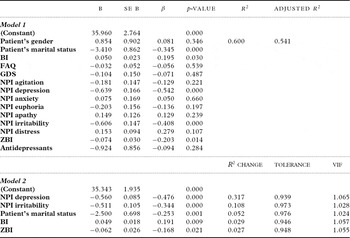
All relevant demographic and clinical variables (patients’ gender, patients’ marital status, BI, FAQ, GDS, NPI agitation, NPI depression, NPI anxiety, NPI euphoria, NPI apathy, NPI irritability, NPI distress, ZBI, and antidepressants) were entered in the regression model to predict QoL-ADc. As shown in Table 4, some of the variables were non-significant in the Model 1. Next, a stepwise model (Table 4, Model 2) was performed by introducing only the significant variables in the Model 1. NPI depression, NPI irritability, patients’ marital status, BI, and ZBI were significant predictors, explaining 53.3% of the variance. NPI depression was the main predictor, accounting for 31.7% of the variance (β = –0.476; p < 0.001). The condition indices and VIF indicated that multicollinearity was not present in the model.
Multivariate regression models for caregivers’ QoL ratings

B = size effect; SE = Standard Error; GDS = Geriatric Depression Scale; NPI = Neuropsychiatric Inventory; BI = Barthel Index; FAQ = Functional Activities Questionnaire; ZBI = Zarit Burden Interview; VIF = Variance Inflation Factor.
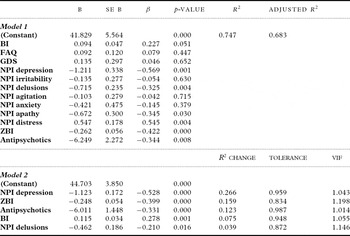
The regression model for staff ratings was performed by entering GDS, BI, FAQ, NPI agitation, NPI depression, NPI anxiety, NPI apathy, NPI irritability, NPI delusions, NPI distress, ZBI, and neuroleptics (Table 5, Model 1). We removed non-significant variables as well as NPI distress because tolerance was below 0.2 and beta coefficient did not have the expected sign. The variables that were significant in the final stepwise model (Table 5, Model 2) were NPI depression, ZBI, neuroleptics, BI, and NPI delusions, accounting up to 66.1% of the variance. There was not multicollinearity in the model.
Multivariate linear regression models for staff QoL ratings

B = size effect; SE = Standard Error; GDS = Geriatric Depression Scale; NPI = Neuropsychiatric Inventory; BI = Barthel Index; FAQ = Functional Activities Questionnaire; ZBI = Zarit Burden Interview; VIF = Variance Inflation Factor.
Discussion
Consistent with previous studies, we found that patients give better ratings on their QoL than proxies do (Logsdon et al., Reference Logsdon, Gibbons, McCurry and Teri2002; Conde-Sala et al., Reference Conde-Sala, Garre-Olmo, Turró-Garriga, López-Pousa and Vilalta-Franch2009). The correlation and the agreement between patients’ and both proxies’ QoL ratings are mild to moderate (Novella et al., Reference Novella2001; Kane et al., Reference Kane2005; Bosboom et al., Reference Bosboom, Helman, Eaton and Almeida2012). Moreover, the concordance between caregivers’ and staff ratings is also low. These results support the hypothesis that different perspectives on QoL exist, which in turn, warn us about the risks associated to relying exclusively on proxies’ reports.
Our results about QoL predictors confirmed that demographic factors did not have a strong effect on patients’ QoL (Lyketsos et al., Reference Lyketsos, Gonzales-Salvador, Chin, Baker, Black and Rabins2003; Banerjee et al., Reference Banerjee2009; Naglie et al., Reference Naglie2011). Perhaps due to their higher prevalence of depressive symptoms, female patients reported poorer QoL than male patients, similar to the findings by Conde-Sala et al. (Reference Conde-Sala, Garre-Olmo, Turró-Garriga, López-Pousa and Vilalta-Franch2009) and Barca et al. (Reference Barca, Engedal, Laks and Selbæk2011). In fact, we observed that the strongest predictor of patients QoL is their mood, particularly the self-reported mood (Hoe et al., Reference Hoe, Katona, Orrell and Livingston2007; Conde-Sala et al., Reference Conde-Sala, Garre-Olmo, Turró-Garriga, López-Pousa and Vilalta-Franch2009; Naglie et al., Reference Naglie2011). Mild-to-moderate AD patients seem to preserve full insight into their mood despite a general lack of awareness of their cognitive deficits (Matsui et al., Reference Matsui2006), so they tend to make feeling-centered assessments. However, the caregiver-reported depression, which is the best predictor of both proxies’ ratings, added only a small predictive power to the model for patients’ ratings. This suggests the existence of differences between perceptions of psychological well-being that could be due to proxy-related variables (personal beliefs, expectations or mood) but also due to the distinct assessment methods (inward exploration versus observation of external signs).
As reported previously, neuropsychiatric symptoms have a negative influence on patients’ QoL (Logsdon et al., Reference Logsdon, Gibbons, McCurry and Teri2002; Hoe et al., Reference Hoe, Katona, Orrell and Livingston2007; Conde-Sala et al., Reference Conde-Sala, Garre-Olmo, Turró-Garriga, López-Pousa and Vilalta-Franch2009). However, the relative importance of each symptom differs among patients and proxies. In addition to depression, patients’ ratings were associated with apathy, which is a mood-related symptom. Caregivers’ ratings were explained by agitation and irritability, which are strongly related to caregivers’ burden and depression (Matsumoto et al., Reference Matsumoto2007). Staff ratings were significantly explained by delusions score but also by neuroleptics use, as reported in previous studies (Ballard et al., Reference Ballard, O'Brien, James and Mynt2001; Mougias et al., Reference Mougias, Politis, Lyketsos and Mavreas2011). One possible explanation is that these patients were less communicative and also participated less in physical and social activities. Cholinesterase inhibitors and anxiolytic drugs were not related to patients’ QoL, unlike some transversal studies noted (González-Salvador et al., Reference González-Salvador2000; Hoe et al., Reference Hoe, Katona, Orrell and Livingston2007). Antidepressants were associated to lower QoL only in non-depressive patients. Given the transverse design of the study, we must be cautious with the conclusions. We cannot assure that, prior to the treatment with antidepressants or neuroleptics, the QoL of the patients was poorer because of the depressive and neuropsychiatric symptoms. Longitudinal studies are necessary to clarify these findings.
In this study, a significant association between burden and self-reported QoL was not found as opposed to earlier findings (Logsdon et al., Reference Logsdon, Gibbons, McCurry and Teri2002; Conde-Sala et al., Reference Conde-Sala, Garre-Olmo, Turró-Garriga, López-Pousa and Vilalta-Franch2009). Burden itself does not appear to affect patients’ QoL but acts as a biasing factor for proxies’ ratings, as others have found (Black et al., Reference Black, Johnston, Morrison, Rabins, Lyketsos and Samus2011). However, the poorer quality of the relationship, patient–caregiver, resulting from high caregiver burden can also have a negative effect on QoL.
Consistent with previous research, the cognitive function was not linearly related to QoL (Logsdon et al., Reference Logsdon, Gibbons, McCurry and Teri2002; Naglie et al., Reference Naglie2011). It has been suggested that cognition could be a crucial aspect for patients in the very early stage of the disease (Matsui et al., Reference Matsui2006; Hurt et al., Reference Hurt2010; Mougias et al., Reference Mougias, Politis, Lyketsos and Mavreas2011). However, as the disease progresses, mood becomes increasingly important for patients and both neuropsychiatric symptoms and disability become prominent for proxies (Tatsumi et al., Reference Tatsumi2009; Vogel et al., Reference Vogel, Bhattacharya, Waldorff and Waldemar2012). Another possibility is that differences in the level of patients’ insight mask change in QoL due to cognitive decline.
Patients’ disability had a significant impact on proxy ratings of QoL, as reported in other studies (Black et al., Reference Black, Johnston, Morrison, Rabins, Lyketsos and Samus2011; Mougias et al., Reference Mougias, Politis, Lyketsos and Mavreas2011). Nevertheless, we did not find BI scores as an independent predictor of patients’ ratings. Literature is not consistent regarding the association between functional status and self-reported QoL (Hoe et al., Reference Hoe, Katona, Orrell and Livingston2007; Conde-Sala et al., Reference Conde-Sala, Garre-Olmo, Turró-Garriga, López-Pousa and Vilalta-Franch2009). One possibility is that the effect of functional measures is explained by other variables such as behavioral symptoms (Matsui et al., Reference Matsui2006). In this study, the effect of BI scores on patient-rated QoL could partly be explained by patients’ gender.
A limitation of this study is its cross-sectional design precluding causal inference. In addition, our results could not be generalizable to patients with severe AD or to those living in nursing homes, but should be generalizable to mild and moderate community dwelling patients. Dementia care in Spain has some peculiarities, such as the common use of “rotation” and cohabitation arrangement instead of the use of nursing home care (Rivera et al., Reference Rivera2008). The use of day care prevents informal caregivers’ burden (Pinquart et al., Reference Pinquart and Sörensen2006). Hence, regardless of the high NPI scores of the patients, our caregivers did not show high level of burden. Otherwise, our findings about caregivers’ ratings on QoL could be generalizable, since the overall caregiver data (age, gender, family relationship) were very similar to the results of the studies conducted by Alzheimer Europe (Georges et al., Reference Georges, Jansen, Jackson, Meyrieux, Sadowska and Selmes2008).
Despite its limitations, the current study shows that mood is the main predictor of QoL self-ratings. Although this effect could have been due to reverse causality (a poor QoL leads to a depressive mood), it would be advisable to implement programs to improve self-esteem, maintain residual skills, and make them feel helpful. We cannot exclude that the scale used to assess QoL could have influenced the results of this study. QoL-AD scale measures the domain “perceived-QoL” of the Lawton model (Logsdon et al., Reference Logsdon, Gibbons, McCurry and Teri2002). Hence, it seems reasonable to expect that QoL-AD scores be more closely related to scores of measures of subjective domains of QoL. However, recent research has shown that the QoL determinants are more similar between different QoL scales than between different types of informants (Bhattacharya et al., Reference Bhattacharya, Vogel, Hansen, Waldorff and Waldemar2010; Black et al., Reference Black, Johnston, Morrison, Rabins, Lyketsos and Samus2011). Our study also shows the uniqueness of each perspective on QoL. Differences between patients’ and proxies’ views are partly rooted in their diverse expectations and importance given to the different domains. In this sense, caregivers’ and staff ratings seem to represent a more balanced reflection of the essential aspects of the patients’ lives (Lawton, Reference Lawton1994). Hence, they are likely to be more sensitive to clinical changes and could be useful as complementary sources of information in clinical trials. We did not observe that caregivers’ perspective was more similar to patients’ view than staff perspective, consistent with the findings of Beer et al. (Reference Beer2010). However, since QoL mainly implies a subjective judgment about own living situation, neither caregivers’ ratings nor staff ratings can replace self-ratings but reinforce or complement them. Therefore, whenever possible, ratings by patients and by both types of proxies should be taken into account to reach a deeper understanding of QoL.
Conflict of interest
None.
Description of authors’ roles
M. Gómez-Gallego conceived the study and its design and gathered the data, contributed to the data analysis, completed interpretation, and drafted the final product. J. Gómez-Amor advised on the design of the study, and provided critical commentary on several drafts of the paper. Juan Gómez-García advised on the design of the study and contributed to the data analysis and the development of the tables and reviewed the paper.
Acknowledgments
We are grateful to Dr. Rebecca Logsdon for authorizing us to validate and use the QoL-AD scale in Spain and to the people of the day-centers who selflessly participated in this study.