INTRODUCTION
In recent years, there has been a dramatic proliferation of research concerned with organizational learning capability and team learning capability (Hirst, van Knippenberg, & Zhou, Reference Hirst, van Knippenberg and Zhou2009; Bresman, Reference Bresman2010). Previous literature regards team learning as a key component of organizational learning. In the learning organization context, team members share knowledge and learn from each other; therefore, team learning is considered critical to organizational learning. In terms of the relationship between team learning and organizational learning, team learning is regarded as a gateway to organizational learning because it bridges the transfer of individual learning to organizational knowledge that can then be shared by all (Pawlowsky, Reference Pawlowsky2001). Senge (Reference Senge1990) suggested team learning as one of the foundations for the learning organization. Prior studies have described the multiple levels of learning in an organization: individual, teams, and organizational (Crossan, Lane, & White, Reference Crossan, Lane and White1999). Recently, a focus on organizational learning has shifted to determining the learning team-members use in various team contexts. Senge described that teams are the fundamental learning unit in modern organizations. While organizations increasingly rely upon effective team learning capabilities to make important decisions (Tjosvold, Yu, & Hui, Reference Tjosvold, Yu and Hui2004), strengthen organizational innovation (Chen, Liu, & Tjosvold, Reference Chen, Liu and Tjosvold2005), and create corporate performance (Certo, Lester, Dalton, & Dalton, Reference Certo, Lester, Dalton and Dalton2006; Malik & Kotabe, Reference Malik and Kotabe2009; Minichilli, Corbetta, & MacMillan, Reference Minichilli, Corbetta and MacMillan2010), the methods by which teams engage in learning across boundaries are less understood (Bresman, Reference Bresman2010). Thus, research is needed to understand the learning models and their influences.
From the resource dependency perspective, firms are not completely independent; they often need other organizations or firms to offer them necessary resources and aids. To survive in the competitive global business environment, reliance on external sources of knowledge and research skills is often considerable. Thus, successful firms can accumulate competence through internal learning after transferring technologies from external technology sources (Lin, Reference Lin2003). However, the key issue is to disseminate and apply external and internal knowledge, to enhance teamwork effectiveness, to meet customer need, and to strengthen firm performance through effective team learning. Thus, aligning various team learning models with organizational innovation should help to create competitive advantages. Prior studies of team learning have mostly focused on the effects of learning behavior (Hirst, van Knippenberg, & Zhou, Reference Hirst, van Knippenberg and Zhou2009) or learning activities (van Woerkom & Croon, Reference Van Woerkom and Croon2009), however, relatively few empirical studies of learning models are available (Lynn, Reference Lynn1998). Although the literature has helped to explain some complex issues about organizational learning, many more studies are needed to identify specific learning models. Investigating different types of learning models is important, because they may have diverse effects on innovation and performance. Few studies have simultaneously examined the relationships between team learning and business model innovation in a conceptual framework, even though prior research has noted the influence of organizational learning on innovation (e.g., Lichtenthaler, Reference Lichtenthaler2009). This study investigated team-learning models, discusses how each learning model differs, why it is important to develop measures for the models, and empirically tested a mediating model to learn how team-learning affects business model innovation and firm performance. This paper seeks to fill the research gap by investigating how cross-functional teams generate business model innovation and firm performance from team learning modes.
The remainder of this study is organized as follows. The next section briefly reviews the related theoretical underpinnings and develops hypotheses to evaluate through research. The research methodology is then presented with the detailed data collection, the samples, and the variables. The analytical results are then presented with a thorough description of the empirical analysis, including the results of the correlation analysis, the common method variance test, the confirmatory factor analysis (CFA), and the ordinary-least-squares regression analysis. Finally, conclusions are presented and implications are proposed.
THEORY AND HYPOTHESES
The concepts of team learning and business model innovation shape this study. The following section presents the main theories and hypotheses associated with these concepts.
Business model innovation
From a resource-based perspective, the ability to innovate has always been an essential component of organizational success (Assink, Reference Assink2006). To compete against rivals, firms must adopt suitable methods of innovation. The business model of a firm performs two important functions: value creation and value capture (Chesbrough, Reference Chesbrough2007). Some successful firms have rapidly changed their business model to strengthen their competitive advantages. For example, development of new cars by the Indian company, Tata Motors, (Tata Nano) illustrates how a firm employs business model innovation to create profitability. The Tata Nano is an inexpensive, rear-engine, four-passenger city car built by Tata Motors that aims primarily at the Indian domestic market. For Tata Motors to fulfil the requirements of its customer value proposition and profit formula for the Nano, it had to reconceive how a car is designed, manufactured, and distributed. As a result, Tata reconceived its supplier strategy, choosing to outsource a remarkable 85% of the Nano components and use nearly 60% fewer vendors than normal to reduce transaction costs and achieve better economies of scale (Johnson, Christensen, & Kagermann, Reference Johnson, Christensen and Kagermann2008). Business model innovation is one of the many innovation strategies adopted by several very successful corporations, including Apple, Wal-Mart, FedEx, Southwest, and the Tata Group. Not only large enterprises pursue business model innovation, but also small and medium-sized enterprises in China prefer to adopt business model innovation, such as ‘Shan Zhai’ manufacturers. ‘Shan Zhai’ mobile phone, the so-called ‘Bandit Cell Phone’, is an interesting case of business model innovation in China. Many manufacturing companies of ‘Shan Zhai’ mobile phones have begun to move beyond mere copying to the realm of creativity and innovation. Some products have been developed to meet the needs and preferences of the local market. By customizing product offerings to local demands, manufacturing companies increase the value of the ‘Shan Zhai’ mobile phone in the local market.
Research has traditionally viewed innovation as new products, new technologies, or alternative forms of administration and service (Raymond & St-Pierre, Reference Raymond and St-Pierre2010). Yet, business model innovation differs from the traditional innovation model. Accordingly, business model innovation consists of products and processes rather than products or processes. For example, Moore (Reference Moore2004) defined business model innovation as either the reframing (for the customer) of an established value proposition, or the reframing of the established role of a company in a value chain (or both). Similarly, Johnson, Christensen, and Kagermann (Reference Johnson, Christensen and Kagermann2008) suggested that reinventing business models consists of creating a customer value proposition, designing a profit formula, and identifying key resources and processes. Because of an increasing focus on the customer, business models have changed in recent years. Consequently, a firm that employs business model innovation is one that has found a way to create value for, and to focus on, customers. The profit formula is the blueprint that defines how a company both creates value for itself, and provides value to the customer. Redesigning an appropriate profit formula must entail the use of appropriate cost techniques. According to Johnson, Christensen, and Kagermann (Reference Johnson, Christensen and Kagermann2008), the business model innovation of a firm is built upon four components: a customer value proposition, a new profit formula, key resources, and key processes. These components are vital to fostering effective business model innovation and to capturing new markets (as shown in Figure 1). In other words, business model innovation results in an entirely distinctive type of firm, one that competes not only for the value proposition of its services or product offerings, but for aligning its new profit formula, its key resources and processes to enhance that value proposition, as well as to capture new market segments and alienate competitors. As noted above, to strengthen business model innovation, many firms employ new product teams or cross-functional teams, comprised of young engineers and various specialties, because more-experienced team members are less susceptible to changes and existing profit formulas and processes are more likely to constrain their thinking (Johnson, Christensen, and Kagermann, Reference Johnson, Christensen and Kagermann2008). New product teams redesign profit formulas and evaluate key resources and processes to create a customer value proposition to re-innovate their business model. Consequently, these teams are more successful at developing successful products than any other types of teams (Dayan & Colak, Reference Dayan and Colak2008). Prior studies have also examined the use of new product teams or cross-functional teams in the innovation process and their effects on innovation outputs (Lovelace, Shapiro, & Weingart, Reference Lovelace, Shapiro and Weingart2001; Post, De Lia, DiTomaso, Tirpak, & Borwankar, Reference Post, De Lia, DiTomaso, Tirpak and Borwankar2009).
Business model innovation

Team learning and business model innovation
From the organizational learning perspective, learning is the process through which firms can acquire external technology and accumulate technology capabilities intended to improve their competitive advantage. The resource-based view perspective defines learning capability as the ability of a firm to develop or acquire new knowledge-based resources and skills as needed to offer whatever new products are desired (Hull & Covin, Reference Hull and Covin2010). In defining the concept of team learning, some researchers have emphasized the learning process. Team learning refers to the collective acquisition, combination, creation, and sharing of knowledge by teams (Zellmer-Bruhn & Gibson, Reference Zellmer-Bruhn and Gibson2006); or collective engagement in reflective decision making, asking questions, seeking feedback, and discussing errors by teams (Edmondson, Reference Edmondson1999; Hirst, van Knippenberg, & Zhou, Reference Hirst, van Knippenberg and Zhou2009). Van Woerkom and Croon (Reference Van Woerkom and Croon2009) and Huber (Reference Huber1991) suggested that team-learning activities consist of information acquisition, information distribution, information interpretation, and information storage and retrieval. Van Woerkom and Croon (Reference Van Woerkom and Croon2009) defined team learning as learning activities carried out by team members through which a team obtains knowledge that allows it to adapt and improve towards better team performance.
Among previous literature on team learning activities, Bresman (Reference Bresman2010) suggested that team learning activities consist of internal learning and external learning (namely, vicarious learning and contextual learning activities). Through internal learning activities, teams are able to improve collective understanding of a situation in members, and improve both the quality and efficiency of their work. External learning helps team members find other experienced working partners to learn from each other, to identify important practices and procedures, and to learn how to implement them. External learning also ensures team members that they are staying abreast of the competition, that they are working on a product that customers value, and that new technologies will not surpass them (Bresman, Reference Bresman2010). Schroeder, Bates, and Juntilla (Reference Schroeder, Bates and Juntilla2002) suggested that employee internal learning forms resources and capabilities, based on cross-training systems, external learning from customers and suppliers, and proprietary processes and equipment developed by the firm. With the aim of building and reinforcing organizational competitive advantage, de Pablos (Reference De Pablos2002) suggested that knowledge from both internal learning (investment in R&D) and external learning (learning from an alliance partner, competitor, etc.) has become a strategic process that contributes to the acquisition and deployment of organizational knowledge stock and flow. Many firms are realizing the potential contributions of teams to enhancing continuous innovation improvement (Chen, Liu, & Tjosvold, Reference Chen, Liu and Tjosvold2005), creating customer value proposition (Ambrosini, Bowman, & Burton-Taylor, Reference Ambrosini, Bowman and Burton-Taylor2007), developing successful new products (Akgun, Lynn, & Yilmaz, Reference Akgun, Lynn and Yilmaz2006), and reducing operating costs and improving response to competitive environment changes (Johnson, Christensen, & Kagermann, Reference Johnson, Christensen and Kagermann2008). Thus, as noted above, business model innovation focuses on enhancing customer value proposition. To enhance business model innovation, organizational teams must acquire both external and internal technology. Thus, team learning may be an appropriate mechanism for strengthening business model innovation. For example, Hull and Covin (Reference Hull and Covin2010) suggested that the internal ability of a firm to innovate, as reflected in its learning capability, has relevance far beyond the likely internal innovation output of the firm. Bierly, Damanpour, and Santoro (Reference Bierly, Damanpour and Santoro2009) suggested that the transfer and use of knowledge from external sources expands the knowledge base of a firm and provides access to new ideas that promote the generation of new products and technology. Tsai and Wang (Reference Tsai and Wang2009) suggested that firms improve their technological innovation by collaborating with competent competitors, thereby simultaneously accelerating their capability development and reducing technological innovation time. To retain technological avant-garde, Figueiredo (Reference Figueiredo2003) suggested that firms engage in technological learning processes to build up their own ability to carry out innovative activities independently. Pascale (Reference Pascale1984) considered product innovation as coming not only from R&D in an organization, but also from customer opinions (i.e., market learning). Consequently, research has viewed innovation as resulting from the learning process (Sarin & McDermott, Reference Sarin and McDermott2003); thereby, effective team learning facilitates the ability of a firm to acquire technological knowledge, improve innovation, respond to markets, and enhance its performance (Slater & Narver, Reference Slater and Narver1995; Bunderson & Sutcliffe, Reference Bunderson and Sutcliffe2003; Bresman, Reference Bresman2010). Previous studies have divided team learning into three types of learning modes: within-team learning, cross-team learning, and market learning (e.g., Lynn, Reference Lynn1998). First, within-team learning is the learning that occurs within the team context. Cross-team learning is the experience one team gains within a company and then transplanted to another team. Finally, market learning is the knowledge gained outside of the firm-from competitors, suppliers, and customers. Team learning is the process through which team members obtain new information or knowledge. Similarly, team learning is also the organizational learning process that aids team members in decision making, increases teamwork effectiveness, and facilitates innovation improvements. Therefore, the following hypotheses inspired by previous studies:
Hypothesis 1 : Within-team learning is positively related to business model innovation.
Hypothesis 2 : Cross-team learning is positively related to business model innovation.
Hypothesis 3 : Market learning is positively related to business model innovation.
Business model innovation and firm performance
Considerable evidence shows that innovation is a method that allows long-term survival and prosperity of enterprises (Damanpour, Walker, & Avellaneda, Reference Damanpour, Walker and Avellaneda2009). When companies are capable of innovating can develop more competitive advantage, thus achieving higher performance (Hurley & Hult, Reference Hurley and Hult1998). Accordingly, the more innovative the organization is, the higher the performance or competitiveness is. For example, Amazon is engaged in business model innovation, which attracts new customers by introducing a new business model, thus enlarging the book market (Markides, Reference Markides2006). Dell is a business model innovator that concentrates on activities that add the most value and on market segments where profits are highest. Another such example is Apple Computers, which transformed itself from a PC manufacturer into a leading consumer electronics company by launching the highly successful Apple iPod and iPhone, thus increasing profitability (Koen, Bertels, & Elsum, Reference Koen, Bertels and Elsum2011; Park, Reference Park2011). These companies pursue business model innovation, thus creating competitive advantage and increasing profitability.
Business model innovation helps enterprises build competitive advantage (Johnson, Christensen, & Kagermann, Reference Johnson, Christensen and Kagermann2008). Developing unique ability derived from business model innovation is the most important source for competitive advantage. Business model innovation creates new business models, more effectively meets customer needs, improves the quality of existing products or attributes, and reduces production costs. Pohle and Chapman (Reference Pohle and Chapman2006) believed that companies achieve optimal benefits of reduced cost and strategic flexibility through business model innovation. Mitchell and Coles (Reference Mitchell and Coles2004) suggested that a firm that changes its business model, thus making business model innovation very difficult for competitors to duplicate, benefits from significant growth and increasing profitability. Numerous studies have shown a positive relationship between business model innovation and firm performance (Chesbrough & Rosenbloom, Reference Chesbrough and Rosenbloom2002; Mitchell & Coles, Reference Mitchell and Coles2004; Pohle & Chapman, Reference Pohle and Chapman2006; Chesbrough, Reference Chesbrough2007; Johnson, Christensen, & Kagermann, Reference Johnson, Christensen and Kagermann2008). Therefore, the development of new concepts, re-creation of customer value, continued engagement in innovative activities, and innovation of its business model can help increase the firm performance of an enterprise and create higher profit. This study proposes the following hypothesis:
Hypothesis 4 : Business model innovation is positively related to firm performance.
METHODS
Sample and procedure
The principle method of data collection in this study was a survey questionnaire with closed, structured questions. The original version of the questionnaire was translated into Chinese by the authors and then translated back from Chinese to English by two bilingual foreign language experts. In a pre-test stage of this study, 30 electronics and information firms were selected. The pre-test results showed that the Cronbach's α for each construct was >0.75 and that all items would be appropriate for subsequent surveys. We also conducted field interviews with 10 managers, asking them a series of open-ended questions regarding the role of team learning and business model innovation in an emerging market. After face-to-face interviews with those managers, we then conducted the survey. At the survey stage, samples were selected from various electronics and information firms in Shanghai and Suzhou of China using a matched dyadic data set of those firms. This study adopted a separation approach to the data collection, including cross-functional team members and their supervisors. Separate survey packets were sent to the managers of the cross-functional team (Form A) and to the members of the cross-functional teams (Form B). Form A contained measures of business model innovation, firm performance, technological turbulence, and competitive intensity, as well as a section that assessed basic firm financial information and demographic characteristics. Form B contained measures of within-team learning, cross-team learning, and market learning, as well as a section that assessed demographic characteristics.
The survey was conducted in two waves. Three weeks after the initial mailing of questionnaires and introductory letters, reminder letters and questionnaires were sent out to non-respondents. A telephone survey was used as a supplementary tool to boost the response rate. Six hundreds questionnaires were sent out to selected electronics and information firms. As a result, we collected 330 copies of surveys, that is, 165 pairs of matched dyadic questionnaires from a study of 330 cross-functional team members and their supervisors sampled from 165 electronics and information industries used in the analytical model. When confirming the representativeness of the research samples, the study evaluated the effects of non-response. The non-response bias was assessed by comparing the first-wave (early respondents) and second-wave (late respondents) data (Armstrong & Overton, Reference Armstrong and Overton1977). The initial response rates was 33.33% and the secondary response rates was 21.67%. Following Armstrong and Overton (Reference Armstrong and Overton1977), t-tests were used to compare early and late respondents with respect to key characteristics such as firm size and annual sales. No significant differences (p < .05) however were found between early and late respondents on these characteristics.
To maintain sample homogeneity, only electronics and information firms in Shanghai and Suzhou of China were used in this study. Table 1, Table 2, and Table 3 show the sample characteristics. At the level of firm characteristics, the sample was diverse: 26.67% of firms represented the computer and peripherals industry, 18.18% of firms were from the communications industry, 19.39% of firms were from the consumer electronics industry, 20% of firms were from the electronic components and materials industry, 7.27% of firms were from the information software industry, 6.67% of firms were from the information hardware industry, and 1.82% of firms were from the optoelectronics industry.
Characteristics of the industries

Characteristics of the teams
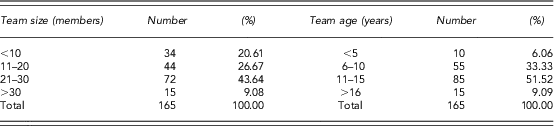
Characteristics of the firms

Measures
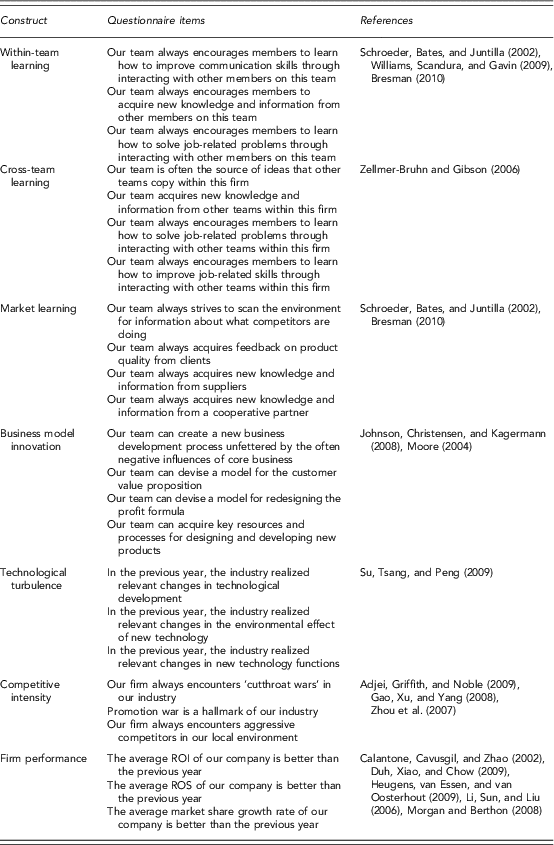
This study analyzed the relationships among contextual variables from the sampled Chinese information and electronics firms. All variables were measured directly from a survey, designed after completing a literature review. The choice of measurement variables reflects prior research. A review of the literature suggests the following constructs: team learning (Schroeder, Bates, & Juntilla, Reference Schroeder, Bates and Juntilla2002; Zellmer-Bruhn & Gibson, Reference Zellmer-Bruhn and Gibson2006; Bresman, Reference Bresman2010), business model innovation (Moore, Reference Moore2004; Johnson, Christensen, & Kagermann, Reference Johnson, Christensen and Kagermann2008; Huang, Lai, Kao, & Chen, Reference Huang, Lai, Kao and Chen2012), and firm performance (Calantone, Cavusgil, & Zhao, Reference Calantone, Cavusgil and Zhao2002; Li, Sun, & Liu, Reference Li, Sun and Liu2006; Morgan & Berthon, Reference Morgan and Berthon2008; Duh, Xiao, & Chow, Reference Duh, Xiao and Chow2009; Heugens, van Essen, & van Oosterhout, Reference Heugens, van Essen and van Oosterhout2009). To satisfy the assessment of content validity, the measurement items were subjected to expert evaluation. The instrument used a Likert scale and comprised seven constructs: within-team learning, cross-team learning, market learning, business model innovation, firm performance, technological turbulence, and competitive intensity. Each indicator was measured on a 7-point Likert scale with 7 representing ‘strongly agree’ and 1 representing ‘strongly disagree’. The following are operational definitions of variables; the items for measurement are shown in the appendix.
Within-team learning
Within-team learning is defined as the learning that occurs within the team context, and team members acquire new information and knowledge by interacting and cooperating with other members (Lynn, Reference Lynn1998). This study modified and used three-item measures of within-team learning from Schroeder, Bates, and Juntilla (Reference Schroeder, Bates and Juntilla2002); Williams, Scandura, and Gavin (Reference Williams, Scandura and Gavin2009); and Bresman (Reference Bresman2010). A high value indicates greater within-team learning. The Cronbach's α measure of reliability for this construct is 0.84.
Cross-team learning
Cross-team learning is defined as the experience gained by one team within a company that transplants knowledge to another team. Team members acquire new information and knowledge by exchanging it with and transferring it among other units or members within that organization (Lynn, Reference Lynn1998). Four-item measures of cross-team learning from Zellmer-Bruhn and Gibson (Reference Zellmer-Bruhn and Gibson2006) were used and modified. A high value indicates greater cross-team learning. The Cronbach's α measure of reliability for this construct is 0.90.
Market learning
Market learning is defined as the knowledge gained outside of the firm – from competitors, suppliers, and customers (Lynn, Reference Lynn1998). Four-item measures of market learning from Schroeder, Bates, and Juntilla (Reference Schroeder, Bates and Juntilla2002) and Bresman (Reference Bresman2010) were used and modified. A high value indicates greater market learning. The Cronbach's α measure of reliability for this construct is 0.89.
Business model innovation
This construct describes a new business model that creates a customer value proposition, designs a profit formula, and identifies key resources and processes (Johnson, Christensen, & Kagermann, Reference Johnson, Christensen and Kagermann2008). The construct uses four items (modified from Moore, Reference Moore2004; Johnson, Christensen, & Kagermann, Reference Johnson, Christensen and Kagermann2008; Huang, Lai, Kao, & Chen, Reference Huang, Lai, Kao and Chen2012) that measure business model innovation. The Cronbach's α measure of reliability for this construct is 0.90.
Firm performance
Firm performance refers to an organization meeting shareholder demands (Luo, Slotegraaf, & Pan, Reference Luo, Slotegraaf and Pan2006). Firm performance includes the measurement of performance goals, including the average return on investment, the average return on sales, and the average market share (Calantone, Cavusgil, & Zhao, Reference Calantone, Cavusgil and Zhao2002; Li, Sun, & Liu, Reference Li, Sun and Liu2006; Morgan & Berthon, Reference Morgan and Berthon2008; Duh, Xiao, & Chow, Reference Duh, Xiao and Chow2009; Heugens, van Essen, & van Oosterhout, Reference Heugens, van Essen and van Oosterhout2009; Huang, Lai, & Lo, Reference Huang, Lai and Lo2012). This study used three question items to measure firm performance. A high value indicates high firm performance. The Cronbach's α measure of reliability for this construct is 0.91.
Control variables
In selecting variables to include as controls, this study used two team-level variables shown to influence team learning in prior studies (Bunderson & Sutcliffe, Reference Bunderson and Sutcliffe2003; Van der Vegt & Bunderson, Reference Van der Vegt and Bunderson2005; Zellmer-Bruhn & Gibson, Reference Zellmer-Bruhn and Gibson2006; Hirst, van Knippenberg, & Zhou, Reference Hirst, van Knippenberg and Zhou2009; Dayan & Di Benedetto, Reference Dayan and Di Benedetto2010) and several strategy variables shown to influence innovation in prior studies (Xu & Zhang, Reference Xu and Zhang2008; Su, Tsang, & Peng, Reference Su, Tsang and Peng2009; Chiang & Hung, Reference Chiang and Hung2010). Thus, this study controlled team size, team age, technological turbulence, competitive intensity, R&D intensity, capital intensity, and industry types in all models. Team size was a count of members in the team. Team age was operationalized as the natural log of the number of years since the team was founded. Technological turbulence referred to the technology rate of change in industry of the focal firm (Jaworski & Kohli, Reference Jaworski and Kohli1993). The construct uses three items (modified from Su, Tsang, & Peng, Reference Su, Tsang and Peng2009) that measure technological turbulence. The Cronbach's α measure of reliability for this construct is 0.87. Competitive intensity can affect firm innovative activity through competition environment effects on a firm (Zajac, Golden, & Shortell, Reference Zajac, Golden and Shortell1991; Aghion, Griffith, & Howitt, Reference Aghion, Griffith and Howitt2006; Gao, Xu, & Yang, Reference Gao, Xu and Yang2008). Competitive intensity refers to the degree of pressure rivals impose on a focal firm (Wu & Pangarkar, Reference Wu and Pangarkar2010). We modified and used three-item measures of competitive intensity from Adjei, Griffith, and Noble (Reference Adjei, Griffith and Noble2009); Gao, Xu, and Yang (Reference Gao, Xu and Yang2008); Zhou, Brown, Dev, and Agarwal, (Reference Zhou, Brown, Dev and Agarwal2007). The Cronbach's α measure of reliability for this construct is 0.88. In addition, R&D investment is generally seen as a crucial determinant of innovation, because it helps firms create and develop new knowledge and technologies into new products and/or processes (Becheikh, Landry, & Amara, Reference Becheikh, Landry and Amara2006). R&D intensity and capital intensity may affect innovation strategies and performance because larger firms typically have larger technology portfolios. Thus, this work controlled the effect of R&D intensity on innovation and defined R&D intensity as total R&D expenditures divided by total sales. Capital intensity should capture barriers to entry resulting from high capital requirements (Mahlich, Reference Mahlich2010). Hence, we also controlled the effect of capital intensity and calculated it by dividing the book value of total assets by total sales (O'Brien, Reference O'Brien2003).
Finally, we controlled the effects of industry variances (Chen & Huang, Reference Chen and Huang2006; Xu & Zhang, Reference Xu and Zhang2008). Six industry-specific dummy variables were used to distinguish these seven industries, including computers and peripherals industry, communications industry, consumer electronics industry, electronic components and materials industry, information software industry, information hardware industry, and optoelectronics industry.
RESULTS
Descriptive statistics and correlation analysis
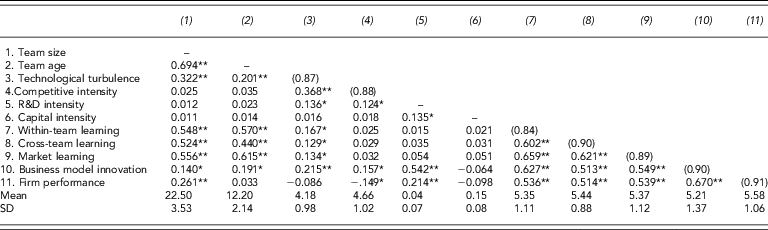
This study first calculated descriptive statistics and Pearson's correlations for the focal variables. Table 4 summarizes the statistics and correlation coefficients. The correlation analysis highlights the relationships among the control, independent, mediating, and dependent variables.
Descriptive statistics and correlation analysis
Note. Figures in parentheses are Cronbach's α's.
n = 165.
*p < .05; **p < .01.
CFA
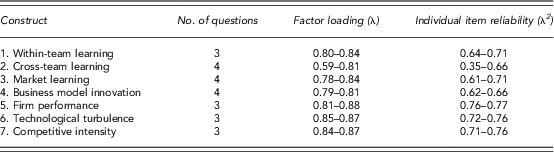
This study used CFA to examine the reliability, convergent validity, and discriminant validity of constructs. Table 5 indicates the fitting index measurements for each construct. Convergent validity is assessed by considering the statistical significance of factor loadings and t-values. All of the multi-item constructs fit this criterion and the loading is significantly related to its underlying factor (t-values >1.96), thus supporting factor convergent validity. Table 6 provides evidence of factor convergent and discriminant validity. The composite reliability and the average variance extracted measures provide support for factor reliability and its convergent validity. As recommended by Fornell and Larcker (Reference Fornell and Larcker1981) and Bentler and Wu (Reference Bentler and Wu1993), all reliability indices are >0.60 and the average variance shared between the construct and measures is above 0.50. Composite reliabilities (the analog of the Cronbach's α for structural equation modelling) are strong for all the multi-item measures, ranging from 0.78 to 0.88. All seven constructs had average variances extracted equal to, or exceeding, 0.51, indicating an acceptable convergent validity.
Individual item reliability
Composite reliability and average variance extracted

Competing model analysis was performed to corroborate the factor structure of team learning. Following Lynn (Reference Lynn1998) and Hirst, van Knippenberg, and Zhou (Reference Hirst, van Knippenberg and Zhou2009), three plausible alternative models are specified. The first model is the null model, which specifies no relationships between or among the various latent variables (i.e., they are uncorrelated). In one-factor model, the 11 items are loaded onto one factor. The one-factor model is plausible in light of past studies that assumed team learning as a single first-order construct (Hirst, van Knippenberg, & Zhou, Reference Hirst, van Knippenberg and Zhou2009). Finally, in the three-factor model, the 11 items are loaded onto three factors, including within-team learning, cross-team learning, and market learning (Lynn, Reference Lynn1998). If the three constructs are truly distinct, the three-factor model should provide the best fit. Table 7 summarizes the results of the model comparison, including the null model and the two alternative models. One would naturally expect the χ2 value for the null model (χ2 = 378.59) to be higher than the two alternative models. The CFA results of team learning indicate that the three-factor model (χ2 = 102.21, df = 41, χ2/df = 2.49, GFI = 0.899, CFI = 0.959, NFI = 0.954, NNFI = 0.962, and RMSEA = 0.084) relative to the one-factor model (χ2 = 225.27, df = 44, χ2/df = 5.12; GFI = 0.899, CFI = 0.959, NFI = 0.954, NNFI = 0.962, RMSEA = 0.115), fits the data better. Thus, these results suggest support for the distinctiveness of cross-team learning, within-team learning, and market learning.
Results of competing model analysis for team learning

Note. Δχ2 is based on null model.
aΔχ2 > 6.33.
Discriminant validity of team learning is assessed through CFA by comparing the χ2 differences between a constrained model (where the inter-factor was set to 1, indicating they are the same construct) and an unconstrained model (where the inter-factor correlation was free) of each pair of constructs (Bagozzi & Phillips, Reference Bagozzi and Phillips1982; Anderson & Gerbing, Reference Anderson and Gerbing1988). The difference between these χ2 values, with degrees of freedom equal to one, is also a χ2 variate. Statistical significance of this χ2 variate indicates that the unconstrained model is a better fit than the constrained model. For all pairs of constructs, all χ2 differences are found to be significant (with differences of 73.97, 65.82, and 43.47, respectively), evidencing discriminant validity of team learning. Table 8 displays the results of discriminant validity of first-order constructs for team learning, suggesting that three constructs have discriminant validity.
Discriminant validity of first-order constructs for team learning

Note. aΔχ2 > 6.33.
Common method variance test
Common method variance is a potential problem for behavioural research (Podsakoff, MacKenzie, Lee, & Podsakoff, Reference Podsakoff, MacKenzie, Lee and Podsakoff2003), which can occur when a single participant responds either to all the variables or to all the items within a single survey (Podsakoff & Organ, Reference Podsakoff and Organ1986). This study not only adopted a separation approach to data collection and a design approach to instrument development, but also adopted the Harman (Reference Harman1967) one-factor test to check for common method bias (Podsakoff & Organ, Reference Podsakoff and Organ1986). An un-rotated factor analysis with 24 items resulted in seven factors that altogether accounted for 78% of the total variance, of which one factor accounted for 20.6%. Common method bias was unlikely in the context of this study since a single factor did not emerge in this analysis and no single factor accounted for the majority of covariance among the variables. In summary, a post hoc analysis using the Harman one-factor test indicated that not all variables load onto a common factor, which suggested that common method variance is not the primary determinant of the results in this study.
Testing of hypotheses
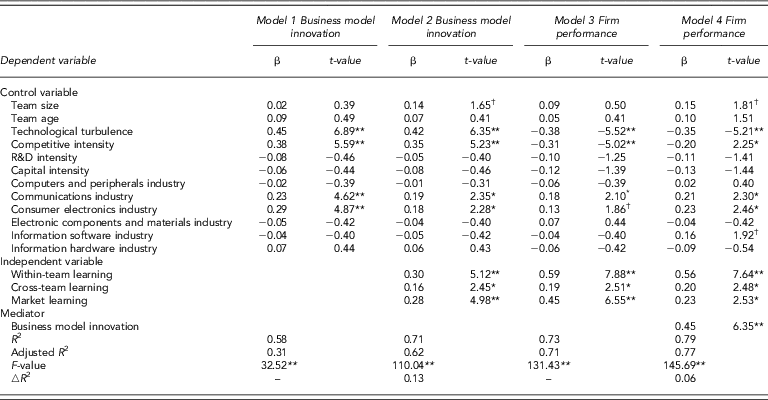
To test the mediating relationship between contextual variables, Baron and Kenny (Reference Baron and Kenny1986) offered a more precise analysis. This study examined the mediating role of business model innovation on the effect of team learning and firm performance, following the procedure discussed by Baron and Kenny (Reference Baron and Kenny1986). Table 9 lists the results of ordinary-least-squares regression analyses of the main effects and the mediating effect, with model 1 including only the control variables. Model 2 puts in the main variables, including within-team, cross-team, and market learning and shows the effects of control and main variables on business model innovation (i.e., mediator). Then, model 3 shows the effects of control and main variables on firm performance. Finally, model 4 shows the effects of control, main variables, and mediator on firm performance. The calculated variance inflation factors are all below the 10.0 cutoff point, indicating that multicolinearity is not a concern.
Results of ordinary least-square regression analysis
Note. The β coefficients shown are standardized.
n = 165.
†p < .1; *p < .05; **p < .01.
We predicted positive relationships between team learning (i.e., within-team, cross-team, and market learning) and business model innovation, and that business model innovation might influence firm performance. Table 8 shows that R 2 increases significantly for models 1 to 2 and that model 2 explains 71% of the total variance in business model innovation. Similarly, R 2 increases significantly for models 3–4 and model 4 explains 79% of the total variance in firm performance. For the controls, technological turbulence and competitive intensity each have positive effect on all of the dependent variables. With regard to Hypothesis 1–3, model 2 indicates that within-team (β = 0.30, t = 5.12, p < .01), cross-team (β = 0.16, t = 2.45, p < .05), and market learning (β = 0.28, t = 4.98, p < .01) show significant effects on the mediator (i.e., business model innovation). Thus, Hypothesis 1–3 are supported. Second, within-team (β = 0.59, t = 7.88, p < .01), cross-team (β = 0.19, t = 2.51, p < .05), and market learning (β = 0.45, t = 6.55, p < .01) show significant effects on firm performance in model 3. Third, the mediator (i.e., business model innovation) shows significant effect on firm performance (β = 0.45, t = 6.35, p < .01) in model 4. Thus, Hypothesis 4 is supported. In terms of examining the mediator, this work shows business model innovation as a partial mediating factor between team learning and firm performance.
Discussions
In an increasingly competitive environment, the only way for a business to rid itself of fierce competition is to develop a business model different from the traditional one. That is, it should embark on business model innovation activities and create an entirely new model to meet the needs in a new economy. To effectively enhance and improve business model innovation, a cross-functional team can evaluate its own resources or needed type of resources, the team resource gap, and the wanted technologies and knowledge, and then learn the wanted technologies and knowledge.
The contribution of this study is at least threefold. Research and practice have recognized that team learning plays an important role in organization innovation. First, this study conceptually defined the team learning construct and operationalized this construct into conceptually distinct indicators to observe and assess. In other words, we developed measures to broader conceptualize team learning to include within-team learning, cross-team learning, and market learning. We have provided some conceptual clarity regarding the team-learning construct and presented evidence regarding construct validity of team learning. The findings provide a better understanding of the multidimensionality of team learning construct, which comprises three empirically distinguishable dimensions (within-team learning, cross-team learning, and market learning). This paper contributes to understanding the external and internal aspects of team learning. Prior studies on team learning have mostly concentrated on a single construct of team learning (Bunderson & Sutcliffe, Reference Bunderson and Sutcliffe2003; Ellis, Hollenbeck, Ilgen, Porter, West, & Moon, Reference Ellis, Hollenbeck, Ilgen, Porter, West and Moon2003; Van der Vegt & Bunderson, Reference Van der Vegt and Bunderson2005; Zellmer-Bruhn & Gibson, Reference Zellmer-Bruhn and Gibson2006; Hirst, van Knippenberg, & Zhou, Reference Hirst, van Knippenberg and Zhou2009) and rarely focused on the multidimensionality constructs of team learning (Lynn, Reference Lynn1998; Bresman, Reference Bresman2010). The existence of the second-order factor in the team-learning construct also confirms the view of not treating the team-learning construct as a single construct, as commonly suggested. This analytical result also supports previous claims associated with the multidimensionality constructs of team learning (Lynn, Reference Lynn1998).
Second, the hypotheses, if they can continue to be supported, have important practical implications for strengthening relationships between team learning and business model innovation. Enhancing business model innovation and improving firm performance requires appropriate within-team learning processes, including interaction and cooperation with other members within the team, and appropriate cross-team learning processes, including interaction and cooperation with other teams, and appropriate market learning processes, including competitors, suppliers, and customers. From the resource-based view perspective, learning is a core firm competence (Carayannis & Alexander, Reference Carayannis and Alexander2002). In terms of team learning processes, the findings of this study suggest that team learning could strengthen business model innovation. The results of empirical analysis seem to agree with those of previous studies that promote the importance of resource-based view (Barney, Reference Barney1986; Grant, Reference Grant1991). Cross-functional teams must engage in exchanges with outside organizations to acquire new knowledge or innovative ideas through external market learning processes. This standpoint also supports previous claims associated with the resource dependence view (Pfeffer & Salancik, Reference Pfeffer and Salancik1978).
Finally, ‘business model innovation’ is one of the business terminologies expansively discussed in recent years, which is a means for many organizations seeking competitive advantages in a new economy. In times of growing globalization, ever-changing technologies, and capricious business environments, it is the business model, rather than technology, that determines whether an organization stands out or falls (Johnson, Christensen, & Kagermann, Reference Johnson, Christensen and Kagermann2008). Continuing business model innovation is essential because it can help a company become more successful, since it can surpass existing advantages and size (Mitchell & Coles, Reference Mitchell and Coles2003).
Limitations
This study has some significant limitations that could help produce higher quality studies in the same area. These limitations may create opportunities for future research on team learning and business model innovation in other industries. First, common method variance is a potential problem in behavioral research (Podsakoff, MacKenzie, Lee, & Podsakoff, Reference Podsakoff, MacKenzie, Lee and Podsakoff2003). This study adopted the separation approach to data collection and the design approach to instrument development to reduce common method bias. The data collection stage utilized two different data sources. For example, questionnaires were sent separately to respondents and their immediate supervisors. In the instrument design, the dependent items were placed at the beginning of the questionnaire. Second, data from a specific set were used, and future studies should examine other data sets to extend model validity. At this stage, the findings and implications would be generalizable insofar as future groups of programmes resemble the sample. Further research may also extend the research hypotheses to various industries. Third, this study only concerns the effect of team learning on business model innovation and firm performance based on Lynn's (Reference Lynn1998) team learning perspective. From the organizational learning perspective, other types of learning may also potentially affect business model innovation. Prior studies have also examined the use of organizational learning in the innovation process and their effects on innovation outputs (Cerne, Jaklic, Skerlavaj, Aydinlik, & Polat, Reference Cerne, Jaklic, Skerlavaj, Aydinlik and Polat2012). Hence, future research will need to examine the impacts of other learning types on business model innovation.
Finally, regarding measurement on organizational performance, past literatures have tended to divide organizational performance into objective measures and subjective measures. However, strategic management researchers usually have difficulty finding a method to measure organizational performance. Although objective financial indicators (such as return on assets) can reflect the precise corporate performance, some literatures have suggested that the better performance measures are financial performance indicators. However, it is usually not easy to acquire the financial data of firms, and the collection of objective performance data can be difficult (Delaney & Huselid, Reference Delaney and Huselid1996). In order to respond to this research limitation, this study replaced objective measures with subjective measures. Past literatures have also suggested that there is a high correlation between subjective performance and objective performance (Dess & Robinson, Reference Dess and Robinson1984; Venkatraman & Ramanujam, Reference Venkatraman and Ramanujam1986; Powell, Reference Powell1992; Delaney & Huselid, Reference Delaney and Huselid1996; McCracken, McIlwain, & Fottler, Reference McCracken, McIlwain and Fottler2001). Damanpour and Evan (Reference Damanpour and Evan1984) indicated that subjective measures can effectively judge the fit between innovative activities and performance. Thus, based on the above, this study adopted a subjective self-report instrument. If it is possible, future researchers should add objective indicators to lower the risk of common method bias (Sha & Chang, Reference Sha and Chang2012). In addition, this study treated the data of a cross-section study as the reference of inference and validation. This study only observed the phenomenon of certain times and could only simply infer the effect of independent variables on the dependent variables instead of the interaction of variables with longitudinal dimensions. This restricted the inference of causal relations (Pedhazur & Schmelkin, Reference Pedhazur and Schmelkin1991).
CONCLUSIONS
This study first distinguished among three constructs, namely cross-team learning, within-team learning, and market learning, and then explored the relationship between team learning and its impact on business model innovation and firm performance. The following summarizes the main findings. First, the results of competing model analysis indicated that the second-order factor model fits better for the team-learning construct. Arguably, we found that a three-factor model shows a better fit than a one-factor model. Specifically, in terms of team learning modes, we found that within-team learning is the most important, market learning comes second, followed by cross-team learning. Next, the empirical results clearly demonstrate that team-learning modes positively relate business model innovation and firm performance. This paper extends our understanding of business model innovation for firms situated in an emerging market by identifying how cross-team learning, within-team learning, and market learning influence business model innovation. Third, the empirical results clearly demonstrate that business model innovation partially mediates the relationship between team learning and firm performance. The findings of this study can pave the way for future research, including various sampling frames and other industries.
Acknowledgements
The authors thank Dr. Laura Petitta and the anonymous reviewers for their helpful comments and suggestions.