1. Introduction
Natural science traditionally concerns itself with at least three tasks. The first is to discover the geography and history of the universe…. A second task is to discover what sorts of things and what sorts of property there are in the universe…. The third task is to state the laws which the things in space and time obey. (Armstrong Reference Armstrong1983)
Philosophers, historians, and scientists (e.g., Sismondo Reference Sismondo2000; Kingsland Reference Kingsland1995; and Brown and Gibson Reference Brown and Gibson1983, respectively) often portray the discipline of ecology as in a frequent, if not constant, state of tension. On one side in the tug of war is the idiographic, or historical, penchant for detailing the spatio-temporal trajectories of particular organisms, populations, communities, and/or ecosystems. On the other side is the nomothetic impulse to uncover timeless truths applicable to all ecological entities. Of course, ecology would not be the fascinating subject that it is today without the vigorous development of both research modes. And of course, the two approaches ideally not only coexist, but also inform and enhance one another. However, it is still possible to ask which is more important to achieving success in the explanation, prediction, and management of ecological systems. Idle curiosity, limited resources for ecological research, and pressing environmental concerns all conspire to motivate this question.
In this paper, I shall focus on a single aspect of the issue, involving the nature of ecological kinds. In ecology, as in any science, classifying the objects of interest is a prerequisite to explaining their behavior. Ecologists typically categorize their objects in one of three ways: according to their internal structures, their relationships to external environments, or their origins and/or current locations in space and time. In other words, ecologists tend to sort things into what I shall call “structural kinds,” “functional kinds,”Footnote 1 or “historical kinds.”
Philosophers have long held that laws of nature cannot range over sets of objects defined in terms of particular times, places, and/or individuals.Footnote 2 This criterion disqualifies generalizations about historical kinds (what I will call “historical generalizations”). But it leaves open the possibility that (some) generalizations about structural and/or functional kinds in ecology are genuine laws.Footnote 3 For this reason, I shall henceforth refer to these latter generalizations as “law-like.” I will argue that law-like generalizations play a justifiably more important role in ecological explanations than do historical generalizations. This conclusion suggests that ecology is—and should be—a primarily nomothetic, or law-oriented, rather than idiographic, or historically oriented, science.
I offer three case studies in support of this conclusion. The first involves the species-area relations of organisms in different trophic levels. This case exemplifies what I claim is a typical practice, in which ecologists explain historical generalizations in terms of law-like generalizations—rather than vice versa. The next two cases help to justify this practice, by suggesting that structural and functional kinds tend to correlate better with important ecological phenomena, such as competition and species richness, than do historical kinds. The first of these latter two cases involves functional vs. historical kinds of organisms; the second, functional vs. historical kinds of ecological communities.
2. Ecological Explanations
[M]odern natural history deals only incidentally with the identity of plants and animals…. It deals principally with their relations to each other, their relations to the soil and water in which they grew, and their relations to…human beings. (Leopold Reference Leopold1949)
Holt et al. (Reference Holt, Lawton, Polis and Martinez1999) review a number of published accounts of food webs (networks of feeding relationships—who eats whom—in ecological communities). They point out two contrasting trends.
1. Among webs in which the consumer species are all arthropods, the slope of the species-area curve varies directly with trophic level. In other words, higher trophic levels have steeper species-area curves.
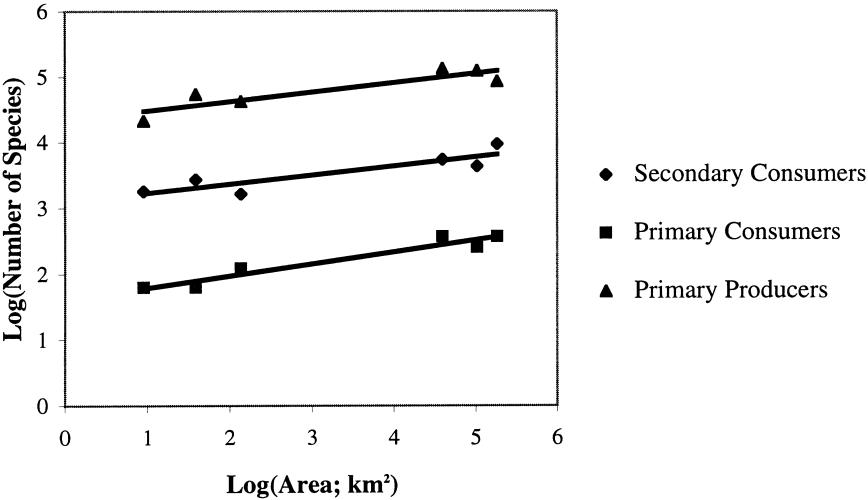
2. However, among webs with strictly vertebrate consumers, the slope does not differ significantly between different trophic levels. For example, the lines in Figure 1 run nearly parallel to each other.Footnote 4
Both of the above patterns involve particular historical kinds: the biological taxa, Arthropoda, and Vertebrata, respectively. Since the Darwinian revolution, systematists have defined taxa in terms of genealogical, hence historical, relationships. Taxa are thus paradigmatic historical kinds.
Plants and Vertebrates on Landbridge Islands in the Sea of Cortez

In a telling move, Holt et al. (Reference Holt, Lawton, Polis and Martinez1999) do not rest content in simply describing the above generalizations. Instead, they seek to explain them. In order to do so, they invoke two law-like generalizations—generalizations that do not refer to particular biological taxa, or to any other historical kinds:
1. Among food webs in which the consumer species require particular food species (in other words, are “trophic specialists”), the slope of the species-area curve varies directly with trophic level.Footnote 5
2. Among webs with generalist consumers that can switch easily from one food source to another, trophic levels do not differ significantly with respect to species-area slope.
Both of these generalizations range over food webs defined in terms of their internal structures. These internal structures are, in turn, defined in terms of relationships between organisms and their (biotic) external environments: Do the consumer organisms require particular species of food, or are they more flexible in their trophic needs?
Given that most arthropods are specialist consumers, and most vertebrates are trophic generalists (Holt et al. Reference Holt, Lawton, Polis and Martinez1999), the two law-like generalizations explain the two historical generalizations—rather than vice versa. I suggest that this case represents how ecologists usually treat the two types of generalization.
3. Niches and Taxonomy
The existence of [taxonomic] groups would have been of simple signification, if one group had been exclusively fitted to inhabit the land, and another the water; one to feed on flesh, another on vegetable matter, and so on; but the case is widely different in nature; for it is notorious how commonly members of even the same sub-group have different habits. (Darwin Reference Darwin1859)
The above example is unusual in an important respect. The taxonomic groups Arthropoda and Vertebrata map roughly into the functional kinds “trophic specialist” and “trophic generalist,” respectively. However, in many cases, higher taxaFootnote 6 fit far less neatly into relevant structural or functional categories. Brown et al. (Reference Brown, Davidson, Munger, Inouye, Diamond and Case1986) report a striking example of this. They discuss competition between species in the functional category “seed-eater.” At their Sonoran Desert sites, this category includes some species in the class Mammalia, some in the phylum Arthropoda, a few in the class Aves, and one lone member of the kingdom Fungi. However, the vast majority of species in all of these taxonomic groups are not seed-eaters.
For generations, many biologists have assumed that the more closely related a group of co-occurring species are, the more intensely they compete with each other. Indeed, there probably is some correlation between relatedness and severity of competition. However, competition often correlates more strongly with functional properties than with relatedness. For example, Brown et al. (Reference Brown, Davidson, Munger, Inouye, Diamond and Case1986) gauge the strength of competition by the degree of “competitive release.” Competitive release is an increase in the population size of one species when some of its competitors have been removed. Brown et al. removed three species of granivorous rodents. In response, four out of the five remaining granivorous rodent populations increased. However, the two insectivorous rodent populations there did not increase. But then again, granivorous ant populations did increase.
The message is clear: taxonomy, and thus relatedness, is a relatively poor predictor of the intensity with which species in the Sonoran desert compete. Feeding behavior does quite a bit better. I suggest that more often than not, important ecological processes—including, but not limited to, competition—correlate better with functional properties than with historical ones.
This pattern, if widespread, might partly explain why some ecologists in the 1970s and 1980s became skeptical about the role played by interspecific competition in ecological communities.Footnote 7 For practical reasons, individual ecologists often limit their investigations to one, or at most a few, taxonomic groups at any given site. If, however, interactions regularly take place between distantly related species, then scientists focused on small, taxonomically defined parts of the biotic community will have missed quite a bit of the action.
4. History vs. Environment
Perhaps the only way for ecologists to discover ecological laws of sufficient generality is by totally ignoring genealogy and concentrating solely on ecological relations. (Hull Reference Hull1987)
The article by Brown et al. (Reference Brown, Davidson, Munger, Inouye, Diamond and Case1986) suggests that in studies of local ecological communities, functional kinds play a more important explanatory role than do historical kinds. The article by Holt et al. (Reference Holt, Lawton, Polis and Martinez1999) hints that this thesis applies to regional scales as well.Footnote 8 In this section, I shall consider the largest scale so far fruitfully investigated in ecology—that of the entire globe.
Believe it or not, the attempt to achieve an accurate description of how the number of species varies across the land surface of the Earth is still an active research frontier.Footnote 9 The best available information concerns the vascular plants (Barthlott et al. Reference Barthlott, Biedinger, Braun, Feig, Kier, Lauer and Mutke1997). What produced, and thus explains, global patterns of plant diversity? More to the point, which explains these patterns better: facts about the current environment, or about the evolutionary past?
To begin answering this question, consider that terrestrial communities can be classified according to any number of schemes. Two of the most basic are “Köppen-Geiger” climate zones and landmasses. Conveniently, these two schemes yield the same number of categories: five each. One can classify communities according to whether they currently experience “dry,” “mild-humid,” “polar,” “snowy-forest,” or “tropical-rainy” climates (Strahler and Strahler Reference Strahler and Strahler1996); or, alternatively, whether they are in Africa, Australia, Eurasia, North America, or South America.Footnote 10
According to the terminology adopted in this paper, the climate categories sort ecological communities into functional kinds, whereas the landmass categories class them into historical kinds. The former classify ecological communities purely on the basis of their environments; the latter, in terms of their spatial locations. Spatial location, in turn, reflects geological and evolutionary history.Footnote 11 Presumably, the communities on a given landmass share more of this history with other communities on the same landmass, than with communities on other landmasses.
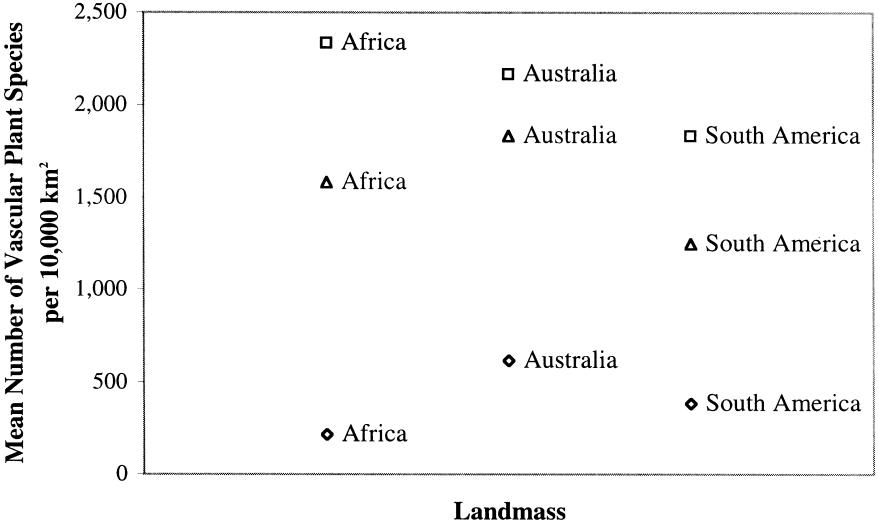
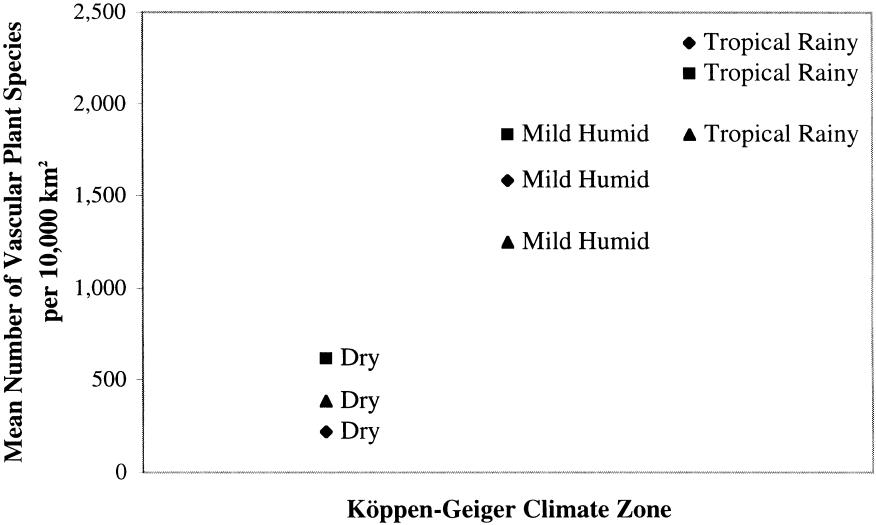
Which kind of kind, then, provides more explanatory and predictive purchase regarding global plant diversity: functional, or historical? Imagine being dropped at a random spot on the land surface of the Earth. Which would allow you to predict the density of plant species around you—that is, the number of species per 10,000 square kilometers—most precisely: knowing the climate, or knowing the landmass on which you stand? Answer: climate wins, hands down. Figure 2b, which plots the same data in two different ways, illustrates this result.Footnote 12 If, for example, you knew that you had been dropped in a dry climate, you could be reasonably confident that there are between 200 and 600 species per 10 square kilometers. However, knowing that you had been dropped in Africa would only allow you to narrow the prediction down to between 200 and 2,300 species. This is a five-fold difference in the margin of error!
Historical Categories

Both the environmental present and the evolutionary past have “signatures,” written into the distributions of plants, animals, etc. across this planet (Ricklefs and Schluter Reference Ricklefs and Schluter1993). However, the most basic and important ecological properties, such as net primary productivity (Rosenzweig Reference Rosenzweig1968) and species diversity, correlate better with environmental variables, and hence functional categories, than with any set of historical variables or categories of which I am aware. This is not to say that history always plays a subordinate role. It may turn out that historical contingencies predominate when it comes to such properties as species composition. Historical effects add complexity—wonderful complexity—to the challenge of understanding ecological systems. But they do not undermine the fact that ecology is—and should be—a primarily nomothetic, or law-oriented, rather than idiographic, or historically oriented, science.
Functional Categories

5. Conclusion
Although a few voices still call for an idiographic approach to biogeography, with each island examined as a unique locus of species assembled for idiosyncratic reasons that can tell us little about other islands, the equilibrium hypothesis has been experimentally confirmed for oceanic islands, proved useful in interpreting many other insular situations, and spawned a mass of research which has given biogeography general laws of both didactic and predictive power. (Simberloff Reference Simberloff1974)
I have thus argued that (1) ecologists typically explain historical generalizations in terms of law-like generalizations, rather than vice versa; and that (2) this practice is justified, since structural and functional kinds, over which the latter range, typically correlate better with basic ecological patterns and processes than do historical kinds. I cited Holt et al.'s (Reference Holt, Lawton, Polis and Martinez1999) treatment of species-area curves at different trophic levels as an example of my first argument. In support of the second, I described Brown et al.'s (Reference Brown, Davidson, Munger, Inouye, Diamond and Case1986) studies of competition within local communities in the Sonoran Desert, and recent data on the global distribution of plant diversity.
These arguments challenge several recurrent claims about the nature of ecological science. For example, Sagoff (for example, in his Reference Sagoff1997 presentation) and Shrader-Frechette (for example, in her Reference Shrader-Frechette2001 article) repeatedly condemn ecology's pretensions to nomotheticity. Ecology is too complex, they say, to be fruitfully characterized in terms of general laws. However, neither of these authors offers any convincing comparison of law vs. historically oriented approaches to ecology.Footnote 13
Sterelny and Griffiths (Reference Sterelny and Griffiths1999) also criticize ecology's nomothetic turn, represented for them by the work of Robert MacArthur. In the ecology chapter of their wide-ranging book, they promote the view that ecological niches should be defined in terms of particular clades.Footnote 14 This, of course, directly conflicts with the moral of the Sonoran Desert example discussed above, as well as the epigraph by Darwin. The global plant diversity example calls into question their extension of historicism to the level of communities.
There is more at stake here than mere truth. While it may seem harmless for philosophers to assail law-oriented ecological theory, others have used similar lines of argument to undermine conservation efforts. Lomborg (Reference Lomborg2001), for example, disparages the use of law-like generalizations, such as species-area relationships, to assess human-caused threats to biodiversity. For this latter task, he insists on the relatively historical approach of species-by-species accounting. Of course, data on individual species are often quite valuable. However, if the arguments presented in this paper are correct, then to rely so heavily on the species-by-species approach is to disregard vital information about impending extinction.