As the debates over the Keystone XL pipeline and regulations on power plants illustrate, political parties in the US (United States) Congress are polarised over energy policy. Republicans want less government regulations over energy policy and continued support for fossil fuels, whereas Democrats want more government regulations for environmental protection and more support for renewable energy. However, party polarisation over energy policy is a relatively recent phenomenon. In fact, energy policy used to be a nonpartisan issue. Regardless of their party affiliation, Democrats and Republicans from producer states supported increased government support for their energy sectors. In other words, energy policy used to be a type of distributive policy, where local interests – rather than national parties’ positions – dictated legislators’ positions on the policy. If energy policy used to be a nonpartisan issue, how do we explain the current level of party polarisation over energy policy? What has made energy policy a partisan issue and contributed to increasing polarisation over energy policy? The existing studies on party polarisation provide explanations on how parties have polarised on general ideology (e.g. McCarty et al. Reference McCarty, Poole and Rosenthal2006) or on some partisan issues, such as environmental policy (e.g. Shipan and Lowry Reference Shipan and Lowry2001). However, the literature has limited explanatory power in explaining how a nonpartisan issue, such as an energy policy, became a partisan issue and at the same time how parties have polarised over the issue. Our approach is guided by the Punctuated Equilibrium Theory (PET). The proponents of the PET have emphasised the need for and benefit of “systematic investigations of the dynamics behind change and stability within particular policy domains” (Baumgartner et al. Reference Baumgartner, Jones, Mortensen, Sabatier and Weible2014: 82). Accounting for policy-specific factors in explaining party politics on a specific policy issue is essential, as each policy area is likely to have its own set of events and problems that affect party dynamics. Indeed, our analysis of energy policy polarisation in Congress demonstrates that energy policy-specific events, in addition to partisan realignment in the South, have contributed to party polarisation over energy policy. By examining how party politics over energy policy has changed in the US Congress, we therefore provide significant findings regarding this important policy area as well as broader lessons for party behaviour in general.
For our empirical analysis, we begin by creating a new measure of the energy policy positions of members of Congress. By applying dynamic ideal point estimation technique to all energy votes in Congress since 1971, we provide a measure that overcomes the shortcomings of existing measures. Using this new measure, we examine the historical trend and causes of party polarisation over energy policy. We find that the parties began to differentiate on energy policy from the early 1970s in both chambers. However, the parties in the House began to polarise from the early 1970s, while the parties in the Senate began to polarise from the late 1980s. Despite this difference between the House and the Senate, our multilevel analysis suggests that major events in energy policy, the convergence of energy policy with environmental policy, and partisan realignment in the South have all contributed to increasing polarisation over energy policy in both chambers. First, we find evidence that some energy policy-specific factors – changing oil prices, the increasing salience of climate change debate since 1988, and the increasing salience of energy policy in Congress – have significantly contributed to increasing party polarisation over energy policy in both chambers. Also, the increasing convergence between energy policy and environmental policy is found to have contributed to increasing polarisation over energy policy. In the House, the convergence started in the early 1970s and has contributed to party polarisation more than any other factor. On the contrary, the convergence in the Senate started from the early 1980s and contributed to polarisation with varying degree of importance. Finally, we find that Southern members tend to have a more conservative position on energy policy. Thus, the decreasing number of Southern Democrats and the increasing number of Southern Republicans have contributed to increasing polarisation over energy policy, similar to party polarisation in general. These results demonstrate that the dynamics of party polarisation on energy policy are consistent with but also different in important ways from those of party polarisation on general ideology, confirming the key argument of the PET that we need to consider the dynamics within a particular domain.
In the next section, we describe the history of partisanship in energy policymaking. We then examine the historical development of party polarisation on energy policy in a systematic way using a new measure of members’ energy policy positions. After documenting the trajectory of party polarisation, we examine the causes of party polarisation over energy policies by testing various theories of policy change and party behaviour in Congress.
A history of partisanship in US energy policies
For most of the history of the US, energy policies were rarely partisan but rather provided opportunities for both parties to provide benefits to their constituents. This resulted largely from a seeming abundance of continuing inexpensive energy. Policymakers provided benefits to their constituents in the form of research grants, subsidies for development, explicit support for construction of things such as hydroelectric power dams, and an absence of regulations and oversight. As one summary states, “policies promoting the aggressive exploitation of fossil fuels were not controversial, but widely supported as engines for economic growth” (Weber et al. Reference Weber, Bernell, Boudet, Vig and Kraft2016: 176; see also Duffy Reference Duffy1997; Freese Reference Freese2003; Graetz Reference Graetz2011: 15; Rosenbaum Reference Rosenbaum2015: 35).
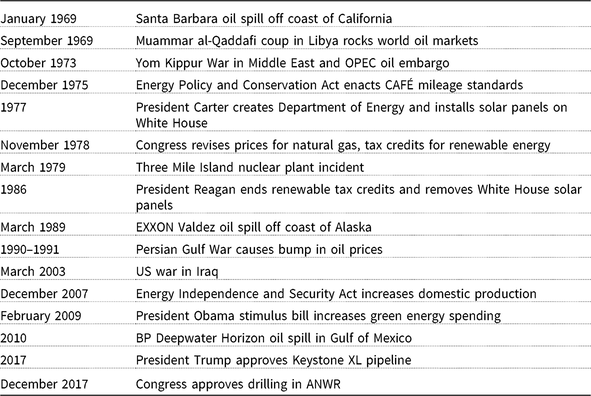
However, energy politics began to change in the early 1970s. We provide Table 1 as a succinct reference to the events described below. After the 1960s had seen some growing concerns over environmental threats from oil spills and air pollution alerts as well as changing politics in the Middle East, the events that really shattered the bipartisan calm on energy issues were the oil crises of the early 1970s. Responding to the war between Israel and its Arab neighbours in 1973, the Organization of Petroleum Exporting Countries cut oil production to punish Israel’s allies, including the US. This event and subsequent actions in the 1970s caused huge increases in oil prices, shook complacency about energy polices and motivated questions about conservation, production and the development of alternative sources of energy besides oil (Graetz Reference Graetz2011: 21; Yergin Reference Yergin2011: 267; Levi Reference Levi2013: 7–8; Rosenbaum Reference Rosenbaum2015: 37). Americans ranked energy policy as the number one problem facing the country in 1974 and placed these issues in the top ten later in the decade as well.
Timeline of events affecting US energy policies

One early legislative manifestation of this concern was the creation of Corporate Average Fuel Economy (CAFÉ) standards for automobile mileage efficiency. The congressional fight over this legislation showed the early formation of battle lines that would harden over time. Democrats favoured using the government to emphasise conservation and renewable sources, whereas Republicans denied that green energy was essential and that government should be the catalyst (Lovins Reference Lovins1976; Graetz Reference Graetz2011: 53; Levi Reference Levi2013: 12–18; Weber et al. Reference Weber, Bernell, Boudet, Vig and Kraft2016: 176).
In the 1980s and 1990s, the two parties continued to disagree over energy policies, but compared to the 1970s and the 2000s, energy debates in these two decades were often somewhat muted. Presidents focused on other issues (Levi Reference Levi2013: 13; Rosenbaum Reference Rosenbaum2015: 39). Environmental groups rarely targeted energy issues and offered mixed views on alternative sources such as solar and wind because of concerns about potential impacts on public lands (Graetz Reference Graetz2011: 123). Energy issues rarely gained salience among the national public, whether measured by lists of top concerns among Americans or by the number of New York Times articles devoted to the topic (Lowry and Joslyn Reference Lowry and Joslyn2014: 159). This is not to suggest that energy controversies were nonexistent but rather that they were somewhat sporadic, driven by crises such as the Three Mile Island meltdown in 1979 and the EXXON Valdez oil spill of 1989. These specific controversies prompted votes in Congress that revealed partisan differences but not the chasm that came later.
Underneath the apparent calm regarding energy, however, things were happening in these decades and into the 2000s that would grow into major fissures between the two parties. In 1988, James Hansen’s testimony initiated the debate in Congress about global warming, an issue that would ultimately split the two parties as well as their constituents (McCright and Dunlap Reference McCright and Dunlap2011). Environmental concerns about climate change and reliance on fossil fuels led to Democratic efforts to increase energy efficiency by increasing CAFÉ standards in 1990 and 1999, losing both times on largely partisan votes. President Clinton initiated discussion of a BTU tax in 1993, losing a vote in Congress along strict party lines. Unimpressed by scientific arguments about climate change but faced with rising oil prices, Republicans instead encouraged energy independence through development of domestic supplies from places such as the Arctic National Wildlife Refuge (ANWR), prompting very partisan votes in 1991, 1995, 2004 and 2017. Efforts at more comprehensive energy acts under President Bush in 2005 and 2007 continued reliance on fossil fuels, motivating again substantial, although not unanimous, partisan disagreement.
By the second decade of the 21st century, partisan differences on energy issues were pervasive and intense. President Obama aggressively encouraged renewable sources of energy, with virtually no support from the Republican side of the aisle as shown in the stimulus vote of 2009. Battles over oil subsidies (2010), offshore oil leasing (2011) and the Keystone XL pipeline (2012) were similarly fought along strict party lines. Since taking office in 2017, President Trump has pursued energy policies such as approving Keystone XL and oil development in the ANWR with only Republican support. The huge growth in domestic energy supply from hydraulic fracturing and horizontal drilling of natural gas and oil deposits has kept many energy prices low but has not eliminated battles that often take partisan lines.
This historical summary and the cited accounts of US energy policy are thorough and informative. But they do not attempt systematic analysis. We do so in the following sections.
Patterns of party polarisation on energy policy in Congress
To analyse party polarisation over energy policy in a systematic way, we first measure the energy policy position of members of Congress. Using the measure, we then examine the degree of party polarisation on energy policy in Congress.
A new measure of energy policy position
When measuring a member’s position on environmental or energy policy, scholars often use the League of Conservation Voter (LCV) scores (e.g. Shipan and Lowry Reference Shipan and Lowry2001). The LCV score, ranging between 0 and 100 for each member of Congress for each year with higher scores reflecting more pro-environment positions, has been the best available measure and is more focused than the Americans for Democratic Action (ADA) scores used in previous analyses of legislative positions of members of Congress. However, the LCV score is problematic because it tends to utilise only a small number of selective energy and environment policy votes. Since consensus votes and less controversial votes are excluded, the ideological differences among members will be estimated to be much larger than they are, making liberals more liberal and conservatives more conservative than they really are (Snyder Reference Snyder1992; Poole and Rosenthal Reference Poole and Rosenthal1997). Another problem of this approach is that the measure is unable to distinguish among nonmoderate legislators, producing less informative measures of ideology. Since only a small number of controversial votes are used to measure members’ ideology, there will be few votes that distinguish among nonmoderate legislators. As a result, many nonmoderate legislators will be estimated to have the same or similar positions, even when there are ideological differences among them. Finally, the LCV score is not a focused measure of a member’s energy policy position because it is based on environmental policy votes as well as energy votes. For example, in the 2016 LCV scorecard, roughly one-third of the Senate votes and one-fourth of the House votes focus on energy. The remaining votes focus on issues, such as the protection of endangered species, that are often only tangentially related to energy policies.
To address these problems, we measure energy policy positions of members of Congress by using all energy policy votes.Footnote 1 By utilising all energy policy votes, this approach produces a finer and more informative measure than the measures based on a small number of selective energy policy votes. By utilising only energy policy votes, this measure avoids conflating a member’s energy policy position with his or her environmental policy position. To measure the energy policy position of a member that is comparable across time, we use a dynamic item response theory (IRT) model or ideal point estimation technique developed by Martin and Quinn (Reference Martin and Quinn2002). By combining information from previous Congresses in estimating policy positions in the current Congress, this approach allows us to directly compare measures from one Congress to another. We fit a one-dimensional dynamic ideal point estimation model to all energy policy votes from 1971 to 2016 for the House and Senate.Footnote 2 Most estimated energy policy positions are in the range between −5 and + 5, with smaller scores indicating more liberal positions on energy policy (i.e. support for more energy conservation and renewable energy).
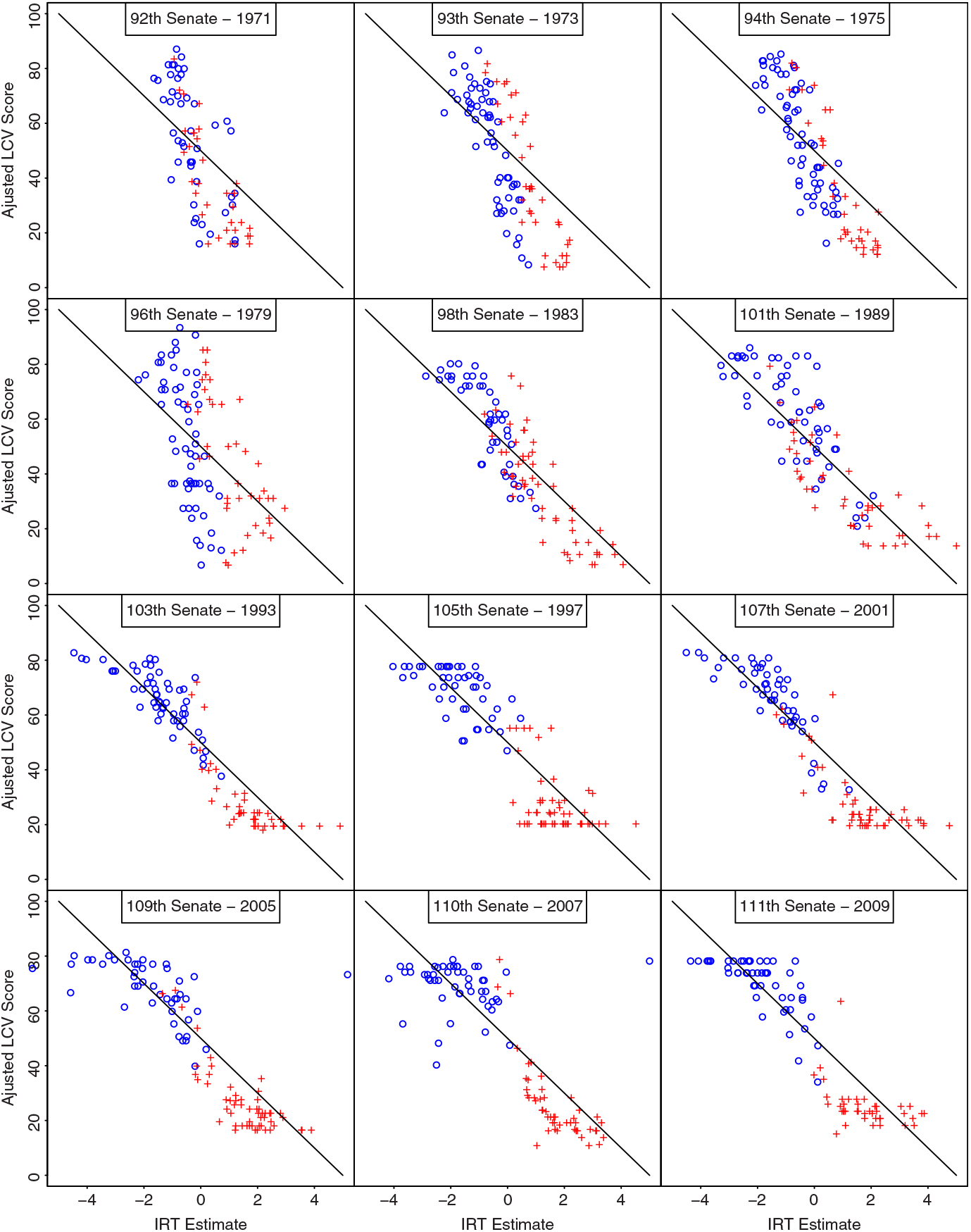
Before we use this measure, we compare the performance of this measure with that of the LCV scores. In Figure 1, we plot the LCV score of senators in select Congresses against their IRT measure. Note that a high score in the IRT measure indicates an opposition to more regulation on energy policy, whereas a high score in the LCV score indicates support for more regulation. Also, the IRT measure ranges typically from −5 to 5, whereas the LCV score ranges from 0 to 100. The figure shows that there are notable differences between the IRT measure and the LCV score. First, the LCV score has a tendency to overemphasise the degree of polarisation, compared to the IRT measure. This is indicated by the fact that the LCV score tends to be higher than the 135-degree line when the IRT measure is negative, and lower than the 135-degree line when the IRT measure is positive. For instance, in the 92nd Congress, senators are estimated to be more polarised in the LCV score than in the IRT score. On the vertical axis, there are several senators with their LCV scores greater than 80. However, their IRT score on the horizontal axis indicates that they are not that far from the centre of the Senate. Although this trend of overemphasising the degree of polarisation in the LCV score becomes weaker in more recent Congresses, we are likely to make an incorrect conclusion about the degree and pattern of polarisation if we rely solely on the LCV score. There is another difference between the IRT measure and the LCV score. The IRT measure is better at distinguishing ideological differences among extreme legislators than is the LCV score. For instance, in the bottom right panel of Figure 1 (the 111th Senate), there are a group of legislators with an 80% LCV score, while their positions are well sorted out on the horizontal axis. This is explained by the fact that the use of selective votes in producing the LCV score makes it a less informative measure of the position, especially among extreme legislators. By using less controversial or lopsided votes as well as controversial votes, our approach is able to capture subtle differences even among nonmoderate legislators.
Comparison of LCV scores and dynamic ideal point estimates of senators in select Congresses.

Historical development of party polarisation on energy policies
Using this measure of members’ positions on energy policy, we examine the historical pattern of party polarisation on energy policy in Congress. First, to determine how much energy policy polarisation has been distinctive from the broad pattern of party polarisation, we compare the pattern of party polarisation on energy policy with that of general ideology. We use the DW-NOMINATE first-dimension score to measure the degree of party polarisation on general ideology because DW-NOMINATE scores are computed using all votes in Congress (Poole and Rosenthal Reference Poole and Rosenthal1997). However, since DW-NOMINATE measures are on a different scale, a direct comparison of DW-NOMINATE scores and our IRT measures is not possible. Thus, to improve the comparability of the measures, we standardised both measures before we compute party positions and polarisation scores.
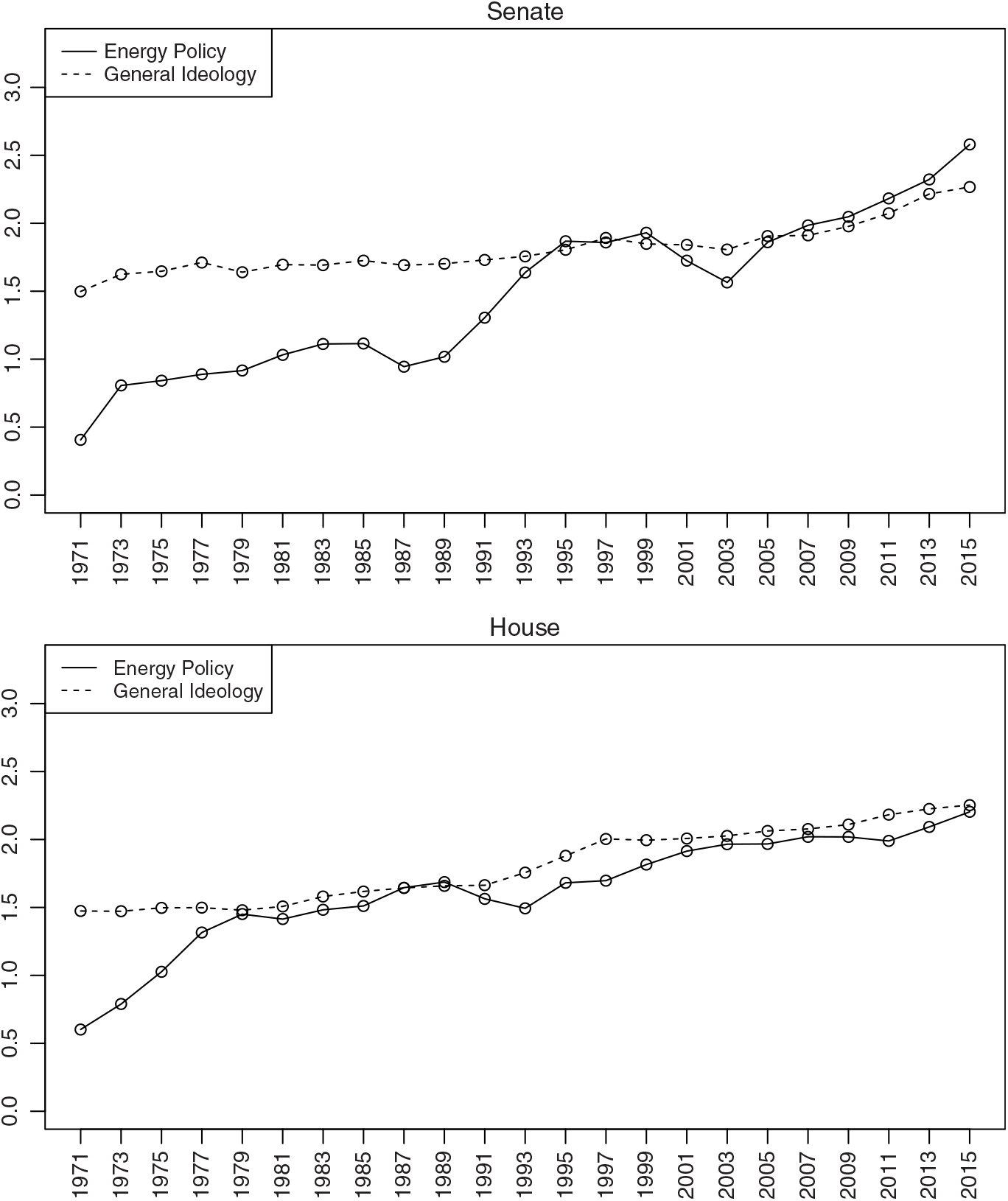
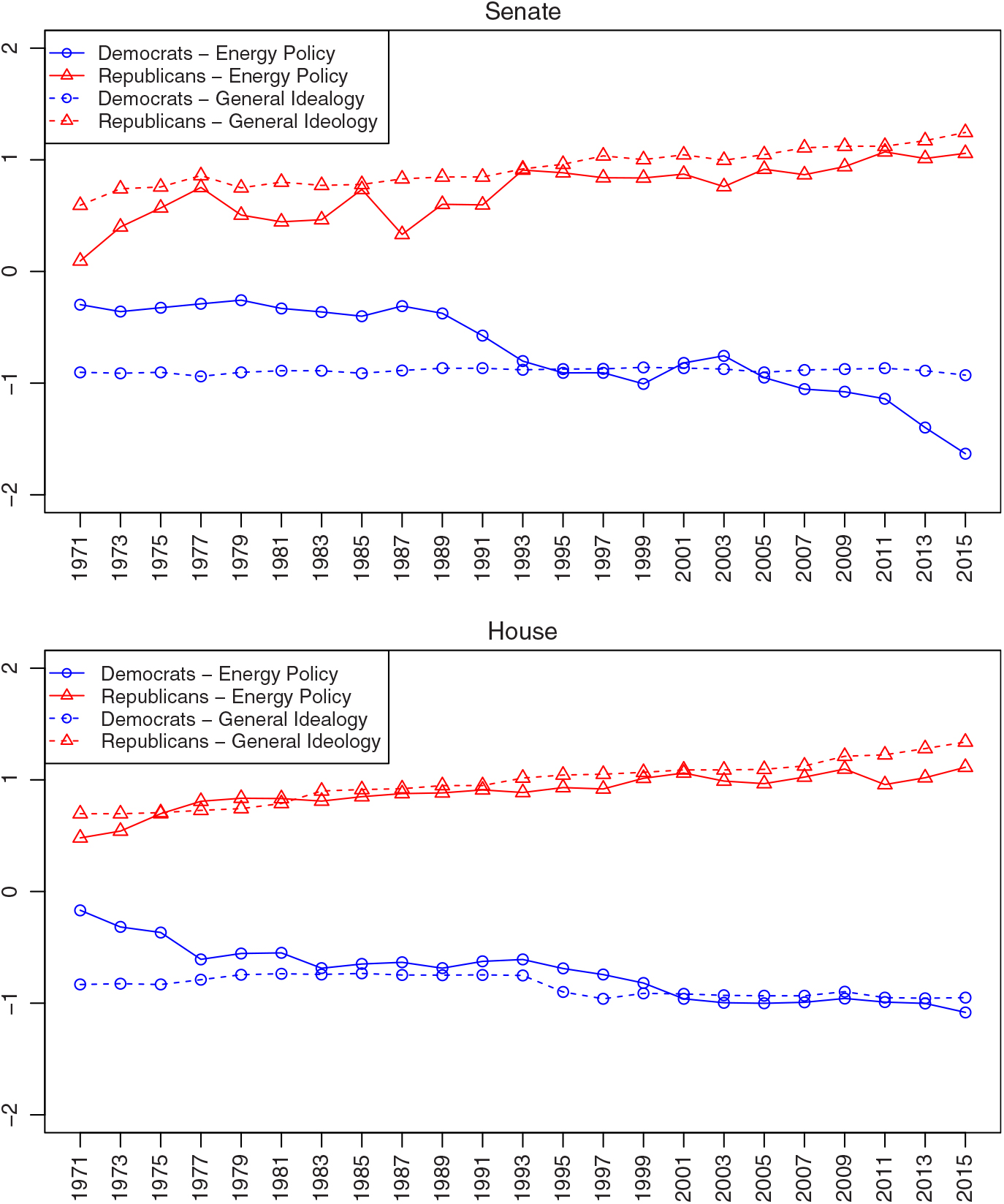
We examine the degree of party polarisation on energy policy and general ideology by the difference between the respective means of the ideal points of Democratic and Republican members, following McCarty et al. (Reference McCarty, Poole and Rosenthal2006). Figure 2 demonstrates that the pattern of party polarisation on energy policy has been distinctive from that of general ideology. In particular, the figure shows that energy policy used to be a nonpartisan issue in the early 1970s. In comparison to the degree of party polarisation on general ideology, the political parties in both chambers were much less polarised on energy policy in the 1970s. While the party polarisation over energy policy increased consistently in the 1970s in the House, the Senate has a different pattern with a steep increase happening in the 1990s and mid-2000s. While a systematic analysis of the inter-chamber difference is beyond the scope of this article, one possible explanation for the inter-chamber difference is the influence of Robert C. Byrd (D-WV) and Senators who represented fossil fuel producer states. In particular, as the majority (1977–1980; 1987–1988) and minority (1981–1987) leaders of the Senate and also with his knowledge of parliamentary procedure, Senator Byrd had a significant influence on the Senate. Since he represented one of the most significant coal-producing states, he was keen on blocking legislation that would have imposed tougher regulations on energy production. Indeed, historical accounts of American energy policy refer to Byrd as “eastern coal interests’ greatest ally” (Graetz 2011: 51). The fact that the Senate was able to pass the Clean Air Act of 1990 only after he was no longer the leader of the Democrats in the Senate illustrates his influence on the energy policy (CQ Almanac 1990). We think this is plausible to a certain degree and thus test the influence of members who represent fossil fuel producer states in the next section. However, we do not think a single senator can explain all the partisan dynamics on energy policy. Unlike the House, party leaders in the Senate have few procedural tools to control the agenda of the Senate.Footnote 3 Also, the fact that the degree of partisan polarisation over energy policy has been gradually increasing since the early 1970s indicates that there were other factors that made energy politics more partisan. In addition, when we plot the median position of each party in Figure 3, we see that Republican Senators were also less partisan on energy policy than on general ideology until the early 1990s. Combined with the fact that this pattern of party polarisation in the Senate is generally consistent with the history of energy policymaking in Congress described in the previous section, suggests that there were more systematic reasons for a different pattern in energy policy polarisation.
Polarisation indices.

Median positions of political parties.

We suspect that the strong party leaders and their control over the agenda in the House can explain the inter-chamber difference. This is because the timing of the convergence between energy policy and general ideology in the House is consistent with the increased powers of the party leaders due to the House reforms in the 1970s. In the House, energy policy positions have converged to the general ideology of the parties by the late 1970s. Since then, each party’s position on energy policy has been consistent with its general policy position. The reforms in the House in the 1970s gave the party leaders the powers to control the floor of the House, which increased the partisanship across the board in this chamber (Rohde Reference Rohde1991).
Notably, this inter-chamber difference in the polarisation pattern of energy policy adds to the need to study energy politics separately, as the polarisation literature finds that the pattern of party polarisation has been similar between the House and the Senate (e.g. Theriault Reference Theriault2010; Theriault and Rohde Reference Theriault and Rohde2011; also see Figure 2). Unlike party polarisation in general ideology, energy policy polarisation is characterised by the inter-chamber differences. Therefore, we consider policy-specific factors as well as general political contexts to fully account for the party politics in this particular issue area in the next section.
Causes of partisan polarisation on energy policies
In this section, we provide systematic assessment of how political parties have polarised on energy policy in Congress or, stated another way, why party polarisation on energy policy has the pattern that we identified in the previous section. Given the similarities and differences in the patterns of polarisation in energy policy and general ideology, we consider factors specific to energy policy as well as factors related to polarisation in general. Thus, building on one of the major arguments of the PET, we first examine factors specific to energy policy to explain the pattern of party polarisation on this issue. We then consider the existing accounts of party polarisation in general. This will also help us identify the factors that can explain why energy policy polarisation lagged behind polarisation in general.
Major events in energy policy
The PET suggests that we need to look for policy-specific factors to explain shifts in party behaviour in specific policy areas. Specifically, the PET argues that “American political institutions were conservatively designed to resist many efforts at change” but also that occasionally, often precipitated by crises or major shifts in issue definition, “some issues catch fire, dominate the agenda, and result in changes” (Baumgartner et al. Reference Baumgartner, Jones, Mortensen, Sabatier and Weible2014: 62; see also Baumgartner and Jones Reference Baumgartner and Jones1993). Other scholars have also ascribed an important role to sudden disturbances. For instance, Birkland’s study of natural disasters describes the importance to policy change of such events that are “sudden, relatively rare, can be reasonably defined as harmful or revealing the possibility of potentially greater future harms” and “is known to policy makers and the public virtually simultaneously” (Birkland Reference Birkland1997: 22).
We build on these notions of the importance of shocks to policy systems by testing the influence of energy policy-specific events on the degree of energy policy polarisation. Specifically, we argue that events described earlier such as the oil crises of the early 1970s and the emergence of the climate change debate sowed the seeds for the partisan alignment on energy policies that has existed ever since. The oil crises of the 1970s were seminal events in American energy politics. The real price of a barrel of imported crude oil jumped from an average of $19.6 in 1971 and 1972 to an average of $43.6 in 1973 and 1974 and continued to grow by 1981.Footnote 4 Many scholars assert that the oil crisis events had immense, long-term consequences for American politics in general but especially for energy issues (Graetz Reference Graetz2011; Fiege Reference Fiege2012; Lowry and Joslyn Reference Lowry and Joslyn2014). Thus, we use the real price of a barrel of imported crude oil (logged) to tap the influence of rising oil prices.
We also examine how the climate change debate in the US has affected the polarisation over energy policy. Although scientists had warned of global warming before then, many analysts describe Hansen’s testimony in June 1988 as the catalyst for debate among American policymakers (Yergin Reference Yergin2011: 454; Titlow and Tinger Reference Titlow and Tinger2016: 250). The United Nations also created the Intergovernmental Panel on Climate Change in 1988. Further, Hansen’s testimony prompted efforts to contradict his arguments from the Global Climate Coalition formed by fossil fuel companies the following year. While the debate raised awareness in the US, creating the potential for changes in energy policies, it had yet to produce a consensus among the public or members of Congress on causes, consequences or responses. Given this variation, we measure the influence of the climate change debate by the percentage of respondents who expressed that they are personally worried about global warming or the greenhouse effect in the Gallup surveys since 1989.Footnote 5 We lag it by one year to account for the possible delay in response to the climate change debate and also to reduce the possibility of reverse causality.
In addition to these two major shocks to the policy system, we need to take into account the increased salience of energy policy due to other events, such as the Three Mile Island nuclear accident and oil spills (e.g. the EXXON Valdez oil spill). Although one can try an indicator variable for each of these events, the small number of Congress-level observations and the difficulty in measuring their lasting influence make such an approach less effective.Footnote 6 Therefore, to measure the salience of energy policy in Congress effectively, we use the number of Government Accountability Office (GAO, formerly General Accounting Office) reports on energy. The GAO is an independent, nonpartisan office that is designed to provide objective, reliable information to Congress. The GAO produces reports in response to requests from congressional committees or subcommittees or that are statutorily required by certain laws. Upon receiving a request, the GAO studies the issue and responds with a report typically 10–18 months later. Conveniently, the GAO categorises their reports for each year by issue area, including one specifically for energy. We thus count the number of GAO reports on energy, lag it by one year to allow for publication time, and consider it as a percentage of all reports as the GAO is more prolific in some years than others. This is a nice measure for salience for several reasons. First, the assumption that congressional interest reflects public interest in an issue is realistic. Second, unlike many public opinion polls used to reflect salience, the numbers are consistent over time. Third, the GAO has consistently maintained high standards for reliability (Kingsbury Reference Kingsbury2010). Fourth, as mentioned, the reports are focused on specific policy areas. Surprisingly, this measure has rarely been used in other analyses that try to capture issue salience over time although some studies have found it useful (Kingsbury Reference Kingsbury2010; Lowry Reference Lowry2008). We expect that this measure of energy policy salience will be positively associated with the degree of energy policy polarisation.Footnote 7 Thus, we summarise the hypotheses as follows:
Hypothesis 1a: Increases in oil prices have a positive association with energy policy polarisation.
Hypothesis 1b: The salience of the climate change debate has a positive association with energy policy polarisation.
Hypothesis 1c: The salience of energy policy in Congress – as measured by the percentage of the GAO reports on energy – has a positive association with energy policy polarisation.
Changing nature of energy policies
In addition to these events, we examine a hypothesis based on the unique nature of energy policymaking in the US. A study by Lowry (Reference Lowry2008) explains the increased partisanship on energy policymaking in Congress by the change in the nature of energy policy from distributive to regulatory. According to Lowry, as energy policy has become more regulatory in its nature, the issue has turned into a more conflictual one, similar to environmental policy. We expect the politics surrounding energy policy to become more intertwined with the politics surrounding environmental policy over this time period for several reasons. First, Americans have become increasingly aware of the environmental consequences of energy use and consumption. Examples abound – but here is just one illustration: a substantial portion (as much as half by some estimates) of unexploited fossil fuels in the US is in federal lands and waters, areas that are precious to environmental advocates (Adler Reference Adler2015: 2). Second, and related, decisions on energy policies are required by law to take into account environmental consequences since the passage of the National Environmental Policy Act (NEPA) of 1970. The NEPA requires assessment of the environmental impacts of all federal decisions (and others using federal money), including energy policies such as the siting of power plants. Third, starting in the 1970s, energy policies often created winners and losers, as do regulatory policies. As just one example, the increased CAFÉ standards first established in 1975 rewarded makers of high-mileage cars while creating significant challenges for makers of low-mileage vehicles. Fourth, environmental interest groups, although not always in agreement on specific energy policies such as proposals for carbon taxes, have coalesced around certain energy policies since the 1970s such as preventing oil exploration in the ANWR and reducing the use of fossil fuels that contribute to climate change. As the politics of energy and the environment converge, so too will the policies become more similar in tone.
If the convergence of energy policy and environmental policy has contributed to party polarisation over energy policy, we expect to see the convergence of the energy policy position and the environmental policy position of a member. That is, if the nature of energy policy has changed into something similar to environmental policy, a member’s position on environmental policy will predict the member’s position on energy policy better over time.
Thus, we capture the effect of the convergence by examining the association between individual members’ environmental policy extremity and their energy policy extremity. For this, we need a measure of a member’s environmental policy position. We apply the dynamic ideal point estimation technique to all environmental policy votes in Congress to measure a member’s environmental policy position.Footnote 8 Once we have a measure of a member’s environmental policy position, we measure the member’s environmental policy extremity in each Congress using her appropriately signed distance from the floor mean. This environmental extremism score is signed positively if the member’s deviation is in the same direction as that of her party mean, and signed negatively if in the opposite direction. This way, a moderate member will be coded as contributing to the moderation of party differences, whereas an extreme member will be coded as contributing to the polarisation of party differences.
Hypothesis 2: A member’s environmental policy extremism will be positively associated with her energy policy extremism. Also, this association will grow over time.
Partisan electoral rivalry
In addition to factors specific to energy policy, we also consider factors related to party polarisation in general. First, we hypothesise that polarisation on energy policies has been driven partly by the competitiveness of partisan electoral rivalry. While political parties are driven by policy goals, they are also driven by electoral goals. Since policy success of the opposition party is likely to have a negative impact on a party’s electoral goals, political parties’ choice of a policy position is likely to be partially affected by the prospect of elections (Lee Reference Lee2016). We expect that this effect should be stronger when party control of the respective chamber is closely contested (Dion Reference Dion1997; see also Patty Reference Patty2008). Expecting a close election, the minority party’s incentives to oppose the policy success of the majority party will increase. In their study of the role of partisanship in party polarisation, Lowry and Shipan (Reference Lowry and Shipan2002) found that when the majority party has a slim seat margin, the parties are more polarised on domestic policy. We would expect the same pattern to emerge on energy policy.
Therefore, to test the effects of partisan electoral incentives, we use the majority party’s seat margin (%) and the status of divided government.Footnote 9 As we discussed, Lowry and Shipan (Reference Lowry and Shipan2002) found that a minority party is more prone to differentiate itself from the majority party when the difference between their numbers of seats is small. We also expect energy policy polarisation to depend on whether party control of government is unified or divided. Under divided government the congressional majority may have a stronger electoral incentive to oppose the president, which would tend to increase polarisation. Thus, we include a measure of divided government – an indicator variable that takes a value of 1 when the majority party of the chamber is different from the president’s party.
Hypothesis 3a: The majority party’s seat margin has a negative association with energy policy polarisation.
Hypothesis 3b: The divided government has a positive association with energy policy polarisation.
Party regional realignment
The literature on party polarisation suggests that the regional realignment of the party base has caused party polarisation in Congress. In fact, regional realignment is one of the most widely recognised sources of party polarisation (Aldrich Reference Aldrich1995; Jacobson Reference Jacobson, Bond and Fleisher2000). By making the affected states’ partisan and ideological tendencies mutually reinforcing, realignment has increased the number of states that reliably elect conservative Republicans in the South or liberal Democrats in the Northeast.
Therefore, to examine the influence of partisan realignment, we focus on the role of Southern members. If the Southern realignment has contributed to the polarisation of energy policy as well, Southern members must have had conservative positions on energy policy as well. In other words, Southern Democrats must have contributed to the moderation of energy policy by making Democrats less extreme, whereas Southern Republicans must have contributed to the polarisation of energy policy by pulling Republicans towards a more conservative energy policy position. Then, the increasing number of Southern Republicans and the decreasing number of Southern Democrats will contribute to energy policy polarisation.
Hypothesis 4: Southern Democrats have a negative association with energy policy polarisation, whereas Southern Republicans have a positive association.
Empirical tests of the theories of partisan polarisation on energy policies
This section tests the empirical validity of the accounts of energy policy polarisation presented in the previous section. For this, we employ a multilevel analysis because our independent variables are at two different levels: Congress level and member level. Energy policy events and electoral conditions are Congress-level variables, as they are expected to affect all members over a period of one or more Congresses. Representing a Southern state or district and the convergence of a member’s environmental policy position with energy policy position are a member-level variable.
The dependent variable in our analyses is the degree of energy policy polarisation at the individual level in each Congress. This is measured by a member’s appropriately signed distance from the floor mean, as we do for environmental policy extremity. That is, energy policy extremism score is signed positively if the member’s deviation is in the same direction as that of her party mean, and signed negatively if in the opposite direction.
In addition to being multilevel data, our data present another challenge because the data has a panel structure. Since members tend to serve multiple Congresses, ignoring this panel structure can artificially increase the significance of the variables by inflating the number of observations at the member level. One solution to this problem is to include member fixed effects. In addition to being methodologically solid, this approach has the advantage of overcoming the problem of the unavailability of some district-level data. For instance, to control for the influence of members who represent fossil fuel producer states or districts (e.g. Robert Byrd of West Virginia, or Russell Long of Louisiana), we need to collect the data on each district’s level of fossil fuel production. However, no such data exist at the district level. One can solve this problem of the data unavailability (and thus minimise the omitted variable bias) by using member fixed effects, as the level of fossil fuel production tends to be stable over time.
However, the downside of including member fixed effects is that we cannot test the influence of time-invariant variables, such as representing a Southern state or district. Given this dilemma, we have decided to adopt both modelling strategies. First, we present the results with member fixed effects for both chambers. Then, we present the results without member fixed effects for the Senate. In the model without member fixed effects, we include the membership in energy-related standing committees and district characteristics as well as the South indicator variable. To account for the fact that these variables are likely to have a different effect across political parties, we have these variables interact with a political party variable.
Member-fixed-effects models
Combining the member fixed effects and environmental policy extremism at the member-level and Congress-level factors, we thus account for energy policy polarisation as follows:
 $$Energy - Policy - Extremit{y_{ij}}{\rm{}}^{\sim}{\rm{ }}N({\mu _{ij}},{\sigma ^2}),\;{\rm{for}}\,\,I{\rm{}} = \;1,{\rm{ }} \ldots ,N$$
(1)
 $${\mu _{ij}}{\rm{}} = {\rm{ }} + {\rm{}}{\alpha _{l[i]}}{\rm{}} + {\rm{}}{\beta _{j[i]}}Environmental - Policy - Extremit{y_i}$$
(2)
 $${\rm{}}^{\sim}{\rm{ }}N(\mu _j^{Congress},\sigma _{Congress}^2),\;{\rm{for}}\,\,j\; = \;1,\; \ldots ,M$$
(3)
 $$\mu _j^{Congress}{\rm{}} = {\rm{ }}{\gamma _0}{\rm{}} + {\rm{}}{\gamma _1}Divided \,\,Governmen{t_j}{\rm{}} + {\rm{}}{\gamma _2}Majority - Seat - Margi{n_j}{\rm{}} + {\rm{}}{\gamma _3}Oil\,\, Pric{e_j}{\rm{}} + {\rm{}}{\gamma _4}Climate\,\, Chang{e_j}{\rm{}} + {\rm{}}{\gamma _5}GAO \,\,Report{s_j}$$
(4)
where N is the total number of members; M is the total number of Congresses from the 91st through 114th; α l[i] represents member fixed effects; Environmental-Policy-Extremityi is the measure of environmental policy extremity, as we discussed above. Note that the coefficient for this variable is modelled as a varying slope because the effects of environmental policy extremism on energy policy polarisation are expected to change over time.
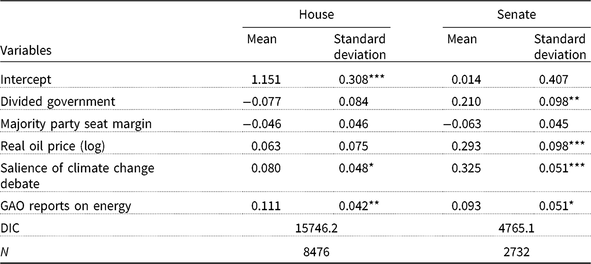
The estimate of this varying slope and varying intercept model is presented in Table 2 and Figure 4. First, Table 2 shows that energy policy event variables are, in general, significantly associated with the increased polarisation over energy policy, providing support for Hypotheses 1a, 1b and 1c. First, the rising oil price is found to be significantly related to polarisation over energy policy in the Senate. Oil price is not found to be significantly related to polarisation in the House. To gauge the substantive effect of the Oil Shocks in the 1970s, we used the estimated model to predict the average level of energy policy extremism in the 92nd Congress (before the Oil Shocks) and the 94th Congress (after the Oil Shocks). We held the value of all other variables at their level in the 92nd Congress, while allowing the price of oil to change from its level in the 92nd Congress (i.e. $19.6) to its level in the 94th Congress (i.e. $43.6). This resulted in a 63% increase in the average energy policy extremism in the Senate and a 5% increase in the House.
Congress-level variables and energy policy polarisation (member-fixed-effects models)
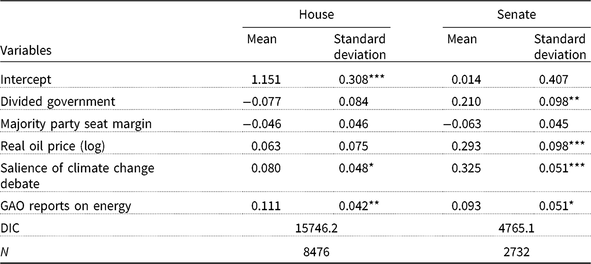
Note: Member-level coefficient estimates are reported in Figure 4. ***, ** and * indicate that 99%, 95% and 90% credible intervals do not include 0, respectively. DIC, Deviation Information Criterion.
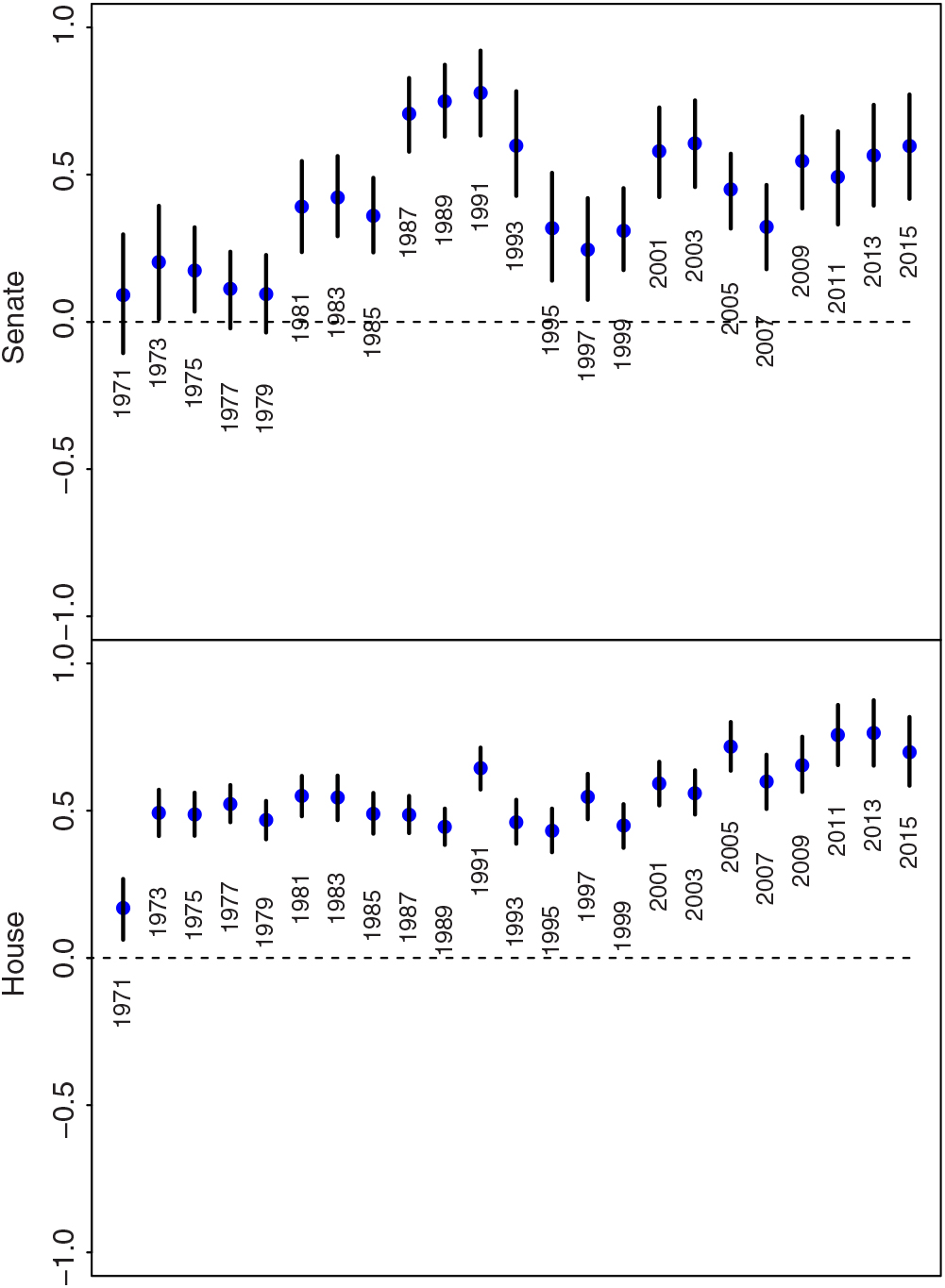
Varying relationships between environmental policy extremism and energy policy extremism.

Second, the salience of climate change debate is found to be significantly associated with energy policy polarisation in both chambers, albeit at the 90% level in the House. Although the observational date does not allow us to make a strong claim about the causality, the positive coefficient indicates that political parties tend to be more polarised over energy policy when the issue of climate change was salient. To gauge the substantive effect of the climate change debate, we used the estimated model to predict the average level of energy policy extremism in the 100th Congress (before the Hansen’s testimony) and the 101st Congress (after the testimony). We held the value of all other variables at their level in the 100th Congress while allowing the salience of climate change debate to change from its level in the 100th Congress (i.e. 0%) to its level in the 101st Congress (i.e. 32.5%). This resulted in an 80% increase in the average energy policy extremism in the Senate and 10% in the House.
Third, the salience of energy policy in Congress – measured by the percentage of GAO reports on energy – is positively and significantly related to polarisation over energy policy in both chambers, albeit at the 90% level in the Senate. The positive coefficient indicates that political parties tend to be more polarised over energy policy when Congress perceived the issue of energy policy as salient and thus requested more reports on energy policy from the GAO. To gauge the substantive effect of the salience of energy policy in Congress, we used the estimated model to predict the average level of energy policy extremism in the 93rd Congress (the lowest salience of energy policy) and the 97th Congress (the highest salience of energy policy). We held the value of all other variables at their level in the 93rd Congress while allowing the percentage of GAO reports on energy to change from its level in the 93rd Congress (i.e. 0.7%) to its level in the 97th Congress (i.e. 10%). This resulted in a 51% increase in the average energy policy extremism in the Senate and 49% in the House.
Also, presented in Figure 4, the varying slopes of environmental policy extremity (β j ) are consistent with the expectation that energy policymaking has become more like environmental policymaking over the years (Hypothesis 2). In the early 1970s (House) and entire 1970s (Senate), the connection between environmental policymaking and energy policymaking was substantively low (the House) and statistically insignificant (the Senate). However, as time went by, the coefficient for environmental policy extremism has become significantly distinctive from zero. The positive slopes indicate that members with more extreme environmental policy position were more extreme in their energy policy positions. Moreover, the increasing size of these coefficients indicates that the association between environmental policy extremity and energy policy polarisation has increased from earlier Congresses to later ones. This is consistent with Lowry’s (Reference Lowry2008) argument that energy policy has become more like environmental policy and that this trend has contributed to partisan divergence on energy policymaking in Congress.
Finally, Table 2 shows that there is partial support for the partisan electoral rivalry theory. Although the majority party’s seat margin (Hypothesis 1a) was not significantly related to energy policy polarisation in both chambers, the divided government variable (Hypothesis 1b) is positively and significantly associated with increased party polarisation over energy policy in the Senate. When the majority party of the Senate was different from the party of the president, senators were more likely to take more extreme positions on energy policy. We do not find the same effect in the House. In the House, whether the majority party was different from that of the president had no distinctive effects on party polarisation over energy policy. Since energy policy had converged to environmental policy early in the 1970s in the House (see Figure 4), we suspect that political parties were polarised over energy policy regardless of the status of the government.
Senate model with no member fixed effects
We also want to examine a key argument for party polarisation that is not specific to energy policy as well as an argument that suggests long-term potential constituent influence. Since the member-fixed-effects model does not allow us to test the effect of partisan realignment in the South and the influence of members representing fossil fuel producer states, we test these theories by including several member-level variables in lieu of member fixed effects. We do this for the Senate data only because fossil fuel production data are not available at the House district level. Thus, the Equations 1 and 2 are replaced by the following:
 $$Energy - Policy - Extremit{y_{ij}}{\rm{}}^{\sim}{\rm{ }}N({\mu _{ij}},{\sigma ^2}),\;{\rm{for}}\,\,I\; = \;1,{\rm{ }} \ldots ,N$$
(5)
 $${\hskip-1.2pc\mu _{ij}} = + {\beta _1}Democrat{s_i} + {\beta _2}Sout{h_i} + {\beta _3}Fossil{\rm{ }}\,\,Fue{l_i} + {\beta _4}Interio{r_i}\\ \quad + {\beta _5}SEP{C_i} + {\beta _6}Democrat{s_i}\,^{*}\,Sout{h_i} + {\beta _7}Democrat{s_i}\,^{*}\,Fossil \,\,{\rm{ }}Fue{l_i}\hskip-1.4pc \\ \quad + {\beta _8}Democrat{s_i}\,^{*}\,Interio{r_i} + {\beta _9}Democrat{s_i}\,^{*}\,SEP{C_i} \\ \quad + {\beta _j}_{[i]}Environmental - Policy - Extremit{y_i}$$
(6)
where Interior represents the membership on the Senate Committee on Interior and Insulars Affair (Senate Committee on Energy and Natural Resources since 1977). SEPC represents the membership on the Senate Committee on Environment and Public Works. Fossil Fuel represents the total amount of fossil fuel production (coal, crude oil and natural gas in billion btu) per capita in each state.Footnote 10
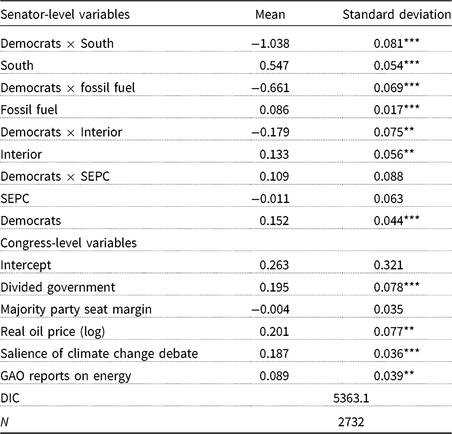
The results are reported in Table 3.Footnote 11 The results at the Congress level are very similar to those with the member fixed effects. The salience of climate change debate, the salience of energy policy in Congress, the rising oil price and the divided government are positively and significantly associated with polarisation over energy policy.
Energy policy polarisation in the senate (without member fixed effects)
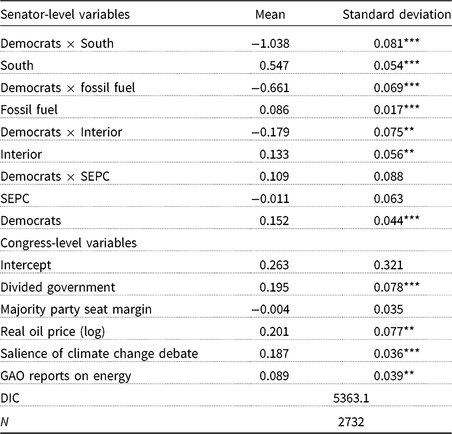
Note: ***, ** and * indicate that 99%, 95% and 90% credible intervals do not include 0, respectively. DIC, Deviation Information Criterion.
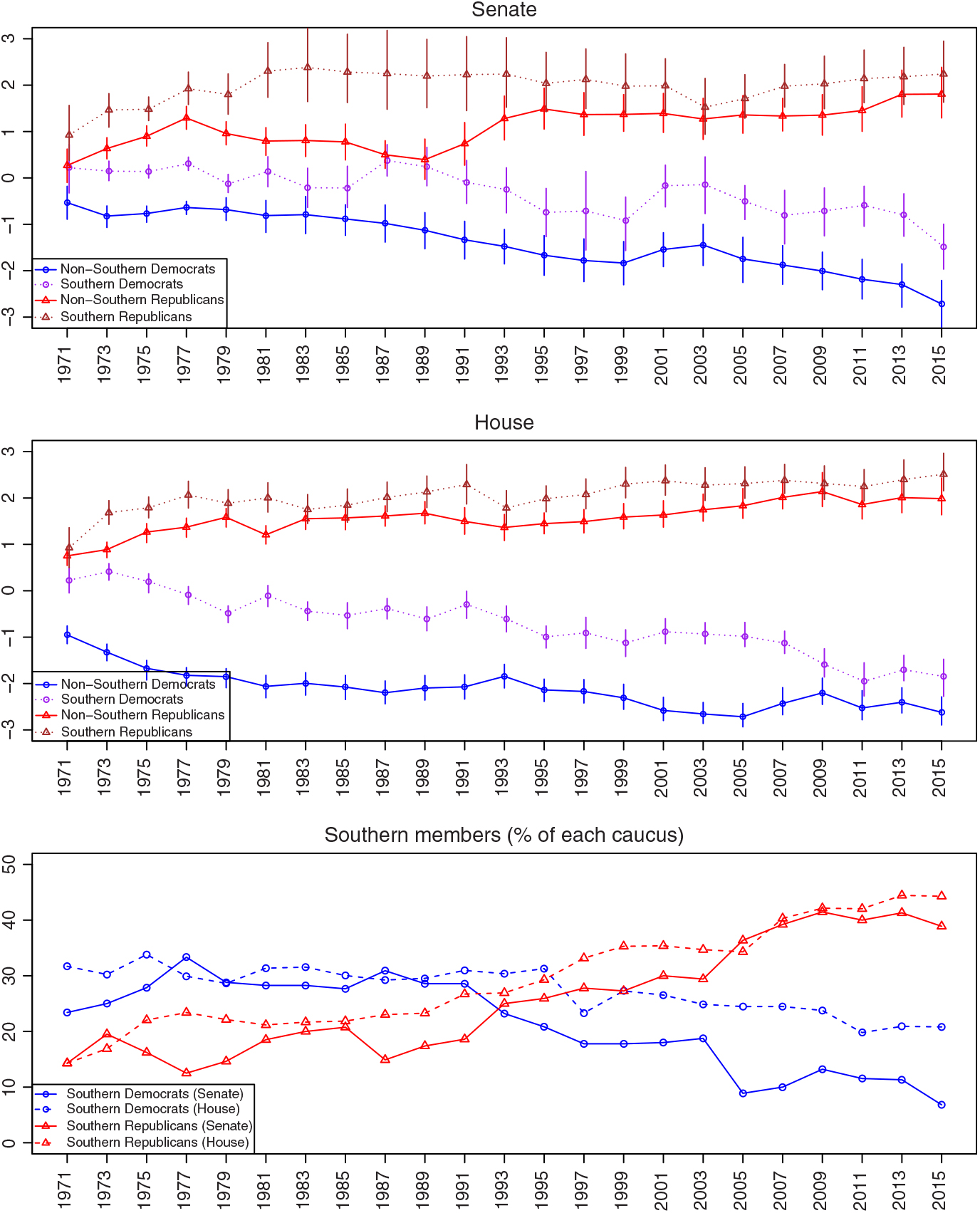
At the member level, the results are consistent with the expectations. First, Southern Democrats (South × Democrats) are negatively and significantly associated with energy policy polarisation. By being more conservative within the Democratic Party (even after holding the state level of fossil fuel production constant), Southern Democrats contributed to the moderation of energy policymaking. This suggests that political parties’ realignment in the South has contributed to the polarisation of energy policy in the Senate, providing support for Hypothesis 4. In order to gauge the degree and influence of Southern realignment in both chambers, we plot the median energy policy positions of Southern and non-Southern members in each party in Figure 5. It shows that Southern Democrats have contributed to the moderation of energy policy by being more conservative on energy policy than non-Southern Democrats in both chambers. On the contrary, Southern Republicans have contributed to the polarisation of energy policy by being more conservative within the Republican Party. Also, the bottom panel of the figure shows the depth of this realignment. It shows that the number of Southern Democrats has been decreasing and that of Southern Republicans increasing, contributing to the increasing polarisation over energy policy.
Median positions and the percentages of Southern and non-Southern members.

Second, we find that Democrats who represent fossil fuel producer states (Fossil Fuel × Democrats) are negatively and significantly associated with energy policy polarisation. This confirms that Senators like Byrd and Long contributed to the moderation of energy policymaking by being more conservative within the Democratic Party. In contrast, the positive coefficient for Fossil Fuel indicates that Republicans who represent fossil fuel producer states contributed to the polarisation of energy policy by being more conservative than other Republicans.
Finally, the members on the Senate Committee on Interior and Insular Affairs (later Energy and Natural Resources) are significantly related to polarisation on energy policy. The members of this committee are likely to have self-selected into this committee due to their state interests. Thus, Democrats in the committee (Interior × Democrats) tended to have a more conservative position on energy policy than other Democrats, contributing to the moderation of energy policy. In contrast, Republicans in the same committee (Interior) contributed to the polarisation of energy policy by being more conservative than other Republicans. We do not find such an effect in the membership on the Senate Committee on Environment and Public Works.
Summary
Our examination of members’ positions on energy policy reveals that the polarisation of energy policy can be explained by several factors. First, we found that energy policy-related events – specifically, rising oil prices (in the Senate), the increasing salience of climate change debate and the increasing salience of energy policy in Congress reflected in the GAO reports on energy – have contributed to increasing party polarisation over energy policy. Second, we found that the convergence of energy policy with environmental policy has contributed to increasing party polarisation over energy policy. Third, we found only partial support for the partisan electoral rivalry theory. The majority party’s seat margins were not significantly related to party polarisation in both chambers, although we found that the divided government has significantly contributed to the polarisation of energy policy in the Senate. Finally, partisan realignment in the South has contributed to increasing party polarisation over energy policy. We found that Southern members were more conservative on energy policy than their co-partisan members. Thus, the decreasing number of Southern Democrats and increasing number of Southern Republicans have contributed to energy policy polarisation.
We also note that there are some inter-chamber differences regarding energy policy polarisation. We suspect that it has something to do with the fact that House members are more affected by their party position. Given the increased powers of party leaders due to the reforms in the 1970s, party leaders in the House were able to control the agenda of the House. Energy policy was not an exception, as witnessed by the rapid convergence of energy policy position and general policy position of House members in Figure 2. Relatedly, the fact that the coefficient for environmental policy extremism tends to be larger in the House (see Figure 4) suggests that environmental policy extremism has stronger influence in the House than it does in the Senate. Because of this, Congress-level factors had smaller variation to explain in the House, making them statistically less significant.
Conclusions
We make several contributions in this article. First, we use every vote on energy policies in Congress between 1971 and 2016 to create a new measure for each member of Congress and for party medians and means on energy issues. We assert that this is a more accurate characterisation of member and party attitudes towards energy issues than LCV or ADA scores.
Second, we use this new measure of policy positions to document the trends in the last five decades of energy politics in the US. Those trends reflect an increased divergence between the two parties that poses a daunting challenge to the development of comprehensive and meaningful overall energy strategies for the country. For decades, analysts and scholars have decried the lack of strong energy policies that could shift the US away from “a system of energy production and consumption that fails to well serve our needs or those of our environment” (Graetz Reference Graetz2011: 6; see also Friedman Reference Friedman2008: 408; Grossman Reference Grossman2012: 332; Hamilton Reference Hamilton, Bent, Orr and Baker2002: xiii). Nevertheless, change has been slow. In 1968, the US relied on fossil fuels and nuclear power for 94% of its energy needs. Fifty years later, the US relies on fossil fuels and nuclear for 89%. In 1968, renewable sources (particularly hydropower) provided 6.1% of American energy. In 2016, renewable sources provided 11%. Accelerating the pace of change will remain difficult with partisan polarisation at the levels we show in this article.
Third, we use our new measure of energy policy positions of the members of Congress to assess the reasons for partisan polarisation on this important policy area. We found that several factors have contributed to increasing party polarisation over energy policy. First, consistent with the PET literature, we found that energy policy-related events contributed to the polarisation of energy policy. In particular, the climate change debate increased salience of energy policy in Congress, and, to some extent, the rising oil prices have shaped partisan behaviour on these issues. Further, the convergence of energy policy with environmental policy has significantly affected energy policy polarisation in Congress. We thus quantitatively affirm earlier qualitative accounts that energy politics in the US had come to more closely resemble environmental politics in recent years. This similarity is accompanied by the heightened political rhetoric and partisan division that characterises current environmental politics in the US. Second, consistent with conventional theories of party polarisation in general, party realignment in the South has contributed to increasing party polarisation over energy policy. Southern members tend to have more conservative positions on energy policy as well. Thus, the realignment of party base in the South has affected the polarisation of energy policy as well. Finally, we also found the importance of parochial or local interests in energy policy. Despite the trend of party polarisation due both to energy policy-specific factors and general factors of polarisation, Democratic members from fossil fuel producer states resisted the pressure from the party, delaying energy policy polarisation (see also Jeong et al. Reference Jeong, Lowry, Miller and Sened2014). In this sense, the nature of energy policy as a distributive policy, albeit weakened recently, has delayed the issue of energy policy from becoming as partisan as regulatory policies.
Having such an accurate measure of the behaviour of policymakers on energy issues tempts numerous other lines of research. One obvious question involves how much we can generalise beyond this issue area. How unusual is the impact of policy-specific factors on divergence? In this article we compare energy voting to environmental voting, but future analyses could also compare it to other issue areas, such as economic policy, that have also witnessed polarisation in recent decades. A second line of research could consider how the trend towards polarisation might be reversed, or at least slowed, in a particular issue area. This could result from a change in the policy area that reduces the partisan divide. For example, one possible cause of reduced polarisation in the area of energy policy involves renewable sources. Recent improvements in technology and the related continuing trend towards lower prices are making renewable sources more appealing to both parties, particularly in states like Texas and Iowa where the potential for wind energy is so high (Worland Reference Worland2017; Grunwald Reference Grunwald2019). This could slow or reduce polarisation. Pursuing this line of research is beyond the scope of this project but would be possible with updating of our measure and then a focus on just the most recent years in the dataset.
Finally, and more broadly than energy policy, this study provides further evidence of the need, as suggested by PET scholars, to assess policy-specific factors in explaining party behaviour (see Jeong and Quirk Reference Jeong and Quirk2019 for the application of this approach to foreign policy). This study does just that within the domain of energy policy, but it also extends the arguments about policy change to include answers to the question of how a nonpartisan issue becomes a partisan one. The accounting for policy-specific factors in explaining increased partisanship in a particular issue is an important extension to the literature on polarisation and party behaviour.
Acknowledgements
We would like to thank the editors and reviewers for their helpful comments on this article.
Data Availability Statement
Replication materials are available in the Journal of Public Policy Dataverse at https://doi.org/10.7910/DVN/2BBRQ6