Introduction
Chitinozoans are organic-walled microfossils common in Ordovician to Devonian marine sediments. In spite of their disputed biological origin (see Liang et al., Reference Liang, Hints, Tang, Cai, Goldman, Nõlvak, Tihelka, Pang, Bernardo and Wang2020a and references therein), chitinozoans are widely used in biostratigraphy of early and middle Paleozoic rocks (e.g., Grahn and Gutiérrez, Reference Grahn and Gutiérrez2001; Asselin et al., Reference Asselin, Achab and Soufiane2004; Vandenbroucke, Reference Vandenbroucke2004; Grahn, Reference Grahn2005a; Steemans et al., Reference Steemans, Le Hérissé, Melvin, Miller, Paris, Verniers and Wellman2009; Vandenbroucke et al., Reference Vandenbroucke, Armstrong, Williams, Paris, Zalasiewicz, Sabbe, Nõlvak, Challands, Verniers and Servais2010, Reference Vandenbroucke, Emsbo, Munnecke, Nuns, Duponchel, Lepot, Quijada, Paris, Servais and Kiessling2015; de la Puente and Rubinstein, Reference de la Puente and Rubinstein2013; Wang et al., Reference Wang, Feng, Vandenbroucke, Li and Verniers2013; Paris et al., Reference Paris, Miller and Zalasiewicz2015a, Reference Paris, Verniers, Miller, Melvin and Wellmanb; Al-Shawareb et al., Reference Al-Shawareb, Miller and Vecoli2017; De Weirdt et al., Reference De Weirdt, Vandenbroucke, Cocq, Russell, Davies, Melchin and Zalasiewicz2019; Liang et al., Reference Liang, Wang, Servais, Wu, Nõlvak, Hints, Wei, Gong and Yan2020b) since the regional and global biozonal schemes were first established around the 1990s (Achab, Reference Achab1989; Paris, Reference Paris1990; Nõlvak and Grahn, Reference Nõlvak and Grahn1993; Verniers et al., Reference Verniers, Nestor, Paris, Dufka, Sutherland and Van Grootel1995; Paris et al., Reference Paris, Achab, Asselin, Chen, Grahn, Nõlvak, Obut, Samuelsson, Sennikov, Vecoli, Webby, Droser, Paris and Percival2004; Grahn, Reference Grahn2005b, Reference Grahn2006). However, alongside revised genus- and family-level systematics (Paris et al., Reference Paris, Grahn, Nestor and Lakova1999), and continuously expanding datasets from different regions in recent years, revisions of several well-known taxa are required. Sporadic discussions on index chitinozoans have been published in recent years, improving the usefulness of these taxa in biostratigraphy (Butcher, Reference Butcher2013; Nowak et al., Reference Nowak, Servais, Pittet, Vaucher, Akodad, Gaines and Vandenbroucke2016; Liang et al., Reference Liang, Servais, Tang, Liu and Wang2017, Reference Liang, Hints, Servais, Luan, Nõlvak, Tang and Wu2019; de la Puente et al., Reference de la Puente, Paris and Vaccari2020), but more work is required to further improve the chitinozoan biozonal schemes in general.
A common and distinctive key species, Lagenochitina esthonica, was first described by Eisenack (Reference Eisenack1955) from the Baltic Region and has since then been identified from Early and Middle Ordovician rocks from Baltica (Estonia, Sweden), Laurentia (Canada), Gondwana (western Australia, Bohemia), Avalonia (UK), and South China (full details listed in Supplemental Data 1). The diagnostic characters of Lagenochitina esthonica include a cylindric neck ended with a remarkable flaring collar and a distinct flexure that connects the neck with a rounded quadrate chamber. Lagenochitina esthonica is one of the largest representatives of the genus, with an average length of ~500 μm based on 18 specimens from the type locality (Eisenack, Reference Eisenack1955). Due to the distinctive morphology and wide distribution, L. esthonica has become one of the most characteristic species for the Early and Middle Ordovician period. In North America, it was put forward as the index taxon for the lower Floian (Achab, Reference Achab1989), together with Conochitina raymondii Achab, Reference Achab1980, just above the globally recognized Euconochitina symmetrica Biozone.
However, two different varieties carrying the diagnostic characters of Lagenochitina esthonica can be detected in previously published literature. One corresponds to the holotype shown in Eisenack (Reference Eisenack1955); the other developed an even larger vesicle with a much more slender outline (e.g., Jenkins, Reference Jenkins1967, pl. 74, figs. 4, 5; Eisenack, Reference Eisenack1968, pl. 25, fig. 25).
The morphology and taxonomy of the two forms have been discussed by previous authors. Eisenack (Reference Eisenack1968) pointed out that the short and slender forms co-occurred in the same population in the glauconite limestone in Estonia (mostly Dapingian in age), while in the “vaginatum limestone” and “Expansus limestone” in Sweden (Darriwilian), only elongated forms were recovered. Bockelie (Reference Bockelie1980) indicated that the species changed from a mixture of short and long forms in the lower Arenig to predominantly long forms in the lowermost Llanvirn. Paris (Reference Paris1981) denoted that the two forms are certainly related, but of different stratigraphic distributions, and suggested that a revision based on the material from the type area in Baltica may allow separating them. Paris and Mergl (Reference Paris and Mergl1984) put forward a dividing standard that restricted typical L. esthonica to specimens carrying the conspicuous shoulders and flexure, as in the holotype, with a ratio of vesicle length to maximum diameter ≤4. The L. esthonica reported by Grahn (Reference Grahn1980) with an inconspicuous flexure was attributed to a later-established taxon, Lagenochitina yilingensis Chen et al., Reference Chen, Paris, Wang and Zhang2009a.
The present study aims to analyze the morphology and distribution of Lagenochitina esthonica sensu lato in order to evaluate the similarities and differences between the short and long forms and revise the taxon accordingly. For this, we use well-preserved material from the eastern Baltic region, stratigraphically ranging from the upper Tremadocian to mid Darriwilian. The morphometrical analysis is complemented with biostratigraphical and paleobiogeographical assessment of range overlaps of the two forms of L. esthonica in time and space.
Geological setting
Locality information
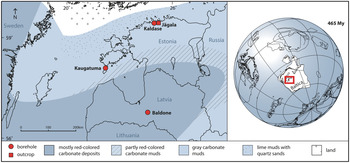
The materials studied in this paper are recovered from four localities: the Jägala waterfall outcrop and Kaldase drill core from northern Estonia; Kaugatuma drill core from Saaremaa Island, western Estonia; and Baldone drill core from Latvia (Fig. 1). These sections represent the eastern part of the Baltoscandian Basin that covered large areas of Baltica during the Ordovician (Männil, Reference Männil1966; Cocks and Torsvik, Reference Cocks and Torsvik2005). In this region, the Lower to lower Middle Ordovician interval is characterized by transition from siliciclastic to cool-water carbonate ramp settings (Nestor and Einasto, Reference Nestor, Einasto, Raukas and Teedum1997; Dronov and Rozhnov, Reference Dronov and Rozhnov2007).
Paleogeographic settings of the study area. The four red marks show the localities of the four at Jägala, Kaldase, Kaugatuma, and Baldone on Baltica.

Stratigraphic and geological time information
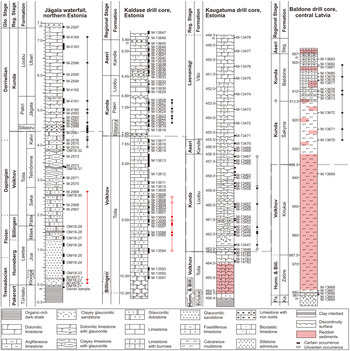
The Jägala waterfall section exposes strata from the upper Türisalu to the Loobu formations, ranging from the Pakerort to Kunda regional stages, corresponding to the Tremadocian to lower Darriwilian (Fig. 2.1).
Lithology and biostratigraphical distribution of Lagenochitina esthonica at Jägala, Kaldase, Kaugatuma, and Baldone sections. Red and black range-through occurrence data represent short and slender forms of L. esthonica, respectively. Bill. = Billingen; Glo. = Global; Hunn. = Hunneberg; Reg. = Regional; Pa = Pakerort; Ka = Kallavere. The samples labeled with the beginning “OM” are used to distinguish those samples from those labeled with the beginning “M.” OM refers to the microfossil samples re-collected by Olle Hints and his colleagues in 2018. Other samples were collected in 1969–2014 by other paleontologists.

In the Kaldase section, strata from the lowermost Volkhov to Aseri regional stages (Fig. 2.2), corresponding to the Dapingian to middle Darriwilian, were continuously sampled for microfossil study.
In the Kaugatuma section, chitinozoan samples were collected from the upper part of the Volkhov to Lasnamägi regional stages, corresponding to the upper Dapingian to the upper Darriwilian (Fig. 2.3). The lowermost part of the Volkhov Regional Stage is characterized by reddish limestone and argillaceous limestone, which are always barren of chitinozoans.
In the Baldone section, the studied interval ranges from the Pakerort to Aseri regional stages, corresponding to the Tremadocian to lower Darriwilian (Fig. 2.4). The lower part of the section, ranging through the entire Volknov Regional Stage, is characterized by reddish sediments that are barren of organic-walled microfossils.
Materials and methods
The four sections were studied for organic-walled microfossils using ~150–300 g samples and acid extraction or disintegration techniques, following the methods described in detail by Paris (Reference Paris1981). Microfossils were hand-picked from the residues and stored in glycerin. Chitinozoans from the Jägala section recently have been reported by Nõlvak et al. (Reference Nõlvak, Liang and Hints2019). Chitinozoan data from the other three sections have not been published previously, but the results have been used to gain general understanding of chitinozoan distribution and diversity patterns on Baltica (e.g., Nõlvak in Paris et al., Reference Paris, Achab, Asselin, Chen, Grahn, Nõlvak, Obut, Samuelsson, Sennikov, Vecoli, Webby, Droser, Paris and Percival2004).
In order to obtain material for morphometric analysis, a total of 155 existing micropaleontological preparations from the four sections were studied, 35 of which contained Lagenochitina esthonica s.l. (Fig. 2). In total, 506 well-preserved specimens were selected for imaging, measuring, and statistical analysis. All specimens were imaged using a Leica M205A stereo microscope equipped with Leica camera system. The measurements were taken from digital images using Leica Application Suite (LAS) software. The systematic framework and terminology follow Paris et al. (Reference Paris, Grahn, Nestor and Lakova1999), and the following measurements were used: vesicle length (L), chamber diameter after correction (Dp*), and the length/width ratio (L/Dp*). The correction factor of the compressed test follows Paris et al. (Reference Paris, Miller and Zalasiewicz2015a), which is a coefficient of 0.8 for the chamber. Of the 506 specimens measured, 460 provided reliable vesicle length data and 483 reliable chamber diameter data. The results were statistically analyzed using R software (R Core Team, 2016). Material selected for scanning electron microscopy (SEM) was cleaned in distilled water and mounted on stubs using thin, water-soluble gelatin film. A Zeiss EVO MA15 SEM at TalTech was used.
Paleogeographical distribution maps were generated using the ArcGIS 10 environment. Geographic coordinates of previously reported Lagenochitina esthonica s.l. occurrences were estimated using Google Earth, and then transferred to paleo-GPS using PointTracker v7.0 (PaleoGIS, http://www.Paleogis.com). The paleomaps adopted in this study are from Scotese (Reference Scotese2016).
Repository and institutional abbreviation
Types, figured, and all the other specimens examined and studied in this paper are stored at the Department of Geology, Tallinn University of Technology (GIT), Tallinn, Estonia.
Results
Morphology and size variation
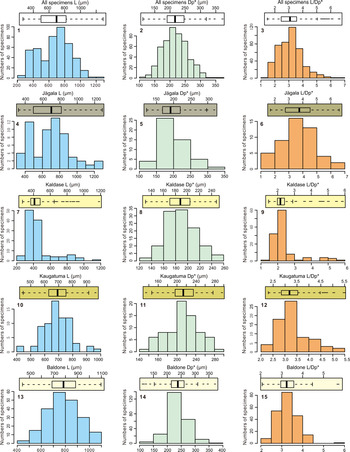
Results of morphometric analysis of 506 specimens of Lagenochitina esthonica s.l. are summarized on Figure 3. The original data of all the measurements are presented in the Supplementary Data 2. When all data are considered, the test length ranges from 268–1288 μm, with mean and median values of 675 μm and 695 μm, respectively (25th and 75th percentiles ~498 μm and 817 μm, respectively; standard error 9.5). Chamber diameter ranges from 121–372 μm, with mean and median values of 219 μm and 217 μm, respectively (25th and 75th percentiles ~191 μm and 246 μm, respectively; standard error 1.84). The ratio of L/Dp* ranges from 1.46–6.60, with mean and median values of 3.10 and 3.09, respectively (25th and 75th percentiles ~2.46 and 3.57, respectively; standard error 0.04).
The statistical analysis shows that the three histograms of test length depicting the entire data set (Fig. 3.1), and separately the data from the Jägala (Fig. 3.4) and Kaldase sections (Fig. 3.7), are far from normal distributions. Two significant acmes can be recognized in Figure 3.1 and Figure 3.4. Values are clustered around 400 μm and a weak acme can be recognized at the interval of 800–900 μm in the Kaldase section (Fig. 3.7). The histograms of Dp* match a normal distribution when all the data are included (Fig. 3.2), while the distributions for each section individually are less perfect. Histograms of L/Dp* show a long tail at the left side, especially at the Kaldase section (Fig. 3.9).
Histograms and box-plots of the test length (L), chamber diameter after correction (Dp*), and the ratio of L/Dp*. (1–3) Based on all the valid data from the studied sections; (4–6) based on the data from the Jägala waterfall outcrop, Estonia; (7–9) based on the data from Kaldase borehole, Estonia; (10–12) based on the data from Kaugatuma borehole, Estonia; (13–15) based on data from Baldone borehole, Lativa.

In the Jägala section, Lagenochitina esthonica s.l. ranges almost through the entire section, starting from the Hunneberg Regional Stage, upper Tremadocian–Floian, and extending to the Kunda Regional Stage, lower and middle Darriwilian (Fig. 2.1). In the lower part of its range, L. esthonica s.l. is distinguished by a stout outline with a rounded square chamber (Nõlvak et al., Reference Nõlvak, Liang and Hints2019, fig. 6G), whereas in the upper part, starting from the upper part of the Volkhov Regional Stage, a slender form with an elongated ovoid chamber occurs (Nõlvak et al., Reference Nõlvak, Liang and Hints2019, fig. 6L, M). The vesicle length measured in the lower part ranges from 323–536 μm, with a mean value of 428 μm based on 17 specimens from samples M-14576 and M-2569. The length measured in the upper part of the section ranges from 451–1288 μm, with a mean value of 803 μm based on 42 specimens from samples M-2576 to M-4164.
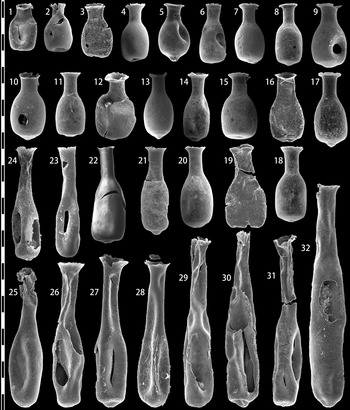
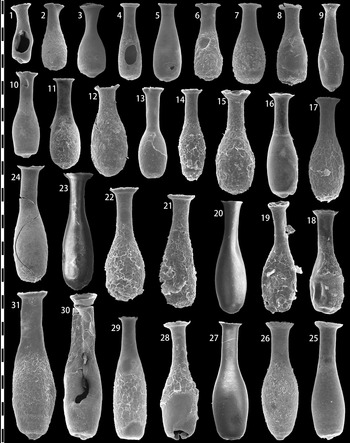
In the Kaldase section, Lagenochitina esthonica s.l. appeared in the Volkhov and Kunda regional stages (Fig. 2.2). The histogram of test length shows that most data are grouped around 400 μm, but a low acme appeared near 800–900 μm (Fig. 3.7). The length of L. esthonica s.l. in the Volkhov Regional Stage ranges from 268–647 μm, with a mean value of 403 μm based on 102 specimens. Tests recovered in this interval are characterized by a rounded square chamber and a relatively short neck, which takes about one-quarter to one-third of the total length (Fig. 4.1–4.22). Specimens from the Kunda Regional Stage range from 477–1181 μm, with a mean value of 815 μm based on 18 measurements. These stratigraphically younger specimens are distinguished by a slender outline with an elongated ovoid chamber and a neck, which takes about one-third to one-half of the total length (Fig. 4.23–4.32).
Lagenochitina esthonica emend. (1–22) and Lagenochitina megaesthonica n. sp. (23–32) from the Kaldase section, northern Estonia. Each black scale bar on the left boundary of the figure represents 100 μm; the total length of the white background line is 2582 μm. Sample M-13596: (1, 6, 9–11, 14, 15, 17, 18, 20–22); Sample M-13597: (2–5, 7, 8, 12, 13, 16, 19); Sample M-13622: (24, 26, 32); Sample M-13627: (25, 27, 31); Sample M-13628: (23, 28–30).

In the Kaugatuma section, Lagenochitina esthonica s.l. occurs in the Kunda Regional Stage, from samples M-13446 to M-13459 (Fig. 2, Kaugatuma drill core, Estonia). Test length ranges from 441–963 μm, with a mean value of 689 μm based on 71 specimens. Histograms of test length, diameter of chamber, and L/Dp* show one peak (Fig. 3.10–3.12). The specimens are all preserved in full relief. Their necks may be very short (e.g., Fig. 5.5, 5.12, 5.21), about one-fifth to one-quarter of the test length. But the necks also can be very long (e.g., Fig. 5.13, 5.16, 5.18), corresponding to about two-fifths to one-half of vesicle length. The outline of the specimens is relatively slender, with an elongated chamber (Fig. 5).
Lagenochitina megaesthonica n. sp. (1–31) from the Kaugatuma section, western Estonia. Each black scale bar on the left boundary of the figure represents 100 μm; the total length of the white background line is 3312 μm. All specimens are from Sample M-13458. (23) holotype, with a repository number of GIT 833-1. (15) paratype, with a repository number of GIT 833-2.

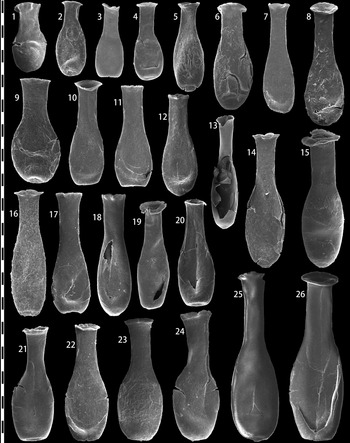
In the Baldone section, Lagenochitina esthonica s.l. has been identified only in the Kunda Regional Stage, from samples M-13670 to M-13682 (Fig. 2, Baldone drill core, central Latvia). The histogram of test length shows a normal distribution. The length ranges from 442–1097 μm, with a mean value of 786 μm, based on 210 specimens (Fig. 3.13). Some of the compressed chambers are reminiscent of a rounded square (e.g., Fig. 6.9, 6.21–6.26). When compression is taken into consideration, the real chamber should have been less square and more elongated.
Lagenochitina megaesthonica n. sp. (1–26) from the Baldone section, central Latvia. Each black scale bar on the left boundary of the figure represents 100 μm; the total length of the white background line is 3584 μm. Sample M-13670: (10–12, 16, 17, 22); M-13671: (9, 23); M-13672: (26); M-13674: (1, 2, 6, 15, 24, 25); M-13676: (3–5, 7, 8, 14, 18, 19); M-13679: (20, 21); M-13682: (13). (23, 26) paratypes, with repository number of GIT 833-3 and GIT 833-4, respectively.

Discussion
Morphology and size variation
According to the statistical results presented above, two distinct groups can be recognized within the specimens previously assigned to Lagenochitina esthonica. Morphologically, both groups carry the diagnostic features of L. esthonica—large bottle-shaped chitinozoans possessing a well-differentiated neck ending with a conspicuous flaring collar and a distinct flexure with nearly parallel flanks. The main difference between the two groups is that one has a rounded square chamber, matching the morphology of the holotype of L. esthonica, whereas the other is much slenderer, with an elongated ovoid chamber, and a relatively longer neck.
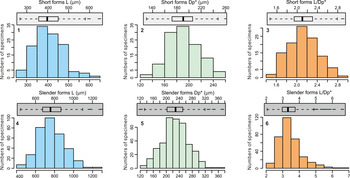
Statistically, test length of the stout group ranges from 268–647 μm, with mean and median values of 406 μm and 398 μm, respectively (25th and 75th percentile around 357 μm and 451 μm, respectively; standard error 4.3), based on 120 specimens from the lower part of the Jägala and Kaldase sections (Fig. 7.1). Vesicle length of the slender form ranges from 441–1288 μm, with mean and median values of 769 μm and 758 μm, respectively (25th and 75th percentile around 675 μm and 868 μm, respectively; standard error 7.60), based on 341 measurements from four sections (Fig. 7.4). Generally, the length of the slender form is about twice that of the short group. The corrected diameter of the chamber of the short form ranges from 130–260 μm, about three-quarters of them range from 160–220 μm (Fig. 7.2) and the slender form ranges from 121–372 μm, nearly three-fifths range from 200–260 μm (Fig. 7.5). The L/Dp* of the slender forms is commonly ~2.5–4 (Fig. 7.6), whereas for the short form it is a~1.8–2.4 (Fig. 7.3). These data allow us to conclude that the two forms represent morphologically distinct assemblages with limited overlap in size and shape.
Histograms and box-plots of the test length (L), chamber diameter after correction (Dp*), and the ratio of L/Dp* of emended Lagenochitina esthonica (1–3), short forms and Lagenochitina megaesthonica n. sp. (4–6), slender forms.

Stratigraphic distribution
Within the four studied sections, the short form of Lagenochitina esthonica s.l. occurs in the Hunneberg to lower Volkhov regional stages at the Jägala outcrop and in the lower and middle parts of the Volkhov Regional Stage in the Kaldase drill core, which corresponds to the upper Tremadocian to lower Dapingian interval (Fig. 2.1, 2.2). The slender form appears in the uppermost Volkhov to Kunda regional stages at the Jägala section, and in the Kunda Regional Stage at the Kaldase, Kaugatuma, and Baldone sections, corresponding to the uppermost Dapingian to the middle part of the Darriwilian (Fig. 2). Thus, based on the distribution of L. esthonica s.l. in the studied sections, the stratigraphic ranges of the two groups are largely separated. Possibly, the younger, long form represents a descendant lineage of the older, shorter form.
Biogeographic distribution
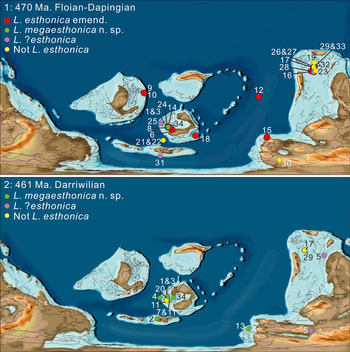
The paleobiogeographic distribution of Lagenochitina esthonica s.l. is wide (see Supplementary Data 1). Considering previously published data, the short form, including the holotype of L. esthonica in Eisenack (Reference Eisenack1955), has been reported in pre-Darriwilian strata in Estonia (Eisenack, Reference Eisenack1955; Grahn, Reference Grahn1984; Hints and Nõlvak, Reference Hints and Nõlvak2006; Nõlvak et al., Reference Nõlvak, Liang and Hints2019), Russia (Obut, Reference Obut and Zhuravleva1973), Norway (Bockelie, Reference Bockelie1978, Reference Bockelie1980), Canada (Achab, Reference Achab1980, Reference Achab1986), Bohemia (Paris and Mergl, Reference Paris and Mergl1984), and China (Chen et al., Reference Chen, Paris, Wang and Zhang2009a, Reference Chen, Zhang and Wangb; Liang, Reference Liang2015; Liang et al., Reference Liang, Servais, Tang, Liu and Wang2017, Reference Liang, Hints, Luan, Tang, Nõlvak and Zhan2018). Most of these occurrences are confined to Early Ordovician. The slender form of L. esthonica s.l., represented by the specimens from the Hope Shale in the UK (Jenkins, Reference Jenkins1967), corresponding to mid Darriwilian, and has been reported in Darriwilian strata in Sweden (Eisenack, Reference Eisenack1955, Reference Eisenack1968, Reference Eisenack1976a; Grahn, Reference Grahn1980; Grahn et al., Reference Grahn, Nõlvak and Paris1996), Estonia (Eisenack, Reference Eisenack1976b; Nõlvak et al., Reference Nõlvak, Liang and Hints2019), and France (Paris, Reference Paris1981). Paleogeographically, the short form is distributed in Baltica, Laurentia, and South China, and the slender form occurs in Baltica, Gondwana, and Avalonia (Fig. 8). Consequently, there also seems to be biogeographic differentiation between the two forms, with only Baltica having both of them represented.
Paleogeographic distributions of emended Lagenochitina esthonica and Lagenochitina megaesthonica n. sp. in the interval of Floian–Dapingian (1) and Darriwilian (2). Detailed information of the occurrence data marked by numbers is presented in Supplemental Data 1. The paleomaps are according to Scotese (Reference Scotese2016).

Conclusions
The above-presented results show that two groups within Lagenochitina esthonica s.l. can be well differentiated by both morphology and stratigraphic ranges. Statistically, two acmes can be recognized in the histograms of vesicle length, one ~400 μm and the other in the interval of 700–800 μm. Morphologically, the short form is distinguished by a rounded square chamber with the L/Dp* ratio ~1.4–2.9, whereas the slender form is featured by an elongated ovoid chamber with the L/Dp* ratio ~2.0–6.6. Stratigraphically, the short form appears in the upper Tremadocian to lower Dapingian, whereas the slender form occurs mainly in the lower and middle Darriwilian. Biogeographically, the two forms co-occurred only in Baltica, further stressing the separation of the two groups. In summary, we interpret these data as indicating the presence of two rather than one species. The type specimen of L. esthonica (Eisenack, Reference Eisenack1955) represents the short form, and based on that, the original species diagnosis and description are emended to include specimens carrying a rounded square chamber with a medium to large vesicle and occurring in pre-Darriwilian strata. Lagenochitina megaesthonica n. sp. is erected for the slender form, referring to specimens with an elongated ovoid chamber with a large to huge test, mainly restricted to the lower and middle parts of the Darriwilian. Separation of these two species provides an additional biostratigraphic marker for Baltoscandia and beyond, contributing also to an improved understanding of the biogeographic distribution of Early and early Middle Ordovician chitinozoans.
Systematic paleontology
Order Prosomatifera Eisenack, Reference Eisenack1972
Family Conochitinidae Eisenack, Reference Eisenack1931, emend. Paris, Reference Paris1981
Subfamily Lagenochitinnae Paris, Reference Paris1981
Genus Lagenochitina Eisenack, Reference Eisenack1931, emend. Paris et al., Reference Paris, Grahn, Nestor and Lakova1999
Type species
Lagenochitina baltica Eisenack, Reference Eisenack1931. The holotype was recovered from the “Ostseekalk” Ordovician erratic limestone from the Baltic shore (Eisenack, Reference Eisenack1931, p. 80–81, pl. 1, fig. 1). Because the holotype is lost, it was replaced by a neotype, also deriving from the “Ostseekalk” (Eisenack, Reference Eisenack1959, p. 2, pl. 3, fig. 6).
Lagenochitina esthonica Eisenack, Reference Eisenack1955, emend. Liang, Nõlvak, and Hints
Figure 4.1–4.22
- Reference Eisenack1955
Lagenochitina esthonica Eisenack, p. 311, pl. 1, figs. 8, 9.
- non Reference Jenkins1967
Lagenochitina esthonica; Jenkins, p. 463, pl. 74, figs. 4, 5.
- p Reference Eisenack1968
Lagenochitina esthonica; Eisenack, p. 156, pl. 24, fig. 10, pl. 29, fig. 25?, text-fig. 1.
- Reference Downie, Lister, Harris and Fettes1971
Lagenochitina esthonica; Downie et al., p. 21, pl. 1, fig. 17.
- non ?Reference Eisenack1972
Lagenochitina esthonica; Combaz and Peniguel, p. 145, pl. 4, figs. 1, 2, text-fig. 2.
- Reference Obut and Zhuravleva1973
Lagenochitina esthonica; Obut, pl. 10, figs. 6–8.
- non Reference Eisenack1976a
Lagenochitina esthonica; Eisenack, p. 186, pl. 2, fig. 1; text-fig. 2.
- p Reference Eisenack1976b
Lagenochitina esthonica; Eisenack, fig. 6.
- Reference Bockelie1978
Lagenochitina esthonica; Bockelie, fig. 2C, D.
- Reference Bockelie1980
Lagenochitina esthonica; Bockelie, p. 12, pl. 2, figs 1–7, text-figs. 7C, 8.
- non Reference Grahn1980
Lagenochitina esthonica; Grahn, p. 3, fig. 19 A–D.
- Reference Achab1980
Lagenochitina esthonica; Achab, p. 234, pl. 3, figs. 1–6.
- non Reference Paris1981
Lagenochitina esthonica; Paris, p. 248, pl. 10, figs. 15, 20.
- Reference Grahn1984
Lagenochitina esthonica; Grahn, p. 22, pl. 4, figs. F, G.
- Reference Paris and Mergl1984
Lagenochitina esthonica; Paris and Mergl, p. 55, pl. 4, figs. 2–6.
- ? Reference Geng1984
Lagenochitina cf. esthonica; Geng, p. 513, pl. 1, fig. 6.
- non Reference Zhen1985
Lagenochitina esthonica; Zhen, p. 378, pl. 1, figs. 17–19.
- non Reference Gao1986
Lagenochitina esthonica; Gao, p. 145, pl. 3, figs 3–6, 10–15, pl. 4, figs. 1–3, 7.
- Reference Achab1986
Lagenochitina esthonica; Achab, p. 693, pl. 2, figs 16–18, pl. 4, figs. 1–3.
- non Reference Grahn, Nõlvak and Paris1996
Lagenochitina esthonica; Grahn et al., pl. 3, fig. 9.
- non Reference Olaru and Apostoae2004
Lagenochitina esthonica; Olaru and Apostoae, p. 302, pl. 1, figs. 1–14.
- non Reference Olaru2005
Lagenochitina esthonica; Olaru, pl. 3, figs. 1–14.
- non Reference Chen and Zhang2005
Lagenochitina esthonica; Chen and Zhang, p. 50, pl. 1, figs. 2, 10, 17, 18, 20, 22.
- non Reference Hints and Nõlvak2006
Lagenochitina esthonica; Hints and Nõlvak, pl. 4, fig. 27.
- ?Reference Grahn and Nõlvak2007
Lagenochitina esthonica; Grahn and Nõlvak, fig. 4C.
- Reference Chen, Paris, Wang and Zhang2009a
Lagenochitina esthonica; Chen et al., p. 324, pl. 4, figs. 4, 8, 11?.
- Reference Chen, Zhang and Wang2009b
Lagenochitina esthonica; Chen et al., p. 159, pl. 2, fig. 7?, pl. 29, figs. 4, 8.
- non Reference Olaru, Grasu and Chihaia2011
Lagenochitina esthonica; Olaru et al., pl. 1, figs. 3, 5, 10, 18, 19, 21.
- Reference Wang, Feng, Vandenbroucke, Li and Verniers2013
Lagenochitina esthonica; Wang et al., p. 56, pl. 3, figs. 1–3.
- Reference Liang2015
Lagenochitina esthonica typical Liang, p. 142, pl. 1, figs. 1–9.
- non Reference Nowak, Servais, Pittet, Vaucher, Akodad, Gaines and Vandenbroucke2016
Lagenochitina esthonica; Nowak et al., fig. 7Q.
- Reference Liang, Servais, Tang, Liu and Wang2017
Lagenochitina esthonica; Liang et al., pl. 1, figs. 1–5.
- Reference Liang, Hints, Luan, Tang, Nõlvak and Zhan2018
Lagenochitina esthonica; Liang et al., fig. 3X.
- Reference Nõlvak, Liang and Hints2019
Lagenochitina esthonica; Nõlvak et al., fig. 6G.
Holotype
Specimen from the lower part of the glauconitic limestone (=Toila Formation), stage B2α (=Volkhov Regional Stage), corresponding to the global Dapingian Stage, at Paldiski, Pakri Peninsula, NW Estonia (Eisenack, Reference Eisenack1955, pl. 1, fig. 8). According to Paris (Reference Paris1981, p. 249), the test dimensions are L-Dp-Dc-Lp: 530-194-94-350 μm.
Diagnosis
Medium to large Lagenochitina with a short cylindrical neck ended with an extraordinary flaring collar. Chamber quadrate ovoid to rounded square, usually with distinct shoulders. The test length is ~1.5–2.9 times the chamber diameter.
Occurrence
If the synonymy list of the present study is adopted, the valid Lagenochitina esthonica occurrences are mainly from Baltica, Laurentia, and South China (Fig. 8), including the lower glauconitic limestone (Toila Formation, Dapingian) (Eisenack, Reference Eisenack1955, Reference Eisenack1968, Reference Eisenack1976b), the Vääna limestone (Dapingian) (Grahn, Reference Grahn1984), and the Leetse Formation (Floian) (Hints and Nõlvak, Reference Hints and Nõlvak2006; Nõlvak et al., Reference Nõlvak, Liang and Hints2019) in Estonia; Arenig strata (Floian) of the Pestovo borehole, Moscow Basin in central Baltica (Obut, Reference Obut and Zhuravleva1973); the Valhallfonna Formation (Floian) in Spitsbergen, Norway (Bockelie, Reference Bockelie1978, Reference Bockelie1980); the lower part of the Lévis Formation (Floian) in Quebec (Achab, Reference Achab1980, Reference Achab1986); the Klabava Formation (Floian–Dapingian) in the Prague Basin, Bohemia (Paris and Mergl, Reference Paris and Mergl1984); the Hunghuayuan, lower part of the Dawan, Ningkuo, and Tungtzu formation (upper Tremadocian–Floian) in South China (Chen et al., Reference Chen, Paris, Wang and Zhang2009a, Reference Chen, Zhang and Wangb; Wang et al., Reference Wang, Feng, Vandenbroucke, Li and Verniers2013; Liang, Reference Liang2015; Liang et al., Reference Liang, Servais, Tang, Liu and Wang2017, Reference Liang, Hints, Luan, Tang, Nõlvak and Zhan2018). In the present study, Lagenochitina esthonica occurs in the Hunneberg to lower Volkhov stages at the Jägala section, and in the lower and middle parts of the Volkhov Regional Stage in the Kaldase core, corresponding to the upper Tremadocian to lower Dapingian, Early to early Middle Ordovician.
Description
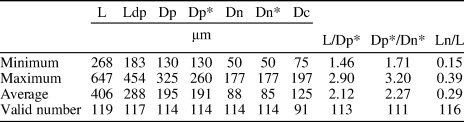
Test medium to large, ranging from 268–647 μm (average 406 μm) in length. Neck clearly differentiated and cylindrical, taking ~15–40% of the test length, ended with an extraordinary flaring collar (e.g., Fig. 4.7, 4.8). Chamber quadrate ovoid to rounded square, usually with distinct shoulders. The maximum diameter is located at the middle part of the chamber, which is 1/3 to 2/3 times the test length after correction. Flexure distinct, flanks nearly parallel to slightly swollen, base flat or slightly convex, base margin rounded. Mucron usually present, but with various shapes and size: it can be short and narrow (e.g., Fig. 4.8, 4.13) or short and wide (e.g., Fig. 4.11, 4.22); sometimes it is prolonged and became narrow in the aboral side (e.g., Fig. 4.5, 4.21); sometimes the test lacks a mucron, which is replaced by a rounded scar (e.g., Fig. 4.20). Test surface can be smooth, but consists of minute granules (e.g., Fig. 4.11, 4.15); it can also have a rugose to spongy surface (e.g., Fig. 4.17, 4.21).
Materials
Seventeen specimens were recovered from samples M-14576 and M-2569 from the Jägala waterfall section (Nõlvak et al., Reference Nõlvak, Liang and Hints2019), and 103 specimens from samples M-13595 to M-13600 from the Kaldase drill core, Estonia (Fig. 2).
Dimension
Dimensions (Table 1) are based on 120 specimens, 12 of which are compressed and others are preserved three-dimensionally.
Dimensions of Lagenochitina esthonica emend. L = test length, Ldp = chamber length, Dp = chamber diameter, Dp* = corrected chamber diameter, Dn = neck diameter, Dn* = corrected neck diameter, Dc = collar diameter, Dc* = corrected collar diameter, L/Dp* = the ratio of the test length to corrected chamber diameter, Dp*/Dn* = corrected chamber diameter to neck diameter, and Ln/L = neck length to test length. The correction factors of 0.7 and 0.8 are adopted for the compressed neck and chamber, respectively, following Paris et al. (Reference Paris, Miller and Zalasiewicz2015a). Raw data of all the measurements are presented in Supplemental Data 2.

Remarks
The emended Lagenochitina esthonica is restricted to specimens with a relatively short test, which is represented by the holotype of the species established by Eisenack (Reference Eisenack1955). The slender forms with a larger and slender test, represented by the specimens reported by Jenkins (Reference Jenkins1967), are excluded, as are the slender forms reported elsewhere (Eisenack, Reference Eisenack1968, Reference Eisenack1976a, Reference Eisenackb; Grahn, Reference Grahn1980; Paris, Reference Paris1981; Grahn et al., Reference Grahn, Nõlvak and Paris1996; Hints and Nõlvak, Reference Hints and Nõlvak2006; Nõlvak et al., Reference Nõlvak, Liang and Hints2019). The short forms recovered in the Jägala (Nõlvak et al., Reference Nõlvak, Liang and Hints2019, fig. 6G) and Kaldase (Fig. 4.1–4.22) sections share the same morphology, similar test size, and were recovered from the same strata in the same area as the holotype. The two specimens recovered in the Canning Basin, Australia (Combaz and Peniguel, Reference Combaz and Peniguel1972) have a relatively large test size, with lengths of 600 μm and 670 μm, and a stout chamber; however, the distinctive flaring collar cannot be observed. The classification of those two specimens requires further study because no valid esthonica data have been reported in this time interval in the area. The specimen reported by Geng (Reference Geng1984) from the Hunghuayuan Formation at Yichang resembles the general outline of L. esthonica, but lacks the distinctive flaring collar. The specimens recovered in the upper Meitan Formation (Zhen, Reference Zhen1985) share similar outline with the slender form of L. esthonica, but with a significantly smaller size. The specimens reported from the Hungshihyen Formation (Gao, Reference Gao1986) have been re-identified as Lagenochitina obeligis Paris, Reference Paris1981, by Liang et al. (Reference Liang, Wang, Servais, Wu, Nõlvak, Hints, Wei, Gong and Yan2020b). The data reported from the Tulghes Group in Romania (Olaru and Apostoae, Reference Olaru and Apostoae2004; Olaru, Reference Olaru2005; Olaru et al., Reference Olaru, Grasu and Chihaia2011) are pieces and hard to classify based on the images presented. The specimens lacking a distinct flexure with a short neck, such as figure 19B–D in Grahn (Reference Grahn1980), have been revised as Lagenochitina yilingensis by Chen et al. (Reference Chen, Paris, Wang and Zhang2009a). The small specimens recovered from the Hunghuayuan and Meitan formations (Chen and Zhang, Reference Chen and Zhang2005) later were emended as Lagenochitina chongqingensis by Chen in Chen et al., Reference Chen, Zhang and Wang2009b. The specimens reported from the Ningkuo Formation at Yiyang, South China (Wang et al., Reference Wang, Feng, Vandenbroucke, Li and Verniers2013) have the smallest size of L. esthonica, with test lengths that range from 170–224 μm. The image shown in Nowak et al. (Reference Nowak, Servais, Pittet, Vaucher, Akodad, Gaines and Vandenbroucke2016) features a less-flaring collar and ovoid chamber that closely resembles Lagenochitina cf. L. longiformis Obut, Reference Obut1995, recovered in the Leetse Formation in northern Estonia by Hints and Nõlvak (Reference Hints and Nõlvak2006).
Lagenochitina megaesthonica new species, Liang, Nõlvak, and Hints
Figures 4.23–4.32, 5, 6
- Reference Jenkins1967
Lagenochitina esthonica; Jenkins, p. 463, pl. 74, figs. 4, 5.
- Reference Eisenack1968
Lagenochitina esthonica; Eisenack, p. 156, pl. 29, fig. 25, text-fig. 1.
- Reference Downie, Lister, Harris and Fettes1971
Lagenochitina esthonica; Downie et al., p. 21, pl. 1, fig. 17.
- Reference Eisenack1976a
Lagenochitina esthonica; Eisenack, p. 186, pl. 2, fig. 1, text-fig. 2.
- p Reference Eisenack1976b
Lagenochitina esthonica; Eisenack, figs. 22, 23.
- Reference Grahn1980
Lagenochitina esthonica; Grahn, p. 32, fig. 19A.
- Reference Paris1981
Lagenochitina esthonica; Paris, p. 248, pl. 10, figs. 15, 20.
- Reference Grahn, Nõlvak and Paris1996
Lagenochitina esthonica; Grahn et al., pl. 3, fig. 9.
- ? Reference Liang2015
Lagenochitina esthonica elongata Liang, p. 145, pl. 11, figs. 10–12.
- ? Reference Liang, Hints, Luan, Tang, Nõlvak and Zhan2018
Lagenochitina aff. esthonica; Liang et al., fig. 4W.
- Reference Nõlvak, Liang and Hints2019
Lagenochitina esthonica; Nõlvak et al., pl. 4, fig. 6L, M.
Holotype
Specimen (GIT 833-1, Fig. 5.23) from sample M-13458 (Kunda Regional Stage, middle Darriwilian; Fig. 2), Kaugatuma drill core, western Estonia, with L-Dp-Dc-Lp dimensions of 867-229-116-574 μm.
Paratypes
Figure 5.15 (GIT 833-2) from sample M-13458, Kaugatuma drill core, western Estonia, with L-Dp-Dc-Lp dimensions of 772-288-120-494 μm; Figure 6.23 (GIT 833-3) from sample M-13671, Baldone drill core, Latvia, with L-Dp*-Dc*-Lp dimensions of 964-291-112-598 μm; and Figure 6.26 (GIT 833-4) from sample M-13672, Baldone drill core, Latvia, with L-Dp*-Dc*-Lp dimensions of 1348-365-147-844 μm.
Diagnosis
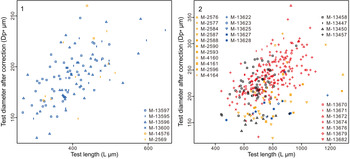
Large to huge Lagenochitina (441–1288 μm, Fig. 9) with a relatively long cylindrical neck (~18–55% of the test length) ended with extraordinary flaring collar. Chamber elongated ovoid with almost parallel flanks, shoulders not distinct. The length is ~2–6.6 times the chamber diameter.
Cross plot of the test length and chamber diameter after correction of Lagenochitina esthonica emend. (1) and Lagenochitina megaesthonica n. sp. (2). The red, blue, black, and orange symbols represent data from Baldone, Kaldase, Kaugatuma, and Jägala sections, respectively. Different shapes represent data from different samples.

Occurrence
The reported data are mainly from Baltica, Avalonia, and North Gondwana (Fig. 8), including the “Expansus Limestone” (Kunda Regional Stage, lower to middle Darriwilian) of Fjäcka, Dalarna, Sweden (Eisenack, Reference Eisenack1955); the Hope Shale (middle Darriwilian) in Shropshire, England (Jenkins, Reference Jenkins1967); the Vaginatum Limestone (Kunda Regional Stage) in Öland, Sweden (Eisenack, Reference Eisenack1976a); strata of upper Langevoja to lower Valaste and upper Aluoja regional substages (ca. lower and middle Darriwilian) in Öland, Sweden (Grahn, Reference Grahn1980); the middle part of the Domfront Pissot Formation (ca. middle Darriwilian) in Brittany, France (Paris, Reference Paris1981); strata above the Granby Event in the Kunda Regional Stage in the Granby crater, Sweden (Grahn et al., Reference Grahn, Nõlvak and Paris1996); and the Sillaoru and Pakri formations (lower Darriwilian) at Jägala, Estonia (Nõlvak et al., Reference Nõlvak, Liang and Hints2019). The data from South China (Liang et al., Reference Liang, Hints, Luan, Tang, Nõlvak and Zhan2018) require further investigation. In the present study, Lagenochitina megaesthonica n. sp. appears in the uppermost Volkhov to Kunda regional stages at Jägala, and Kunda Reginal Stage at the Kaldase, Kaugatuma, and Baldone sections, corresponding to the upper part of the Dapingian to lower and middle parts of the Darriwilian, Middle Ordovician.
Description
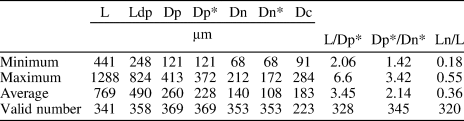
Test large to huge, ranging from 441–1288 μm with an average value of 769 μm in length. Neck clearly differentiated and cylindrical, occupying ~18–55% of the test length, ended with an extraordinary flaring collar. Chamber elongated ovoid to sub-cylindric. The maximum diameter is located at the middle part of the chamber, which is 15–50% of the test length after correction. Flexure broad and shoulders inconspicuous, flanks nearly parallel to slightly swollen, base flat or slightly convex, base margin rounded. Mucron usually present, but with various shapes and size, as in Lagenochitina esthonica emend. Test surface can be smooth or covered by rugose to spongy structures (e.g., Fig. 5.21, 5.22). The rugose and smooth surface can co-occur in one specimen (e.g., Fig. 5.28, 5.29).
Etymology
Referring to the large size and the name Lagenochitina esthonica, under which specimens of the new species previously have been assigned.
Materials
Forty-four specimens were recovered from samples M-2576 and M-4164 from the Jägala section, Estonia; 18 specimens were recovered from samples M-13622 and M-13628 from the Kaldase drill core, Estonia; 75 specimens were recovered from samples M-13447 to M-13458 from the Kaugatuma drill core, Estonia; and 249 specimens were recovered from samples M-13670 and M-13682 from the Baldone drill core, Latvia (Fig. 2).
Dimension
Dimensions (Table 2) are based on 386 specimens, 244 of which are compressed and others are preserved three-dimensionally.
Dimensions of Lagenochitina megaesthonica n. sp. L = test length, Ldp = chamber length, Dp = chamber diameter, Dp* = corrected chamber diameter, Dn = neck diameter, Dn* = corrected neck diameter, Dc = collar diameter, Dc* = corrected collar diameter, L/Dp* = the ratio of the test length to corrected chamber diameter, Dp*/Dn* = corrected chamber diameter to neck diameter, and Ln/L = neck length to test length.. The correction factors of 0.7 and 0.8 are adopted for the compressed neck and chamber, respectively, following Paris et al. (Reference Paris, Miller and Zalasiewicz2015a). Raw data of all the measurements are presented in Supplemental Data 2.

Remarks
Large and slender forms of previously reported Lagenochitina esthonica (Eisenack, Reference Eisenack1968, Reference Eisenack1976a, Reference Eisenackb; Grahn, Reference Grahn1980; Paris, Reference Paris1981; Grahn et al., Reference Grahn, Nõlvak and Paris1996; Hints and Nõlvak, Reference Hints and Nõlvak2006; Nõlvak et al., Reference Nõlvak, Liang and Hints2019). Lagenochitina megaesthonica n. sp. is distinguished by its large test with a flaring collar in all Lagenochitina species. It differs from L. esthonica emend. in its large and slender test (Fig. 9) with a less-distinctive flexure and weak shoulder. The test outline of L. megaesthonica n. sp. resembles Lagenochitina boja Bockelie, Reference Bockelie1980, in slender form with a flaring collar, but differs from the latter in having a more distinct flexure and larger test. Some specimens possessing a very short neck (e.g. Fig. 5.5, 5.6, 5.12) resemble Lagenochitina yilingensis in test morphology. However, considering the small number of such specimens, they are taken to represent intraspecific variation within L. megaesthonica n. sp. in this study. Lagenochitina esthonica elongata and Lagenochitina aff. L. esthonica are adopted for the same material recovered in the uppermost Meitan Formation at Tongzi, Guizhou, South China (Liang, Reference Liang2015; Liang et al., Reference Liang, Hints, Luan, Tang, Nõlvak and Zhan2018). These specimens also share a slender outline and a flaring collar resembling L. megaesthonica n. sp.; however, their test length is shorter, ranging from 434–592 μm, and the collar is less flaring than in typical L. megaesthonica n. sp. Considering that only three specimens have been recovered, a question mark is added in the synonymy list at the present.
Acknowledgments
We thank the Estonian Research Council (PRG836), the National Natural Science Foundation of China (41972015), the Youth Innovation Promotion Association of the Chinese Academy of Sciences (2021306), and the Strategic Priority Research Program of the Chinese Academy of Sciences (XDB26000000) for providing financial support. Two reviewers, S. de la Puente and an anonymous reviewer, and two editors, E. Currano and G. Nestell, are acknowledged for providing vital comments and suggestions to improve the manuscript. This study is a contribution to the IGCP projects 653 “The Onset of the Great Ordovician Biodiversification Event” and 735 “Rocks and the Rise of Ordovician Life."
Data availability statement
Data available from the Dryad Digital Repository: http://doi.org/10.5061/dryad.vmcvdncsx.