The COVID-19 pandemic disrupted education globally, contributing to poor mental health among medical students. Reference Bilgi, Aytaş and Karatoprak1–Reference O’Byrne, Gavin and McNicholas5 This disruption affected classes and clinical rotations as medical students were not allowed to have clinical contact with patients. Reference O’Byrne, Gavin and McNicholas5,Reference Khamees, Brown and Arribas6 Medical schools in the US transitioned to online curriculums in the months of March and April, 2020 to decrease potential exposure to the SARS CoV-2 virus. This rapid transition required extensive coordination and communication, as well as adapting the curricula to new platforms while ensuring education was as rigorous as in-person instruction. The numerous adjustments early in the pandemic contributed to the stress and isolation among students. Reference Halperin, Henderson and Prenner3
Medical students are vulnerable to stress and depression during medical school in the US. Reference Bagby-Stone7,Reference Luibl, Traversari and Paulsen8 Internal and external pressure to perform at a high level despite events occurring locally, nationally, or globally contribute to rates of depression and suicide that exceed that of the general US population. Reference Luibl, Traversari and Paulsen8,Reference Doyle, Davis and Quadri9 Personal sources of stress, such as tuition funding, having inadequate time to participate in stress-reducing activities, and coping with a fast-paced curriculum designed to quickly impart basic medical knowledge and skills in a limited time period, all contribute to an increased level of stress, anxiety, and depression. Reference Damiano, de Oliveira and Ezequiel10 Understanding the effects of a sudden change in curriculum, and communication about these changes during a pandemic or any other disaster on the mental health of students is critical to planning for future disaster events that affect this vulnerable population.
The purpose of this study was to examine medical student perception of their institutions’ communication efforts during the COVID-19 pandemic, and the association of pandemic-related curriculum changes and communication with depression in the Fall of 2020, among students enrolled in a US medical school during the previous (2019 - 2020) school year.
Methods
This convenience sample of medical students using an online REDCap survey recruited students through social media and email from participating medical schools. The survey was open from September 1, 2020 to December 31, 2020. Study methods were approved by the University of Texas Medical Branch Institutional Review Board (IRB), and data analyses were approved by the Baylor College of Medicine IRB.
Students who did not give their consent were exited from the survey, while those who enrolled from 2019 - 2020 were excluded. There were 144 multiple-choice or free-text questions. Participants were not compensated for participation.
Depression Measure
The Center for Epidemiological Studies-Depression (CESD-10) is a 10-item measure of depressive symptoms during the past week. Responses ranged from 0 = “Rarely or none of the time (less than 1 day)” to 3 = “Most or all of the time (5 - 7 days”). To develop a dichotomous risk of depression outcome, a standardized cutoff of 10 was used to determine elevated risk of depression (≥ 10, “at risk”) compared to no elevated risk of depression (< 10, “average” risk).
Medical School Communication and Response
A total of 10 questions about medical school communication had Likert scale responses that were collapsed into “Very poor/ poor,” “Fair,” and “Well/ Very well.” Of the remaining questions, 17 were about medical schools’ preparedness, and they had 5-point Likert scale responses ranging from “Strongly disagree” to “Strongly agree.” Also, 11 questions characterized how concerned students felt their medical schools were with respect to the well-being of students, student ability to access facilities and services, how well online classes prepared them, and passing courses. They had 5-point Likert scale responses, ranging from “Not concerned at all,” to “Very concerned.” These survey questions were pilot tested by 10 medical students and 3 medical school educators, and included written and verbal feedback.
Exposure to SARS-CoV-2 Virus and Vaccination
Students were asked about personal testing or hospitalization for the virus and whether any of their family or friends had tested positive, been hospitalized, or had passed away due to the SARS-CoV-2 virus. They were also asked about their intention to get vaccinated if a vaccine was approved by the FDA (as this survey was administered before vaccine approval). Those who answered “Maybe I will get it” were further asked what would encourage them to get vaccinated.
Statistical Analyses
Bivariate analyses were conducted using Chi-Square tests. Logistic regression was then used to determine the odds of depression risk after ensuring that all significant variables had been controlled. All analyses were conducted using SAS Statistical Software version 9.4 (Cary, NC).
Results
A total of 145 medical schools were contacted; of these, 76 (52.4%) responded, and 26 (34.2%) emailed advertisements to their students. Also, among the 367 medical students who accessed the survey, 22 did not consent, and 133 did not complete it for a sample size of 212. Respondents lived in 22 US states and represented 28 medical schools. This study was estimated to have a 6.7% margin of error in a population of approximately 75000 medical students.
At least 48.6% of respondents were at risk of developing depression, with 61% of first year students at risk. Demographics were similar between students at high risk compared with average risk students, (Table 1) except for their year in medical school. A large proportion (98%) reported communication from their universities occurred via email, 55.6% reported university announcements, 43.1% reported online announcements, and 36.6% reported communication through their faculty. Some (16.7%) mentioned other methods of communication in free-text responses. Virtual town hall meetings were considered particularly helpful methods of communication by those reporting this method.
Characteristics of medical student sample by risk of developing depressive disorder, N = 212

* Center for Epidemiological Studies of Depression, short-form (CESD-10), contained 10 questions with responses ranging from 0 to 3. The “average risk” score was <10 and the “at risk” score was ≥ 10. This cutoff of depressive symptomology for this measure is established in the literature.
** Medical students responded to a question about whether their ability to cope with events surrounding the SARS CoV-2 pandemic period had changed since the beginning of the pandemic.
*** Medical students responded to a question about whether their feelings related to the 10 depression symptoms changed since the Fall of 2019.
A majority of students were willing to get a COVID vaccine (163/212; 76.9%), or would consider it (48/212; 22.6%). Among the 114 students tested for the SARS CoV-2 virus, 5.3% (6/114) tested positive. Close to 46% of students (97/212) reported a family member or friend had tested positive for SARS CoV-2. Among those, 23.7% (23/97) reported hospitalization and 10.3% (10/97) reported a related death among their family or friends.
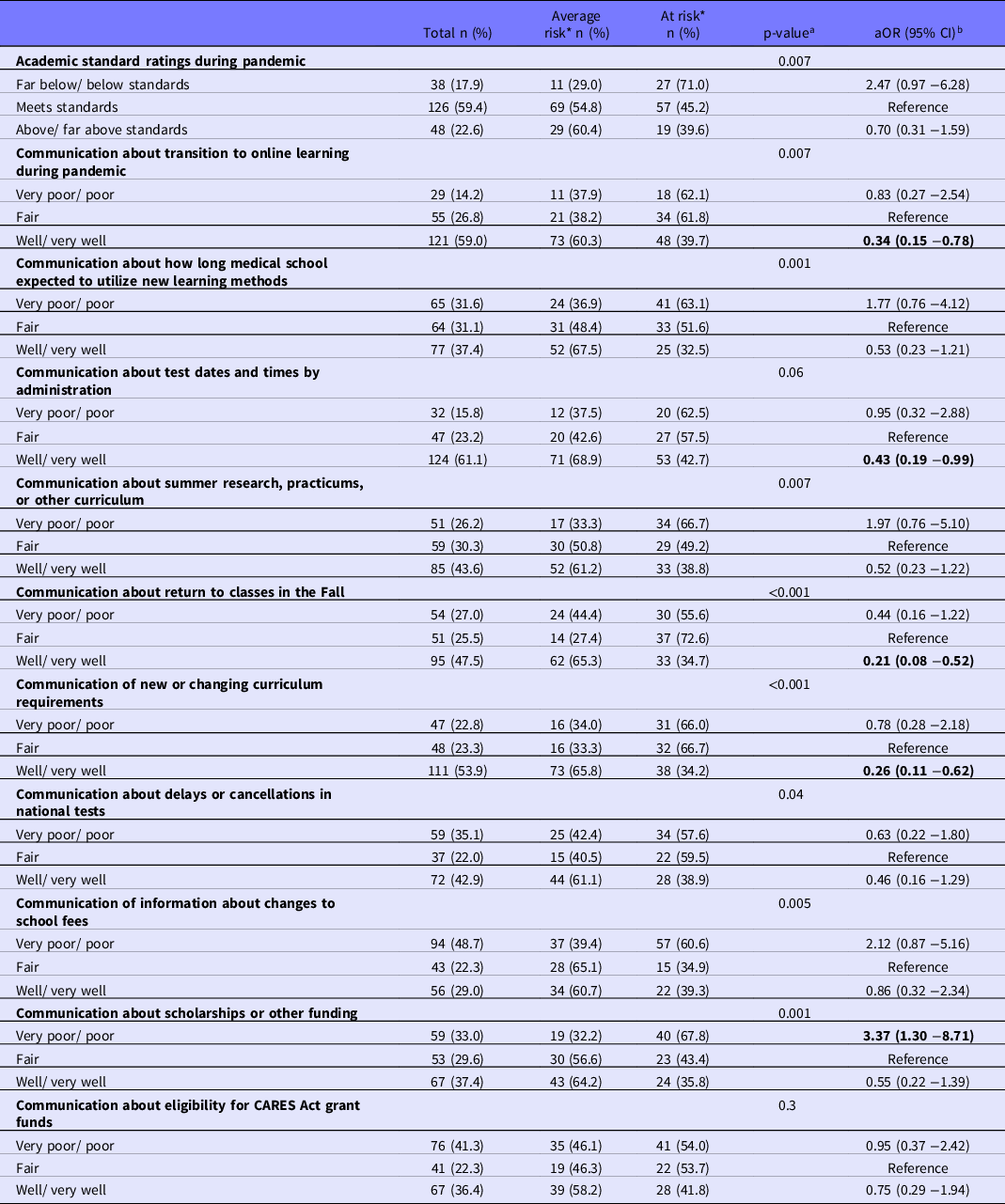
There were differences in schools’ communication about online learning by depression risk (Table 2). Students at risk of developing depression reported communication was poor at a higher frequency compared to average risk students. After controlling for variables associated with the risk of developing depression in bivariate analyses, students had lower odds of being at risk for depression if they felt their universities did a good job communicating: the transition to online learning, test dates and times by administration, plans to return to classes in the Fall, and new or changing curriculum requirements. Students who felt communication about scholarships or other funding was poor had more than 3 times the odds of being at the risk of depression in adjusted analyses.
Description of how well medical school communicated with students by risk of developing depressive disorder (N = 212)

aOR= adjusted odds ratios; 95% CI = 95% confidence interval
*Center for Epidemiological Studies of Depression, short-form (CESD-10), contained 10 questions with responses ranging from 0 to 3. The “average risk” score was < 10 and the “at risk” score was ≥ 10. This cutoff of depressive symptomology for this measure is established in the literature.
aChi-Square test p-value for unadjusted bivariate analyses.
baOR adjusted for year in medical school, change in coping, and change in depressive symptoms.
Bold odds ratios indicate significance at P < 0.05.
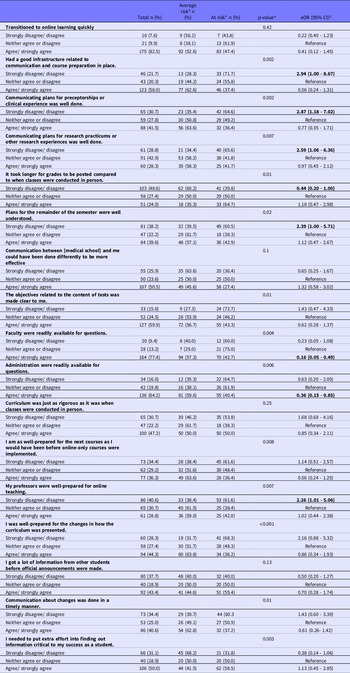
Student agreement or disagreement with statements about their medical school’s communication and response during the SARS CoV-2 pandemic period by risk of developing depressive disorder (N = 212)

aOR= adjusted odds ratios; 95% CI = 95% Confidence Interval
*Center for Epidemiological Studies of Depression, short-form (CESD-10), contained 10 questions with responses ranging from 0 to 3. The “average risk” score was < 10 and the “at risk” score was ≥ 10. This cutoff of depressive symptomology for this measure is established in the literature.
aChi-Square test p-value for unadjusted bivariate analyses.
baOR adjusted for year in medical school, change in coping, and change in depressive symptoms.
Bold odds ratios indicate significance at P < 0.05.
Most students felt universities transitioned quickly to online learning, and that the curriculum was rigorous (47.2%) or were neutral (22.2% ; Table 3). They also felt communication could have been done differently to be more effective (50.5%). In adjusted analyses, students were more than 3 times the odds of being at risk for developing depression if they disagreed that: their university had a good infrastructure for communication and course preparation in place, that plans for preceptorships or clinical experience were well done, or that communication about plans for research practicums or other research experiences were well done. Students had more than 2 times the odds of being at risk for developing depression if they disagreed that: plans for the remainder of the semester were well understood or that their professors were well-prepared for online teaching. Students who disagreed that their universities took longer to post grades during online learning had lower odds of being at risk for depression. Students who agreed that faculty were readily available for questions or that administration staff were readily available for questions had lower odds of being at risk of developing depression.
Discussion
A substantial proportion of medical students who participated in this survey were at risk of developing depression. Depression among US medical students ranges from 21.7% to 59.1% according to studies with a cutoff score of ≥16 on the CESD-20. Reference Rotenstein, Ramos and Torre11 Among the medical students sampled early in the pandemic, 24% were found to be depressed. Reference Halperin, Henderson and Prenner3 Although the observed rate of 48.6% falls within previously reported limits, it is still problematic as close to 50% of medical students in this sample were at risk of developing depression. These students need resources and guidance to address the distress they are feeling. A particularly high rate of first year students were at the risk of depression (61%) during the 2019 - 2020 academic year. These students may have been particularly vulnerable, as previous research found students had the lowest physical, emotional, and overall health at the end of year 1, and at the time of this survey, many participants would have been in the first part of their second year. Reference McKerrow, Carney and Caretta-Weyer12 The addition of physical isolation from their fellow students may have exacerbated the stress encountered by these first year students. Inclusion of virtual meetups organized by student societies or by universities may help, but depressed students may have difficulty utilizing such opportunities. Facilitating the process of moving back in with their families may offer more support if remote education becomes necessary again in the future. Universities may need to proactively push for federal policies that can fund and make allowances available for medical students to participate in medical education across state or country borders during periods of time when remote education is the only way to maintain student health and safety.
Students who felt that communication about scholarships or other funding was poor or very poor had more than 3 times the odds of being at risk of developing depression. Students who depended on loans or external funding, such as scholarships for higher education, were more likely to experience anxiety and stress that could lead to depression. Reference Brenneisen Mayer, Souza Santos and Silveira13–Reference Phillips, Wilbanks and Salinas15 This study indicates it is important for medical schools to communicate regularly with students who rely on scholarships or other funding. It is also possible that students who felt more depressed were more likely to need financial assistance with tuition, or were more likely to perceive their universities’ communication about scholarships and other funding as poor. Regardless, these results indicate the importance of strong communication with students about funding. Although it may be difficult to provide individualized communication with students, messages about funding, providing reassurance to students on a regular basis with general information and acknowledgment of the administrations’ awareness about the importance of this issue could help alleviate some student anxiety. Future research could focus on the development of solutions to this issue of communication and evaluate the optimum intervals between information offerings to improve reassurance without causing a communication burn-out for students.
Most communication between medical schools and their students took place via email, however, in situations that cause stress, medical schools may consider utilizing a variety of methods for communication with students. College students who used computer mediated communication in a previous study preferred synchronous and interactive methods of online communication such as instant messaging, and social networks. Reference Vrocharidou and Efthymiou16 These previous findings, combined with students freely reporting satisfaction in this study with remote town halls, suggest future paths for strengthening communication to alleviate communication - related anxiety among medical students during times of uncertainty or in emergency situations. Reference Vrocharidou and Efthymiou16 Town halls may provide a forum for students to ask questions or provide suggestions to improve communication and how the curriculum is offered or adjusted in a way that is appropriate for each university’s program, enabling them to feel more empowered in the decisions related to their future. Furthermore, using these opportunities to discuss how to identify stress and depression, how to address it with classmates or family, share experiences with mental health struggles, and understand what services are available may assist with the normalization of discussing mental health issues, and thereby encourage help-seeking. Reference Brower17 Training faculty preceptors or facilitators to recognize and address mental health in small group settings, such as problem-based learning groups could also help to identify and normalize help-seeking among students.
There is evidence that even short programs aimed at reducing stress through group stress management and self-care workshops for medical students can decrease stress and increase mindfulness. Reference Greeson, Toohey and Pearce18 Similar programs that enhance communication between medical students and their universities could be developed and adapted for remote access, as well as in-person access. As medical students are at a heightened risk of experiencing poor mental health, it is important that interventions are not temporary, as it is apparent that medical students need mental health services, especially during disaster events.
In general, most students felt that their universities communicated well regarding the changes in curriculum during the COVID-19 pandemic. In particular, good communication about curriculum expectations and anticipated changes was associated with lower odds of having an elevated risk of developing depression. As concerns about the learning environment and academic performance are associated with increased anxiety and stress among students, it is reassuring that good communication about these issues is associated with lowered odds of being at risk for depression. Reference Damiano, de Oliveira and Ezequiel10
This study was developed with direct input from medical students. The concern they felt about the curriculum and communication was reflected in the questions, as well as their response to the survey. Future research should focus on the quantity and quality of communication between medical schools and students, as well as mental health among medical students with methodology informed by both medical students and medical school administration. In addition, future research should evaluate how the COVID-19 pandemic affects the cohort of students that were represented by this survey. Maintaining the well-being and health of these future healthcare providers is critical to ensuring the continuity of a quality healthcare system.
Limitations
The strength of this study lies in the national recruitment in the US, with students being eligible to participate even if their universities did not send email invitations. Several universities were represented, but the results of this study may not have reflected the experience of all medical schools. Although the sample is small, it may be representative of a significant population of medical students. Biases may have existed within the sample as participants who felt that there were issues with their medical school’s communication may have been more likely to participate than those who felt that their institutions responded well to the pandemic. The sample had a high proportion of first and second year students, so the experiences of more advanced medical students may not have been adequately captured.
Conclusion
In conclusion, universities appeared to do a good job communicating with their students during the pandemic. However, this study also highlights the need for ongoing efforts to address mental health by medical schools, and to better understand the effects of disasters, not just the COVID-19 pandemic, on their well-being. Improving communication on this issue through normalizing help-seeking behavior, offering more interactive forms of communication, particularly during disasters, and ensuring that communication about funding is clear may assist medical students in feeling less stress related to their education, and begin to address high rates of depressive symptoms in this population.
Acknowledgments
We would like to acknowledge the 26 medical schools that informed their students about the survey via email, including those faculties who helped the authors of this manuscript with submitting studies to committees or IRBs in a manner consistent with their university’s policies for gaining approval for surveys originating outside their own institution.
Conflicts of interest
The authors have no conflicts of interest to declare.