Introduction
In the last two decades, two strands of social science research have significantly advanced our understanding of the institutional configurations of advanced industrial societies. The first strand of literature, profoundly influenced by Esping-Andersen's seminal The Three Worlds of Welfare Capitalism (1990), has stressed cross-national differences among welfare-states and identified distinct types of welfare regimes across the world. The second (e.g. Deeg and Jackson, Reference Deeg and Jackson2007; Hall and Soskice, Reference Hall, Soskice, Hall and Soskice2001; Whitely, Reference Whitely1999; Hollingsworth and Boyer, Reference Hollingsworth and Boyer1997) has stressed the embeddedness of national business practices in their cultural and institutional context, with the Varieties-of-Capitalism (VOC) literature elucidating the institutional foundations of diverse national ‘varieties’ of economic systems or, more narrowly, production regimes. Subsequent research (e.g. Schröder, Reference Schröder2009; Iverson, 2005; Ebbinghaus and Manow, Reference Ebbinghaus, Manow, Ebbinghaus and Manow2001) has started to bridge these two strands of literature by investigating the links between particular forms of social protection and economic systems or national systems of production. The latter literature has focused primarily on the static aspects and positive relationships between those domains, while institutional changes have received comparatively little attention (Deeg and Jackson, Reference Deeg and Jackson2007; Rhodes, Reference Rhodes2005). By focusing explicitly on such changes, this article hopes to contribute to our understanding of the dynamics that shape relationships between national forms of social protection and their economic systems.
Existing research has shed some light on the distinct links and complementarities between Japan's economic system (‘The Japanese Model’) and features of its system of social protection (e.g. Estévez-Abe, Reference Estévez-Abe2008; Miyamoto, Reference Miyamoto2008; Takegawa, Reference Takegawa2007), but there is as yet limited understanding of the changes that have modified these links since the burst of the so-called bubble economy at the beginning of the 1990s. While this article focuses on the case of Japan's occupational pensions to investigate such changing dynamics, our theoretical framework and findings will hopefully contribute more widely to a general understanding of factors that shape changes in the welfare regime-economic system nexus.
A key assumption of this article is that institutional complementarities between social protection and economic systems influence the nature of any adjustments to these arrangements. Our key argument is that such complementarities define ultimately the limits of such changes, while an analysis of social actors’ cost–benefit calculus helps us to explain the particular nature of the changes within these boundaries.
The article proceeds as follows. Following some methodological remarks, we discuss the existing literature on links between social protection and economic systems, focusing primarily on the role of Japan's occupational pensions. Against this backdrop, we subsequently develop a theoretical framework for the study of the dynamics of such links. Applying this framework to recent changes in Japanese occupational pensions, the penultimate section presents the findings of an interview-based research project. The final section consists of an overall conclusion.
Methodological remarks
In addition to Japanese secondary statistical, ministerial and academic sources, this article is primarily based on an analysis of semi-structured interviews with human resource managers of medium- and large-sized Japanese companies, labor union officials, experts in governmental and semi-governmental institutions, actuaries, as well as pension and human resource management experts from research and academic institutions. To avoid a sector bias, specialists were chosen from both manufacturing (automobile, electronics) and servicing industries (transport, utilities). Whenever possible, statements and assessments where crosschecked against those of other informants and secondary sources. The one- to two-hour-long interviews were, with one exception, conducted in Japanese in April 2009 with twenty-two informants at fifteen locations. Two of the informants are members of the official eight-member ‘Occupational Pension Research Group’ (Kigyō Nenkin Kenkyūkai), established by the director-general of the Pension Bureau of the Ministry of Health, Labor and Welfare to discuss and advise the government on issues of occupational pension reform (see the appendix for the anonymous list of informants).
Literature review
Existing research on capitalist diversity has aimed to establish typologies of production and welfare regimes. While the Varieties-of-Capitalism literature has grouped countries according to the way firms respond to different institutional environments of production systems (e.g. Deeg and Jackson, Reference Deeg and Jackson2007; Hall and Soskice, Reference Hall, Soskice, Hall and Soskice2001), Esping-Andersen's (Reference Esping1990, Reference Esping-Andersen1999), welfare regime analysis has focused on how welfare benefits are distributed across countries based on the rights and duties of individuals. Both of these typologies arrive at very similar country groupings with most liberal market economies (LME) being accompanied by ‘liberal’ welfare states, and coordinated market economies (CME) being accompanied by either social democratic or conservative welfare arrangements (Schröder, Reference Schröder2009).
Scholars such as Iversen (Reference Iversen2005), Iversen and Soskice (Reference Iversen and Soskice2001) and Huber and Stephens (Reference Huber and Stephens2001) have argued that a large welfare state constitutes an important, if not definitional, component of CMEs. The underlying argument is that firms and workers in CMEs engage in human capital investment strategies that are based on long-term employment relationships. For employees to be willing to invest in firm-specific skill development, job security is a critical factor. Voters in CMEs are therefore likely to demand insurance against income loss via strong redistributive and social insurance polices to balance the risks of unemployment in CMEs where workers’ firm-specific skills contribute to inflexible external labour markets and lower chances of re-employment.
With regard to this argument, the Japanese case presents something of a puzzle. While the country is widely considered to be an important example of a CME – with long-term mutually cooperative relationships between firms and labour, between firms and banks and between different firms (e.g. Dore, Reference Dore2000; Aoki, Reference Aoki1988) – its comparatively lean welfare state with little extension of social rights independent of market mechanisms (‘de-commodification’) prompted Esping-Andersen (Reference Esping-Andersen1997) to classify the country as a hybrid combination of liberal and conservative-corporatist welfare regime elements. That is, low public expenditure levels and comparatively heavy reliance on private welfare suggested to him a closer relationship to the liberal model, whereas employment and status-segmented social insurance schemes, scarcity of public social services due to the dominance of familialism in society and unequal levels of benefits were seen as characteristic of the corporatist model.
Explicitly addressing this puzzle, several scholars (e.g. Estévez-Abe, Reference Estévez-Abe2008; Miyamoto, Reference Miyamoto2008; Takegawa, Reference Takegawa2007; Estévez-Abe et al., Reference Estévez-Abe, Iversen, Soskice, Hall and Soskice2001) have argued that we need to go beyond a traditional welfare state analysis to understand how Japan's work-based and savings-oriented social security programs and their functional equivalents have sustained the country's CME in place of its small welfare state. Key building blocks of these ‘alternative’ arrangements are policies that promote private welfare provision along sectoral lines, policies that protect jobs and income by regulating market competition and policies through which the state creates jobs and training opportunities, especially public works projects.
Japanese occupational pensions are a key component of policies to promote such private welfare provision and have been shown to be highly compatible with common Japanese human capital investment strategies that are based on long-term employment relationships for regular employees. The essence of the compatibility argument is that the so-called ‘three pillars of the Japanese employment system’, namely seniority-oriented pay, long-term employment practices and enterprise-based unions (e.g. Debroux, Reference Debroux2003), have supported dominant work practices such as frequent job rotations, broad job descriptions, teamwork and on-the-job training that are crucial for the development of firm-specific skills. As an integral part of the seniority-oriented pay systems, occupational pensions have complemented these employment practices by providing incentives for cooperative industrial relations and long-term-oriented employment and by giving companies access to stable funds for internal long-term investment strategies (Estévez-Abe, Reference Estévez-Abe2008). Reflecting the typically fragmented nature of welfare schemes in Japan (Miyamoto, Reference Miyamoto2008), it is important to note, however, that only regular workers are commonly eligible for occupational pension benefits.
In order to illuminate the above-mentioned interdependencies in closer detail, we need to consider the reasons and influencing factors that prompt companies to provide occupational pension benefits and how they apply to the Japanese case.
A major motive of firms to pay occupational pensions is to influence the recruitment, retention as well as retirement of workers. According to Logue and Rader (Reference Logue and Rader1998), there is no definitive theory or robust empirical research that would indicate why certain types of pension plans are favoured over others, but a common assumption is that the choice is influenced by considerations of employer-specific human capital. Firms that rely heavily on company-specific knowledge are likely to adopt defined benefit (DB) plans with back-loaded final-pay formulas (benefits based on average earnings during a specified number of years at the end of a worker's career with the benefit equalling a percentage of the worker's final average earnings multiplied by the number of service years) where workers have an incentive to sustain their efforts over their entire career so that they can achieve high career-end salaries. The major advantage of DB plans from an employee's perspective is that they provide a stable replacement rate of final income. As real wages change, employers have to adjust their funding rates and thus bear the investment risks in these plans.
In contrast, companies that rely more heavily on workers with specialist knowledge from the external labor market are more likely to prefer defined contribution (DC) plans that are not as heavily back-loaded and more easily portable if an employee changes jobs (Bodie et al., Reference Bodie, Marcus, Merton, Bodie, Marcus and Merton1988). In a DC plan, employers make provision for periodic contribution payments into an account that is established for each participating employee. Depending on underlying regulations, contributions can be made either by the employer, the employee or by both parties. The final benefits are a reflection of the total of all contributions and any investment gains or losses. Benefits are thus not specified in advance and the employer does not shoulder any investment risk.
A third plan type are cash balance (CB) plans, which combine features of traditional DB and DC plans. In a CB plan, the employer credits a participant's account with an employer contribution plus interest credit. Such individual accounts make the plan look like a DC plan, but the funding limits, funding requirements and investment risk are based on DB requirements. Changes in the portfolio do not affect the final benefits of the participants upon retirement or termination. In other words, just like in a DB plan, the company solely bears all ownership of profits and losses in the portfolio. Employer contributions can be credited in several ways, for example as a fixed amount, a fixed percentage of earnings or through point systems that link factors like ‘job grade’, ‘abilities’, ‘number of years of employment’ or ‘performance’ to specific pay credits. Members’ accounts grow by these annual pay credits and an interest credit at either a fixed rate or a variable rate linked to an index such as the government bond rate. If the plan adopts a variable interest rate, the employer's risk is more limited. A key difference between DB, DC and CB plans is the benefit accrual. DB plans provide for larger benefit accruals later in an employee's career, while benefits in DC and CB plans accrue earlier (see Rappaport et al., Reference Rappaport, Young, Levell, Blalock, Gordon, Mitchell and Twinney1997 for more details on CB plans).
The adoption of a particular type of occupational pension plan is thus a strategic choice for a certain type of incentive structure. Furthermore, this choice is likely to be influenced by government regulation, which can make such schemes attractive to both sponsors and employees by providing a favourable tax treatment resulting in deferred or even permanently reduced taxes (Logue and Rader, Reference Logue and Rader1998).
Before the occupational pension reforms of the early 2000s, which will be discussed in the findings section, Japanese employers used basically three types of DB-type retirement provisions: lump-sum retirement payments via Book-Reserve Plans (BRPs), pension payments via Tax-Qualified Pension Plans (TQPPs) and Employee Pension Funds (EPFs). The beneficiaries of these plans were workers who were covered by implicit long-term employment promises and seniority-oriented wage structures. Similar to the prevailing seniority-oriented wage structures, these DB-type plans rewarded loyalty to the company with disproportionally increasing benefits after long years of tenure, while voluntary quitting was heavily penalised by sharply reduced benefits (Maruyama, Reference Maruyama1995). These arrangements were supported by government regulation, which restricted tax benefits solely to pension plans that were designed as DB schemes, while DC plans did not receive any preferential tax treatment and attracted consequently only a small number of participants (Estévez-Abe, Reference Estévez-Abe2008; Watanabe, Reference Watanabe1998).
Government regulation played an important role in shaping the institutional foundations of the EPFs, which were first introduced in 1966. In the late 1950s, employers lobbied for changes in the tax code to spread the annual expenses for retirement benefits by replacing lump-sum payments through BRPs with new occupational pensions in form of EPFs. However, this idea was first rejected by the Ministry of Health and Welfare because the bureaucrats feared that such an improvement of occupational pensions would negatively impact their plans for increases in the benefit levels of the main public pension insurance, the Employees’ Pension Insurance (EPI). It was feared that improved occupational pensions would result in less political backing for higher public pension benefits in the EPI as they were advocated by the Ministry of Health and Welfare. Eventually, in a political compromise, firms were allowed to contract out of the earnings-related component of the public EPI in return for a general increase in EPI benefits (Shinkawa, Reference Shinkawa, Bonoli and Shinkawa2005). This means in practice that a firm with an EPF pays a reduced social security contribution to the public pension system in exchange for providing a pension benefit that substitutes the earnings-related part of the public EPI. In addition to this substitutable component (daikō bubun), the EPF is required to pay a supplementary component (fuka bubun), which up to the year 2001 had to be at least 30 per cent of the substitutable benefits accrued while working for a firm. The nature of these arrangements illustrates how the Japanese state ‘outsourced’ public pension obligations to the private sector (Miyamoto, Reference Miyamoto2008).
A third important factor influencing employers’ interest in pension schemes is the schemes potential as a measure to preserve industrial peace vis-à-vis the trade unions (Esping-Andersen, Reference Esping-Andersen and Shalev1996; Bridgen and Meyer, Reference Bridgen and Meyer2005). During intensive labor conflicts following World War II, Japanese employers struggled to reestablish their control over the workforce until the early 1950s. During this period, employers used generous BRPs as an incentive for unions to sign revised labor agreements that aimed at curtailing radical labor movements by limiting union membership to employees of the firm (Estévez-Abe, Reference Estévez-Abe2008). Through the dissemination of BRPs, employees were ‘forced’ to invest their retirement income in their employers and were thus made into ‘stakeholders’ in their companies’ fortunes. By the mid-1960s, a new kind of cooperative industrial relations had emerged which emphasised a company-level long-term alliance between workers and management. Beginning in the late 1960s, companies replaced BRPs, which remained attractive as a source for internal capital for reinvestments, partially by TQPPs or EPFs, which were comparatively more attractive in terms of their tax treatment. However, just like BRPs, these schemes offered limited portability of pension rights and continued to strengthen thereby the long-term employment relationships.
The above discussion has highlighted some of the stable and complementary aspects of Japan's employment practices and occupational pension arrangements. In addition to these links, it can be argued that BRPs and DB plans had wider ramifications for Japan's financial system and corporate governance practices, reinforcing feedback effects. The internal reserves of BRPs can be used to reduce a firm's external liabilities or to finance new investments, thereby contributing to its financial autonomy by cutting dependence on external finance via equity markets. DB plans tend to invest in more conservative investments with a guaranteed minimum return, whereas DC plans are expected to have a stronger demand for high-return equities. The latter are therefore likely to press more for shareholder-value-oriented corporate governance. Japanese BRPs and DB plans, whose assets have been administered by life insurance companies and trust banks, have thus been closely linked to the country's bank-based financial system, which has been characterised by stable shareholdings and stakeholder-centered, rather than shareholder-centered, corporate governance practices (Jackson and Vitols, Reference Jackson, Vitols, Ebbinghaus and Malow2001).
While this literature review has highlighted some of the most striking complementarities between Japan's occupational pension arrangements and its employment practices, financial system and corporate governance patterns, it is important to stress that these relationships are by no means as stable as the VOC literature might suggest (Deeg and Jackson, Reference Deeg and Jackson2007). In fact, Japanese companies are, just like those in other industrialised countries, confronted with growing cost pressures and changing regulatory environments which have induced various corporate reforms. For example, recent research has established that Japanese firm- bank relationships, corporate finance and governance patterns, as well as inter-firm relationships, have undergone substantial transformations since the 1990s (e.g. Aoki, Jackson and Miyajima, Reference Aoki, Jackson and Miyajima2007).
A depressed stock market and declining interest rates following the burst of the bubble economy in the early 1990s contributed to a rapid increase in underfunding of the prevailing Japanese DB plans. Data from the Pension Fund Association show that in the period 1989–2003, the average return on assets managed by EPFs was just 2 per cent in nominal terms, while the government set guaranteed rate was 5.5 per cent (Kigyō Nenkin Rengōkai, 2003). Furthermore, new accounting standards that were introduced in April 2000 made these unfunded pension liabilities for the first time visible on companies’ balance sheets and damaged their stock market valuations (Kigyō Nenkin Kenkyūkai, 2007; Shiniapuran Kaihatsu Kikō, 2004).
Against the backdrop of these cost pressures, it is natural to assume that Japanese companies would seek to restructure their occupational pension arrangements. The key question is how we can explain the nature of any such changes with reference to the pertaining complementarities between occupational pension arrangements and other business practices.
Theoretical framework
Ebbinghaus and Manow (Reference Ebbinghaus, Manow, Ebbinghaus and Manow2001) argue that existing institutional complementarities provide institutional advantages under international competition. Employers are therefore likely to opt for adaptations in industrial relations and social protection that maintain these beneficial production regimes. Vogel (Reference Vogel2006), building on insights from New Institutional Economics, the VOC literature and economic sociology, outlines a theoretical framework according to which actors consider changes based on a cost–benefit calculus on three levels of rationality. The first level is an analysis of the immediate costs and benefits of an action. On a second level, actors consider the wider cost and benefit ramifications, such as implications for other practices. This is essentially the perspective of the VOC literature. On a third level, which adds a sociological perspective, actors will consider social and reputational costs and benefits. These three circles of rationality overlap in practice and it is difficult to prove one logic of rationality to be more important than another, but this model can be useful to specify how different actors and their cost–benefit calculus might shape outcomes. Applying this theoretical framework to an analysis of changes in Japanese occupational pensions, we will discuss in the findings section the specific cost–benefit calculus of the country's employers, employees and the civil service.
While a cost–benefit calculus influences actors’ perceptions of what appear to be possible or desirable changes under any given circumstances, there is also the question how such outcomes can be achieved in the reform process. In particular from the employers’ perspective, it is helpful to refer here to Pierson's (Reference Pierson1996) seminal paper The New Politics of the Welfare State in which he develops hypotheses about the preconditions under which politicians may be able to advocate retrenchments of welfare programmes. While Pierson's analysis focuses on politicians and public benefits, some of his insights apply equally to actors and benefit programmes in the private sector. Pierson argues that budgetary crisies can open up opportunities for reform, because advocates of retrenchment can ‘exploit such moments to present reforms as an effort to save the welfare state rather than destroy it’ (Pierson, Reference Pierson1996: 177). In the analysis below, we will investigate to what extent Japanese employers have used such negotiation strategies while restructuring their benefit programs.
Findings
General trends in occupational pension provision since the early 2000s
As mentioned above, underfunding problems caused by depressed stock markets in the latter half of the 1990s and changes in accounting standards in the year 2000 put increased cost pressures on Japanese occupational pension plans. In response to these problems, the Japan Federation of Economic Organisations (Keidanren) and the Japan Federation of Employers’ Associations (Nikkeiren) lobbied for new tax-exempt benefit options such as DC plans and options to leave the semi-public EPFs (e.g. Keidanren, 1996). Such new options were at first not welcomed by the overseeing bureaucrats of the Ministry of Health and Welfare, since they were expected to weaken the dominant position of the semi-public EPFs, but private sector pressure led eventually to substantial regulatory reforms in the years 2001/02 (Kigyō Nenkin Kenkyūkai, 2007; informants 1, 6, 16). The new legislation was enacted in two separate laws. The first law changed the rules governing DB plans, including an option for EPFs to return their assets related to the contracted-out portion of the public EPI back to the government, the introduction of hybrid CB plans and other types of new DB plans, as well as the scheduled elimination of TQPPs until 2012. The second law introduced DC plans with a modest level of employer contributions under tax-exempt status.
The new legislation presented various new options for pension program restructuring and many large companies engaged subsequently in such activities. Before discussing the factors that shaped these changes, let us first take a brief look at overall developments. Although the percentage of companies paying retirement benefits decreased slightly after 2001/02, 84 per cent of companies with more than thirty employees continue to pay such benefits (Kōseirōdōshō, 2008), which make up 6.8 per cent of total labour costs in manufacturing (JILPT, 2008).
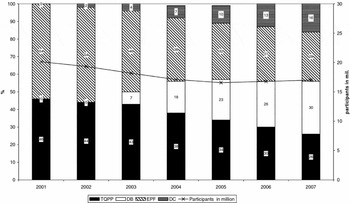
The number of active pension plan participants declined from 20.1 million in 2001 to 17 million in 2007, while DB- and DB-type benefits remain, in relative terms, the dominant form of retirement benefit (Figure 1).
Occupational pension plan participants (relative and absolute numbers)

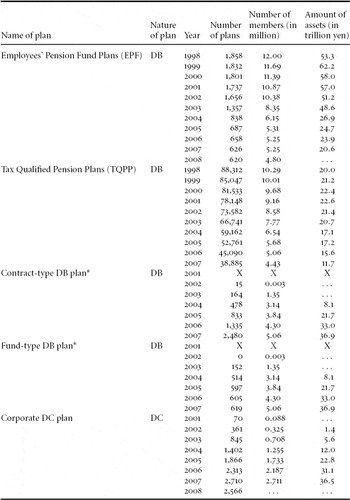
While the number of EPFs and TQPPS has declined substantially since the early 2000s, these plans were to a large extent compensated for by newly introduced DB and DC plans (Table 1).
Indicators of major Japanese occupational pension plans (1998–2008)

Notes: X = not applicable; . . . = not available; *Numbers for members and amount of assets do not distinguish between contract-type and fund-type plans.
Sources: Life Design Kenkyūjo, 2000; Nomura Research Institute, 2007; Kigyō Nenkin Kenkyūkai, 2008; Kigyō Nenkin Rengōkai, 2008.
While there were 1,737 EPFs with 10.87 million participants in 2001, only 620 plans with 4.8 million members remained in 2008. About 50 per cent of former EPFs were converted into new DB plans, during which process the companies returned their obligations for the contracted-out portion of the public Employees’ Pension Insurance back to the government (Kōseirōdōshō Nenkinkyoku, 2009). This has had the effect of removing large pension liabilities from corporate balance sheets (Sato, Reference Sato2005) and has fundamentally altered the state-enterprise welfare mix since almost all large companies have now left the semi-public EPFs, with only smaller companies remaining.
Given the scheduled elimination of TQPPs by 2012, it is not surprising that these plans, which are most dominant among smaller firms, have also experienced a significant decline since the 2001/02 reforms. Both in terms of the number of plans and participants, TQPPs have declined by one-half. However, just like in the case of the EPFs, many of these schemes were transferred into the newly available types of DB or DC plans.
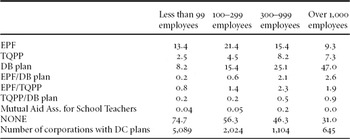
The most significant development with regards to medium- and large-sized companies is that these companies have largely left the semi-public EPFs and have replaced them with multi-layered retirement benefit systems that offer a combination of DB and DC benefits. In contrast, over 50 per cent of companies with less than 300 employees offer now only DC plans (Table 2).
Occupational pension plans offered in addition to DC plans (in %)

Source: Kigyō Nenkin Kenkyūkai, 2008.
Actors’ cost–benefit calculus and pension restructuring
Employers
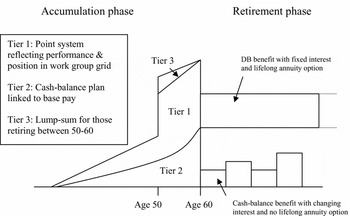
All of the informants agreed that cost considerations were the most important factor driving employers’ pension restructuring efforts. However, while employers in liberal market economies like the United States or the United Kingdom have drastically reduced DB plans in the last two decades to minimise companies’ costs and risk exposure (US Department of Labor, 2008; Office for National Statistics, 2008), this has clearly not been the case in Japan. Here, medium- and large-sized employers have instead often created new multi-layered retirement benefit systems in which DB benefits continue to play a dominant role. Forty-seven per cent of large companies have adopted DC plans in addition to the existing DB plans, thus only partially replacing DB benefits with DC schemes. The percentage of DC benefits within the new retirement benefit packages varies, but does usually not exceed 10–25 per cent (informants 12, 13, 14, 19). A good example of such restructuring efforts is the electronics giant Panasonic (formerly Matsushita). In 2002, immediately after this option became available, Panasonic left the semi-public EPF. Up until then, retirement benefits (consisting of a lump-sum and an EPF pension) were primarily a reflection of age and length of service as part of a final salary system. Beginning in 2002, Panasonic started to operate a multi-layered retirement benefit system (Figure 2).
Panasonic's retirement benefit system (since 2002)

For the first tier, it adopted a point system, which reflects both individual performance evaluations and the position of employees in a grid system of ‘work groups’, linking this point system to benefits paid through a DB plan. As a second tier, it introduced a CB plan, whose benefits were linked to the development of employees’ base pay. As a third tier, it maintained a lump-sum benefit for employees retiring between 50 and 60 years of age. Other large companies adopting similar complex pension systems include, for example, Tokyo Electric Power Corporation and Daihatsu Motor Corporation (Nihon Keizai Shinbun, 2008a).
What explains the resilience of DB plans in Japan? If we refer to the theoretical framework in the previous section, it is evident that immediate costs and benefits are only one factor influencing Japanese actors. To understand the recent changes, the importance of the historical legacy of Japanese occupational pensions can hardly be overestimated. All of the informants agreed that current developments could only be understood with explicit reference to the system of lump-sum retirement payments (BRPs) and underlying entrenched views that retirement benefits − regardless of their financing mode as BRPs, TQPPS or EPFs − have so far been considered a form of deferred wage. This social consensus has functioned as a departure point for management and labour and is one important explanatory factor for the resilience of DB benefits.
While Japanese employers have undoubtedly sought to reduce their cost and risk exposure since the early 2000s, they have been careful not to alienate long-term employees by toppling existing incentive structures (informants 2, 3, 4, 1, 14, 15, 16, 18, 19, 20, 21, 22). Such social constraints, whether real or perceived, have shaped the institutional innovation of the newly evolving multi-layered retirement systems. As part of a careful reform approach, Japanese employers have reduced their direct costs and risks by partially replacing DB with DC benefits and by tying the existing DB benefits closer to employees’ performance factors. The latter change reflects a general trend in Japanese wage systems in recent years, where seniority factors have also been partially replaced by performance factors (Conrad, Reference Conrad2010). The overall moderate nature of these reforms is confirmed by the fact that companies have rarely reduced the overall contribution levels after reforming their benefit structures (Shiniapuran Kaihatsu Kikō, 2004).
Companies have thus maintained fairly comprehensive pension benefit packages for their regular workers, but at the same time have realised cost reductions by drastically increasing the proportion of non-regular workers that are not covered under any of these schemes (informants 2, 3, 4, 1, 14, 15, 16, 18, 19, 20, 21, 22). The percentage of such non-regular workers in the Japanese labour force has increased substantially from 20.1 per cent in 1994 to 33.2 per cent in 2006 (JILPT, 2009).
Japanese employers have therefore not made any substantial direct benefit cuts for their core labour force, and have frequently communicated the partial shift to DC plans to those employees as an unavoidable strategy to preserve the very existence of occupational pension benefits (informants 1, 7, 8, 13). This is the same implementation strategy that Pierson (Reference Pierson1996) has identified for the retrenchment of public welfare programs.
While all informants acknowledged that shareholder value factors have recently gained in importance in the corporate governance of Japanese companies, none of the informants believed that this had any significant influence on occupational pension arrangements. None of the informants believed that the increase of DC plans could be explained by heightened (foreign) shareholder pressure. This finding is in line with the results of a recent study by Jackson (Reference Jackson, Aoki, Jackson and Miyajima2007: 294) who finds that ‘corporate governance factors had no significant influence on adopting merit pay elements based on individual performance, firm performance, business unit performance, or competitors’ wages’. However, some informants stressed another important issue related to corporate governance. According to this view, traditional BRPs continue to be an interesting option for internal finance, because they make companies less dependent on equity markets and immunise them from stock market movements that can negatively affect companies’ balance sheets (informants 17, 20, 21, 22).
In sum, it appears that from the employers’ perspective the overall cost–benefit calculus regarding BRPs and DB plans is still positive. Dominant concerns appear to be human resource management factors, whereas changes in corporate governance seem to have had little impact. The new multi-layered benefit structures have allowed companies to reduce their cost and risk exposure by mixing DB and DC benefits. The comparatively large DB shares within these new benefit packages continue to function as a mechanism to retain core workers with firm-specific skills and to signal employers’ long-term commitment to prospective future employees. The brunt of companies’ cost-cutting measures has been borne by the increasing number of non-regular workers that are usually not eligible for any occupational pension benefits.
Employees
How did Japanese employees, represented by the labour unions, react towards pension restructuring? Although the labour unions did not involve themselves deeply in the discussions leading up to the 2001/02 pension reforms (informants 1, 4), the resulting legal framework supports strongly their position since any transfers from the old DB to the new DC systems have to be agreed by a high proportion of the participants and the enterprise unions. Depending on the extent of such transfers between two-thirds and three-quarters of the participants as well as the labour unions representing more than one third of the participants have to agree (NRKS and KNMKN, 2008). These stringent standards have certainly limited the possibilities of companies to conduct single handedly far-reaching reforms. Furthermore, the Japanese Trade Union Federation, which consults individual enterprise unions, in principle takes a negative stance towards the introduction of DC plans (informants 1, 8, 9).
However, in some sectors, such as electric machines, represented by the Japanese Federation of Electric Machine Workers’ Unions, the arrival of DC pensions was in fact welcomed as a positive development because these plans allow employees to make their own investment decisions and are easily portable if employees switch jobs (informant 12). This assessment reflects the fact that Japan's labour markets have recently witnessed an increase in mid-career hiring patterns. In the case of mid-career transfers, workers’ opportunity costs are lower in DC plans because their benefits are more easily portable to a new employer than DB benefits (informants 3, 12).
Overall, Japanese unions have not categorically blocked occupational pension reform at the company level. In many cases, they have cooperated with management and eventually agreed to the partial introduction of DC pensions (informants 2, 4, 7, 8, 9, 11, 12, 13, 14, 15, 17, 19). None of my informants could recall cases in which company unions had fundamentally opposed such reforms. Several informants stated that the labour unions had usually compromised on the pension issue in return for, in the unions’ view, more important issues such as job security or the maintenance of corporate pension systems (informants 1, 7, 8, 9, 13, 14). Overall, the unions’ stance towards recent pension restructuring appears to be a reflection of the prevailing labour market duality in Japan, which is characterised by little solidarity between regular and non-regular workers. Regular long-term workers, represented by the unions, have a particular interest in the long-term profitibility and survival of their companies and have therefore agreed to limited benefit reductions. Moreover, they have had an implicit interest in agreeing to the employment of more non-regular workers, who until recently could not even join labour unions, because these workers are normally not eligibile for occupational pensions. By employing more non-regular workers, the benefit cuts of regular workers could thus be kept to a minimum.
Civil service
Lets us finally examine how the interests of the public sector officialdom have influenced recent pension restructuring.
Many political scientists have highlighted the strong agenda-setting and legislative power of the Japanese bureaucracy and its specific interests in securing post-retirement career paths in semi-public agencies (e.g. Estévez-Abe, Reference Estévez-Abe2008; Johnson, Reference Johnson1995). The occupational pension reforms of the years 2001/02 confirm the important role of the bureaucracy in the policy-making process, but also show that the reforms were not single handedly initiated or shaped by the ministerial civil service.
In the context of the financial deregulation initiative (the so-called ‘Financial Big Bang’ reforms) of the ruling administation under prime minister Hashimoto Ryūtaro, the business community, represented by the Japan Federation of Economic Organisations (Keidanren) and the Japan Federation of Employers’ Associations (Nikkeiren), as well as the Administrative Reform Council of the ruling Liberal Democratic Party (LDP), have supported the introduction of DC pensions at least since the year 1996 (Keidanren, 1996; Gyōsei Kaikaku Kaigi, 1996). Based on a June 1999 report by the LDP's Subcommitee on Private Pensions, four ministries − the Ministry of Labour (MOL), the Ministry of Health and Welfare (MHW), the Ministry of Finance (MOF) and the Ministry of International Trade and Industry (MITI) − were involved in drafting the pension legislation (Yamazaki, Reference Yamazaki2011).
Running the joint secretariat of the four ministries in its Pension Bureau, MHW played a particularly important role. Prior to the 2001/02 pension reforms, government regulation restricted tax benefits solely to pension plans that were designed as DB schemes. While MHW had orginally rejected employers’ requests for such tax breaks for occupational pensions, the eventual political compromise saw the introduction of EPFs in the year 1966. In retrospect, these arrangements turned out to be quite beneficial for this ministry. On the one hand, the resulting public–private pension mix corresponded well with the widely publised pension-mix model of the World Bank (1994) to which Japan also subscribed during the 1990s. In the related political discourse, MHW could cite comparatively generous occupational benefits as a reason not to extend public pension provision, or even to cut such provision. On the other hand, the semi-public nature of the occupational EPFs gave ministerial bureaucrats fairly close control over their design and management.
In the late 1990s, MHW had mixed feelings about the planned pension changes. On the one hand, it acknowledged that companies had substantial difficulties financing their pension schemes and that they needed more flexible options, including DC plans. Improving the menu of occupational pension choices was also seen as an important way to enhance private pension provision in light of necessary public pension cuts. On the other hand, MHW considered and continues to consider EPFs and DB pensions as an integral component of a well-balanced public–private pension mix (informant 6).
The MOF had similarily conflicting interests in the legislation. On the one hand, it considered – in line with MITI's view – DC plans as an important instrument to deregulate and develop Japan's financial markets as part of the Big Bang reforms; on the other hand, it feared and continues to fear that high tax-free contribution ceilings would result in declining tax revenues (Yamazaki, Reference Yamazaki2011; Nihon Keizai Shinbun, 2008b). In 1999, the tax issue led to a stalemate between the MHW, MOL and MITI, which favoured more generous tax exemptions, and the MOF, which was opposed to them. The final decision on the tax exemption had thus to be taken by the LDP's tax commission (Yamazaki, Reference Yamazaki2011).
Despite differing ministerial interests in the particulars of the pension legislation, the overall cost–benefit calculus favoured inter-ministerial support for the new DC pensions, even though these developments would prove to have negative implications for the possible post-career paths of ministerial officials. In the past, retired bureaucrats from MHW and the Social Insurance Agency had numerous re-employment opportunities (as so-called ‘descendants from heaven’ or amakudari) related to the management of the semi-public EPFs in conjunction with the Employees’ Pension Fund Association (EPFA)(Kōsei Nenkin Rengōkai). With the dramatic decline of EPFs, these job opportunities have dropped markedly and the EPFA had to be reestablished as the Pension Fund Association (PFA) (Kigyō Nenkin Rengōkai) in October 2005. This new organisation is under less ministerial control than its predecessor, but reportedly still has a strong self-interest to maintain the remaining EPFs and to organise the transfer of TQPPs into other DB-type plans, not least to secure employment opportunities for retired bureaucrats (informant 17).
There can be no doubt that government regulation has played a large role in shaping companies’ options for pension restructuring. In fact, some foreign observers have claimed that the resilience of Japanese DB plans is the result of the low tax-free contribution ceilings of the DC schemes. According to Huh and McLellan (Reference Huh, McLellan and 2007: 10), ‘the low contribution caps set forth in the DC legislation prevented many Japanese firms from fully converting their existing DB plans to DC plans, so some firms turned instead to Cash Balance (CB) plans’. However, based on the available statistical evidence and the assessment of the informants, this statement cannot be said to reflect the overall complexity of the issue.
The regulatory environment has undoubtedly exerted a considerable impact on the way companies have restructured their pension plans since 2001/02 and explains to a certain extent the continued popularity of DB plans. However, many of the informants stated that these factors alone could not explain the resilience of DB plans.
It is true that the DC law is rather inflexible and prevents an unlimited transfer to DC plans because it does not allow companies to pay voluntarily taxable contributions beyond the tax-free amounts. Since contributions are in most cases paid as a percentage of wages, which in the main still increase in line with tenure, it is usually the contributions of older workers that can reach the maximum contribution ceilings. Accordingly, many companies have adopted overall contribution rates that allow their highest wage earners to stay within these ceilings (informants 3, 4, 7, 10, 19).
In practice, however, only 29 per cent (2007) of DC plans have chosen amounts that reach the legal maximum contributions (Kigyō Nenkin Rengōkai, 2008). In other words, 70 per cent of companies seem not be directly affected by the tax framework. According to several informants, this underlines that the corporate commitment to DB benefits is real and not solely a function of the tax framework. According to this view, DB pensions are widely regarded as a tax-advantaged way to manage externally what used to be internally managed lump sum benefits (BRP). Higher tax ceilings for DC pensions would not address the fundamental problem that DC pensions are not a suitable vehicle to replace DB-type lump sum benefits (informants 2, 3, 6, 7, 12, 13, 15).
However, other informants voiced the opinion that the contribution ceilings are posing a problem and that many larger companies would in fact like to transfer more DB into DC benefits (informants 10, 11, 16, 17, 19; Nihon Keizai Shinbun, 2008a). The business community has been requesting higher contribution ceilings for some years now and a slight increase is scheduled for 2010. Any major increases or the adoption of a tax framework considering lifetime contributions, as occurs in the UK, seems unlikely (informants 4).
To sum up, the civil service has accommodated employers’ demands for new DC options and allowed companies to dissolve the dominant EPFs by returning the contracted-out portion of the public Employees’ Pension Insurance back to the government. The resulting decline of EPFs has significantly affected former arrangements where public pension benefits were complemented by privately financed but largely state-controlled occupational benefits. Consequently, the bureaucracy's grip on occupational pension provision has weakened considerably. While low contribution caps on DC plans are congruent with some bureaucratic interests, it would be wrong to consider these caps as the only or dominant factor explaining the continued popularity of DB plans among Japanese companies.
Conclusions
This article has discussed the significant changes of Japanese occupational pensions since the early 2000s. Our analysis has shown that these schemes have been key components of policies to promote private welfare provision and have been highly compatible with human capital investment strategies that are based on long-term employment relationships of regular workers. However, since the 1990s, occupational pensions have come under increased pressure due to underfunding problems caused by depressed stock markets and changes in accounting standards that made these underfunding problems apparent. In response to these challenges, Japanese companies restructured their occupational pension arrangements. The nature of these efforts can be explained with reference to existing institutional complementarities with the economic system on the one hand and changes in social actors’ cost–benefit calculations on the other hand. Whereas complementarities, especially with human resource management factors, have ultimately defined the limits of these changes, an actor-centered analysis has helped us to explain the particular nature of changes within these boundaries.
Utilising new legal options, Japanese companies have achieved cost and risk reductions through the partial replacement of DB benefits by CB and/or DC benefits and through an increase in the ratio of workers that are not covered by any retirement benefits. However, compared to recent developments in the US and UK, Japanese DB plans show a relatively strong resilience. After seven years since the introduction of DC plans, only 16 per cent of occupational pension participants are covered by these schemes. A variety of factors contribute to this finding. While explicit and strong employee pressure for the continued use of DB plans has been lacking, government regulation and entrenched views among employees and employers about the nature and purpose of retirement benefits have been shown to be crucial explanatory factors. The evolving multi-layered structure of many companies’ retirement benefit systems, comprising both DB and DC benefits, can be explained as a result of regulatory constraints, on the one hand, and as a purposeful attempt to limit companies’ risks and costs while maintaining at least partially the employers’ responsibility for the social welfare of their core workforce, on the other hand. While companies have sustained pension benefits for these regular workers, they have at the same time increased the ratio of non-regular workers that are not eligible for these benefits.
Acknowledgements
This research was supported by funding from the Great Britain Sasakawa Foundation. I would also like to thank my informants, the reviewers and editors of the Journal of Social Policy, and the following persons for their support and comments on earlier versions of this paper: Miki Arimori, Hugo Dobson, Glenn Hook, Tadashi Nakada, Martin Seeleib-Kaiser, Hiroko Takeda, Susumu Yamamoto.
Appendix: List of informants