

Introduction
The research on comparative judicial politics today, as compared to 20 years ago, is varied, vast, and vibrant. Much of the judicial behavior research in comparative politics focuses on single countries. Single-country studies can be beneficial in certain respects, particularly in terms of depth and detail. However, single-country studies have their limitations for purposes of comparison, particularly with respect to questions about how alternative institutional rules influence judges’ decisions (Hall Reference Hall and Randazzo2018).
One aspect of institutional influence that has received scant empirical attention across countries is docket type. Using court cases from two Scandinavian countries, we examine the effect of docket rules on judicial behavior. Docket type is a key source of institutional variation both across and within judicial systems. Mandatory dockets consist of cases that the courts must adjudicate. Discretionary dockets consist of cases that the courts choose to adjudicate even though they are under no obligation to do so. Existing studies, primarily in the United States, show that variations in docket type can have a substantial influence on the functioning of high courts, the behavior of justices, and the outcomes of cases (e.g., Hall Reference Hall1985; Eisenberg and Miller Reference Eisenberg and Miller2009; Brace, Yates, and Boyea Reference Brace, Yates and Boyea2012).
From this body of research, scholars have suggested (Dyevre Reference Dyevre2010; Grendstad, Shaffer, and Waltenburg Reference Grendstad, Shaffer and Waltenburg2015) that docket type shapes judicial behavior of European courts. However, few studies of the continent have empirically tested this relationship. Nobody has comparatively tested it. This empirical gap is unfortunate because European courts have responded to increasing caseloads either by providing justices with a higher degree of discretionary docket control or by introducing procedures that grant discretionary power to lower-court judges and external case-selection bodies (Andrews Reference Andrews2017; Sunde Reference Sunde2017; Verkerk and van Rhee Reference Verkerk and Rhee2017). Institutional changes in docket control are assumed to be integral in transforming European supreme courts from courts of appeals focusing on decision-making case by case to courts of precedent that clarify and develop law (Sunde Reference Sunde2015). Thus, it is important to study how different docket types affect judicial behavior, to better understand how institutional reforms influence decision-making on the European continent.
In this article, we address this gap and examine the influence of docket type on dissents and reversals, as well as the conditioning effect of docket type on litigants’ status in case outcomes and justices’ preferences regarding their votes. We use a most similar systems research design and analyze data on tax decisions in the Danish and Norwegian Supreme Courts. The Danish and Norwegian courts operate in a similar socioeconomic, political, and legal environment. However, whereas the Norwegian court has near-complete discretionary docket control administered by a rotating panel of three justices over the entire time period, the Danish court has never had complete discretion over case selection. Instead, in tax decisions the Danish court transformed from having a fully mandatory docket to outsourcing discretionary power to lower-court judges, as well as to an external body. The Norwegian and Danish courts thus offer a comparative test of the transportability of the effects of discretionary versus mandatory dockets.
Our findings offer three empirical contributions to the existing literature. First, we show that a discretionary docket is associated with higher dissent and reversal rates than a mandatory docket. However, when these discretionary powers are granted to lower-court judges, we do not find significantly different dissent and reversal rates compared to a mandatory docket. Second, we show that mandatory dockets shape case outcomes by facilitating appeals from low-status litigants. Third, we demonstrate that justices’ preferences are more strongly expressed when they have discretionary docket control, compared to that of mandatory dockets. Considered together, these findings underscore the importance of docket type on judicial behavior and demonstrate the transportability of the effect of an institutional design on judicial behavior.
This article proceeds as follows. In the next section, we discuss the existing literature on the relationship between docket type and judicial behavior, and we generate expectations about how variations in docket type influence dissents, reversals, litigants, and justices. Next, we demonstrate the comparability of the Danish and Norwegian Supreme Courts, paying particular attention to variations in case-selection procedures. We then explain our data, measurement choices, and estimation strategy. Finally, we present our results and discuss our conclusions. We particularly encourage researchers to engage more extensively in the “comparative” aspects of judicial behavior, which we argue is feasible when the legal systems derive from similar legal principles, legal cultures, or legal history.
Comparing Courts across Countries with Docket Type
Empirical research on comparative judicial politics has seen tremendous growth in recent years (see, e.g., Kapiszewski and Taylor Reference Kapiszewski and Taylor2008; Case Reference Case2012). However, whereas the majority of this empirical research focuses on single-country studies, the number of empirical studies that encompass two or more countries is markedly less prevalent (e.g., Cooter and Ginsburg Reference Cooter1996; Hönnige Reference Hönnige2009; Wetstein et al. Reference Wetstein, Ostberg, Songer and Johnson2009; Weiden Reference Weiden2011; Hanretty Reference Hanretty2012; Bricker Reference Bricker2017; Weinshall, Sommer, and Ritov Reference Weinshall, Sommer and Ritov2017).
Of those studies examining judicial behavior across multiple countries, scholars have shown a particular interest in analyzing attitudinal factors. Yet, institutional constraints can be an equally powerful catalyst for moving judicial behavior. Comparative scholarship focusing on the institutional effects of docket control on behavior is much more limited (Fontana Reference Fontana and Dixon2011). Previous scholars have leveraged the comparative advantage of American state governments (Eisenberg and Miller Reference Eisenberg and Miller2009; Brace et al. Reference Brace, Yates and Boyea2012) or changes in docket rules within a single country (Eisenberg and Huang Reference Eisenberg and Kuo-Chang2012) to model the effects of docket type. Nevertheless, as Fontana (Reference Fontana and Dixon2011, 626) notes, “scholars have not studied comprehensively the different docket control structures in place around the world.” Our study adds to this literature by analyzing these institutional effects across two countries: Denmark and Norway.
Existing scholarship on the relationship between docket type and judicial behavior suggests that this institutional feature affects dissent and reversal rates, conditions the impact of litigant status, and influences the magnitude of attitudinal behavior on courts. The following section presents this literature and generates predictions about docket type and judicial behavior.
Effects of Docket Type on Dissent and Reversal
The probability that justices disagree with each other (dissent) or with lower courts (reversal) is expected to increase when justices have discretionary docket control, compared to mandatory dockets. One explanation for this relationship is that courts with docket control can dismiss meritless cases and instead select legally important ones. Discretionary case-selection criteria (“importance beyond the case,” “principled cases,” etc.) or, alternatively, cues that identify legally important cases (i.e., lower-court disagreement) are likely to identify difficult or indeterminate cases. Difficult cases offer more than one valid solution. The proportion of difficult cases on a court’s docket is thus expected to increase when courts have discretionary docket control (Eisenberg and Miller Reference Eisenberg and Miller2009).
Another explanation for the relationship between docket type and dissent, which is not mutually exclusive, is that discretionary docket control is associated with smaller caseloads. Such caseloads increase the time that justices have to work on each case and decrease the personal and collegial costs of writing dissents (Epstein, Landes, and Posner Reference Epstein, Landes and Posner2013). Conversely, when caseloads are higher because of lower discretionary power, justices should show greater aversion toward dissenting for fear of increasing the workloads of their colleagues and damaging collegial relationships (Epstein, Landes, and Posner Reference Epstein, Landes and Posner2011).
Empirically, comparative research has found that discretionary docket control is associated with higher dissent and reversal rates. In a study of US state supreme court decisions in 2003, Eisenberg and Miller (Reference Eisenberg and Miller2009) found that the average dissent rate across states was 27% in discretionary docket cases compared to 19% in mandatory docket cases and that the average reversal rate was 52% in discretionary docket cases compared to 28% in mandatory docket cases. Studies within high courts that combine discretionary and mandatory dockets have found similar patterns (Hall Reference Hall1985; Eisenberg, Fisher, and Zvi-Rosen Reference Eisenberg and Fisher2011). Eisenberg et al. (Reference Eisenberg and Fisher2011) studied 3,562 cases decided in 2007 by the Israeli Supreme Court. They found that the court reversed 45% of criminal appeals and 69% of civil appeals in discretionary docket cases, compared to 25% and 33%, respectively, in mandatory docket cases.
Research relying on longer time-series data within courts that switch from mandatory dockets to discretionary dockets, however, has shown more inconsistency in the relationship between docket type and dissent and reversal rates. Bentsen (Reference Bentsen2018) found that the dissent rate increased from 10% to 29% (and then stabilized at 20%) shortly after a switch from mandatory to discretionary dockets in criminal appeals on the Norwegian Supreme Court in 1995. Narayan and Smyth (Reference Narayan and Smyth2007) found no significant effect on dissent after a switch in docket type on the Australian Supreme Court; however, the effect of greater discretion appears to be captured by lower caseloads. Hendershot et al. (Reference Hendershot, Hurwitz and Pacelle2013) found that alterations of the US Supreme Court’s discretionary issue agenda had an influence on rising levels of dissent. Studying the Taiwanese court, however, Eisenberg and Huang (Reference Eisenberg and Kuo-Chang2012) found no effect of a switch in docket from mandatory to discretionary on reversal rates, suggesting that the lack of effect was due to inertia in the working habits of the justices.
Despite some inconsistencies of results, the overall literature tends to argue and find that docket type influences both the dissent and reversal behaviors of courts. Accordingly, we hypothesize (H1) that the probability of dissent is higher with discretionary dockets than with mandatory dockets and (H2) that the probability of reversal of lower-court decisions is higher with discretionary dockets than with mandatory dockets.
Effects of Docket Type: The Success of Individual Private Litigants
Docket type can shape judicial behavior by conditioning structural differences between parties. Studies have suggested that discretionary dockets can favor more resourceful and experienced litigants (e.g., central governments) both at the case-selection stage (Caldeira and Wright Reference Caldeira and Wright1988; Flemming and Krutz Reference Flemming and Krutz2002; Thompson and Wachtell Reference Thompson and Wachtell2009; Eisenberg et al. Reference Eisenberg and Fisher2011; Chen, Huang, and Lin Reference Chen, Huang and Lin2014; Hanretty Reference Hanretty2020) and at the merits stage (Eisenberg et al. Reference Eisenberg and Fisher2011; Alarie and Green Reference Alarie and Green2017).
However, compared to discretionary dockets, we should expect mandatory dockets to produce case outcomes that are even more skewed in favor of high-status litigants. The reason for this expectation is that mandatory dockets are completely driven by litigants’ decisions to appeal. Although rational litigants are incentivized to settle cases out of court (or alternatively not pursue appeals) when the cost of litigation outweighs the potential benefits (Priest and Klein Reference Priest and Klein1984), their ability to make rational decisions can vary according to their resources and experience (Galanter Reference Galanter1974). That is, the less resourceful (the have-nots) or the less experienced litigants (the one-shotters) should be more likely to appeal cases with a low probability of winning than more resourceful (the haves) or more experienced litigants (the repeat players).
Whereas courts with discretionary docket control have the power to filter out cases that have a low probability of success, courts with mandatory dockets do not. Accordingly, when case selection is exclusively driven by litigants’ strategic calculations, courts should review a higher number of cases, and a greater proportion of these cases should be easier to decide. Numerous studies in various contexts have demonstrated that a litigant’s relative status matters to case outcomes (Wanner Reference Wanner1974; Atkins Reference Atkins1991; Songer and Sheehan Reference Songer and Sheehan1992; McCormick Reference McCormick1993; Hanretty Reference Hanretty2014). For example, Brace et al. (Reference Brace, Yates and Boyea2012) showed that the effect of litigant status on case outcomes on US state supreme courts is conditioned by docket type. Using deviations from a 50% plaintiff/respondent win rate as the dependent variable, Brace et al. (Reference Brace, Yates and Boyea2012) found that mandatory dockets, as opposed to discretionary dockets, favor “repeat player” respondents over “single-shot” individual plaintiffs.
Accordingly, we hypothesize (H3) that mandatory dockets increase the chance of success for high-status litigants, compared to discretionary dockets.
Effects of Docket Type on Attitudinal Behavior
A US-dominated literature has argued that discretionary docket control facilitates attitudinal decision-making. Research has shown that discretionary docket control enables attitudinal behavior on the US Supreme Court (Segal and Spaeth Reference Segal and Spaeth2002; McGuire et al. Reference McGuire, Vanberg, Smith and Caldeira2009) and that the impact of attitudinal behavior is stronger on US state supreme courts with discretionary docket control than on state supreme courts with mandatory dockets (Brace et al. Reference Brace, Yates and Boyea2012). Theoretically, this literature has suggested that discretionary docket control enables attitudinal behavior because justices can select cases strategically to overturn lower-court decisions with which they disagree ideologically (McGuire et al. Reference McGuire, Vanberg, Smith and Caldeira2009). This suggestion also implies that ideologically motivated case selection contributes to the high dissent and reversal rates on the US Supreme Court.
Ideologically motivated case selection, however, is most likely when institutional arrangements facilitate the information necessary to predict case outcomes. When all justices on the court participate en banc at both the case-selection stage and the merits stage (such as in the US Supreme Court), the justices can make reasonable assumptions about the likely outcomes at the merits stage. In contrast, when decision-making is made by rotating justice panels, informational constraints reduce the possibility for justices to engage in strategic case selection (Flemming and Krutz Reference Flemming and Krutz2002). Consequently, studies of case selection by courts on which a subset of justices screens cases have found that justices are motivated by legal considerations and cues signaling whether a case is important (Flemming Reference Flemming2005; Hanretty Reference Hanretty2020). Accordingly, when judicial decisions are made by justice panels at both the case-selection stage and the merits stage, we should expect less variation in attitudinal behavior between different docket types.
However, we could still expect a conditioning effect of docket type on the expression of preferences because courts with discretionary docket control, compared to courts with mandatory dockets, decide a higher proportion of difficult cases that allow for the expression of justice preferences. This expectation follows from the “indeterminacy hypothesis” of judicial behavior: in the absence of a clear-cut legal solution of a case, justices fall back to their preferences to resolve the case (Dyevre Reference Dyevre2010, 311–14). Consistent with the indeterminacy hypothesis, studies of judicial behavior have found attitudinal effects on European high courts on which a subset of justices on panels exercises discretionary docket control (Grendstad, Shaffer, and Waltenburg Reference Grendstad, Shaffer and Waltenburg2015). These effects are commonly smaller in magnitude than in studies of attitudinal effects in the United States.
Accordingly, we hypothesize (H4) that the impact of justices’ attitudinal preferences on their behavior is greater when justices have discretionary docket control, compared to mandatory dockets.
A Most Similar Systems Design: Danish and Norwegian Supreme Courts
The Danish and Norwegian Supreme Courts offer a favorable and instructive institutional comparison of the impact of docket type on judicial behavior in the European context. Importantly, these two courts are situated in two countries that share several key political, cultural, legal, and institutional similarities (see table 1). Norway and Denmark are geographically close to one another and have populations of roughly equal size. Both countries are parliamentary democracies that have been characterized by political scientists as consensual democracies (Knudsen and Rothstein Reference Knudsen and Rothstein1994; Lijphart Reference Lijphart1999). Indeed, Norway and Denmark, together with Sweden, Iceland, and Finland, are often considered to be a distinct group of countries in political science studies (designated the “Nordic model”), characterized by generous welfare states funded by high taxes, high interpersonal trust, universal social rights, and equality (see, e.g., Knutsen Reference Knutsen2017). Their legal systems are so similar historically that the Danish ambassador to the United States in 1950 “pointed out [that] the laws of the Scandinavian states are closer to each other than are the laws of the [different] states of the United States” (Orfield Reference Orfield1952, 773).
Institutional Detail: Danish and Norwegian Supreme Courts

Note.—Rows 1–7, 11, and 18 are gathered from Sunde (Reference Sunde2017). ECHR = European Convention on Human Rights; EU = European Union; EEA = European Economic Area.
From 1537 to 1814, Norway was largely subject to Danish rule (the Danish-Norwegian union). During this period, Norway and Denmark had a common Danish-Norwegian Supreme Court, which was based in Copenhagen. When the union was dissolved in 1814, this common arrangement had to be terminated, and the Norwegian Constitution of 1814 established the Norwegian Supreme Court as an independent court of last resort (sec. 88 of the Norwegian Constitution). The newly established court was, however, modeled according to its Danish counterpart, with a similar organization, working method, and oral process (Schei Reference Schei2015).
The two courts are still very similar today. Both courts are a part of what scholars refer to as the Nordic legal system—a civil law system exhibiting common-law features (Lindblom Reference Lindblom2000; Hirschl Reference Hirschl2011; Sunde Reference Sunde2015). Most interestingly, although the Nordic legal system considers precedents to have an important influence on the law, precedents are not legally binding, as is the case in Anglo-American common law (Blume Reference Blume2011; Hirschl Reference Hirschl2011). On their own initiative, the Norwegian and Danish Supreme Courts have redefined their legal and social task so that their stated tasks now match their de facto law-making functions. In 1994, the Norwegian and Danish Supreme Courts defined their tasks as creating “legal unity, legal clarification and legal development” (Sunde Reference Sunde2017, 72–73).
Whereas the Danish court consists of 19 justices (one chief justice and 18 associate justices), the Norwegian court consists of 20 justices (one chief justice and 19 associate justices). Both courts have general jurisdiction over all cases involving criminal, civil, administrative, and constitutional law. The Danish Supreme Court is located at the top of a three-tiered court hierarchy consisting of 24 district courts, three courts of appeals, and one supreme court. The Norwegian Supreme Court is located at the top of a three-tiered court hierarchy consisting of 63 district courts, six courts of appeals, and one supreme court. The recruitment of justices to the two supreme courts follows similar institutional procedures (Christensen Reference Christensen, Magid, Melchior and Stocholm2011; Grendstad, Shaffer, and Waltenburg Reference Grendstad, Shaffer and Waltenburg2015; Sunde Reference Sunde2015). In both countries, independent judicial appointment boards announce vacancies, handle applications, and make a final recommendation to the government, who then forwards the recommendation for a formal appointment by the king in council. Both appointment boards recommend justices based on professional criteria. To date, the respective governments have always appointed the justices recommended by the judicial appointment boards.
Once an appeal is granted, the decisional environments in the two courts are similar, except for how the courts treat seniority and assign opinion writing. Cases in both courts are decided by majority vote in two rotating panels consisting of five justices. Panels are created in a semirandom (or arbitrary) fashion. In both courts, the role of presiding justice is given to the chief justice or, in the absence of a chief justice, the most senior justice (Pagter Kristensen Reference Pagter Kristensen, Per Magidp, Stocholm and Tamm2011; Sunde Reference Sunde2015, chap. 7). Some differences exist between the two courts, however. In the Norwegian court, the presiding justice is assigned the responsibility of presenting case facts and legal sources for the other justices, whereas in the Danish court, this task is assigned to the opinion writer. Additionally, in the Danish court, the initial task of writing the opinion is given to the most junior justice. By contrast, in Norway, opinion authorship follows a schedule such that all justices on the panel, except the presiding justice, take turns writing the decision of the court. Moreover, the style of the final judgments is somewhat different; whereas judgments of the Danish court appear more impersonal and are written as the opinion of the full court, judgments of the Norwegian court are written in a more personal style (similar to judgments of the US Supreme Court). When it comes to voting on a case, it is the least senior justice in Denmark who initiates the voting process, while in Norway this task is given to the most senior justice. Thus, seniority plays a different role in the Norwegian and Danish courts. Finally, in Denmark, cases raising more principled legal questions are decided in enlarged panels, most often composed of seven justices. In Norway, cases raising more principled legal questions concerning international law or constitutional issues are decided in the grand chamber with 11 justices or en banc with a maximum odd number of justices.
The similarities in the Danish and Norwegian legal systems also relate specifically to tax law. Scholars often refer to a Nordic model of taxation (Olsen Reference Olsen1992; Ganghof Reference Ganghof2006; Livingston Reference Livingston2016) and classify Denmark and Norway in the same tax law family (“Northern European Nordic”; Thuronyi, Brooks, and Kolozs Reference Thuronyi and Brooks2016, chap. 2). The Nordic model of taxation, writes Livingston (Reference Livingston2016, 78), “involves relatively high and only modestly progressive individual income tax; significantly lower corporate dividend and capital gain taxes; and, increasingly, environmental taxes that have a pollution-reducing as well as a revenue-raising function … and a high degree of sophistication in tax administration.” As such, for purposes of our analysis, the population of tax cases accessing the two courts every year should be quite similar.
Key Institutional Difference between the Two Courts: Docket Control
Whereas similarities between Denmark and Norway dominate, there is one crucial difference: the Norwegian court has near-complete discretionary control over its case docket, while its Danish counterpart exercises little discretionary control. The different docket categories on the Danish and Norwegian Supreme Courts are illustrated in figure 1. The figure shows four different case trajectories, which we classify according to four categories: (1) complete mandatory docket, (2) mandatory docket of principled cases, (3) discretionary docket by external appeals boards, and (4) discretionary docket by justice panels.
Four docket categories in tax cases on the Norwegian and Danish Supreme Courts. The box indicates the court of original jurisdiction. (Sources: Pagter Kristensen [Reference Pagter Kristensen, Per Magidp, Stocholm and Tamm2011] and Sunde [Reference Sunde2017].)

The Norwegian Supreme Court belongs to the “discretionary docket by justice panels” category. Since 1996, the court has had near-complete discretion over its case selection. The selection is administered by the appeals committee, which screens all appeals. The committee is composed of three justices who rotate among all of the justices. An appeal is granted if only one of the three justices finds that the case promises “importance beyond” itself (Bårdsen Reference Bårdsen2018). In describing the cases selected by the Appeals Committee, Norwegian Supreme Court Justice Arnfinn Bårdsen (Reference Bårdsen2018, 11) stated: “The need for a clarifying ruling from the Supreme Court will typically emerge because the legal material leaves no definite answer regarding what the law is—it is open to debate whether the applicable norm says A or B; professionally trained lawyers can, on justified grounds, argue for both—or even more—positions.”
In contrast, the Danish Supreme Court has never had complete discretion based on justice panels. Instead, at various points in time, the court has found itself in one of the other three categories. Before a procedural change occurred in 2007, some cases on the Danish court followed the “complete mandatory docket” category. Under this configuration, all cases involving government departments in Denmark started in the second-instance court (the appeals court) and would automatically be heard by the supreme court if one of the parties appealed the case.
After the 2007 procedural change, most of the cases in the Danish court belonged to the “mandatory docket of principled cases” category. Under this configuration, cases would start in the district court. However, the district court could transfer the case to the appeals court if they believed that the case raised a “principled” legal question. Therefore, many tax cases would still start in the appeals court, and consequently, litigants would have a right to appeal the case to the supreme court. Another reform occurred in 2014, after which the appeals court was granted authority to decide whether a case should start in the district court or in the appeals court. That is, the final discretionary power to define a case as “principled” now lay at the court of appeals. Nevertheless, in the case of a loss at the appeals court, the parties would still have a right to appeal the case to the supreme court.
In addition, some cases in Denmark arrive at the supreme court through an external appeals board (hence, these cases belong to the “discretionary docket by external appeals boards” category). The external appeals board (the Procesbevillingsnævnet) has discretionary power similar to the Norwegian appeals committee and is only able to grant an appeal if a case is of a “principled character.” The board consists of five members: one supreme court justice (who does not serve on the supreme court while on the board), a district court judge, an appeals court judge, a noted lawyer, and a law professor.Footnote 1 The decision to grant appeals is made by simple majority (Nørgaard Reference Nørgaard2001). The external appeals board is not the main source of cases for the Danish Supreme Court. Rather, it functions as the mechanism that identifies principled cases that lower-court judges failed to identify (Pagter Kristensen Reference Pagter Kristensen, Per Magidp, Stocholm and Tamm2011, 143–44).
Although the recent institutional changes do not grant discretionary power to the Danish justices in a similar way as on the Norwegian court, the intention has clearly been for the Danish court to concentrate its resources on the most principled cases (Pagter Kristensen Reference Pagter Kristensen, Per Magidp, Stocholm and Tamm2011, 137). Despite this intention, however, we can expect that case-selection competence and incentives for identifying principled cases vary among lower-court judges and external bodies. The variation in case-selection competence and incentives should, in turn, influence the different proportion of principled cases between the dockets of the courts. Hence, the number of dissents and reversals, as hypothesized in H1 and H2, will also show variation between the two courts.
The differences in selection procedures should also affect the magnitude of attitudinal behavior on the two supreme courts. To test whether docket type influences relative party status (H3) and the expression of preferences (H4), we address the question of government deference. In both countries, a long-standing debate exists concerning whether the supreme courts are too deferential toward the government. Deference can stem from an overly insular recruitment of justices from government administrative offices (Kjønstad Reference Kjønstad1997; Gøtze Reference Gøtze2010) or as a consequence of the governments’ superior resources and experiences relative to private litigants (Ryssdal Reference Ryssdal2007).
The recruitment of justices to the Danish and Norwegian courts is generally perceived as nonpartisan (Sunde Reference Sunde2015; but see Grendstad, Shaffer, and Waltenburg Reference Grendstad, Shaffer, Skiple and Waltenburg2015), but scholars have suggested that justices’ preferences toward the government party vary according to their preappointment occupational socialization (Gøtze Reference Gøtze2010; Skiple Reference Skiple2015; Skiple et al. Reference Skiple, Grendstad, Shaffer and Waltenburg2016). Empirical studies of cases concerning public economic interests versus private economic rights on the Norwegian Supreme Court have shown that justices with experience from the legislation department of the executive branch are more likely to favor the government party (Skiple Reference Skiple2015), whereas academics are more likely to favor the private party (Grendstad, Shaffer, and Waltenburg Reference Grendstad, Shaffer and Waltenburg2015, chap. 5; Skiple et al. Reference Skiple, Grendstad, Shaffer and Waltenburg2016). Zimmer (Reference Zimmer2015) found similar patterns in a descriptive analysis of 124 income tax cases from 1997 to 2012. Accordingly, if docket control indeed affects the degree to which the judges express their personal preferences, this should be evident from the magnitude to which the justices’ preappointment legal socialization influences their attitudes under the various docket regimes.
Data, Measurement, and Procedures
The data collected by the authors in this study encompass all civil law tax cases before the Danish court from 2006 to June 2017 and the Norwegian Supreme Court from 1996 until 2016. The data for the Danish court build on and extend the Danish Supreme Court Database (McKenzie, Bentsen, and Skiple Reference McKenzie, Bentsen and Skiple2016), while the data on the Norwegian Supreme Court build on the Norwegian Supreme Court Database (Grendstad, Shaffer, and Waltenburg Reference Grendstad and Shaffer2016). For this study, the data on the Norwegian Supreme Court comprise 207 court decisions, and the data on the Danish Supreme Court comprise 330 court decisions. For the Norwegian Supreme Court, we use an existing variable measuring whether a public party is up against a private party in a tax case (Bjørnebekk Reference Bjørnebekk2015; Grendstad et al. Reference Grendstad and Shaffer2016).Footnote 2 In the Danish data, tax cases were identified by the Danish tax authorities being a party to the case.
Apart from the fact that the two countries belong to the same tax law family, which ensures compatibility of analysis across the two courts, there are three other reasons why we study tax cases. First, studying tax cases allows us to include the “complete mandatory docket” category in our data because tax cases in the Danish court arrived at the court through complete mandatory dockets until the 2007 reform and beyond (Pagter Kristensen Reference Pagter Kristensen, Per Magidp, Stocholm and Tamm2011, 140–41). Second, tax cases usually pit individuals or corporations against the government, allowing us to test H3 (mandatory dockets increase the chance of success for high-status litigants, compared to discretionary dockets). Third, tax cases in the Scandinavian courts reason well with the phenomenon of government deference, indicating that we can make reasonable assumptions about justices’ preferences toward government deference based on earlier studies (e.g., Grendstad, Shaffer, and Waltenburg Reference Grendstad, Shaffer and Waltenburg2015).
We extend our data on the Norwegian court back to 1996 for two reasons. First, because the Norwegian court handles fewer tax cases than the Danish court, a longer time span ensures a sufficient sample size. Second, 1996 was the first full year of tax cases after the comprehensive 1995 reform in Norwegian criminal procedures. Since 1996, the supreme court has exercised full discretion over the selection of criminal cases. Although the 1995 reform did not have a direct influence on the handling of civil tax cases, it was a game-changing reform for the court moving toward being an active developer of the law (Sunde Reference Sunde2015). Thus, by limiting the sample to cases decided in the period after 1995, we secure a higher degree of internal measurement validity.
Dependent Variables: Nonunanimity, Reversal, and Government Win
We include four different dependent variables in our analyses: nonunanimous decision, dissent, reversal, and government win (see table 2 for descriptive statistics for both dependent and independent variables).

To measure nonunanimous decisions, we rely on a dichotomous variable that takes the value 1 if the decision contains any form of disagreement between justices and the value 0 if the decision is unanimous. In the construction of the nonunanimous decision variable, we note the difference between dissents (disagreement about the substantive outcome of the case) and concurrences (disagreement about the rationales leading to the outcomes of decisions). In Norway, justices frequently offer concurrences (Bentsen Reference Bentsen2018). This practice is not common in Denmark (Pagter Kristensen Reference Pagter Kristensen, Per Magidp, Stocholm and Tamm2011, 173). Hence, we develop two different variables for nonunanimous decisions on the Norwegian court: one variable that includes all forms of disagreement (dissent and concurrence) and one variable that only includes dissents.
To measure reversal, we include a dichotomous variable that takes the value 1 if a majority of the justices on the court vote to reverse the lower-court decision, indicating that the appellant wins the case. The variable is coded 0 if there is no reversal.
To measure government wins, we include a dichotomous variable that takes the value 1 if the public party wins the case and the value 0 if the private party wins the case.Footnote 3 To test H4 (attitudinal effects), we code the data at the level of justices. In a nonunanimous case, the variable takes the value 1 if a justice votes in favor of the government party and the value 0 if a justice votes in favor of the private party.
Independent Variables
To test whether the probability of dissent and reversal is higher with discretionary dockets than with mandatory dockets (H1 and H2), we develop a categorical variable of docket type corresponding to the four categories in figure 1. The variable takes the value “discretionary” if the case arrives at the court through the Norwegian Appeals Committee (i.e., discretionary docket by justice panels), the value “external appeals board” if the case arrives at the court through the Danish Appeals Committee (i.e., discretionary docket by external appeals boards), the value “mandatory principled” if the case arrives at the court through right of appeal but lower-court judges have defined the case as “principled” (i.e., mandatory docket of principled cases), and the value “mandatory” if the case is appealed by right to the Danish Supreme Court without any discretion being utilized (i.e., complete mandatory docket). We employ the value “complete mandatory docket” as the reference category. To test whether mandatory dockets, compared to discretionary dockets, increase the success rate of high-status litigants (H3), we develop a dichotomous variable (individuals) taking the value 1 if the private party is an individual and the value 0 if the private party is a corporation or association. We group associations with corporations, since there are very few association litigants in our data (and theoretically, they should have similar levels of resources available to them). If one or more individuals team up with one or more corporations or associations, the variable also takes the value 0. Cases in which multiple private citizens participate take the value 1.
To test the influence of docket type on the magnitude of justices’ attitudinal behaviors (H4), we need a parsimonious measure that can be used across countries and that captures justices’ preappointment legal socialization. Therefore, we include one dichotomous variable (government career) that takes the value 1 if the justice spent the majority of his or her career in government administration and the value 0 if the justice spent the majority of his or her career as a judge, private attorney, or academic. This measure differs from measures used in studies of government deference on the Norwegian Supreme Court (Grendstad, Shaffer, Skiple, et al. Reference Grendstad, Shaffer, Skiple and Waltenburg2015). These studies used a detailed measure of each justice’s occupational pursuits in government administration (i.e., attorney general of civil affairs, legislation department, public prosecutor). Such a detailed measure does not necessarily capture socialization processes in government administration adequately because it does not account for the relative lengths of justices’ socialization in government administration relative to other preappointment careers. In addition, a detailed government administration variable is not useful for our comparative purposes because the different offices in government administration are not necessarily comparable.
Since our dependent variables are binary, we rely on logistic regression models to test all four hypotheses. All of the models have been tested using various control variables. The full models are discussed and shown in the appendix. Model selection is based on the Akaike information criterion measure, which considers model fit while accounting for the number of independent variables.
Empirical Results
Effects of Docket Type on Nonunanimity and Reversal
We begin by examining levels of nonunanimity, dissent, and reversal as a function of docket type (H1 and H2). Docket type is the predictor variable in all three models, with mandatory docket as the reference category.Footnote 4 External appeals board is excluded from the nonunanimity and dissent model because this category has no variation regarding the dependent variable. All of the cases selected by the external appeals board were decided unanimously. Results are displayed in models 1 (nonunanimity), 2 (dissent), and 3 (reversal) in table 3.

Note.—Coefficients are logits. Standard errors in parentheses. Models 1 and 2 control for enlarged panels; model 3 controls for enlarged panels, European Union, European Convention on Human Rights, government appellant, and individuals; and model 4 controls for government appellant. The full results are displayed in tables A2–A5.
* p < .1.
** p < .05.
*** p < .01.
We use models 1–3 to generate the average change in predicted probability for nonunanimous decisions, dissents, and reversals for the respective category of docket type compared to mandatory dockets, while control variables are held at their observed values. Figure 2 plots the results.Footnote 5
Discretionary dockets are associated with higher nonunanimity and reversal rates. Average change in predicted probability compared to mandatory jurisdiction. Results are based on three separate logistic regression models of nonunanimous decisions (a) and reversals (b) after controlling for the size of the panel. a, Change in the predicted probability of nonunanimity given the various docket types, compared to the reference category of mandatory dockets (in black), and change in the predicted probability of dissent on the outcome given various docket types, compared to the reference category of mandatory dockets (in gray). b, Change in the predicted probability of reversal given various docket types, compared to the reference category of mandatory dockets. Ninety-five percent confidence intervals appear around the estimates.

First, figure 2 shows a substantial and significant difference in the probability of nonunanimous decisions and reversals between mandatory and discretionary dockets. The average change in the predicted probability of nonunanimity between mandatory and discretionary dockets is 24 percentage points (95% confidence intervals of [16.4, 30.6]), while the similar estimate for reversals is 20 percentage points [11.5, 29.1]. Figure 2 also shows that part of the nonunanimity effect can be assigned to different norms of writing concurrences. When we run a similar model with dissent as the outcome as the dependent variable, the change in the probability of dissent between discretionary and mandatory dockets is 17 percentage points [10.3, 23.9].Footnote 6
The average change in predicted probability of nonunanimity between mandatory dockets and mandatory principled dockets is 4 percentage points [−2, 10.2], and the similar estimate for reversals is 7 percentage points [−1.6, 15.7]. As discussed earlier, mandatory principled cases are selected on the premise that they raise principled legal questions. However, these cases are identified as principled by lower Danish court judges, and the litigants have the final say regarding whether the supreme court will hear the case. The results reflect the ambiguity of this selection process. The “external appeals board” category is not associated with a different reversal rate than mandatory dockets. The change in predicted probability of reversal is 1 percentage point [−18.4, 20.5]. The validity of the external appeals board results is hampered by the small number of observations in this category (
 ).
In summary, the results suggest substantial differences in nonunanimity and reversal rates between discretionary and mandatory dockets.Footnote 7 The results offer support for H1 and H2.
Effects of Docket Type on the Success of Individual Private Litigants
To test whether mandatory dockets increase the success rate of high-status litigants (H3) as compared to discretionary dockets, we run a logistic regression model with government win as the dependent variable and individual litigants, docket type, and an interaction term between individual litigants and docket type as predictors.Footnote 8 Our hypothesis predicts that individuals, compared to corporations/associations, have a lower chance of success against the government party under mandatory dockets, compared to discretionary dockets. Results are displayed in model 4 (government win) in table 3.
We use model 4 to generate the average change in the predicted probability of government wins for individual litigants (as opposed to corporations or associations) under discretionary, mandatory, and mandatory principled dockets with control variables held at their observed values. Figure 3 plots the results.
Docket type conditions the effect of low-status litigants. Average change in predicted probability of a government win after controls when an individual is a party, as opposed to corporation/association, under discretionary, mandatory, and mandatory principled dockets. Ninety-five percent confidence intervals appear around the estimates.

Figure 3 shows substantial and significant differences for government wins when the individual is a party, as opposed to corporations/associations under discretionary dockets, mandatory dockets, and mandatory principled dockets. The government party does not have a higher chance of success against individuals and corporations/associations when cases arrive through discretionary dockets. The change in the predicted probability of a government win when the government is up against individuals, as opposed to corporations/associations under discretionary docket, is −0.02 [−16.9, 12.8].Footnote 9
In contrast, when cases arrive through mandatory dockets, there is a 19 percentage point higher probability [3.9, 33.5] that the government party wins when facing an individual litigant, as opposed to corporations or associations. The difference in the probability of a government win persists under the mandatory principled docket. The government party has an 18 percentage point higher probability [−.005, 36] of winning against individuals, but the increased confidence interval dilutes the effect.
In summary, the results in figure 3 show that individuals have a lower chance of winning against the government party than corporations/associations under mandatory dockets, compared to discretionary dockets. The results offer support for H3.
Effects of Docket Type on Attitudinal Behavior
We now turn to test whether the impact of justices’ attitudinal preferences on their behavior is greater when justices have discretionary docket control, compared to mandatory dockets (H4). We expect justices’ preferences to be more clearly expressed when they exercise discretionary docket control.
Accordingly, we run a logistic regression model in which justices who vote in favor of the government party in nonunanimous cases constitute the dependent variable, and government career is the predictor. Following conventional procedures in studies of individual attitudinal effects, we subset our data to nonunanimous decisions (see, e.g., Epstein et al. Reference Epstein, Landes and Posner2013, 137–45).Footnote 10
We run separate logistic regression models for discretionary and mandatory dockets.Footnote 11 To test the effect of a government career under mandatory and mandatory principled dockets, the mandatory model includes an interaction term between docket type and government career.Footnote 12 Results are shown in models 5 (discretionary docket) and 6 (mandatory dockets) in table 4.
Logistic Regression Models: Government Vote
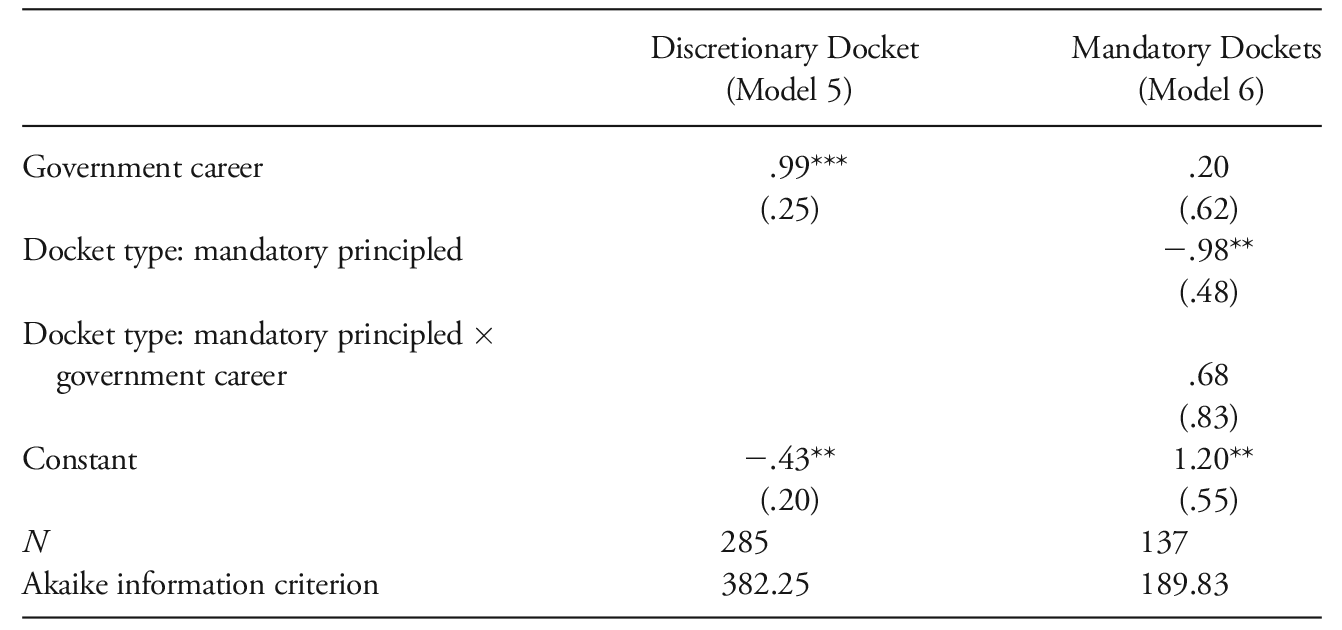
Note.—Coefficients are logits. Standard errors in parentheses. Model 5 controls for individuals and government appellant; model 6 controls for seniority, gender, center born, and academic. The full results are displayed in tables A6 and A8.
* p < .1.
** p < .05.
*** p < .01.
We use models 5 and 6 to generate the average change in the predicted probability of a government vote in nonunanimous decisions under discretionary and mandatory dockets when justices have a government career, compared to justices who do not have a government career (i.e., the justices have careers as lower-court judges, private practitioners, or legal academics). The results in figure 4 show substantial and significant differences in the effect of justices’ government experience between discretionary dockets and mandatory dockets in nonunanimous cases.
Docket type conditions the effect of justices’ preferences. Average change in the predicted probability of government votes when a justice with a government career is casting the vote, as opposed to a justice with an attorney, academic, or judge career in nonunanimous cases under discretionary, mandatory, and mandatory principled dockets. Ninety-five percent confidence intervals appear around the estimates.

Under a discretionary docket, the change in predicted probability of a pro-government vote in nonunanimous cases between justices with government careers compared to justices with careers from private practice, judgeships, and legal academia is 22.9 percentage points [12.8, 32.9].Footnote 13 In contrast, there is no significant effect of government career in nonunanimous cases under mandatory and mandatory principled dockets. In nonunanimous cases under mandatory dockets, there is a 4.5 percentage point higher probability that government career justices vote in favor of the government party, but the large confidence interval dilutes the effect [−22.4, 31.4]. In nonunanimous cases under mandatory principled dockets, there is a 19.2 percentage point higher probability that government career justices vote in favor of the government party, but the confidence interval dilutes the effect [−4.7, 43].Footnote 14
In summary, these results show substantial and significant effects of government careerism with discretionary dockets. The results show no effects of government careerism under mandatory dockets. The results offer support for H4.
Discussion and Conclusion
US-centric studies have demonstrated that docket type is a key institutional arrangement for understanding the behavior of high courts. Our study of the Danish and Norwegian Supreme Courts demonstrate that docket type also shapes judicial behavior on European courts. Specifically, we have shown that discretionary dockets are associated with higher levels of dissent and reversals, that mandatory dockets provide low-status litigants with a lower chance of winning against a government party, and that justices’ preferences, under discretionary dockets, toward the government party are expressed more strongly.
The results also show that granting lower-court judges the authority to identify cases as principled does not have a strong influence on dissent, reversals, outcomes, and justices’ preferences. That is, we do not observe the same differences in dissent, reversals, litigant status, and justices’ preferences between mandatory dockets and mandatory principled dockets as we observe with the differences between mandatory and discretionary dockets.
Our findings have several implications for judicial behavior research and for institutional design. First, our findings add to a series of studies (Hall Reference Hall1985; Eisenberg and Miller Reference Eisenberg and Miller2009; Brace et al. Reference Brace, Yates and Boyea2012; Eisenberg and Huang Reference Eisenberg and Kuo-Chang2012) underscoring the importance of docket type as an influential variable for judicial behavior. While these effects are not always apparent when a researcher is examining a single country, when data are considered across countries, researchers can observe docket-type effects operating in ways that are similar to the comparative state court studies in America (i.e., Eisenberg and Miller Reference Eisenberg and Miller2009; Brace et al. Reference Brace, Yates and Boyea2012). We think researchers should avail themselves of the “comparative” aspect of judicial politics more often when examining institutional rules of various judicial systems. Such a task can sometimes be difficult given the varied nature of judicial systems across countries, but the comparative task is feasible when the legal systems derive from similar legal principles, legal cultures, or legal histories. For example, multiple studies have compared similar common-law systems such as Canada and the United States (or even Australia and the United Kingdom). In the area of European courts scholarship, Bricker (Reference Bricker2017) notes his selection of European countries as originating from their adoption of the German Rechtsstaat (rule of law) model of constitutionalism, while Hanretty (Reference Hanretty2012) focused his comparative study of dissents on the two Iberian countries. Given their Nordic legal system, Denmark and Norway, along with the other Nordic countries (Sweden, Finland, and Iceland), similarly constitute a group of courts that are apt for comparison.Footnote 15
Moving forward, a systematic mapping of different docket types across high courts would be a useful contribution to the study of comparative judicial politics. As the Danish and Norwegian cases illustrate, the institutional design of case-selection procedures, and thus docket types, differ remarkably across and even within countries. A framework for a systematic mapping of different docket types should therefore include not only a distinction between discretionary and mandatory dockets but also the actors (justices, lower-court judges, and external bodies) and the decisional rules and principles that govern their decisions. Using panel data with both within- and across-country variation on docket type, controlling for legal systems, scholars can get a better understanding of how different case-selection procedures shape dockets and behavior on high courts.
Second, our findings demonstrate the conditioning effect of docket type on litigants’ relative status. This finding adds to numerous studies showing the influence of litigants’ relative status on court outcomes (Galanter Reference Galanter1974; Wanner Reference Wanner1974; Atkins Reference Atkins1991; Songer and Sheehan Reference Songer and Sheehan1992; McCormick Reference McCormick1993; Hanretty Reference Hanretty2014), but it suggests that the effect of litigants’ relative status in Scandinavian courts, similar to the US state supreme courts (Brace et al. Reference Brace, Yates and Boyea2012), is conditioned by docket type. The mechanisms underlying our litigant resource finding remain unclear. We have suggested that both experience and resources might explain the effect. Future research could test the relative importance of these mechanisms by advancing measures of litigants’ relative status (e.g., Hanretty Reference Hanretty2014) and attorney experience (e.g., McGuire Reference McGuire1995; Chen et al. Reference Chen, Huang and Lin2014).
Third, while scholars have suggested that docket type might have a conditioning effect on attitudinal behavior on European courts (Dyevre Reference Dyevre2010; Grendstad, Shaffer, and Waltenburg Reference Grendstad, Shaffer and Waltenburg2015; Skiple et al. Reference Skiple, Grendstad, Shaffer and Waltenburg2016), our study demonstrates this conditioning effect empirically. In contrast to the strategic case-selection setting of US courts, we have shown a conditional effect of docket type on attitudinal behavior in an institutional setting in which justices select cases on rotating panels. Thus, we do not argue that these justices select cases strategically but rather that they select more indeterminate cases, which in turn are more likely to trigger justices’ preferences regarding decisions on the merits. Our findings are suggestive of such an indeterminacy explanation, but a more rigorous test would be available if we had a more precise measurement of indeterminate cases and data from the case-selection stage.
During the last few decades, many European high courts have transformed from being reactive courts of appeal to proactive courts of precedent (Sunde Reference Sunde2015). Such a transformation is not possible without making changes to a court’s docket, and our study has explored some of the potential implications and consequences of implementing different types of strategies for deciding what cases will reach the highest court. One important implication is that the institutional design of the Norwegian Supreme Court seems more suited to identifying principled cases than the design of the Danish Supreme Court. Another important issue, however, is determining the type of case-selection mechanism that is best suited to detect errors in lower-court decisions. We might rightfully assume that a court with full discretion to select only those cases that are indeterminate enough to go both ways would in fact capture the very cases in which any error correction is needed. However, in courts with complete discretion, it is fully up to the screening committee to assess whether a case is indeterminate enough to get a full review by the court. The question thus remains whether any errors could have been identified if the court had had mandatory obligation to review the case in full. While these questions are beyond the scope of this article, future research on judicial discretion and docket types should more closely address the role and workings of the various actors involved in the screening of appeals to high courts.



