Two new funerary inscriptions from the village of Al-Brahama, Al-Rujban (Al Jebal al-Gharbi district, Libya)
1. New Neo-Punic funerary inscription
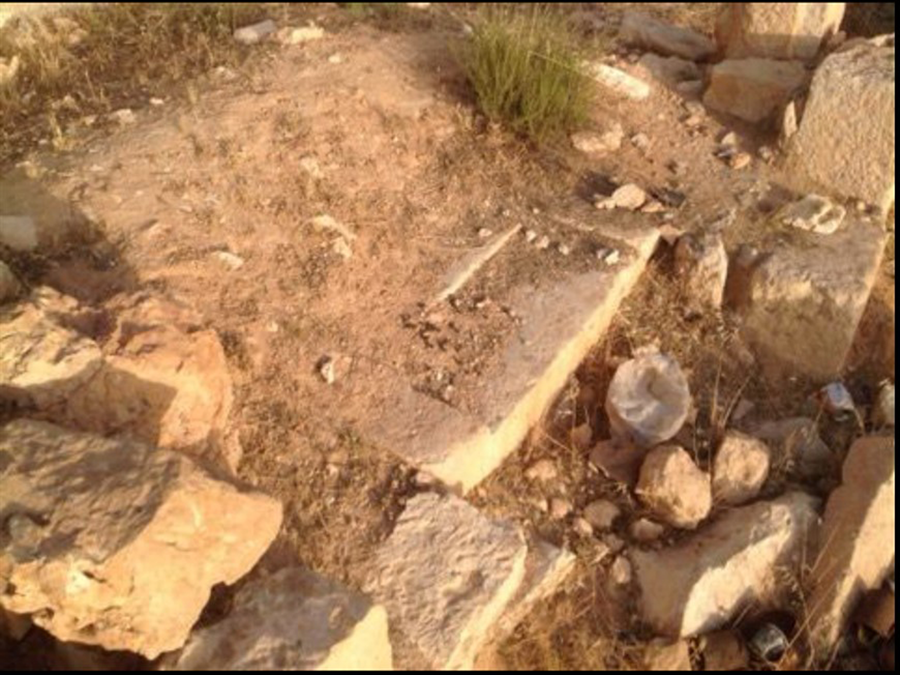
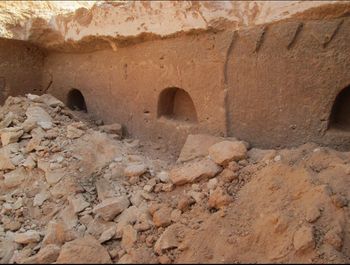
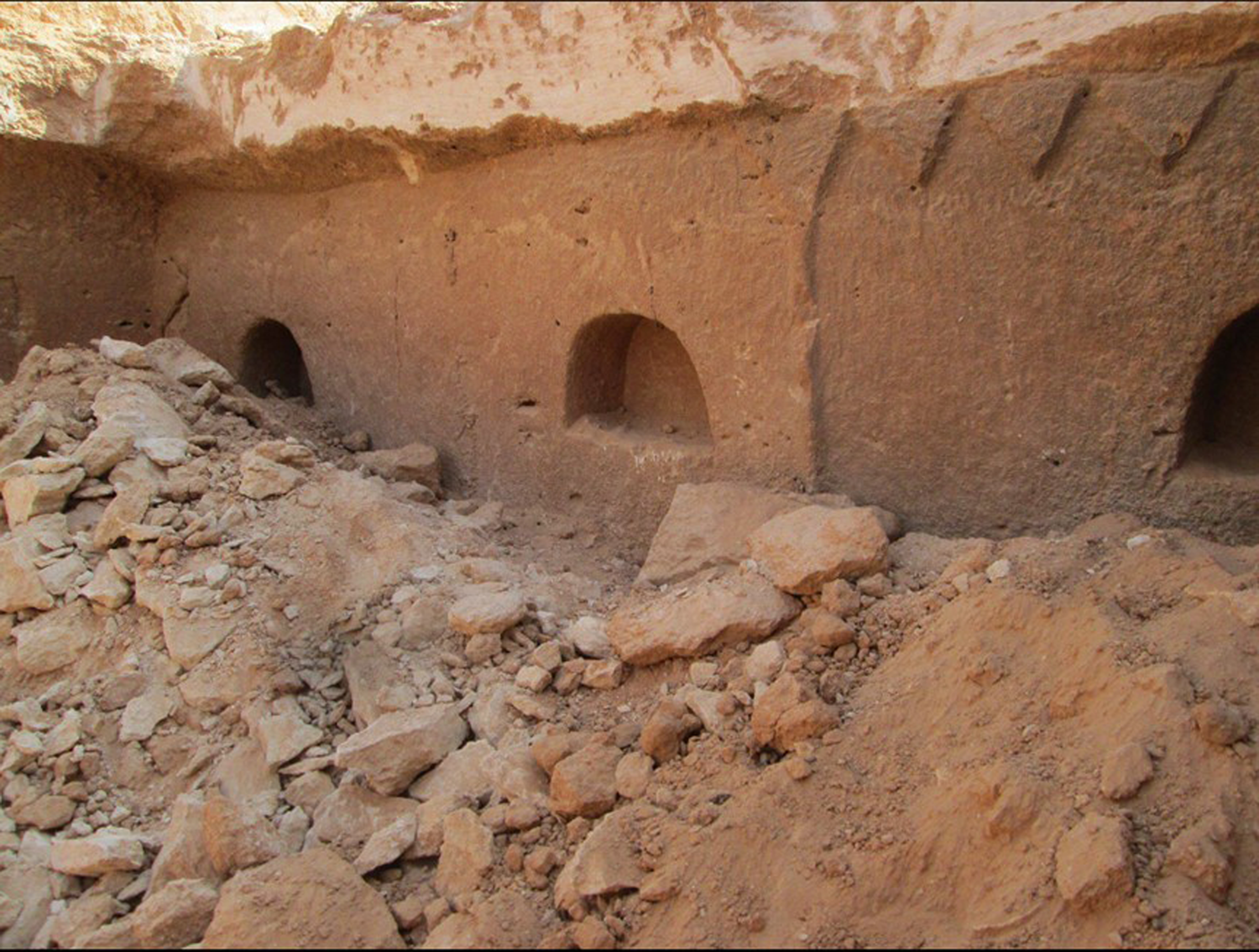
This inscribed stone block was found in the remains of a tomb (Figure 1) discovered by a local resident (who wishes to remain anonymous) on his land beside his house at Al-Brahama village near Al-Rujban in the Western Jebel district, approximately 100 km inland, south of ancient Sabratha, Tripolitania.
Remains of the tomb where the neo-Punic inscription was found by a Libyan resident in the area.

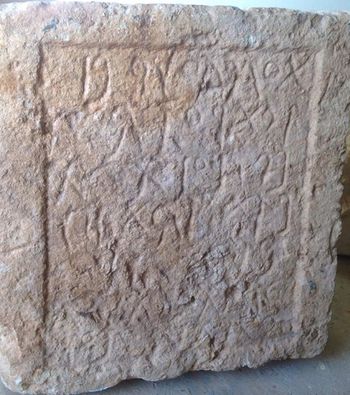
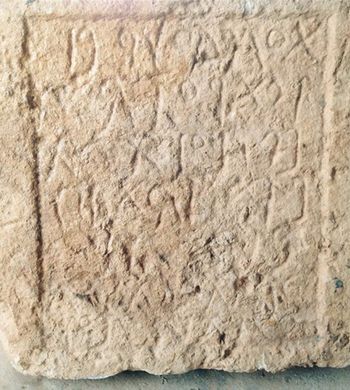
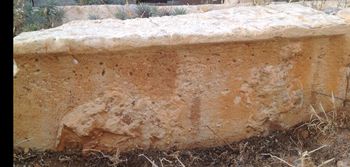
Both photos of the inscription, on which my subsequent transcription is based, were taken by the land owner (Figures 2–3). The rectangular block (precise dimensions unknown) bears a carefully incised recessed tabula ansata on its front face. The neo-Punic script used suggests a date from the Roman period. The text comprises seven lines (each line accommodating approximately 9 letters). The first four lines are legible and their reading and translation cause no problems. The last three lines (5–7) are no longer fully legible as a result of damage to the surface of the stone.
Neo-Punic inscription from Al-Brahama: general view.

Neo-Punic inscription from Al-Brahama: inscribed surface.

Transcription
A suggested reading is as follows (illegible letters are indicated by +, uncertain letters by under dotted):
mʿnsbt ʿsd bn
nymrʿn hʿs
kyn bʿnʾ lʾ
bnm w lbwhm hn
5 ḅṇ + + + + + + +
ḷʿḅṇṃ ḥṇ ẉ ʿ + +
+ + + + + + + bʾ +
Translation
Stele of Aside son of Nymran the Askyn, built for his sons and for his father Hanno son of (…illegible …) for his sons Hanno(?) … (…illegible…)
Line-by-line commentary
Line 1. mʿnsbt = stele which is equivalent to Latin monumentum/memoria, indicating the funerary monument which is most likely the direct object of the sentence (cf. Kerr Reference Kerr2010, 152). It recurs in another neo-Punic inscription from Wadi el-Amud: IPT 77.1). The word is ultimately derived from Phoenician MṢBT, as found in e.g. KAI 6, 1.1 and 7, ll. 1–2, Um el-Alwamid, and other Phoenician places in North Africa (Maktar: KAI 149, ll. 1–2 (Npu); KAI 78, ll. 4 and 6 (Pu); HNPI Hr Drombi N 1, l.1). See Jongeling Reference Jongeling2008, 397.
Line 1. ʿsd = asido: a Libyan name (cf. Jongeling Reference Jongeling2008, 306; PIBB 122, 123). It is preceded by the article ‘h’ in this inscription, which indicates its Semitic origin; cf. HNPI S. Antioco N 3, l.2; Jongeling Reference Jongeling2008, 362, 388.
Lines 2–3. hʿskyn: a Libyan name, possibly a toponymic adjective. Also it could be hʿslkyn, as a variant of slkny/slkʿny (HNPI Hr Maktar N 64, l.31 and N 76, l. 29; and Hr Meded N 5, N 7); see Jongeling Reference Jongeling2008, 362.
Line 3. nymrʿn = Nimiran: a Libyan personal name, found also in HNPI Wadi el-Amud N 2, l. 2 (= Levi Della Vida Reference Levi Della Vida1964, Tripol. 39; TRE 39; IPT 77 (Npu)); see Jongeling Reference Jongeling2008, 358.
Line 3. bʿnʾ = ‘bna’, ‘bny’: ‘he built’, which recurs in a neo-Punic inscription from Henchir Drombi in Tunisia (HNPI Hr Drombi N1, ll.1-2) and in the phrase bʿnʾ lʾ = ‘He built for him’ (HNPI Metameur N 1, l.3; on which see Kerr Reference Kerr2010, 160). Also it occurs in other inscriptions from Roman Tripolitania in different forms: bʾnʾ (HNPI Breviglieri N 1, l.1 from el-Khadra, Tarhuna); bʿnʿ (HNPI El-Amruni N 1, l.3); and bn (HNPI Labdah N 58 = IPT 67, l.1). See Jongeling Reference Jongeling2008, 385–386; Kerr Reference Kerr2010, 50.
Lines 3–4. lʾ bnm: i.e. l + abnm = ‘for + his sons’, which is attested in different forms in texts from Wadi el-Amud: bnʾm (HNPI Wadi el-Amud N 2 = IPT 77, l.1); bnam (HNPI Wadi el-Amud N 1 = IPT 79, l.6). Cf. Latino-punic vlybanem = ‘for his sons’ (LPE Gasr el-Azaiz LP 1, ll.3-4 (Npu) = IRT 893), on which see Kerr Reference Kerr2010, 139, 150.
Line 4. lbwhm = lʾbwhm: ‘for his father’. It contains a lexeme ‘ab’ in the singular/plural ‘parents’ (Jongeling Reference Jongeling2008, 381; Kerr Reference Kerr2010, 97, 142). It recurs in Latino-Punic inscriptions from Roman Tripolitania as labvnom (LPE Wadi Umm el-Agerem LP 1, Wadi Chanafes LP 1; on which see Kerr Reference Kerr2010, 97).
Line 4. hn: Hanno, a Punic male personal name, attested by neo-Punic inscriptions elsewhere in Roman Tripolitania at Al-Qusbat (HNPI Al-Qusbat N 1 = IPT 86, l.4), Lepcis Magna (HNPI Labdah N 9 = IPT 17 = KAI 130 (Npu) = Levi Della Vida Reference Levi Della Vida1964, Tripol. 12 = IRT neo-Punic 12, l.6), and Oea (HNPI Tripoli N 7 = IPT 83, l. 4). See Jongeling Reference Jongeling2008, 334.
Line 6. lʿbnm hn: ‘for his sons Hanno(?) and …’; for commentary cf. that on lines 3–4 above.
Lines 5 and 7 are largely illegible as a result of damage to the surface of the stone.
2. New Latin funerary inscription
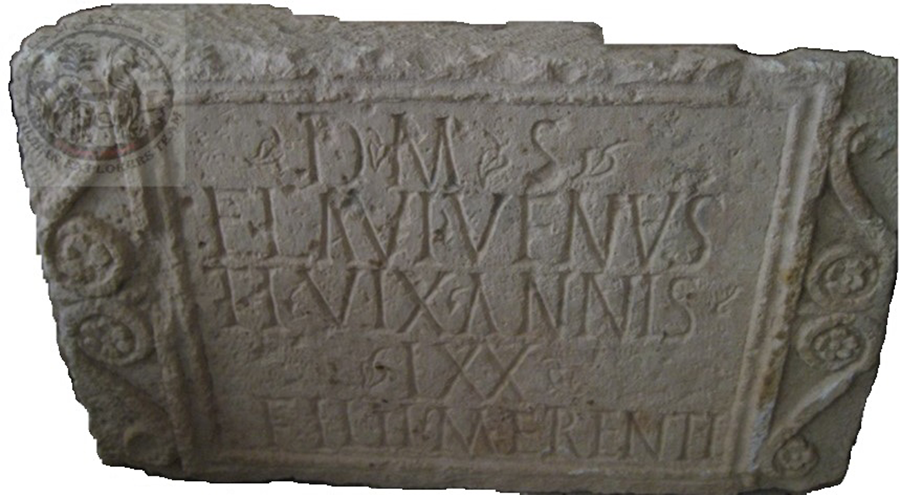
An inscribed block, perhaps originally part of a larger monument, has also been revealed in Al-Brahama (Figure 4). It bears a dedicatory text inside a moulded frame, decorated with a vine scroll with a motif of rosettes to the right and left hand sides. The man who found this inscription said that he discovered it while digging the land near his home, in the same place where he found the neo-Punic inscription (see above). The text is centred and the letters are carved in well-formed monumental capitals, punctuated with hederae.
Tombstone with inscribed Latin funerary text from Al-Brahama.

Transcription
D(is) M(anibus) s(acrum)
Flaui Venus-
ti, uix(it) annis
LXX,
filii merenti.
Translation
Sacred to the departed spirits of Flavius Venustus, (who) lived 70 years, (his) children (set this up) to a deserving (parent).
Commentary
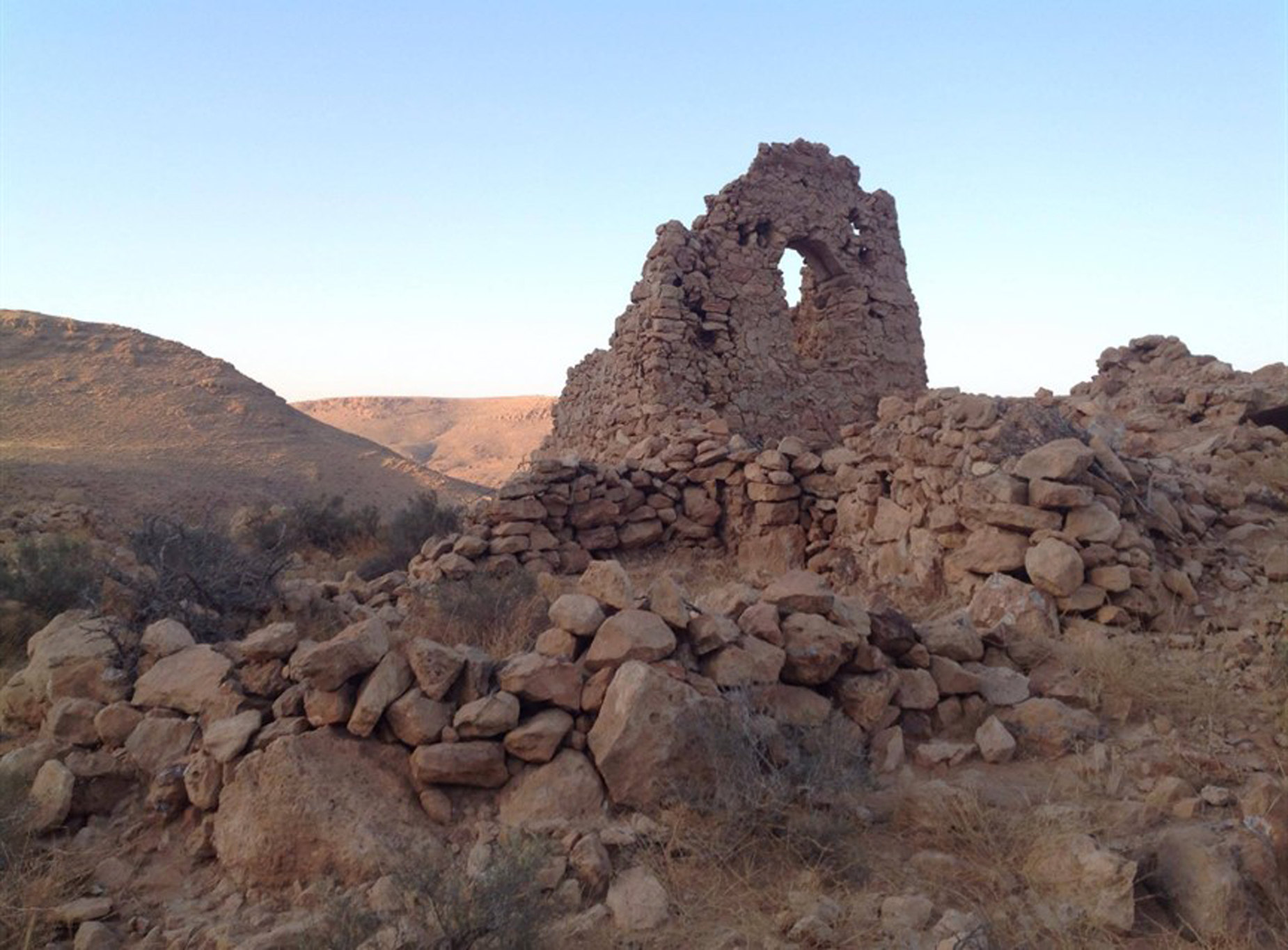
Although the Roman nomen Flavius is widespread (thanks to the Flavian dynasty of emperors: AD 69–96), the cognomen Venustus, common in central and western parts of Africa Proconsularis, seems to be attested here for the first time in Tripolitania. The onomastic formula and style of letter carving suggest a date in the second or early third century AD. Despite the reported findspot, I think this stone is most likely from a tomb in the area of the Roman centenarium, built on a high location in the late Roman period to control the area – the building remains still can be seen in Al-Brahama village near the town of Al-Rujban (Figure 5).
Roman centenarium in el-Barahma village.
Reinterpretation of a neo-Punic inscription from Tarhuna
Inscription from an undecorated limestone stele with triangular pediment (106 × 41.5 × 15.5 cm), found in the village of Al-Araban, southwest of Tarhuna (Garbini Reference Rossi and Garbini1976–1977 [1983], 19), since 2007 in the Murqub district of Libya. The stone is now conserved in the Assaraya Alhamra (the Red Castle) Museum in Tripoli.
Editio princeps: Garbini in Rossi and Garbini Reference Rossi and Garbini1976–1977 [1983]. Subsequent editions: Garbini Reference Garbini1983; Garbini Reference Garbini1986, 17–18; Sznycer Reference Sznycer1982 [1988], 196–197; Amadasi Guzzo Reference Amadasi Guzzo1992, 101–103; Garbini Reference Garbini1992; Sznycer Reference Sznycer and Bohec1994; TRE 54; Jongeling and Kerr 2005, 26–27; Garbini Reference Garbini2006, 194; HNPI Tarhuna N1.
Text
mnsbt spbyt
bt gʿrʿf mʾ t-
nʾ qwyntʾ
btm
Translation
Stele of Spbyt (i.e. Sophbyt), the daughter of Garaf, which Quintus erected at his own expense.
Line-by-line commentary
Line 1. mnsbt: ‘stele’ (see commentary on line 1 of text no. 1 above).
Line 1. Spbyt/Sophbyt: a Libyan female personal name. The text of this inscription has been studied by many scholars, although Jongeling (Reference Jongeling2008, 55), who discussed this text thoroughly, did not agree with my reading S as the first sign of the name SOPHBET (TRE 54). During my last visit to the area between Garyan and Tarhuna with Mr Mokhtar Eljweely and some of his friends from Garyan I saw a monument which they called the Stele of Sofbeet. As this is plausibly the origin of this inscription, I think the reading of Sophbet is the right one and ‘S’ is the first sign of the name.
Line 2. mʾ: relative pronoun ‘which’ (= mu in Latino-Punic IRT 877, lines 1, 7; IRT 828, lines 1, 2 (Npu)). See Jongeling Reference Jongeling2008, 394.
Lines 2–3. tnʾ: erected (HNPI Hr Maktar N 24, N 26; Guelma N 8).
Line 3. qwynt: male personal name, transliteration of Latin Quintus, which occurs in other inscriptions in this form (HNPI Hr Maktar N 81; Ksiba Mraou N 3). See Jongeling Reference Jongeling2008, 371.
Line 4. btm: ‘at his own expense’ (considered the more probable reading here than ‘bnm’ by Jongeling Reference Jongeling2008, 55); a phrase that recurs in many Punic and Neo-Punic inscriptions from Tripolitana/Libya (see IPT; Jongeling Reference Jongeling2008, 409), of which it is found in a final position, as here, also in HNPI Breviglieri N 1; Labdah N 12, N 19, N 63.
Observations on tombs in the Jefara plain
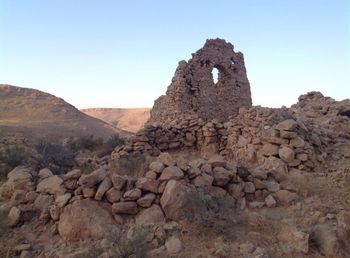
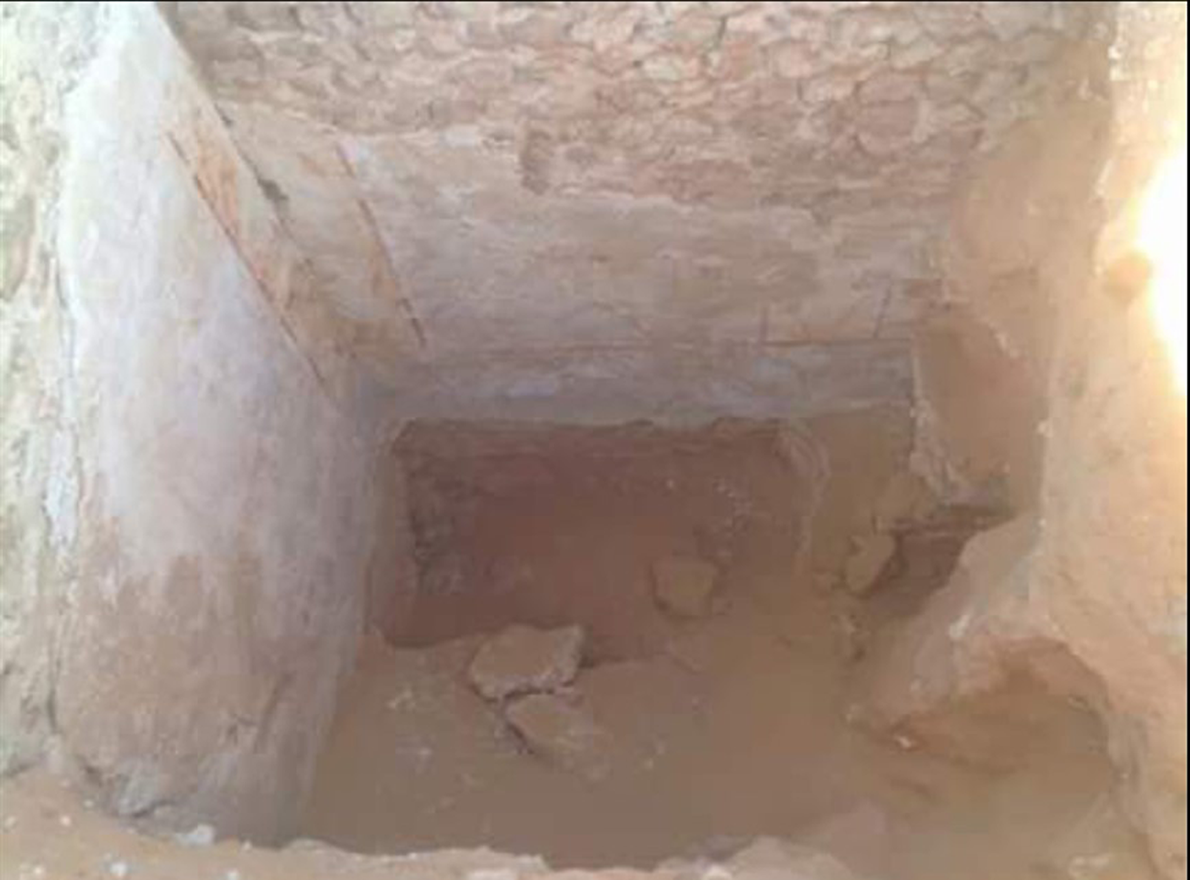
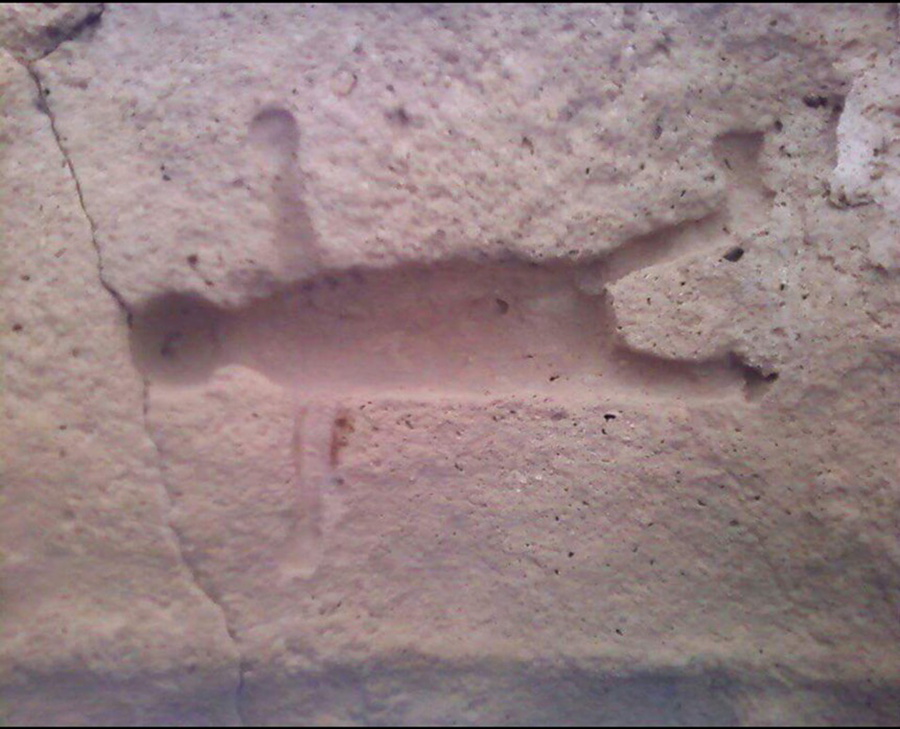
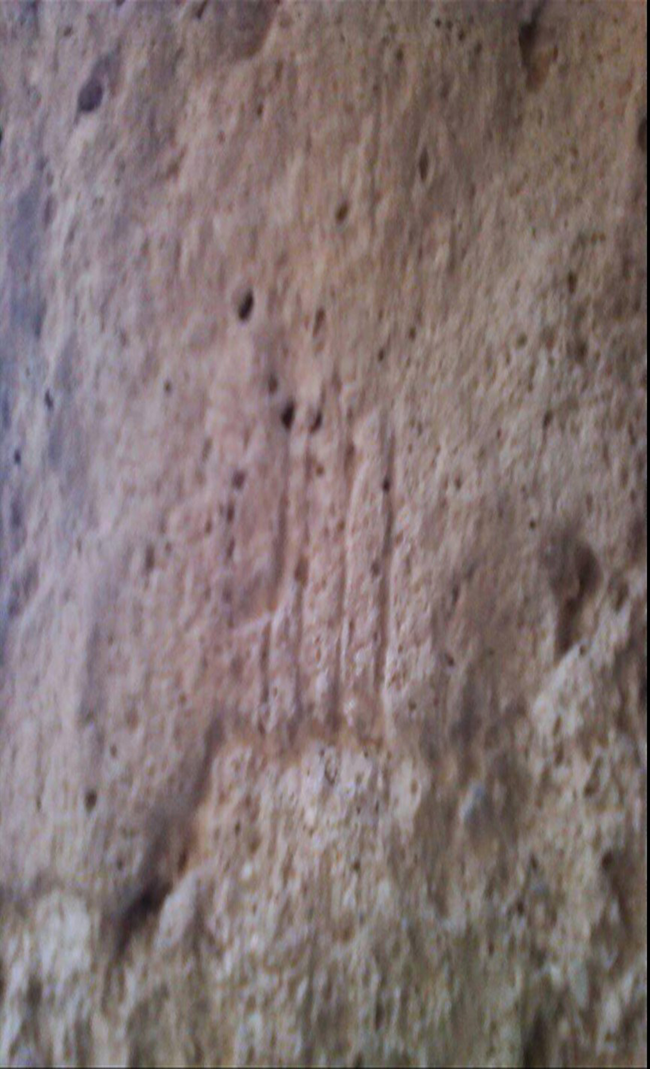
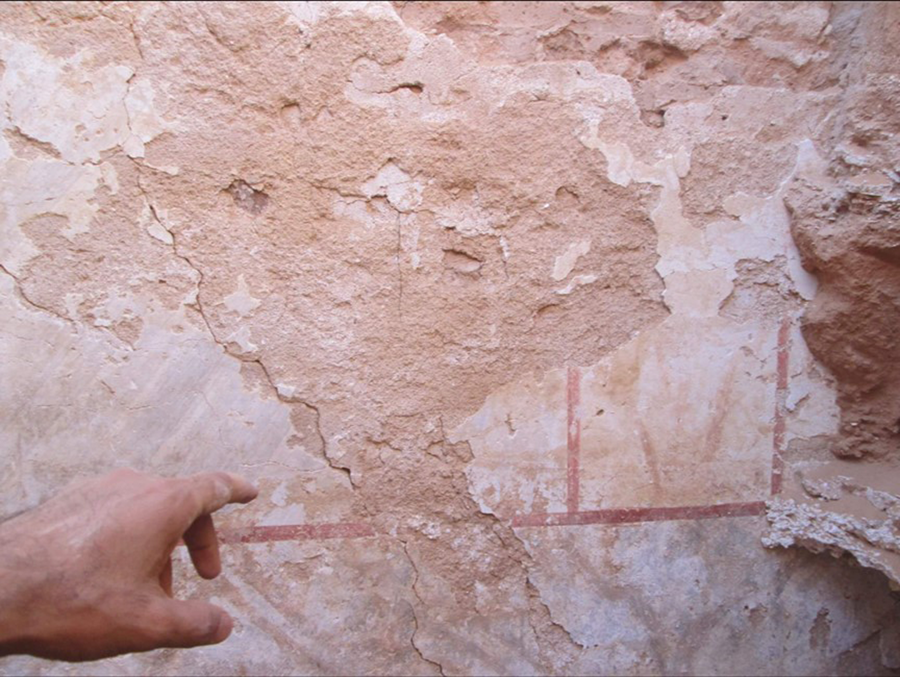
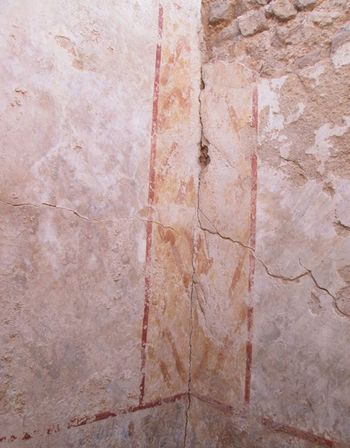
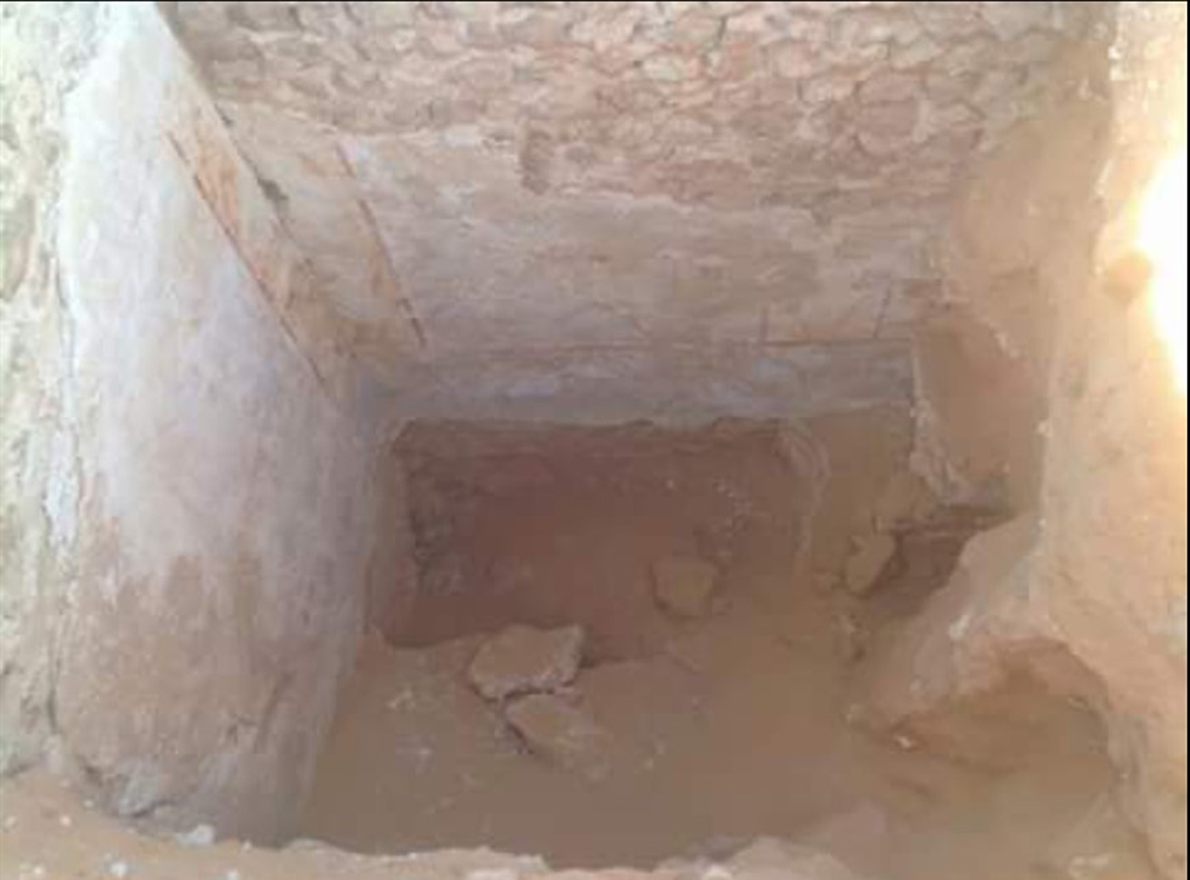
The following photographs (Figures 6–12) are of Phoenician tombs in th Jefara Plain south of Sabratha and I think that they were destroyed by tomb thieves who were looking for gold.
Phoenician tomb with frescoes before their destruction by thieves looking for gold.
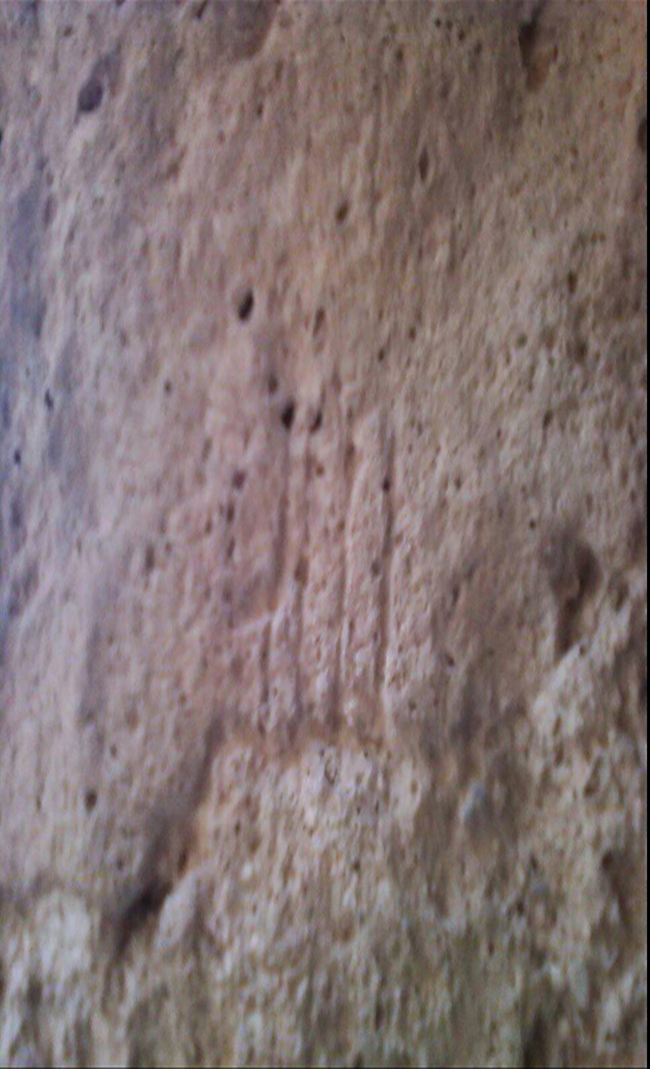
Symbol of a god, found on the wall of tomb depicted in Figure 6, associated with a graffito (Figure. 8).

Graffito found with the symbol of a god (Figure 7).
Detail of fresco on the wall of the tomb (Figure 8) before destruction.
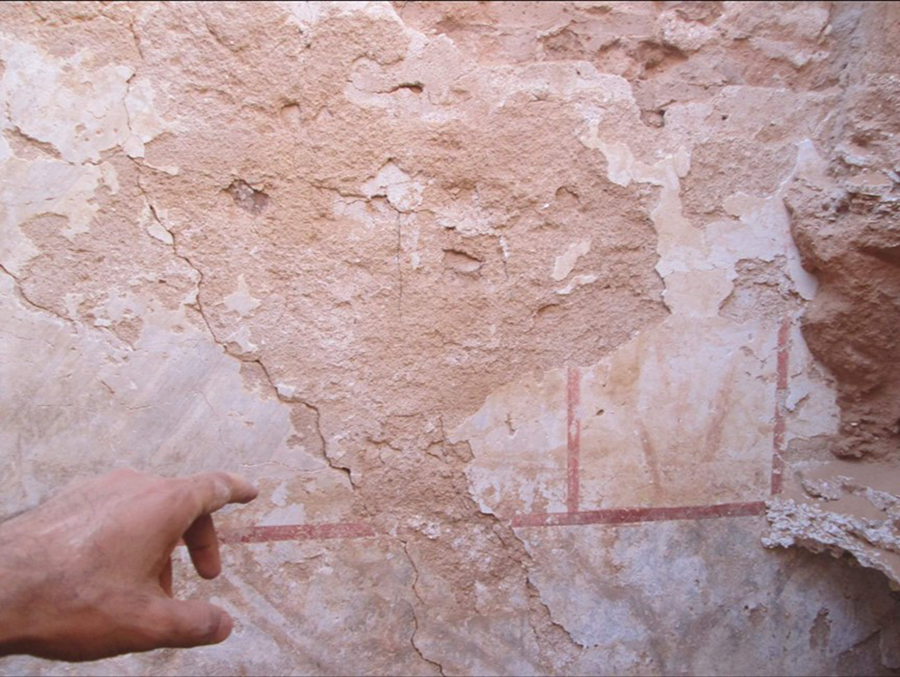
Photo of a fresco in the tomb (Figure 6) taken before a shepherd damaged it.

Destroyed Phoenician tomb. I have been told that a Shepherd destroyed these Phoenician tombs in the Jefara plain, but I believe it was done by thieves looking for gold.
Relief representing a camel and a man feeding it (from the same area).

Acknowledgement
I wish to thank Dr Benet Salway of University College London for his assistance. The responsibility for any errors remains that of the author.
Abbreviations
- HNPI
= Jongeling Reference Jongeling2008. Texts available online at www.punic.co.uk/phoenician/neopunic-inscr/puninscr.html (accessed on 18 September 2019)
- IPT
Levi Della Vida, G. and Amadasi Guzzo, M. G. (eds). Iscrizioni Puniche della Tripolitania (1927–1967). L'Erma di Bretschneider, Rome. 1987.
- IRT
Reynolds, J. M. and Ward-Perkins, J.B. (eds). Inscriptions of Roman Tripolitania. British School at Rome, Rome/London. 1952 + IRT2009: Inscriptions of Roman Tripolitania, enhanced electronic reissue by G. Bodard and C. M. Roueché, 2009.
Available at: http://inslib.kcl.ac.uk/irt2009/ (accessed on 18 September 2019).
- KAI
Donner, H. and Röllig, W. Kanaanäische unde Aramäische Inschriften, mit einem Beitrag von O. Rossler, I-III2. Harrassowitz, Wiesbaden. 1966–1969.
- LPE
= Kerr Reference Kerr2010.
- PIBB
Manfredi, L.-I. Monete Puniche: repertorio epigrafico e numismatico delle leggenda Puniche (Bolletino di numismatica, monografia 6). Istituto poligrafico e Zecca dello stato, Roma. 1995.
- TRE
Elmayer, A. F. Tripolitania under the Roman Empire (B.C. 47–A.D. 235) (Markaz Jihad Al-Libyin 8). GSPLAJ, Tripoli. 1997.