1. Introduction
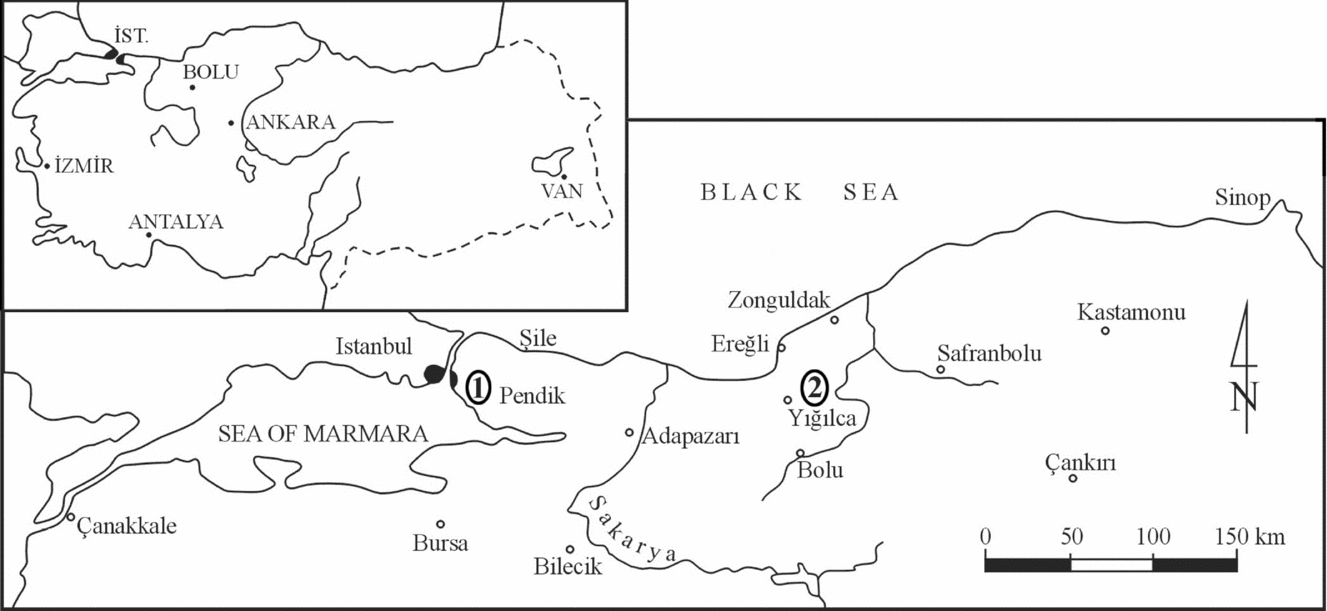
Northwestern Turkey formed the independent Pontides Terrane during Early Palaeozoic time. The eastern part of the Pontides has yielded some Ordovician (Tremadocian to Sandbian) shelly faunas (Dean et al. Reference Dean, Monod, Rickards, Osman and Bultynck2000), but the western sector, which includes Istanbul (Fig. 1), is less well known. In this paper, faunal assemblages of Middle and Late Ordovician and Early Silurian ages are described, chiefly brachiopods from the Istanbul and Bolu (Yığılca) areas in the western Pontides. Since the Istanbul conurbation has expanded enormously over the past 60 years, many previous outcrops have now vanished. The rocks are poorly fossiliferous, with many taxa represented only by one or more variably preserved specimens; however, about 500 fossils have been collected by one of us (CS) over many years from Istanbul and the Bosphorus area, and about 200 specimens were collected in 1983 by S. Biberoğlu and M. Özaltın from Yığılca, north of Bolu (Figs 2, 3). Since these fossils are poorly known, apart from in preliminary papers (Sayar, Reference Sayar1979a ,Reference Sayar b ) and a limited publication (Sayar, Reference Sayar1979c ), all in the Turkish language, we feel it is desirable to present these data to a wider audience here. In particular, the important Hirnantia Fauna of latest Ordovician (Hirnantian) age is recognized for the first time in Turkey, and the Early Palaeozoic geographical location of the Pontides Terrane is also discussed.
The Middle and Upper Ordovician faunal localities from the western Pontides, NW Turkey.

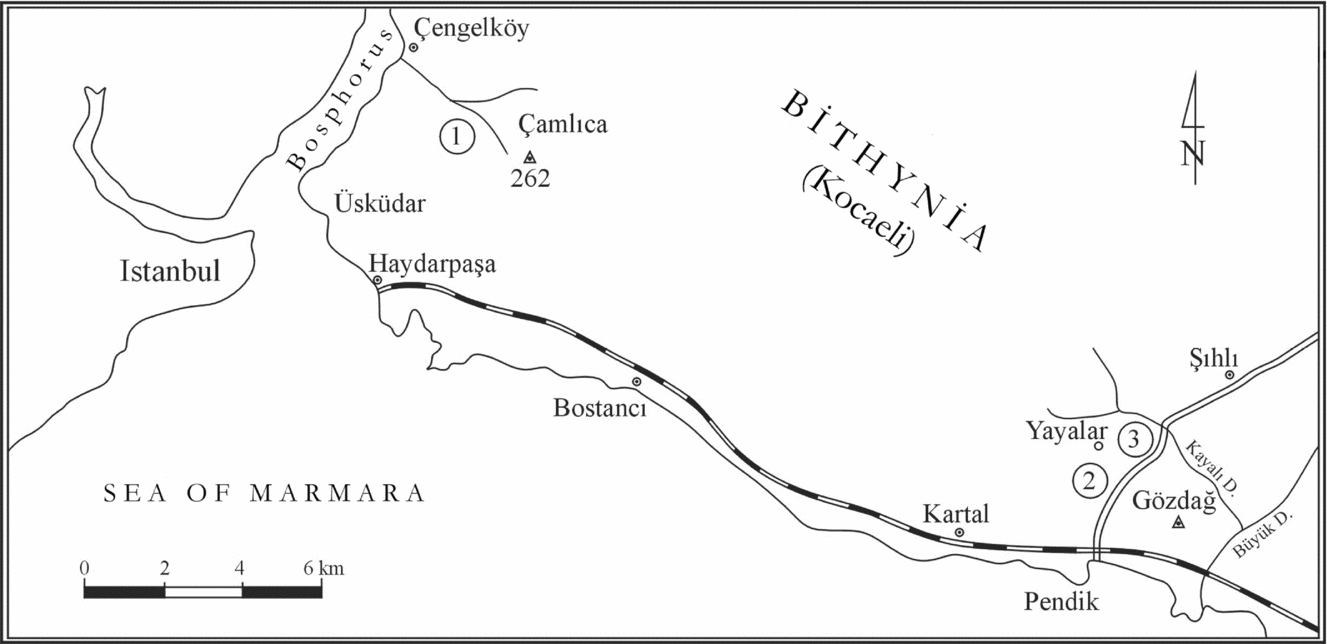
The Istanbul and Kocaeli area.

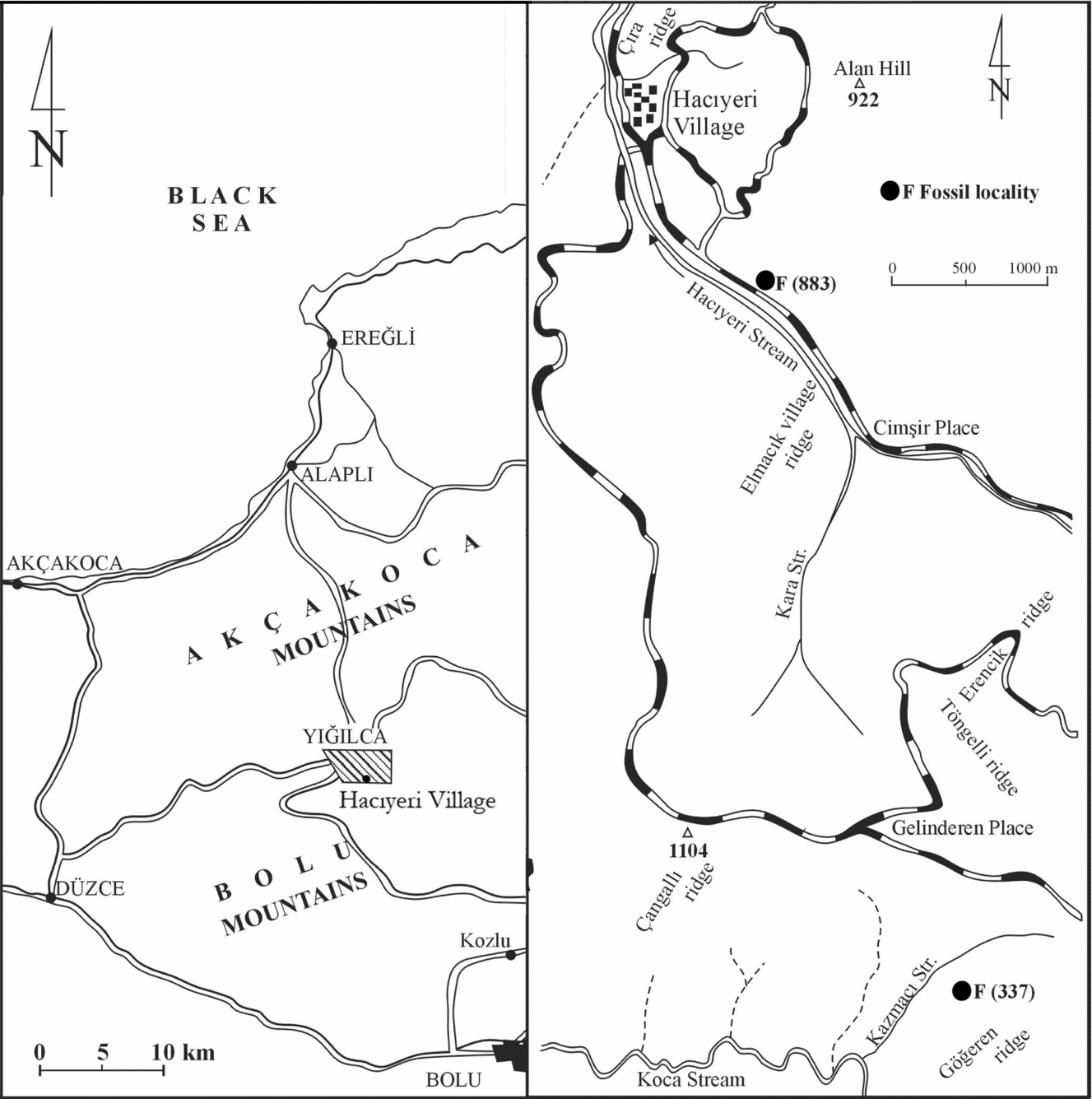
The Yığılca area, north of Bolu.

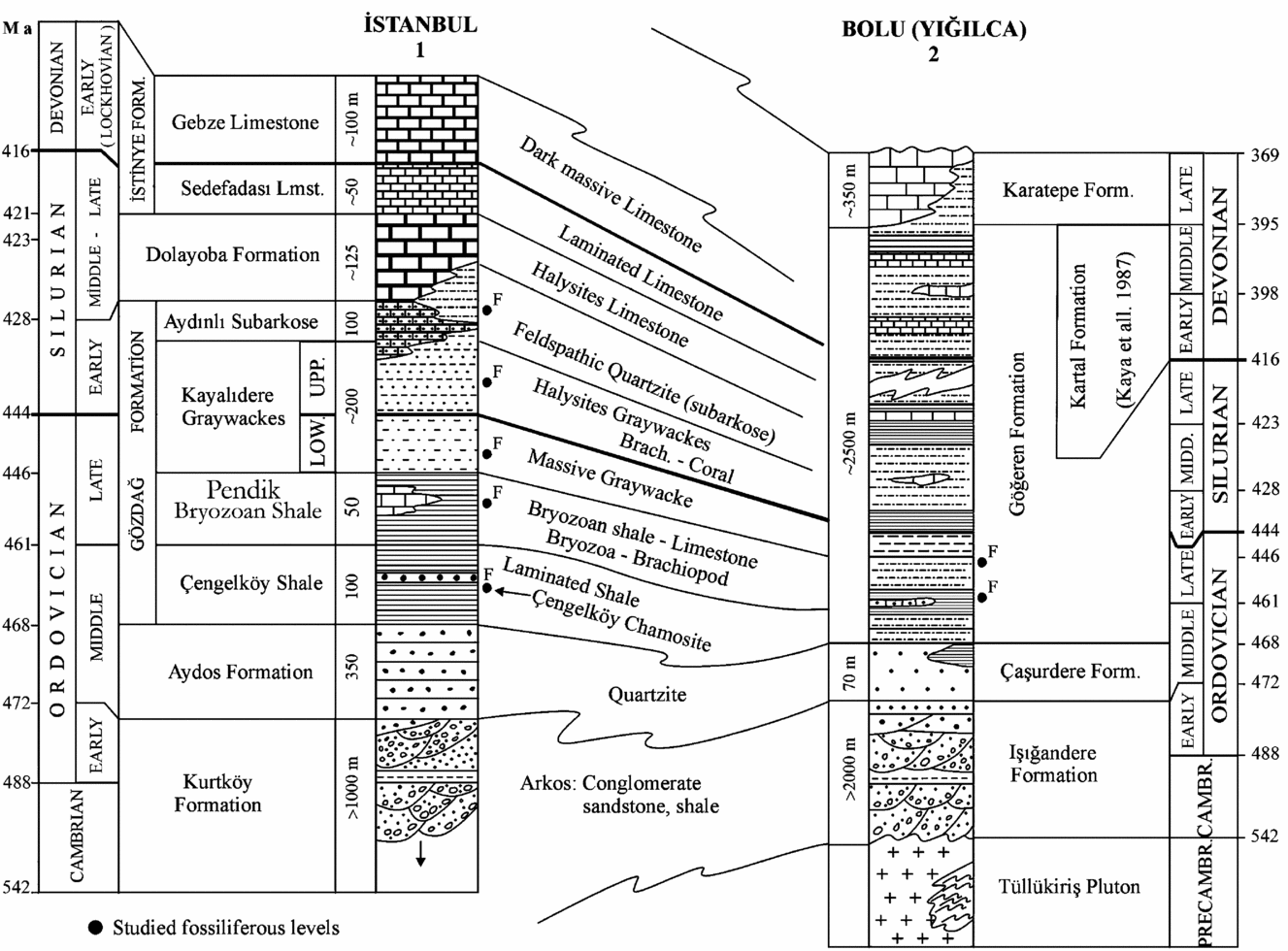
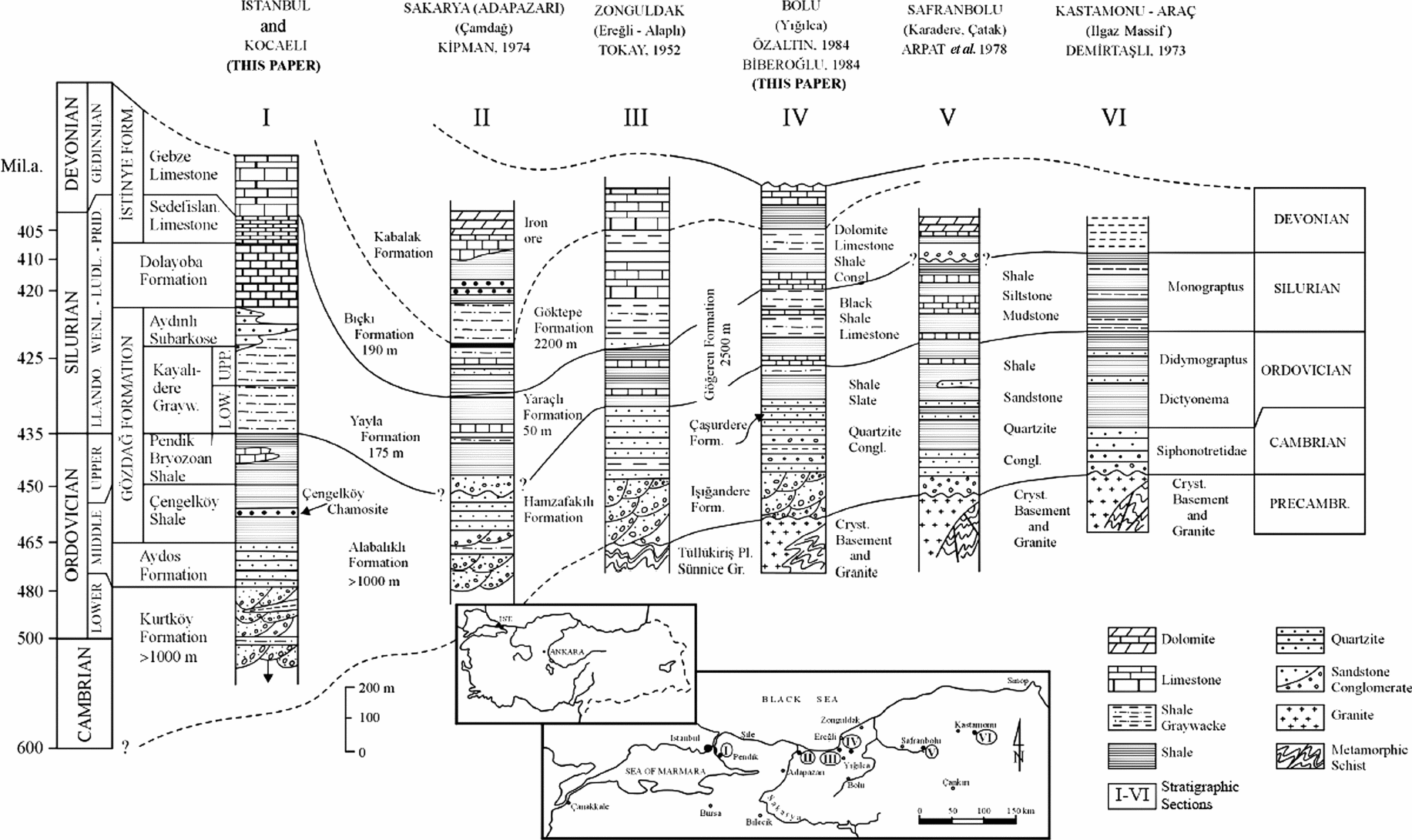
In the western Pontides, the Lower Palaeozoic consists of coarse clastic successions unconformably and transgressively overlying the crystalline basement rocks (Tokay, Reference Tokay1952). In Istanbul, Paeckelmann (Reference Paeckelmann1938) recorded the 400–500 m thick fossiliferous beds as the ‘Graywacke Horizon’, which he thought was of Devonian (Gedinnian) age, as the uppermost part of his Late Silurian to Gedinnian Quartzite Series, which was later termed the Gözdağ Formation by Önalan (Reference Önalan1981) and is upgraded here to group status. The ‘Graywacke Horizon’, now termed the Kayalıdere Formation, is divided into lower shales (150 m) above which are turbidites (200 m). The succession can be divided into five chronostratigraphic subunits according to their lithologies and fossil contents as described below (Fig. 4).
Lithostratigraphical and chronostratigraphical correlation of the Lower Palaeozoic sequences of Istanbul and the Bolu (Yığılca) area, western Pontides.

2. Middle Ordovician to Lower Silurian rocks and fossils of Istanbul
The oldest fossiliferous beds around Istanbul and in the Bosphorus area at Kocaeli (Bithynia) are the Ordovician Gözdağ Group, which conformably overlies the Aydos Formation (Önalan, Reference Önalan1981). Below the Aydos Formation lie purple-coloured clastic sediments more than a kilometre thick (the Palaeozoic basement of the region), which are mainly conglomerates, sandstones and shales. These were originally termed the ‘Arkose Horizon’ by Paeckelmann (Reference Paeckelmann1938), then generally called the ‘Arkose Series’ and finally renamed the Kurtköy Formation by Önalan (Reference Önalan1981). The Kurtköy Formation is found at several localities over a large area of the western Pontides; however, no age-diagnostic fossils have been found in it, and so it is simply considered here to be of probable Cambrian to Early Ordovician age (Figs 4–6). The Gözdağ Group is conformably overlain by the Upper Silurian ‘Halysites Limestone’ of Paeckelmann (Reference Paeckelmann1938), later termed the Dolayoba Formation (125 m) by Önalan (Reference Önalan1981), which is a typical reef limestone with some shaly interbeds and with very common Halysites coral colonies and typical and diverse cosmopolitan brachiopods. The Gözdağ Group, which is more than 400 m thick, consists of the following formations.
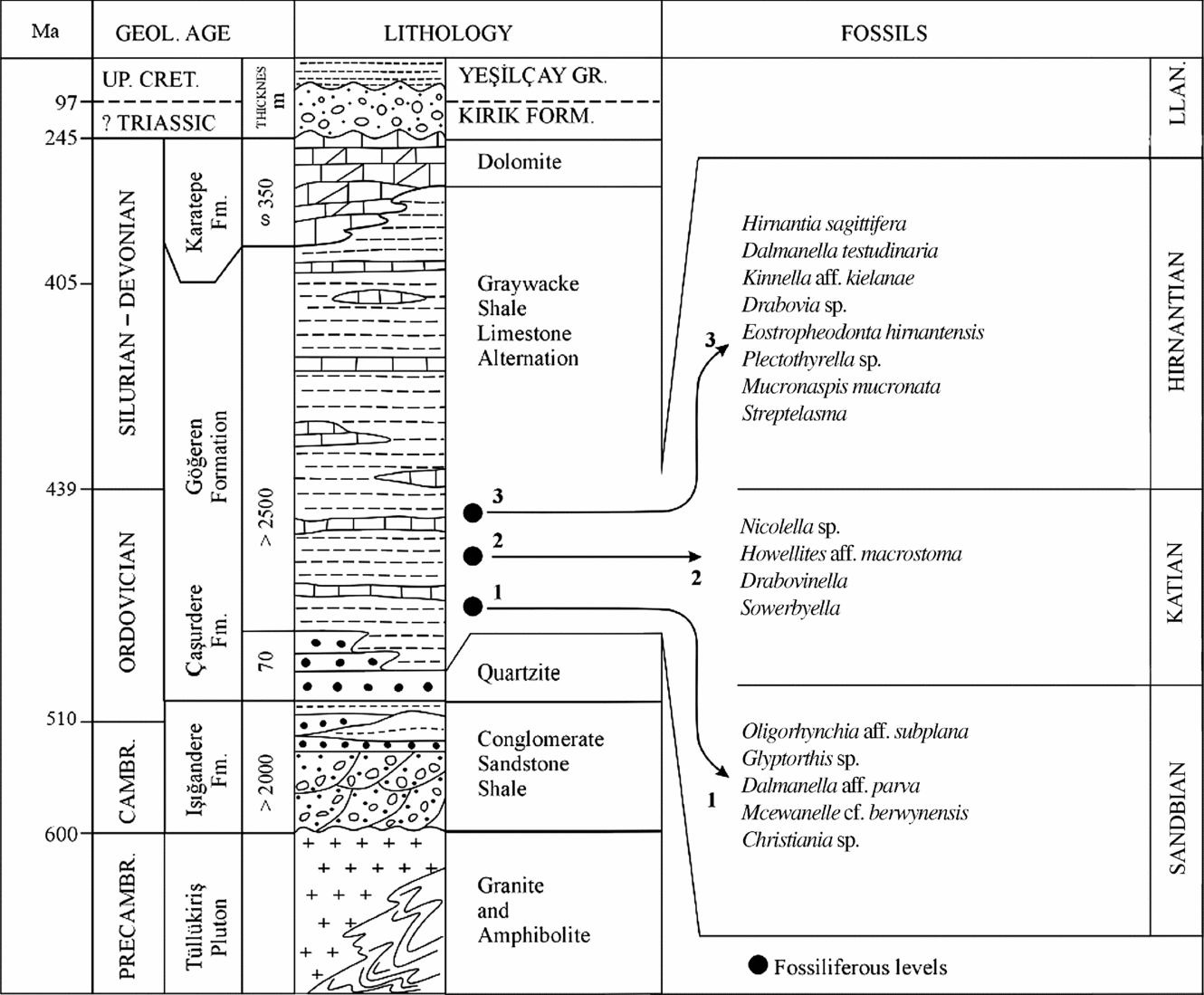
Generalized stratigraphic section of the Lower Palaeozoic sediments in the Bolu (Yığılca) area, with the fossiliferous levels indicated.

Lithostratigraphic and chronostratigraphic correlation of the Lower Palaeozoic sequences in the western Pontides. I – Istanbul–Kocaeli; II – Sakarya; Adapazarı (Çamdağ); III – Zonguldak (Ereğli–Alaplı); IV – Bolu (Yığılca); V – Zonguldak (Safranbolu); VI – Kastamonu–Araç (Ilgaz Massif). Includes data from Demırtaşli (Reference Demırtaşli1973) and Arpat et al. (Reference Arpat, Tutuncu, Uysal and Gōğer1978).

2.a. Çengelköy Shales and Chamosite
The oldest fossiliferous beds are the Çengelköy Shales and Chamosite (100 m), originally termed the ‘Laminated Shales and Chamosite’ by Arıç (Reference Ariç1955) and Sayar (Reference Sayar1964, Reference Sayar1984), which conformably overlie the unfossiliferous Aydos Formation (0–350 m), previously termed the ‘Quartzite Horizon’ by Paeckelmann (Reference Paeckelmann1938). The following conulariids and brachiopods are identified from the Çengelköy Shales and Chamosite: Exoconularia istanbulensis Sayar, Exoconularia bohemica (Barrande), E. (Metaconularia) consobrina (Barrande), E. cf. pyramidata (Hoenenghaus), Archaeoconularia fecunda (Barrande), Paracraniops aff. pararia (Williams), Orbiculoidea aff. stincharensis (Reed), Onniella aff. flava (Havlíček) and Aegiromena aff. descendens (Havlíček). These fossils are of Middle Ordovician (Darriwilian–Sandbian) age and have close affinity with the Mediterranean Province (Arıç, Reference Ariç1955; Sayar, Reference Sayar1964, Reference Sayar1970, Reference Sayar1984; Havlíček & Vanek, Reference Havlíček and Vanek1966) (Figs 4, 6).
2.b. Pendik Bryozoan Shales
The second unit, the higher levels of fine clastic sediments of the ‘Bryozoan Shales’ or Pendik Bryozoan Shales (50 m), conformably overlies the Çengelköy Shales and Chamosite and is seen 1.5 km north of Pendik, Istanbul. These fossiliferous shales have interbeds of bryozoan-rich limestone, which are the first occurrence of carbonate deposition in the thick and otherwise arenaceous clastic successions around Istanbul and the Bosphorus area. The brachiopods and ostracods from the bryozoan shales demonstrate a Late Ordovician (Katian) age (Figs 4, 6I). Brachiopods identified include Sulevorthis (Orthambonites) calligramma (Dalman), Nicolella actoniae (Sowerby), Hesperorthis aff. craigensis (Reed), Glyptorthis maritima Wright, Saukrodictya hibernica Wright, Saukrodictya cf. porosa Havlíček, Drabovia sp., Hirnantia transgrediens Havlíček, Onniella aff. bancrofti Havlíček, Kullervo sp., Sowerbyites aff. hibernicus Mitchell, Leptestiina prantli Havlíček, Anisopleurella tricostellata Cooper, ‘Strophomena’ sp. and Christiania sp., which occur with endemic ostracods including Piretella bithynia Sayar & Schallreuter, Klimphores anatolica Sayar & Schallreuter and Eochilina paeckelmanni Sayar & Schallreuter, and with the bryozoans Reteporina sp. and Atactotoechus sp. and pelmatozoan columnals (Sayar, Reference Sayar1984; Sayar & Schallreuter, Reference Sayar and Schallreuter1989). This faunal assemblage seems provincially mixed, with Anisopleurella and the strophomenid more characteristic of the Avalonia–Baltic Province, but Drabovia, Leptestiina and Howellites representing the Mediterranean Province. Both the lithological and faunal characteristics suggest that the region became warmer during Early Katian time.
2.c. Lower Kayalıdere Formation
This formation consists of turbidites, which are 200 m thick near Pendik. It contains the distinctive Hirnantia brachiopod Fauna and diplograptid graptolites, and thus these beds help define the Ordovician–Silurian boundary locally (Sayar, Reference Sayar1979a ,Reference Sayar b ). The massive but relatively fine-grained, greenish-grey rocks are about 80–100 m thick, and were recorded as the ‘Halysites Graywackes’ of Gedinnian age by Paeckelmann (Reference Paeckelmann1938). These turbidites conformably overlie the Pendik Bryozoan Shales at 5–6 km northeast of Pendik. They contain a ‘brachiopod–diplograptid’ fauna, and the following fossils are identified: the brachiopods Toxorthis proteus (Temple), Dolerorthis aff. sowerbyana (Dalman), Hesperorthis sp., Comatopoma sp., Skenidioides aff. asteroidea (Reed), Resserella aff. llandoveriana Williams, Hirnantia sagittifera (M'Coy), Leangella aff. scissa (Davidson), Eoplectodonta rhombica (M'Coy), Leptaena rugosa (Dalman), Plectothyrella cf. crassicostis (Dalman) and Protatrypa aff. thorslundi Boucot & Johnson and the diplograptids Glyptograptus aff. persculptus Salter, Climacograptus aff. normalis Lapworth and Climacograptus sp., as well as some small Thamnopora tabulate coral colonies and pelmatozoan columnals. These fossils are a Hirnantia Fauna of latest Ordovician (Hirnantian) age, and help to define the Ordovician–Silurian boundary in the Istanbul and Bosphorus areas (Sayar, Reference Sayar1979a Reference Sayar b –Reference Sayarc).
2.d. Upper Kayalıdere Formation
The formation continues upwards as coarse-grained, brownish turbidites (Sayar, Reference Sayar1975, Reference Sayar1979a Reference Sayar b –Reference Sayarc), which were also originally part of the ‘Halysites Graywackes’ considered Gedinnian in age by Paeckelmann (Reference Paeckelmann1938). The Upper Kayalıdere Formation rocks contain typical Early Silurian (Rhuddanian–Aeronian) brachiopods, such as Leangella scissa (Davidson), Eoplectodonta duplicata (Sowerby), Stricklandia lens (Sowerby) prima Williams, Stricklandia lens (Sowerby) typica Williams and Hindella crassa (Sowerby), with the corals Goniophyllum cf. pyramidale (Lindström), Halysites, Palaeofavosites and Streptelasma (Sayar, Reference Sayar1979a Reference Sayar b –Reference Sayarc). Above these beds lies the ‘Feldspathic Quartzite’ or Upper Quartzite of Sayar (Reference Sayar1964), later termed the Aydınlı Formation or Aydınlı Subarkose (0–100 m) by Önalan (Reference Önalan1981), which have typical Llandovery fossils of Late Aeronian to Telychian age (Sayar, Reference Sayar1964, Reference Sayar1975) (Figs 1, 2).
3. Middle Ordovician to Lower Silurian rocks and fossils of the Bolu (Yığılca) Area
Brachiopods were also collected from shales and turbidites with limestone intercalations more than 2500 m thick, named the Göğeren Formation in the valley of the Hacıyeri and Kazmacı streams (Fig. 6, sections I to VI), near Hacıyeri Village, 3 km south of Yığılca district, Adapazarı sheet G.26-b2, in the ‘gred net’ (31–32) (71–72) and (27–28) (72–73) on 1:25000 scale topographic maps, north of Bolu. Fossiliferous levels with diverse brachiopods appear first at 200–250 m above the base of the formation (Figs 1, 3; F.337; F.883). The rocks were named the Karadere and Hacıyeri formations by Görmuş (Reference Görmuş1982) and, like those at Istanbul, were also originally regarded as Devonian in age. Then S. Biberoğlu and M. Özaltın (unpub. M.Sc. theses, Mining Faculty İTÜ, 1984) renamed them the Göğeren Formation and realised that they represented continuous sedimentation from the Ordovician to the end of the Devonian because of their contained fossils. The Ordovician and Silurian successions (Figs 4, 5) and the Ordovician–Silurian boundary were first identified through studies of brachiopods from the lower beds of the Göğeren Formation (Figs 5, 6) by C. Sayar in those unpublished theses. The following brachiopods have been identified from the lower beds of the Göğeren Formation: Mcewanella cf. berwynensis (MacGregor), Dalmanella aff. parva Williams, Glyptorthis sp., Christiania sp. and Oligorhynchia aff. subplana Cooper, with some Bryozoa colonies and crinoid columnals. Those fossils indicate a general Middle Ordovician age. Above the latter there are brachiopods including Mcewanella sp., Nicolella sp., Howellites aff. macrostoma (Barrande), Drabovinella sp. and Sowerbyella sp., with some Bryozoa and tetradellid ostracods, a trilobite pygidium and pelmatozoan columnals. This fauna is of Late Ordovician (Katian) age and, as at Istanbul, appears to represent a mixture of provincial representatives. The higher beds in the Göğeren Formation have a Hirnantia Fauna of latest Ordovician age within a Hirnantia–Mucronaspis association, including the brachiopods Hirnantia sagittifera (M'Coy), Dalmanella testudinaria (Dalman), Ravozetina rava (Marek & Havlíček), Drabovia sp., Saukrodictya sp., Dedzetina sp., Kinnella aff. kielanae (Temple), Eostropheodonta hirnantensis (M'Coy), Coolinia dalmani Bergström and Plectothyrella cf. crassicostis (Dalman); the trilobite Mucronaspis cf. mucronata (Brogniart); and the coral Streptelasma sp. This fauna proves the Hirnantian age and indicates that the local Ordovician–Silurian boundary must be immediately above that fossiliferous level.
4. Palaeogeography and conclusions
Ordovician geography had complicated developmental phases during Ordovician and Silurian times. Those evolving phases are shown in different ways in the varied palaeogeographic reconstruction maps prepared from palaeomagnetic, plate tectonic, palaeobiogeographic and lithofacies data by, for example, Gahagan & Ross (Reference Gahagan and Ross1988), McKerrow, Dewey & Scotese (Reference McKerrow, Dewey and Scotese1991) and Cocks & Torsvik (Reference Cocks and Torsvik2002). However, all authors are agreed that the supercontinent of Gondwana dominated about half of the southern hemisphere. At Gondwana's northern margin lay most of southern Europe and southwestern Asia, including much of Turkey. That area included Armorica (France and related areas), Spain, the Italian area and Bohemia (Perunica), which at the end of the Silurian became crustal fragments separated by rifting from Gondwana when the Palaeotethys Ocean opened (McKerrow, Dewey & Scotese, Reference McKerrow, Dewey and Scotese1991; Torsvik & Cocks, Reference Torsvik, Cocks, Van Hinsbergen, Buiter, Torsvik, Gaina and Webb2011). In contrast, further to the west, Avalonia (including England and Wales) had left Gondwana during approximately Cambrian–Ordovician time, with a widening Rheic Ocean between it and Gondwana (Cocks & Fortey, Reference Cocks, Fortey and Bassett2009); by the Middle Ordovician (Sandbian) the Avalonian faunas did not form part of the Mediterranean Faunal Province of the rest of the area. Those Sandbian fossils of Avalonia have more affinity with the warmer Baltica Province of northern Europe than those of Gondwana, and by end of the Katian the Avalonian and Baltic faunas had largely merged.
Turkey was divided into three parts in Late Ordovician time: a northern sector, the Pontides (considered in this paper); a southern sector, the Taurides; and between the two a central sector from which no Early Palaeozoic fossils are known, although there are Ordovician metagranites dated at 467 Ma (Okay, Satır & Shang, Reference Okay, Satir and Shang2008), and which is not discussed further here. Some authors, for example, Kozur & Göncüoğlu (Reference Kozur and Göncüoğlu1998), have split the Pontides into a western Istanbul Terrane and an eastern Zonguldak Terrane, but we regard the Pontides as unified in the Early Palaeozoic. The Taurides, from which many Early Palaeozoic faunas have been described, some reviewed by Dean, Uyeno & Rickards (Reference Dean, Uyeno and Rickards1999), was an integral part of the core of the Gondwana supercontinent (Torsvik & Cocks, Reference Torsvik, Cocks, Van Hinsbergen, Buiter, Torsvik, Gaina and Webb2011). However, an Ordovician conodont fauna which has close affinity with North European and North Atlantic Province forms was recorded from the Hadim area, Konya (Central Anatolia), within the middle Taurus Belt by Gedik (Reference Gedik1977, p. 46). The Taurides also contain extensive lithological evidence for the Hirnantian glaciation (Monod et al. Reference Monod, Kozlu, Ghienne, Dean, Günay, Le Hérissé, Paris and Robardet2003), in contrast to the Pontides, although no Hirnantia Fauna has yet been recorded from the Taurides.
The Pontides carried Early Palaeozoic faunas that are generally different from those of the Taurides, and thus its palaeogeographical position is not yet clear. There is no reason to suppose that the Pontides formed an integral part of the core of Gondwana during the Ordovician, and, because of the lithological and faunal differences in the Hirnantian, it seems probable that it did not lie close to the Taurides then. The Pontides did not join the Central and Tauride sectors of modern Turkey until the Paleocene–Eocene at about 55 Ma (Okay, Satır & Shang, Reference Okay, Satir and Shang2008). Dean et al. (Reference Dean, Monod, Rickards, Osman and Bultynck2000) described Early (Tremadocian) to Middle (Darriwilian) Ordovician shelly faunas from the Zirze area in the eastern Pontides, and concluded that, particularly in the Tremadocian, the trilobites and other fossils were very similar to those in southern England and Wales, which were parts of the independent continent of Avalonia. However, in the western Pontides considered here, the Sandbian (Early Caradoc) shallower shelf faunas listed above suggest that NW Turkey remained at least a marginal part of the southern European Mediterranean Province.
In the Istanbul and Bosphorus area, the first clear indication of warmer-water faunas is seen in the Upper Ordovician Pendik Shales, in which some brachiopod genera, such as Nicolella, Sulevorthis (Orthambonites), Saukrodictya and Kullervo, are the same as in Avalonia–Baltica, although others, such as Leptestiina and Drabovia, still demonstrate links with the Mediterranean Province. The ostracods Klimphores, Piretella and Eochilina also show faunal affinity to northern and western Europe. Although the Pontides bryozoan reefs and associated brachiopods and ostracods can only be generally dated to Katian in age, it seems most likely that they were deposited during Middle Katian times within the Boda Global Warming Event (Fortey & Cocks, Reference Fortey and Cocks2005). Comparable small bryozoan patch reef developments are known from many places in the Middle Katian, for example, Morocco, Scandinavia, Siberia and Kazakhstan, some of which were reviewed by Webby (Reference Webby1984). In Morocco, like the Pontides, the bryozoan limestones are the only carbonates seen within a very thick clastic succession, although the brachiopods found there (Havlíček, Reference Havlíček1971) are less diverse than those in the Pontides. Thus the lithological and faunal features suggest that the western Pontides might have been located within temperate-water seas connected to northern Europe and the Baltic region during Late Ordovician time.
In the palaeogeographic reconstruction maps of the Ordovician prepared on the basis of palaeomagnetic data, plate tectonics, palaeobiogeography and palaeoclimatology, Turkey was shown as a single unit placed at latitudes of about 60–70°S in the Sandbian (458 Ma) and 50–60°S at the Ordovician–Silurian boundary (443 Ma) by Ziegler et al. (Reference Ziegler, Hansen, Johnson, Kelly, Scotese and Van der Voo1977) and Gahagan & Ross (Reference Gahagan and Ross1988). However, from the faunas described here, it seems more likely that the Pontides were probably independent of the rest of Turkey and situated at about 30–40°S. But the precise Ordovician location of the Pontides remains uncertain.
5. Systematic notes on the brachiopods
All the fossils discussed and described here are deposited in the Palaeontology Laboratory of the General Geology Department in the Mining Faculty, Istanbul Technical University (İTÜ). Bibliographic references to genera and above are not given here since all are in the Treatise on Invertebrate Paleontology (Kaesler Reference Kaesler1997–2006). Measurements are in millimetres: L – length; W – width.
Superfamily Strophomenoidea King, 1846
Genus Leptaena Dalman, Reference Dalman1828
Leptaena rugosa Dalman, Reference Dalman1828
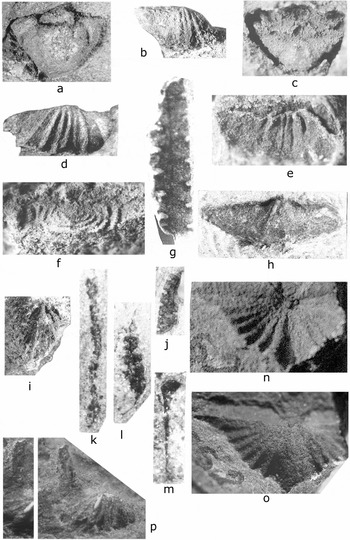
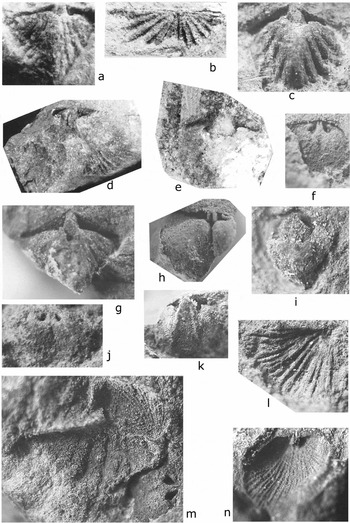
All specimens come from the Lower Kayalıdere Formation, Pendik, Istanbul. (a, c) Leangella aff. scissa (Davidson, Reference Davidson1871); (a) ventral internal mould, İTÜ.620, ×6; (c) brachial view of exterior of conjoined valves, showing interarea, delthyrium and cardinal process, İTÜ.624, ×11. (b, d, e) Eoplectodonta rhombica (M'Coy, Reference M'Coy, Sedgwick and M'Coy1852); (b) dorsal internal mould, İTÜ.641a, ×5.5; (d) ventral internal mould, İTÜ.719d, ×5; (e) dorsal valve inner surface, İTÜ.652a, ×5. (f) Leptaena rugosa Dalman, Reference Dalman1828, ventral valve external mould, İTÜ.633c, ×6. (h) Eoplectodonta aff. rhombica (M'Coy, Reference M'Coy, Sedgwick and M'Coy1852), ventral internal mould, İTÜ.635, ×6. (i) Protatrypa aff. thorslundi Boucot & Johnson, Reference Boucot and Johnson1964, dorsal internal mould, İTÜ.668, ×6. (n, o) Plectothyrella cf. crassicostis (Dalman, Reference Dalman1828), exterior and interior of dorsal mould, İTÜ.622, ×6. (g, j) Climacograptus aff. normalis Lapworth, Reference Lapworth1877; upper part of rhabdosome and deformed reverse side, İTÜ.712a, b, ×7.5. (k) Glyptograptus sp. aff. nicholsoni Toghill, Reference Toghill1970, deformed rhabdosome fragment, İTÜ.792, ×7.5. (l) Glyptograptus cf. persculptus (Elles & Wood, Reference Elles and Wood1907), a complete juvenile rhabdosome, İTÜ.585, ×16. (m) ?Climacograptus sp., proximal end of sicula (virgella), İTÜ.119, ×16. (p) ?Diplograptus sp., rhabdosome fragment, İTÜ.717, on the pedicle valve of Eoplectodonta sp., İTÜ.603, ×7.2.

Remarks. One ventral external mould, İTÜ.633c (L, 5.8 mm; W, 10.7 mm), from the Lower Kayalıdere Formation, Pendik, Istanbul is known. It is a typical specimen of L. rugosa, which was described by Dalman (Reference Dalman1828) from the Dalmanitina Beds (Hirnantian), Västergötland, Sweden, and was revised by Marek & Havliček (Reference Marek and Havlíček1967) and Bergström (Reference Bergström1968). This Turkish specimen was recorded by Sayar (Reference Sayar1979c , p. 90, pl. 24, figs 1, 2) as Leptaena martinensis Cocks, Reference Cocks1968, but the latter is now known to be a synonym of L. rugosa. The Istanbul form is smaller than the lectotype of L. rugosa.
Genus Eostropheodonta Bancroft, 1949
Eostropheodonta hirnantensis (M'Coy, Reference M'Coy1851)
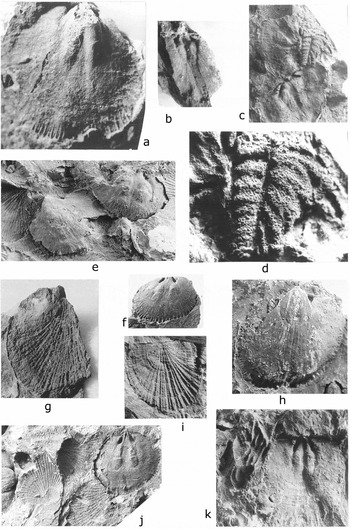
All specimens come from Locality 337 in the Göğeren Formation, Haciyeri Village, south of Yığılca, Bolu, apart from (b) and (g, h), which come from Locality 883, also at Haciyeri. (a, b) Ravozetina rava (Marek & Havliček, Reference Marek and Havlíček1967); (a) ventral valve internal mould, İTÜ.Y.21b, ×7; (b) dorsal valve internal mould, İTÜ.Y.5a, ×3. (c, d) Dedzetina sp., dorsal internal mould, İTÜ.Y1–8a, on its upper right Mucronaspis aff. mucronata (Brongniart, Reference Brongniart1822); incomplete pygidium, the left part and posterior extremity (spine) broken, İTÜ.Y.1–8b, ×2; (d) the same specimen enlarged, ×10. (e, f) Hirnantia sagittifera (M'Coy, Reference M'Coy1851); (e) lower left, ventral internal mould İTÜ.Y.1a, upper right, dorsal internal mould, İTÜ.Y.1b, ×2; (f) dorsal internal mould compressed posteriorly, İTÜ.Y.17, ×2.5. (g, h, k) Dalmanella testudinaria (Dalman, Reference Dalman1828); (g, h) counterpart ventral external and internal moulds, İTÜ.Y.16a, b ×2.3; (k) dorsal internal mould, İTÜ.Y.2–2, with Mucronaspis aff. mucronata (Brongniart, Reference Brongniart1822), external mould of incomplete cranidium, longitudinally compressed, İTÜ.Y.2–1b, (on the cranidium, the glabella, three furrows and the left eye are visible), ×2.5. (j) Drabovia sp., internal and external moulds of dorsal valve, İTÜ.Y.11, ×2.5. (i) Eostropheodonta hirnantensis (M'Coy, Reference M'Coy1851); external mould of dorsal valve, İTÜ.Y.1–7, ×2.5.

Remarks. One external mould of a dorsal valve, İTÜ.Y.1–7 (L, 13.2 mm; W, 14.4 mm), from Locality 337, Göğeren Formation, Hacıyeri Village, south of Yığılca, Bolu. The hinge line is straight, shorter than the maximum width (12 mm), with small denticles on hinge line; shell ornamented by radial parvicostellate ribs and concentric growth lines, about 5–6 ribs per 2 mm near the front margin. The species was originally described as Orthis hirnantensis by M'Coy (Reference M'Coy1851) from the Hirnant Formation (Hirnantian) of North Wales, and was revised and a lectotype selected by Temple (Reference Temple1965). The Bolu specimen is smaller than the lectotype (L, 20.5 mm, W, 25.7 mm). E. hirnantensis from beds of Hirnantian age at Glyn Ceiriog, North Wales (Hiller, Reference Hiller1980), is slightly more transverse.
Superfamily Plectambonitoidea Jones, 1928
Genus Leangella Öpik, 1933
Leangella aff. scissa (Davidson, Reference Davidson1871)
All specimens come from the Lower Kayalıdere Formation, Pendik, Istanbul. (a, b) Toxorthis proteus Temple, Reference Temple1968; (a) internal mould of deformed ventral valve, İTÜ.562; (b) dorsal interior, İTÜ.563, both ×6. (c) Dolerorthis aff. sowerbyana (Davidson, Reference Davidson1869), ventral internal mould, İTÜ.577, ×8. (d) Comatopoma sp., internal mould of dorsal valve, poorly preserved, İTÜ.682, ×6. (e) Hesperorthis sp., ventral internal mould, İTÜ.574a and (Gr to the left) a poorly preserved Climacograptus sp., İTÜ.574b, ×6. (g, h) Skenidioides aff. asteroidea (Reed, Reference Reed1917); (g) internal mould of ventral valve, İTÜ.545a, ×7.6; (h) dorsal internal mould, İTÜ.550a, ×6. (i) Leangella aff. scissa (Davidson, Reference Davidson1871), ventral internal mould, İTÜ.621, ×7.5. (j, l) Hirnantia cf. sagittifera (M'Coy, Reference M'Coy1851); (j) internal mould of dorsal valve (young form) İTÜ.582, ×7.5; (l) external mould of ventral valve, İTÜ.584b, ×6.5. (f, k, m, n) Resserella aff. llandoveriana Williams, Reference Williams1951; (f) dorsal internal mould, İTÜ.642b, ×5.5; (k) ventral internal mould, İTÜ.592, ×11; (m) ventral external mould and dorsal internal mould together with dorsal internal mould of Eoplectodonta rhombica (M'Coy, Reference M'Coy, Sedgwick and M'Coy1852), İTÜ.642a, ×8; (n) ventral external mould, İTÜ.633b, ×7.

Remarks. Twenty-one specimens from the Lower Kayalıdere Formation (Hirnantian) and 44 specimens of Leangella from the Upper Kayalıdere Formation (Rhuddanian–Aeronian) have been studied from the same locality at Pendik, Istanbul (Sayar, Reference Sayar1979c , p.78, pl. 17, figs 6–8; pl. 18, figs 1–9). The Hirnantian form, identified here as Leangella aff. scissa, differs in its smaller size, relatively longer shell and more concave dorsal valve than the Rhuddanian specimens of true Leangella scissa (Sayar, Reference Sayar1979c , p. 76, pl. 14, figs 3–5; pl. 15, figs 1–7; pl. 16, figs 1–5; pl. 17, figs 1–5). The species was originally described as Leptaena scissa by Davidson (Reference Davidson1871), and revised as Leangella scissa by Cocks (Reference Cocks1970) from the Upper Haverford Mudstone Formation (Rhuddanian) of Haverfordwest, Pembrokeshire, Wales. Leangella cf. scissa from Hirnantian rocks at Västergötland, Sweden (Bergström, Reference Bergström1968), differs in its longer shell and flatter cardinal angles. Leangella cf. scissa from the Dolhir Formation (Late Katian) of North Wales (Hiller, Reference Hiller1980), is more transverse and has a larger ventral muscle area than the Istanbul specimens. The Leangella aff. scissa from Istanbul is similar to the Leangella aff. cylindrica (Reed, Reference Reed1917) of Cocks (Reference Cocks1982), from Hirnantian beds in the Oslo-Asker District, Norway, in its shell outline, and longer and more convex ventral valve.
Genus Eoplectodonta Kozlowski, 1929
Eoplectodonta rhombica (M'Coy, Reference M'Coy, Sedgwick and M'Coy1852)
Figures 7b, d, e, 9m, ?7h
Remarks. The Istanbul material is mostly semicircular to transversely oval in outline, and was previously recorded as Eoplectodonta duplicata (Sowerby, Reference Sowerby and Murchison1839) by Sayar (Reference Sayar1979c , p. 83, pl. 19, figs 1–6; pl. 20, figs 1–13; pl. 21, figs 1–8; pl. 22, figs 1–10) and designated then as the ‘Normal Form’ (L, 3.5–8 mm; W, 7–14 mm) İTÜ.652a; but some more transverse, shorter and smaller specimens (L, 3.5–4.5 mm; W, 7–13 mm) were identified as Eoplectodonta aff. duplicata (Sowerby, Reference Sowerby and Murchison1839) and grouped as an ‘Alate Form’ (Sayar, Reference Sayar1979c , pp. 83–90, pl. 22, figs 19–22; pl. 23, figs 1–8). The latter, including the external mould of a brachial valve İTÜ.642a from the Lower Kayalıdere Formation of Pendik, are smaller and more transverse with acute cardinal angles and smaller ventral muscle areas, and are reassigned here to Eoplectodonta aff. rhombica (M'Coy, Reference M'Coy, Sedgwick and M'Coy1852) (Fig. 7h), İTÜ.635. E. rhombica was originally described as Leptaena sericea (Sowerby) var. rhombica by M'Coy (Reference M'Coy, Sedgwick and M'Coy1852) from the Crag Hill Beds (Late Katian) of Horton-in-Ribblesdale, Cumbria, England, and was revised as Eoplectodonta rhombica by Cocks (Reference Cocks1982). The Istanbul specimens are closely related but lack rugae on the posterior margin, in a similar way to Eoplectodonta cf. rhombica from the Early Katian of Pomeroy, Ireland, described by Mitchell (Reference Mitchell1977). Eoplectodonta aff. rhombica from Istanbul (Fig. 7h) shows similarity to some specimens of Eoplectodonta cf. rhombica (Williams, Reference Williams1963) from the Early Katian of Girvan, Scotland, and seems also closely related to Eoplectodonta sp. 1 described by Harper (Reference Harper1989) from the Late Katian of Girvan.
Family Chilidiopsoidea Boucot, 1959
Genus Coolinia Bancroft, 1949
Coolinia dalmani Bergström, Reference Bergström1968
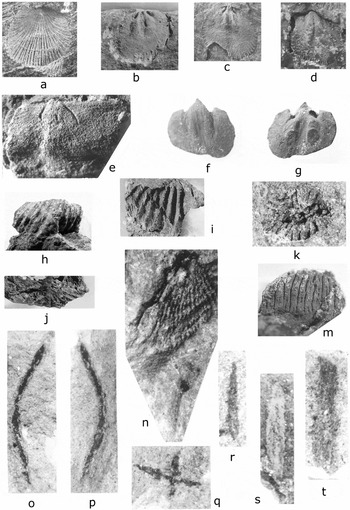
(a, e, h–j, m) come from Locality 337 in the Göğeren Formation, Haciyeri Village, south of Yığılca, Bolu, (b–d, f, g) from Locality 883, also at Haciyeri, and (n–t) from the Lower Kayalıdere Formation, Pendik, Istanbul. (a–c) Drabovia sp.; (a) dorsal external mould, İTÜ.Y.1–5, ×2.5; (b, c) dorsal internal moulds, İTÜ.Y.5, İTÜ.Y.5.1, ×2.4. (d, f–g) Kinnella aff. kielanae (Temple, Reference Temple1965); (d) ventral internal mould, İTÜ.Y.12a, ×2; (f, g) ventral and dorsal views of internal mould of conjoined valves, İTÜ.Y.23, ×4. (e) Coolinia dalmani Bergström, Reference Bergström1968, internal mould of deformed ventral valve, İTÜ.Y.3, ×4.3. (h–j) Plectothyrella cf. crassicostis (Dalman, Reference Dalman1828), counterpart ventral internal and external moulds with beak and umbo compressed, İTÜ.Y.4a, b, ×2.2. (k) ?Thamnopora sp., transversely broken small tabulate coral colony, İTÜ.664, ×6. (m) Streptelasma sp., internal mould of flattened corallite affected by tectonic deformation İTÜ.Y.14, ×2.3. (n) Climacograptus sp. aff. normalis Lapworth, Reference Lapworth1877, proximal fragment with sicula and some poorly preserved theca; in the upper left is dorsal external mould of Skenidioides aff. asteroidea (Reed, Reference Reed1917), İTÜ.719;720a, ×10. (o, p) ?Climacograptus sp., deformed internal and external moulds, the counterpart of a distal end fragment, İTÜ.718a, ×7; (q) synrhabdosome of a diplograptid with four individuals, İTÜ.743a, ×10, one partly broken. (r–t) Diplograptidae gen. et. sp. indet., (r) İTÜ.728, ×10. (s) İTÜ.737, ×10. (t) İTÜ.735, ×7.

Remarks. One ventral internal mould, İTÜ.Y.3 (L, 8.6 mm; W, 16.2 mm); from Locality 337, Göğeren Formation, Hacıyeri Village, south of Yığılca, Bolu, is characteristic of the species. The ornament can be seen internally on the left flank, and is three ribs per millimetre at 5 mm in front of the umbo. The species was described by Bergström (Reference Bergström1968) from the lower Dalmanitina Beds (Hirnantian), at Stommen, Västergötland, Sweden, and by Cocks (Reference Cocks1982). The Bolu specimen is smaller than the holotype (40 mm wide). Coolinia (Fardenia) comes (Marek & Havliček, Reference Marek and Havlíček1967) from the Hirnantian of Bohemia is 17 mm wide and differs in its stronger internal ribbing, and the anterolateral ends of the dental plates are less curved than the Bolu material.
Superfamily Orthoidea Woodward, 1852
Genus Toxorthis Temple, Reference Temple1968
Toxorthis proteus Temple Reference Temple1968
Figure 9a, b
Remarks. One ventral internal mould, İTÜ.562 (L, 4.5 mm; W, 8 mm), and one dorsal interior, İTÜ.563 (L, 4 mm; W, 9 mm), were recovered from the Lower Kayalıdere Formation at Pendik (Sayar, Reference Sayar1979c , pp. 50–51, pl. 2, figs 3–8). Toxorthis proteus was described by Temple (Reference Temple1968) from the Keisley Limestone (Hirnantian) of Westmoreland, Northern England. The Istanbul material is similar to the holotype but the dorsal valve has three median ribs in the sulcus (one of them bifurcated) and more distinctive concentric growth lamellae at the anterior margin.
Genus Dolerorthis Schuchert & Cooper, 1931
Dolerorthis aff. sowerbyana (Davidson, Reference Davidson1869)
Remarks. Only one ventral internal mould, İTÜ.577 (L, 4.5 mm; W, 5.5 mm), with an ornament of 10–12 angular radial ribs was described from the Lower Kayalıdere Formation at Pendik by Sayar (Reference Sayar1979c, p.51, pl. 3, figs 1–8). The species was originally described from Rhuddanian siltstones near Meifod, Wales, by Davidson (Reference Davidson1869) and revised by Temple (Reference Temple1970). The Istanbul specimen is smaller, more convex and has fewer radial ribs than the holotype. The dorsal valve is unknown.
Genus Hesperorthis Schuchert & Cooper, 1931
Hesperorthis sp.
Remarks. One ventral internal mould part and counterpart, İTÜ.574a (L, 6 mm; W, 7 mm), from the Lower Kayalıdere Formation, Pendik, was described by Sayar (Reference Sayar1979c , pp. 52–3, pl. 4, figs 1–3). It is of medium size, subquadrate and moderately convex; cardinal margin straight, nearly equal to the width; interarea high and apsacline; cardinal angles subrounded; ventral muscle area subtriangular; subcordial poorly preserved thick radial ribs on shell. On the same specimen there is a ferruginous rhabdosome of Climacograptus sp. (İTÜ.574b).
Superfamily Plectorthoidea Schuchert & Le Vene, 1929
Genus Comatopoma Havliček, 1951
Comatopoma sp.
Remarks. One dorsal valve internal mould, İTÜ.682, from the Lower Kayalıdere Formation, Pendik, was described by Sayar (Reference Sayar1979c , pp. 52–3, pl. 4, fig. 4). This specimen shows close affinity to Comatopoma sororium Marek & Havlíček, Reference Marek and Havlíček1967 (Havlíček, Reference Havlíček1977) from the Kosov Formation (Hirnantian) of Bohemia. The shell is oval in shape and gently convex; the hingeline is straight with the cardinal angles rounded; the widest part of the shell is nearly mid-length. There is a wide shallow sulcus from the umbo to the anterior margin; the orthocline dorsal interarea is less than 1 mm high; the cardinal process is blade-like; the brachiophore supports are long and thin but with strong sockets; the dorsal muscle scars are elliptical; and there is multicostellate internal ribbing (3–4 per millimetre) near the anterior margin.
Superfamily Skenidioidea Kozłowski, 1929
Genus Skenidioides Schuchert & Cooper, 1931
Skenidioides aff. asteroidea (Reed, Reference Reed1917)
Figure 9g, h
Remarks. About 12 internal and external moulds of ventral and dorsal valves, but no conjoined valves, were found in the Lower Kayalıdere Formation at Pendik, and identified as Skenidioides aff. asteroidea Reed, by Sayar (Reference Sayar1979c , pp. 57–60, pl. 5, figs 5–8; pl. 6, figs 1–10; pl. 7, figs 1–7). Skenidioides asteroidea was originally described as Scenidium lewisi Davidson, var. nov. asteroidea by Reed (Reference Reed1917) from the Starfish Bed at Thraive Glen in the Drummuck Group (Katian), Girvan, Scotland. The Turkish material shows a close relation to it, but the holotype has fewer ribs (20) and acute cardinal angles. Skenidioides cf. asteroidea described by Wright (Reference Wright1964) from the Portrane Limestone (Hirnantian), near Dublin, Ireland, and by Hiller (Reference Hiller1980) from north Wales, are close to the Istanbul form, but the Portrane material is smaller and has fewer ribs (12–21). The Welsh material is nearly the same size but also has fewer ribs. Skenidioides scoliodus Temple (Reference Temple1968), from the Keisley Limestone (Hirnantian), northern England, differs in its small size (L, 0.5–2.5 mm; W, 0.5–3 mm), deep dorsal sulcus and longer median septum.
Superfamily Dalmanelloidea Schuchert, 1913
Genus Dalmanella Hall & Clarke, 1892
Dalmanella testudinaria (Dalman, Reference Dalman1828)
Figure 8g, h, k
Remarks. Several internal and external moulds of both ventral and dorsal valves, including İTÜ.Y.16a (L, 18.7 mm; W, 24.3 mm); İTÜ.Y 2–2 (L, 14.2 mm; W, 15.8 mm), a dorsal internal mould (Fig. 8k) with a cranidium of Mucronaspis aff. mucronata (Brongniart); and İTÜ.Y 2–1b, were found at Locality 337 in the Göğeren Formation at Hacıyeri Village, south of Yığılca, Bolu. The species was originally described as Orthis testudinaria by Dalman (Reference Dalman1828), from the Dalmanitina Beds (Hirnantian) of Östergötland, south central Sweden, and revised as Dalmanella testudinaria by Williams & Wright (Reference Williams and Wright1963), Temple (Reference Temple1965), Marek & Havliček (Reference Marek and Havlíček1967), Bergström (Reference Bergström1968) and Jin & Bergström (Reference Jin and Bergström2010). Bergström (Reference Bergström1968) concluded that the different sizes and shell thicknesses in some Dalmanella testudinaria populations might be the result of environmental variations.
Genus Ravozetina Havliček, 1974
Ravozetina rava (Marek & Havliček, Reference Marek and Havlíček1967)
Figure 8a, b
Remarks. One ventral valve internal mould, İTÜ.Y 21b (L, 9.4 mm; W, 9.1 mm) from Locality 337, and one dorsal valve, İTÜ.Y 5a (L, 11.2 mm), from Locality 883, were both found in the Göğeren Formation at Hacıyeri Village, south of Yığılca, Bolu. The species was originally described as Onniella rava by Marek & Havliček (Reference Marek and Havlíček1967) from the Kosov Formation (Hirnantian) of Bohemia, and was revised as Ravozetina rava by Havliček (Reference Havlíček1977). The Bolu material is similar but rather larger than the holotype from Bohemia and the pedicle valve is more rounded and has finer internal ribs.
Genus Dedzetina Havliček, Reference Havlíček1951
Dedzetina sp.
Figure 8c, d
Remarks. Only one dorsal internal mould, İTÜ.Y 1–8a (L, 10 mm; W, 13 mm) (Fig. 8c, d), together with a trilobite pygidium, probably Mucronaspis mucronata (İTÜ.Y 1–8b), was found at Locality 337, Hacıyeri Village, south of Yığılca, Bolu. The brachiophore supporting plates are thin and strongly divergent (100–110°); the large muscle field is shield-shaped, medianly divided by a strong ridge and surrounded laterally by a low ridge; the posterior adductors are separated from larger anteriors by low transverse ridges converging posteriorly. It is similar to Dedzetina microstoma, which was described by Havlíček (Reference Havlíček1977) from the Králûv Dvûr Formation (Late Katian) of Bohemia. The single specimen from Bolu is similar in shape and internal features to Dedzetina microstoma, but the holotype has thick brachiophore supports. Dedzetina cf. microstoma described by Harper (Reference Harper1989) from Girvan also has thicker brachiophore supporting plates than the Bolu form; however, there is not enough Turkish material for more precise assignment.
Genus Resserella Bancroft, 1928
Resserella aff. llandoveriana Williams, Reference Williams1951
Figure 9f, k, m, n
Remarks. Sayar (Reference Sayar1979c , pp. 70–2, pl. 11, figs 1–12; pl. 12, figs 1–11) described Resserella aff. llandoveriana from internal and external moulds of ventral and dorsal valves, including İTÜ.642b, İTÜ.592, İTÜ.633b (L, 1.5–7.5 mm; W, 1.8–9 mm). Resserella llandoveriana was described by Williams (Reference Williams1951) from the Haverford Mudstone Formation (Rhuddanian) of Pembrokeshire, Wales. The small Resserella aff. llandoveriana from the Lower Kayalıdere Formation (Hirnantian) is scarce and its radial ribs are thicker than those of larger specimens such as the holotype. However, true R. llandoveriana occurs in the Upper Kayalıdere Formation at Pendik, which is of Early Llandovery (Rhuddanian) age (Sayar, Reference Sayar1979c ).
Superfamily Enteletoidea Waagen, 1884
Genus Drabovia Havliček, Reference Havlíček1951
Drabovia sp.
Figures 8j, 10a–c
Remarks. External and internal moulds of dorsal valves and one external mould of a ventral valve were found at Locality 337 (including İTÜ.Y.11 and İTÜ.Y.1–5) and Locality 883 (İTÜ.Y.5 and İTÜ.Y.5–1), both in the Göğeren Formation, Hacıyeri Village, South of Yığılca, Bolu (L, 9.1–12; W, 9.5–10 mm). The Hirnantian Bolu specimens are of smaller size and have a larger dorsal muscle area and finer fascicostellate ribs than Drabovia postrema Havlíček, Reference Havlíček1951 (Havlíček, Reference Havlíček1977) from the Bohdalec Formation (Katian) of Bohemia. The latter is subrectangular to transversely oval, with coarser fascicostellate ribs and has thin, long, slightly divergent brachiophore supporting plates. The Bolu form has a thin, blade-like cardinal process shorter than the brachiophores, which are thick and diverge at 75–85°; the dental sockets are small, and the dorsal muscle field is oval, surrounded by a low ridge, and is quadripartite, with long triangular to elliptical posterior adductors located in front of the brachiophore supports and separated from subrectangular anterior scars by a low transverse ridge.
Genus Hirnantia Lamont, Reference Lamont1935
Hirnantia sagittifera (M'Coy, Reference M'Coy1851)
Figures 8e, f, 9j, l
Remarks. This species is not common, but includes İTÜ.582 (L, 3.5 mm; W, 5 mm), a juvenile specimen (Fig. 9j), and İTÜ.584b (Fig. 9l), a ventral external mould showing the ornament, from the Lower Kayalıdere Formation, Pendik; and İTÜ.Y.1a and 1b (Fig. 8e), ventral (L, 10.9 mm; W, 14.5 mm) and dorsal (L, 13.6 mm; W, 15.4 mm) internal moulds, and İTÜY.17 (Fig. 8f) from localities 337 and 883, respectively, in the Göğeren Formation at Hacıyeri Village, south of Yığılca, Bolu. Sayar (Reference Sayar1979c , pp. 61–3, pl. 8, figs 1–8) described this material as Hirnantia cf. sagittifera. The species was originally described as Orthis sagittifera by M'Coy (Reference M'Coy1851) from the Hirnant Limestone (Hirnantian) of Aber Hirnant, North Wales and was revised as Hirnantia sagittifera by Lamont (Reference Lamont1935), Temple (Reference Temple1965), who chose and figured the lectotype (Sedgwick Museum Cambridge A41217; L, 16.3 mm; W, 15.2 mm), and Marek & Havliček (1967). Juvenile forms from the Lower Kayalıdere Formation (Fig. 9j; L, 2.5–5 mm; W, 3.5–6 mm) are somewhat different, but the adults are similar to those from Wales and Bohemia; however, the Bolu material is similar to British, Baltic and Bohemian specimens.
Genus Kinnella Bergström, Reference Bergström1968
Kinnella aff. kielanae (Temple, Reference Temple1965)
Figure 10d, f, g
Remarks. One pair of conjoined valves internal mould (Fig. 10f, g), İTÜ.Y.23 (L, 7 mm; W, 9.2 mm), and one ventral internal mould, İTÜ.Y.12a, were found at Locality 883 in the Göğeren Formation at Hacıyeri Village, south of Yığılca, Bolu. Temple (Reference Temple1965) described Hirnantia? kielanae from the Dalmanitina Beds (Hirnantian) of the Holy Cross Mountains, Poland, which was revised by Marek & Havliček (1967) and as Kinnella kielanae by Bergström (Reference Bergström1968). The Bolu specimens show differences in the long oval muscle area of the ventral valve and the wider median ridge of the dorsal valve than that of the holotype. The Bohemian subspecies Kinnella kielanae proclinis Havliček (Reference Havlíček1977) differs in its oval shape with a circular ventral muscle area and in a narrower median ridge in the dorsal valve.
Superfamily Rhynchotrematoidea Schuchert, 1913
Genus Plectothyrella Temple, Reference Temple1965
Plectothyrella cf. crassicostis (Dalman, Reference Dalman1828)
Figures 7n, o, 10h–j
Remark. One dorsal valve, İTÜ.662 (L, 6.4 mm; W, 18 mm) from the Lower Kayalıdere Formation, Pendik, and İTÜ.Y.4a, b (L, 17.2 mm), the internal and external moulds of a pedicle valve, were found at Locality 337 in the Göğeren Formation at Hacıyeri Village, south of Yığılca, Bolu, and were described as Plectothyrella crassicosta by Sayar (Reference Sayar1979c , p. 100, pl. 27, figs 1–2). The species was originally described as Atrypa? crassicostis by Dalman (Reference Dalman1828) from the Dalmanitina Beds (Hirnantian) of Västergötland, Sweden. It is a senior synonym of Plectothyrella platystrophoides Temple (Reference Temple1965), which was revised by Marek & Havliček (1967), as recognized by Bergström (Reference Bergström1968) and Cocks (Reference Cocks1982). Plectothyrella cf. crassicostis from Istanbul and Bolu differs from the Swedish P. crassicostis in being smaller, more transverse rather than elongate, less globose in outline and in having fewer radial ribs.
Superfamily Atrypoidea Gill, 1871
Genus Protatrypa Boucot, Johnson & Staton, Reference Boucot, Johnson and Staton1964
Protatrypa aff. thorslundi Boucot & Johnson, Reference Boucot and Johnson1964
Remarks. Two dorsal internal moulds dorsal, İTÜ.668 and İTÜ.669 (L, 8.5 mm; W, 5.5 mm), were found in the Lower Kayalıdere Formation at Pendik (Sayar, Reference Sayar1979c , p. 109, pl. 31, figs 6–8). The species was originally described by Boucot & Johnson (Reference Boucot and Johnson1964) from the Ede Quartzite (Aeronian) of Jämtland, Sweden, but the dorsal valve of the Istanbul specimen differs in being more convex and more elongate than the type material. Protatrypa malmoeyensis Boucot, Johnson & Staton, Reference Boucot and Johnson1964 from the Aeronian of Norway, and P. septentrionalis (Nikiforova in Nikiforova & Andreeva, Reference Nikiforova and Andreeva1961) from Llandovery beds of the Siberian Platform both have a longer hinge line and a less convex shell.
Acknowledgements
We warmly thank Prof. Dr Erol Gurdal, Birol Yilmaz, Zeynep Özbey and Şeyma Tok, all of Istanbul Technical University, for discussion and technical assistance, as well as Ali Uygur for the photography of fossils, and also The Natural History Museum, London, for hospitality (CS) and facilities (LRMC).