School classrooms, and the psychological and learning climates within, are environments enriched with possibilities for the promotion of children's socioemotional and behavioral health (Hamre & Pianta, Reference Hamre and Pianta2001; Mashburn et al., Reference Mashburn, Pianta, Hamre, Downer, Barbarin, Bryant and Howes2008). As structured forums for learning, classrooms are unique environments that intentionally bring together a diverse group of children and adults for a specific period of time on most days of the week. Although the children are active participants, teachers guide processes to establish a “climate” in the classroom that facilitates the learning of facts as well as children's social, emotional, and behavioral development. Children's response or receptivity to a classroom climate depends on a number of factors, including individual differences in neurobiological stress responsivity. In particular, children with heightened levels of physiological reactivity may be biologically sensitive to context such that they are more susceptible to the effects of both positive and negative environments (Boyce & Ellis, Reference Boyce and Ellis2005; Bush & Boyce, Reference Bush, Boyce and Cicchetti2016; Ellis, Boyce, Belsky, Bakermans-Kranenburg, & van IJzendoorn, Reference Ellis, Boyce, Belsky, Bakermans-Kranenburg and van Ijzendoorn2011), including the classroom.
The study of these developmental processes is particularly important during the initiation of formal schooling, as children are required to shift from the less structured environments of home or preschool to a more regimented schedule expected within kindergarten classrooms (La Paro, Rimm-Kaufman, & Pianta, Reference La Paro, Rimm-Kaufman and Pianta2006; Sink, Edwards, & Weir, Reference Sink, Edwards and Weir2007). Moreover, children's adjustment to kindergarten has been shown to exert lasting consequences on a range of behavioral outcomes through middle childhood and adolescence (Hamre & Pianta, Reference Hamre and Pianta2001; Myers & Pianta, Reference Myers and Pianta2008). Among the most well-documented findings from developmental cascades research are the consequences of failures in developmental transitions on longer term psychological outcomes (Masten & Cicchetti, Reference Masten and Cicchetti2010). In combination with research on the rapidly increasing rates of early school expulsion (Zinsser, Zulauf, Das, & Silver, Reference Zinsser, Zulauf, Das and Silverin press) and grade retention (Davoudzadeh, McTernan, & Grimm, Reference Davoudzadeh, McTernan and Grimm2015), there are compelling reasons to identify the range of conditions that assist children in adapting to and thriving in kindergarten. The present study examined the potential moderating influence of children's biological sensitivity to context, as measured by their autonomic nervous system reactivity to challenge, on the relation between classroom climate and changes in children's externalizing symptoms across the school year.
Core Features of Classroom Climate: Instructional Styles
Climate is understood to encompass both social-emotional and instructional features of the classroom environment (Matsumura, Slater, & Crosson, Reference Matsumura, Slater and Crosson2008; Rucinski, Brown, & Downer, Reference Rucinski, Brown and Downerin press). For the purposes of the present study, we highlight the role of teachers’ instructional practices because they are central to the determination of the classroom climate. Decades of prior research indicate a relation between classroom climate and an array of academic outcomes during childhood, including student performance, motivation to learn, and absenteeism (Thapa, Cohen, Higgins-D'Alessandro, & Guffey, Reference Thapa, Cohen, Higgins-D'Alessandro and Guffey2012). Complementary to this body of literature are studies that have observed the classroom climate to relate to outcomes beyond the educational realm, including children's socioemotional and behavioral health. Structured, well-managed classrooms establish clear expectations for appropriate behavior and have been associated with lower levels of aggression and other externalizing problems, as well as greater social competence (Brophy-Herb, Lee, Nievar, & Stollak, Reference Brophy-Herb, Lee, Nievar and Stollak2007; Thomas, Bierman, Powers, & Conduct Problems Prevention Research Group, Reference Thomas, Bierman and Powers2011). Lower levels of problem behavior have also been observed within classrooms where teachers and students share warm relationships and open communication styles (Pianta, Steinberg, & Rollins, Reference Pianta, Steinberg and Rollins1995).
Child centered and teacher directed are two prominent categorizations of classroom instructional practices (Driscoll & Pianta, Reference Driscoll and Pianta2010; Stipek & Byler, Reference Stipek and Byler2004; Tang et al., Reference Tang, Pakarinen, Lerkkanen, Kikas, Muotka and Nurmi2017) with theoretical roots in constructivism and behaviorism, respectively (Daniels & Shumow, Reference Daniels and Shumow2003). When using a child-centered approach, teachers view children as active participants in their own learning and engage in instructional practices that facilitate children's self-directed, autonomous efforts to acquire knowledge. Child-centered instructional methods are responsive to the needs of individual children and account for variation in children's interests, motivations, and learning styles (McCombs, Reference McCombs, Meece and Eccles2010). In contrast, teacher-directed styles are more didactic in character and promote teachers’ managerial role in learning activities as children passively receive information. In a teacher-directed approach, greater emphasis is placed on attaining predetermined goals than on the process through which learning occurs (Lerkkanen et al., Reference Lerkkanen, Kiuru, Pakarinen, Poikkeus, Rasku-Puttonen, Siekkinen and Nurmi2016; Woolfolk Hoy & Weinstein, Reference Woolfolk Hoy, Weinstein, Evertson and Weinstein2006).
Child-centered and teacher-directed practices have previously been conceptualized as mutually exclusive such that teachers could be classified as engaging in the former or the latter (Pianta, La Paro, Payne, Cox, & Bradley, Reference Pianta, La Paro, Payne, Cox and Bradley2002). Child-centered practices are consistent with the professional guidelines outlined by the National Association for the Education of Young Children; however, conclusions regarding the optimal instructional approach have been equivocal. Examined primarily in regard to children's academic performance, some studies have touted the superiority of child-centered practices (Cornelius-White, Reference Cornelius-White2007; Stipek et al., Reference Stipek, Feiler, Byler, Ryan, Milburn and Salmon1998), whereas others have argued that children's outcomes are improved with use of teacher-directed styles (Crosnoe et al., Reference Crosnoe, Morrison, Burchinal, Pianta, Keating, Friedman and Clarke-Stewart2010; Kikas, Peets, & Hodges, Reference Kikas, Peets and Hodges2014).
Reconciliation of these conflicting findings may come from recent recognition that there is not a clear dichotomy in the real-world application of these instructional styles (Chiatovich & Stipek, Reference Chiatovich and Stipek2016). Rather, child-centered and teacher-directed practices coexist in the classroom setting and are utilized in varying proportions that are “continuously negotiated” between teachers and students (Tzuo, Reference Tzuo2007). Thus, what is of greater utility is the relative use of child-centered versus teacher-directed practices. Moreover, there is evidence that the extent to which this relative use of child-centered versus teacher-directed pedagogical components associates with student outcomes is contingent on the individual characteristics of the children in those classrooms (Kikas et al., Reference Kikas, Peets and Hodges2014; Stipek & Byler, Reference Stipek and Byler2004; Stipek, Feiler, Daniels, & Milburn, Reference Stipek, Feiler, Daniels and Milburn1995). Biological reactivity to challenge (often understood as “stress reactivity”) may serve as one such individual characteristic, rendering children more sensitive to qualities of social environments, including instructional practices within the classroom environment.
The Autonomic Nervous System and Biological Sensitivity to Context in the Classroom
The autonomic nervous system is composed of two branches, the sympathetic nervous system and the parasympathetic nervous system. The parasympathetic nervous system dampens sympathetic nervous system activity through activation of the 10th cranial (vagus) nerve, which inhibits the firing rate of the sinoatrial node, the natural pacemaker tissue of the heart. It can be conceptualized as a brake that when released, allows the heart to accelerate (Porges, Doussard-Roosevelt, Portales, & Greenspan, Reference Porges, Doussard-Roosevelt, Portales and Greenspan1996). The extent to which this vagal mechanism exerts inhibitory pressure on the heart is measured by respiratory sinus arrhythmia (RSA), a naturally occurring variation in heart rate that occurs during the breathing cycle (Hayano, Yasuma, Okada, Mukai, & Fujinami, Reference Hayano, Yasuma, Okada, Mukai and Fujinami1996). Changes in RSA from baseline in response to challenging conditions (i.e., RSA reactivity) are conceptualized as indices of children's stress regulatory capacities (Beauchaine, Gatzke-Kopp, & Mead, Reference Beauchaine, Gatzke-Kopp and Mead2007). Vagal withdrawal (i.e., decreases in RSA reflective of increased reactivity) accelerates heart rate and allows greater sympathetic nervous system input to the heart while vagal augmentation (i.e., increases in RSA reflective of lower reactivity) slows the heart rate and inhibits the input of the sympathetic nervous system to the heart (Porges, Reference Porges2007). Broadly, higher RSA reactivity is considered a functional physiological state for responding to moderately challenging environmental stressors and has been associated with better emotion regulation, social skills, and problem solving (Beauchaine, Reference Beauchaine2001; Fox & Calkins, Reference Fox and Calkins2003). Lower levels of RSA reactivity may represent a less adaptive response to emotionally evocative stressors, though positive RSA change scores (vagal augmentation) have also been associated with greater sustained attention and social engagement during challenges, particularly those that are more cognitive in nature (Beauchaine, Reference Beauchaine2001). Of note, there are no absolute thresholds that define hyper- or hyporesponsive patterns of RSA in relation to adjustment, and such associations may change with age and risk level (Zisner & Beauchaine, Reference Zisner, Beauchaine and Cicchetti2016).
Polyvagal theory describes the functional role of the vagal system in regulating attention, emotion, and social processes when individuals encounter challenging environments (Porges, Reference Porges1995). This theory has provided a context for understanding the relation of dysregulated RSA reactivity to forms of children's psychopathology that are characterized by poor behavioral and emotional self-regulation, including externalizing problems (Beauchaine, Gatze-Kopp, et al., Reference Beauchaine, Gatzke-Kopp and Mead2007). Empirical research has observed associations between externalizing symptoms and both higher and lower levels of RSA reactivity, with divergent findings that may be attributed to differences between clinical and normative samples and variation in the type of laboratory stressors used to evoke reactivity (for a review, see Zisner & Beauchaine, Reference Zisner, Beauchaine and Cicchetti2016).
Notwithstanding empirical evidence for main effects between RSA reactivity and externalizing outcomes, the theory of biological sensitivity to context (BSC) suggests such relations are more complex than the presumed uniform pathogenic effects of heightened reactivity (Ellis et al., Reference Ellis, Boyce, Belsky, Bakermans-Kranenburg and van Ijzendoorn2011). Rather, BSC posits that heightened biological reactivity promotes children's capacity to benefit from positive, supportive, and nurturing conditions, but increases the risk for children's maladaptive outcomes under negative, risky, and adverse conditions (Boyce & Ellis, Reference Boyce and Ellis2005; Ellis & Boyce, Reference Ellis and Boyce2008; Ellis, Essex, & Boyce, Reference Ellis, Essex and Boyce2005). Empirical studies of biological reactivity as a marker of sensitivity to context have focused primarily on influences of the familial environment. For example, compared to children lower in RSA reactivity, more reactive children have been found to exhibit fewer externalizing symptoms when reared in family environments with lower adversity (Obradović, Bush, Stamperdahl, Adler, & Boyce, Reference Obradović, Bush, Stamperdahl, Adler and Boyce2010). Greater RSA reactivity has also been associated with greater school engagement for children in the context of low family adversity, but low levels of engagement when family adversity was high (Obradović et al., Reference Obradović, Bush, Stamperdahl, Adler and Boyce2010). Heightened autonomic reactivity has been associated with greater emotion regulation (Skowron, Cipriano-Essel, Gatzke-Kopp, Teti, & Ammerman, Reference Skowron, Cipriano-Essel, Gatzke-Kopp, Teti and Ammerman2014) and lower externalizing (Boyce et al., Reference Boyce, Essex, Alkon, Goldsmith, Kraemer and Kupfer2006) and internalizing (Wetter & El-Sheikh, Reference Wetter and El-Sheikh2011) symptoms among children living within more supportive family environments compared to highly reactive children reared in contexts of greater family adversity. As compared to more highly reactive children, BSC suggests that lower levels of physiological reactivity (i.e., moderately reactive or nonreactive) “buffer individuals against the chronic stressors encountered in a world that is neither highly threatening or consistently safe” (Ellis & Boyce, Reference Ellis and Boyce2008, p. 185). The BSC hypotheses regarding less reactive children should not be interpreted through the same lens as research on maladaptively low levels of physiological reactivity. Rather, studies of BSC have generally observed no significant associations between adversity and mental health or school functioning among children with lower than average reactivity (or RSA augmentation), which supports the notion that those children are “less sensitive” to environmental influences (Essex, Armstrong, Burk, Goldsmith, & Boyce, Reference Essex, Armstrong, Burk, Goldsmith and Boyce2011; Obradović et al. Reference Obradović, Bush, Stamperdahl, Adler and Boyce2010; Rudolph, Troop-Gordon, & Granger, Reference Rudolph, Troop-Gordon and Granger2011).
The BSC framework may also be applicable to understanding children's adjustment within important developmental contexts beyond the family environment. Given the considerable quantity of time children spend at school and engaged with teachers/peers, children may be differentially susceptible to classroom conditions, much like they are differentially susceptible to qualities of the family context. To our knowledge, only one prior study has examined relations between the classroom environment and children's mental health outcomes from this more nuanced perspective. In support of BSC, Essex et al. (Reference Essex, Armstrong, Burk, Goldsmith and Boyce2011) observed that children with higher levels of biological reactivity exhibited the greatest mental health symptoms under conditions of high conflict or low closeness with their teacher and the fewest symptoms in the context of more supportive, less conflictual teacher–child relationships. Children with lower reactivity appeared “buffered,” with low levels of symptoms that did not vary with qualities of conflict or support in the teacher–child relationship (Essex et al., Reference Essex, Armstrong, Burk, Goldsmith and Boyce2011). As argued by leaders in the field of educational research, such findings suggest the importance of examining neurobiologically mediated sensitivity to measures of the teacher relationship and classroom environment (Pianta, Reference Pianta and Cicchetti2016).
The present study addressed gaps in prior research by examining the moderating effect of children's parasympathetic reactivity on the relation between class climate and children's externalizing symptoms. We evaluated these relations during the transition to kindergarten, focusing on this developmental period because of its salience in terms of socioemotional and behavioral development and its prognostic implications for school success. Guided by the BSC framework (Boyce & Ellis, Reference Boyce and Ellis2005), we hypothesized that parasympathetic reactivity would moderate the association between the classroom climate (proportion of child-centered to teacher-directed practices) and student externalizing mental health symptoms. We expected a significant relation of classroom climate to externalizing symptoms among children with higher reactivity, such that more reactive children would develop increased symptoms across the school year in classrooms characterized by greater proportional use of teacher-directed instructional practices and decreased symptoms in classrooms with greater use of child-centered practices. Externalizing symptoms were not expected to be associated with the relative use of child-centered to teacher-directed practices for low-reactive children.
Method
Participants
The current study consisted of 338 children (48% female, M age = 5.32 years, SD = 0.32) who were recruited for a longitudinal examination of the family and school environments, social status, physiological functioning, and mental and physical health outcomes (Bush, Obradović, Adler, & Boyce, Reference Bush, Obradovic, Adler and Boyce2011). The sample was diverse in race/ethnicity (19% African American, 11% Asian, 43% European or Caucasian, 4% Latino, 22% multiethnic, and 2% other) and socioeconomic status (range = $10,000–$400,000; M = $60,000–$79,000; Mdn = $80,000–$99,999), representing the sociodemographic characteristics of the geographic area from which families were drawn. Biological mothers were the primary source of caregiver-reported data (87%), followed by biological fathers (9%), adoptive mothers (2.5%), biological grandmothers, (0.6%), and individuals with other relations to the child (0.9%).
Procedures
Families were recruited in fall from six public schools in the San Francisco Bay Area selected to provide a heterogeneous sample. Data collection occurred across three successive waves from children across 29 kindergarten classrooms taught by 17 teachers (several teachers participated in more than 1 year of data collection). The study was open to all families with a child who was a student in a participating classroom. Families were only excluded if lack of fluency in English or Spanish precluded sufficient comprehension of the questionnaires.
Parents and teachers provided informed consent and children provided assent to participate. To provide compensation for time and effort, parents and children were given $100 in gift certificates over the course of the school year, teachers were given $30 for each completed child assessment, and schools were given $20 for each child enrolled in the study. This study was approved by the Committee for the Protection of Human Subjects of the University of California, Berkeley, and the Committee on Human Subjects of the University of California, San Francisco.
Measures
Demographics
During the fall of the kindergarten year, parents provided data on demographic characteristics, including socioeconomic status, ethnicity, household structure, and other background information.
Classroom climate
The Early Childhood Classroom Observation Measure (ECCOM; Stipek & Byler, Reference Stipek and Byler2004) evaluated teachers’ use of child-centered and teacher-directed instructional styles related to social climate and classroom management. During spring of the kindergarten year (March–April), trained research assistants conducted 60 min of observation within each classroom using procedures outlined in the ECCOM manual. Following observation sessions, research assistants independently coded the extent to which teachers utilized various instructional methods (described below) on a 5-point scale ranging from 1 (0%–20% of the time) to 5 (81%–100% of the time). Each classroom was observed and coded by two research assistants who demonstrated high reliability with each other (classroom social climate intraclass correlation; ICC = .84; classroom management ICC = .83) with the exception of four classrooms that were coded by one observer; however, this individual was highly reliable with other coders (ICCs ≥ .91). Across the sample, most children (85%) were enrolled in half-day kindergarten classes. The remainder of children (15%) were in full-day kindergarten classes. Classrooms were observed for the same amount of time during a prespecified observation window irrespective of the length of the kindergarten day.
The social climate dimension of the ECCOM reflects interpersonal and communication practices, teacher warmth, student engagement, and the extent of individualization of learning activities. The classroom management dimension of the ECCOM captures rules, routines, discipline, and children's level of responsibility in the classroom. Child-centered and teacher-directed styles may co-occur within each of these dimensions of the classroom environment (Kikas et al., Reference Kikas, Peets and Hodges2014). Using the ECCOM, teachers received four separate ratings of child-centered and teacher-directed practices in the management climate and social climate domains of the classroom environment (child-centered social climate, teacher-directed social climate, child-centered classroom management, and teacher-directed classroom management). For example, child-centered social climate codings were applied when teachers provide opportunities for children to speak in front of their peer group and asked each for help on tasks. A more teacher-directed social climate was coded when teachers directed children to work individually or in teacher-directed groups and when children were instructed to mainly rely on the teacher for assistance. Child-centered management practices were coded when teachers used clear, consistently applied, flexible rules, whereas teacher-directed class management practices reflected instances when teachers used more detailed, rigid rules.
The present study focused on the amount of time teachers spent using child-centered instructional practices relative to teacher-directed practices, rather than the absolute amount of time spent using each style. Building upon previous work, we used this ratio calculation in order to create an arithmetic proxy for the dynamic interrelationship of constructivist (child-centered) versus didactic (teacher-directed) components that characterize the lived reality of classroom instructional environments (Kikas et al., Reference Kikas, Peets and Hodges2014; Tzuo, Reference Tzuo2007). We calculated a ratio score for each ECCOM dimension, yielding one child-centered/teacher-directed ratio for classroom social climate and one child-centered/teacher-directed ratio for classroom management. The range of ECCOM scores in our sample was such that higher scores indicated that teachers used a greater proportion of child-centered methods relative to teacher-directed methods, and lower scores indicated that teachers used a child-centered and teacher-directed practices in relatively equal proportions. There were no classrooms predominated by teacher-directed practices relative to child-centered styles.
RSA reactivity
During fall of the kindergarten year, children's autonomic reactivity was evaluating by computing changes in RSA as children completed four, developmentally appropriate challenge tasks that have been shown to reliably elicit moderate stress responses. A brief description of the protocol follows; for more detailed information, the reader is referred to Bush, Alkon, Obradović, Stamperdahl, and Boyce (Reference Bush, Obradovic, Adler and Boyce2011).
Children were read a calming story aloud during a 2-min baseline period, after which the challenge tasks began. Each stress-eliciting task was paired with a nonstressful control condition that had parallel motor and engagement demands. Control conditions provided baseline reference values that were used to derive reactivity scores without the confounds of motor activity. The protocol consisted of (a) social challenge (structured interview) and social control (naming common animals and colors); (b) cognitive challenge (digit span) and cognitive control (one and two digit repetition); (c) sensory challenge (taste identification of two drops of concentrated lemon juice) and sensory control (two drops of water on the tongue); and (d) emotional challenge (watching an emotionally evocative movie clip) and emotional control (watching an emotionally neutral movie clip).
RSA was monitored continuously throughout the challenge protocol using the Biopac MP150 (Biopac Systems, Santa Barbara, CA) interfaced to a PC-based computer. Children were familiarized with the equipment, then four spot electrodes were affixed in the standard tretrapolor configuration on the child's neck and chest and ECG electrodes were placed on the right clavicle and lower left rib. Analog data were monitored on the computer for signal and noise, and digitized data were stored for offline analysis. RSA reactivity was derived using recommendations set forth by the Society for Psychophysiological Research Committee on heart rate variability (Berntson et al., Reference Berntson, Thomas Bigger, Eckberg, Grossman, Kaufmann, Malik and Van Der Molen2007). The sampling frequency was 1 kHz. Prior to completing analyses, each waveform was verified, interbeat interval were checked visually, and artifacts were identified using a MindWare software program algorithm (http://www.mindwaretech.com). RSA was estimated as the natural logarithm of the variance of heart period within the high-frequency bandpass associated with respiration at this age (i.e., 0.15–0.80 Hz; Bar-Haim, Marshall, & Fox, Reference Bar-Haim, Marshall and Fox2000; Rudolph, Rudolph, Hostetter, Lister, & Siegel, Reference Rudolph, Rudolph, Hostetter, Lister and Siegel2003). Outlier data (>3 SD from the group mean) were checked and verified minute-by-minute.
We calculated a composite, cross-task measure of reactivity given the nature of the classroom as a dynamic environment in which children are exposed to a variety of different stressor types (e.g., relational, cognitive, and emotional). Of note, this strategy has also been employed in prior research of childhood environments, autonomic reactivity, and mental health (Alkon et al., Reference Alkon, Goldstein, Smider, Essex, Kupfer and Boyce2003; Calkins, Graziano, & Keane, Reference Calkins, Graziano and Keane2007; Essex et al., Reference Essex, Armstrong, Burk, Goldsmith and Boyce2011). Thus, mean RSA magnitude was calculated for each 1-min interval within each task and then averaged to create an overall task mean (correlations among tasks ranged from .29 to .63; all p values < .01). Using RSA measured during the control conditions, four task-specific reactivity scores were created (control mean subtracted from task mean) and then averaged again to create one index of RSA reactivity. Negative reactivity scores were indicative of greater RSA reactivity (a decrease in RSA) and positive scores were indicative of lower RSA reactivity (an increase in RSA).Footnote 1 Across the four tasks, 47.1% of the sample had negative reactivity scores and 52.9% of the sample had positive reactivity scores (see Bush, Alkon, et al., Reference Bush, Alkon, Obradović, Stamperdahl and Boyce2011, for more information).
Externalizing symptoms
Children's externalizing symptoms were assessed in fall and spring of the kindergarten year using a composite of parent-, teacher, and child-reported measures. Parents and teachers completed the externalizing scale from the Health and Behavior Questionnaire (HBQ; Essex et al., Reference Essex, Boyce, Goldstein, Armstrong, Kraemer and Kupfer2002), which assesses children's oppositional symptoms, conduct problems, overt hostility, and relational aggression. The Berkeley Puppet Interview (BPI; Ablow & Measelle, Reference Ablow and Measelle2003) evaluated children's own perceptions of their externalizing symptoms with items that parallel those on the HBQ. The BPI is administered in a standardized fashion during which children are presented with opposing statements from two puppets that represent positive and negative dimensions of different behaviors and attributes. Children are asked to indicate the puppet (i.e., dimension) with which they most identify. A counterbalanced order of positive and negative items was allocated equally between the two puppets to prevent children's stronger identification with one puppet over the other. Children's responses were videotaped and coded by trained research assistants using a 7-point scale that reflected the specific statement that was endorsed and the degree of endorsement. Interrater reliability based on double-coded data was high for both fall (ICCs ≥ .91) and spring (ICCs ≥ .92).
Multi-informant methods offer advantages over single-reporter measures of children's psychological symptoms (Kraemer et al., Reference Kraemer, Measelle, Ablow, Essex, Boyce and Kupfer2003), and may be particularly beneficial when gathering information on symptoms of externalizing (Angold & Costello, Reference Angold and Costello1996; Costello, Mustillo, Erkanli, Keeler, & Angold, Reference Costello, Mustillo, Erkanli, Keeler and Angold2003). Following procedures outlined by Kraemer et al. (Reference Kraemer, Measelle, Ablow, Essex, Boyce and Kupfer2003), we used principal components analysis to integrate parent and teacher reports from the HBQ and children's report from the BPI. Three components were extracted: a trait component, reflecting individual differences in externalizing symptoms; an informant component that captured differences due to parent, teacher, and child perspectives of symptoms; and a context component that reflected differences due to the context or environment in which symptoms are expressed (for more information, see Bush, Alkon, et al., Reference Bush, Alkon, Obradović, Stamperdahl and Boyce2011). Analyses for the present study used externalizing symptom scores based on the trait (first) component of the principal components analysis.
Statistical analysis plan
Due to the hierarchical structure of the data (children nested within teachers’ classrooms), analyses were conducted in a multilevel framework using SPSS MIXED. Two models of moderation separately examined the interaction of children's fall RSA reactivity and indices of the classroom environment (classroom management ratio or social climate ratio) on children's externalizing symptoms in the spring, controlling for gender, socioeconomic status (a composite of standardized parental income and education), ethnicity (dummy coded variables; Caucasian and ethnic minority), and children's externalizing symptoms in the fall. Class duration (half day or full day) and the number of children in the classroom were also evaluated for inclusion in the models as potential covariates. These classroom structural variables were not significant in any of our models (p values ranging from .27 to .93), nor did their inclusion change the pattern or significance of our findings. Thus, they are not included in the final models presented below.
Results
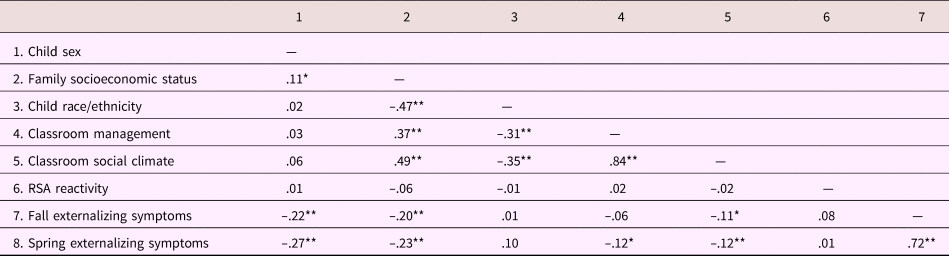
See Table 1 for zero-order correlations between key study variables. Of note, examining bivariate correlations of the primary predictors and outcome, RSA reactivity was not associated with externalizing problems in fall or spring of the school year, and measures of the classroom environment were only weakly correlated with externalizing problems.
Zero-order correlations of key study variables

Note: Sex coded as 0 = Male, 1 = Female. Ethnicity coded as 0 = Caucasian, 1 = Minority. RSA, respiratory sinus arrhythmia. *p ≤ .05. **p ≤ .01.
Child-centered to teacher-directed ratio of classroom social climate
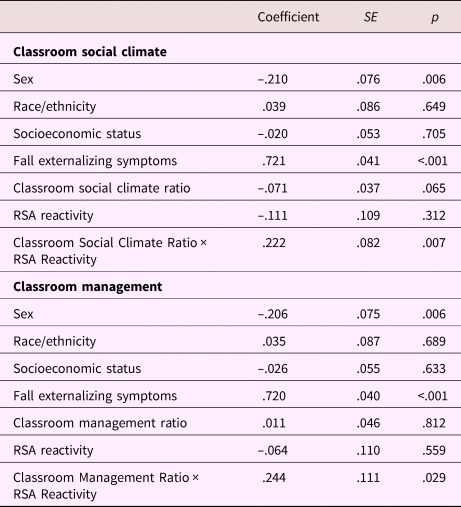
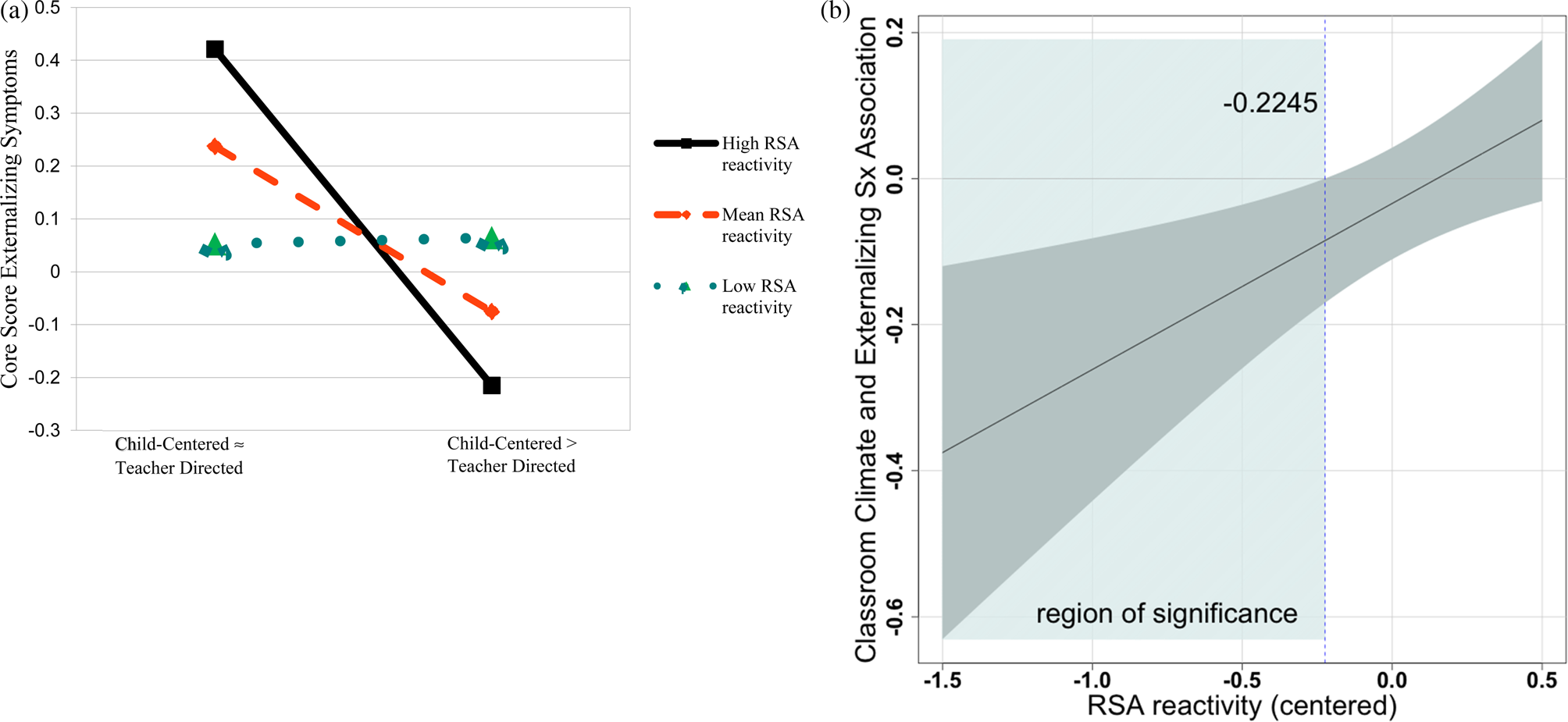
The first model investigated the interactive effects of the classroom social climate ratio and children's RSA reactivity on externalizing symptoms in spring of the kindergarten year, controlling for symptoms at the beginning of the school year. As indicated in Table 2, there was a significant interaction between the ratio of child-centered to teacher-directed social climate practices and children's RSA reactivity on children's externalizing symptoms (b = .221, SE = .082, p = .007). Analysis of simple slopes indicated that the classroom social climate practices ratio negatively influenced prospective changes in externalizing symptoms among children with greater RSA reactivity (b = –.145, SE = .047, p = .002). There was no significant association between social climate and externalizing symptoms at lower levels of RSA reactivity (p = .95; see Figure 1). To complement these results, we computed the regions of significance for the interaction effect, which identify the specific values of RSA reactivity at which the slope between the social climate ratio and changes in children's externalizing symptoms is significant (Preacher, Curran, & Bauer, Reference Preacher, Curran and Bauer2006). Findings from these additional analyses indicated that the classroom social climate ratio was significantly associated with externalizing for approximately 25% of our sample (when children's RSA reactivity [mean-centered] was < –0.22, representing those with greater parasympathetic withdrawal reactivity to challenge; see Figure 1b).
Regression coefficients in models of children's externalizing symptoms as a function of classroom environment, children's RSA reactivity, and their interaction

Note: Ratio, child-centered practices/teacher-directed practices. RSA, respiratory sinus arrhythmia. Sex coded as 0 = Male, 1 = Female. Ethnicity coded as 0 = Caucasian, 1 = Minority.
(a) Interaction between classroom social climate and children's respiratory sinus arrhythmia (RSA) reactivity in the prediction of externalizing symptoms at the end of the kindergarten year. (b) Regions of significance plot for the interaction between classroom social climate and children's RSA reactivity on externalizing symptoms. Classroom social climate and children's RSA were both modeled as continuous measures in all analyses. To demonstrate the interactive association, this figure shows example classroom social climate results plotted at 1 SD below the mean (a value of 1.13, indicating approximately equal proportion of child-centered and teacher-directed practices) and 1 SD above the mean (a value of 3.88, indicating greater use of child-centered relative to teacher-directed practices).

It is important to contextualize the association among high reactive children within our sample's distribution on the classroom social climate ratio (i.e., higher ratio values reflect more use of child-centered practices relative to teacher-directed practices and lower ratio values reflect generally comparable use of child- and teacher-directed practices). Our results indicate that children with heightened levels of RSA reactivity exhibited decreases in externalizing symptoms over the course of the school year when teachers engaged in greater proportional use of child-centered methods but exhibited increases in externalizing problems when in classrooms with higher use of teacher-dominated practices (those with nearly equal use of child-centered and teacher-dominated practices).
Child-centered to teacher-directed ratio of classroom management
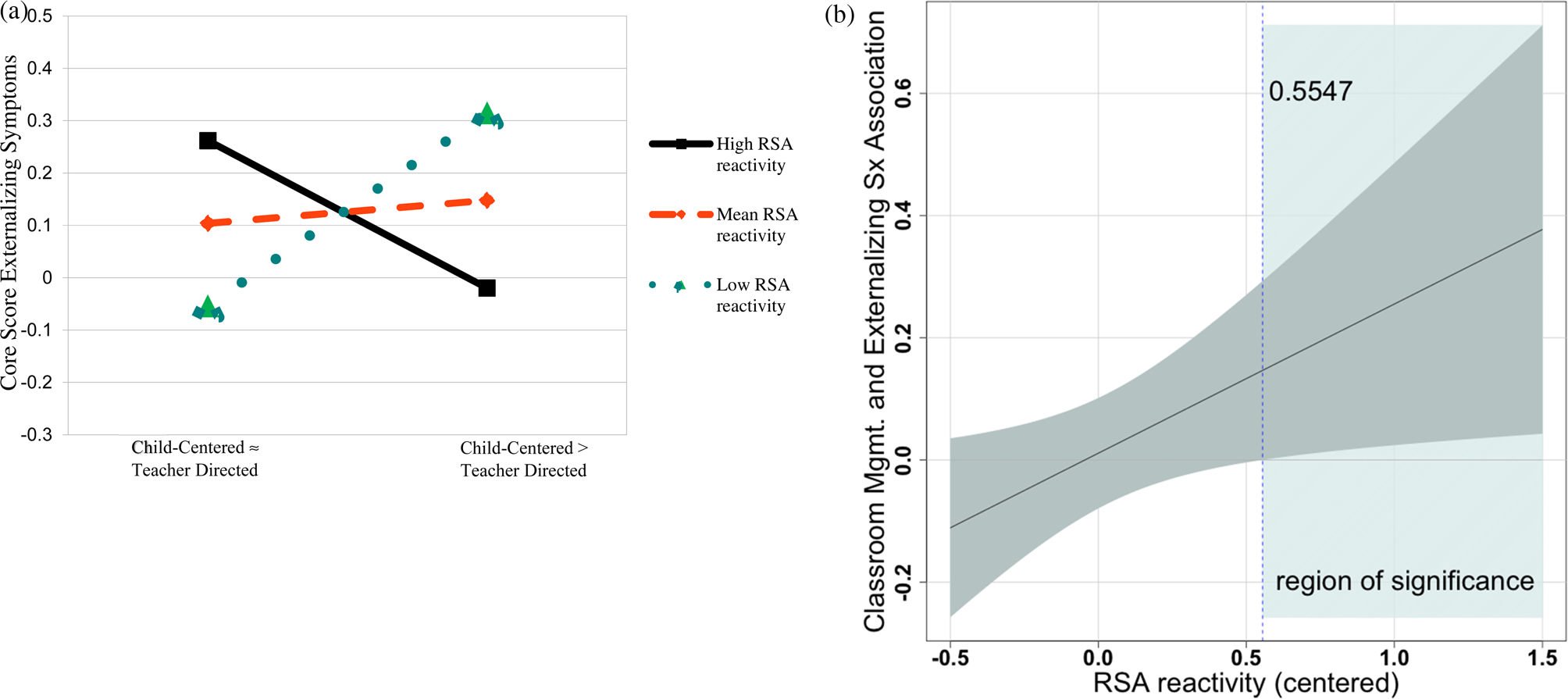
The second model investigated the interactive effects of the classroom management ratio and children's RSA reactivity on externalizing symptoms. The ratio of child-centered to teacher-dominated classroom management practices interacted with children's RSA reactivity to predict externalizing symptoms in the spring, above and beyond symptoms in the fall (b = .24, SE = .11, p < .03; see Table 2). Figure 2 provides a graphical illustration of the analysis of simple slopes plotted at 1 SD above and below the mean of RSA reactivity. The classroom management pattern of findings was similar to the social climate model, although this association manifested as a full crossover interaction wherein an interaction term can be significant despite lack of significance for simple slopes at 1 SD above and below the mean (Baron & Kenny, Reference Baron and Kenny1986). To illustrate, when plotted for children with higher reactivity (1 SD above the mean), the classroom management ratio was negatively associated with changes in children's externalizing symptoms; however, this simple slope was not significant (p = .25). Among children with low RSA reactivity (1 SD below the mean), the management ratio was associated with increases in externalizing symptoms in the spring, although this simple slope was also not significant (p = .10). The regions of significance framework indicated that the relation between the classroom management ratio and children's externalizing symptoms was significant only at particularly low levels of RSA reactivity, reflective of vagal augmentation to challenge (RSA reactivity > 0.56, approximately 3% of our sample; see Figure 2b).
(a) Interaction between classroom management ratio and children's respiratory sinus arrhythmia (RSA) reactivity in the prediction of children's externalizing symptoms at the end of the kindergarten year. (b) Regions of significance plot for the interaction between classroom management and children's RSA reactivity on externalizing symptoms. Classroom management and children's RSA reactivity were both modeled as continuous measures in all analyses. To demonstrate the interactive association, this figure shows example classroom management results plotted at 1 SD below the mean (a value of 0.91, indicating approximately equal proportion of child-centered and teacher-directed practices) and 1 SD above the mean (a value of 3.11, indicating greater use of child-centered relative to teacher-directed practices).

Given the results of the regions of significance plots, we are cautious to further describe and interpret the results of the classroom management model. However, we have opted to do so because of our desire to compare the pattern to that found in the social climate model, the potential for this effect to be more robust in samples with greater extremes of classroom environment, and the interest in how these relations may unfold in underaroused children. Among children with higher RSA reactivity, classrooms characterized by greater child-centered management practices relative to teacher-directed styles were negatively associated with changes in spring externalizing symptoms, controlling for initial symptom levels in the fall. However, use of approximately equal proportion of child-centered and teacher-directed approaches were associated with increased externalizing symptoms for more reactive children. An opposite pattern of relations emerged among low reactive children. Greater relative use of child-centered versus teacher-directed approaches was associated with increases in spring externalizing symptoms among children with lower RSA reactivity, while equivalent use of these styles was associated with decreases in spring levels of externalizing among less reactive children, above and beyond fall symptoms.
Discussion
Evidence of the long-term implications of children's initiation to formal schooling has fostered increased efforts to promote success during this developmental transition (McIntyre, Eckert, Arbolino, Reed, & Fiese, Reference McIntyre, Eckert, Arbolino, Reed and Fiese2014). Despite expansive school transition initiatives and policies, it has been reported that nearly half of children experience moderate to high levels of difficulty in kindergarten (Rimm-Kaufman, Pianta, & Cox, Reference Rimm-Kaufman, Pianta and Cox2000). Of note, deficits in regulatory capacities were the most frequently cited source for such difficulties and were more commonly reported than deficits in academic skills or lack of formal preschool experience (Rimm-Kaufman et al., Reference Rimm-Kaufman, Pianta and Cox2000). There is robust evidence indicating that particular characteristics of the teacher–child relationship and the classroom climate promote self-regulation and social competence (e.g., Boyce et al., Reference Boyce, Obradović, Bush, Stamperdahl, Kim and Adler2012; Skinner, Zimmer-Gembeck, & Connell, Reference Skinner, Zimmer-Gembeck and Connell1998; Wilson, Pianta, & Stuhlman, Reference Wilson, Pianta and Stuhlman2007). However, any one type of instructional approach is never “one size fits all,” raising the critical question of which children may be more or less likely to benefit from particular classroom climates. The present study examined the potential moderating role of individual differences in children's physiological stress reactivity (specifically, parasympathetic response to challenging tasks) on the relation between classroom climate and externalizing symptoms. As hypothesized, findings indicated a significant interaction between the ratio of child-centered to teacher-directed instructional practices in the classroom and children's RSA reactivity on externalizing symptoms in spring of the kindergarten year, controlling for baseline levels of externalizing symptoms measured in the fall.
Two separate models were tested to explore the ratio of instructional styles in classroom social climate versus classroom management. Although teachers’ practices in the social and management domains of the classroom environment are often associated (and were highly correlated in the present study),Footnote 2 empirical and theoretical research suggests these two domains uniquely influence the effectiveness of instruction as well as children's school adjustment (Pianta, Reference Pianta2003; Stipek & Byler, Reference Stipek and Byler2004). As discussed at length by Evans, Harvey, Buckley, and Yan (Reference Evans, Harvey, Buckley and Yan2009) and demonstrated empirically by Hamre and Pianta (Reference Hamre and Pianta2005) and Buyse, Verschueren, Doumen, Van Damme, and Maes (Reference Buyse, Verschueren, Doumen, Van Damme and Maes2008), children vary significantly in their classroom needs, with some children demonstrating a greater need for rules and routines (classroom management; Pekrun, Reference Pekrun2006) and others responding more profoundly to teacher warmth (social; Ahnert, Pinquart, & Lamb, Reference Ahnert, Pinquart and Lamb2006; Jennings & Greenberg, Reference Jennings and Greenberg2009). As such, even if teachers who use more of one particular type of practice (i.e., child centered or teacher directed) in the classroom social climate are more likely to employ the same type of instructional practices in the management domain (and vice versa), the two domains reflect different aspects of the classroom milieu (e.g., discipline vs. relational) that can vary in their relations to children's behavior. Analogous to measures of parental discipline and warmth that provide unique, nonoverlapping information about the family environment, measures of teachers’ behavior across the climate and management domains may capture related but distinct aspects of the classroom environment.
In this study there were both similar and unique aspects of findings across the two dimensions of the classroom climate. Greater proportional use of child-centered social climate practices relative to teacher-directed social climate practices was associated with significantly lower levels of externalizing symptoms for children who exhibited heightened RSA reactivity, whereas a more equal use of child-centered and teacher-directed instructional practices was associated with greater externalizing symptoms among more reactive children. There was no association between social climate instructional practices and externalizing problems among children who showed lower or more moderate levels of stress reactivity. As such, greater proportional use of child-centered approaches in the construction of the classroom's social climate appears to not be uniformly promotive of better behavior for all students, but may play a beneficial role in the promotion of emotion regulation and preventing the development of externalizing problems in highly physiologically reactive children.
This pattern of findings is aligned with the theory of BSC (Boyce & Ellis, Reference Boyce and Ellis2005), which posits that heightened stress physiology signifies children's unique susceptibility to characteristics of the social environment, while lower or more moderate reactivity levels render children less vulnerable to environmentally induced effects on health and development. There is an impressive body of theoretical literature and empirical evidence in support of these proposed individual differences in BSC. Numerous studies have demonstrated that children with high physiological reactivity (i.e., heightened biological sensitivity) do exceptionally well in positive family environments and significantly worse in adverse family environments, relative to children who exhibit moderate or low stress reactivity (Bush & Boyce, Reference Bush, Boyce and Cicchetti2016; Ellis et al., Reference Ellis, Boyce, Belsky, Bakermans-Kranenburg and van Ijzendoorn2011; Hartman & Belsky, Reference Hartman and Belsky2016). The current study extends the application of this theoretical framework beyond its predominant empirical roots in studies of the family environment by demonstrating that heightened RSA reactivity rendered children more sensitive to the contextual features of the classroom climate, particularly social climate characteristics.
Child-centered social climate practices involve the display of positive affect and teacher behaviors that communicate acceptance, nurturance, and respect to each individual child. In contrast, a more teacher-directed social climate allocates praise and rewards conditional on reaching a preset goal and consists of teacher–child interactions that are more directed toward the acquisition of basic skills (Stipek & Byler, Reference Stipek and Byler2004). Physiologically reactive children may be especially sensitive to the ratio of child-centered to teacher-directed social climate strategies, such that high levels of acceptance and positive affect engender greater motivation to self-regulate in an effort to please the teacher, whereas use of conditional rewards may not have this same effect. As described by applications of self-determination theory to the classroom environment, teachers’ unconditional warmth facilitates student engagement, enhances motivation, and promotes positive outcomes by meeting the basic psychological need for relatedness (Nie & Lau, Reference Nie and Lau2009; Ryan & Deci, Reference Ryan and Deci2000). Although there were no classrooms in our sample in which teacher-directed strategies predominated over child-directed behaviors, it is plausible that use of teacher-directed strategies could undermine the effectiveness of child-centered practices in the classroom.
In the classroom management model, there was a negative relation between a reliance on child-centered classroom management practices and externalizing problems for more reactive children consistent with the social climate model, though the simple slope did not reach statistical significance. It may be the case that the environment-dependent implications of heightened stress reactivity emerge more unequivocally when evaluating the interpersonal or affective components of a particular context such as those reflected in the social climate domain. In the only other study of BSC to address the classroom environment, Essex et al. (Reference Essex, Armstrong, Burk, Goldsmith and Boyce2011) found that highly reactive children were sensitive to the affective components of the teacher–child relationship; teacher practices in regard to classroom management were not examined.
Specific to the classroom management model and not present in the social climate model, greater proportional use of teacher-directed classroom management strategies was associated with lower externalizing problems for children exhibiting low RSA reactivity. It should be noted that the simple slope of this effect was only marginally significant in the full sample (with regions of significance testing that indicated it was significant primarily for children with the very lowest reactivity). We were thus cautious to interpret such findings, but we chose to do so because the results of the classroom management model reflect a crossover interaction where simple slopes can be nonsignificant despite the presence of a true conditional effect (Baron & Kenny, Reference Baron and Kenny1986). Further, this pattern of relations can be understood in the context of extant research on the environmental and behavioral correlates of low reactive children. Underarousal of the parasympathetic nervous system can reflect deficits in emotion regulation and attention that preclude adaptive engagement with the environment (Beauchaine, Reference Beauchaine2001) and promote impulsive, riskier behaviors to increase arousal (Raine, Reference Raine2002). Children lower in RSA reactivity may benefit behaviorally from greater classroom structure and more stringent teacher management, which is well aligned with research on parental management strategies for low-reactive children (Degnan, Calkins, Keane, & Hill-Sotherland, Reference Degnan, Calkins, Keane and Hill-Soderland2008; Tu, Erath, & El-Sheikh, Reference Tu, Erath and El-Sheikh2017). For example, when reared in family environments characterized by higher levels of parental control and directiveness, children lower in RSA reactivity engage in less disruptive behavior (Degnan et al., Reference Degnan, Calkins, Keane and Hill-Soderland2008) and have fewer peer problems (Tu et al., Reference Tu, Erath and El-Sheikh2017). Similar processes may be operating in the classroom environment: low-reactive children may benefit from the firm boundaries, structured routine and transitions, and greater teacher direction of classrooms in which teacher-directed and child-centered management practices are used in generally equal proportions.
To provide quantitative support for BSC and clearly distinguish such effects from theories of diathesis-stress, we conducted additional analyses guided by Roisman et al. (Reference Roisman, Newman, Fraley, Haltigan, Groh and Haydon2012). Briefly, we calculated the proportion affected (PA) index for the classroom social climate model (PA = 37%) and the classroom management model (PA = 39%). These values exceeded the suggested cutoff of 16% for drawing conclusions of BSC. Roisman et al. also suggest that erroneous conclusions of differential susceptibility may emerge when linear relations are misspecified for nonlinear models; however, we found no evidence of curvilinear main or moderated effects among our variables. Thus, additional tests provide increased support for consideration of the results of the present study within the BSC framework.
Results of the current study should be considered in the context of several limitations. First, instructional styles in the current study ranged from generally equal use of child-centered and teacher-directed practices to classrooms in which child-centered styles predominated. Though our classrooms were representative of the larger geographic area from which our sample was drawn, we did not capture classrooms in which teacher-directed instructional styles predominated greatly over child-centered practices. Thus, we are unable to comment on how such a primarily teacher-directed style may interact with children's physiological reactivity to influence externalizing symptoms. Prior research has described the limited ability of any one study to capture the full range of observations that underlie interactions between the environment and children's physiological sensitivities (Bush & Boyce, Reference Bush, Boyce and Cicchetti2016). As such, we cannot generalize our results to other classroom environments with broader distributions of ratios of child-centered to teacher-directed practices (or different ranges of physiological reactivity and externalizing symptoms). Second, analyses in the present study examined the influence of teachers’ instructional styles at one time point during the school year, but we recognize teachers may shift their proportional use of various practices in response to student learning and outcomes over the course of the school year. Future studies with repeated measures of teachers and students may elucidate these transactional relations. Third, qualities of the classroom environment and children's RSA reactivity are part of a larger constellation of contextual and biological factors that underlie the development of externalizing disorders, including harsh parenting (Roubinov, Boyce, & Bush, Reference Roubinov, Boyce and Bush2018). Further examination of aspects of the classroom environment and children's stress physiology in relation to known parenting risk factors for externalizing would be informative to further elucidate how these relations unfold under particular conditions of early family adversity.
The functions of formal schooling extend far beyond equipping children with specific learning or academic skills. The beginning of kindergarten has been described as children's first major ecological transition (Bronfenbrenner, Reference Bronfenbrenner1979) and one in which they acquire the new social role of student and its associated rules and responsibilities (Seung Lam & Pollard, Reference Seung Lam and Pollard2007). Moreover, the age of 5 to 6 years is a key period of brain development during which children's executive functioning rapidly advances in response to environmental influences, with significant downstream effects on early behavioral and emotional self-regulation (Thompson & Nelson, Reference Thompson and Nelson2001). The classroom climate has a central role in promoting children's well-being during this time, and in particular, it has been argued that one of its most important tasks is “to promote children's self-regulation through instructional and emotional support” (Blair & Diamond, Reference Blair and Diamond2008, p. 907). There is growing epidemiological and public policy interest in promoting children's socioemotional and behavioral competencies as part of broad educational reform in the United States (Jennings & Greenberg, Reference Jennings and Greenberg2009). Schools are a natural and accessible venue for increasing access to early supportive services for children, though are often underutilized (Ko et al., Reference Ko, Ford, Kassam-Adams, Berkowitz, Wilson, Wong and Layne2008; Werner-Seidler, Perry, Calear, Newby, & Christensen, Reference Werner-Seidler, Perry, Calear, Newby and Christensen2017).
Results of the current study suggest that understanding and attending to individual differences in stress physiology may not only help identify children at heightened risk but also can assist in meeting the diverse instructional needs of kindergarten children for whom a more universal approach exacerbates risk or fails to capitalize on potential protective factors. Although the present study focused on externalizing problems, such early childhood disruptive behavior has broad impacts on children's learning, peer and teacher relationships, school engagement, and risk for longer term health and functioning outcomes (Aebi, Plattner, Metzke, Bessler, & Steinhausen, Reference Aebi, Plattner, Metzke, Bessler and Steinhausen2013). Our results add to the compelling body of research that indicates the importance of examining children's physiological reactivity as a potential moderator of early environmental effects on a range of important outcomes relevant to developmental psychopathology (see, for review, Bush & Boyce, Reference Bush, Boyce and Cicchetti2016). The present study focused on relations with externalizing behavior; however, the relevance of RSA reactivity to children's broad emotion regulation skills and other psychopathology (e.g., internalizing) suggests the interactive effects of classroom characteristics and RSA reactivity may extend to other behavioral and mental health outcomes early in life.
School settings are increasingly valued as contexts in which processes of maladaptive and adaptive development can be understood and shaped, yet the use of informative biometrics in developmental science-based research of educational settings remains more of an exception rather than the norm (Pianta, Reference Pianta and Cicchetti2016). Just as parents can benefit from information about temperamental/physiological differences in children and “goodness of fit” in terms of parenting (Newland & Crnic, Reference Newland and Crnic2017) and neighborhood (Colder, Lengua, Fite, Mott, & Bush, Reference Colder, Lengua, Fite, Mott and Bush2006) effects on children's development, providing teachers with training that promotes understanding of individual differences in children's stress biology and responsivity to classroom climate factors can provide benefits to teachers and the children who require educational intervention. Although expecting teachers to calibrate their classroom styles to individual children's reactivity phenotypes may be impractical for a variety of reasons, enhanced knowledge can improve teachers’ interpretation of children's behavioral responses to classroom practices and aid in decisions about how to respond. Moreover, inclusion of biological measures can enhance understanding of prevention efforts in schools and highlight the conditions under which interventions are optimally effective (Cicchetti & Gunnar, Reference Cicchetti and Gunnar2008). Greater integration of biologically informed theory and evidence into classroom teaching and learning infrastructure is an important next step on the path toward the interdisciplinary integration of education and human development.
Conflicts of Interest
The authors have no conflicts of interest to report.
Funding Statement
This study was supported by National Institute of Mental Health Grants R01MH62320 (to W.T.B.) and 5K23MH113709 (to D.S.R.), the MacArthur Foundation Research Network on Psychopathology and Development (to W.T.B.), and the Canadian Institute for Advanced Research (to W. T.B.).