INTRODUCTION
In the Southern Hemisphere, humpback whales (Megaptera novaeangliae) are divided into seven geographically distinct breeding populations which migrate into the sub-tropics each austral winter from polar and sub-polar feeding grounds (International Whaling Commission (IWC), 1998). The South Pacific supports at least five breeding sub-populations: East Australia; New Caledonia; Tonga; French Polynesia; and Colombia/Ecuador (IWC ‘breeding stocks' Ei–iii, F and G).
Whilst separation of these sub-populations is well described (Garrigue et al., Reference Garrigue, Aguayo, Amante-Helweg, Baker, Caballero, Clapham, Constantine, Denkinger, Donoghue, Florez-Gonzalez, Greaves, Hauser, Olavarria, Pairoa, Peckham and Poole2002, in press; Olavarría et al., Reference Olavarría, Baker, Garrigue, Poole, Hauser, Caballero, Flórez-González, Brasseur, Bannister, Capella, Clapham, Dodemont, Donoghue, Jenner, Jenner, Moro, Oremus, Paton, Rosenbaum and Russell2007; Hauser et al., Reference Hauser, Zerbini, Geyer, Heide-Jørgensen and Clapham2010) knowledge about their seasonal migration routes varies greatly. It is generally assumed that South Pacific humpback whales migrate to the Antarctic feeding grounds roughly to the south of their breeding ground (Chittleborough, Reference Chittleborough1965; Dawbin, Reference Dawbin and Norris1966). In studied sub-populations, satellite telemetry, photo-identification and genotype surveys have confirmed this, albeit with greater dispersal across the Antarctic feeding areas (Steel et al., Reference Steel, Garrigue, Poole, Hauser, Olavarría, Flórez-González, Constantine, Caballero, Thiele, Paton, Clapham, Donoghue and Baker2008; Garrigue et al., Reference Garrigue, Zerbini, Geyer, Heide-Jørgensen, Hanaoka and Clapham2010; Hauser et al., Reference Hauser, Zerbini, Geyer, Heide-Jørgensen and Clapham2010; Constantine et al., Reference Constantine, Allen, Beeman, Burns, Charrassin, Childerhouse, Double, Ensor, Franklin, Franklin, Gales, Garrigue, Gates, Gibbs, Hutsel, Jenner, Jenner, Kaufman, Macie, Mattila, Oosterman, Paton, Robbins, Schmitt, Stevick, Tagarino and Thompson2011; Robbins et al., Reference Robbins, Dalla Rosa, Allen, Mattila, Secchi, Friedlaender, Stevick and Nowacek2011). Based on these observations, ‘nucleus’ feeding grounds are currently demarcated within IWC Antarctic Management Areas V (130–160°E), VI (180°E–120°W) and I (100°W–70°W), with intervening regions demarcated as ‘margin’ (IWC, 2010). Through Discovery marking and satellite telemetry work, migratory connections of the East Australian breeding sub-population and their polar feeding grounds are relatively well understood (Chittleborough, Reference Chittleborough1965; Rock et al., Reference Rock, Pastene, Kaufman, Forestell, Matsuoka and Allen2006; Franklin et al., in press; Gales et al., Reference Gales, Double, Robinson, Jenner, Jenner, King, Gedamke, Paton and Raymond2009; Franklin et al., in press). In contrast, migratory connections for the more easterly sub-populations, for example New Caledonia and French Polynesia, are still being described (Albertson-Gibb et al., Reference Albertson-Gibb, Acevedo, Olavarría, Aguayo-Lobo, Poole and Baker2009, in press; Garrigue et al., Reference Garrigue, Zerbini, Geyer, Heide-Jørgensen, Hanaoka and Clapham2010).
During the 20th Century, intensive commercial whaling throughout the Southern Hemisphere killed over 200,000 humpback whales within a seven-decade period (Clapham & Baker, Reference Clapham, Baker, Perrin, Würsig and Thewissen2001). Following cessation of whaling efforts Australian sub-populations have shown evidence of fast population growth (Bannister, Reference Bannister1994; Paterson et al., Reference Paterson, Paterson and Cato1994), however these rates of recovery have not been mirrored within Oceania where sub-population densities appear to have remained low (Constantine et al., in press). As a consequence, the Oceania sub-populations were recently reclassified as ‘Endangered’ by the International Union for Conservation of Nature (IUCN) (Childerhouse et al., Reference Childerhouse, Jackson, Baker, Gales, Clapham and Brownell2008).
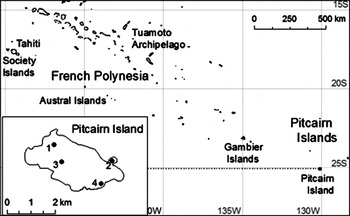
The easterly range of the Oceania breeding grounds is thought to extend to approximately 120°W (Reeves et al., Reference Reeves, Leatherwood, Stone and Eldredge1999). The only well described wintering aggregation towards the extreme of this range occurs in French Polynesia (8–27°S 134–155°W) where humpbacks (IWC ‘breeding stock F') are regularly recorded from mid-July through to mid-November (Poole, Reference Poole2002, Reference Poole2006). French Polynesia covers 5,000,000 km2 of ocean and consists of five main island groups: Marquesas Islands; Tuamotu Islands; Gambier Islands; Society Islands; and Austral Islands (Figure 1). Existing survey effort has predominantly focused on the western island groups (Society and Austral Islands) and suggests that the highest densities of humpback whales occur within the Austral Islands and the Windward group of the Society Islands. Humpbacks in the Tuamotu Archipelago have been documented at a lower density (Poole, Reference Poole2002, Reference Poole2006; Gannier, Reference Gannier2004).
French Polynesia and the Pitcairn Islands; inset shows Pitcairn Island and the location of land-based observation platforms. Marquesas Islands to the north (not shown).

Here we present the first humpback whale field study undertaken in the remote Pitcairn Islands (25°04′S 130°06′W), 650 km to the east of western French Polynesia (Figure 1). This area lies directly north of Antarctic Management Area VI, close to the boundary of Area I. Based on documented summer dispersal patterns (Steel et al., Reference Steel, Garrigue, Poole, Hauser, Olavarría, Flórez-González, Constantine, Caballero, Thiele, Paton, Clapham, Donoghue and Baker2008; Garrigue et al., Reference Garrigue, Zerbini, Geyer, Heide-Jørgensen, Hanaoka and Clapham2010; Hauser et al., Reference Hauser, Zerbini, Geyer, Heide-Jørgensen and Clapham2010; Constantine et al., Reference Constantine, Allen, Beeman, Burns, Charrassin, Childerhouse, Double, Ensor, Franklin, Franklin, Gales, Garrigue, Gates, Gibbs, Hutsel, Jenner, Jenner, Kaufman, Macie, Mattila, Oosterman, Paton, Robbins, Schmitt, Stevick, Tagarino and Thompson2011), whales sighted around Pitcairn Island could be migrating from feeding grounds anywhere between the Antarctic Peninsula (Area I) and the regions further west (Areas V and VI). Humpback whales are a seemingly new visitor to these waters; anecdotal records suggest that a seasonal presence does not pre-date 1990. Consequently, at present nothing is known about the biology or behaviour of these whales. It is possible that the near-shore pristine waters of Pitcairn Island may be an important mating and calving ground for the humpback sub-population associated with French Polynesia, or potentially, with another undocumented, more remote area in the central South Pacific.
MATERIALS AND METHODS
Study area
Pitcairn Island (25°04′S 130°06′W) is one of four islands that constitute the Pitcairn Islands group, and the only one that is inhabited. It covers a total of 4.5 km2 in an irregular shape, and is rugged with no fringe reef resulting in limited access to the sea (Figure 1) (FCO, 2007). Local weather is dominated by often strong prevailing south-easterly winds, making large coastal swells around the island common.
Study period and data collection
As the island's small breakwater can only be used to launch boats in fine weather conditions, visual surveys were conducted from the land. Observations were undertaken from 8 June 2007 to 31 August 2007. Surveys took place daily utilizing high vantage points around the island. Although attempts were made to observe all ocean areas surrounding the island, the cliffed edge, thick vegetation and irregular shape precluded the use of a systematic survey protocol. Observations were carried out for one hour, 1–2 times a day dependent on weather, utilizing locations where the largest proportion of sea is visible.
The Gannets Ridge platform (Figure 1(1)) was used daily as it presented the widest viewing area. Ship Landing Point (Figure 1(2)), Highest Point (Figure 1(3)) and Upper Tautama (Figure 1(4)) were then used in rotation for the remaining daily time slot. During each observation all visible sea was scanned slowly using binoculars (×10). Time, location, group size, presence of calves, distance from the coast, behaviour, and weather and sea conditions were recorded for each sighting. Requests for incidental sighting notification were also spread amongst the Pitcairner community.
Interviews
While on Pitcairn Island eight members of the Pitcairner community were selected for informal interview. Two individuals were selected from each of the following age groups: 16–30, 30–40, 40–50 and >50 years old. The population of Pitcairn Island was 46 at the time of this study. Due to the small size and elevated topography of the island, which provides vantage points from houses and garden plots, it is assumed that anecdotal reports of humpback whales inhabiting the inshore waters are accurate. In addition, of the 8 interviewees 3 were part of the limited subsistence fishery which undertakes regular at-sea coastal fishing during favourable conditions. Individuals were asked about their experience of when whales were first sighted each year, the approximate number of sightings per year and the observed behaviour of whales in the region. Trends were identified within this information and compared to the observations made during the visual survey. Seasonal tourism workers visiting the island group each winter were also asked for their experiences.
RESULTS
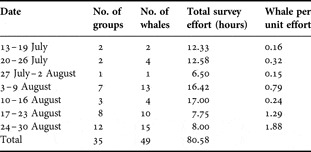
During a total of 80.56 survey hours, 35 separate whale sightings were made totalling 49 whales.
Spatial and temporal distribution
Humpback whales were sighted in all areas around Pitcairn Island, in both deep, offshore and shallow, inshore waters. The first sighting was made on 18 July 2007 with the last sighting made on 30 August 2007. The survey was terminated on 31 August 2007. Table 1 shows the spread of sightings observed by week. Within the survey period, sightings were greatest per unit effort in the last week of August, representing 34% of all group sightings and 31% of all whale observations.
Temporal distribution of sightings with whales per unit effort—no sightings were made prior to 18 July 2007.

Social groupings and behaviour
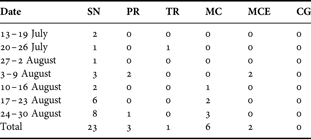
The temporal distribution of different social groupings is presented in Table 2. Calves were first sighted on 7 August 2007, and became more regular from the 21 August 2007. The most common group size observed was singletons, followed by mother and calf pairs. There were eight calf observations in total, all accompanied by at least one adult, presumably the mother. High energy displays were observed during many sightings, predominantly by singletons and mother and calf pairs. Behaviours included periods of stationary peduncle slaps, pectoral fin slaps and breaching.
Temporal distribution of different social groupings of humpback whales 2007. Group class abbreviations; SN, singleton; PR, pair; TR, non-competitive trio; MC, mother and calf; MCE, mother, calf and escort; CG competitive group (taken from Hauser et al., 2000)—no sightings were made prior to 18 July 2007.

Anecdotal reports of humpbacks
Elders of the Pitcairner community do not recall a seasonal presence of humpback whales before 1990. Anecdotal reports suggest a steady but limited increase in sightings from late July to late September. Regular sightings of high energy displays were reported, with sporadic reports of calves during late August and early September. Community elders had anecdotal knowledge, as passed on from their elders, of American whaling ships frequently visiting Pitcairn Island during the mid-19th Century; however, there are no records to suggest any cetaceans were taken from the Pitcairn Islands group. Port of call records show visiting whaling vessels to be from New Bedford and Nantucket (Ford, Reference Ford1996), most likely for sperm whaling within the Pacific Ocean or transiting to Australasia for the capture of right whales.
Other marine mammals reported
A pod of approximately 10 pilot whales (Globicephala sp.) was sighted on transit to the island 8 km east of Pitcairn Island (April 2007). Pitcairners expressed an awareness of pilot whales but that sightings were not made close to land. Short-finned pilot whales (Globicephala macrorhynchus) are documented to occur in the region (Reeves et al., Reference Reeves, Leatherwood, Stone and Eldredge1999). This is also confirmed by seasonal tourism workers. In addition, tourism workers reported minke whale (Balaenoptera sp.), a large pod of unidentified dolphins, and a stranded Cuvier's beaked whale (Ziphius cavirostris) within the Pitcairn Islands group. There is also an anecdotal record of a vagrant pinniped (species unknown) coming ashore in the 1940s.
DISCUSSION
The results of this survey provide the first direct evidence that humpback whales visit the waters of Pitcairn Island during the austral winter. This represents the most easterly record of humpbacks reported to date in Oceania. In addition, the presence of singletons performing high-energy displays, and mothers with calves, suggests a possibility that the in-shore waters may be used for breeding and calving. Mother and calf pairs were sighted in all areas around Pitcairn Island, including shallow, inshore waters indicative of breeding grounds.
It is also possible that humpback whales are visiting other uninhabited islands in the Pitcairn Islands group, but this could not be verified within the scope of this study. We note that hourly sighting rates throughout August are greater than 10 × higher than those made from Fiji (0.01–0.03) over an equivalent period (Gibbs et al., Reference Gibbs, Paton, Childerhouse and Clapham2006), although differences in survey vantage points preclude the sighting rates recorded during our survey from being directly compared with those presented by Gibbs et al. (Reference Gibbs, Paton, Childerhouse and Clapham2006).
Without satellite telemetry, photo-identification or genotype data it is not possible to separate local residents from short-term travellers, and therefore we cannot currently distinguish whether the region is frequented by a small number of whales over a long period (e.g. as seen in Rurutu, French Polynesia: Poole, Reference Poole2006), or briefly inhabited by a larger number of individuals on migration (e.g. as seen in the Cook Islands: Hauser et al., Reference Hauser, Zerbini, Geyer, Heide-Jørgensen and Clapham2010).
Population identity of Pitcairn whales?
Whether the Pitcairn Island humpbacks represent part of a larger local wintering population, or are migrating through the Pitcairn Islands en route to wintering grounds to the west and/or north, is yet to be identified. Anecdotal reports do not suggest strong bimodality in the seasonal occurrence indicative of a migratory route, and at present available sightings data are too patchy to allow for strong inference either way.
Given the relative proximity of the Pitcairn Islands to French Polynesia, the assumption that whales migrate through the Pitcairn Islands to French Polynesia from their Antarctic feeding grounds is logical. In addition, the relatively short history of humpbacks at Pitcairn Island, as reported by the Pitcairner community, is suggested to have also occurred within eastern Polynesia, where local whaling records imply an absence of humpback whales prior to the 19th Century (Olavarría et al., Reference Olavarría, Baker, Garrigue, Poole, Hauser, Caballero, Flórez-González, Brasseur, Bannister, Capella, Clapham, Dodemont, Donoghue, Jenner, Jenner, Moro, Oremus, Paton, Rosenbaum and Russell2007). This lends further support to the theory that Pitcairn whales may belong to the same breeding population as French Polynesia (IWC ‘breeding stock F') which could be redistributing their wintering range in response to environmental factors, or alternatively expanding their range due to recent population growth. The sighting of humpback whales in areas without historical occurrence is also suggested to have occurred in Hawai'i, where anecdotal, cultural and local whaling records also suggest an introduction within the 19th Century (Herman, Reference Herman1979)
Despite the proposed recent appearance of humpbacks wintering in eastern Polynesia, the French Polynesia population shows significant genetic differentiation from the neighbouring wintering populations to the east and west. There has thus been some speculation that the French Polynesia sub-population has relocated from a more remote, undocumented breeding ground in the South Pacific (Olavarría et al., Reference Olavarría, Baker, Garrigue, Poole, Hauser, Caballero, Flórez-González, Brasseur, Bannister, Capella, Clapham, Dodemont, Donoghue, Jenner, Jenner, Moro, Oremus, Paton, Rosenbaum and Russell2007). It is possible that the Pitcairn Island whales could be in transit to these wintering grounds, as well as (or instead of) travelling to French Polynesia.
Finally, a regional isolation of the Pitcairn Island humpbacks from the larger wintering population in western French Polynesia cannot be ruled out. The large distance (>2000 km) between Pitcairn Island and the areas of high humpback density within French Polynesia (Society and Austral Island groups; Figure 1), coupled with the relatively continuous humpback presence during the peak breeding season, could be considered indicative of a separation.
Research in the Pitcairn Islands—now and in the future
With limited historic whaling or formal whaling records undertaken in this area, anecdotal evidence is an important resource for understanding the population dynamics of Pitcairn Island humpback whales at a primary level. Due to the working conditions of this area, further research into current population identity is likely to be problematic. The persistent large coastal swells and lack of a fringe reef or harbour makes access to the water incredibly difficult, whilst the island's small size offers a limited amount of lee making at-sea data collection exceptionally difficult.
Due to poor weather conditions during the survey period, photo-identification and sloughed skin samples could not be collected as part of this exploratory study. Within the survey period, sightings per unit effort peaked in the final week of August, the last week of the survey. However, anecdotal reports suggest a continued presence through September, and it is therefore not known whether greater numbers can be observed later in the season. Despite the logistical difficulties, longer boat-based surveys, including biopsy sampling and/or fluke photo-identification approaches and/or telemetry studies, would be necessary to illuminate the residency patterns of the humpbacks using Pitcairn Island waters, and would pave the way for comparing these whales with the better described population wintering in French Polynesia to the west.
ACKNOWLEDGEMENTS
We express our gratitude to the Pitcairn Island Office and the British Foreign and Commonwealth Office, especially Leslie Jacques and Mark Waller, for their help and assistance in making this report possible. Many thanks to Joe Scutt Phillips for his assistance during the project, and to those people who supplied valuable information, Tom Christian, Betty Christian, Jacqui Christian, Paul Warren and Graham Wragg. We thank James Driscoll for his helpful editorial comments and Michael Poole for early discussions on humpback whales in Pitcairn Island waters. Finally, many thanks to the special people of Pitcairn Island for the assistance they gave to this work, and their incredible kindness and hospitality.