


Introduction
Intellectual property (IP) Typical Cases have become a nationwide phenomenon in China, garnering widespread attention and acclaim across various sectors. The Supreme People’s Court (SPC) initiated this in 2010 by annually selecting and publishing the ‘Chinese Courts’ 50 Typical IP cases’ from cases concluded at all court levels.
IP Typical Cases are released not only by the SPC but also by courts at various levels, including high courts, intermediate courts, and district-level courts. For example, the Jiangsu Province High People’s Court, Suzhou City Intermediate People’s Court, Wujiang District People’s Court of Suzhou, and Suzhou IP Tribunal have each published their own sets of IP Typical Cases. That said, the cases issued by the SPC attract the most attention.
Beyond the courts, a wide range of institutions also participate in this practice, including other judicial organs like the People’s Procuratorates and administrative agencies such as the China National Intellectual Property Administration (CNIPA), the Ministry of Agriculture and Rural Affairs, Market Regulation Administrations (formerly Industrial and Commercial Administrations) and Copyright Administrations. Professional and industry organisations – such as bar associations, intellectual property protection associations, knowledge economy development associations, China Intellectual Property News, China Trial, and various law firms – have likewise published their own IP Typical Cases.
Not only are the issuers diverse in nature and administrative level, but the themes assigned to these Typical Cases are equally varied. Most cases published by the SPC and local courts are general, representing ‘typical’ cases for a particular year without any special thematic focus. However, some collections focus on specific themes or slogans, such as marking the anniversary of an IP court or tribunal, or highlighting goals like ‘strengthening IP protection’, ‘serving and safeguarding technological innovation’, ‘supporting the healthy development of private enterprises’, ‘judicial empowerment for the development of new productive forces’, or addressing ‘IP risks in technology enterprises’.
IP law stands out in terms of case compilation and publication compared to other branches of law. Taking the SPC’s Guiding Cases as an example, by 2020, ‘the Court had issued 24 batches of 139 Guiding Cases, with IP cases representing the highest proportion among all types of cases’.Footnote 1 This pattern has persisted. As of February 2026, the SPC had issued a total of 272 Guiding Cases, of which 37 (13.6%) concern intellectual property, placing IP in the top tier alongside civil and criminal cases. While Typical Cases are issued across various fields, such as civil law,Footnote 2 administrative law,Footnote 3 and environmental law,Footnote 4 IP law dominates in terms of the number of batches, cases per batch, and diversity and coverage of the issuing bodies.
Typical Cases and Guiding Cases issued by the SPC of China are critical components of the China’s broader case guidance system.Footnote 5 Although Typical Cases were excluded from the system’s foundational documents, policymakers have since emphasised their role in ‘strengthening case guidance’, and ensuing ‘correct application of laws and unifying adjudicatory standards’, aligning them with the Guiding Cases in subsequent policies.Footnote 6 Chinese IP scholars recognise that both types of cases, inter alia, are legal sources of IP law.Footnote 7 Despite limited research on (IP) Typical Cases, there is extensive literature on IP Guiding Cases, pointing out their similarity to common law precedents in legal reasoning,Footnote 8 citation issues,Footnote 9 and potential improvements.Footnote 10 More broadly, scholars have examined the function,Footnote 11 status as a source of law,Footnote 12 and theoretical underpinnings of Guiding Cases,Footnote 13 highlighting the gap in scholarship on Typical Cases despite their established role in the case guidance system.
Moreover, despite the enduring popularity and institutional significance of IP Typical Cases, both issuers and the broader public remain largely unclear about their meaning, the basis of their ‘typicality’, and their intended functions. In practice, issuers are producing Typical Cases without a fully articulated understanding of what qualifies them as such. Policymakers, however, do possess a basic conceptual awareness of the IP Typical Case system. For instance, policy documents clarify that entities issuing IP Typical Cases should refrain from labelling them as ‘Guiding Cases’ to preserve a formal differentiation between the two categories.Footnote 14
While prior research, including a study by a judge at the Ningbo City Intermediate People’s Court, has examined the functions and limitations of IP Typical Case,Footnote 15 and other scholarship has addressed their role within the case guidance system,Footnote 16 to the best of the author’s knowledge, this paper is the first to empirically assess the current state of IP Typical Cases and to integrate doctrinal insights. By clarifying the ambiguity surrounding the concept of IP Typical Cases, this paper seeks to contribute to the field by deepening the understanding of China’s IP law and governance and, more generally, of the development of the case guidance system in China.
This paper is structured in three sections. Section 1 analyses the Weibo corpus to trace the development of IP Typical Cases from 2010 to 2025, explaining the growing nationwide focus on them. Section 2 examines the dual legal and societal functions of IP Typical Cases as conceptualised by the SPC’s normative documents. Section 3 empirically confirms and specifies these functions by revealing the economic, political, and legal connotations of IP Typical Cases through a semantic network analysis. It then identifies system deficiencies arising from the neglected tension between these functions: doctrinally hard cases require reference to Typical Cases (legal function), while simple cases address the public (societal function).
1. Growing attention to IP Typical Cases in China
(a) Word frequency time series
The data source for this study was the Weibo platform. Weibo is one of China’s largest social media platforms, reporting approximately 588 million monthly active users as of June 2025.Footnote 17 Weibo functions not merely as a space for public interaction, but also as an important component of the Chinese government’s broader strategic framework.Footnote 18 The number of official government Weibo accounts had exceeded 140,000 nationwide by 2020.Footnote 19 The data were collected using a commercial web-crawling application, Octopus Data Collector, developed by Shenzhen SKIEER Information Technology Co Ltd. The software is widely adopted in industry and public-sector contexts, with more than 10,000 enterprise clients and over 4.5 million registered users.Footnote 20 For this study, the author employed the built-in template entitled ‘Weibo Keyword Search – Filter by Time Span’.
For the purpose of demystifying IP Typical Cases, the author included both terms ‘知识产权’ (intellectual property) and ‘典型案例’ (typical case) in the search box. The earliest relevant Weibo post identified in the preliminary search was dated 10 February 2010. That date was accordingly set as the starting point of the collection period, while 17 July 2025 – the date on which the data collection was carried out – was designated as the end date. As indicated by the application, the crawler is subject to Weibo’s front-end display restrictions, meaning that the template can retrieve only those posts visible on the publicly accessible Weibo webpage.Footnote 21 For example, a keyword search combining ‘intellectual property’ and ‘typical case’ yields a maximum of 50 result pages on the Weibo website interface. To mitigate this platform-imposed limitation, the author divided the overall time span into approximately 120 separate collection runs, each capturing roughly 200–300 posts (shown within 50 pages on Weibo) within a defined sub-period. In total, 31,597 posts were collected and exported to Excel.
This study is subject to several methodological limitations that warrant further research. First, it relies on a Weibo-based corpus, which may not fully represent IP Typical Cases, as not all public authorities use the platform. That said, comparable practices are seen on platforms like WeChat, such as the February 2026 publication by the State Administration for Market Regulation.Footnote 22 Secondly, Weibo’s content censorship may shape certain aspects of online discourse, though this should not materially affect the study’s findings.
To examine the relationship between time and the amount of public attention paid to IP Typical Cases by Weibo users, a time-series analysis of word frequency changes was conducted. The results are presented in Figure 1.
Word frequency change of ‘IP Typical Case’ from 2010–2025.

Figure 1. Long description
The line graph plots frequency on the y axis, ranging from 0 to 700, and date on the x axis, spanning from 2010-01 to 2025-01. From 2010 to 2014, frequency remains near zero with occasional small spikes. Between 2015 and 2019, sporadic peaks appear, reaching up to about 100. After 2020, the frequency increases in both baseline and spike magnitude, with several pronounced peaks exceeding 200, 400, and one above 700 around early 2023. The frequency remains elevated and variable through 2025, with frequent moderate spikes.
Five key findings emerge here. First, overall public attention to IP Typical Cases increased steadily from 2010 to 2025, with a marked upward trajectory. Secondly, attention experienced a sharp surge in 2013, followed by further increases in 2014 and 2015, and remained at elevated levels between 2015 and 2018. Thirdly, after 2019, attention spiked again, entering a new high range and remaining consistently high over the past five years. Fourthly, in terms of monthly distribution, nearly every year exhibited a prominent peak around April, significantly higher than in other months. Additionally, noticeable fluctuations were observed between November and January in recent years. Fifthly, in terms of the overall distribution trend, attention gradually shifted from being concentrated around specific time points to being more evenly spread across the entire year between 2010 and 2025. Multiple factors may account for the above results.
With the 2008 National Intellectual Property Strategy Outline, IP shifted from being merely a legal system to a key component of China’s national development strategy, becoming an integral policy instrument for promoting economic and social development, science, education, talent cultivation, and sustainable growth.Footnote 23 This shift led to the creation of supporting mechanisms, including the release of Typical Cases, with the first batch issued by the SPC in April 2010 under the title ‘50 Typical IP Cases of Chinese Courts’ Intellectual Property Judicial Protection in 2009’.Footnote 24 This explains the earliest occurrence of relevant Weibo posts in 2010. From 2009 to 2019, China’s level of IP protection increased from 0.064 to 0.202, with an average annual growth rate of 12.18%,Footnote 25 corresponding to the steady rise in public attention to IP Typical Cases visible on Weibo during this period.
The first surge in attention to IP Typical Cases in 2013 and their continued prominence are linked to the 18th National Congress of the Communist Party of China (CPC), which emphasised the ‘rule of law’ as the fundamental method of governing the country and called for ‘improving the ability of cadres to govern the country using legal thinking and legal methods’.Footnote 26 President Xi Jinping’s rise to power from late 2012 onward has been significant in advancing the rule of law in China.Footnote 27
As part of this broader advancement, the IP agenda has been elevated to a more prominent position and incorporated into ‘the broader strategy for the great rejuvenation of the Chinese nation’Footnote 28 and ‘the overall framework of the innovation-driven development strategy’.Footnote 29 Qiushi, the official publication of the CPC, observed that since the 18th Congress, ‘Xi Jinping has … emphasised that IP protection must be strengthened to build a modern socialist country and … protecting intellectual property means protecting innovation’.Footnote 30 Significant advancements in the IP field since the 18th Congress – reflected in the inclusion of IP in the Civil Code, amendments to IP laws, and the establishment of the world’s highest punitive damages standardsFootnote 31 – mark a remarkable development compared with the period of 17th Congress.Footnote 32 IP Typical Cases gained unprecedented attention at this critical juncture through the years following 2013.
The other significant increase later in 2019 correlates with the 19th National Congress of the CPC. It marked a ‘further elevation’ beyond the high level of attention reached in 2013, consistent with the expectations expressed by the Director of the CNIPA regarding IP-related work following 19th Congress.Footnote 33 The 19th National Congress report emphasised the need to ‘strengthen the creation, protection, and utilisation of intellectual property’.Footnote 34 Following the report, the Party members and cadres of CNIPA ‘expressed their commitment to … making further achievements in … the building of a strong IP nation’.Footnote 35 In 2018, two major measures adopted by the CPC and the State Council called for improvements to the IP litigation and court system,Footnote 36 and reorganised the CNIPA to address the divided administration of trademarks and patents.Footnote 37 In 2019, the first document dedicated specifically to IP reiterated the need to ‘firmly establish the concept that protecting intellectual property is protecting innovation’ and to utilise comprehensive legal, administrative, economic, technological, and social governance mechanisms to strengthen protection,Footnote 38 reflecting a heightened commitment to IP as a matter of national development.Footnote 39 Guided by the spirit of the 19th Congress, major IP laws – including the Trademark Law, Anti-Unfair Competition Law, Patent Law, and Copyright Law – were revised between 2019 and 2020.
The sustained high level of attention from 2020 to 2025 is closely tied to strengthened central IP policies since the 19th Congress and especially after the 20th Congress. Evidence for this appears in three areas. First, major CPC meetings increasingly affirmed the critical role of IP in national development. The 2020 Fifth Plenary Session called for ‘strengthening IP protection’.Footnote 40 The 25th Politburo study session emphasised that ‘IP protection concerns the modernisation of the national governance system and capacity, high-quality development, the well-being of the people, the overall landscape of opening-up, and national security’.Footnote 41 The 2022 20th Congress stressed the need to ‘strengthen legal protection for intellectual property’,Footnote 42 reaffirming its important role ‘in the overall development of the Party and the nation’.Footnote 43 The 2024 Third Plenary Session urged the establishment of ‘an efficient integrated IP management system’.Footnote 44
Secondly, the CPC Central Committee and State Council issued major policy documents, including the Plan for Building the Rule of Law in China (2020–2025), which called for improvements to IP laws and regulations;Footnote 45 the Outline for Building an Intellectual Property Powerhouse (2021–2035), which identified IP as a ‘strategic resource for national development and a core element of international competitiveness’;Footnote 46 the 2023 Institutional Reform Plan, which further elevated the status of the CNIPA following its 2018 reorganisation;Footnote 47 and subsequent policies promoting private companies and foreign investment, with added measures for IP protection.Footnote 48
Thirdly, compared with earlier practice, the CNIPA has adopted a more proactive posture and demonstrated closer alignment with Party directives. This is evident in its dedicated website section on ‘Thoroughly Studying and Implementing the Spirit of the 20th CPC National Congress’Footnote 49 and a notice requiring nationwide IP authorities to ‘study comprehensively, understand thoroughly, and implement fully’.Footnote 50 Meanwhile, the CNIPA’s 2024 call for ‘IP professionals to embark on a new journey’Footnote 51 signals China’s intention to ‘further strengthen IP protection efforts’Footnote 52 beyond 2025 as it pursues becoming an IP powerhouse.
The recurring annual spike in attention around April is driven by the publicity for ‘World Intellectual Property Day’ on 26 April, with most IP Typical Cases released around this date and linked to the occasion. Discussions about IP Typical Cases also increase during the year-end and Lunar New Year periods, as many authorities publish them as part of annual reviews of local IP protection efforts.
The declining concentration of attention at specific time points and increasingly year-round distribution of discussion on IP Typical Cases from 2010 to 2025 reflect the normalisation of IP-related work in China. Improvements in IP protection have boosted public awareness and engagement, which in turn have further helped strengthen IP protection, leading to sustained discussions and regular activities. For example, on 23 May 2025, the Nanjing Intermediate People’s Court released a Typical Case on counterfeit Huawei earphones.Footnote 53 On 3 November 2023, the SPC issued ‘Typical Cases on IP protection in the film industry’ to ‘strengthen the rule-of-law publicity in the film sector’ and ‘stimulate innovation and creativity’.Footnote 54 Similarly, in September 2023, during the China International Fair for Trade in Services, the Beijing IP Court conducted public legal education based on selected Typical Cases.Footnote 55
(b) Widespread praise among Chinese top law firm lawyers
The enthusiasm surrounding IP Typical Cases in China is also reflected among legal professions. Lawyers frequently take pride in having cases they represented selected by various institutions as ‘IP Typical Cases’.
The author examined the official websites of Chinese law firms ranked in the Law.com International Global 200 list for 2024, including Dacheng (大成), King & Wood Mallesons (金杜), Yingke (盈科), AllBright (锦天城), Zhong Lun (中伦), DeHeng (德恒), Grandall (国浩), Jingsh (京师), JunHe (君合), Fangda (方达), and Tahota (泰和泰). References to ‘IP Typical Cases’ were collected from the profile pages of lawyers practising IP and are summarised in Table 1. Across these 11 leading firms, 136 IP lawyers listed cases they had handled that were selected as different categories of Typical Cases. Many lawyers highlight such cases in the ‘representative achievements’ section of their profiles, often alongside personal honours, and some firms prominently feature these distinctions in their promotional materials. As such, selection as a Typical Case is widely regarded as a mark of professional distinction among leading law firms in China.
Chinese top law firm lawyers’ recognition of IP Typical Cases

Table 1. Long description
Starting from the top row, the first column lists law firms, the second column lists lawyers, and the third column details the IP Typical Cases each lawyer represented. Dacheng is listed first, spanning 23 consecutive lawyer rows, including Chen Fu, Cheng Qiang, Chen Sanben, Shan Wenfeng, Fu Gang, Gao Yan, Guo Yueming, Huang Jun, Huang Miao, Hu Hong, He Baoping, Liu Chun, Liu Feng, Song Yao, Wang Xianhui, Yang Yuzhou, Zhang Binghua, Zhang Chunyao, Zhang Fudong, Zhao Lei, Zhao Yun, Zhao Yunhu, and Zhu Xuchao. Each lawyer is associated with one or more IP Typical Cases, such as Supreme People’s Court Intellectual Property Tribunal’s 100 Typical Cases, Jiangsu Courts Top 10 Typical Cases, Fujian Province’s Top 10 Typical Cases, Nanjing Bar Association’s Typical Cases, Provincial Courts Top 10 Typical Cases, Nanjing Courts Top 10 Typical Cases, Zhejiang Procuratorates Typical Cases, Shenzhen Intellectual Property Top 10 Typical Cases, Supreme People’s Court Typical Cases on Antitrust, Henan Courts Annual Top 10 Typical Cases, Guangdong Intellectual Property Protection Association Typical Cases, Hunan High People’s Court Typical Cases, SPC Typical Case, Supreme People’s Court Annual Typical Cases, Nantong Intermediate People’s Court Top 10 Typical Cases, Wuxi Administration for Market Regulation Top 10 Typical Cases, Henan Courts Typical Cases, Chengdu Courts Top 10 Typical Cases, Supreme People’s Court Top 10 Typical Cases on Anti-Unfair Competition, Zhengzhou Courts Top 10 Typical Cases, and Wenzhou Lawyers Top 10 Typical Cases. The next law firm, King & Wood Mallesons, spans 11 lawyer rows, followed by AllBright with 17, Yingke with 25, Zhong Lun with 10, DeHeng with 18, Grandall with 15, Jingsh with 2, JunHe with 4, Fangda with 3, and Tahota with 8. Each lawyer under these firms is similarly associated with specific IP Typical Cases, including Supreme People’s Court, Shanghai Intellectual Property Court, Beijing High People’s Court, Ministry of Agriculture and Rural Affairs, Anhui Courts, Shandong High People’s Court, Hefei Courts, Zhuhai Intermediate People’s Court, Wuxi Intellectual Property Protection Center, Liaoning Courts, Guangdong Lawyers Association, Sichuan High People’s Court, Jiangsu High People’s Court, and China Customs. The table structure maintains firm grouping, with lawyers and their represented cases listed sequentially within each firm. All case names and lawyer names are presented exactly as shown, including Chinese characters where provided.
Yet the question remains: for the central government and local authorities, legal professionals, and various associations and institutions, what exactly is this IP Typical Case that has attracted increasing attention, received widespread praise, and been actively promoted? What does the term ‘IP Typical Case’ truly mean when invoked? What makes a Typical Case ‘typical’? The following Sections unpack the institutional connotations and substantive specifics of the IP Typical Case system.
2. The dual functions of IP Typical Cases in normative documents: legal uniformity and social governance
The original design of the IP Typical Case system appears to embody a dual objective, although it has never been articulated with complete clarity. On the one hand, policymakers sought to guide judicial practice, promote the uniform application of legal standards, and enhance the quality of legal reasoning across courts nationwide. On the other hand, Typical Cases were designed to serve broader social governance objectives, including the popularisation of law, the promotion of core socialist values, and other related goals.
(a) Legal function of unifying the application of laws
As the first purpose, IP Typical Cases were intended to unify the application of law – what this paper defines as their legal function. On this point, the system designers have expressed a clear understanding, as evidenced by the judicial policies issued by the SPC. In its latest 2024 policy, the SPC emphasised the need to ‘deepen research on the unification of legal application’, which includes ‘conducting in-depth studies on the case guidance system with Chinese characteristics … and giving full play to the role of Typical Cases in unifying adjudicatory standards, guiding judicial adjudication …’.Footnote 56
Earlier, in 2020, to promote the unification of legal application standards, ensure judicial fairness, and enhance judicial credibility, the SPC issued its ‘Opinions of the Supreme People’s Court on Improving the Working Mechanism for Unifying the Application of Law’, which stated that:
All people’s courts shall recommend Typical Cases … that possess significance for unifying standards of legal application and establishing judicial rules … Judicial guiding documents and Typical Cases play a guiding and regulating role in ensuring the correct application of law and the unification of adjudicatory standards.Footnote 57
Additionally, to strengthen and standardise the reasoning behind court rulings and the application of law, the SPC issued the following guidance in 2018: courts ‘should regularly collect, organise, and compile exemplary judgments within their jurisdictions that have guiding significance, fully taking advantage of the instructive, normative … functions of Typical Cases in legal interpretation and reasoning’.Footnote 58
Further evidence can be found in the SPC’s non-policy opinions. In 2018, when responding to a proposal at the First Session of the 13th National People’s Congress calling for Guiding Cases to be improved, the SPC stated that ‘intermediate people’s courts across the country have generally adopted the practice of compiling and publishing Typical Cases to promptly summarise adjudicatory experience and guide judicial work’.Footnote 59 The Court further defined Typical Cases as the ‘foundation and supplement’ to Guiding Cases, categorising them as ‘Reference Cases’.Footnote 60 It also noted that both Guiding and Reference (Typical) Cases serve to ‘unify adjudicatory standards, ensure the correct application of law, uphold judicial fairness, and enhance the quality and efficiency of adjudication’.Footnote 61 In response to another proposal, the SPC stated that courts at all levels attach great importance to the study of Typical Cases, refer to Guiding Cases when adjudicating similar cases, and actively cite the adjudicatory rules of Typical Cases as reasoning in IP judgments.Footnote 62 In fact, as early as 2011, the SPC had already acknowledged the role of Typical Cases in improving adjudicatory quality. It pointed out that, in order to enhance judges’ judicial competence, case studies should be emphasised in judicial training, and advised making ‘full use of the Guiding Cases released by the SPC and Typical Cases from local courts’.Footnote 63
(b) The societal function:popularisation of law and social governance
Another intended function of IP Typical Cases is law popularisation and social governance – what this paper defines as their societal function. More specifically, this function encompasses the dissemination and communication of legal knowledge, the cultivation of legal awareness, and serving as a catalyst for the implementation of government socio-economic strategies and policies. On this point, the policymakers appear to have a relatively clear understanding. With respect to IP Typical Cases, ‘the SPC and the CNIPA attach great importance to the publicity of Typical Cases, strengthening public communication through various means to enhance social awareness of such cases, guide the public to comply with adjudicatory rules, and foster a sound business environment for intellectual property protection’.Footnote 64 In some of the court policies discussed above that emphasised the legal function of Typical Cases, explicit expectations regarding their educational and social roles can also be observed. For instance, Typical Cases are not only to ‘unify adjudicatory rules and guide judges in adjudication’, but also to ‘disseminate value concepts, promote social governance, and ... to serve the public in learning the law’.Footnote 65 In addition to their ‘instructive and normative’ role in judicial reasoning, Typical Cases are also assigned an ‘educational function’.Footnote 66 They are believed to ‘unify adjudicatory standards, ensure the correct application of law, uphold judicial fairness, and improve the quality and efficiency of adjudication’, while at the same time ‘promoting the core socialist values’.Footnote 67
The concepts related to educational or societal roles discussed above remain ambiguous, further reflecting the lack of clarity in policymakers’ design of the Typical Case system. Nonetheless, certain points can be identified that allow a tentative outline of how social governance is mediated through Typical Cases. First, among the ‘core socialist values’ is the value of the ‘rule of law’Footnote 68 – arguably the value to which the SPC’s policy formulations primarily refer. The advancement of the rule of law and the promotion of core socialist values intersect, as both processes utilise Typical Cases as a medium. In this sense, Typical Cases are embedded within these parallel processes. Secondly, given the relationship between intellectual property and economic development, Typical Cases also function as a catalyst for the implementation of economic strategies, for example by contributing to the creation of a favourable business environment. Thirdly, Typical Cases serve as tools of law popularisation. Taken together, these dimensions suggest that IP Typical Cases provide a perfect lens through which the relationship between law (and the rule of law), state-initiated political campaigns, and economic activities in China can be examined, which will be discussed further in Section 3.
Moreover, both the advancement of the rule of law and the promotion of economic development may ultimately depend on the public’s awareness of, and respect for, the law. This makes law popularisation not only related to but also central to societal function. In using Typical Cases to popularise intellectual property law, the government seeks both to enhance public awareness of IP law and to signal its supportive stance towards investment and business development.
3. IP Typical Case system’s realistic deficiency and its resolution
(a) Three-dimensional economic-political-legal connotations
Motivated by the ambiguity and the nationwide enthusiasm surrounding IP Typical Cases, the author explored the system’s operation using semantic network analysis (SNA) on Weibo posts from 2010 to July 2025. SNA, a method widely used across the social sciences, examines the occurrence and proximity of word pairs in textual content.Footnote 69 This approach helps to identify the contextual patterns in which IP Typical Cases are mentioned, thereby shedding light on their meaning and roles within the social and legal dimensions of Chinese society.
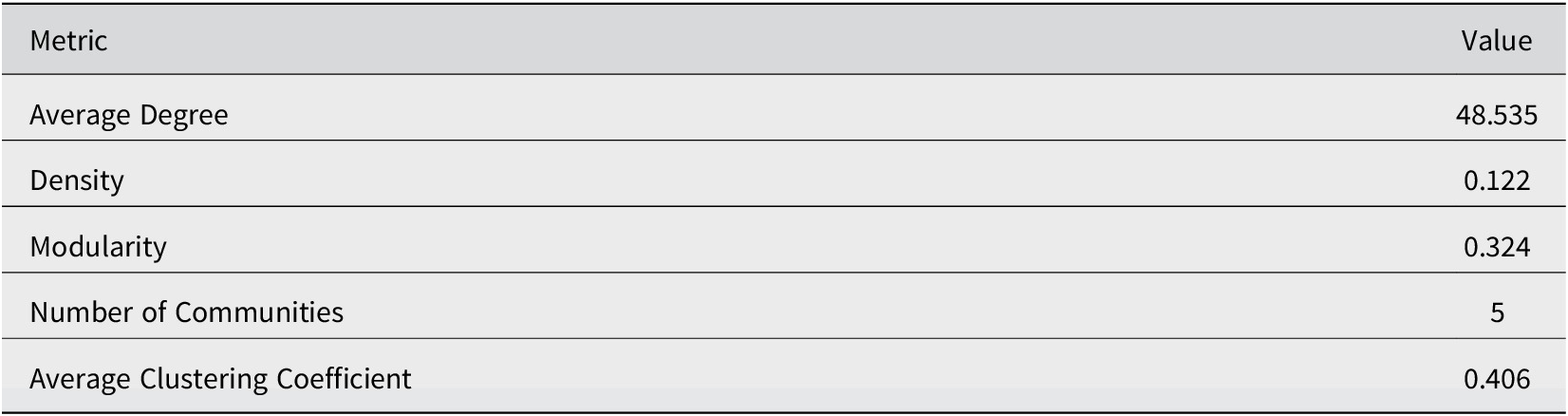
Using the same dataset of 31,597 Weibo posts as in the time series analysis, the author applied Python to calculate Pointwise Mutual Information (PMI), filtering the corpus to retain the 400 words used most frequently. PMI measures the likelihood of two words co-occurring more than by chance.Footnote 70 Using PMI results in Graph Exchange XML Format, the author visualised the co-occurrence network with Gephi, where Figure 2 presents word relationships, with colours indicating modularity-based community (cluster) detection. After comparing the interpretability of different clustering strategies, weak co-occurrences were filtered by removing edges with weights below 7.6239. The descriptive statistics of the resulting network, presented in Table 2 below, indicate strong modularity and reveal five clearly distinguishable semantic communities. The author selected three of these communities for further analysis,Footnote 71 through which the institutional and conceptual specifics of IP Typical Cases can be delineated.
Clusters revealing IP Typical Case’s economic-political-legal dimensions

Figure 2. Long description
At the center is a dense core of yellow nodes, surrounded by overlapping clusters of green, orange, and purple nodes. Each node is labeled with a unique identifier. The green cluster dominates the lower left, the orange cluster occupies the lower right, the purple cluster is in the upper left, and the yellow cluster is central and extends toward the upper right. Numerous lines connect nodes within and between clusters, with the highest density of connections in the central region. Peripheral nodes are less connected and are positioned at the outer edges of each cluster. The network structure visually separates the clusters, indicating distinct but interconnected economic, political, and legal dimensions.
Cluster analysis descriptive data

Table 2. Long description
From the top row downward, the left column lists metrics and the right column shows values. Average Degree is 48.535. Density is 0.122. Modularity is 0.324. Number of Communities is 5. Average Clustering Coefficient is 0.406.
Note: Weak co-occurrences were filtered by removing edges with weights below 7.6239.
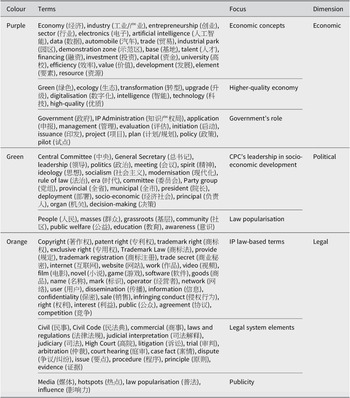
First, the purple community illustrates the economic dimension of IP Typical Cases. This community can be further divided into three thematic sub-clusters. The first cluster covers core concepts in the economic field, including economy (经济), industry (工业/产业), entrepreneurship (创业), sector (行业), electronics (电子), artificial intelligence (人工智能), data (数据), automobile (汽车), trade (贸易), industrial park (园区), demonstration zone (示范区), base (基地), talent (人才), financing (融资), investment (投资), capital (资金), university (高校), efficiency (效率), value (价值), development (发展), element (要素), and resource (资源), as summarised in Table 3 below. This reflects the potential significance and role of IP Typical Cases in promoting economic governance. It aligns with the Chinese government’s ongoing practice of actively integrating IP with science and technology, industry, regional growth, and trade, and of regarding IP as a powerful instrument for supporting high-quality economic development.Footnote 72 The Pudong National Demonstration Zone for Intellectual Property Protection is regarded as a stronghold for IP protection, exerting a positive influence on the commercial and trade sectors.Footnote 73 As a demonstration industrial park, the Suzhou Industrial Park integrates elements such as talent, capital, and universities, and has established the China (Suzhou) Intellectual Property Protection Centre to promote innovation, serving enterprises and fostering economic growth.Footnote 74 Regarding the second topic, higher-quality economic development is associated with greening and intelligent transformation.Footnote 75 Against the backdrop of China’s ongoing economic transformation and upgrading as such,Footnote 76 IP Typical Cases are increasingly associated with themes captured by keywords such as green (绿色), ecology (生态), transformation (转型), upgrade (升级), digitalisation (数字化), intelligence (智能), technology (科技), and high-quality (优质). The government plays a forward-looking leadership role in economic development through planning.Footnote 77 In implementing IP strategies and fostering an IP-driven economy, it assumes responsibilities in policymaking, regulation, and strategic planning.Footnote 78 Thus, in the third topic, words like government (政府), IP administration (知识产权局), application (申报), management (管理), evaluation (评估), initiation (启动), issuance (印发), project (项目), plan (计划/规划), policy (政策) and pilot (试点) frequently appear in association with IP Typical Cases.
Main terms in clusters and thematical descriptions

Table 3. Long description
Starting from the top row, the table has four columns: Colour, Terms, Focus, and Dimension. The purple cluster spans three rows, listing terms such as economy, industry, entrepreneurship, sector, electronics, artificial intelligence, data, automobile, trade, industrial park, demonstration zone, base, talent, financing, investment, capital, university, efficiency, value, development, element, and resource. Its focus is economic concepts and its dimension is economic. The next purple row includes terms green, ecology, transformation, upgrade, digitalisation, intelligence, technology, and high-quality, with a focus on higher-quality economy. The third purple row lists government, I P Administration, application, management, evaluation, initiation, issuance, project, plan, policy, pilot, focusing on government’s role. The green cluster spans two rows: the first lists Central Committee, General Secretary, leadership, politics, meeting, spirit, ideology, socialism, modernisation, rule of law, era, committee, Party group, provincial, municipal, president, deployment, socio-economic, principal, organ, decision-making, with a focus on C P C’s leadership in socio-economic development and a political dimension. The second green row includes people, masses, grassroots, community, public welfare, education, awareness, focusing on law popularisation. The orange cluster spans three rows: the first lists copyright, patent right, trademark right, exclusive right, Trademark Law, provide, trademark registration, trade secret, internet, website, work, video, film, novel, game, software, goods, name, mark, operator, network, user, dissemination, information, confidentiality, sale, infringing conduct, right, interest, public, agreement, competition, focusing on I P law-based terms and a legal dimension. The second orange row includes civil, Civil Code, commercial, laws and regulations, judicial interpretation, judiciary, High Court, litigation, trial, arbitration, court hearing, case fact, dispute, issue, procedure, principle, evidence, focusing on legal system elements. The third orange row lists media, hotspots, law popularisation, influence, focusing on publicity. Each cluster is visually anchored by colour and mapped to its thematic focus and dimension.
Secondly, the green community reveals the political dimension of IP Typical Cases. Many IP-related policies issued by the CPC Central Committee or the central government begin with quotations from, or references to reports and speeches by, General Secretary Xi Jinping. Because the rule of law and governance according to law have been accorded unprecedented importance under the Xi Jinping administrationFootnote 79 – elevated to a new level of political significanceFootnote 80 – and because IP constitutes an integral part of the legal system, it has consequently assumed a pronounced political character. This explains the frequent co-occurrence of IP Typical Cases with keywords such as Central Committee (中央), General Secretary (总书记), leadership (领导), politics (政治), meeting (会议), spirit (精神), ideology (思想), socialism (社会主义), modernisation (现代化), rule of law (法治), era (时代), committee (委员会), Party group (党组), provincial (全省), municipal (全市), president (院长), deployment (部署), socio-economic (经济社会), principal (负责人), organ (机关), and decision-making (决策). In addition, scholars observed decades ago that Chinese citizens historically lacked sufficient legal consciousness.Footnote 81 In response, China launched its first national ‘law popularisation campaign’ in 1985 with the aim of ‘cultivating citizens’ legal awareness’ and ‘enhancing the legal literacy of the entire population’.Footnote 82 IP law faced the same situation. In 1995, the China-United States Agreement Regarding Intellectual Property Rights required China to ‘conduct training and education on intellectual property protection across the country’ by ‘incorporat[ing] intellectual property laws into the state’s knowledge-of-law popularisation scheme’ and to ‘heighten the awareness of … intellectual property laws in the society’ through media.Footnote 83 This would ‘increase awareness of intellectual property rights among a population’ that had been little exposed to notions of private property.Footnote 84 IP Typical Cases are regarded by the government as an important vehicle for law popularisation. The Central Committee of the CPC and the State Council have called for ‘using cases to popularise the law’ and ‘fully utilising typical cases to explain the law to the public, making the process of resolving these cases a public lesson in law for all citizens’.Footnote 85 Law popularisation continues to this day, and even saw reinforcement with new legislation introduced in September 2025.Footnote 86 In this interpretation, IP Typical Cases are linked to keywords like people (人民), masses (群众), grassroots (基层), community (社区), public welfare (公益), education (教育), and awareness (意识). Although ‘law popularisation’ (普法) belongs to the orange (legal) community discussed later, it occupies a transitional position between the two communities, as the campaign is a state-led political initiative that operates through legal doctrines.
The political significance of IP gives the practice surrounding IP Typical Cases bureaucratic features, with the central government driving local actions through political ideas and tasks. The ‘ecological civilisation’ concept from the 18th Party Congress guided environmental policy implementations through non-institutionalised mechanisms.Footnote 87 Similarly, under the CPC Central Committee’s emphasis on IP, institutions – including the SPC, CNIPA, and local authorities – increasingly treated IP-related work as a political task, with the issuing of IP Typical Cases as a prominent manifestation of this. This orientation reflects what may be described as a form of ‘political incentive’ operating within the governance structure.Footnote 88 As Shen Changyu, Party Secretary and Director of the CNIPA, stated: ‘The CNIPA will firmly uphold the Party’s overall leadership over intellectual property undertakings … and will faithfully implement General Secretary Xi Jinping’s important instructions on strengthening IP work as well as the decisions and arrangements of the CPC Central Committee and the State Council’.Footnote 89 In this light, the nationwide enthusiasm for promoting IP Typical Cases across judicial bodies, law enforcement agencies, government institutions, and even professional associations reflects a politically motivated commitment.
Thirdly, the orange community represents the legal dimension of IP Typical Cases. The keywords within this community largely consist of terms frequently used in the texts of China’s IP laws, which the author refers to as IP law-based terms. These include copyright (著作权), patent right (专利权), trademark right (商标权), exclusive right (专用权), trademark law (商标法), provide (规定), trademark registration (商标注册), trade secret (商业秘密), internet (互联网), website (网站), work (作品), video (视频), film (电影), novel (小说), game (游戏), software (软件), goods (商品), name (名称), mark (标识), operator (经营者), network (网络), user (用户), dissemination (传播), information (信息), confidentiality (保密), sale (销售), infringing conduct (侵权行为), right (权利), interest (利益), public (公众), agreement (协议), and competition (竞争). These terms fall into three categories: (1) those extensively used in statutes like the Copyright, Patent, Trademark, and Anti-Unfair Competition Laws, and related regulations and SPC’s Legal Interpretations; (2) semantically related terms; and (3) supplementary terms elaborating legal provisions. These terms are indispensable when explaining how a case exemplifies the interpretation and application of IP rules, contributing to the uniform application of IP laws and thus qualifying as a ‘Typical Case’.
For example, ‘copyright’, ‘patent right’, and ‘trademark right’ (including the ‘exclusive right’ of registered trademarks) all belong to IP, with ‘infringing conduct’ targeting these rights.Footnote 90 ‘Work’ constitutes the object of copyright and appears 166 times in the Chinese Copyright Law; ‘video’ and ‘film’ are classified as ‘audiovisual works’ under article 3,Footnote 91 while a ‘novel’ is categorised as a ‘literary work’ under the same provision. The copyright protection of ‘games’ relates to the idea-expression dichotomy, a fundamental and debated issue in copyright law.Footnote 92 ‘Software’ is likewise listed in Article 3 of the Copyright Law and the Regulations on Computer Software Protection (State Council Decree No 339). ‘Operator’ is synonymous with ‘internet service provider’ for the purpose of digital copyright law,Footnote 93 a term widely used in the Regulation on the Protection of the Right of Communication through Information Networks (State Council Decree No 468), while ‘network’ appears in provisions such as article 10 of the Copyright Law. The term ‘user’ is present in multiple provisions of the Supreme People’s Court Provisions on the Application of Law in Civil Disputes over Infringement of the Right of Communication through Information Networks (Interpretation No 20 of 2012), particularly articles 3 and 7–12 (addressing direct and indirect liability). ‘Dissemination’ appears extensively in the Copyright Law as one of the regulated acts, alongside reproduction. In the context of trademark law, a trademark identifies the source or reputation of goods,Footnote 94 and the Trademark Law contains 79 instances of the term ‘goods’, 14 of ‘name’, 6 of ‘mark’, and 8 of ‘sale’. References to ‘public’ recognition or confusion appear 8 times. Trade secrets and other IP-related rights are protected under the Anti-Unfair Competition Law, where ‘trade secret’ appears 29 times, and ‘confidentiality’ 6 times, reflecting the need for confidentiality measures. Article 13 (formerly Article 12) of the Anti-Unfair Competition Law, known as the ‘internet clause’,Footnote 95 addresses online unfair competition, explaining the presence of ‘internet’ and ‘competition’. Keywords such as civil (民事), Civil Code (民法典), commercial (商事), laws and regulations (法律法规), judicial interpretation (司法解释), judiciary (司法), High Court (高院), litigation (诉讼), trial (审判), arbitration (仲裁), court hearing (庭审), case fact (案情), dispute (争议/纠纷), issue (要点), procedure (程序), principle (原则) and evidence (证据), though not specific to IP law, are components of the broader legal system. They are commonly employed in presenting the factual background, issue, reasoning, holding, and legal significance of an IP case.
This community also includes keywords such as media (媒体), hotspots (热点), law popularisation (普法), influence (影响力), among others. As noted, Typical Cases serve as tools for IP law popularistion. Also, their release is often accompanied by media promotion to amplify their social impact.
To summarise and interpret the empirical findings in this section in light of normative framework discussed in Section 2, the three-dimensional connotations – economic, political, and legal – closely correspond to the objectives that normative documents envisage for the IP Typical Case system. The economic and political dimensions suggest that IP Typical Cases function as instruments of social governance, encompassing the popularisation of law among the public, the promotion of core socialist values within society, and broader goals related to social development that extend beyond the internal domain of legal doctrine and adjudication. By contrast, the legal dimension aligns with the normative design of the system in serving an instructive role for legal application and the adjudication of similar cases.
(b) Why ‘Typical’: decoding the typicality of IP Typical Cases
Despite the IP Typical Case’s intended dual function shown in Section 2 and further confirmed by the foregoing empirical analysis, policymakers – shaped by an ambiguous understanding of the typicality of a Typical Case – have failed to recognise the inherent tension between these functions. The legal function requires the doctrinal complexity of a ‘hard case’, while the societal function depends on simple, communicable cases suitable for public education.
IP Typical Cases should play a ‘rule-guiding role’ in ‘hard and complex cases’, as implied in the SPC’s policies.Footnote 96 However, whether the adjudication of simple cases, which stand in contrast to such hard cases, requires reference to Typical Cases is a separate question. The answer, in principle, is negative. The issue of what renders a Typical Case ‘typical’ is closely connected to this problem.
Hard cases and simple cases are fundamentally different. A hard case is ‘a case in which the judge must engage in substantive reasoning … that is, a case requiring the substantive application of legal methodology (doctrinal methods)’.Footnote 97 When a judge faces a situation in which no applicable legal norm (that is, direct reasoning premise) exists, the judge must ‘personally intervene and, through substantive reasoning, construct new norms’ to serve as a major premise for adjudication.Footnote 98 Hard cases fall into two types: those lacking clear binding rules and those in which existing rules conflict with the judge’s substantive judgment.Footnote 99 Dworkin’s articulation of hard cases is even more straightforward: in a hard case, ‘no settled rule dictates a decision either way’.Footnote 100 Legal argument in hard cases ‘turns on contested substantive concepts’.Footnote 101
By contrast, simple cases are those that are not doctrinally controversial. In such cases, the norms provided by legal sources are clear, and those sources possess strong binding force.Footnote 102 Raz’s arguments on ‘regulated cases’ and ‘unregulated cases’ lend further support. ‘Regulated cases are those which fall under a common law or statutory rule which does not require judicial discretion’.Footnote 103 Raz states:
A dispute is regulated if questions of the form: ‘In this case should the court decide that p?’ have a correct legal answer, i.e., if there is a gap in the law applying to the case … [However,] since the law applying to unregulated disputes has gaps, no particular solution to the dispute is required by law …Footnote 104
Precisely because no predetermined solution exists – leading to controversy – only hard cases necessitate reference to Typical Cases to achieve the unification of legal application. Hard cases require judges to engage in complex reasoning without clear legal guidance, making them prone to variation. In such cases, Typical Cases help unify adjudication by providing guidance on legal norms and reasoning. In contrast, simple cases involve clear rules, leaving no need to refer to other cases, including Typical Cases.
From another perspective, hard cases primarily target legal professionals; the general public, without legal training, is not expected to understand them in the same way. In contrast, simple cases are directed at the general public.
To clarify this distinction further, it is helpful to introduce the concept of legal dogmatics (Rechtsdogmatik, in German). It is the existence of hard cases (as opposed to simple cases) that renders legal dogmatics indispensable.Footnote 105 Legal dogmatics is highly specialised, forming the essence of law in the narrow sense. It comprises three activities: ‘(1) the description of valid law; (2) the study of the concepts and systematic structure of that law; and (3) the proposal of solutions to hard legal cases’.Footnote 106 Doctrinal legal reasoning has long been revered in civil law systems, particularly in Germany,Footnote 107 and was the dominant legal method in the common law world as well.Footnote 108 The German jurist Robert Alexy notes that ‘if we follow the terminology used by some of the more authoritative jurists, then … the term legal dogmatics should be understood as referring to the narrow and genuine sense of legal scholarship’.Footnote 109 Legal dogmatics is ‘the working method by which legal professionals engage with positive law’.Footnote 110 Doctrines and doctrinal research are emblematic of the work of law professors, law students, and practising lawyers.Footnote 111
Consequently, legal dogmatics as a body of knowledge distinguishes legal professionals from the general public. Ordinary citizens neither concern themselves with nor possess the capacity to engage in highly specialised questions such as ‘whether the reasonable royalty rate for standard-essential patents, determined under a modified version of the Georgia-Pacific factors, complies with the FRAND commitment and the purpose of patent law’.Footnote 112 By contrast, the public can easily grasp slogans such as ‘Protecting intellectual property is protecting innovation’, as broadcast in the Nanjing Metro,Footnote 113 or be drawn to appeals like ‘Protecting intellectual property and fostering a sound business environment’, which align with local authorities’ efforts to optimise the business environment and promote economic development, as seen in Weihai City, Shandong Province.Footnote 114
Although the distinction between hard and simple cases is analytically useful, the boundary is not absolute. First, members of the public may always find the specific legal reasoning in any case complex and difficult to understand, even in cases classified here as simple. Secondly, the best legal principles are often simple enough to be understood by the public, yet sufficiently significant to warrant further engagement by scholars. As Justice Holmes reminds us, ‘hard cases … make bad law’.Footnote 115 In this sense, well-reasoned hard cases may also deserve recognition for their exemplary societal governance. For example, a 2025 SPC Typical Case on protecting artificial intelligence model architecture and parameters for comic-style photo transformations is arguably doctrinally significant, while also being promoted for its societal value in ‘regulating the development of the artificial intelligence industry and maintaining market competition order in emerging sectors’.Footnote 116
Even with a careful distinction between hard and non-hard cases, Typical Cases may struggle to offer specific guidance on adjudication, as distinguishing cases even in jurisdictions with developed case law system is hard.Footnote 117 Moreover, issuers often provide limited explanations of their ‘typical significance’, and may face difficulties in offering more detailed accounts in the future. That said, some restraint in prescribing detailed doctrinal reasoning can help preserve judicial autonomy.
(c) The predominance of non-hard cases and the systematic problem of IP Typical Cases
The SPC’s policy appears to prioritise the legal rather than the societal function of IP Typical Cases. As a result, special attention should be given to their doctrinal exemplarity, with a focus on selecting hard cases. Ironically, however, most IP Typical Cases are not doctrinally difficult.
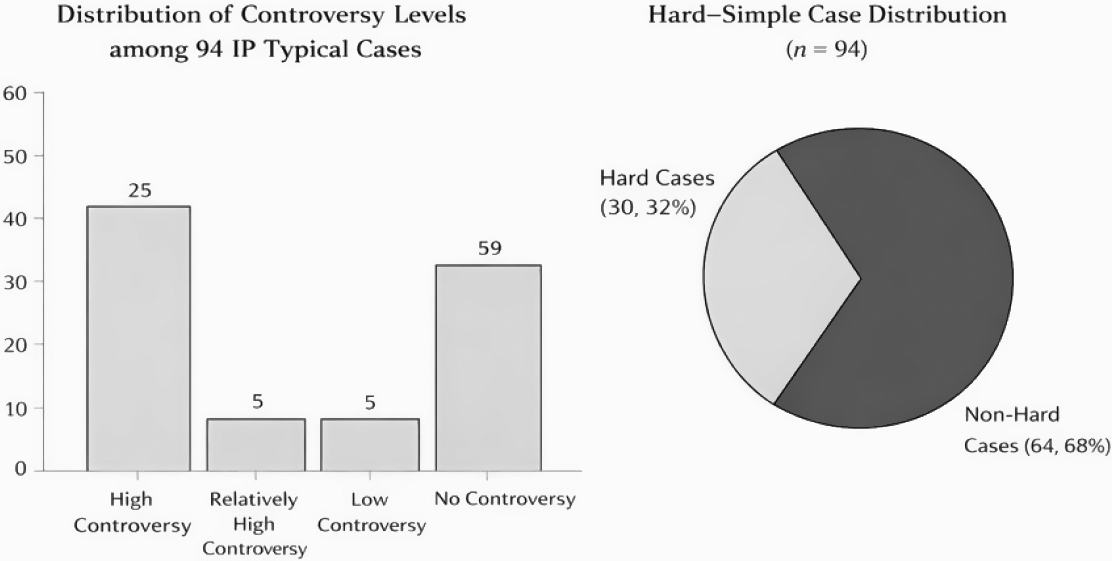
The author examined the ‘50 IP Typical Cases of Chinese Courts’ released by the SPC between 2022 and 2024: ‘2022 Chinese Courts’ 50 Typical IP Cases’,Footnote 118 ‘2023 Chinese Courts’ 50 Typical IP Cases’,Footnote 119 and ‘2024 People’s Courts’ IP Typical IP Cases’.Footnote 120 In total, 108 cases were released (50 in 2022, 50 in 2023, 8 in 2024). After excluding 12 unavailable cases and two unrelated anti-monopoly cases, 94 cases remained for analysis. The Supplementary Material (Table 4) provides a complete list of these cases, including their case numbers, names, relevant scholarly discussions, and assessments of their level of controversy. The author classified cases using controversy level based on the volume and prominence of scholarship in China National Knowledge Infrastructure (CNKI) as ‘high’, ‘relatively high’, ‘low’, or ‘none’.
Figure 3 below summarises the 94 cases: 25 were highly controversial, 5 relatively highly controversial, 5 low in controversy, and 59 uncontroversial. Based on the hard–simple distinction, 30 cases were classified as hard (high or relatively high controversy), while 64 (68%) were non-hard.
Snapshot of controversy levels and hard–simple case distribution.

As discussed earlier, only hard cases necessitate reference to Typical Cases. Therefore, the predominance of non-hard cases demonstrates that, in practice, most IP Typical Cases fail to fulfil their institutional purpose of promoting the uniform application of law.
Most of the examined cases are not hard cases, so what makes them ‘typical’? Their typicality lies not in doctrinal sophistication or exemplary legal reasoning, but in alignment with China’s socio-economic governance objectives. Some cases were selected for addressing legal gaps created by emerging technologies such as artificial intelligence and were regarded as good judicial practice from a political standpoint.Footnote 121 Others were driven by policy focus on areas like Chinese traditional culture, foreign investors, private enterprises, or new plant varieties.
IP Typical Cases are explicitly stated to help ‘foster a market-oriented, law-based, and internationalised business environment’,Footnote 122 promote ‘the inheritance, development, and dissemination of folk literature and art’,Footnote 123 and encourage ‘the healthy and orderly development of the film industry’.Footnote 124 They also represent ‘active explorations in protecting breeding plant varieties’,Footnote 125 as well as protecting the seed industry, which ‘is a strategic and fundamental sector for the nation’.Footnote 126 Other cases focus on ‘deterring trade secret infringement crimes’,Footnote 127 ‘ensuring equal protection of Chinese and foreign IP rights’,Footnote 128 protecting ‘the innovation of traditional Chinese medicine’,Footnote 129 protecting ‘innovation achievements of private high-tech enterprises’,Footnote 130 and ‘enhancing protection for internationally renowned trademarks while fostering a law-based and internationalised business environment’.Footnote 131 These narratives therefore reflect broader social governance aims, consistent with the empirical findings in Section 3(a) that IP Typical Cases extend beyond their legal dimension to embody economic and political meanings.
The new developments in the 2024 batch of Typical Cases further demonstrate that their typicality often lies in their societal function.Footnote 132 The SPC invited prominent IP law professors to comment on the ‘typical significance’ of each case, with many observations aligning with the societal dimension identified in this paper. For instance, one scholar praised a case for its positive role in advancing new productive forces in biopharmaceuticals and fostering innovation.Footnote 133 Another highlighted the value in ‘creating a favourable business environment’ and regulating ‘new forms of internet-based consumer evaluation’.Footnote 134 A third commentator emphasised the ‘significance for the gaming industry’,Footnote 135 while another observed that the typicality lies in addressing ‘disputes arising from algorithmic content generation’, contributing to ‘the cultivation of new productive forces and the healthy development of digital economy enterprises’, and in ‘safeguarding major Spring Festival film releases’.Footnote 136
Finally, it is important to consider whether IP Typical Cases achieve other related objectives beyond their binary roles. Two points merit attention. First, in theory, IP Typical Cases may influence the direction of national IP or innovation policy. Courts can be policy actors in the formation and implementation of public policy.Footnote 137 However, in the Chinese context, the relationship appears to operate more often in the opposite direction: national policy shapes judicial practice. This dynamic reflects China’s constitutional–political framework, where Party leadership steers the rule-of-law process,Footnote 138 and the People’s Congress’s oversees the courts.Footnote 139 At the local level, a ‘competing to protect IP’ phenomenon of encouraging courts to engage more actively with IP disputes – analogous to competing for attracting foreign direct investmentFootnote 140 – exists among provincial governments, as seen in GuangdongFootnote 141 and Jiangsu,Footnote 142 the two provinces with the highest GDP. More directly relevant to this paper, courts’ selection of Typical Cases is frequently driven by prevailing political priorities and national IP policies, consistent with the empirical findings in Section 3.
Secondly, some Typical Cases reflect an emerging consensus within the court system, aiding judges and lawyers even without detailed doctrinal guidance. For example, a 2022 IP Law Enforcement Typical Case by the Guangdong Administration for Market Regulation (Guangdong IP Administration) involved mutual recognition of evidence in a cross-border trade dispute, where infringing goods seized by Hong Kong Customs – originally exported from Nansha, Guangzhou – were subsequently determined by mainland authorities to constitute trademark infringement.Footnote 143
Conclusion
The IP agenda has become one of the core priorities of the CPC and the Chinese government in the new era under Xi Jinping’s administration. A dazzling and ever-expanding variety of IP Typical Cases have emerged, capturing nationwide attention. Originating in courts’ early case-release practices, IP Typical Cases have since been institutionalised and normalised, now issued by a wide range of institutional actors, including courts, procuratorates, government agencies, professional associations, and actively promoted by practising lawyers. Yet no prior study has addressed the fundamental question: what exactly are IP Typical Cases?
This paper shows that the meaning and function of IP Typical Cases has rarely been clearly articulated by institutional designers. The SPC’s normative documents suggest that their original purpose was to unify the interpretation and application of law in hard cases, providing reference models for the application of legal provisions. They also aimed to promote law popularisation and serve as a catalyst for the implementation of socio-economic policies.
The Semantic Network Analysis in this article reveals that IP Typical Cases embody three dimensions – economic, political, and legal. Specifically, apart from guiding the uniform application of IP law, they currently play roles in socio-economic activities and the broader social governance structure: promoting industrial, technological, and trade development; driving the green and intelligent transformation of the economy; facilitating the implementation of national strategies and policies; popularising IP law; fostering public awareness of IP protection.
This paper then highlights a paradox: policymakers have overlooked an intrinsic tension between the system’s legal and societal functions. This stems from the unresolved question of what makes a case ‘typical’. The legal function requires the doctrinal complexity of a ‘hard case’, whereas the societal function depends on simple, communicable cases suitable for public education. While the current IP Typical Case system has some cases involving complex doctrinal reasoning appreciated by legal professionals, the vast majority of the cases are not doctrinally hard and only serve as instruments for popularisation of law or as catalysts for social governance, aimed at the general public.
China will likely continue issuing IP Typical Cases, but greater clarity is needed as to whether their typicality lies in doctrinal or societal function. A clear distinction between hard and simple cases is therefore warranted. Only with this differentiation can IP Typical Cases effectively function as a dual engine across legal and societal dimensions: hard cases promoting uniform legal application, and simple cases advancing social governance and law popularisation. Absent such clarification, the predominance of non-hard cases will continue to dilute the system’s doctrinal role.
Lastly, the IP Typical Case system holds potential for developing China’s case guidance system and, more narrowly, for the formation of IP legal dogmatics. While China’s case guidance system differs from the Western common law system, it is often regarded as comparable. Guiding Cases, as the top-tier and most authoritative case type within this system, can certainly play a substantial role in refining the case guidance framework and shaping the overall landscape of Chinese law. Typical Cases, as another key component, also possess considerable potential. Their influence derives not only from their institutional status but also from their much greater volume, wider range of issuing bodies, and increased visibility among legal professionals and the public. Once the structural deficiency identified in this paper is addressed, this engine could exert meaningful influence. Besides, legal dogmaitcs is crucial to the development of law, and Chinese IP law is no exception. Despite the seemingly intuitive nature of this proposition across jurisdictions, China lacks a strong tradition of IP legal dogmatics. Adding to this are rapid technological changes that continually challenge Chinese IP law. Together, these factors underscore the urgent need for a coherent doctrinal framework. Scholarship has emphasised the importance of forming legal dogmatics for the evolution of Chinese copyright law.Footnote 144 In line with this view, this paper advocates treating IP Typical Cases – once distinguished between hard and simple cases – as pivotal sources for developing IP legal dogmatics.
Supplementary material
The supplementary material (Table 4) for this article can be found at https://doi.org/10.1017/lst.2026.10133.




 Open access

