Katherine Dunham (1909–2006) has a large and vast dance repertoire, built while directing and choreographing for her company from the 1930s through the 1960s. Although she was always politically engaged, she rarely addressed social issues explicitly in her choreography (Dee Das Reference Dee Das2012). Footnote 1 There are, however, a few exceptions, such as her unfinished ballet Christophe, her Popular Front dances of the late 1930s, her anti-lynching ballet Southland (presented during her first South American tour in 1950), and her Black Power choreography of the late 1960s (Dee Das Reference Dee Das2014, Reference Dee Das2017). These dances engaged with histories of racialized violence and its destructive effects nationally, as well as abroad (Dee Das Reference Dee Das2014). Tango (1954) could be characterized in the same way, due to Dunham's statements that the performance, created circa 1951, acquired a political tenor when she presented it in Buenos Aires in 1954 following the death of her friend “Pipita” Cano (Dunham Reference Dunhamn.d.a). The performance, Dunham wrote, carried the “sinister frustration” of the city, its “militaristic oppression,” and its “cruelty” (Dunham Reference Dunhamn.d.a, 1).
During her first trip to Buenos Aires in 1950, Dunham was sympathetic to Peronism: the Argentine populist political movement led by Juan Domingo Perón (Argentine general and politician, 1895–1974), which he introduced during his presidency from 1946 to 1955. However, by her next visit, Dunham had changed her opinion. In her unpublished memoires, she explains that everything had changed after the death of Eva “Evita” Perón (Dunham Reference Dunhamn.d.a, 1), Perón's second wife and Peronist politician. Dunham's ostensibly political performance, Tango, premiered during her second South American tour on September 16, 1954, in Buenos Aires, Argentina, and was intended as a protest against Perón's government.
In this article, I argue that Katherine Dunham's characteristic method of working, based on ethnographic engagement with popular, local dances, encouraged an interpretation of Tango that paralleled the cultural policies promoted by Perón's government rather than working as a protest performance against Perón. Indeed, this article aims to show that local audiences perceived the piece as a reinforcement of what they already agreed with, which was the construction of a national identity using elements of tango and folklore rather than as a critical form of expression against Peron's government. Considering that the Peronist government exalted nationalism and tradition, and privileged, popular, local culture over a unified, global “high” culture, Dunham's use of a stylized popular dance prevailed over the protest message. As I will demonstrate, the piece subsequently operated as a reaffirmation of Peronist values.
There is some existing scholarship on Dunham's Tango, most notably Vévé Clark's book chapter “Performing the Memory of Difference in Afro-Caribbean Dance: Katherine Dunham's Choreography, 1938–87” (1994); a brief comment in Joyce Aschenbrenner's book Katherine Dunham: Dancing a Life (Reference Aschenbrenner2002); and a mention in Joanna Dee Das's recent book Katherine Dunham: Dance and the African Diaspora (2017).Footnote 2 However, this article challenges Clark and Aschenbrenner's interpretations of the performance. According to Clark, “the agitprop works in the Dunham corpus were deliberate re-castings of regional dances designed to express anger and protest against certain sociopolitical practices” (1994, 198). She argues that the fact that Argentine audiences knew their “national dance” very well allowed them to “appreciate the ways in which the tango might be used to express defiance” (198). Aschenbrenner coincides with this point of view, stating that “[t]he audiences sensed and responded to her message, although many were afraid to show their approval openly” (Reference Aschenbrenner2002, 148). These critics, however, reached these conclusions without any substantial engagement with the local reception of the work. On the other hand, Dee Das, citing my argument, acknowledges that “ironically, Dunham's dance did create solidarity with the Argentine people—just not for the reasons she envisioned” (2017, 147).
My research is based on careful examination of extant primary and secondary source materials.Footnote 3 The first part of the article provides a brief contextualization of the Argentine political and social moment, together with a historicizing of Argentine concert dance. I then examine how theatrical dance has a universalistic, elite background that Peronist cultural policies challenged by promoting not only a “popular/mass” culture, but also by enabling working-class access to “high” culture Footnote 4 events. From there, I consider Dunham's first visit to Buenos Aires and her initial relationship with Perón and Eva. Finally, I analyze Tango and its interpretations, Dunham's rejection of Peronism that Tango purportedly represents, scholarly readings of the performance, local press reviews at the time, and how the local audience perceived it.
Dance and Politics in Argentina During Dunham's South American Tours
In 1946, by democratic vote, Juan Domingo Perón became president of Argentina. His first term ended in 1952, and during that same year, he was reelected through to 1955. Perón's second term was interrupted by a military coup d’état called the Revolución Libertadora (September 16, 1955). During these first two terms, Perón established an approach to politics that could be termed “populist” (Laclau Reference Laclau2010), but with its own characteristics.Footnote 5 Perón's first two terms are referred to as the “First Peronism,” or the period when he established the basis of his movement.
In general terms, the administration of President Perón gave significant support to national industry, causing a massive internal migration from the rural areas to big cities in search of work opportunities.Footnote 6 This migrant population soon demanded more participation in politics as well as social and cultural spheres, and Peronism responded with several policies that benefited not only the working classes but also the middle class. This generated upward mobility that Peronism termed “social justice” (Torre Reference Torre2002, 26).
Peronist cultural policies emphasized the “welfare democratization” (Torre and Pastoriza Reference Torre, Pastoriza and Torre2002, 304) state policy, which focused on expanding social welfare programs that promoted broader access of the popular sectors to arts, tourism, education, and leisure. The expansion of social welfare programs challenged the standard definition of so-called “high” culture in opposition to “popular/mass” culture: through cultural diffusion, Peronist policy promoted greater access for the working class to cultural goods, and thus, a new “cultural consumer” emerged. As theater scholar Yanina Leonardi (Reference Leonardi, Soria, Rocca and Dieleke2010) states, this diffusion occurred through access to areas previously established as the exclusive patrimony of middle and upper classes, including federal theaters like the Teatro Colón (Colón Theater), the most important opera theater in the country and one of the most prominent of the region.
Peronist cultural policies also focused on the creation of a national cultural identity, which was founded on what Raymond Williams (Reference Williams1994, 174) terms a “selective tradition” (tradición selectiva)Footnote 7 that privileged “Western and Latin culture through its Hispanic roots” (Perón Reference Perón1947).Footnote 8 Thus, the government sought to establish a cultural program based on traditional forms that did not imply a break with the past, but rather, recuperated values of the preexisting culture that could be re-signified according to the Peronist ideology. The project was based on the idea of championing national art forms over foreign/universalistic ones, suggesting a certain parallelism between the cultural dependence and the economic dependence that Peronism challenged (Leonardi Reference Leonardi2012).
During this period, the artistic field of Argentine concert dance was being consolidated (Cadús Reference Cadús2017a). Dance established itself in Argentina as “high” culture in 1913 when Serge Diaghilev's company, the Ballets Russes, arrived for the first time at the Colón Theater, invited by the Ciacchi entertainment enterprise, with the support of the members of the Buenos Aires intellectual elite (Destaville Reference Destaville and Durante2008). At the turn of the century, the Argentinean cultural elite comprised a Buenos Aires oligarchy that wanted Buenos Aires, and by extension Argentina, to be the most modern nation in Latin America. They needed a theatrical dance that distinguished itself from popular forms like folklore, circus, and tango. Consequently, dance as “elite culture” was shaped by a Eurocentric model of cultural modernity, with the Ballets Russes, and later with modern dance from the United States, as the most representative forms (Tambutti Reference Tambutti2011).
Argentine modern dance started in 1944 with the settlement of Miriam Winslow,Footnote 9 who created the first Argentine modern dance company: the Winslow Ballet. In this company, she trained the so-called “trailblazers” of Argentine modern dance (Isse Moyano Reference Isse Moyano2006). Dunham's first arrival in Argentina thus coincided with the growth and development of the Buenos Aires modern dance movement as well as the Peronist government's integration of concert dance, and especially ballet, since it was notable within official institutions, as part of Peronist cultural policies. For example, the government sponsored performances for worker unions at the Colón Theater, at mass public and political events, in parks, and in tours to the provinces, which made visible and sometimes tense the gap between “high” culture and “popular/mass” culture (Cadús Reference Cadús2017b, Reference Cadús2012).
First Encounter, First Impressions of Peronism: Katherine Dunham's 1950 Visit to Buenos Aires
When Dunham arrived in Buenos Aires for the first time, in 1950, she was already a renowned dancer, choreographer, and anthropologist. She was touring for the first time in South America, but her name was not unfamiliar to the audience in the capital city of Argentina. This popularity is evidenced by the expectations that her company's arrival generated. There were many newspaper reviews published before the company's arrival that noted her importance not only because of her career trajectory, but also because of her previous recognition in Paris (Crítica 1950a)Footnote 10 and the Argentine public's reverenced for Parisian taste in art expressions.
In 1950, Dunham performed at the Casino and Opera Theaters in Buenos Aires, which were commercial and well-known theaters where several international dancers had also performed. The Ballet Dunham company performed at the Casino Theater from September 1 to October 16, 1950, with a total of fifty-four shows. They presented a program titled Caribbean Rhapsody.Footnote 11 Following this, they performed at the Grand Opera Theater from October 20 to November 16, 1950, with a total of fifty-two shows.Footnote 12
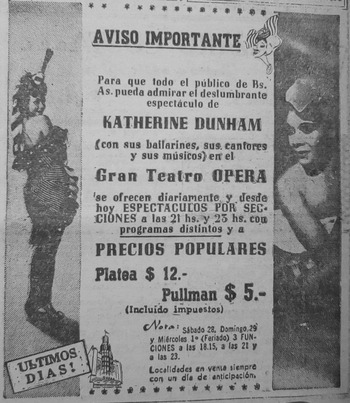
In total, they performed for eleven weeks, presenting 106 shows. These shows received an enthusiastic response from local audiences, whose applause following the first presentation called the company back on stage to bow an impressive eight times (La Razón 1950, 10). Additional evidence of the company's success includes the number of performances they gave weekly; beginning with a show every weeknight, except for Tuesday (the company's day off), and two shows during the weekend. Later, these performances were increased to twice a day during weeknights and three times on weekends and holidays, with more affordable prices, as can be seen in this announcement (Photo 1). Furthermore, the company received much attention from the public and the press, and they were formally received by President Perón and Eva.
Advertisement featured in newspaper La Razón, October 26, 1950, p. 9. Located at the Biblioteca del Congreso de la Nación Argentina.

At the time, Eva Perón was president of the Partido Peronista Femenino (Female Peronist Party) and was in charge of the Fundación Eva Perón (Foundation Eva Perón for Social Aid). This organization dealt with labor union problems and attempted to satisfy the concerns of the poor working class. Besides the direct social assistance provided by the Foundation, where Evita personally took care of people's health, labor, or housing problems, the Foundation also organized student and youth sports championships, the creation of Hogar Escuelas (Home Schools), residences for the elderly, transit homes, the Escuela de Enfermeras (Nursing School), Ciudad Estudiantil (Student's City), and República de los Niños (Children's Republic), among other projects.
During Dunham's visit, Eva invited her and her company to visit the Foundation, and they later performed a benefit show for the Foundation Eva Perón at the Colón Theater on October 2, 1950.Footnote 13 The newspapers advertised the performance as an act of generosity by Dunham in the service of Social Aid, suggesting that it was Dunham's idea after having seen the Foundation's work (Crítica 1950b, 10). The tickets were sold at the CGT (Confederación General del Trabajo [The General Confederation of Labor]), which encouraged their workers to attend as an act of solidarity.
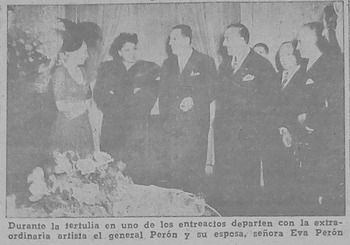
During the benefit show's intermission, Dunham met President Perón, Eva, and other government authorities in a social gathering, a typical practice for the President and First Lady (Photo 2). Following the benefit, the Foundation invited Dunham and her company for lunch at the Presidential Mansion (Quinta Presidencial de Olivos). The lunch honored the Paris Opera BalletFootnote 14, Dunham's company, and Conchita Piquer's companyFootnote 15, and expressed gratitude for their collaboration with the Foundation's social work. During their meeting with the President, Evita, and other public servants, folkloric artists performed (La Nación 1950, 6), potentially stirring Dunham's interest in Argentine dance practices.
Published in newspaper La Razón, October 3, 1950, p. 4, with the following caption: “During a social gathering, in one of the intervals, General Perón and his wife, Mrs. Eva Perón, talking with the extraordinary artist.” Located at the Biblioteca del Congreso de la Nación Argentina.

According to the dance journalist Laura Falcoff, Dunham's interest in folklore during her visit to Buenos Aires prompted arrangements for a tango demonstration during her stay. Analyzing a photograph taken in a newspaper,Footnote 16 she writes, “An unknown couple was visible in the newspaper photograph, dancing. Juancito Díaz played the piano, Tania sang, and Enrique Santos DiscépoloFootnote 17 narrated a story about the origins of tango” (Reference Falcoff and Durante2008, 252).Footnote 18 According to Falcoff, after that performance, Dunham felt motivated to create a choreography set to music by Osvaldo Pugliese, a well-known tango composer, named Tango.Footnote 19 Regardless of the origin of the dance, whether it was inspired by the folkloric artists that performed during the presidential luncheon or during a separate staged tango performance, the piece was presented in Argentina during her second visit in 1954.
(Re)interpreting Peronism: Dunham's Tango as Protest and the Local Reception
From 1954 to 1955 Dunham and her company toured Europe and South America, and returned to Buenos Aires from September 16 until November 28, 1954. During this second trip they presented Tango, the dance inspired by Dunham's previous visit to Argentina, among other dances.Footnote 20, Footnote 21
According to the production notes, Tango was created around 1951. It is a brief dance (four minutes and fifty-four seconds in duration, as indicated in the production notes) performed by three male and two female dancers, including Dunham, with music by Argentine tango composer Osvaldo Pugliese and set and costumes by John Pratt. Pugliese was a famous tango composer. Mobilized by the Spanish Civil War, he had joined the Communist Party, and although Dunham never joined the party, she used her status as a renowned dancer to engage in civil rights activism as well as the Spanish Republican cause. Pugliese and Dunham might have connected since they shared similar political leanings.Footnote 22 During the First Peronism, Pugliese was imprisoned for his participation in the Communist Party, and though the reason for and length of his imprisonment remain unclear, it is believed that he was persecuted for political reasons connected to the Peronist government.Footnote 23 Dunham's unpublished mémoire, “Love Letters from I Tatti,” reveals that she was aware of his imprisonment, something that might have inspired her to conceive of Tango as a protest piece.
Dunham described the choreography in the production notes as well as in a 1983 interview with Vévé Clark (Reference Clark1994). She said that Tango was inspired by a “street number,” and it was meant to evoke her first visit to Buenos Aires when she used to walk late at night after her shows and heard tango songs in cafes, rhythms which she connected with their African roots: “I thought of those cafes as if they were on a street of Afro-America” (Dunham quoted in Clark 1994, 199). Vicente Rossi's book, Cosas de Negros (Reference Rossi1926) could be considered the first to investigate tango's African diasporic origins (Varela Reference Varela2016). Although this book was undervalued at the time, Dunham was probably aware of its existence or the history it took up. In this sense, even though the word “authentic” appears in Dunham's descriptions of Tango, I concur with Dee Das's perspective that “by the mid-1940s, Dunham had disavowed ‘authenticity’ and embraced fusion, hybridity, creativity, and modernity as more adequate terms to describe her choreography” (2014, 46). In this sense, Tango could be considered part of Dunham's “politics of positive representation” choreographic strategy that presented black people and culture in a “positive light,” and performed and “created” the African diaspora (Dee Das Reference Dee Das2014, 4). This is what Dee Das (Reference Dee Das2017) conceives of as Dunham's labor as the “Unofficial Ambassador of Diaspora,” when, between 1947 and 1960, her company toured internationally. Dunham stimulated audiences with her “presentation of disparaged and hidden Africanist cultural practices as high art,” (125) by highlighting in Tango the African diasporic presence. This perspective is emphasized in the production notes where the tango is referred to as Argentina's “heartbeat” or “underbeat” (Dunham Reference Dunhamn.d.b). The production notes explain that Tango is “[a] deep tribute and at the same time the proof of Miss Dunham's love and understanding of the meaning of the rhythm which is the beat of the Argentine people” (Reference DunhamDunham n.d.b).
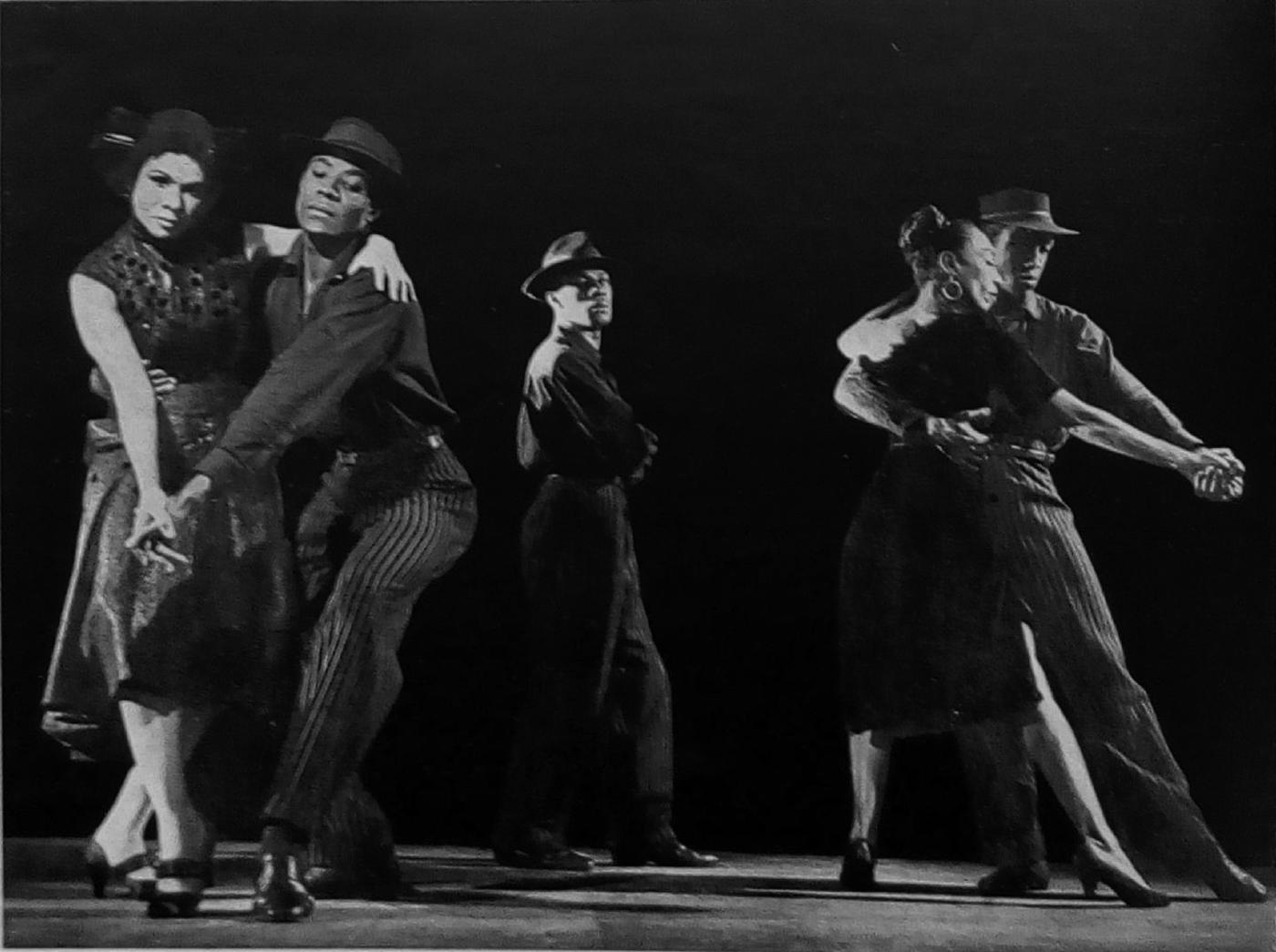
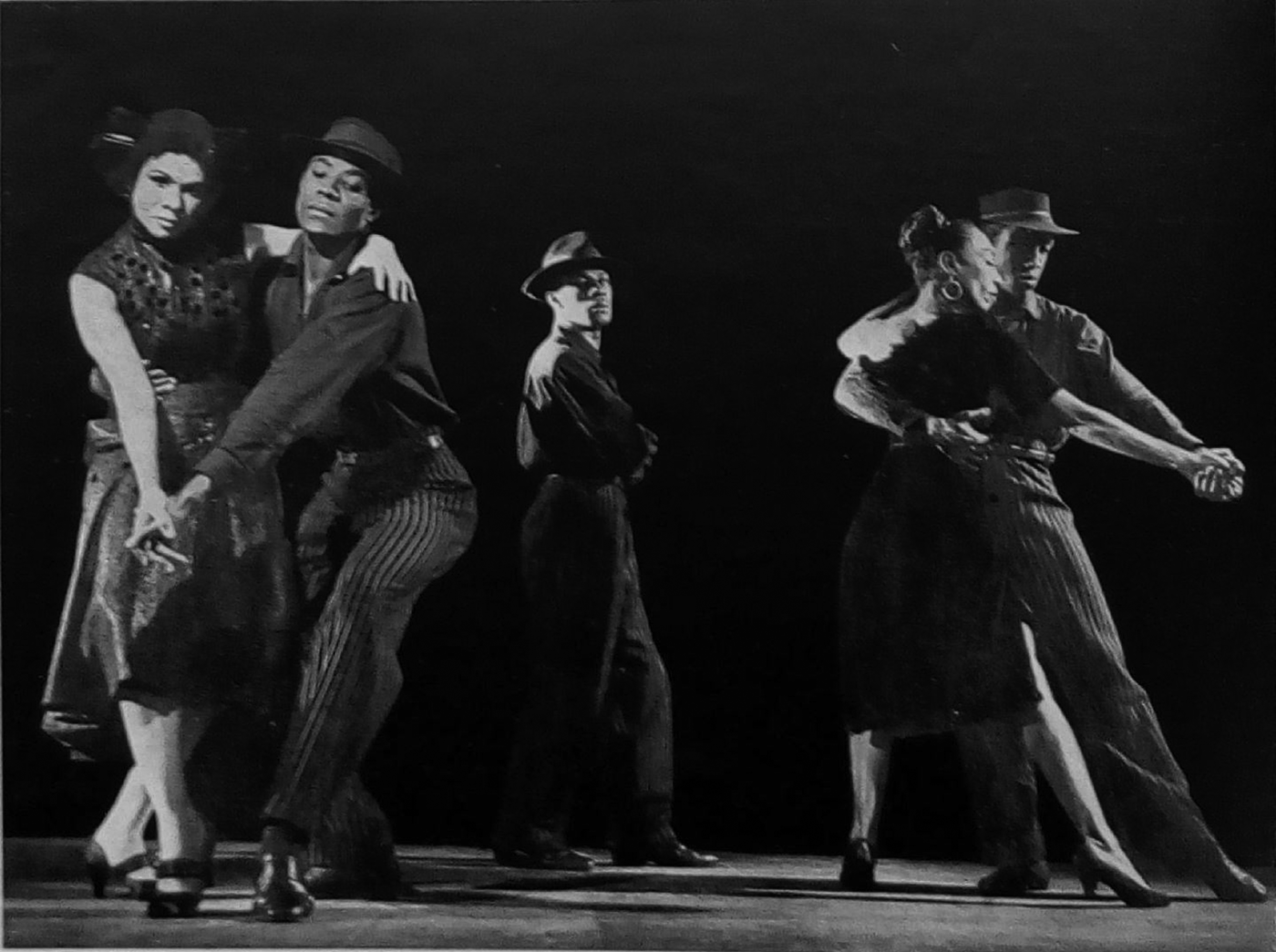
According to the production notes, Tango begins with a man who crosses the proscenium and performs “authentic” tango steps, and as he exits the stage, he hits his right shoe with his right hand (Reference DunhamDunham n.d.b). Then, a couple appears in the center of the stage. Motionless, they start pivoting in place with heel stomping, and then leave the stage dancing tango (Reference DunhamDunham n.d.b). The single man crosses the stage again, and after his exit, Dunham enters and stops in the center, her face in full lightFootnote 24 (Reference DunhamDunham n.d.b). In Dunham's narration, “She is going somewhere with great urgency, looks back over her shoulder as if she were being pursued. She meets one partner then two others and has a brief tango step with the first partner. She is suffering from high, nervous tension” (Dunham quoted in Clark 1994, 199). Her main partner (Vanoye Aikens) enters; he puts a hand on her hip and initiates partnered movement. The production notes describe this moment as follows: “Their movements are solemn, almost hieratic. Their faces are set, angry and hard” (Dunham Reference Dunhamn.d.b). “She executes a series of movements in which she very sharply opens her thigh due to his pressure; he hits her with his knee so that she opens hers.” These movements “imply sexual motivation, but also refer to the clashing of two people ideologically even though they are politically on the same side. In the process, however, she seems to fling away everything around her in an attempt to express another political position” (Dunham quoted in Clark 1994, 199). Then, the two couples and the solo dancer perform tango in a geometric pattern across the stage (Dunham Reference Dunhamn.d.b), as intimated in Photo 3.
“Dos momentos de la notable creación del ‘Tango’” (Two moments of the remarkable creation named “Tango”). Photograph by Alejandro Castro, in Ballet. Ideario de la danza, December 1954–January 1955, p. 30. Located at the Biblioteca del Departamento de Artes del Movimiento of the Universidad Nacional de las Artes.
From off stage, a long sustained single note by a soprano voice and drum section sound. Dunham writes that this “roll of military drums” underlying the tango rhythm played by musical conductor Bernardo Noriega represented her denunciation of her friend Pipita's death (Dunham Reference Dunhamn.d.a, 2). Due to Argentina's history of military coups, however, military drums probably would have been understood as a generic reference to military violence.
Then, her partner lifts Dunham in a low diagonal lift, puts her down, and circles her as she stomps her heels on the floor and the light changes to red tones (Dunham Reference Dunhamn.d.b). As the foot stomps end, the couple and solo dancer leave the stage, and Dunham's partner lets her down and they separate to opposite sides of the stage. In her interview with Clark, Dunham recounts:
The piece ends on a harsh, sharp note of defiance. The defiance is directed toward the Argentine people, the Peróns and the situation. I was a different person then. That was my second trip back to Argentina and I had no illusions about the political situation by then. (quoted in Clark 1994, 199)
Emphasizing this point, the production notes describe the piece as a “courageous political comment” (Dunham Reference Dunhamn.d.b).
In her consideration of the piece, Clark asks of Tango, “Why was Katherine Dunham so angry, in 1954, when she returned to Buenos Aires?” (1994, 199). And I add: What made her change her mind about the Peróns between 1950 and 1954? Perhaps the answer lies in Dunham's account of her first visit and her encounter with the President and his wife in her autobiographical book Island Possessed:
I was still in a state of trauma after seeing Buenos Aires and Evita and Juan Perón, chiefly Evita. I had visited the Señora's public and social works at her invitation, but I was also a performer there, seeing much of the seamy side of their support of the “descamisados,” having many friends among those of class hated by Evita and consequently Perón, the aristocracy of Argentina. After a benefit for the “Benefactoress,” [sic] a command performance at the Colón Ópera, I was literally ordered the following morning to review the orphanage, various nurses’ training schools established in the confiscated homes of some of my friends, the refuge for prostitutes or mothers without husbands where one or two complained bitterly to me as though I could waive their, literally, prison sentence. (Dunham Reference Dunham1969, 174)
As can be gleaned from this passage, Dunham's aristocratic friends shaped her opinion of Peronism. They formed part of the characteristically racist and classist Buenos Aires upper class. For example, they referred to the working masses who migrated from rural areas to big cities as cabecitas negras (little blackheads) because of their dark skin and black hair. As historian Natalia Milanesio (Reference Milanesio, Karush and Chamosa2010) points out, for the Buenos Aires upper and middle classes, the rural migrant population, with indigenous features, was vulgar and unsuited to urban life. Thus, the entrenched image of a Europeanist Argentina exemplified by Buenos Aires—white, urban, modern, and socially exclusive—was challenged by urban migration under Peronism. Nevertheless, the upper classes would have accepted Dunham due to her class and status as a renowned foreign artist, precisely because their racism was strictly attached to strong classist attitudes. For the upper classes, the difference between “black” and “white” people was primarily based on class, education, and style differences, and they adopted a racist stance toward those racialized as black based on class difference (Grimson Reference Grimson2016, 25).
Thus, what is Tango protesting against? Is it a critique of the intolerance of different political positions, as Dunham suggests in the Clark interview? Or is she demonstrating her annoyance toward a redistributive state policy that challenged upper-class interests as her autobiography suggests?
There is also another hypothesis that Vévé Clark suggests, quoting the program notes. She considers Tango a political protest because Dunham dedicated it to the memory of her personal friend Pipita Cano, who died between the tours of 1950 and 1954 under “mysterious circumstances,” and suggests that it could be either a “crime of passion” or a “political assassination connected with ‘disappearance’ methods of dispensing with activists or both” (1994, 199–200).
This claim requires two clarifications: who Pipita Cano was and to what does “disappearance methods” refer. First, Josefina “Pipita” Cano Raverot was an upper class woman dedicated to the bohemian world of radio and cinematography, and she had her own radio program on El Mundo called El Chalet de Pipita (Pipita's Chalet). In my opinion, she could be one of Dunham's aristocratic friends who likely expressed a dissenting opinion about Perón's government. Second, the circumstances around Pipita's death were mysterious given that she died after falling from her balcony. The suspicion was that her lover, a tango pianist, murdered her. However, my research showed that she was not a political figure or activist persecuted by Perón.
Notably, the well-known anti-Peronist writer Juan José Sebreli describes Pipita in his autobiography as a society woman whose speech and accent belonged to the porteño Footnote 25 upper class. He also suggests that her broadcasting stations were made to appeal to the middle and upper classes. In this text, Sebreli explains her death as a fall from her balcony, and given his opposition to Peronism, it is important to highlight that he does not mention any possible political crime (Sebreli Reference Sebreli2005, 90–91).
Furthermore, the notion of “disappearance methods against activists” invoked by Clark is historically inaccurate. The practice of forced disappearance, in which government officials detained, tortured, and murdered citizens suspected of political “subversion,” started approximately in 1974 with the Triple A (Alianza Anticomunista Argentina [Argentine Anticommunist Alliance]), and increased under the last military dictatorship (1976–1983). Thus, el desaparecido (disappeared person) belongs to a particular historical period, and it is inaccurate to conflate disappearance with other historical periods or governments. Although Dunham reveals that she altered the tenor of Tango due to Pipita's death (Dunham Reference Dunhamn.d.a, 1), saying that Pipita died for political reasons, and remarks from the production notes explain that it is a performance in memory of “a woman who died mysteriously, but for obvious political reasons under the Perón regime,” (Dunham Reference Dunhamn.d.b) without video documentation of the piece, it is difficult to ascertain precisely what, if any, protest Tango enacted. Besides, as I explained before, Pipita Cano was not a political figure, and was not persecuted by Perón. Thus, the political tenor of Tango, based on Pipita's death, is a wrong assumption.
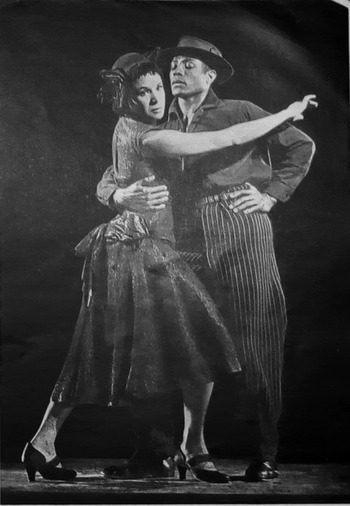
There are two images of Tango’s presentation in Buenos Aires (Photos 3 and 4). However, no clear sense of “protest” is discernable from them. One features the full cast and one shows Dunham partnered with Vanoye Aikens; both appeared in the Argentine dance magazine Ballet. Ideario de la danza (Castro Reference Castro1955a, Reference Castro1955b). Aspects of the ensemble picture invoke tango, even if it does not fully capture tango culture (see Photo 3). The male dancers wear black silk shirts, black pinstriped trousers, black felt hats, and black shoes (Dunham Reference Dunhamn.d.b). The trousers, shoes, and fedoras are indeed characteristic of tango. However, the men are not wearing suit jackets, and their partially open shirts do not adhere to the Buenos Aires dress code of the time (Grimson Reference Grimson2016). Moreover, the open shirts evoke representations of Perón's supporters as descamisados (the shirtless).Footnote 26 In the picture, there is also a man walking alone behind the dancing couples, who is likely to be the man who crosses the stage in the opening of the piece, as described in the production notes. He could represent the compadrito, the mythic tango man from the arrabal (suburban slum) who first practiced the tango in turn-of-the-century Buenos Aires. The positioning of the dancing couples’ bodies alludes to the tango embrace. However, their embrace is not traditional given the position of the women's arms on the men's shoulders, and the rigidity of the extended arms. Rather, this positioning is characteristic of British and American ballroom tango at that time, directly invoked in Dunham's own description of the dance as seductive in the manner of Rudolph Valentino (Dunham Reference Dunhamn.d.a, 1).
“Dos momentos de la notable creación del ‘Tango’” (Two moments of the remarkable creation named “Tango”). Photograph by Alejandro Castro in, Ballet. Ideario de la danza, December 1954-January 1955, p. 31. Located at the Biblioteca del Departamento de Artes del Movimiento of the Universidad Nacional de las Artes.
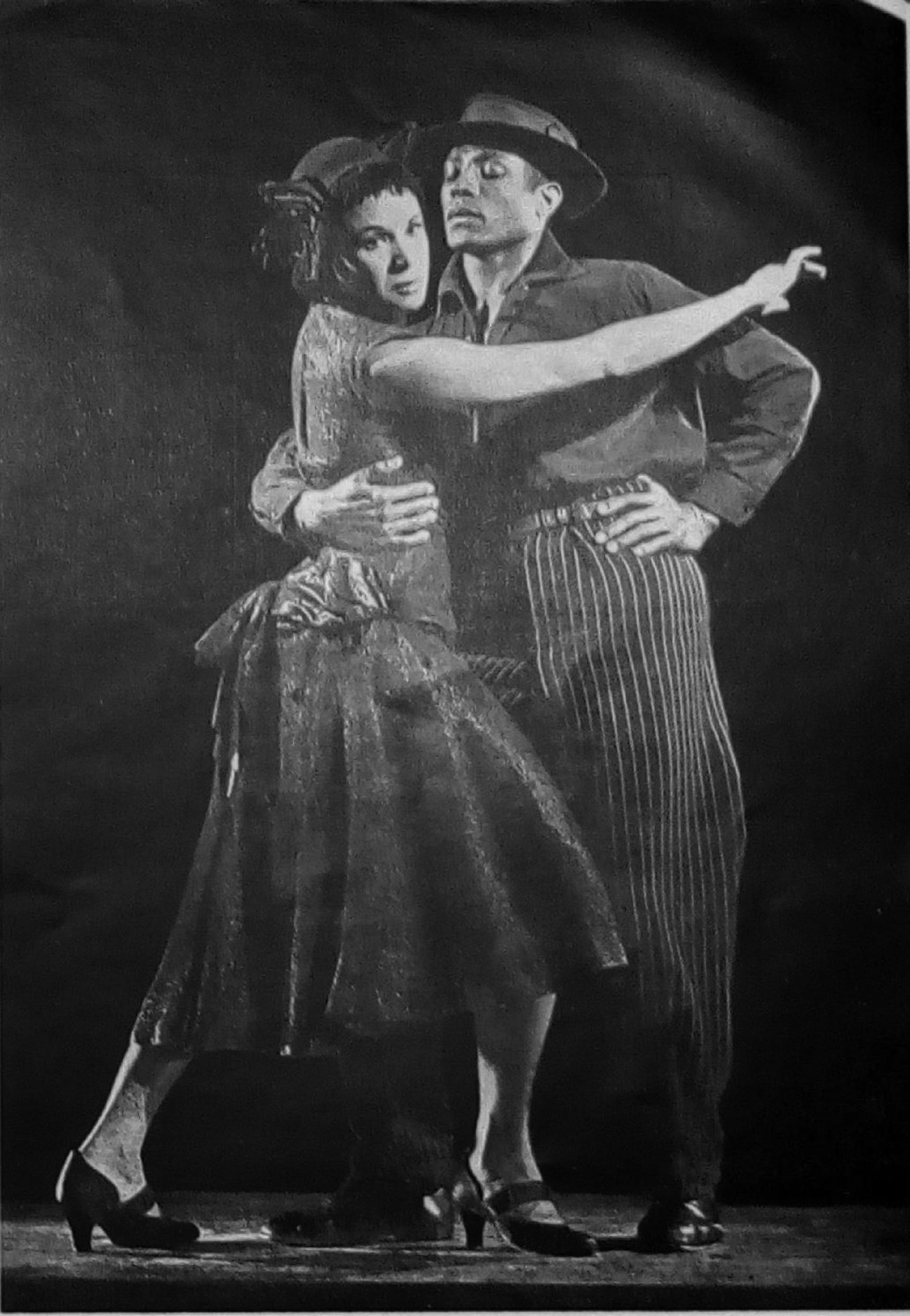
The second image features only Dunham and Vanoye Aikens (see Photo 4). He is embracing and gazing at her, but she avoids his look. Perhaps this is the moment of the dance that Dunham describes in the interview with Clark: “She executes a series of movements in which she very sharply opens her thigh due to his pressure; he hits her with his knee so that she opens hers” (1994, 199).
Although there are two pictures of the 1954 version of Tango, they do not offer sufficient indication as to whether the dance represented any form of protest against the Peronist government. In fact, the clothing might be seen to reaffirm Peronist ideals. Recall the dancers’ open shirts, which in Argentina would have been associated with the descamisados, the iconic symbol of the Peronist masses. The term descamisado emerged in the opposition press following the October 17, 1945, demonstration when thousands of people marched on the Casa Rosada, the President's office, to demand Perón's release after his imprisonment by the military regime, an event lauded by Peronists as the foundational act of Peronism. Anti-Peronists portrayed this event as a barbaric infiltration of the working classes into the city and propagated multiple derogatory terms for Peronist supporters.Footnote 27 However, Peronists flipped the significance of some of those terms, including descamisado, associating them instead with devotion to the Peronist movement. Nevertheless, for anti-Peronists, to be a Perón's supporter meant to be a negro (black), racializing the political identification (Grimson Reference Grimson2016, 43). Therefore, working class audiences who had access to Dunham's performances through accessible pricing might have further identified the open-shirt-wearing dancers with descamisados due to their African-American identity. They may, in fact, have been understood as the embodiment of the audience's social position.
The Dunham company's performances in Buenos Aires were reportedly very successful, and Tango was celebrated (La Nación 1954, 4). According to newspaper reviews, the audience did not perceive the intended protest character of the piece, but they were attracted by the “exotic” character of the dances featured on the program and the dancers themselves, in terms of the ethnic and folk origin of the former and blackness of the latter.
The Buenos Aires society of the 1950s imagined themselves as being of immigrant descent, part of the European diaspora, and as an isolated white outpost in Latin America. This is what Oscar Chamosa and other researchers call “the myth of the white nation” (Reference Chamosa, Karush and Chamosa2010, 114). Anything diverging from that, especially folk representations, were considered “exotic.” This is the reason why Perón's supporters, and therefore Peronism, were also racialized by the upper classes. As Alejandro Grimson (Reference Grimson2016) states: the upper and middle classes needed a black “other” in the Argentine sense of “non-white” in order to define their own white, Europeanist, urban, and anti-Peronist identity. During the First Peronism, the presence of the cabecitas negras in the capital city shattered the myth of Argentine homogeneity.
Nevertheless, in Argentina race terms are complex because, as indicated previously, they are more concerned with class and ethnic hierarchy than skin color. Even if a working class person's skin color is whiter than a given member of the middle class, he or she is labeled “black” due to his or her body language and way of talking and dressing. That is why, for the upper class, Peronists could be “blacks,” but Dunham could be considered “white” or “exotic” in an enthralling way. At the same time, for the working class, Dunham might have been seen as an embodiment of their class status, or construed as an “exotic” other based on blackness as a measure of exclusion given that the workers wanted to be included as Argentine citizens (Grimson Reference Grimson2016).
So, while Dunham's Tango highlighted the African roots of tango, local reception inevitably would have been shaped by racialized language and identities of the Peronist era. For these combined and complex reasons, Dunham's performance achieved great success.
In the local press there were just a few mentions of Tango, all of which refer to it as a stylization of a popular local dance. Newspapers constantly emphasized its charming character, which attracted the audience, as in this example:
A magnificent stylization of Argentine tango, with musical motifs by composer Osvaldo Pugliese, which [together with an altiplano (high Andean plateau) processional dance—a typical ritual indigenous dance from the mountain range of the Andes] got the audience's attention and compliments because of their originality and great inspiration. (La Prensa 1954, 6)Footnote 28
Similarly, El Laborista wrote about the entire performance, although not specifically on Tango:
The ovation given by all the members of the audience, not only when she appeared for the first time on stage, but also when the premiere at the Casino finished, confirms one more time how much this country appreciates and values the magnificent art of the distinguished artist of color. … The racial aspect perfectly captured, and showed by Katherine Dunham in its most ancient way, this is to say, in dance—here is her great merit—establishing a balance without letting the shape stifle the essence and without hiding the color—despite exotic tonality that it could flaunt—the human root or the vital contents of what she wanted to express. (El Laborista 1954, 7)Footnote 29
This passage demonstrates the audience and the critics’ view, what Jauss (Reference Jauss1976) named the “expectation horizon” of dance. This expectation horizon was Romantic, by placing folkloric roots as an idyllic past. It also explicitly shows that the racial aspect of the company enthralled the audience. Although Dunham wanted to perform the most “authentic steps” of tango (Reference DunhamDunham n.d.b), the local audience saw it as a stylization. Tango was Dunham's interpretation of what she thought tango was, and following her first visit, it was her reinterpretation of Peronism.
There is no evidence that the local audiences that saw the play—formed by the intellectual Buenos Aires elite, the regular dance spectators, but specially the popular audiences attracted by the exotic component and the affordable prices of the show, and that identified with Peronism—perceived the protest message of Tango. On the contrary, it is likely that the application of tango and the altiplano (high Andean plateau) dance elicited greater acceptance and sympathy from the audience. They felt identified more than criticized, considering that, at the time, the Peronist government actively exalted and promoted nationalist culture. Moreover, as I stated earlier, the photos of Tango show that the men's costumes could have reinforced the audience's identification. As such, my research shows that Tango did not operate as a protest performance against Perón's government as Dunham wanted, but, quite the opposite. The choreographic use of a popular language operated in parallel with the cultural policies promoted by the Peronist government.
The following paragraph from Crítica newspaper implies this perspective. Although it is a text from her visit in 1950, it presents to the readers and audience a way of understanding Dunham's art in relation to Peronist policies. Under the title “Hay que Saber Quién es Quién” (You Must Know Who is Who), the newspaper describes three personalities: George Marshall, author of the Marshall Plan; Katherine Dunham; and the Italian filmmaker Vittorio de Sica. The writing is sensationalist, melodramatic, and didactic. It describes Dunham's career and gives special importance to her revalorization of popular dances and it relates this characteristic to her support of the Fundación Eva Perón:
Empathizing the popular sense of the Foundation, she prepares a demonstration of her art in benefit of Social Aid. Her art is a cheerful mix of three ingredients: great show, applied dance, and the love of all popular essences. The last one includes this charity act that took place on October 2. (Crítica 1950c, 8)Footnote 30
In the same sense, the article written by Juan Silbert and published in Ballet. Ideario de la danza, defends Dunham's art by emphasizing its popular character:
The theater and dance are the most bastard forms of art: their origin and meanings are eminently popular, because there is always an audience, a spectator, which is the cause and the reason of the creation. This first idea has been frequently forgotten and a false intellectualism has taken possession of the scene, trying to create elite snooty performances. That is why the fresh and the popular nature of Katherine Dunham represents liberation and return. (Reference Silbert1955, 23)Footnote 31
These paragraphs, along with the audience and press response, indicate that the popular character of the work articulated with the Peronist privileging of popular culture and prevailed over and above the protest character that Dunham aimed to convey.
Conclusion
This article intervenes in two theoretical discussions. First, it questions the tensions between authorial intention and audience interpretation. Dunham staked her career on an ethnographic authority that was based on a deep understanding of the places she visited (Dee Das Reference Dee Das2014). However, this analysis reveals that outsider knowledge is always partial and based on the information provided by informants, which, in Dunham's case, seemed to be the aristocratic Buenos Aires elite. In this sense, the article raises a methodological problem that is central to the history of dance, which is the difficulty of analyzing a choreographic work through still photographs, as opposed to audiovisual material for example, authorial descriptions, which are necessarily founded on Dunham's point of view, and nonexpert journalistic reports (see Adshead-Lansdale and Layson Reference Adshead-Lansdale and Layson2007).
Second, the article intervenes in discussions on dance and politics, especially on dance's dialogue with Peronism and its cultural policies. This research aims to contribute to the literature on Dunham, though it was not my intention to focus on her as figure, but rather on the relation between dance and Peronism that her performance illuminates.
Katherine Dunham's Tango, according to its choreographer, is a protest performance against Perón's government. There are some theories regarding what it is specifically protesting against, but there is no conclusive evidence or convincing arguments that the dance conveyed the representation of a protest in the eyes of the Argentine audiences. I considered the local reception of the piece and how the dance and its protest message might have been perceived by the Argentine audience. This analysis shows that this message was not received as intended. The company received notable press and audience success, driven, as I argue, by the performance's exotic character and the centering of popular and folkloric culture. Because of the importance given by Dunham and her dances to popular culture, Tango was perceived as supporting the cultural policies promoted by Perón's government, instead of working as a protest performance against it. Although the message of the dance is supposed to be dissent, its form gave a contrary impression to the local audience. Tango operated as an affirmation of the values supported by the Peronist movement, including nationalism, tradition, and the privileging of popular local culture over “high” universalistic culture. Moreover, Dunham's aim to recuperate the African diasporic presence in the tango, along with the male dancer's open shirts, might in fact have produced identification with Peronist audiences.