Introduction
Pseudanoplocephala crawfordi, a common parasite inhabiting the small intestines of free-range pigs and wild boar, can cause weight loss, growth obstruction, abdominal pain, diarrhoea and even death (Jiang et al., Reference Jiang, Jin, Wu and Cui1990; Wang, Reference Wang2002). More importantly, P. crawfordi is an important zoonotic parasite, with 21 human cases identified in Liaoning, Henan and Shaanxi provinces of China, posing significant public health problems (Wang, Reference Wang2002; Han et al., Reference Han, Yan, Wang, Wu and Wang2012).
Pseudanoplocephala crawfordi was first described in the small intestine of a wild pig and recorded as one member of the genus Pseudanoplocephala. Since then the position of P. crawfordi has been reclassified several times (Jiang et al., Reference Jiang, Cui, Jing and Wu1986). Yang et al. (Reference Yang, Zhai and Chen1957) detected a cestode from pigs and named it Hsuolepis shengi. Hsuolepis shensiensis sp. nov., a new species of the genus Hsuolepis, was also found in pigs (Liang & Zheng, Reference Liang and Zheng1963). Pseudanoplocephala nipponemsis was reported from Sus scrofa leucomystax in Japan (Hatsushika et al., Reference Hatsushika, Shimizu, Kawakami and Sawada1978). In 1982, Li et al. suggested that H. shengi, H. shensiensis sp. nov., P. nipponemsis and P. crawfordi were synonyms, and that P. crawfordi was the valid species name. However, recently, based on genetic analyses of the internal transcribed spacer ribosomal DNA (ITS rDNA) and partial mitochondrial DNA (mtDNA) sequences, our group suggested that P. crawfordi was a member of genus Hymenolepis (Jia et al., Reference Jia, Yan, Du, Song, Zhao, Zhao, Cheng and Zhao2014).
The ITS rDNA sequences do not usually display sufficient sequence variation among individuals within a population and between populations (Gasser et al., Reference Gasser, Bott, Chilton, Hunt and Beveridge2008), and selection of one or more single regions of mtDNA would cause deviation in phylogenetic analysis (Jia et al., Reference Jia, Yan, Du, Song, Zhao, Zhao, Cheng and Zhao2014). On the other hand, due to its maternal inheritance, high mutation rate and relatively conserved genome structures, mtDNA has been widely used not only for molecular evolutionary studies, but also for more precise identification of closely related species (Li et al., Reference Li, Lin, Song, Wu and Zhu2008; Lin et al., Reference Lin, Qiu, Liu, Wu, Weng, Xie, Hou, Pan, Yuan, Zou, Hu and Zhu2011; Liu et al., Reference Liu, Lin, Li, Liu, Liu, Yuan, Song, Zhao, Zhang and Zhu2011; Zhao et al., Reference Zhao, Li, Blair, Li, Elsheikha, Lin, Zou and Zhu2012, Reference Zhao, Jia, Cheng, Zhao, Bian and Liu2014). Recent publications have also shown that mtDNA genomic sequences are robust genetic markers in investigating phylogenetic relationships at different taxonomic levels, especially when concatenated protein-coding sequences are used for phylogenetic analysis (Wang et al., Reference Wang, Wang, Zhao, Gao, Li and Zhu2011; Burger et al., Reference Burger, Shao, Beati, Miller and Barker2012, Reference Burger, Shao and Barker2014; Jia et al., Reference Jia, Yan, Lou, Ni, Dyachenko, Li and Littlewood2012; Liu et al., Reference Liu, Gasser, Su, Nejsum, Peng, Lin, Li, Xu and Zhu2012a, 2013).
Based on long-range polymerase chain reaction (PCR)-coupled sequencing and bioinformatics methods, the objectives of the present study were to characterize the mitochondrial genome of P. crawfordi and compare this genome with that of closely related cestode species, in addition to revealing the phylogenetic position of P. crawfordi with other cestodes, using concatenated amino acid sequences of 12 protein-coding genes.
Materials and methods
Molecular analysis
Adult worms of P. crawfordi were collected from the small intestine of naturally infected pigs in Yangling district of Shaanxi Province, north-western China. All the cestodes obtained were washed extensively in physiological saline, identified morphologically to species (Li et al., Reference Li, Zhang and Wei1982), fixed in 70% (v/v) ethanol and stored at − 20°C for subsequent experiments. Total genomic DNA was extracted from individual cestodes by proteinase K treatment, and column-purified directly using TIANamp Genomic DNA Purification System (Tiangen, Beijing, China). The specimens were further confirmed as P. crawfordi using their ITS rDNA sequences, according to methods described by Jia et al. (Reference Jia, Yan, Du, Song, Zhao, Zhao, Cheng and Zhao2014).
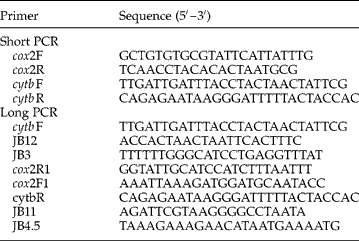
Fragments of cox2 and cytb were amplified individually from P. crawfordi by PCR, with primers (table 1) designed based on mtDNA sequences of Hymenolepis diminuta (von Nickisch-Rosenegk et al., Reference von Nickisch-Rosenegk, Brown and Boore2001) using the program Primer Premier 5.0 (PREMIER Biosoft International, Palo Alto, California, USA). The PCR was performed in a 25-μl reaction system containing 2 × Taq MasterMix (Dye Plus) (Vazyme, Nanjing, China), 0.4 μm of each primer and 1 μl of DNA template, under the following conditions: after an initial denaturation at 94°C for 5 min; followed by 35 cycles of 94°C for 45 s (denaturation), 45°C for 30 s (annealing) and 72°C for 1 min (extension); and then 72°C for 10 min (final extension). The no-DNA control was also included in each amplification. Each amplicon (4 μl) was checked by ethidium bromide-stained agarose (1%) gel after electrophoresis at 110 V for 30 min. The positive amplicons were sent to Sangon Company (Shanghai, China) for sequencing in both directions.
Sequences of primers used to amplify PCR fragments from Pseudanoplocephala crawfordi.
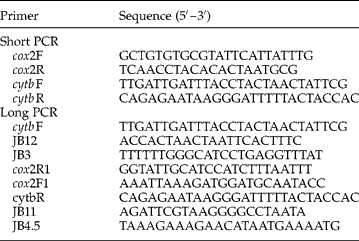
The complete mitochondrial genome of P. crawfordi was amplified with four overlapping long fragments between cox1 and cox2 (approximately 4 kb), between cox2 and cytb (approximately 4 kb), between cytb and nad1 (approximately 4 kb), and between nad1 and cox1 (approximately 4 kb). The long PCR was performed in 25 μl using 2 mm MgCl2, 0.5 mm of each deoxynucleoside triphosphate (dNTP), 2.5 μl 10 × long and accurate (LA) PCR buffer (Mg2+ free), 0.4 μm of each primer, 0.25 μl LA Taq (5 U/μl) (TaKaRa, Dalian, China) and 1 μl of DNA, in a thermocycler (Biometra, Göttingen, Germany) with the following cycling conditions: 92°C for 2 min (initial denaturation); then 92°C for 10 s (denaturation), 45°C for 30 s (annealing) and 60°C for 8 min (extension) for 9 cycles; followed by 92°C for 10 s, 45°C for 30 s and 60°C for 9 min for 25 cycles; and a final extension at 60°C for 10 min. Each amplicon (4 μl) was examined as above. The positive PCR products were cloned into pGEM-T Easy vector (Promega, Madison, Wisconsin, USA) according to the manufacturer's instructions, and at least three positive transformants were sent to Sangon Company (Shanghai, China) for sequencing in both directions using a primer-walking strategy.
The complete mtDNA sequence of P. crawfordi was assembled by aligning overlapping regions using DNAStar 5.0 (Burland, Reference Burland2000). Gene boundaries were confirmed based on comparison and alignment with the complete mitochondrial genome sequences of H. diminuta (GenBank accession number: AF314223; von Nickisch-Rosenegk et al., Reference von Nickisch-Rosenegk, Brown and Boore2001) using Clustal X 1.83 (Larkin et al., Reference Larkin, Blackshields, Brown, Chenna, McGettigan, McWilliam, Valentin, Wallace, Wilm, Lopez, Thompson, Gibson and Higgins2007). Nucleotide sequences for each of the 12 protein-coding genes were translated into amino acid sequences using invertebrate mitochondrial genetic codes in MEGA 5.0 (Tamura et al., Reference Tamura, Peterson, Peterson, Stecher, Nei and Kumar2011) with the default settings. The amino acid sequences inferred for the mitochondrial genes of P. crawfordi were aligned with those of H. diminuta by using Clustal X 1.83 (Larkin et al., Reference Larkin, Blackshields, Brown, Chenna, McGettigan, McWilliam, Valentin, Wallace, Wilm, Lopez, Thompson, Gibson and Higgins2007). The nucleotide composition and frequency of codon usage were calculated using MEGA 5.0 (Tamura et al., Reference Tamura, Peterson, Peterson, Stecher, Nei and Kumar2011). The tRNA genes of the mitochondrial genomic sequence of P. crawfordi were predicted using the online tool ARWEN (Laslett & Canbäck, Reference Laslett and Canbäck2008), based on putative secondary structures and manual adjustment for their potential to form tRNA-like secondary structures and anticodon sequences. Two ribosomal RNA genes (rrnL and rrnS) were determined by comparison with the mitochondrial genome of H. diminuta (von Nickisch-Rosenegk et al., Reference von Nickisch-Rosenegk, Brown and Boore2001).
Phylogenetic analyses
To investigate the value of the mitochondrial genomic sequence in determining the phylogenetic position of P. crawfordi, the deduced amino acid sequences of the 12 protein-coding genes (PCGs) were concatenated into a single alignment, and then aligned with those of seven other cestodes (H. diminuta, NC_002767; H. diminuta, AF314223; Echinococcus multilocularis, AB018440; Echinococcus granulosus, NC_008075; Taenia multiceps, FJ495086; Taenia solium, NC_004022; Taenia hydatigena, FJ518620 and Taenia pisiformis, NC_013844), using the pseudophyllidean cestode Spirometra erinaceieuropaei (JQ267473) as the outgroup. Ambiguous sites and regions in the alignment were filtered using Gblocks (http://molevol.cmima.csic.es/castresana/Gblocks_server.html) with the options for a less stringent selection (Talavera & Castresana, Reference Talavera and Castresana2007), and then subjected to phylogenetic analysis using Bayesian inference (BI) and maximum parsimony (MP) analysis. MP analyses were performed using PAUP* 4.0 Beta10 program (Swofford, Reference Swofford2002) with default parameters. BI analyses were operated in MrBayes 3.1.1 (Ronquist & Huelsenbeck, Reference Ronquist and Huelsenbeck2003), with four independent Markov chains run for 200,000 metropolis-coupled MCMC generations, sampling a tree every 1000. The first 1000 trees were omitted as burn-in, and the remaining trees were used to calculate Bayesian posterior probabilities (PP). Phylograms were shown using the program Tree View 1.65 (Page, Reference Page1996).
Results and discussion
Mitochondrial genome organization
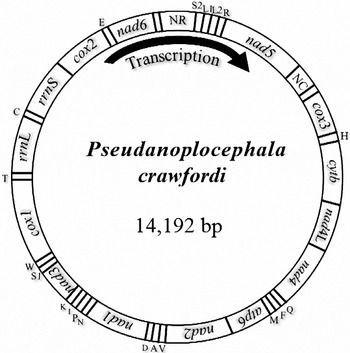
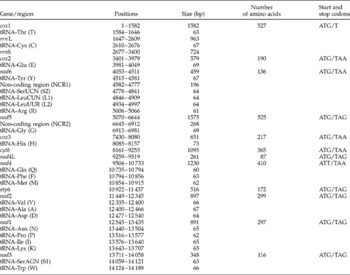
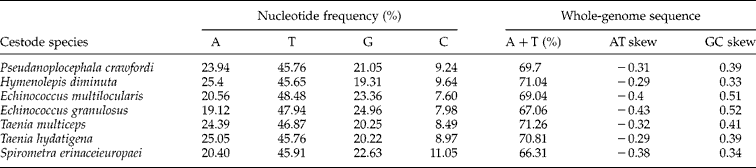
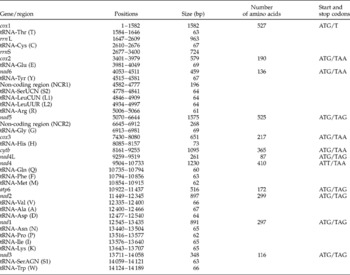
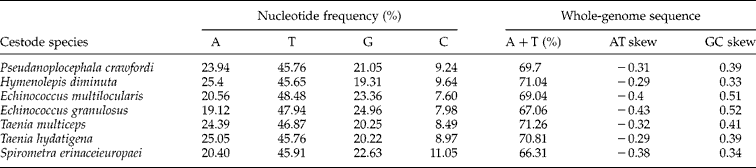
The complete mitochondrial genome sequence of P. crawfordi (GenBank accession number: KR611041) is a circular molecule of 14,192 bp (fig. 1) and encodes 36 genes, including 12 protein-coding genes (cox1-3, nad1-6, nad4L, atp6 and cytb), 22 transfer RNA genes, two ribosomal RNA genes (rrnL and rrnS) and two non-coding regions, but lacks the atp8 gene (table 2). All genes were distributed in the coding strand with same transcription direction, typical for other tapeworms reported to date (Liu et al., Reference Liu, Lin, Li, Liu, Liu, Yuan, Song, Zhao, Zhang and Zhu2011, Reference Liu, Li, Li, Zhou, Xiong, Lin, Zou and Zhu2012b). Notably, the mitochondrial gene arrangement of P. crawfordi is completely identical to that of H. diminuta with the translocational order of tRNA-SerUCN (S2) and tRNA-LeuCUN (L1) (S2 → L1 → L2), seeming to be unique, differing from that of other cestodes hitherto sequenced (L1 → S2 → L2) (Jia et al., Reference Jia, Yan, Guo, Zhu, Wang, Shi, Chen, Zhan, Zhang, Fu, Littlewood and Cai2010; Liu et al., Reference Liu, Lin, Li, Liu, Liu, Yuan, Song, Zhao, Zhang and Zhu2011, Reference Liu, Li, Li, Zhou, Xiong, Lin, Zou and Zhu2012b). The mitochondrial genome sequences of P. crawfordi are biased toward T and A (A = 23.94%, T = 45.76%, C = 9.24%, G = 21.05%), which is similar to those of H. diminuta, T. multiceps and T. hydatigena, but is slightly different from those of E. multilocularis, E. granulosus and S. erinaceieuropaei, which are biased toward T and G (table 3). The A+T content was 69.7%, which was consistent with mitochondrial genomes of other Cyclophyllidea species sequenced to date. The strand bias in nucleotide composition is calculated by AT skewness ([A% − T%]/[A% +T%]) and GC skewness ([G% − C%]/[C% + G%] (Perna & Kocher, Reference Perna and Kocher1995). AT skews and GC skews of the complete mitochondrial genomes were calculated for Taeniidae cestodes to date (table 3). The compositions of complete mtDNA of P. crawfordi were strongly biased toward T (AT skew = − 0.31, and GC skew = 0.39). The skew values of P. crawfordi were slightly different from those observed in the mtDNA of other cestodes (table 3). It has been suggested (Hassanin et al., Reference Hassanin, Léger and Deutsch2005) that GC skew values are the best reflection of strand asymmetry. Therefore, all cestodes in this study displayed strand asymmetry (GC skew between 0.33 and 0.52) (table 3).
Circular map of the mitochondrial genome of Pseudanoplocephala crawfordi; gene scaling is approximate and all genes are coded by the same DNA strand, the arrow indicating the direction of transcription. All genes have standard nomenclature except for the 22 tRNA genes, which are designated by the one-letter code for the corresponding amino acid; numerals differentiate each of the two leucine- and serine-specifying tRNAs (L1 for codon families CUN and L2 for UUR, S1 for AGN and S2 for UCN), with small non-coding (NR) and large non-coding (NC) regions.

Mitochondrial genome organization of Pseudanoplocephala crawfordi.
The nucleotide composition (%) of the mitochondrial genome of Pseudanoplocephala crawfordi for comparison with those of six closely related cestode species.
An overlap was detected between the 3′-end of nad4L and the 5′-end of nad4 in all flatworms (Jia et al., Reference Jia, Yan, Guo, Zhu, Wang, Shi, Chen, Zhan, Zhang, Fu, Littlewood and Cai2010). Interestingly, the length of overlap is the same (16 bp) in P. crawfordi and H. diminuta. The lengths in Taenia species and Echinococcus species were 34 bp and 40 bp, respectively (Nakao et al., Reference Nakao, Yokoyama, Sako, Fukunaga and Ito2002, Yang et al., Reference Yang, Rosenzvit, Zhang, Zhang and McManus2005; Jia et al., Reference Jia, Yan, Guo, Zhu, Wang, Shi, Chen, Zhan, Zhang, Fu, Littlewood and Cai2010).
Protein-coding genes and non-coding regions
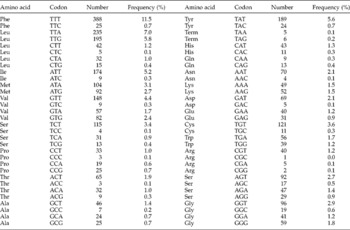
The boundaries between PCGs, translation initiation and translation termination codons of the mitochondrial genome of P. crawfordi were inferred by aligning their sequences with those of H. diminuta. Nearly all the 12 PCGs of P. crawfordi used ATG as their start codon (with the exception of nad4, which used ATT), whereas in H. diminuta TTT (for cox1) was used as start codon (von Nickisch-Rosenegk et al, Reference von Nickisch-Rosenegk, Brown and Boore2001), and five PCGs (cox2, cox3, nad4, nad6, cytb) used TAA as their stop codon, while six others (nad1, nad2, nad3, nad4L, nad5 and atp6) used TAG. The incomplete stop codon (T) was also inferred as a stop codon for cox1, which was consistent with the findings of studies of some other cestodes (Nakao et al, Reference Nakao, Abmed, Yamasaki and Ito2007; Jia et al., Reference Jia, Yan, Guo, Zhu, Wang, Shi, Chen, Zhan, Zhang, Fu, Littlewood and Cai2010; Liu et al., Reference Liu, Li, Li, Zhou, Xiong, Lin, Zou and Zhu2012b). This gene is probably completed through post-transcriptional polyadenylation with two adenosines (Ojala et al., Reference Ojala, Merkel, Gelfand and Attardi1980).
For the entire mitochondrial genome of P. crawfordi, the nucleotide composition significantly favours T and A, also corresponding to the codon usage. Excluding the termination codons, a total of 3350 amino acids from protein-coding genes were encoded by the mitochondrial genome of P. crawfordi. The codon usage for P. crawfordi mitochondrial genomes is listed in table 4. The most frequent usage of codons was TTT (phenylalanine) for P. crawfordi, with frequencies of 11.5%, followed by TTA (leucine) (7.0%). The codon CGC (arginine) was only used once.
Codon usage of Pseudanoplocephala crawfordi mtDNA-encoded proteins.

The total number of codons is 3361 for P. crawfordi, excluding the incomplete termination codons.
A total of 22 tRNA genes, ranging from 60 to 73 bp in size, were predicted in the mitochondrial genomes of P. crawfordi. The putative secondary structures of the tRNA genes (not shown) were quite different from those of H. diminuta (von Nickisch-Rosenegk et al., Reference von Nickisch-Rosenegk, Brown and Boore2001). All tRNA genes appeared to fold into the typical clover-leaf structure, except for tRNA-SerAGN (S1), which lacked the dihydrouridine (DHU) arm, while three other tRNA genes of H. diminuta, namely tRNA-SerAGN (S1), tRNA-SerUCN (S2) and tRNA-Arg (R), have an unpaired DHU arm.
The rrnL and rrnS genes of P. crawfordi were identified based on comparisons with sequences from H. diminuta. The rrnL and rrnS are positioned between tRNA-Thr (T) and cox2, separated by tRNA-Cys (C), with A+T sizes of 963 bp and 724 bp, respectively.
The mtDNA of P. crawfordi included two non-coding regions, namely, the large non-coding (NC) region and the small non-coding (NR) region. The NC was located between nad5 and tRNA-Gly, with an A+T content of 79.59%, while the NR was located between tRNA-Tyr and tRNA-Ser-UCN, with an A+T content of 73.88%. These results were similar to those found for non-coding regions of H. diminuta, with A+T contents of 81.42% and 73.81%, respectively. The non-coding regions are likely to contain the origins of replication and transcription (Wolstenholme, Reference Wolstenholme1992).
Phylogenetic analyses
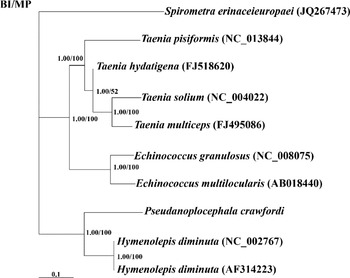
Given the high level of interspecific variation in nucleotide sequences of mitochondrial genes (Hu & Gasser, Reference Hu and Gasser2006), we reconstructed phylogenetic trees to assess the relationships between eight species of cestodes, employing two different methods (BI and MP) and different models based on the concatenated amino acid sequences of 12 PCGs. The topologies of BI and MP trees are identical, with minor differences in PP and bootstrap percentage (BP) of MP analyses (fig. 2). Phylogenetic analysis was divided into two major clades: all the Taeniidae species were clustered together, indicating that Echinococcus and Taenia were sister genera, supporting morphological classification (Wang, Reference Wang2002); and P. crawfordi and H. diminuta were grouped together within the clade of family Hymenolepididae, demonstrating that P. crawfordi was phylogenetically closer to H. diminuta, consistent with the identity (75.2%) of the nucleotide sequences between mitochondrial genomes of P. crawfordi and H. diminuta.
Genetic relationships of Pseudanoplocephala crawfordi with four species of Taenia, two of Echinococcus and Hymenolepis diminuta, inferred by Bayesian inference (first value) and maximum parsimony (second value) based on the concatenated amino acid sequence data representing 12 protein-coding genes, with Spirometra erinaceieuropaei (JQ267473) as the outgroup; scale bar = posterior probability.

Traditionally, descriptions of the characteristics of tapeworms have relied mostly on morphological features and life cycle (Wang, Reference Wang2002). There are many similar characters between P. crawfordi and H. diminuta, such as having an external seminal vesicle and the same intermediate host (a coleopteran insect), indicating that they may have a common origin. Recently, our study based on ITS rDNA and mitochondrial nad1 sequences indicated that P. crawfordi was within the clade of genus Hymenolepis with high support values, suggesting that P. crawfordi would be one member of the genus Hymenolepis but not in a new genus Pseudanoplocephala (Jia et al., Reference Jia, Yan, Du, Song, Zhao, Zhao, Cheng and Zhao2014). Unfortunately, only one complete mitochondrial genome from the genus Hymenolepis, namely H. diminuta, has been sequenced and reported. Therefore, expanding taxon sampling from Hymenolepis and Pseudanoplocephala is clearly needed in the next step for phylogenetic studies of Hymenolepis using mtDNA.
In conclusion, the present study sequenced the complete mitochondrial genome of P. crawfordi, the first complete mtDNA genome from the genus Pseudanoplocephala, showing that P. crawfordi was closely related to the family Hymenolepididae and having the potential to speed up the development of classification, evolution, molecular epidemiology and control of P. crawfordi infection in swine.
Financial support
This work was supported, in part, by the Program for New Century Excellent Talents in University (NCET-13-0489), the Fund for Basic Research Key Scientific (ZD2012010), and the Open Funds of the State Key Laboratory of Veterinary Etiological Biology, Lanzhou Veterinary Research Institute, Chinese Academy of Agricultural Sciences (SKLVEB2013KFKT007).
Conflict of interest
None.