

Introduction
Medicines work – but only in patients who take them regularly. Yet, non-adherence to medication is widespread: between 25% and 50% of prescribed medication is not taken as directed, with damaging consequences for patients’ health (Haynes et al., Reference Haynes, Taylor and Sackett1979, Reference Haynes, Ackloo, Sahota, McDonald and Yao2008; Nieuwlaat et al., Reference Nieuwlaat, Wilczynski, Navarro, Hobson, Jeffery, Keepanasseril and Haynes2014). In the USA alone, the lack of medication adherence is estimated to cause over 125,000 deaths per year and lead to annual costs of up to $289 billion (Osterberg & Blaschke, Reference Osterberg and Blaschke2005).
Despite these negative consequences, prior research has struggled to establish cost-effective and scalable interventions that improve medication adherence (Viswanathan et al., Reference Viswanathan, Golin, Jones, Ashok, Blalock, Wines and Lohr2012). For example, one study provided patients with education and training about medication adherence (Gray et al., Reference Gray, Fenerty, Harper, Spencer, Campbell, Henson and Waterman2012). Other studies have tested rewarding medication adherence by offering financial incentives (Volpp et al., Reference Volpp, Troxel, Mehta, Norton, Zhu, Lim and Asch2017) or have used motivational interviewing techniques to promote adherence (Solomon et al., Reference Solomon, Iversen, Avorn, Gleeson, Brookhart, Patrick and Katz2012). Neither of these studies found a statistically significant difference between treatment and control groups (for an exception, see Choudhry et al., Reference Choudhry, Avorn, Glynn, Antman, Schneeweiss, Toscano and Shrank2011, which found a 5% increase in medication adherence when the fees of medication were waved altogether). Indeed, a recent literature review concludes, “Current methods of improving medication adherence for chronic health problems are mostly complex and not very effective” (Nieuwlaat et al., Reference Nieuwlaat, Wilczynski, Navarro, Hobson, Jeffery, Keepanasseril and Haynes2014, p. 2).
In the current research, we propose that one reason why prior interventions to promote medication adherence have not been successful is because they insufficiently highlight the costs of non-adherence. That is, while providing training about medication adherence may include information about the negative consequences of non-adherence, these are likely not salient enough to participants who receive a wealth of information (Gray et al., Reference Gray, Fenerty, Harper, Spencer, Campbell, Henson and Waterman2012). Likewise, when using motivational interviewing techniques, a brief discussion of the costs of non-adherence may get lost among the great amount of information covered (Solomon et al., Reference Solomon, Iversen, Avorn, Gleeson, Brookhart, Patrick and Katz2012).
Instead, we highlight that an explicit emphasis on the costs of non-adherence is crucial to motivating patients to take their medication, given individuals’ robust tendency to experience loss aversion: they are more concerned with avoiding losses than they are with acquiring equivalent gains (Kahneman & Tversky, Reference Kahneman and Tversky1979; Kahneman et al., Reference Kahneman, Knetsch and Thaler1991; Pope & Schweitzer, Reference Pope and Schweitzer2011). This suggests that interventions to improve medication adherence may be more successful when they emphasize avoiding the personal health costs of non-adherence (i.e., making it salient to patients what they stand to lose by not adhering to their medication). We therefore propose that such a change in framing and emphasis – in turn, increasing the salience of the costs of non-adherence – can lead to improvements in medication adherence.
Highlighting the personal health costs of non-adherence is particularly important because patients are likely to neglect them. Indeed, prior research suggests that individuals tend to discount personally unfavorable information. For example, people neglect loan information when in debt (Golman et al., Reference Golman, Hagmann and Loewenstein2017), ignore investment portfolios when the stock market is falling (Karlsson et al., Reference Karlsson, Loewenstein and Seppi2009) and disregard arguments that run contrary to their own beliefs (Albarracín & Kumkale, Reference Albarracín and Kumkale2003). Similarly, because information regarding the personal health costs of non-adherence are unfavorable to patients, they may be motivated to ignore or disregard this information.
In the current research, we designed and tested an intervention aimed at increasing medication adherence for patients recently diagnosed with a chronic illness. We experimentally manipulated the salience of the personal health costs of non-adherence and examined whether this intervention subsequently increased medication adherence. We recruited patients when they picked up their medication prescription for the first time at their local pharmacy, where they were asked to commit to take their medication as prescribed. Crucially, we varied the framing of the consequences of non-adherence. In the treatment condition – the personal health costs group – patients were asked to commit to take their medication and were given information that highlighted that non-adherence would adversely affect their own health.
We tested this intervention against three comparison groups. The no commitment condition is a baseline control group: patients picked up their medication prescription and were not asked to commit to take their medication as prescribed. That is, patients consented to take part in the experiment, but did not receive an experimental intervention.
In the second comparison group, the commitment only condition, patients were asked to commit to take their medication as prescribed, but were not given any additional information regarding the losses incurred from non-adherence. Because prior research finds that commitments increase the follow-through of pledged behavior only when the consequences of not doing so are salient to those who commit (Rogers et al., Reference Rogers, Milkman and Volpp2014, Reference Rogers, Milkman, John and Norton2015), we hypothesized that patients in this group would not be any more likely to adhere to their medication.
In the third comparison group, labeled the societal cost condition, patients were asked to commit to take their medication as prescribed and were given information that highlighted the societal costs of non-adherence. The inclusion of this condition was motivated by increasing calls from policy-makers in recent years to make the societal costs of medication more salient to patients (Sinaiko & Rosenthal, Reference Sinaiko and Rosenthal2011). This includes the UK, where the current study was conducted: the UK's Secretary of State for Health advocated that medication packages should display cost information alongside the message ‘Funded by the Taxpayer’ in an attempt to encourage patients to take their medication as prescribed (Knapton, Reference Knapton2015).
We hypothesized that participants in the societal cost condition would not be more likely to adhere to their medication prescription because the societal costs of non-adherence are likely insufficiently aversive to constitute a loss patients are motivated to avoid (Hardin, Reference Hardin1968). That is, patients are likely unmoved by the prospect of societal costs because the burden of those costs is distributed among the millions of other tax-payers funding the system. We therefore predicted that only patients in the personal health costs condition would be more likely to adhere to their medication.
Study
Participants and design
The study was a randomized controlled trial implemented across 278 pharmacies in London, UK, and was added to a pre-existing program called the New Medicine Service (NMS), a free scheme funded by the National Health Service (NHS) offered to patients in England who are prescribed a new medicine to treat a common long-term condition, initially focused on asthma, type 2 diabetes, antiplatelet therapy and hypertension (Elliott et al., Reference Elliott, Boyd, Salema, Davies, Barber, Mehta and Craig2016). The prescription co-payment is low by international standards (£8.40), and over 90% of prescription items are free of charge (e.g., because they meet one of the exemption criteria or purchased an annual prepayment certificate; see Elliot et al., Reference Elliott, Boyd, Salema, Davies, Barber, Mehta and Craig2016). Patients with one of these conditions were invited to participate in the NMS by their pharmacist when picking up their medication for the first time. If the patient agreed to participate, they received an NMS leaflet, and these were used as the medium for the experimental manipulation in the current study. The NMS protocol involves follow-up contact with the patient 7–14 days after the intervention, either by inviting the patient back into the pharmacy or by contacting them via phone, whichever may be preferred by the patient. During these conversations, the pharmacist recorded patients’ responses to questions about their medication adherence, the dependent variable of this study.
The study’s sample size was based on a power analysis conducted prior to the study. On the basis of past interventions targeted at increasing medication adherence, we aimed to detect a minimum change in adherence of 4.4% (Krousel-Wood et al., Reference Krousel-Wood, Hyre, Muntner and Morisky2005). To achieve 80% power to detect this effect with four intervention groups and with patients clustered within pharmacies, analysis revealed that we would require 2500 participants per condition with 182 clusters. Based on the average number of patients treated in each pharmacy per month, subsequent analysis indicated that at least 6 months would be required to collect the sample size needed to obtain this power. Because we expected some pharmacies and patients to drop out of the trial through attrition, we designed the study to run for 9 months with 278 pharmacies.
The study ran between July 2015 and March 2016 (see Figure S1, available online, for a more detailed timeline). In total, 254 pharmacies (91.37% of all pharmacies) sent in partial data for 16,191 patients. Of these, 1049 patients (6.5%) opted out of taking part in the trial and 129 patients (0.8%) were under the age of 18 and therefore ineligible to participate. The pharmacists were unable to contact 3342 patients (20.64%) at follow-up and were thus not able to measure their medication adherence – these patients are considered to have dropped out of the trial. The attrition rate did not significantly differ across the four conditions (cluster-weighted χ 2(3) = 0.22, p = 0.975) and was similar to a prior study in a similar context (Elliott et al., Reference Elliott, Boyd, Salema, Davies, Barber, Mehta and Craig2016). The analysis was performed on the remaining 12,043 patients in the trial (M age = 56.13, 54% female), which came from 249 pharmacies. This study was granted ethical approval by the NHS National Research Ethics Service (NRES) Research Ethics Committee (ref: 15/WM/0225).
Independent variable: manipulation of perceived consequences of non-adherence
Patients were allocated to one of four conditions, randomized at the pharmacy level: personal health costs, commitment only, societal cost and no commitment. For the purposes of this study, we altered the NMS leaflet participants received from their pharmacist. Participants in the personal health costs, commitment only and societal cost conditions were asked to commit to take their medication by signing a pledge on a detachable sticker. Pharmacists encouraged patients to attach signed stickers to their medication packets. To manipulate how salient the personal health costs of non-adherence were, we altered the sticker text (see Figure 1). Participants in the no commitment condition did not receive the leaflet that contained this sticker.
Sticker designs. From left to right: personal health costs, commitment only and societal cost. Pharmacists encouraged patients to attach signed stickers to their medication packets.

In the personal health costs condition, patients were given text that highlighted the health costs of non-adherence. The text read: “Not taking my medication as prescribed could risk my health. I want to do all I can to improve my health, so I commit to taking this medication exactly as prescribed, or I will speak to my GP or pharmacist if I have a concern.”
In the commitment only condition, patients were given text that did not emphasize the costs of non-adherence. The text read: “I will take this medication as prescribed. I commit to taking this medication exactly as prescribed, or I will speak to my GP or pharmacist if I have a concern.”
In the societal cost condition, patients were given text that highlighted the societal costs of non-adherence. The text read: “The NHS loses £300 million per year from wasted medication. I want to do my bit to support the NHS, so I commit to taking this medication exactly as prescribed, or I will speak to my GP or pharmacist if I have a concern.”
Cluster randomization at the pharmacy level
Conditions were randomized across pharmacies rather than across individual patients, for two reasons. First, this lowered the risk of contamination across individuals; in other words, it lowered the likelihood of patients discovering they were receiving a different intervention from other patients, which might influence their behavior. Second, the pharmacists working within any individual pharmacy were not aware of the interventions being offered by pharmacists elsewhere, though they were aware that they were participating in a trial with multiple conditions. This helps prevent the possibility that pharmacists would influence the outcome of the study through demand characteristics (Nichols & Maner, Reference Nichols and Maner2008). To further reduce the potential for bias, the investigator who randomized pharmacies to conditions was blind to which conditions were being assigned.
Prior research suggests that medication adherence rates are lowest in the most deprived geographical areas (Shea et al., Reference Shea, Misra, Ehrlich, Field and Francis1992; Frazier et al., Reference Frazier, Davis-Ali, Dahl, P.A., S.H. and K.E.1994; Apter et al., Reference Apter, Reisine, Affleck, Barrows and ZuWallack1998). To ensure the best split of patients across conditions, we therefore conducted a stratified randomization based on the deprivation level of the postcode the pharmacy was located in so that each group had an equal distribution of pharmacies in economically deprived areas. Deprivation was measured using the Carstairs index, an established measure of geographic deprivation in the UK, which is based on four census indicators: low social class, lack of car ownership, household overcrowding and male unemployment (Morgan & Baker, Reference Morgan and Baker2006).
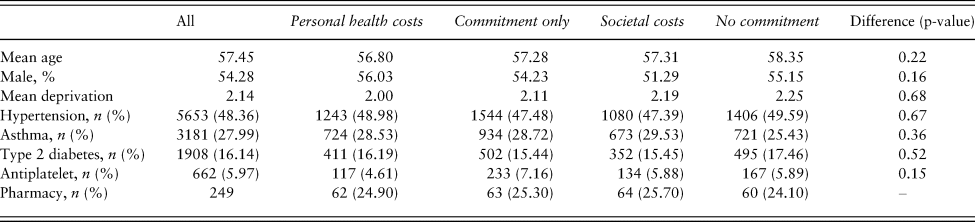
After the study was conducted, we tested whether the randomization was successful.Footnote 1 We examined whether the four conditions were balanced across their average deprivation level, as well as age, gender and the type of illness for which a patient was receiving treatment. Analyses reveals that the randomization was successful, as no characteristic significantly differed between the different groups (see Table 1).
Randomization balance across conditions

Differences were calculated using a χ 2 test, except for age and deprivation, which were calculated using linear regressions. All analyses use clustered standard errors at the pharmacy level.
Dependent variable: medication adherence
Medication adherence was measured in a follow-up conversation patients had with their pharmacist 7–14 days after they first picked up their medication. During the conversation, pharmacists asked patients four questions to assess medication adherence, which make up the Morisky Medication Adherence Scale (Morisky et al., Reference Morisky, Green and Levine1986).Footnote 2 Patients responded ‘yes’ or ‘no’ to the following questions: “Do you ever forget to take your medicine?” “Are you careless at times about taking your medicine?” “Sometimes if you feel worse when you take the medicine, do you stop taking it?” “When you feel better do you sometimes stop taking your medicine?” We chose to use the four-item rather than the eight-item version of this measure to ensure that disruption to the pharmacy's service was held to a minimum, though we note shortcomings of this shortened version in the ‘Discussion’ section below. Prior research suggests that any ‘yes’ response should be treated as an indication of non-adherence, and therefore patients were considered non-compliant if they answered affirmatively to any individual question (Morisky et al., Reference Morisky, Green and Levine1986). While the scale typically measures non-adherence, we reverse-coded the measure and report adherence rates in the subsequent analysis to improve clarity. Patients were assigned a score of 1 if they were adherent and 0 if they were non-adherent.
We note that pill refill rates or similar objective measures of medication adherence commonly used in US contexts were not available in the current setting due to various restrictions present in the current study context. For example, because we operated within the framework of the NMS through which the intervention was administered and measurement of medication adherence was conducted, we were unable to seek additional approval necessary for electronic measurements without disruption to the NHS. In addition, because patients are able to refill their medication at any pharmacy (either within the particular pharmacy chain that was the site of our intervention or other pharmacies), we were not able to obtain pill dispensing data (i.e., centralized dispensing data were not available at the time of the study to track this). However, the Morisky Medication Adherence Scale is a widely used and validated measure of medication adherence, particularly in the UK, and has compared favorably with objective measures such as electronic monitoring devices (Haynes et al., Reference Haynes, Taylor, Sackett, Gibson, Bernholz and Mukherjee1980; Shi et al., Reference Shi, Liu, Fonseca, Walker, Kalsekar and Pawaskar2010). We note shortcomings of this approach and potential future research opportunities in the ‘Discussion’ section below.
Control variables
We also measured and included in our analyses several control variables that have previously been associated with medication adherence: gender, age, financial deprivation (measured using their geographic location) and the type of illness patients were being treated for. While individual studies indicate that patient-level factors are important to medication adherence, meta-analyses have suggested that no single, robust patient-level factor predicts medication adherence (Haynes et al., Reference Haynes, Taylor and Sackett1979; Steiner & Prochazka, Reference Steiner and Prochazka1997). For example, studies have found females to be more (Lertmaharit et al., Reference Lertmaharit, Kamol-Ratankul, Sawert, Jittimanee and Wangmanee2005), less (Hertz et al., Reference Hertz, Unger and Lustik2005) and equally likely (Senior et al., Reference Senior, Marteau and Weinman2004) to adhere to medication as men. Similarly, age has been found to have mixed effects on adherence (Hinkin et al., Reference Hinkin, Hardy, Mason, Castellon, Durvasula, Lam and Stefaniak2004; Barclay et al., Reference Barclay, Hinkin, Castellon, Mason, Reinhard, Marion and Durvasula2007). However, prior research suggests a more robust relationship between adherence and financial deprivation, such that those with lower incomes are less likely to adhere to their medication prescription (Shea et al., Reference Shea, Misra, Ehrlich, Field and Francis1992; Frazier et al., Reference Frazier, Davis-Ali, Dahl, P.A., S.H. and K.E.1994; Apter et al., Reference Apter, Reisine, Affleck, Barrows and ZuWallack1998). Previous studies also suggest that medication adherence is influenced by illness type: patients suffering from diseases with fluctuations or absence of symptoms, such as asthma, have been shown to have poorer rates of adherence (Hungin et al., Reference Hungin, Rubin and O'Flanagan1999; Kyngas & Lahdenpera, Reference Kyngas and Lahdenpera1999; Vlasnik et al., Reference Vlasnik, Aliotta and DeLor2005), while patients who have improvements in symptoms due to their medication are often more adherent (Lim et al., Reference Lim, Ngah, Rahman, Suppiah, Ismail, Chako and Na1992; Viller et al., Reference Viller, Guillemin, Briancon, Moum, Suurmeijer and van den Heuvel1999; Grant et al., Reference Grant, Devita, Singer and Meigs2003). The analyses therefore also include the illnesses patients were being treated for.Footnote 3
Results
We first specified a logistic regression to estimate the effect of the personal health costs condition against an indicator variable that groups all three comparison groups. We report the odds ratio (OR), which indicates the likelihood that a patient in the treatment condition was adherent to their medication in comparison to patients in the three comparison groups. An OR higher than 1 indicates that patients in the personal health costs condition had greater medication adherence in comparison to the comparison groups. Similarly, an OR below 1 indicates reduced adherence in the personal health costs condition in contrast to the comparison groups.
Analysis reveals that patients in the personal health costs condition were significantly more likely to adhere to their medication (OR = 1.82, 95% confidence interval [CI] = 1.35–2.44; see Model 1 of Table 2). That is, patients who received the sticker that contained a message highlighting the personal health costs of non-adherence had 1.82 times higher odds of adhering to their medication than patients across the three comparison conditions. Model 2 of Table 2 provides the regression analysis outcomes, including the control variables. The results are consistent with those in Model 1, such that the personal health costs condition remains significantly different from the three comparison groups (OR = 1.84, 95% CI = 1.37–2.47).
Logistic regression models predicting adherence rates using the Morisky Medication Adherence Scale, comparing the personal health costs condition against pooled comparison groups (Model 1), including covariates (Model 2)

Standard errors are clustered at the pharmacy level. The reference group for personal health costs is an indicator variable comprising the mean for all three comparison groups. The reference group for illness type is hypertension, the largest group.
**p = 0.01, ***p = 0.001.
CI = confidence interval; OR = odds ratio.
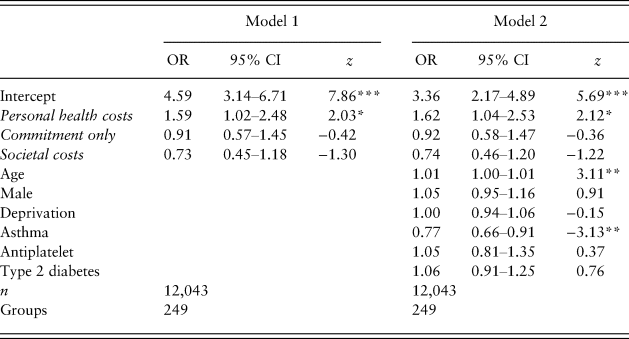
Comparisons for individual conditions are shown in Table 3, which provides the results from logistic regression models comparing the personal health costs, the commitment only and the societal cost conditions to the baseline control group, the no commitment condition. Consistent with our predictions, only patients in the personal health costs condition had significantly higher medication adherence compared to the no commitment control condition (OR = 1.59, 95% CI = 1.02–2.48). In contrast, patients in the societal cost condition (OR = 0.73, 95% CI = 0.45–1.18) and the commitment only condition (OR = 0.91, 95% CI = 0.57–1.45) did not report significantly different adherence rates compared to the no commitment baseline control group.
Logistic regression models predicting adherence rates using the Morisky Medication Adherence Scale across groups (Model 1) and with covariates (Model 2)

Standard errors are clustered at the pharmacy level. The reference group is the no commitment condition.
*p = 0.05, **p = 0.01, ***p = 0.001.
CI = confidence interval; OR = odds ratio.
As a robustness check, we also analyzed the results using patient responses to the Morisky Medication Adherence Scale items as an ordinal rather than binary measure of adherence. For example, a patient who indicated that they were adherent to their medication across all questions is assigned a 4 (representing a patient who is highly adherent), whereas a patient who indicated that they were non-adherent across all questions would receive a 0 (highly non-adherent). The results using this five-point scale are consistent with those reported with the binary measure. Including the covariates, patients in the personal health costs condition had significantly higher medication adherence compared to the other conditions combined (OR = 1.85, 95% CI = 1.38–2.48), as well as the no commitment control condition alone (OR = 1.64, 95% CI = 1.05–2.56).
An additional way to analyze the data is by analyzing the percentage of participants who adhered to their medication prescription across conditions. To do so, we conducted a χ 2 test, which was statistically significant (χ 2 = 116.18, p < 0.001). Analogous to our earlier analyses, the highest level of medication adherence was in the personal health costs condition (87.92%), followed by the no commitment condition (82.12%), the commitment only condition (80.59%) and the societal loss condition (77.02%).
Alternative explanations
Although the self-reported measure of medication adherence used in the current study has been widely validated in previous research, it is possible that differences between the treatment and comparison groups are driven by changes in responses to individual scale items. For example, being informed of the personal health costs of non-adherence may influence patients’ responses to questions relating to their health (e.g., “Sometimes if you feel worse when you take the medicine, do you stop taking it?”), but not to questions unrelated to health (e.g., “Do you ever forget to take your medicine?”). To examine whether this was the case, we conducted additional logistic regression analyses for each individual question patients were asked. Consistent with the analysis of the full adherence measure, we found that respondents in the personal health costs condition reported significantly higher medication adherence rates for each individual question (see Table S1).
Discussion
Patients frequently do not adhere to their medication, harming their personal health while also increasing the financial burden on society more broadly. Despite such negative outcomes, previous research has often been unable to establish cost-effective and scalable interventions that improve medication adherence (Nieuwlaat et al., Reference Nieuwlaat, Wilczynski, Navarro, Hobson, Jeffery, Keepanasseril and Haynes2014). In the current research, we suggest that this absence of effective interventions is driven in part because many prior studies have insufficiently made the costs of non-adherence salient to patients. Instead, we proposed that patients would be more likely to adhere to their medication when this behavior is framed as avoiding the personal health costs of non-adherence (i.e., making it more salient to patients what they stand to lose by not taking their medication as prescribed). This is especially important considering that patients may be motivated to discount personally unfavorable information, such as the personal health costs of non-compliance. Indeed, we find that participants in a condition that made the personal health costs of non-adherence more salient had 1.84 times higher odds of adhering to their medication prescription in comparison to three comparison groups.
Our study has at least three advantages over previous research. First, the large-scale nature of the current study included participants from a range of ages, levels of deprivation and illness types, increasing the present study’s generalizability. Second, the study was conducted as a randomized controlled trial by pharmacists who were blind to the study's hypothesis, thus alleviating concerns that participants increased their medication adherence due to demand characteristics. Third, the intervention was conducted on real patients, increasing the ecological validity of our findings. These strengths represent a significant advantage over prior studies conducted with smaller, less representative samples and laboratory designs (Nieuwlaat et al., Reference Nieuwlaat, Wilczynski, Navarro, Hobson, Jeffery, Keepanasseril and Haynes2014). While our findings suggest only a relatively small effect of the personal health costs of treatment on adherence rates, small effects when applied at scale can result in significant economic and societal benefits (Matz et al., Reference Matz, Gladstone and Stillwell2017).
In addition to providing a cost-effective and scalable approach to improving medication adherence, the current study offers at least three additional contributions to the existing literature. First, the current study shows that an emphasis on the societal costs of non-adherence did not significantly alter medication adherence. While patients in the personal health cost condition adhered more to avoid the health costs of non-compliance, patients in the societal cost condition were not motivated to avoid the societal costs of non-compliance. This result is particularly striking given increasing calls in recent years from policy-makers to make the societal costs of non-adherence more salient to patients (Sinaiko & Rosenthal, Reference Sinaiko and Rosenthal2011). However, the lack of statistically significant differences for patients in the societal cost condition is in line with prior research suggesting that personal appeals are more persuasive (Petty et al., Reference Petty, Cacioppo and Goldman1981; Sorrentino et al., Reference Sorrentino, Bobocel, Gitta and Olson1988; Petty & Cacioppo, Reference Petty and Cacioppo2012; Scannell & Gifford, Reference Scannell and Gifford2013), in part because they are more self-relevant (Kettle & Häubl, Reference Kettle and Häubl2011; Shu et al., Reference Shu, Mazar, Gino, Ariely and Bazerman2012). This suggests that policy-makers intending to implement policies that highlight the societal costs of non-compliance to patients may need to be temperate in their expectations, as providing this information may not promote medication adherence.
Second, the current study suggests that committing to a course of action may not increase follow-through when the costs of non-compliance are not sufficiently salient. Note that patients in the commitment only condition who were asked to commit to take their medication as prescribed but were not given additional information regarding the costs of non-adherence were no more likely to adhere to their medication than participants in the baseline control group, the no commitment condition. Whereas many prior studies highlight the beneficial effects of pre-commitments on the follow-through of pledged behavior, such as vaccination rates (Milkman et al., Reference Milkman, Beshears, Choi, Laibson and Madrian2011) and retirement savings (Beshears et al., Reference Beshears, Choi and Madrian2011), the results of the current study suggest that such pre-commitments may be effective only when the personal costs of non-compliance are sufficiently salient for those who commit.
We note, however, important differences between our study and previous designs. Beshears et al. (Reference Beshears, Choi and Madrian2011) imposed penalties on withdrawals, and Milkman et al. (Reference Milkman, Beshears, Choi, Laibson and Madrian2011) asked participants to make a specific plan to receive the flu vaccine. In the commitment only condition in the current study, patients were asked to make a public pledge to take their medication as prescribed, which involved neither an explicit cost (as in Beshears et al., Reference Beshears, Choi and Madrian2011), nor did it involve a specific plan of when and where participants would take their medication (similar to Milkman et al., Reference Milkman, Beshears, Choi, Laibson and Madrian2011). Researchers and policy-makers alike may therefore have to consider the extent to which the costs of not following through – and making specific plans of following through – constitute necessary conditions for pre-commitments to change behavior (see also Rogers et al., Reference Rogers, Milkman and Volpp2014, Reference Rogers, Milkman, John and Norton2015).
Third, the results of the current research may also extend to other harmful health behaviors beyond medication non-adherence. Consider that for a number of important health behaviors, such as getting tested for a sexually transmitted disease (Barth et al., Reference Barth, Cook, Downs, Switzer and Fischhoff2002) or seeking help for a mental illness (Link et al., Reference Link, Phelan, Bresnahan, Stueve and Pescosolido1999; Gulliver et al., Reference Gulliver, Griffiths and Christensen2010), many current interventions emphasize the health benefits of engaging in these behaviors. Instead, the current study indicates that harmful health behaviors could be minimized by devising interventions that highlight the personal health costs of not engaging in favorable health behaviors, particularly in situations where individuals tend to neglect these threats to their well-being. Such interventions would not only build off the current results, but also could help to alleviate the burden on public healthcare systems (Hallsworth, Reference Hallsworth2017).
The present study also has several limitations that suggest directions for future research. One constraint is that the measure of medication adherence was self-reported by the patient during a follow-up conversation with their pharmacist. It is possible that patients were not responding with complete honesty to the pharmacist’s questions; for example, they may have over-reported adherence due to social desirability or biases in recall (Randall & Fernandes, Reference Randall and Fernandes1991; Fisher, Reference Fisher1993). We again note that obtaining objective medication adherence measures that are more common in US contexts – such as pill refill rates or mobile phone-based platforms (Waltz, Reference Waltz2016) – was not possible in the current setting (see above for a detailed description). However, we urge future research to supplement self-reported adherence with alternative measures, especially with the advent of new technologies that may be more accurate in determining whether a pill was not only picked up, but also ingested by study participants. We hope that policy-makers recognize the potential of these more accurate mechanisms to determine medication adherence and update the current legal framework to make such study designs possible in the future.
A further limitation is that we were unable to track the long-term efficacy of the intervention. Our measure of medication adherence occurred 7–14 days after participants picked up their medication, and so we are unable to estimate the long-term outcomes of the intervention. Specifically, future research should explore whether the intervention effects we find are limited to just the first pill refill or also extend to repeated refills. To better test the long-term outcomes, future studies could incorporate a longitudinal design and compare the effectiveness of this intervention vis-à-vis other approaches that focus on emphasizing the health benefits of medication adherence, such as financial incentives or motivational interviewing. In addition, we note that we used the shortened four-item version of the medication adherence measure, which also exists in a longer eight-item version, in order to keep disruption to the pharmacies’ services to a minimum. Some of the items included in the longer but not the shorter version of this measure would have provided important insights into several aspects of our investigation. For example, one dropped item is, “Did you take all your medicine yesterday?” This could have further helped to rule out the alternative explanation that the effect is specific to health-related items. Another dropped item is, “How often do you have difficulty remembering to take all your medicine?” This could have shed important light on the underlying mechanism of our manipulation (i.e., that the personal health costs condition increased the saliency of the consequences of non-adherence). We therefore urge future research to carefully consider the hard trade-offs inherent in choosing between the shorter and longer versions of this particular medication adherence measure.
Our study design also does not allow us to capture potential negative side effects caused by increased medication adherence. While an increased uptake in medication might have benefits for most patients, the heterogeneity in treatment outcomes may lead some patients to experience a greater frequency of adverse events. This could occur, for example, in patients who previously had poor medication adherence and now receive too much medication and are therefore at a greater risk of potential side effects. Our intervention did include language to ensure patients would seek out expert help when encountering side effects (the stickers noted, “…or I will speak to my GP or pharmacist if I have a concern”), but we urge future research to better disentangle the potential benefits of increased medication adherence from the possible side effects of the medication to treat the chronic illnesses in our study (i.e., asthma, type 2 diabetes, antiplatelet therapy or hypertension). Finally, the current study recruited patients recently diagnosed with several common long-term health conditions; however, it remains unclear whether the interventions would operate in the same way for shorter courses of medication, which future studies could investigate (e.g., a course of antibiotics to treat an infection), or for those already established on medications for long-term conditions.
In conclusion, medication non-adherence is a costly problem for individuals and society, but prior research has struggled to establish cost-effective and scalable interventions that improve medication adherence. We propose that this is the case in part because many prior studies have made the personal health costs of non-adherence insufficiently salient to patients. The current study demonstrates that when the personal health costs of non-compliance – which patients may be motivated to neglect – are made more salient, they are more likely to adhere to their medication prescription. Shifting patients’ focus toward the personal health costs of non-adherence may therefore constitute a cost-effective and scalable way to improve medication adherence, making both patients and society better off.
Supplementary material
To view supplementary material for this article, please visit https://doi.org/10.1017/bpp.2019.1
Acknowledgements
This research was funded by the UK Department of Health. We appreciate the help of Annabelle Bonus from the UK Department of Health and Khuram Ahmad from Boots UK in helping to coordinate the trial. The views expressed are those of the authors and not necessarily those of the Department of Health or Boots UK. We received helpful feedback from attendees at the Society of Judgment and Decision-Making Conference, the Center for Decision Sciences at Columbia Business School and talks at Warwick Business School, UCL School of Management and Tilburg University. Dan Berry has since left the UK Department of Health and Social Care.
The first two authors contributed equally. J.M.J. and J.J.G. were responsible for the overall design of the study. D.B., C.L.K. and T.T. oversaw the day-to-day conduct of the study. J.M.J. and J.J.G. were responsible for the statistical analysis. All authors made substantial contributions to the drafting of the paper.