Of the many icons of black American uplift, none is more widely revered than the Jubilee choir.Footnote 1 Its first and most famous brand was the Fisk Singers, whose popularity as concert hall performers of plantation-era spirituals turned them into international superstars in the 1870s.Footnote 2 Jubilee culture spread to South Africa, in 1890, with Orpheus McAdoo's Virginia Singers.Footnote 3 Touring the subcontinent for nearly five years turned McAdoo's company into another celebrated brand, and, as Robert Trent Vinson remarks, “fostered a powerful new era of black transnational relationships between the United States and South Africa.”Footnote 4 Thus began, in Zine Magubane's words, “a dialogue” between “two marginalized and dispossessed groups of black people.”Footnote 5
The dialogue was not, however, between equals; the Americans enjoyed more social, cultural, and economic standing than their black South African counterparts. This has encouraged the perception that black Americans were more “modern” than black South Africans, and thereby qualified to lead Africans in the project of racial uplift. Many black Americans, black South Africans, and white South Africans of the period seem to have subscribed to this viewpoint, and recent scholarship has largely been content to reproduce it. However, not all black South Africans shared this view. As the music traveled from the US South to Southern Africa, it generated not only African imitation but also local black debate and even critique; the transnational political culture that emerged contained some dissonant, African nationalist, strains. This article calls for a reconsideration of the Jubilee phenomenon, one that takes into account the diversity and complexity of South African responses.
To widen understanding of this black Atlantic nexus involves a careful look at the cultural-economic context in which Jubilee choirs operated both as commodities and as entrepreneurial agents. Print culture was an important factor here; not only did it help to shape choirs’ public image, but it also was a tool for income generation.Footnote 6 Promotional books accompanied the Fisk Singers on tour, and were extremely popular as commodities in their own right.Footnote 7 The Hampton Singers – rivals to Fisk – were also quickly immortalized in book form.Footnote 8 Coverage of the choirs rapidly spread to other print media. This textual archive suggests that the Jubilee phenomenon was as much about political economy as it was about art.Footnote 9 As such, it triggered intense international debate, within and across black and white communities, regarding the role of black labor in late nineteenth-century industrial capitalism.
Although Jubilee Singers arose in the US South, they can and should be seen as participants in a fully global enterprise. The choirs emerged from Fisk and Hampton; both schools were established by the American Missionary Association, which assumed a worldwide perspective on its evangelical responsibilities.Footnote 10 Hampton's head, General Samuel Armstrong, was himself the son of missionary parents stationed in Hawaii. The authors of Hampton assert that the school's “key-note” was
the fact that its chief brought from Hawaii to Virginia an idea, worked out by American brains in the heart of the Pacific, adequate to meet the demands of a race similar in its dawn of civilization to the people among whom this idea had first been successfully tested.Footnote 11
Awareness of this international evangelical matrix allows us to approach McAdoo's South African episode as an encounter between two mission-educated black communities. Emphasis on their shared membership of a global Christian network moves us beyond the hierarchies of New World black leaders and Old World African imitators.
This article addresses coverage of McAdoo's Singers in South Africa's Grahamstown Journal and Imvo Zabantsundu. Both newspapers operated from the Eastern Cape. The Journal, a flagship of entrepreneurial British colonialism, was founded in 1831 by L. H. Meurant.Footnote 12 Imvo was South Africa's first black independent newspaper, founded and edited by John Tengo Jabavu in 1884.Footnote 13 Sharp ideological divisions distinguish their responses to black America. This is less surprising than the fact that Jabavu chose to republish the Journal’s response alongside his own. Unpacking this choice casts new light on Jabavu's ideological project. So does analysis of Imvo’s earlier coverage of McAdoo's Singers, which occurred, untranslated, in the Xhosa pages of the newspaper.Footnote 14 Those pages host a heated dialogue on the subjects of black modernity, diaspora, and leadership. Taken together, these materials suggest that black transnationalism between these two countries is more complex than many scholars have recognized.
SELLING THE FISK JUBILEE SINGERS
South Africans were already familiar with Jubilee choirs by the time McAdoo's company arrived. They had known of them since the Fisk Singers had toured England, seventeen years earlier. In 1873, a letter appeared in the Isigidimi Sama-Xosa newspaper, also titled the Kaffir Express. Its author, “JD,” evidently a devout British settler, discloses that
a company of the African race from Nashville, U.S., called the “Jubilee Singers of Fisk University” have just been making a singing tour of the Northern States. – their object when they started being the raising of twenty thousand dollars to endow the University to which they belong.Footnote 15
The Fisk Singers have raised this phenomenal sum “by their sweet singing of hymns and sacred pieces.” They inspire JD with a business proposal “to the Native Readers”:
whether the above would not be a good plan for them to adopt when they wish to raise funds for any religious or educational purpose; whether they would not feel more pleasure handling such money, which would have been fairly earned by them; than as if (as too often happens now) the poor but liberal public of great Britain had been appealed to.
Explaining that “singing is one of the talents of the African race for as a people they are better singers than we are,” JD argues that they have a divine mandate to use this talent rather than keep it “buried in the earth.” He suggests that “the natives” “pick out from their neighbourhood or congregation, or school, a select company of their best singers, and, after first putting themselves under the protection of God … go throughout South Africa and charm the money out of their (in this respect) less gifted European fellow countrymen.” His parting request is that “the pieces sung should be truly religious pieces.” JD's fascination is prompted as much by the Singers’ commercial success as by their musical gifts. Legitimating both, for JD, is Christianity. However, he appears to lack confidence in Christianity's hold over the local populace, and is anxious that Africans may prefer financial to moral profit; hence only “truly religious pieces” should be performed, and only for elevated purposes.
Similar concerns, about the dangerous potential of black musicality to escape the bounds of spiritual propriety, informed contemporary white American commentary on Fisk's and Hampton's Jubilee choirs. Gustavus Pike's two books on the Jubilee Singers, J. B. T. Marsh's The Story of the Jubilee Singers, and the Armstrong and Ludlow volume on Hampton can all be read as efforts both to capitalize (literally) on black creativity, and simultaneously to contain the threat that it poses to white missionary paternalism. The authors deployed different tactics to the same end. Pike's books take the greatest rhetorical risk by presenting the musicians as powerful agents of “revolutionary” American modernization. Despite selling over 30,000 copies within the space of a few years, his books gave way to J. B. T. Marsh's, which followed a safer rhetorical framework, one that situated blacks as mere accessories of missionary evangelism rather than as important culture-brokers of a new social order.Footnote 16 Marsh's approach was more consistent with the ruling ideology and social practices of the Jim Crow era.
Pike's original The Jubilee Singers pronounced the musicians’ individuality as artists and subjects. His technique – clearly influenced by the slave narrative genre – appeals to its readers’ abolitionist sensibilities by providing personal stories of the Singer's former lives as slaves, as well as their new lives at Fisk. Six of the nine stories are in the first person, from a request that “it would be very interesting and profitable to us to hear from their own lips an account of their former condition.”Footnote 17 Engraved portraits accompany all nine. Remaining chapters describe the tour itself, and the book concludes – as do subsequent Jubilee-related books – with an appendix of songs.
The Singers emerge as creative collaborators in the AMA missionary campaign. Pike's presentation of their interiority, agency, and accomplishments reflects his embrace of a democratic–capitalist modernity whereby Fisk will “introduce the reign of equal educational privileges and equal rights, which, if successful, would necessarily revolutionize the state.”Footnote 18 The “growth and wealth of the mind” works in lockstep with socioeconomic expansion.Footnote 19 “Nothing awakens desires and creates want like educational institutions … Nothing will make a market for the things produced in factories so surely as the school-house and the church.”Footnote 20 Pike's “revolutionary” discourse extends beyond the South to embrace the entire nation.
Fisk's mission, according to Pike, is the cultivation not only of consumers, but also of Talented Tenth leaders, equipped with “the reigning powers that have shaped the destinies of the nation,” and destined to operate as clergy, statesmen, “the legal, the medical, the distinctive literary professions … the philosophers, the chemists, the geologists and botanists.”Footnote 21 Pike's encomium to black higher education concludes with his affirmation: “Power is generated at the university as at no other place. The more educated a people, the more superior, and the dominant power proceeds from them.”Footnote 22 This image of educated black Americans as wielders of national power clearly exceeds the conventions of uplift ideology.
Just one year later, J. B. T. Marsh published The Story of the Jubilee Singers. Unlike Pike's two books, this text was to undergo regular revisions, updating tour and personnel details, and adding songs. Like Pike's works, this volume sold well; by 1878 it was in its seventh edition and had sold 54,000 copies. For all of Marsh's textual revisions, his ideological stance never changed; his book offered a soothing alternative to Pike's, which solved the threat of autonomous blackness by promoting its cooptation into mainstream capitalist America. For Pike, it is as successful, elite stakeholders that the Jubilee Singers advertise and reward the AMA. Marsh's contrasting solution is to demote the Singers to a mass missionary instrument, deprived of their stakeholding authority.
As part of this deflationary exercise, Marsh removed photographs of the Singers, as well as their first-person voices. His book was interested less in their individual lives than in their illumination of slavery and its aftermath: “Such [stories] have been selected as together give the truest idea of slavery as it was felt by the generation to which the Jubilee Singers belong; of the changes and difficulties to which emancipation introduced them; of the sympathy and assistance they need and deserve.”Footnote 23 Far from celebrating the Singers’ commercial, professional, and aesthetic attainments, Marsh accentuates the risks that such success presents to their moral character. He celebrates only their ability to survive touring with humility intact:
the readiness with which the Singers met the new social demands that were made upon them in their work, was as remarkable as the quiet modesty and self-possession with which they received the attentions and honours that came so suddenly to them. It was a dizzy change … But their heads were not turned by it … their manners … have remained … natural and unaffected.Footnote 24
Marsh shifts the personal chapters to the end of the volume. He makes the Singers’ lives secondary to their touring, just as he subordinates their individuality to their group identity.
BLACK AMERICANS REWRITE JUBILEE SONG-POWER
During this period, black commentary also emerged, in James Monroe Trotter's Music and Some Highly Musical People, a pathbreaking work of musical theory, history, and appreciation, that foregrounds black contributions to American classical and popular musical culture.Footnote 25 Trotter's chapter on the Fisk Singers initially praises the American Missionary Association for “rearing” such institutions as Fisk. The real father-hero, however, is the Jubilee choir, which Trotter defines
as perhaps the most picturesque achievement in all our history since the war. Indeed, I do not believe that anywhere in the history of the world can there be found an achievement like that made by these singers; for the institution just named … has been built by the money which these former bond-people have earned.Footnote 26
He credits the Singers with constructing the university, not merely assisting in its survival. Whereas both Pike and Marsh are careful to describe the Singers as “endowing” Fisk, Trotter writes instead that “they have erected” the institution.
This association of the Singers with material primacy, and architectural monumentality, quickly gained traction among black Americans. By 1885, for example, writing in the AME Church Review, Mrs. Mossell commented on the Singers’ extraordinary aesthetic and financial capital:
Through all the long years … the weird, plaintive melodies that welled up in their souls have passed down from mother to child, and at last bore fruit when sung by the band of singers from the South land, the sweet-voiced Jubilee Singers who sung a university into existence.Footnote 27
And, most famously, W. E. B. Du Bois's “Sorrow Songs,” in 1903, conflated the songs with the building:
when I came to Nashville I saw the great temple builded of these songs tower over the pale city. To me Jubilee Hall seemed ever made of the songs themselves, and its bricks were red with the blood and dust of toil. Out of them rose for me morning, noon, and night, bursts of wonderful melody, full of the voices of my brothers and sisters, full of the voices of the past.Footnote 28
The political-economic undertones of these representations suggest that the Singers prefigured more radical forms of self-determination, to contemporary black commentators, than white commentators could imagine or sanction. For Trotter, the Singers began to redress slavery's economic injustice itself. This is evident when he discusses their “song power,” or musical affect. About the ability of the Singers to “charm” their audience, white and black writers were unanimous. On this subject Marsh and Pike both quote the same passage by Reverend Henry Ward Beecher, an early white sponsor of the Singers. Beecher's unself-conscious account casually conflates slavery, pleasure, and charm: “They will charm any audience, sure; they make their mark by giving the spirituals and plantation hymns as only they can sing them who know how to keep time to a master's whip. Our people are delighted.”Footnote 29
Trotter's account of musical affect differs significantly: “The cultured and the uncultured were alike charmed and melted to tears as they listened with a new enthusiasm to what was a wonderfully new exhibition of the greatness of song-power.” This provides
a most striking and yet pleasing exhibition of poetic justice, when many of those who really, in a certain sense, had been parties to their enslavement, were forced to pay tribute to the signs of genius found in this native music, and to contribute money for the cause represented by these delightful musicians.Footnote 30
Surrender of their money to former slaves becomes, for Trotter, white reparations for slavery. Those same white audiences that Pike and Marsh regarded as abolitionist, Trotter saw as complicit with enslavement. The performers’ ability to extract capital from their former captors suggests a future in which further rightful redistribution may occur.
FISK CONTRA HAMPTON: THE CHORAL POLITICS OF CLASSICAL AND INDUSTRIAL EDUCATION
Divergent as these black and white American accounts are, they share an understanding that the Fisk choir embodied the educational values of its institution. These were the values of liberal arts: Fisk's core curriculum included Greek, Latin, mathematics, French, natural sciences, and theology. As Marsh enthuses, Fisk “had demonstrated the capacity of that despised race for high culture.”Footnote 31 The alliance of Jubilee choirs with higher education was soon contested by the Hampton Choir, which formed in 1872. Hampton was the alma mater of Orpheus McAdoo, and the school for which he advocated while touring in South Africa. He reported his South African observations in Hampton's journal, the Southern Workman, and even created a scholarship for the black South African student Titus Mbongwe to study there. McAdoo had, as well, been a member of the reconfigured Fisk Singers. For these reasons it is just as important to consider Hampton's musical and educational ideology as it is to consider Fisk's; they both inform McAdoo's formation and his reception abroad.
Hampton was a normal (teacher-training) school, that also provided industrial and agricultural education. Premised on the view that what black populations needed was “not only the teaching of books, but the far broader teaching of a free and yet disciplined life,” Hampton aimed to meet that goal by creating “members of their own race trained to self-respect, industry, and real practical virtue.”Footnote 32 It dismissed the liberal-arts model, contending that a practical curriculum was “far more desirable than one which promises to turn out graduates proficient in a dead language or facile in oratory.”Footnote 33
The Jubilee choir was central to the institute. Not surprisingly, its choral aesthetic was as different from Fisk's as its educational agenda. Where Fisk Singers sang in standard English, Hampton's Singers sang in regional dialect, offering a greater “authenticity.” “The peculiar strength of the Hampton Chorus is the faithful rendering of the original slave songs … [preserving] that pathos and wail which those who have listened to the singing on the old plantations recognize as the ‘real thing’.”Footnote 34
Hampton's Choir, like Fisk's, exploited print media; Hampton and Its Students was that institution's equivalent to the promotional books by Pike and Marsh. Unlike theirs, however, this work does not equate the Singers with the school. It contains biographical student narratives, to be sure, but not those of the musicians. The Singers, we learn, “prefer that no more personal account of themselves should be given to the public … Their voices are their own witness.”Footnote 35 Rather than divulge their histories, the authors highlighted their labors: “The young women [singers] worked in the laundry, kitchen, dining-room, and sewing-room. The men are chiefly farm-hands. Dungey supports himself by shoemaking. Towe works at the forge, and Catus at the carpenter's bench. Waddy … repairs machinery and does what plumbing is required.”Footnote 36 Much of the book derives from the Singers’ journals, which detail the concert tours. As these journal extracts underscore, it is only the Singers’ physical and vocal activities that have ideological value for this narrative; the Singers’ subjectivities are removed from the image of the institution.
Whereas the Fisk Singers figuratively assisted in building Jubilee Hall (through the cash generated by their singing), the Hampton Singers, as this book emphasizes, quite literally helped to build their school, in their manual labor. The differences in class position are significant. The Fisk Singers were regarded – by both Pike and Marsh – as members of a professional class tasked with cultivating sensibility. Their professional status summarized the values, and achievements, associated with Fisk as an institute of higher learning. In other words, the Fisk Singers exemplify the Talented Tenth, and as such they can be seen to symbolize the university whose existence they endow. That the books by Pike and Marsh are named after them, rather than after Fisk, indicates just how prominent the Singers were as icons of that institution's Talented Tenthness. The Hampton Singers, on the other hand, are seen by the school's administrators, and authors, as a laboring class, in keeping with the industrial educational emphasis of the institution. It is telling that despite the school's s financial reliance on the Singers, only their songs, and not the company itself, receive a mention in the book's title. To name the book after the laborers would contradict the school's ethos.
BLACK SOUTH AFRICANS DEBATE THE SINGERS IN INDIGENOUS LANGUAGES
Like its nineteenth-century American counterpart, South Africa was divided between academic and industrial education as channels for black advancement. This was evident in the curriculum of the prestigious Lovedale College, a missionary institution open to black and white students. Lovedale was academic; however, from the mid-1880s, only white students were allowed to study Latin and Greek. This new policy, introduced by the revered principal Dr. James Stewart, made it impossible for black graduates to qualify for Cape University, and consequently for the British civil service examination.
One of the first press battles fought by John Tengu Jabavu, as editor of the newly launched Imvo Zabantsundu, was, notably, about this discriminatory policy. One particularly provocative editorial in Lovedale's newspaper, the Christian Express, asserted against Imvo protest
that the life and death question of native people in this country now, is not classics or even politics – but industry; that the foothold the natives will be able to maintain in the country depends almost entirely on the habit of steady conscientious work; and that it is of more consequence for them to understand this, than to be able to read all the lore of the ancients.Footnote 37
By the time McAdoo's Singers arrived in South Africa, June 1890, Jabavu had been fighting a rearguard action in support of nonracial, classical, higher education for several years.
By 1890, it was not only black access to higher education that was diminished; it was also their access to the franchise, which the 1887 Parliamentary Registration Act had dramatically curtailed. Communal African land tenure was now ineligible to meet the franchise property qualification, eliminating 20,000 Africans from the electoral roll. “Cape liberalism,” the mid-century ideology and practice of British constitutionalism, in which Jabavu had considerably invested, was giving way to aggressive white supremacism. Jabavu used the pages of Imvo as well as the device of an organized delegation to England to upbraid the empire with violating what, for him, were its core values of equality, justice, free trade, and nonracialism. His delegation was declined by the colonial minister on the grounds that the British home government was not empowered to overrule this legislation.Footnote 38
It was into this crisis-ridden arena of aggressive capitalist modernization, replete with systematic black disenfranchisement, the expansion of the black proletariat and subproletariats, and the further weakening of an already small and fragile black petty bourgeoisie, that McAdoo's Jubilee Singers arrived.Footnote 39 It is no wonder that some black South Africans ecstatically welcomed the performers, and McAdoo's glowing account of contemporary America, as the answer to their problems. Jabavu, however, was not among them. The Xhosa pages of Imvo – where, as George Frederickson suggests, the most politically radical strands of the newspaper often lurked, untranslated – became the venue for a lively intra-black debate on the Singers.Footnote 40
The Singers’ primary purpose in touring South Africa was economic self-interest: McAdoo was an entrepreneur in business for himself, unlike the managers of the original Fisk and Hampton choirs. It is striking how readily some Africans misconstrued McAdoo's company as following in the altruistic footsteps of these earlier choirs. The Singers’ advocate in Imvo – on 18 September 1890 under the pen name “Dorotili” – is among these revisionists, writing, “The people are in these lands gathering money not for their aggrandisement; they are gathering money to build schools to educate black people in America and this land they have travelled to.”Footnote 41 Dorotili's conviction is that only education – of a separatist, black American kind – can facilitate African advancement: “They have brought education; which means they are educating themselves – put simply they are educating each other – this is not being done for them as we have permitted the white people of this land to do for us.”
The vision of racial self-sufficiency was, at this time, wishful thinking; in 1890 black Americans were not, across the US, the only instructors at their schools. Dorotili condemns black South Africans in order to affirm black Americans, contending,
These people are the children of slaves but in the little more than twenty-years in which they have been free they have become educated like the English. We, in almost a century and without having been enslaved, have remained “Barbarians” apart from a few … What they aspire to is upliftment/uplifting; when we of Imvo Zabantsundu disparage them out of envy, and by not patronizing them with contributions and by not trying to follow them, it is that we fear to act in self regard.Footnote 42
So infused is Dorotili with the conviction that African interests, and identities, depend on a vanguard of black Americans for realization, that any resistance to this prospect must be understood as self-loathing. Not only does he dismiss the majority of black South Africans as “barbarians,” he also denounces all black domestic efforts to promote higher education as nonexistent: “There is no black person who has ever said to a white person that we want higher education. It is taboo.”Footnote 43 This overlooks Jabavu's repeated demand, over the years, to whites, for exactly that: a black higher education at Lovedale that includes the study of Greek and Latin.
More broadly, Dorotili fails to respect Imvo’s own contributions to knowledge production. It had emerged as the voice of a black community now independent of white missionary control. The paper's inaugural issue (3 November 1884, 2) contends that “a large class has been formed among the Natives which has learned to loathe the institutions of barbarism, and to press for the better institutions of a civilised life.”Footnote 44 Classist though Jabavu's formulation is, it is arguably, not quite of an American Talented Tenth order of elitism. Jabavu's editorials suggest a more expansive definition of community than intelligentsia and professionals, one that includes all male Africans who are stakeholders in imperial liberal capitalist modernity, by virtue of property ownership (individual or collective), and capital production (as workers or employers). Imvo aimed to showcase, validate, and serve this class.
Dorotili may not trust South African blacks to find solutions or provide adequate leadership, but he considers that they might help to secure diasporic salvation. Consequently he proposes that Jabavu and other local black dignitaries meet with McAdoo, to organize scholarships to America, where, he contends, the education that awaits is comprehensive: “These men [McAdoo's company] say that we will receive all of the higher education that we need in America.” This he defines as both practical and classical: “They say what uplifts a person is not only an academic education; a people that desire uplift should be learned in business.”Footnote 45
Dorotili's arguments and perceptions were reinforced a couple of weeks later by Josiah Semouse, whose SeSotho article about the Singers, printed in a mission newspaper, contends of black Americans, “Today they have their own schools, primary secondary and high schools, and also universities. They are run by them without the help of the whites.”Footnote 46 The results, according to Semouse, are impressive: “They have magistrates, judges, lawyers, bishops, ministers and evangelists, and school masters. Some have learned a craft such as building etc.”Footnote 47 These examples of uplift continue Dorotili's conflation of industrial and classical policies.
Semouse also, like Dorotili, denounces his African peers in order to elevate America: “When will the day come when the African people will be like the Americans? When will they stop being slaves and become nations with their own government?”Footnote 48 Whatever information, and propaganda, McAdoo shared in his lectures to South African audiences, he surely did not claim America as the home of black political autonomy. He more modestly evangelized on behalf of Hampton, industrial education, and the US as a land of black opportunity. To do so required him to suppress the brutal reality of Jim Crow, of which he was well aware, as a black American from the South. His awareness may have increased once he joined the Fisk Singers, since the ensemble had, under its leader, Frederick Loudin, been active in promoting the 1875 Civil Rights Act, defeated in 1883 by the Supreme Court.
I have suggested that for American black and white commentators, Jubilee Singers denoted and connoted a range of black relations to modern capitalism. These commentaries share a national history, geography, and infrastructure. Losing this common ground, circulating abroad, opens the Jubilee Singers to more imaginative, idiosyncratic interpretations of political economy that are not bound by the same empirical conditions and considerations. Dorotili and Semouse should, then, be read as thinkers whose elevation of black America illuminates more intellectual, political creativity than may at first appear. Theirs is an impressive exercise in revision. Semouse rewrites the US as a land of black nation-states. Dorotili transforms McAdoo from a profit-seeking businessman into a pure philanthropist. At the same time he redefines Hampton Institute as a space of comprehensive, not merely industrial, education. Together these writers create the aura of a land, and leaders, that transcend the limits both of a black self-serving capitalism and of a white supremacist social order. Both writers, that is, transform their American subject matter in order to imagine African transformation. The idealization permits a romantic refuge against the deteriorating conditions of black South African life. Despite their lexicon of practical projects – a delegation, studies abroad, leadership by a black American vanguard – their agenda is primarily the conjuring of an existential zone of freedom that they consider unimaginable in their native land.
For a rationalist like Jabavu, such romanticism is part of the problem. It dissipates political energy, and may threaten the ability of black South Africans to become citizens protected by an accountable government. When ideas of black empowerment are not grounded in a legislative and economic system, the results are, he suggests, black abdication of responsibility, self-alienation, and loss of community. Javavu's opening response is as tentative as Dorotili's is confident: “I might be in error but perhaps I may suggest to us Africans that here we shall find no help in sending our people to America if they will return as experts that will have forgotten to uplift their own people.” His rebuttal proceeds:
we will have forsaken the will of the All Mighty if Africans of these parts of South Africa should seek education from afar to return to be of assistance to us. It is that again we see those who have not fulfilled this design. Lives go to ruins in those distant lands they travel to and when they return, we are merely satisfied to praise them. Those who return not having fulfilled their mission end up … failing to find work to apply their minds to …Footnote 49
It is worth noting the prescience of Jabavu's contentions. Several of the transnational activities that McAdoo's choir initiated were failures. Titus Mbongwe, the recipient of McAdoo's scholarship to Hampton, died en route to the US. A number of South African choirs that were inspired by the Jubilee Singers concluded badly. Not only did they not achieve commercial success when they travelled to the UK and the US; they also occasioned more than one personal “ruination.”Footnote 50
Aside from the risk of professional failure and atomization, Jabavu argues, diasporic travel is self-defeating as a means of self-realization, since it involves both exploiting and submitting to a country that has no stake in South African people. Africans thereby put themselves in a dependent relationship that is contrary to the principles of uplift itself. “To go to America is to eat off the sweat of other men while we lack the courage to do for ourselves.” Notably Jabavu does not condemn all forms of cross-national exchange: “It is all good to take from … our brethren from America but let us use it to help ourselves where we are. Bacon the intellectual of the English once said ‘Whatever man has done, man may do.’ What African Americans have done we too can do here.”Footnote 51
Jabavu critiques the others’ hope that because black America provides a symbol of uplift, it can also materially effect that uplift. Such a hope, he suggests, paralyses Africans, and traps both locals and returnees in inauthenticity: “when they return, we are satisfied merely to praise them.” American travel does not strengthen Africans; on the contrary, it diminishes them. What he supports, instead, is a much more circumscribed role: rather than a global vanguard, responsible for the missionary salvation of black South Africans, black Americans should simply supply an ideological tool for challenging local colonial racism. How are South Africans to respond when that same racism appropriates the Jubilee Singers to its own ends? That is the issue he addresses in Imvo’s next discussion of McAdoo's choir, one month later.
THE JUBILEE SINGERS AS AN INSTRUMENT OF COLONIAL RACISM
We have seen how divergent black South African opinions could be on the subject of the Jubilee Singers and, more widely, on the nature of the relationship between Africans and the diaspora. Whether they support American leadership or oppose it, these writers all demonstrate intellectual and political creativity in dealing with their American source materials. They deconstruct and recombine the ideological templates of American classical and industrial education. As the quotations from Semouse and Dorotili reveal, these thinkers can utilize the language of slavery in diverse ways to characterize their own colonial condition. While their understanding of the Singers as agents of economic autonomy resembles James Monroe Trotter's, it lacks his concern with reparations. In these ways, we can see both the overlaps and the disparities between black experiences in these two countries.
If black writings on either side of the Atlantic articulate markedly diverse responses to black choral production, the musical commentaries of white Americans and white South Africans overlap more than they differ. This is especially the case with Hampton's ideologues and the journalism of the Grahamstown Journal. In 1863, twenty-seven years before the Journal covered McAdoo's company, it published a piece on “one of the first performances by a black choir,” consisting of “Hottentots and Fingoes” who had been under missionary musical instruction. For the Journal, this concert revealed music's potential as an instrument of white domination:
First is demonstrated a truth of no ordinary importance, at a moment when the taming of our savage neighbours is looked upon by many as an utter impossibility, namely, the capacity of these savages for civilisation. Next, we are struck by the fact that music has been able in a few short weeks to subdue and discipline natures so wild and intractable that moral teaching, law, and even our holy religion itself have laboured for years to conquer them with but very inadequate success.Footnote 52
Likewise, Hampton had always considered vocal music a powerful disciplinary mechanism for the production of a morally upright, socially subordinate, economically productive workforce. As General Armstrong remarked in his 1886 Annual Report,
Of the important moral effect of music in the training of these two races [Indian and black] I am thoroughly convinced. I have watched the animal, passionate look upon the face of some of these students, under the influence of music give place to one which gave evidence of higher and better feelings … a regular training in music has become a part of the curriculum, so that every student who goes out to teach may be able to use this powerful instrument for good in the moral upbringing of the community where he labors.Footnote 53
This late nineteenth-century disciplinary choralism was remarkably consistent with that practiced in antebellum America, in plantation slavery. As Lori Shipley explains, “Singing was encouraged by slave owners as it helped keep slaves on task, which increased their productivity. A particularly good slave singer might even be paid a wage to keep fellow slaves singing at a good tempo, thus keeping their work output high.”Footnote 54
In October 1890, these repressive musical–social associations resurface in the Grahamstown Journal. The Jubilee Singers suggest, to its editor, the fantasy of a social polity based on forced black labour. The mass proletarian tenor of such fantasy is not obvious in the Journal’s initial report of 19 September, which focusses on soloists rather than on the ensemble: “The members of this troupe … possess amongst them some most magnificent voices, two of which may be classed as phenomenal, namely, Miss Mattie E. Allen's contralto … and Mr. O. M. McAdoo's bass, being one of the deepest voices ever heard.”Footnote 55
Such prose connects the Singers to a petty-bourgeois elite, not an industrial army. But the following week's coverage starts to generalize (proletarianize) its object, praising the Singers’ willingness to sing multiple encores, and marveling at their seemingly infinite vocal resources:
Scarcely a piece was rendered without an encore. So well do these singers perform their task, and so generously do they respond to the demands of their audiences, that it is a marvel how they sustain so much work and keep their voices in good tone. They are like singing birds that warble their joyous songs all day long and never weary or fail.Footnote 56
Of the spirituals’ connections to slavery, the reporter makes short shrift: “The songs rendered by these singers are the weird, plantation songs of the slaves of the Southern States of America, who used to steal away into the cane-brakes, and there pour out their religious feelings in songs composed of verses and paragraphs from the Bible.” An acknowledgement of slavery's oppressiveness is absent; so too is any understanding of spirituals as responses to that oppression.
The Journal’s October article, reprinted on 16 October in Imvo, shifts gears again, to praise “the rough discipline of slavery” as
not without its beneficial effects in inuring the negroes to that habit of regular toil which seems very foreign to the aboriginal African mind. When we see in Natal and Zululand nearly half a million of stalwart people spending their lives in almost absolute idleness, while the Colony is obliged to import coolies to till the soil, there is a strong temptation to wish that we could apply some moderate pressure to such laggards, to make them work.Footnote 57
The reintroduction of slavery, then, might be the answer to South Africa's problems. It would assist the white man's burden to “indoctrinate” recalcitrant black people in the values of “enlightenment, sobriety and industry”:
Our fixed policy should be to prepare them for it by industrial and educational training, by breaking up the despotic tribal governments, and by abolishing the superstitious and embruting customs of heathenism. We cannot afford to let the natives stagnate in their immemorial barbarism. Their welfare and ours alike require that we should be continually seeking to elevate them. The task will tax all our prudence, skill and patience; but the reward will be ample. There is a mine of wealth in the native labour of South Africa, far exceeding in value all the gold and gems its soil contains; though like those hidden treasures, it will require much toil and skill on our part to bring it to light, and to utilise it.
This extraordinary outburst can control neither its capitalist metaphors nor its racist anxieties. It is the government of the United States, more than the choir itself, that elicits its respect. The Journal sees in the choir “what American life and education have been able to do for the descendants of West African slaves.” From that example, “the Kafir, Fingo, and Bechuana races … should be capable of being developed into an equal aptitude for music and song, and an equal power of industrious application, and of civilisation generally.” However, the allegedly poor progress of “aboriginal” South Africans undermines the case for colonial optimism. Long-lasting colonial coercion would be ideal: “the races of this country have only been the objects of instruction for two or three generations; while America has had the negro in hand for several centuries.”
The Jubilee Singers thus allow the Grahamstown Journal to idealize slavery as the optimal expression of contemporary South African capitalism. It is interesting that even the Singers’ musical ability becomes a gift bestowed by whites. Blacks are “capable of being developed into an … aptitude for music and song.” The only creative agency that the newspaper can credit to the Singers is their “industrious application,” itself the result of external pressure, and tuition, from their instructors. The musicians’ voices are the vocal equivalent of hands that are trained to labor.
The Journal’s culmination in openly authoritarian discourse gives a more sinister slant to its earlier coverage. When the newspaper first praises the Singers for their unstinting performance of “their task” and the quality of their “work,” this fixation on labor anticipates its endorsement of forced labor. The simile of the performers as “singing birds that warble their joyous songs all day long and never weary or fail” becomes the image of laboring nonhumans (machines or animals), not of gifted artists. In this allegory of industrial triumph and colonial beneficence, the Singers freely create additional surplus value (the endless encores) and are also, paradoxically, unalienated (like birds). In exchange for paying to watch and hear these performing bodies, the audience becomes a temporary plantation owner.
JABAVU'S ENGLISH-LANGUAGE RESPONSE TO THE JUBILEE SINGERS
Jabavu's 16 October description of the Jubilee Singers could not contrast more. Where the Journal combines a bourgeois fixation on soloists with a massed vision of industrial machines, Imvo plays a different numbers game:
Four gentleman and six ladies of our colour have shown, and are showing, that as many voices may be made so to blend as to sound as one voice, which is cultivated to such perfection as to be set to every trick of the art, conceivable or inconceivable. One would suppose that now a hundred people were singing, and then but one was, while all the time these Jubilee Singers were singing together.
In Jabavu's countervision, the ability of the Singers to switch between the sound of absolute unison and the sound of a massed choir becomes an index of aesthetic supremacy and political-economic potency. This organization has the discipline and strength to represent itself both as a single unity and as a harmonious collective. In creating this sonic illusion, and numerical indeterminacy, the Singers deprive their white audience of the role assigned to them by the Journal: that of surrogate plantation owners. Instead, they put whites in the vulnerable position of a settler minority potentially outnumbered and outsmarted by a black body whose aesthetic, political, and capital-commanding authority is unarguable.
Against the Journal’s proletarian precriptions, Imvo argues,
Their visit will do their countrymen here no end of good. Already it has suggested reflection to many who, without such a demonstration, would have remained sceptical as to the possibility, not to say probability, of the Natives of this country being raised to anything above remaining as perpetual hewers of wood and drawers of water.
Whereas the Journal sees in the Singers an argument for authoritarian control over black “development” (“Their welfare and ours alike require that we should be continually seeking to elevate them”), and stresses the centrality of white “toil and skill” in realizing the “wealth” of black labor, Imvo instead highlights the potential of blacks to creatively transform the body politic of South Africa: “The recognition of the latent abilities of the natives, and of the fact that they may yet play a part peculiar to themselves in the human brotherhood, can not fail to exert an influence for the mutual good of all the inhabitants of this country.”
Furthermore, the Jubilee Singers invite black South Africans to study history (rather than enter into slavery) and consequently extend pan-African epistemology: “The visit of our friends, besides, will lead to the awakening in their countrymen here of an interest in the history of the civilisation of the Negro race in America, and a knowledge of their history is sure to result beneficially to our people generally.” Indeed, where the Journal attempts to minimize the historical and racial connections of the Singers to South Africa (by stressing the Singers’ West African descent), Imvo repeatedly foregrounds their racial kinship: the Singers are “brethren” from America “now visiting this quarter of their fatherland.” Their continental bonds are being broadcast across the world:
They have sung before the millions on the habitable globe the honeyed music which served to dissipate the miseries of their African fathers and forefathers in the plantations of the New World, whither they had been taken by the ship-load as slaves; and melodious strains they sing, diffusing sweetness wherever they are heard.
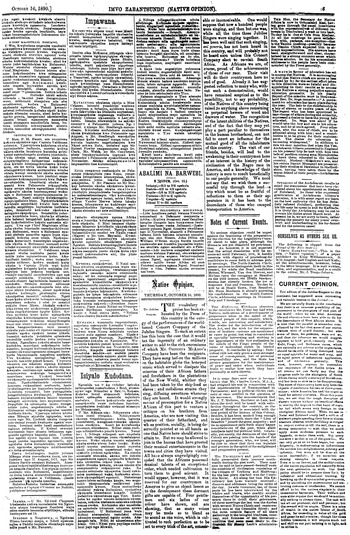
Since the Grahamstown Journal’s racism is the antithesis of Jabavu's black nationalism, we may well ask what editorial agenda was served by his reprinting the Journal. One historian, Chinua Thelwell, has noticed this bizarre insertion, and concluded that Jabavu's motivations are “unclear.”Footnote 58 Jabavu did more than simply insert an offensive news item. He transformed the structure of his newspaper to accommodate the item, adding an additional page to the customary four. He introduced two never-to-be repeated columns, “Ourselves as Others See Us” and “Current Opinion,” the former directly above the latter. These columns allow him to highlight citations from other white and black media (Figure 1).
Imvo Zabantsundu, 16 October 1890, 4.

“Ourselves as Others See Us” opens,
The following is clipped from the Friend of the Free State: “Imvo Zabantsundu” This is the title (“Native Opinion”) of a paper published in King Williamstown. It is bi-lingual – half English and half Kafir … It is well written, calm, and argumentative, and is a credit to the editor, Mr. J. Tengo Jabavu.
This citation not only validates the newspaper; it legitimates the “calm” argument that Jabavu makes on behalf of black South African advancement. The “Current Opinion” column prefaces the Journal reprint with “The advent of the Jubilee Singers to this continent has suggested some interesting and valuable lessons to the Journal.” An understated irony lurks in these words; the real lessons afforded by the Singers, Jabavu has already implied, and reinforced through the Friend of the Free State, lie in his own editorial. The “lessons” taught by the Journal are, in fact, the disclosure of its ignorance and bigotry.
Jabavu continues his citational playfulness, and subversive page design, in the “Current Events” section. Immediately to the Journal’s left, Jabavu extracts the black Kaffrarian Watchman quoting, approvingly, the secretary of Native affairs, on the “development of progressive ideas in the mind of the coloured people of this country.” This runs graphically alongside, and ideologically against, the Journal’s claim that Native South Africans are lacking black Americans’ “power of industrious application, and of civilisation generally.” According to the Watchman, that power is evident and on the increase. Jabuvu includes several other news items that testify to Africans’ growing desire for Western education and private property. These also attest to liberal white clergy and Cape politicians’ support for such desires. The effect is to surround the Journal’s vitriol with a chorus of well-informed white authorities engaged in productive conversations, and travels, with “Natives.”
Jabavu's citational conduct in Imvo belongs to – and may even initiate – a strong black South African tradition of textual critique.Footnote 59 (This tradition is perhaps most fully developed in Sol Plaatje's landmark book of 1916, Native Life in South Africa.) Jabavu's orchestration of white and black liberal voices on this page provides more than a polyphonic counterbalance to the Journal’s racism. It provides an instance of an antiracist democracy superimposed upon racially exclusionary discourse. By appearing to tolerate ignorant white bigotry, Jabavu exposes and diminishes it. Colonial racism becomes the minor, anachronistic outlier of a “civilized” discourse authored, and sung, by an international black majority with supporting parts performed by friendly whites.
What Jabavu achieves with his insertion of the offending Journal in fact parallels the behavior of the Jubilee Singers, in his editorial, who deploy “artistic tricks” to disturb white domination. Both the newspaper and the performers outmanoeuvre and outnumber racist settlers. Their numerical/ideological shrinkage of hostile colonials intensifies with the global reach of this mobile choral army. Those white bodies are now frozen in time and space, surpassed by a dynamic pan-Africanism that both expands and contracts oceanic distances. Jabavu's editorial emphasizes the migratory movements of the Jubilee Singers as well as their enslaved progenitors; they move from being cargo on slave ships to professionals addressing “millions on the habitable globe.” His supportive whites also move across space – Mr. Foure tours the region to talk with black communities, while Archdeacon Gibson travels to England with black students.
The sonic actions of the American Jubilee Singers become the springboard, then, for Jabavu to stake, in English, the claims of black South Africans for recognition as modern, educated, and educable subjects who are capable of, and entitled to, the full apparatus, and insignia, of liberal capitalist self-determination. Jabavu emphasizes the pan-African, as well as the national, scope of racial identity formation, and the global reach of black aesthetic culture. His Xhosa intervention, as we have seen, emphasizes instead the power of the local, and the limitations of black diaspora as a source of African uplift. These contrasting publications play to different publics, both of which were highly exercised by the spectacle of black American music in an era of industrial capitalism.
Looking at the circulation of Jubilee choirs in 1890s black South Africa invites us to start asking further questions about black transnationalism, on stage and in print culture. Neither the US choirs nor the models of education with which they were associated were merely celebrated by the African continent and its growing print industries; rather, Africans selectively engaged with and adapted the materials of the US South, to suit their local, regional needs and desires. This meant that for some, including John Tengo Jabavu, black America functioned less as a global leader and more as a cultural, political, and intellectual inspiration. Within this transnational choir of blackness, no country, and no region, should be assigned the lead.