I. INTRODUCTION
Nonequilibrium processing techniques can be exploited to generate inorganic materials with crystal structures and microstructures suitable for various technological applications.Reference Suryanarayana1, Reference Murty and Ranganathan2 Nonequilibrium synthesis techniques developed during the past few decades include rapid solidification processing, mechanical alloying/milling, plasma processing, combustion synthesis (also known as self-propagating high-temperature synthesis), vapor deposition, ion or electron or neutron irradiation, severe plastic deformation, etc.Reference Merzhanov3–Reference Suryanarayama5 Combustion synthesis is a typical nonequilibrium processing technique characterized by very fast heating rates (∼103 to 106K/s). As a solid-state powder processing technique, combustion synthesis involves thermal wave formation and rapid propagation, heat and mass transfer conditions, phase formation, and dynamic recrystallization of powder particles, which makes it a suitable processing route for developing micro- and nanocrystalline materials during a very short period. There are many reports on the combustion synthesis of inorganic materials in nonequilibrium conditions because the investigation of the synthesis of intermetallics using the combustion procedure has attracted considerable scientific and technological interest.Reference Oliveria and Kavinay6–Reference Warma, Rogachev, Mukasyan and Hwang9
However, there are few studies devoted to the combustion synthesis and characterization of copper alloys, including Mg/Ni/Cu, Cu/Ni/Mn, Fe/Cu, Al/Cu, and Ni/Cu systems.Reference Yasuda, Tsuchiya, Sasaki, Okinaka and Akiyama10–Reference Matson and Munir15 In most of these studies, alloys were prepared from oxides or metal nitride precursors using both solid and solution combustion synthesis techniques. Organic and inorganic reactants, such as citric acid, urea, and aluminum, were used as reductants.
Copper containing alloys are well-known industrial materials among the intermetallic phases. Especially, copper–zinc alloys (also called brasses) are important from an industrial point of view: it is used for decoration for its bright gold-like appearance, for applications where low friction is required, and for plumbing and electrical applications. Due mainly to cost advantages, copper-based alloys emerge as attractive substitutes in many structural and pressure-tight applications. Besides their corresponding strength and hardness, electrical properties indicate that they could also be interesting alternatives to machined, pressed, stamped, and fabricated components.Reference Elsner, Jänsch-Kaiser and Gorski16 Therefore, in the present work, we attempted the realization of a combustion process in a CuO + 0.15(C2H4)n + kZn (k varies in the range 0.2–1.6 mol) reactive mixture to find out the perspectives of the process for synthesizing Cu–Zn alloys with different Zn content. To achieve this objective, we have investigated the temperature distributions in the combustion wave, reduction peculiarities of CuO with Zn and polyethylene (C2H4)n, and compositional and morphological changes in alloy powders caused by the nonequilibrium conditions of the combustion process. Inert dilution tests were performed with KCl salt to examine temperature degradation in the combustion wave and its influence on the composition of alloy powders. Note that the preparation of metallic Cu powder from CuO using different organic and inorganic powders (polystyrene, polyethylene, urotropin, silicon, etc.) has been reported in the literature.Reference Yamukyan, Manukyan and Kharatyan17, Reference Yamukyan, Manukyan and Kharatyan18 However, to the best of our knowledge, the preparation and characterization of Cu–Zn alloy powders by the combustion technique have not been reported thus far.
II. EXPERIMENTAL
We used a premixed powder mixture consisting of copper oxide (particle size 1–15 μm; Aldrich, St. Louis, MO), zinc powder (particle size 1–25 μm; Daejung Chemicals, Korea), polyethylene powder (particle size <50 μm; Aldrich), and preliminary ground potassium chloride (particle size <50 μm; Kanto Chemicals, Tokyo, Japan). The concentration of zinc was varied from 0.2 to 1.6 mol per mol of CuO. The highest concentration of Zn (1.6 mol) corresponds to the Cu5Zn8intermetallic compound.
We used a combustion vessel, which allowed the synthesis and recording of sample temperatures under argon pressure. Zinc concentration variations and inert diluents, such as KCl, were monitored. Quantities of the mixed powder ranging from 130 to 150 g were gently pressed into a cylindrical cup with a diameter of 4.0 cm and a height of 8–9 cm. Approximately 2–3 g of Ti + C powder was then placed on top of the sample as an easy ignition agent. The cup containing the reaction mixture was installed into a combustion chamber under a nickel–chromium coil. Next, the chamber was evacuated and filled with argon to a pressure of 2.0 MPa to suppress possible sample elongation during the combustion process. Ignition was achieved using power added into the nickel–chromium coil placed on top of the green mixture. Two temperature detectors (tungsten–rhenium thermocouples) placed inside of the sample were mounted on special metallic contacts located on a heat insulating plate. The first thermocouple was placed in the middle of the sample for accurate measurement of temperature changes in the combustion wave. The second thermocouple was installed at the bottom of the sample at a specified distance and its signal was mainly used to estimate the time between thermocouples to calculate combustion velocity. Both signals from the thermocouples were continuously recorded by the data acquisition system (GL100A; Graphtec Co., Irvine, CA). The parameters examined were combustion temperature (T c) and combustion wave velocity (U c).
After combustion, the burned sample was placed in a mortar and manually ground with a pestle for acid leaching. Dilute HCl (10–15%) was used for all triturations. After treatment with acid, the remaining solids were always rinsed with distilled water and dried in vacuum.
The “THERMO” software programReference Shiryaev19 was used to simulate the adiabatic combustion temperature (T ad) and equilibrium phase concentration in the combustion wave. The calculation of equilibrium characteristics was based on minimizing the thermodynamic potential of the system. The initial parameters (temperature and pressure) of the system were set to 25 °C and 2.0 MPa, respectively. The analysis was performed at Zn and KCl concentrations of 0–2.0 mol.
X-ray diffraction (XRD) patterns were recorded using a Siemens D5000 system (Simens, Erlanger, Germany) with monochromatized Cu Kαradiation (40 kV, 30 mA) at step size increments of 0.02°. Scanning electron micrographs (SEM) of the samples were obtained using a JSM-5410 scanning electron microscope (JEOL, Tokyo, Japan) operating at 15 kV. SEM samples were dusted onto an adhesive conductive carbon disk attached to an aluminum mount and coated with Au before examination. The Cu and Zn concentrations were determined by an inductively coupled plasma (ICP) atomic emission spectrometer (Optima 4300; Perkin-Elmer, Waltham, MA).
After the synthesis, the gas from the reactor was collected into special plastic pockets for gas chromatography (GC). GC analysis was carried out on an Agilent 6890 series gas chromatograph (Agilent, Santa Clara, CA) using a HP-1 ms Ultra Inert column (30 m × 530 μm id, phase 3 μm), and thermal conductivity detector was used to analyze the product gas with helium as carrier gas.
III. RESULTS AND DISCUSSION
A. Adiabatic combustion temperature and equilibrium phases
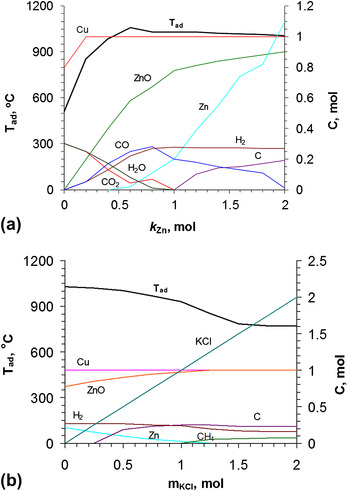
A preliminary thermodynamic analysis was conducted to calculate the adiabatic combustion temperature (T ad) and equilibrium product composition of the CuO + (C2H4)n + kZn system as a function of the Zn mole number (k). The initial concentrations of CuO and (C2H4)n needed to start the combustion reaction were 1.0 and 0.15 mol, respectively. Theoretically, 0.167 mol of (C2H4)n is required to complete the reduction of CuO. However, considering that Zn also participates in the reduction process, the concentration of (C2H4)n was reduced to 0.15 mol. The result of the calculation is presented in Fig. 1(a), where it is shown that the adiabatic combustion temperature of the CuO + 0.15(C2H4)n mixture (k = 0) is 500 °C, and this temperature is obviously extremely low to support a self-sustaining combustion process. The addition of Zn to the initial mixture results in an increase in adiabatic temperature up to the melting point of Cu (1080 °C, at k = 0.6), followed by a monotonous decrease of T ad at k > 0.6. The recovery of Cu mainly occurs by zinc, resulting in little competition between zinc and (C2H4)n. The noticeable participation of (C2H4)n in the reduction process is expected, and gaseous CO, CO2, and H2O are formed along with ZnO when the zinc concentration is low (k < 1). When the concentration of Zn is over the stoichiometric point (at k ≥ 1.0), polyethylene is forced out of the reduction process.
Adiabatic combustion temperatures and equilibrium phases in (a) CuO + 0.15(C2H4)n + kZn and (b) CuO + 0.15(C2H4)n + Zn + mKCl systems.
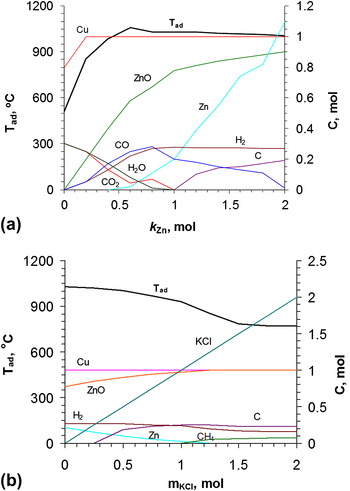
The effect of KCl flux on T ad and the phase composition of the products were also studied for CuO + 0.15(C2H4)n + Zn + mKCl and the results of the analysis are shown in Fig. 1(b). This investigation was initiated by the fact that molten KCl may have a perceptible influence on the combustion parameters and morphology of the Cu/Zn alloy when used as a flux. Molten KCl does not affect the equilibrium phases as an inert diluent, and therefore, no K+ and Cl− containing phases were predicted by the analysis. From the data shown in Fig. 1(b), it can also be postulated that the recovery of CuO mainly occurs by metallic Zn, despite significant variation in the adiabatic combustion temperature.
It can be determined from the analysis data that the reduction of CuO with (C2H4)n is thermodynamically less favorable than the Zn reduction process, as the combustion heat of Zn is higher than that of (C2H4)n. However, taking into account the fact that the combustion process is rapid and does not always occur via thermodynamically favorable routes, the production of Cu/Zn alloy powders with a combination of (C2H4)nand Zn was attempted. Later sections describe that the combustion experiments generally ignored the Cu recovery route predicted by thermodynamic analysis owing to the rapid temperature change in the combustion wave.
B. Temperature distributions in the CuO + 0.15(C2H4)n + kZn + mKCl system
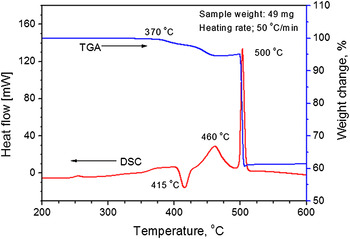
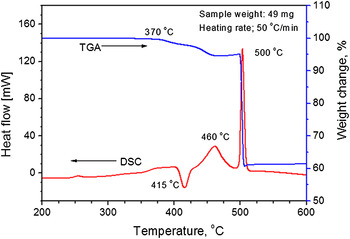
A differential scanning calorimetry-thermogravimetric analysis (DSC-TGA) analysis was carried out to determine the thermal behavior of the CuO + 0.15(C2H4)n + Zn reaction mixture and the weight losses that occurred during heating. The sample was heated at a rate of 50 °C/min in an argon gas flow. As shown in Fig. 2, the TGA curve of the initial mixture reveals two major weight losses: one has a monotonous character and occurs in the temperature range of 370–498 °C with a value of 5.0% and the other is very sharp and occurs at 500 °C with ∼33% weight loss. The first weight loss in the 370–498 °C temperature interval is possibly related to the thermal decomposition of polyethylene. The major weight loss (33%) around 500 °C is due to the volatilization and oxidation of polyethylene as well as the partial evaporation of Zn. The DSC curve suggests that the chemical reaction in the given system starts at 415 °C and the process then begins to move at its maximum rate, resulting in a fast exothermic combustion process at 500 °C.
DSC–TGA analysis of the CuO + 0.15(C2H4)n+ Zn mixture.
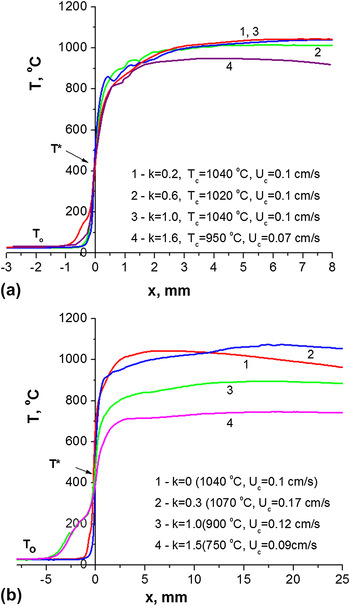
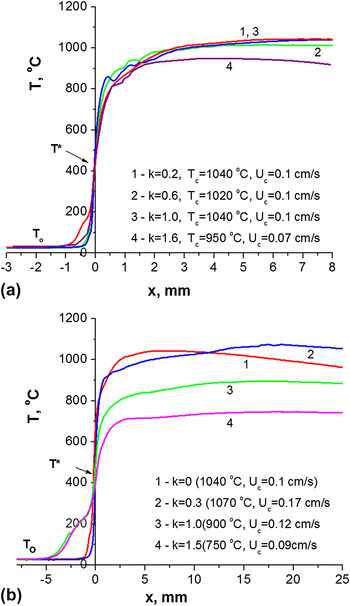
The combustion ability of the CuO + 0.15(C2H4)n mixture was tested before the main experiments. The experiments revealed that the combustion process could not be realized in the given mixture without Zn powder. The minimum concentration of Zn powder required to activate the combustion process was 0.2 mol. Figure 3(a) gives averaged temperature distributions of CuO + 0.15(C2H4)n + kZn (k varies in the range 0.2–1.6) samples at the reaction coordinate (x). These distributions were obtained from experimentally measured temperature–time profiles, T (t), where the time was modified to the reaction coordinate (x) by multiplying with the combustion speed (U c). As shown in Fig. 3(a), the starting temperature of the combustion process is designated as T* (450–500 °C) and corresponds to the sharp peak in the DSC curve (Fig. 2). The main temperature increase occurred from 25 to 800–900 °C, and the long-tail postcombustion processes followed. Exothermic reduction of CuO with Zn and (C2H4)n occurs quickly, and therefore, a nonequilibrium state is usually involved in combustion synthesis and characterized by a fast heating rate (∼2 × 10³ K/s), estimated from the temperature distributions. In the given temperature distributions, the combustion temperature, T c, remains constant for k = 0.2, 0.6, and 1.0 (1040 °C) and only drops by 70–90 °C for k = 1.6. These results agree with the thermodynamically predicted data. The temperature distributions are mostly flat with some oscillation, possibly related to the Cu/Zn eutectic formation. The size of the reaction zone (right side of the ordinate) is ∼4.0–8.0 mm, depending on the synthesis conditions. The propagation velocity of the combustion wave is low and its absolute values range from 0.07 to 0.17 cm/s. The temperature–time distributions of the CuO + 0.15(C2H4)n + Zn system, which is diluted with different amounts of KCl, were also measured. The corresponding temperature distributions shown in Fig. 3(b) indicate that an unexpected increase in the temperature to 1070 °C occurs when 0.3 mol of KCl is added to the mixture (line 2). The combustion temperature was then reduced to 900 °C when the KCl content was increased to 1.0 mol (line 3). The combustion limit with a minimum temperature of about 750 °C was reached at m = 1.5 (line 4). Attenuation of the combustion wave occurs below this temperature. The temperature distributions obtained with 1.0 and 1.5 mol of KCl show temperature retardation in the preheating zone (250–300 °C), which appears to be related to the heat consumed during the melting of the polyethylene. The combustion velocity shows a tendency similar to that of the temperature: it first increases from 0.1 (m = 0) to 0.17 cm/s (m = 0.3) and then drops monotonously to 0.09 cm/s (m = 1.5) [Fig. 3(b)]. An unexpected slight increase in the combustion parameters at low KCl content (m = 0.3) can be explained by molten KCl, which improves physical contact between reactant particles, contributing to improved combustion performance.
Averaged temperature distributions in the combustion waves of (a) CuO + (C2H4)n + kZn and (b) CuO + (C2H4)n + Zn + mKCl systems.
C. Phase composition and morphology
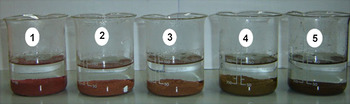
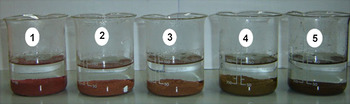
A number of Cu/Zn compositions with ZnO solid by-product were successfully obtained as a result of the combustion process; therefore, all samples were first ground and treated with a diluted HCl solution to remove ZnO. Samples having different colors were obtained after the acid treatment. Figure 4 shows the colors of the purified powders versus the initial Zn concentration. The sample has a red color identical to that of Cu powder at k = 0.2. However, the powder color changes from red to light red (samples 2 and 3), dark gold (sample 4), and then to brown (sample 5) with an increasing k. This continuous color change possibly indicates that Cu/Zn alloys of different compositions were obtained. According to our observation, alloy powder formation strongly depends on the combustion temperature and occurs when the combustion temperature is above 950 °C. For the lower combustion temperatures (samples diluted with 1.0–1.5 mol of KCl), the color of the acid-leached samples changed in the reverse direction, i.e., from dark gold to red, indicating the presence of Cu.
Cu/Zn powders of different compositions obtained from the CuO + 0.15(C2H4)n + kZn system: sample 1, k = 0.2; sample 2, k = 0.4; sample 3, k = 0.6; sample 4, k = 1.0; sample 5, k = 1.6.
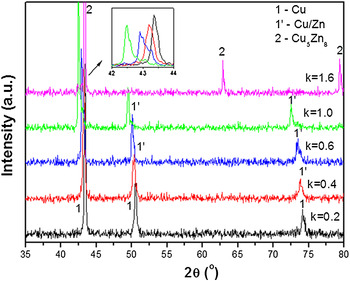
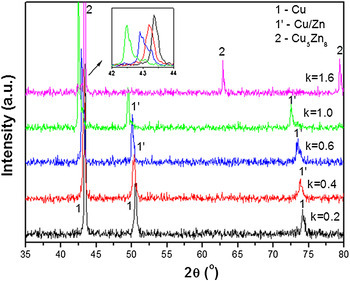
XRD patterns of the samples after acid leaching are shown in Fig. 5. All three peaks accurately indicate the Cu phase at k = 0.2. However, the peaks shift further to the left with an increasing k, indicating the formation of Cu/Zn alloy phases with a different Zn content. These shifts are clearly demonstrated in the upper part of Fig. 5. In addition, phase pure Cu5Zn8 intermetallic compound was obtained at k = 1.6, which corresponds to the stoichiometric point of the given phase.
XRD patterns of acid purified reaction products synthesized with different amounts of Zn.
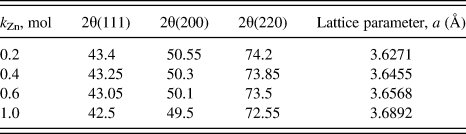
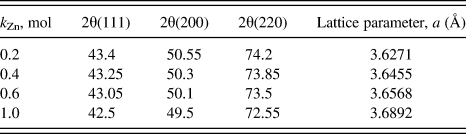
Lattice parameter of as-prepared alloys calculated from XRD patterns are shown in Table I. One can see that at k = 0.2, the lattice parameter of final powder is a = 3.6271 Å, which is very close to the lattice parameter of Cu (a = 3.6146 ÅReference Lubarda20). This indicates that all Zn were spent on the reduction process, and almost, pure copper was obtained at k = 0.2. At k > 0.2, the lattice parameter of alloy powder has been increasing parallel to Zn concentration. At k = 1.0, the lattice parameter reaches to 3.6892 Å, which means that alloy powder prepared by combustion process contains approximately 30% of Zn.Reference Rendle21
Lattice parameter of Cu–Zn alloys.
The effect of KCl on the phase composition of CuO + 0.15(C2H4)n + Zn + mKCl revealed no change with XRD peaks at m ≤ 0.6. Moreover, the XRD peaks of the alloy powders become sharper with small amounts of molten KCl (0.2–0.6 mol), thereby indicating its high crystalline nature. However, when the formation rate of the Cu/Zn alloy was retarded at m > 0.6, a three-phase product consisting of Cu, Zn, and ZnO was obtained.
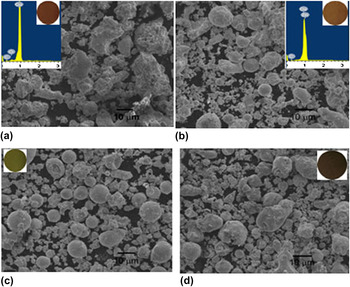
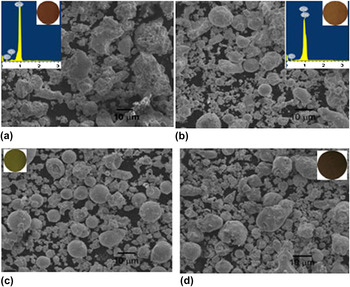
The morphology changes of Cu/Zn powders versus Zn concentration are shown in Fig. 6. Energy dispersive x-ray spectroscopy (EDX) analysis spectra are also shown in the upper portions of Figs. 6(a) and 6(b). SEM investigation revealed that micrometer-sized and irregularly shaped Cu particles were obtained with 0.2 mol of Zn [Fig. 6(a)]. Cu/Zn alloy particles produced with 0.6 and 1.0 mol of zinc were partially spherical [Figs. 6(b) and 6(c)], and the number of spherical particles were comparably higher at a composition of Cu:Zn = 1:1. The average particle diameter estimated from the micrographs is 5–30 μm. However, visible shape deformation of the spherical particles was observed at k = 1.6. This may be caused by either Cu5Zn8phase formation or a combustion temperature decrease. Note that dilution with 0.2–0.6 mol of KCl noticeably increased the number of spherical particles. An increase in KCl concentration (>1.0 mol) disturbed the alloy powder formation process, and irregularly shaped Cu powder was produced.
SEM micrographs of powders synthesized from the CuO + 0.15 (C2H4)n + kZn system: (a) k = 0.2; (b) k = 0.6; (c) k = 1.0; (d) k = 1.6.
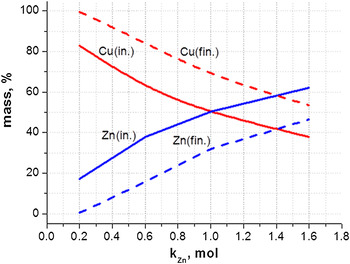
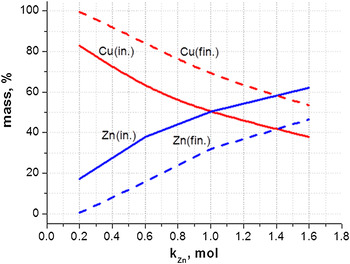
The concentration of Cu and Zn elements in alloy powders was analyzed using the ICP technique, and the results obtained are shown in Fig. 7. Here, Cuin and Znin are the concentrations of metals in the initial mixture and Cufin and Znfin are the concentrations of metals in the final alloy powders measured by ICP. The concentration of Zn decreased after the combustion process. This decrease is almost constant for the 0.2–1.6 krange and its absolute value is 15–17% (or 0.2 mol). Therefore, it can be concluded that about 0.2 mol of Zn was consumed in the reduction process. The sufficient portion of remainder of the Zn acted as an alloying component.
The concentrations of Cu and Zn before and after the synthesis (the final metal concentrations were determined by ICP analysis).
D. Combustion chemistry
Despite the negative thermodynamic prognostics, the combustion process in the CuO + 0.15(C2H4)n + kZn system successfully produced Cu/Zn alloys of different compositions. According to data analysis, ∼0.2 mol of Zn is consumed in the reduction process, compared to the 1.0 mol Zn consumption predicted by thermodynamic analysis. This makes clear that the reduction of CuO in the combustion wave occurred with both Zn and (C2H4)nreducants. As mentioned above, the exothermic reduction of CuO by molten Zn starts at ∼450–500 °C and can be presented by the following reaction:
 $${\rm{CuO}}\, + \,1/5{\rm{Zn}}\, \to {\rm{4}}/{\rm{5CuO}} + {\rm{1}}/{\rm{5ZnO}}\, + \,1/5{\rm{Cu}}{\rm{.}}$$
Heat release via reaction [Eq. (1)] stimulates the formation of the combustion wave and its propagation along the initial sample. This stimulates polyethylene decomposition and the formation of gaseous hydrocarbons throw of which the reduction of CuO more likely occurs. The literature on polyethylene combustion has been reviewed with an emphasis on the identification of gaseous products generated under various thermal decomposition conditions.Reference Paabo and Levin22 It was demonstrated that the combustion of polyethylene can produce many gaseous products; the nature of which depends mainly on the external conditions such as temperature and oxygen availability. The final products formed during complete combustion of polyethylenes are carbon dioxide (CO2) and water (H2O). However, under incomplete flaming or nonflaming combustion conditions, many other low molecular weight hydrocarbons and oxygenated compounds [e.g., carbon monoxide (CO), alcohols, aldehydes, ketones, and esters] are also generated.
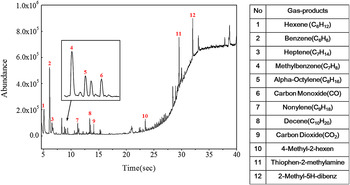
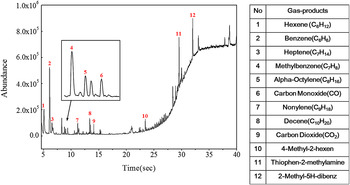
We have performed GC analysis of combustion gases to find out the composition of gases formed after the combustion of (C2H4)n. GC spectra shown Fig. 8 indicate that the main oxidation products of (C2H4)n are CO2 and CO. The water steam formed during the oxidation of (C2H4)n was condensed inside of the reactor and was observed visually. Beside the oxidation products, GC analysis revealed a number of degradation products generated from polyethylene during the combustion. The composition of the thermal degradation products of polyethylenes in argon atmosphere was demonstrated to be mainly unsaturated hydrocarbons, consisting of l-alkenes containing 6 to 10 carbons, corresponding n-alkanesReference Blazsó23 (Fig. 8). Therefore, it may be assumed that reduction of the remaining CuO occurred by gaseous hydrocarbons formed in the combustion wave at elevated temperatures. For illustration, the reduction process of the CuO residue by unsaturated hydrocarbons can be as follows:
 $$(2x\, + \,y/2){\rm{CuO}}\, + \,{\rm{C}}_x {\rm{H}}_y \, \to \,(2x{\rm{ }} + \,y/2){\rm{Cu}}\, + \,x{\rm{CO}}_2 \, + \,y/2\,{\rm{H}}_2 {\rm{O}}{\rm{.}}$$
GC analysis of gaseous products evolved during the combustion process.
When two metals (Cu and Zn) are in the high temperature zone (>900 °C), alloy formation occurs:
 $${\rm{Cu}}\, + \,k{\rm{Zn}}\,({\rm{liquid}})\, \to \,{\rm{CuZn}}_k .$$
At high Zn concentrations, the combustion process led to Cu5Zn8individual phase formation:
 $$<![CDATA[$$5{\rm{Cu}}\, + \,{\rm{8Zn}}\, \to \,{\rm{Cu}}_{\rm{5}} {\rm{Zn}}_{\rm{8}} .$$
Our experimental findings demonstrate that both reactants [Zn and (C2H4)n] were involved in the reduction process of CuO. Approximately 0.2 mol of CuO was recovered by Zn and the remaining 0.8 mol by (C2H4)n. These findings should be explainable after a comprehensive kinetic study of the combustion chemistry. However, reasonable explanations can be proposed based on the specificity of the investigated system. It is assumed that volatile hydrocarbon molecules that were formed in the combustion wave can reach the CuO particles much faster than molten Zn, owing to higher kinetic energy. In this case, kinetic factors become dominant and the reduction of CuO by hydrocarbons appears veracious.
IV. CONCLUSIONS
The combustion process in a CuO + 0.15(C2H4)n + kZn + mKCl reactive mixture was investigated for synthesizing Cu/Zn alloy powders with different Zn to Cu molar ratios. Temperature distributions revealed that self-propagating combustion waves with a maximum temperature of about 950–1040 °C can be released if 0.2–1.6 mol of Zn is consumed in the combustion experiments. It was shown that about 0.2 mol of Zn was involved in the reduction process, whereas the remaining Zn was used in the alloy composition. Our experimental findings clearly demonstrate that more than 80% of the CuO is recovered with (C2H4)n, as unsaturated hydrocarbons molecules formed after the thermolysis of polyethylene have higher kinetic energies and can reach the CuO particles much faster than molten Zn. The concentration of Zn in the alloy composition was 0.5–45 wt%, depending on the reaction conditions. The Cu/Zn alloy particles produced were partially spherical, and the number of spherical particles was comparably high in the Cu/Zn = 1/1 composition. The average particle diameter estimated from the micrographs was 5–30 μm.
ACKNOWLEDGMENT
This research was supported by a grant from the Fundamental R&D Program for Core Technology of Materials (No. 10037206, multifunctional metal matrix composites by controlled reaction) funded by the Ministry of Knowledge Economy, Republic of Korea.