Introduction
Dementia is often complicated by agitation, aggression, disinhibition, and other challenging behaviors. In a meta-analysis of 19 nursing home studies, prevalence rates ranged from 4% to 82% for aberrant motor behavior, 10% to 39% for verbal aggression, and 11% to 44% for physical aggression (Zuidema et al., Reference Zuidema, Koopmans and Verhey2007). These symptoms reflect residents’ suffering; they create a stressful working environment for staff; and they greatly increase the costs of care (IPA, 2010a). Antidepressant, antipsychotic, and analgesic medications can be effective when behaviors stem from comorbid major depression, psychosis, or pain but psychotropic medications have only modest efficacy in remaining cases and sometimes have onerous side effects (Schneider et al., Reference Schneider, Dagerman and Insel2006; IPA, 2010b). As a result, non-pharmacological interventions should be used as first-line strategies to ameliorate behavioral symptoms whenever possible (IPA, 2010a). Cohen-Mansfield postulated that people with dementia behave in an agitated manner when their needs, for example for stimulation, social interaction, and physical comfort, are not perceived or addressed by caregivers. These unmet needs could be addressed by means of an enriched, “person-centered” care model and, more specifically, through psychosocial interventions that are designed to elicit residents’ interest, engagement, and participation (Cohen-Mansfield, Reference Cohen-Mansfield2001).
There is now strong evidence that interventions work best when they are tailored to participants’ backgrounds and preferences (Cohen-Mansfield, Reference Cohen-Mansfield2001; O'Connor et al., Reference O'Connor, Ames, Gardner and King2009). For example, music that participants had enjoyed earlier in life led to a greater decrease in agitation than standard classical music (Gerdner, Reference Gerdner2000); audiotapes of a family member's voice proved more successful in reducing agitation than a stranger's voice (Garland et al., Reference Garland, Beer, Eppingstall and O'Connor2007); and a home-based occupational therapy intervention based on people's interests and capabilities led to fewer agitated behaviors, and elicited more engagement and pleasure, than a wait-list control (Gitlin et al., Reference Gitlin2009). In yet another study, activities that were carefully matched to participants’ cognitive, physical, and sensory abilities, and their lifelong habits and roles, proved more successful in eliciting pleasure and interest, and in alleviating agitation, than the control condition of a staff education session (Cohen-Mansfield et al., Reference Cohen-Mansfield, Libin and Marx2007). The additional effect on emotions and engagement might explain why non-pharmacological interventions enhance residents’ quality of life more than would be expected through a fall in agitation levels alone (IPA, 2010a).
A promising intervention that is tailored to individuals’ needs and capabilities derives from the educational system developed by Maria Montessori and subsequent educational theorists to promote engagement in learning. Key elements of the methodology include matching demands to students’ levels of competence by breaking tasks into smaller components, grading elements in order of difficulty, and using guided repetition. These principles have been adapted to help provide personalized stimulation, meaningful activity, and engagement for people with dementia, even to those with severe cognitive deficits, by means of using demonstration and templates and adjusting difficulty of tasks as well as the pace of speech and movement to each participant's needs (Camp, Reference Camp1999; Orsulic-Jeras et al., Reference Orsulic-Jeras, Judge and Camp2000; Camp et al., Reference Camp2006). Activities are designed to tap procedural memory, which is better preserved than verbal memory (Squire, Reference Squire2004), while minimizing language demands and providing external cues to compensate for cognitive deficits. Familiar objects provide cues to their own use (e.g. playing cards suggest sorting them in a sequence or by color) and tasks are demonstrated by a facilitator who then hands the object to participants, thus prompting them to follow suit. Because the approach is not reliant on language, it has the potential to assist individuals from diverse language backgrounds who have lost fluency in their second and subsequent languages, which limits them in their communication with staff members and coresidents in residential care. Montessori-based activities elicited high levels of engagement and pleasure in a small study of nursing home residents with dementia (Camp et al., Reference Camp2006), and led to a modest fall in agitation scores in a larger trial using a set of predetermined activities (Lin et al., Reference Lin, Yang, Kao, Wu, Tang and Lin2009).
In the current study, we compared the levels of observed agitation, affect, and engagement in nursing home residents with dementia and associated high-frequency behavioral symptoms before, during, and after personalized activities delivered in accordance with Montessori principles and a relevant control condition. As research suggests that verbally agitated behaviors (e.g. calling out) are associated with lowered mood, while physically agitated behaviors (e.g. pacing) are associated more with a lack of meaningful occupation and socialization, we focused on physically agitated behaviors (Cohen-Mansfield, Reference Cohen-Mansfield2001). A control condition and randomized crossover design were employed to check for the possibility that participants benefit from social interaction, regardless of its content and mode of delivery. The study hypotheses were that: (1) social interaction alone significantly improves agitation, mood, and engagement; (2) the Montessori-based intervention has a benefit over and above those resulting from social interaction; and (3) because the intervention can be delivered non-verbally, they have more positive outcomes for people who have lost fluency in English.
Methods
Design and sample selection
The study employed repeated measures, crossover design with random allocation of the order of the treatment and control conditions. The primary investigator (Eva van der Ploeg) generated the random allocation sequence using Excel Random Number Generator. Recruitment of aged care facilities in the Melbourne region (Australia) started in July 2009 and data collection was completed in September 2011. Participants and facility staff were blinded to the hypotheses of the study. The protocol was approved by the ethics committees of Monash University and the participating health organizations. A more detailed study protocol has been published online (Van der Ploeg and O'Connor, Reference Van der Ploeg and O'Connor2010). The following criteria were required for inclusion in the trial: (1) a chart diagnosis of dementia; (2) a physically agitated behavior that occurred at least several times a day outside nursing interventions; (3) confirmation by nurses, visiting physician, and/or psychiatrist that the behavior was not due to untreated pain, physical illness, major depression, or psychosis; (4) residence in a specialist dementia unit or psychogeriatric nursing home for at least three months; and (5) consent to the study by the next of kin or guardian. Residents were excluded from the study if: (1) they refused the intervention on two occasions; (2) their psychotropic medications were likely to be changed over the study period (medical and nursing staff were asked not to alter psychotropic medications during the study period if possible); (3) nursing and medical staff reported an acutely life-threatening physical illness; or (4) a behavior presented a potential hazard to the researchers. Once participants were selected, a single target behavior was selected in discussion with staff based on nurses’ ratings of residents’ behaviors in the previous two weeks using the Cohen Mansfield Agitation Inventory (CMAI) (Cohen-Mansfield, Reference Cohen-Mansfield1986).
Treatment
The study period of four weeks prevented participation being compromised by disease progression, intercurrent illness, or treatment changes. Individual sessions were designed to be long enough to detect real changes across time but short enough to avoid interruptions by meals, nursing care, or visitors. Consented, willing participants were randomized to Montessori or control blocks for two weeks then switched to the other condition. Both conditions were delivered for 30 minutes twice weekly, giving a total of four Montessori and four control sessions, at times when nursing staff reported that target behaviors were most frequent. Observations of behavior, engagement, and affect were conducted in the 30 minutes before, during, and after each session.
Facilitators (psychologists and higher degree psychology students) were trained extensively by means of a didactic presentation, written guidelines and received regular personal supervision throughout the study. Following training, the activity facilitators selected up to ten activities per participant based on discussion with the family about participants’ former interests and hobbies. Typical selections included listening and singing along to favorite music, looking at and sorting pictures, arranging flowers, sorting dry pastas, folding towels, screwing nuts and bolts together, planting seeds, and making puzzles. Charts were checked to identify health factors that could impede participation. Facilitators sought to engage the residents in selected activities, with flexibility to respond to their perceived level of interest by shifting from one to another. Where engagement proved difficult, facilitators simply kept participants company for the required period.
To control for the non-specific benefits of one-to-one interaction, facilitators engaged participants in social interaction by means of general conversation or conversation based on newspaper stories and pictures. As before, they kept participants company if engagement could not be achieved.
Outcome measures
Primary measure
A trained observer recorded if the target behavior had been present (yes/no) during each 1-minute interval over the three 30-minute periods before, during, and after the Montessori or control period, giving a behavior score that ranged from 0 to 30 per period. For 39 out of the 44 participants, the selected behavior was pacing or aimless wandering, two displayed repetitive mannerisms, one inappropriate disrobing, one grabbing onto door handles and rocking in her wheelchair, and one general restlessness. Hence, all target behaviors fell in the category of physically non-aggressive behaviors. Inter-rater reliability for behavior counts was very high with an average κ of 0.98 over five sessions.
Secondary measures
(a) Observers used the Philadelphia Geriatric Center Affect Rating Scale (PGCARS) (Lawton et al., Reference Lawton, van Haitsma and Klapper1996) to record the predominant type of affect (pleasure, contentment, interest, neutral affect, anger, sadness, anxiety/fear) during every minute. The predominant affect was rated as 1; others were rated 0. For the purpose of analysis, pleasure and contentment have been grouped together as “positive affect”; anger, sadness, and anxiety/fear as “negative affect.” Scores for each category ranged from 0 to 30 per 30-minute period. Inter-rater reliability was excellent with an average κ of 0.92 across five sessions.
(b) The predominant level of engagement was recorded during every minute using the Menorah Park Engagement Scale (MPES) (Skrajner and Camp, Reference Skrajner and Camp2007) with a choice between non-engagement (e.g. a blank stare), self-engagement (e.g. fiddling with clothes), passive engagement (e.g. watching or listening), and constructive engagement (e.g. actively handling objects or talking). Non- and self-engagement have been grouped together as “negative engagement.” As before, scores for each engagement category ranged from 0 to 30 per period. Inter-rater reliability was high with an average κ of 0.82 across five sessions.
Other measures
The Mini-Mental State Examination (MMSE) (Folstein et al., Reference Folstein, Folstein and McHugh1975) and the Clinical Dementia Rating (CDR) (Hughes et al., Reference Hughes, Berg and Danziger1982) were used to establish dementia severity. Based on discussion with staff, and confirmation by the Montessori facilitators’ experiences, residents were rated (yes/no) with respect to their ability to speak sufficient English to conduct a very basic conversation.
Sample size calculation
Sample size was calculated for the primary outcome measure (agitation) for a two-sided hypothesis test with a Type I error rate of 0.05 and a Type II error rate of 0.10 (90% power). We based our sample size calculation on data from the study by Garland et al. (Reference Garland, Beer, Eppingstall and O'Connor2007). In the 30-minute baseline observation period, we anticipated that participants would display a mean count of 5.0 physically agitated behaviors (maximum 30) with a standard deviation of 2.15. We anticipated a mean improvement of 0.69 behaviors per period during the control condition (effect size 0.32) compared with a mean improvement of 1.53 per period during Montessori activities (effect size 0.71), giving a difference of 0.84 between the conditions. We estimated a within-person correlation of 0.70. This resulted in a sample size of 45 participants when assuming the same variance (SD = 2.15) across conditions. Based on previous experience, and the relatively brief duration of this study, we expected 10% attrition and recruited 50 participants.
Statistical methods
In 25 of 352 sessions (7%), some data points were missing for an average of 7.6 out of the total of 90 minutes of observations. Data were missed toward the end of the post-intervention period in 17 cases and from the intervention periods during eight sessions. If less than half of an observation period was missing, we imputed data by carrying forward previous observations. If data were missing for over half of a period, we imputed data by calculating the average across the other Montessori or control sessions. Stata 11 (StataCorp., College Station, TX, USA) was used for data analysis. Results are shown as mean scores and incidence rate ratios. Ratios over 1 signify an increase in a mean value and below 1 a decrease in that value with respect to a nominated contrast or reference group. The outcome variables, counts of agitated behavior, and different categories of affect and engagement during 30-minute periods, were over-dispersed relative to Poisson expectations and so they were modeled via random effects negative binomial regression as functions of the intervention (Montessori versus control), time (“before” and “after” the intervention versus “during”), English language fluency (fluent versus non-fluent), two-way and three-way interactions of these variables, age (years), gender, dementia severity (mild and moderate versus severe), and order effects (Montessori first versus control first).
Results
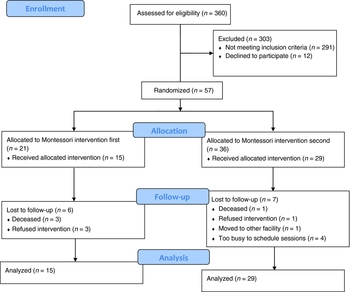
We screened all 360 current residents of two dementia units and seven specialist psychogeriatric nursing homes in metropolitan Melbourne, Australia. The flow of participants is described in Figure 1.
Flow chart of participants.

The average age of the 44 participants was 78.1 years (SD = 9.8) and 30 were female. The mean MMSE score was 6 (SD = 8, range = 0–23), but 26 participants (including 12 residents who had lost their fluency in English) were unable to complete the MMSE. Based on their CDR ratings, 29 had severe dementia, 13 moderate dementia, and 2 mild dementia. Staff and Montessori facilitators rated 12 individuals as lacking fluency to such an extent where they could not hold a basic conversation in English. All of the 12 had migrated to Australia earlier in life from non-English speaking countries.
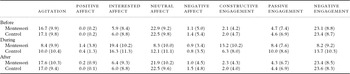
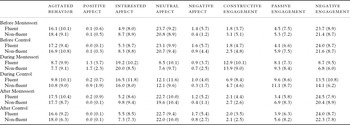
In the periods before Montessori and control sessions, mean agitation scores were high at about 17 out of 30 minutes. In the majority of “before” periods, residents displayed neutral affect and negative engagement (Table 1). During both the Montessori and control sessions, agitation scores were nearly halved and sessions were spent predominantly with interested affect and constructive or passive engagement. Outcomes for fluent and non-fluent participants are shown separately in Table 2.
Means and standard deviations of agitated behavior, affect, and engagement scores across conditions and time periods (1,056 observations on 44 participants)

Means and standard deviations of behavior, affect, and engagement scores categorized by English language fluency (768 observations for fluent and 288 observations for non-fluent participants)

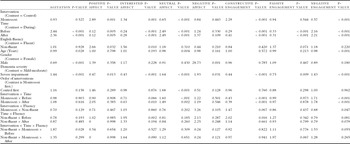
Incidence rates during the interventions, regardless of type, differed from those before and afterward for all outcomes except negative affect (Table 3). During both the Montessori and control sessions, there was significantly less agitation, more positive and more interested affect, less neutral affect, more constructive and passive engagement, and less negative engagement. These time effects were accentuated by the Montessori intervention. During the Montessori intervention in contrast to control sessions, there was more positive and interested affect, less neutral affect, more constructive engagement, and less negative engagement.
Incidence rate ratios and p-values for effects on agitated behavior, affect, and engagement (1,056 observations on 44 participants)

For those who lacked fluency in English, analyses show that once all the interactions of intervention, time, and fluency were accounted for, there was a significantly larger fall in agitated behaviors during the Montessori than the control sessions (Tables 2 and 3). There was no such distinction for participants who could converse in English. Changes in affect and engagement were similar between the fluent and the non-fluent groups (Table 3). We have reanalyzed the results omitting the 12 people who had lost their fluency in English to ensure that the results for the complete sample were not driven by this subgroup. No significant changes in the results were identified.
Once interactions were explained, older age was associated with reduced agitation, neutral affect, and negative engagement. Males had a lower incidence of agitation and greater incidence of negative affect than females. Participants with severe dementia displayed more agitation, neutral affect and negative engagement, and less interested affect and constructive and passive engagement, than those with mild or moderate dementia. These effects were similar across time and treatment conditions (not in Table). We identified an order effect for neutral affect, which was due to differences during intervention times. The least neutral affect was displayed during intervention time when Montessori was presented first (M = 6.5, SD = 9.0), followed by Montessori second (M = 9.2, SD = 10.0), control second (M = 10.5, SD = 11.2) with control first (M = 11.2, SD = 9.7) resulting in the most neutral affect (not in Table).
Discussion
The Montessori and control conditions resulted in 50% and 42% reductions, respectively, in agitated behavior counts compared to baseline. Montessori activities were more successful than the control condition in generating positive affect and constructive engagement and, by corollary, in reducing neutral affect and negative engagement. In addition, the Montessori intervention proved more effective for participants who had lost fluency in English in reducing levels of agitation.
The study was subject to some limitations. Because of the nature of the activities, it was not possible to blind observers to the Montessori or the control conditions but they were trained to record behavior, affect, and engagement styles consistently across sessions and their inter-rater reliability was excellent. In addition, treatment facilitators reported in supervision meetings that they were sometimes tempted to resort to the Montessori approach when the control activities failed to capture participants’ interest. They were encouraged to follow the protocol closely but, if there was some crossover in approach, it would almost certainly have resulted in an underestimate of differences between the two conditions.
Our case-by-case randomization method resulted in more participants being allocated to start with the control sessions. In the regression analyses, a significant order effect was found only for neutral affect. The selection of the study participants resulted in the exclusion of people who refused engagement on two consecutive occasions (n = 4) and of one person who was too aggressive to interact with the facilitators. It seems self-explanatory that psychosocial interventions can only be trialed and implemented with people who are willing and able to socially engage. We explored in which condition the four participants who refused participation were when they refused the intervention as this could introduce a potential selection bias. However, dismissal was equally spread across conditions, with two individuals refusing the Montessori intervention and two refusing during the control phase (one after completing the Montessori sessions).
The most frequently displayed agitated behaviors were all physically non-aggressive behaviors. We did not select individuals who displayed high-frequency verbal behaviors only, as these behaviors have been linked with lowered mood (Cohen-Mansfield, Reference Cohen-Mansfield2001). Physically aggressive behaviors (such as hitting, kicking, and pushing) were not highly prevalent in our sample and usually occurred during nursing interventions (which was an exclusion criterion for this study). The results of our study may not be applicable to individuals who display verbal or physically aggressive behaviors.
The differences for positive affect were small and may not seem clinically relevant. However, the 1-minute time slot to rate predominant affect proved to be too long. “Predominant” implied that an affect was shown for at least 30 sec to be recorded. This was usually only feasible for interest and neutral affect. For example, smiling and laughter or overt expressions of anger usually come in bursts that last for seconds only. Future studies may consider working with shorter periods (predominant affect in 30 sec time slots) or counting incidence of an affect that is of particular interest, for example the number of smiles or angry outbursts.
The crossover design accounted for interindividual differences in baseline levels of agitation and the use of repeated measures helped account for intra-individual fluctuations in behavior and responsiveness. In addition, direct measures of participants’ behavior, mood, and engagement made by highly trained observers for each minute over a 90-minute period provided more reliable data, and many more data points, than scales completed by nursing staff. This is one of the first studies to use both a baseline and treatment control condition to test the effectiveness of personalized activities tailored to participants’ skills, interests, and backgrounds (Cohen-Mansfield et al., Reference Cohen-Mansfield, Libin and Marx2007; Reference Cohen-Mansfield, Marx, Dakheel-Ali, Regier, Thein and Freedman2010; Gitlin et al., Reference Gitlin2009). Our findings replicate previous studies in the following respects: social contact per se reduced agitation compared to baseline situations (Cohen-Mansfield et al., Reference Cohen-Mansfield, Libin and Marx2007; Reference Cohen-Mansfield, Marx, Dakheel-Ali, Regier, Thein and Freedman2010; Gitlin et al., Reference Gitlin2009) and personalized activities elicited more positive mood and engagement than both baseline and control conditions (Orsulic-Jeras et al., Reference Orsulic-Jeras, Judge and Camp2000; Cohen-Mansfield et al., Reference Cohen-Mansfield, Libin and Marx2007; Gitlin et al., Reference Gitlin2009; Lin et al., Reference Lin, Yang, Kao, Wu, Tang and Lin2009). Increases in interest and engagement were of a similar order to those found in an earlier study of Montessori-based activities (Orsulic-Jeras et al., Reference Orsulic-Jeras, Judge and Camp2000), but the 50% reduction in agitation is significantly higher than the 1%–30% reduction in agitation reported in other studies (Gerdner, Reference Gerdner2000; Garland et al., Reference Garland, Beer, Eppingstall and O'Connor2007; Lin et al., Reference Lin, Yang, Kao, Wu, Tang and Lin2009). This larger reduction may be due to the selection of participants with high-frequency behaviors targeted at peak times as well as the use of direct observations of behavior as compared to the staff-rated scales used in some of the other studies. However, we also found a similar reduction in agitation with the non-personalized control condition. This is an important finding, as it shows that even a simple social contact intervention of keeping someone company, that requires no additional training or resources, can assist in settling individuals with high-frequency agitation. It may also be a reflection of how in current care there is ample opportunity for improvements in stimulation, diversity, and social contact.
Montessori activities offered additional benefits to participants who were unable to converse in even rudimentary English, all of whom came from non-English speaking backgrounds. The reduction in agitation for people who had lost their fluency in English was significantly larger during the Montessori intervention than during the control condition, suggesting that individualized activities that require few language skills can play an important role in meeting the needs for stimulation and social interaction of this vulnerable group. We have shown previously that, in Australia, older Italian and Greek people with dementia who lived in mainstream nursing homes communicated less often with staff and coresidents, and were prescribed more psychotropic medication, than individuals in ethno-specific homes that catered specifically for Italian- or Greek-speaking people (Runci et al., Reference Runci, Redman and O'Connor2005; Reference Runci, Eppingstall and O'Connor2012). Unless family members visit very frequently, residents may feel isolated. Activities based on Montessori principles can help overcome their sense of isolation.
Effects during the 30 minutes directly after the interventions were delivered, were limited in the current study, but could increase with more frequent or longer sessions depending on the individual. However, manpower and resources are an important consideration since personalizing activities and delivering them on a one-to-one basis is labor intensive and therefore costly. Many aged care facilities seek to engage residents in meaningful activity programs. Personalizing these activities, and finding ways to deliver them non-verbally for residents with limited language fluency, might not incur extra recurrent costs but could greatly enrich residents’ lives. Second, people with less severe dementia may well benefit from group activities as well (Skrajner and Camp, Reference Skrajner and Camp2007). Finally, Montessori-type activities, while complex in nature, can be delivered by people from a wide range of backgrounds including volunteers and family members. A recent study in our region reported that volunteers in nursing homes spent little time with residents with marked dementia and challenging behaviors but were keen to learn new skills provided they were given sufficient training and ongoing support (Van der Ploeg et al., Reference Van der Ploeg, Mbakile, Genovesi and O'Connor2012). Interventions to ameliorate family members’ burden and stress have usually considered the family caregivers and resident separately (e.g. support groups and dementia education sessions), overlooking the loss of relationship between the two (Stephens et al., Reference Stephens, Kinney and Ogrocki1991; Rankin et al., Reference Rankin, Haut and Keefover2001). Preserving and enhancing this relationship through meaningful activities can restore a sense of competence and self-determination for relatives (Motenko, Reference Motenko1989).
Conclusion
Both the Montessori intervention and the control condition may assist aged care facilities in settling residents with physically non-aggressive behaviors, especially when targeting behaviors at times of peak frequency. The Montessori intervention is especially suitable to calm individuals who have lost their English language fluency. It can also assist in eliciting more constructive interactions, interest, and positive emotions, hence making it a potentially pleasant intervention for family members and volunteers to deliver.
Conflict of interest
None.
Description of authors’ roles
Eva van der Ploeg was responsible for project management, was involved as a Montessori facilitator and observer, conducted the analysis, and wrote the draft of the paper. Barbara Eppingstall assisted with project management and was involved as observer in the study. Cameron Camp trained the Montessori facilitators in the methodology and provided supervision throughout the project. Susannah Runci was involved in the design of the initial project and served as an advisor during the project. John Taffe assisted with the statistical analysis, and the interpretation and presentation of the results. Daniel O'Connor conceived the original research idea and supervised the project. All authors read and approved the final version of the paper.
Acknowledgments
We thank the study facilitators and observers for their contribution: Caroline Bambrick, Emily Berger, Nathan Castle, Anna Clark, Sandra Genovesi, Zac Griffith-Jones, Tapiwa Mbakile, Donna Papas, and Clio Wright. Finally, we would like to thank the Dementia-CRC, the Mason Foundation, and the NH & MRC for providing the funds to complete this study.