One of the major difficulties when studying the phenomenon of stress stems from the fact that it is both an abstract concept and a concrete phonetic realisation in communicative situations. To make matters worse, terms such as ‘stress’ and ‘accent’ have been used variously over the years to refer both to the abstraction and the utterance-level reality (Ladd Reference Ladd2008: 52). As Beckman & Edwards (Reference Beckman, Edwards and Keating1994: 8) explain, ‘stress is not a paradigmatic specification like tone or vowel quality. Rather it is a syntagmatic structural specification. It is one of the devices that a language can use to set up a hierarchical organization for its utterances’. At the utterance level, a stressed syllable is more prominent than the syllables which surround it, but as the first section of this paper outlines, opinions have differed over what causes this prominence. In this paper, the term ‘stress’ is used to refer to the concept, and where necessary, the term ‘prominence’ is used to distinguish the phonetic realisation of a stressed syllable.
French and English, despite sharing much of their vocabulary, are vastly different phonetically and phonologically. This is particularly evident in the domain of stress, where the two languages differ so greatly that many French speakers find it very difficult to perceive prominent and also unstressed syllables in English, which often leads to serious comprehension problems. These difficulties are so important for certain individuals that some French authors have posited the existence of ‘stress deafness’ with regard to languages such as English, where stress plays a defining role (Dupoux & Peperkamp Reference Dupoux, Peperkamp, Laks and Durand1999, Dupoux, Peperkamp & Sebastián-Gallés Reference Dupoux, Peperkamp and Sebastián-Gallés2001, Peperkamp & Dupoux Reference Peperkamp, Dupoux, Gussenhoven and Warner2002).
Syllables are perceived as more or less prominent according to several acoustic cues, and the relative importance of these cues is not the same in French and in English. As relative prominence is not simply an acoustic phenomenon but also a perceptual phenomenon, its perception depends on picking up on these acoustic cues. In the first section of this paper, the nature of stress and prominence in both languages is examined briefly. It is suggested that a reason for ‘stress deafness’ may be that French and English native speakers may not process these cues in the same way. This is an example of linguistic transfer, a concept discussed briefly in the second section. In order to investigate the possibility of this particular aspect of linguistic transfer, a cross-linguistic perceptual experiment was devised; in the third and principal section of this article, this experiment and its results are presented.
1 Stress
Stress has always seemed to resist all attempts at definition: the closer one investigates the nature of stress, the more difficult it becomes to define. One of the reasons for this is that a stressed (or prominent) syllable is distinguished not only by acoustic features, but it is also a perceptual phenomenon, i.e. in defining it, one must account not just for its production, but also for its perception by the interlocutor. Couper-Kuhlen (Reference Couper-Kuhlen1985) defines stress as ‘nothing more than the fact that in a succession of spoken syllables or words some will be perceived as more salient or prominent than others’ (Couper-Kuhlen Reference Couper-Kuhlen1985: 19). Stress is also therefore a relative and not an absolute feature, and the stressed syllable must be defined as prominent in relation to its surrounding environment. Stress plays a role in three main areas: lexical recognition, syntactic processing and discourse structure (Cutler, Dahan & van Donselaar Reference Cutler, Dahan and van Donselaar1997). However, this study is not concerned with the functions of stress, but in how important the acoustic cues are in distinguishing the prominent syllable at the phonetic level.
1.1 Stress in English
One thing is certain about stress, which is that unusually for human language, it is highly iconic (Pennington Reference Pennington1996: 137), i.e. the acoustic effort involved in marking stress coincides with the relative magnitude of the stress. The prominent syllable is marked by variations in four acoustic cues: fundamental frequency (F0), amplitude, duration and formant structure. The perceptual correlates of these four acoustic cues are respectively: pitch, volume, length and a different timbre to the vowel. Phonologists and phoneticians do not all agree about which of these cues is the most important in English, but most seem to agree that stress in English is usually marked by variations in the fundamental frequency of the prominent syllable, which led Bolinger (Reference Bolinger1958) to posit the existence of a ‘pitch accent’ in English. It is important to remember, however, that as prominence is a communicative feature, it may manifest itself in many different ways: the prominent syllable does not necessarily bear a pitch accent, a syllable may be metrically strong without necessarily being stressed, etc. (Ladd Reference Ladd2008: 61).
Stress is a relative phenomenon, and most authors agree that it is marked by several degrees of prominence. There is some disagreement as to how many levels exist in English; for example, according to Pennington (Reference Pennington1996: 131–132), between four and six levels suffice for a detailed transcription. Other authors, such as Cruttenden (Reference Cruttenden1986: 21), distinguish four levels: primary stress, secondary stress, tertiary stress and unstressed.
Aside from its form, stress also has different functions. Firstly, in English, stress exists at the level of the word: this is generally referred to as word stress or lexical stress. An example of word stress in English is the word uniˈversity /ˌjunɪˈvзːsɪti/, where the primary word stress occurs on the third syllable. If any syllable other than the third syllable is pronounced with more prominence than the other syllables, this is considered to be a speech error. The nature and behaviour of stress above the level of the word in English is a great deal more complex. Any syllable, stressed or otherwise, may also receive additional weighting. This additional weighting above the level of the word has sometimes been referred to as ‘sentence stress’, but it is perhaps more helpful to think of it as focus, as it may be placed on different syllables according to the utterer's discursive intention. Focus ‘gives prominence to the syllables that are lexically stressed, primarily by assigning them a pitch accent’ (Xu & Xu Reference Xu and Xu2005: 160). Syllables receiving focus will therefore be more prominent than the other stressed syllables. Focus generally occurs on the stressed syllable of the last lexical word (i.e. a verb, noun, adverb or adjective) of the sentence, and in such cases is often referred to as the nucleus, or nuclear stress. With longer sentences composed of several prosodic groups, each prosodic group or tone-unit may also contain a more prominent syllable. In addition to word stress and focus, any stressed syllable may be given additional, or contrastive stress; this type of stress, also known as ‘narrow focus’ is a language universal and is highly unpredictable (Lado Reference Lado2008: 216). Although word stress is fixed in English, focus projection will depend on the information structure of the sentence in question. The rhythm of English is therefore composed of a succession of more or less prominent syllables, i.e. unstressed and variously stressed syllables.
1.2 Stress in French
The situation in French is no less complex than in English. Comparing French to other European languages, some authors have even concluded that French is a language without stress. This situation becomes clearer when we accept that although French does not have word stress, there is relative prominence, although to a lesser degree than in English. Rossi (Reference Rossi, Fónagy and Léon1979) for example, after conducting several experiments on the production and perception of stress, concluded that French was a language without stress, in the sense that stress and intonation in French, both by their nature and by their function, do not constitute two distinct entities (Rossi Reference Rossi, Fónagy and Léon1979: 39). However, empirical research has shown that French listners do rely on certain acoustic cues in the rhythm of the language to segment speech (Wenk & Wioland Reference Wenk and Wioland1982: 196). It is generally accepted, however, that French does have stress. Dahan & Bernard (Reference Dahan and Bernard1996: 342) list final stress, secondary stress and contrastive stress as the three categories of stress in French. Although no real consensus is apparent, most authors do agree that the last syllable of each tone unit in French is marked out from the others.
Stress in French depends on the separation of sentences into prosodic units or tone units, which are given different names by different authors, both in English and in French. Many authors in English simply refer to these prosodic units as ‘rhythmic groups’ (e.g. Cutler et al. Reference Cutler, Dahan and van Donselaar1997). In fact, two levels of prosodic unit may be distinguished in French. The smaller of the two, a ‘stress group’ (Di Cristo Reference Di Cristo, Hirst and Di Cristo1998) or an ‘Accentual Phrase’ (Jun & Fougeron Reference Jun and Fougeron1995), may contain several syllables or even words. Di Cristo states that French has a ‘rhythmic stress’, which is ‘regularly assigned to the final full syllable (i.e. not containing a schwa) of the last lexical item of a stress group’. He describes a stress group as ‘a prosodic unit containing a stressed syllable preceded by a number of unstressed ones’ (Di Cristo Reference Di Cristo, Hirst and Di Cristo1998: 4). The larger prosodic units, such as ‘intonative units’ (Di Cristo Reference Di Cristo, Hirst and Di Cristo1998) or ‘Intonation Phrases’ (Jun & Fougeron Reference Jun and Fougeron1995), may contain several of the smaller units. Jun & Fougeron (Reference Jun, Fougeron and Botinis2000) later add a third unit, the ‘Intermediate Phrase’.
In terms of production, the group-final syllable in French is marked most notably by an increase in its duration (Benguerel Reference Benguerel1973, Di Cristo Reference Di Cristo, Hirst and Di Cristo1998, Lacheret-Dujour & Beaugendre Reference Lacheret-Dujour and Beaugendre1999: 41, Jun & Fougeron Reference Jun, Fougeron and Botinis2000, Astésano Reference Astésano2001), but this may also be in part a contextual effect. As Astésano (Reference Astésano2001: 54) states, it may be that increased syllabic duration in French is a result of the presence of stress, or it may be a possible component of stress. Whichever is the case, this syllable is consistently longer than the others, and is generally marked by the pitch contour, often with a rise, but when the stress group occurs at the end of an intonation unit, the stressed syllable will frequently be accompanied (at least in declarative utterances) by a fall in both F0 and in amplitude (Di Cristo Reference Di Cristo, Hirst and Di Cristo1998: 4). However, these modifications may simply result from the position of the syllable at the end of the rhythmic group (Faure & Di Cristo Reference Faure and Di Cristo1973: 234). During an utterance, the acoustic energy invested by the speaker often diminishes towards the end of each prosodic unit, particularly intonative units, as the articulatory force diminishes, and in French, this phenomenon is especially evident. The phenomenon of final syllable lengthening is also apparent in isolated words, which has been interpreted by some as a sort of word stress in French (e.g. Delattre Reference Delattre1965, Dahan & Bernard Reference Dahan and Bernard1996). Whatever the interpretation of this ‘final accent’, it has no discriminating value, and although it may aid in segmenting speech, it adds nothing to the meaning of the word on which it happens to occur.
1.3 Stress perception studies
This study owes a great deal to the classic stress perception studies carried out over half a century ago (Fry Reference Fry1955, Reference Fry1958). As stated in the introduction, stress is tremendously difficult to define, perhaps because it is not merely a phenomenon of production, but also of perception. Daniel Jones highlighted the problem in 1956: ‘Stress may be described as the degree of force with which a sound or syllable is uttered. It is essentially a subjective action’ (Jones Reference Jones1956: 245). Advances in technology in the 1950s and 1960s (notably the Haskins Pattern Playback Synthesiser) led to new possibilities in the domain of experimental phonetics. Numerous studies were carried out on the perception of the acoustic correlates of stress, especially in English, to attempt to establish which were the most important.
In 1955, Dennis Fry used the Haskins equipment to modify the acoustic parameters of word pairs of the type ˈpermit (noun) perˈmit (verb), and he found that duration and intensity had an effect on stress perception, the former more than the latter (Fry Reference Fry1955: 767–768). In a second series of tests, Fry (Reference Fry1958) introduced the F0 cue and found it to be more reliable than duration. He also raised the question of formant structure as a cue to stress perception, which he further examined several years later, but his results, although seeming to attribute greater importance to vowel quality than to duration, were limited by the technology available to him (Fry Reference Fry, Zwirner and Bethge1965: 431). Bolinger, in the same year and with the same equipment as Fry, carried out fourteen tests, resulting in the proposal of a theory of pitch accent in English (Bolinger Reference Bolinger1958). The central notion was that of ‘pitch prominence’, which he described as ‘a rapid and relatively wide departure from a smooth or undulating contour’ (Bolinger Reference Bolinger1958: 112). The importance he gave to stress as a perceptual phenomenon is highlighted in the following definition: ‘When only one item is given pitch prominence, it is heard as accented. The pitch movement may be UP TO, DOWN TO, or DOWN FROM the accented syllable’ (op. cit.: 127). As for the importance of duration as a cue, Bolinger explained it away in typically pragmatic fashion: ‘A pitch obtrusion requires time for its execution. When the pitch accent is embraced completely by a single syllable, the syllable is lengthened to accommodate the necessary range of pitches. . .Figuratively speaking, it is there IN ORDER to make room for the accent (op. cit.: 138).
Lieberman (Reference Lieberman1960), again using word pairs, chose to examine production. He examined the acoustic cues of utterances, and corroborated the results of the perception tests of both Fry and Bolinger, finding that ‘the stressed syllable had a higher fundamental frequency than the unstressed syllable of the same utterance in 90 per cent of the cases, a higher peak envelope in 87 per cent, and a longer duration in 66 per cent’ (Lieberman Reference Lieberman1960: 397). Robert Jenkins found that the cues to stress perception were, in order of importance, ‘pitch’, ‘timbre’ and ‘loudness’ (Jenkins Reference Jenkins1961: 1557). Morton & Jassem (Reference Morton and Jassem1965: 178) concurred, finding that ‘fundamental frequency changes were by far the most effective in producing universally accepted stress-marking’, especially rises in F0.
Interest in stress in French was admittedly less pronounced during this period, but in 1962, André Rigault used the PAT speech synthesis equipment at Edinburgh University to conduct perception tests on French subjects using synthesised words and sentences. He found that increased frequency consistently produced an impression of increased prominence (Rigault Reference Rigault1962: 738). Rigault's findings went against the traditional view that stress in French was primarily a durational phenomenon (Delattre Reference Delattre1938), but supported those of an earlier study made using an oscilloscope (Parmenter & Blanc Reference Parmenter and Blanc1933). The findings of the 1950s and 1960s were summarised by Lehiste (Reference Lehiste1970) who examined data for five European languages: French, English, Polish, Hungarian and Swedish:
The intensity of speech sound may be influenced by respiratory effort, by degree of opening of the vocal tract, and by the interaction between fundamental frequency and formant frequency. The perception of stressedness appears to be based on a number of factors, the most influential of which is fundamental frequency. Other phonetic correlates of stress, besides fundamental frequency and intensity, include vowel quality and duration. There is a high degree of interaction between stress and other suprasegmental features. (Lehiste Reference Lehiste1970: 153)
It would seem therefore that in terms of production, stress in French is consistently marked by an increased duration, whereas F0 plays an important role in terms of perception.
Finally, recent efforts have often been concentrated on production, although there have also been perception studies, sometimes producing conflicting results. Studies on stress in French have also attributed a greater role to F0 than to duration as a cue, for example, Dahan & Bernard (Reference Dahan and Bernard1996). Heldner (Reference Heldner2001, Reference Heldner2003) tested the reliability of intensity and spectral emphasis (frequency band-filtered intensity) as acoustic correlates of focus in Swedish. He found that although spectral emphasis was a more reliable predictor of the words receiving focus, overall intensity also increased in words containing a syllable receiving focus. Sluijter & van Heuven (Reference Sluijter and van Heuven1996) found, however, that overall intensity was not a reliable correlate of stress (Sluijter & van Heuven Reference Sluijter and van Heuven1996: 2482). As stress depends so much on the perception of prominence, it was important to conduct perceptual studies to explore this further. In a study involving two perception tests, Sluijter, van Heuven & Pacilly (Reference Sluijter, van Heuven and Pacilly1997: 510) found that intensity was not a reliable cue on the perception level either. Cambier-Langeveld & Turk (Reference Cambier-Langeveld and Turk1999), in a study of vowel-lengthening as an indicator of focus in English and Dutch, found that in English not only was the prominent syllable lengthened, but that all the syllables in the accented word received some lengthening. Xu & Xu (Reference Xu and Xu2005) found ‘consistent alignment of f0 valley with the onset of stressed syllable, and consistent alignment of f0 peak with the offset of stressed syllable when the syllable is non-word-final or word-final but not focused’ (Xu & Xu Reference Xu and Xu2005: 194). It would seem from these more recent studies, that F0 and formant structure and duration all work together, but that intensity is less important than previous studies (e.g. Fry Reference Fry1955) showed. Further perception studies are necessary to help understand the picture, and cross-linguistic studies remain a useful way of providing insight into the nature of the perception of prominence.
1.4 Some differences between English and French
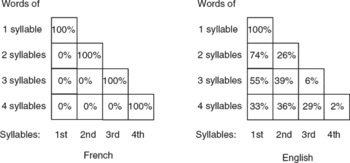
Perhaps the most well-known and well-documented prosodic difference between French and English is that of isochrony (Pike Reference Pike1945). The traditional view is that French is a syllable-timed language, in that it accords a more or less equal period of time to each syllable (apart from the final syllable of each breath group, as previously stated). Of course, syllables in French are not all perfectly equal in length, as explained above, but the resistance of French to reduce its syllables contributes to the ‘myth’ of the isosyllabic nature of French (Astésano Reference Astésano2001: 33). English, on the other hand, is generally held to be stress-timed, as the distance in time between stressed syllables is fairly constant, no matter how many syllables occur between those stressed syllables. As a consequence, English often reduces unstressed syllables (schwa is the prime example of a reduced vowel) and certain vowels or even syllables may disappear altogether. This is not to be confused with vowel length opposition, which is also present in English but not in French. It seems to be the reduction or the suppression of unstressed syllables which causes the most difficulties for native French speakers when they attempt to reconstruct the meaning from running speech in English (Pennington Reference Pennington1996: 146–148). Since Pike posited the dichotomy of stress- and syllable-timed languages, certain authors have agreed with the assertion that English is isochronous (Abercrombie Reference Abercrombie and Abercrombie1965: 18), but many authors have consistently sought to question the validity of the two categories, as Bertinetto (Reference Bertinetto1989) points out. For example, Jenkins (Reference Jenkins2000: 149) states that ‘the concept of stress-timing appears to have little basis in reality’. Wenk & Wioland (Reference Wenk and Wioland1982: 204) prefer the terms ‘trailer-timed’ for French and ‘leader-timed’ for English, terms clearly influenced by the fact that primary word stress in English more often occurs on a syllable towards the beginning of a word than at the end. In a classic study comparing several European languages, Delattre (Reference Delattre1965: 21) found the position of the stressed syllable to be a major difference between French and English (Table 1).
A comparison of the position of the most prominent syllable in English and French (Delattre Reference Delattre1965: 29).

Finally, as Peter Roach has said on the subject of isochrony: ‘one is obliged to conclude that the basis for the distinction is auditory and subjective – a language is syllable-timed if it sounds syllable-timed’ (Roach Reference Roach and Crystal1982: 78). This supports my view that stress is as much (if not more) a perceptual phenomenon as an acoustic one.
To summarise the behaviour of stress in English and French, six major differences can therefore be established:
(i) English has different types of stress: word stress (or lexical stress), focus and contrastive stress (or narrow focus) which may be separated into between four and six levels. French however, does not have word stress and marks out the final syllable of each prosodic group.
(ii) The two languages use F0 (i.e. the ‘pitch accent’) differently.
(iii) Of the four cues to stress, F0 seems the most important in terms of perception in both languages; however, duration plays a more important role in the production of stress in French.
(iv) Stress in English tends to occur towards the beginning of the word, whereas in French, the last syllable of tone units is more prominent.
(v) In terms of isochrony, English tends to regulate its rhythm by the stressed syllables, interspersed with unstressed syllables, whereas French tends to give a more equal value to all syllables (apart from the final syllable of prosodic groups).
(vi) Unstressed and destressed syllables are generally reduced to a greater or lesser degree in English.
When learning a second language (L2), certain characteristics of the learner's mother tongue (L1) influence the learning process. When two languages differ as greatly as do English and French in terms of stress, it is to be expected that linguistic transfer should occur. In the next section, the question of linguistic transfer and how it contributed to the hypothesis is examined briefly.
2 Linguistic transfer
Linguistic transfer, often referred to as L1 interference, is a major factor in L2 acquisition. Whereas some errors present in learners’ interlanguage are individual and some are universal, most are related directly or indirectly to the learners’ L1. Children seem to learn their L1 (or even several languages) with little or no conscious effort, but adults find the task more challenging. There are many reasons for becoming a less efficient language learner with age, and although some aspects of language learning such as learning new lexical items may continue all one's life, the effects of the L1 will be felt most strongly when it comes to the phonology of a language (Pennington Reference Pennington1996).
In the early half of the twentieth century, the Prague Linguistic Circle were interested in linguistic transfer in relation to phonological features and coined the term ‘phonological deafness’ (Polivanov Reference Polivanov1931, Trubetzkoy Reference Trubetzkoy1939). It is interesting to note that in the formulation of this concept, the Czech linguists were more interested in perception than in production. However, it is the relationship between perception and production which interests many researchers in second language acquisition. Most of the perception models since the 1950s highlight the active nature of perception (Rost Reference Rost2002, Tatham & Morton Reference Tatham and Morton2006). Indeed, more recent work with neuroimaging has confirmed that areas of the brain which are active during language production are also active during language perception, which would seem to support ‘active’ models of perception (Mildner Reference Mildner2006: 35).
Lado's (Reference Lado1957) contrastive analysis hypothesis suggests that for a given learner, language points which are similar in L1 and L2 will be easier to learn, whereas those which are less similar will be harder to master. Eckman (Reference Eckman1977) continues in the same vein as Lado, but integrates the theory of markedness. According to Eckman, markedness has a bearing on the ease with which a feature may be acquired. Eckman explains his ‘markedness differential hypothesis’ as follows:
The areas of difficulty that a second-language learner will have can be predicted on the basis of a comparison of the first language and the target language such that:
(1) Those areas of the target language that are different from the first language and are relatively more marked than in the first language will be difficult.
(2) The degree of difficulty associated with those aspects of the target language that are more different and more marked than in the native language corresponds to the relative degree of markedness associated with those aspects.
(3) Those areas of the target language that are different from the first language but are not relatively more marked than in the first language will not be difficult.
In this conceptualization, markedness is defined in the following terms: ‘A phenomenon or structure X in some language is relatively more marked than some other phenomenon or structure Y if cross-linguistically the presence of X in a language implies the presence of Y, but the presence of Y does not imply the presence of X’.
(Eckman Reference Eckman1977: 321)Eckman's markedness differential hypothesis could contribute to understanding the problems of some French learners of English, as stress in English when compared to French corresponds to the concept of ‘structure X’ in Eckman's explanation. Following Eckman's arguments cited above, as stress is more marked in English than in French, it will be more difficult to learn for native French speakers. More recent research backs up this idea; for example, Rasier & Hiligsmann (Reference Rasier and Hiligsmann2007: 59) suggest that their study ‘provides experimental support for Eckman's view that markedness is an important factor in predicting and explaining learning difficulties, especially the cases of prosodic transfer between the learners’ L1 and L2’.
Flege (Reference Flege and Strange1995) proposes an evidence-driven model to account for L2 speech acquisition, the speech learning model (SLM). His model contains four postulates and seven hypotheses which are intended to account for the interaction of L1 and L2 phonetic subsystems throughout a learner's life via the creation of memory representations, which Flege calls ‘phonetic categories’. The perceived differences between categories are fundamental, and L2 sounds may be mapped onto L1 categories, which exist in a common ‘phonological space’ (Flege, Schirru & MacKay Reference Flege, Schirru and MacKay2003: 469). However, as Brown (Reference Brown and Archibald2000: 9) points out, Flege's model fails to explain the exact nature of this mapping process. A more recent model, MacWhinney's (Reference MacWhinney2008) ‘Unified Competition Model’ takes its very name from the competing forces at play between a learner's L1 and L2 in the language-learning process. MacWhinney prefers the term ‘entrenchment’ and contends that the learner creates ‘self-organizing maps’ (SOMs) of the target language and proposes a series of mechanisms to explain the processes of entrenchment.
Whereas the majority of second language acquisition (SLA) models are based mainly on studies of segmental features, this study concerns the interaction between the prosodic features of English and French. In a study on the perception of stress in French, Dolbec & Santi (Reference Dolbec and Santi1995) suggested the existence of a ‘linguistic filter’, which, they claimed, was particularly present with prosodic features. They suggested that the L1 acted as a linguistic filter which conditions or orients the interpretation of the acoustic signal (Dolbec & Santi Reference Dolbec and Santi1995: 46).
Dupoux & Peperkamp (Reference Dupoux, Peperkamp, Laks and Durand1999), Dupoux et al. (Reference Dupoux, Peperkamp and Sebastián-Gallés2001), and Peperkamp & Dupoux (Reference Peperkamp, Dupoux, Gussenhoven and Warner2002) originally developed the concept of ‘stress deafness’ whilst working on French and Spanish corpora and subjects but then enlarged scope of their research to take in other European languages, most notably English. According to Dupoux & Peperkamp (Reference Dupoux, Peperkamp, Laks and Durand1999), the listening apparatus of interlocutors is tuned to a greater or lesser degree according to their L1. As a result, they often have difficulties when exposed to a language other than the one to which they were exposed as children (Dupoux & Peperkamp Reference Dupoux, Peperkamp, Laks and Durand1999: 203). Although the term ‘stress deafness’ is somewhat dramatic, stress in English does clearly create great difficulties for certain French learners of English. It is reasonable to assume that the problems which many native French speakers experience in deciphering authentic running speech in English stem largely from the four main differences which were listed at the end of Section 1 above. In order to investigate this question more fully, a study of stress perception was conducted, which is presented in the next section.
3 The experiment
3.1 The hypothesis
As the term ‘stress deafness’ implies, certain French native speakers appear unable to identify stressed syllables in English. As explained in Section 1 above, there are four acoustic cues to prominence: F0, amplitude, duration and formant structure. In terms of perception, these four acoustic cues correspond to pitch, volume, length and timbre. Based on what is known about the production of stress in English and French, it may be assumed that speakers of these two languages listen for stress differently. To be more precise, the relative importance attributed to each of the perceptual correlates of the acoustic cues of prominence may vary according to the L1 of a given speaker. One may also wonder whether, given the phenomenon of linguistic transfer, this relative importance of the cues is carried over into the L2. These questions led us to formulate the following hypothesis:
French native speakers and English native speakers do not perceive prominence in the same way in English and in French.
The experiment is therefore an attempt to determine the relative importance which the subjects attribute to the acoustic cues and/or their perceptual correlates according to their native language, and according to the language they are listening to. The cues which were focused on were F0 (pitch), duration (length) and formant structure (timbre). The variable of amplitude (volume) was not included, as existing research on English and French has shown that F0 and duration are the most important cues in the two languages, respectively, as discussed earlier. The cue of formant structure was added, as syllable reduction is a phenomenon which is much more common in English than in French, and is commonly held to be a problem area for French learners by language teachers and resource developers in France.
3.2 Subjects
This study featured twenty subjects, of which ten were native English speakers and ten were native French speakers. All were aged between twenty and twenty-five years. The French subjects were all studying History and Geography, whereas the group of English speakers was more heterogeneous, comprising a mixture of students studying in France on the Erasmus university exchange programme. The language proficiency of the subjects was not tested and varied between subjects, although none could be described as being near native-speaker level in their L2.
3.3 Stimuli
In the tradition of the experiments carried out at Haskins labs in the 1950s, this study uses two-syllable word pairs where the positioning of word stress depends on the grammatical category. It therefore focused entirely on syllable prominence at the word level, but as the stimuli were generated from words read aloud in both English and French, and word stress does not occur in French, it cannot be said that word stress was compared in the two languages. Where this study differs from previous studies is in its use of the word pair protocol not only for the English stimuli but also for the French stimuli. The stimuli consisted of four words: two English and two French. For the English words, ˈtransfer /ˈtrænsfзː/ (noun) and transˈfer /trænsˈfзː/ (verb) were chosen. As discussed in Section 1 above, French does not have word stress, but it was possible to use the local regional variety of French to constitute the French stimuli. In standard French, when the letter -e is present in the orthography in word-final position, it is not pronounced. In the various accents of the Midi region of France, however, this vowel, known in French as ‘e-caduc’ or ‘e-muet’, is generally realised. A recent study showed it to be present in between 52% and 86.8% of cases where a final -e was present in the orthography (Durand Reference Durand, Baronian and Martineau2009). Whilst not actually the same as an English schwa, this vowel was as close as possible in French to the final vowel of the English noun ˈtransfer. The meridional French schwa is closer to the French /ø/ in unstressed position (Durand Reference Durand, Baronian and Martineau2009: 134), making it a little more short, tense, rounded and front than /зː/, and more close, front and rounded than schwa. Using this idea, the French words boîte /bwatə/ and boiteux /bwatø/ were chosen as stimuli. This pair of words, whilst not being distinguished by word stress, behave acoustically in a fashion similar to the two English words which have stress on the first and second syllable, respectively. Because the meridional accent was used, both utterances are composed of two syllables (CVCV): in boîte, the first syllable is more prominent than the second, and in boîteux, the second syllable is more prominent than the first. It is important to add that in normal (i.e. non-experimental) conditions, native speakers of either standard or meridional French perceive boîte as a one-syllable word and boîteux as a two-syllable word, even when uttered with the meridional accent, whereas a non-French speaker would perceive two syllables for each word. However, in the experimental conditions described in this paper, none of the subjects questioned the possibility of identifying one of two syllables for the stimuli.
The four original words were recorded in the anechoic chamber of the Laboratoire Parole et Langage at the Université de Provence, Aix-en-Provence. The two French words were read by a French native speaker from the town of Marseilles, and the two English words by a native British English speaker. The stimuli were then validated by ten native speakers for each language. The validation process entailed playing the stimuli as isolated words and also embedded in utterances to the twenty native speakers and asking them to rate the stimuli as sounding ‘authentic’ (i.e. uttered by a native speaker) or ‘not authentic’. All the stimuli were validated, and several of the French speakers commented on the strong meridional accent.
Next it was necessary to synthesise the four words in order to create the stimuli for the experiment. MBROLAFootnote 1 was used to modify the duration and the formant structure and MomelFootnote 2 to modify the F0 curve. The Momel algorithm allows us to modify the F0 curve by factoring the raw curves into two components: a macromelodic component, which corresponds to the global pitch contour of the utterance, and which is independent of the nature of the constituent phonemes, and a micromelodic component consisting of deviations from the macromelodic curve and which is determined entirely by the segmental constituents of the utterance and is independent of the macromelodic component. The four stimuli all had rise-fall peaks on the stressed syllable, and the Momel software enabled us to manually lower the peak on the stressed syllable and raise the peak on the unstressed syllable at regular intervals until they reached the opposite values to the starting positions, whilst the algorithms used by Momel ensured a smoothing of the contour. This operation was performed over regular (linear) intervals.
In total, 100 stimuli were created from the four original words, 50 from the English word-pair and 50 from the French word-pair (see Table 2). For the purposes of explaining this process, a word stressed on the first syllable is called W1 and a word stressed on the second syllable W2. Five stimuli were generated from W1 in each language, with vowel durations varying between W1 and W2 (i.e. three intermediate stimuli). As vowel structure was also an element which was to feature in the test, a way had to be devised of introducing different formant structures into the stimuli. To have modified all of the formants for each stimulus would have been very difficult and time-consuming, so instead of actually modifying the formant structure, the process described above was simply repeated, but using W2 to generate the five stimuli for each language. This produced ten words for each language, where the vowel quality was determined either by W1 or by W2. The 50 experimental stimuli for each language were obtained from these ‘words’ by modifying the F0 curve in five stages from W1 to W2. In this way, 50 stimuli were obtained for each language where F0, duration and formant structure could each be identified as somewhere between W1 and W2. For example, a stimulus could be transfer (W1D4F3). This stimulus would originate from W1 (therefore the formant structure is akin to ˈtransfer not to transˈfer), the relative duration of each syllable is four-fifths of the way between ˈtransfer and transˈfer, and the F0 curve is three-fifths of the way between ˈtransfer and transˈfer. These five steps are not intended to correspond to the levels of stress mentioned above (Cruttenden Reference Cruttenden1986, Pennington Reference Pennington1996) but simply to establish five distinct gradations of the parameters for the purposes of the protocol.
The generation of the final 50 stimuli for each language: 25 stimuli from W1 and 25 from W2. All 25 stimuli have different F0 curves (steps 1–5), and each stimulus was obtained from one of the 5 duration- modified ‘words’.

3.4 Protocol
The subjects’ task was simple: they had to tick a box corresponding to the syllable which they thought was stressed (accentuée in French). The instructions asked them specifically to tick either the box labelled W1 or W2 (ˈtransfer/transˈfer) or M1/M2 (boîte/boiteux) depending on which word they thought each stimulus most resembled. For example, the instructions in English were:
Please tick the box labelled W1 if you think the word you hear resembles the noun ˈtransfer (i.e. stressed on the first syllable), and tick the box labelled W2 if you think the word you hear most resembles the verb transˈfer (i.e. stressed on the second syllable).
There was a limited response time as the recording of the stimuli was played non-stop at a constant rate of one stimulus per second. The boxes were labelled W1 and W2 for the English test and M1 and M2 for the French test. The subjects listened to the stimuli through headphones in a language laboratory. First, the subjects read the instructions. Then they completed a warm-up test consisting of ten items in their L1. Next they listened to the 50 stimuli played in random order twice each in their L1. After a few minutes’ pause, the subjects completed the same warm-up test, and then the same test of 50 items played twice in their L2. The experiment may therefore be represented as:

where:
L = language
W = word generated from W1 or from W2
D = modification of duration
F = modification of F0 curve
R = repetition of stimuli
N = native language of subjects
S = number of subjects
3.5 Results
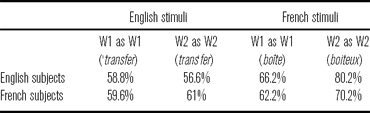
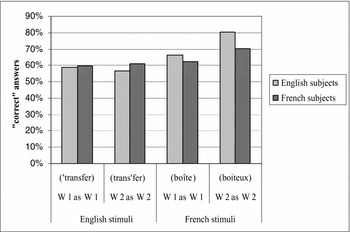
For each of the two tests (one for the French stimuli and one for the English stimuli), there was one dependent variable (the subjects’ answers) and four independent variables, WORD (if the subject ‘correctly’ identified whether the stimulus had been generated from W1 or W2), F0 CURVE, DURATION and NATIVE LANGUAGE. From the first ANOVA table of the results, it was clear that the factor WORD was present in all the significant results (results were considered significant if p was less than .05). In other words, the quality of the vowels played a primary role in the stress judgements of all the subjects; the fact that the stimuli had been generated from either W1 or W2 was a very important factor in influencing the subjects’ choice. The fact that segmental cues were so important is an interesting result in itself, but in order to better understand the other factors at play, the results were recoded to change the way the factor WORD was used. Henceforth, if a subject chose the first syllable for a stimulus created from W1 or the second syllable for a stimulus created from W2, that answer was coded R (for RIGHT) and W (WRONG) if not. In this way, it is not the actual initial word itself used to generate each stimulus which is taken into account, but only whether an initial word has influened the subjects’ decisions. The results of both tests for both groups of subjects are shown in Table 3 and represented as a histogram in Figure 1, with percentages for the number of times W1 was perceived as W1 and W2 was perceived as W2. It is clear from these results that, as mentioned above, in the majority of cases the word was ‘correctly’ identified, i.e. the formant structure proved to be a very powerful indicator of the prominent syllable.
Percentage results of ‘correct’ answers for both tests and both groups of subjects (i.e. W1 was identified as originating from W1 and W2 from W2).

Percentage results of ‘correct’ answers for both tests and both groups of subjects (i.e. W1 was identified as originating from W1 and W2 from W2).

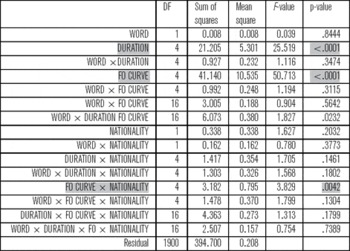
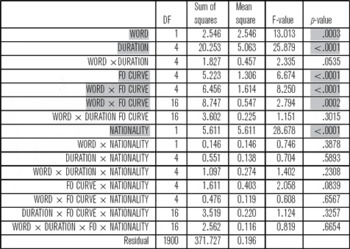
The significant results for the English test are shaded in the ANOVA table (Table 4).
English stimuli (recoded without WORD) ANOVA table for ‘RIGHT/WRONG’.

They may be summarised as follows:
(i) The greater the modification of the duration of the vowel segments of the stimuli, the greater the effect on the stress judgements of both groups of subjects.
(ii) The same effect was observed for modifications of the F0 curve, but to a slightly more pronounced degree.
(iii) The English-speaking subjects were more strongly influenced by modifications of the F0 curve than were the French speaking subjects.
For the French test, the significant results from the ANOVA tests are shaded in Table 5.
French stimuli (recoded without WORD): ANOVA table for ‘RIGHT/WRONG’.

They may be summarised as follows:
(iv) Both groups of subjects identified stimuli generated from W1 more often than stimuli created from W2, i.e. the segmental cues present in W1 were a greater influence on subjects’ stress judgements than those present in W2.
(v) As for the English test, the greater the modification of the duration of the vowel segments of the syllables in the stimuli, the greater the effect on the stress-judgements of both subject groups.
(vi) Modifications to the F0 curve of the stimuli appeared to be significant, but no discernible pattern was perceived in relation to subjects’ stress judgements.
(vii) English-speaking subjects were more influenced by modifications to the formant structure with the French stimuli than the French-speaking subjects.
(viii) English-speaking subjects behaved differently to French-speaking subjects independently of the other factors (F0, formant structure or duration).
3.6 Discussion
The results of this study support the hypothesis that French and English native speakers listen to stress differently in English and in French, albeit for a small sample of subjects and in limited phonological contexts. The experimental design of this study was not devised to prove or disprove the concept of ‘stress deafness’, but it does seem that some sort of linguistic transfer has occurred. The most evident result is the importance of segmental cues in identifying the stressed syllable, for both groups of subjects. Both from the results shown in Table 3 and from the ANOVA tests, it is evident that for the French stimuli, vowel quality proved even more reliable as an indicator than for the English stimuli. It is likely (although not certain) that this is due to the way the experiment was constructed. In English, it is normal to reduce the second vowel of a word such as ˈtransfer to a schwa, and in various communication situations, the second vowel may indeed be anywhere between the full vowel of transˈfer and the reduced vowel of ˈtransfer. The same cannot be said for the two second vowels of the French stimuli, where any variation which may be observed in a communicative context would not be due to vowel reduction through destressing but to other factors, such as dialectal or idiolectal influences. Another possible explanation is that in manipulating the F0 curve with the Momel algorithm, the formant structure of the vowels was affected. Putting aside these two potential experiment-based explanations for this result, it may well be that segmental factors are indeed an important cue in English for identifying the prominent syllable. Certain authors maintain that with stress-timed languages such as English, segmentation of the speech signal is achieved through the alternation of strong and weak syllables (Cutler et al. Reference Cutler, Dahan and van Donselaar1997: 148). If this is the case, segmental cues, and in particular vowel quality, would be more important than the cues of F0, amplitude and duration.
The most interesting result, at least given the literature cited in Section 1 above, is the fact that the English-speaking subjects relied more on F0 than the French subjects for the test in their own language (point (iii) above). Also, F0 modifications influenced the stress judgements for both groups of subjects in the English test, but not in the French test. This holds with the view that the pitch contour which accompanies the prominent syllable is of great importance in English and that, at least subjectively, the cue of pitch is relatively more important in English than in French, and perhaps the most important of all the cues. The perception studies of the 1950s and 1960s all point to F0 being the most important cue for English speakers, but the picture is less clear for French speakers. F0 is perhaps the most important cue for French speakers, too, but duration seems to play a larger role than for English speakers (see Astésano Reference Astésano2001 for a literature review). This may also be due to the fact that French does not have vowel length opposition as English does, which ‘frees’ vowel duration as a cue for prominence. The results support the view that F0 is an important cue in the perception of stress for speakers of both languages, but it is more reliable for English stimuli: the results for the English test showed that F0 modification was a reliable cue for stress position in English, whereas in French, although F0 was picked up on by the subjects, they were unable to use the cue effectively.
The other result which deserves comment is the fact that English-speaking subjects were more influenced by vowel quality for the French test than were the French native speakers (point (vii) above). A possible reason for this may be that the English subjects resorted to segmental cues in the absence of sufficiently salient cues in F0, in other words, the lack of a pitch accent in French. This would seem to be a clear case of linguistic transfer, and it may be an example of what Ellis (Reference Ellis2008) calls ‘contingency’, i.e. resorting to another contingent linguistic cue in the absence of the cue which would be used in the L1: ‘a cue with high availability but low reliability may initially be used over a cue that is of lower availability, even though it is in fact more reliable’ (Ellis Reference Ellis2008: 378). Indeed as Cutler et al. (Reference Cutler, Dahan and van Donselaar1996: 147–148) point out, the importance of the opposition between ‘full’ stressed and reduced unstressed syllables in English may mean that segmental cues, and in particular vowel quality, are more important for native English speakers than for native French speakers. It is difficult to explain, however, without further experimentation, why the English and French subjects behaved differently independent of the factors of vowel quality, F0 and duration.
4 Conclusion
The results support the hypothesis that English and French native speakers listen for stress differently and that some form of linguistic transfer is apparent. Nevertheless, these findings cannot necessarily be generalised to other contexts. In order to confirm these results, more studies must be undertaken, involving more subjects, a greater variety of stimuli and targeting stress in other contexts, not simply at word level.
Acknowledgements
I would like to thank Daniel Hirst and his colleagues at the Laboratoire Parole et Langage, Université de Provence, Aix-en-Provence, for all their help and encouragement.